











![30강 현대대수학 프렐라이 제7판 갈로아이론의기본정리 (p.218~) [완강]](https://i.ytimg.com/vi/YAs-usTmNTc/maxresdefault.jpg)


![[현대대수학] 프렐라이 48절 체의 자기동형사상 | 켤레동형사상](https://i.ytimg.com/vi/_dTohX_ztmc/maxresdefault.jpg)

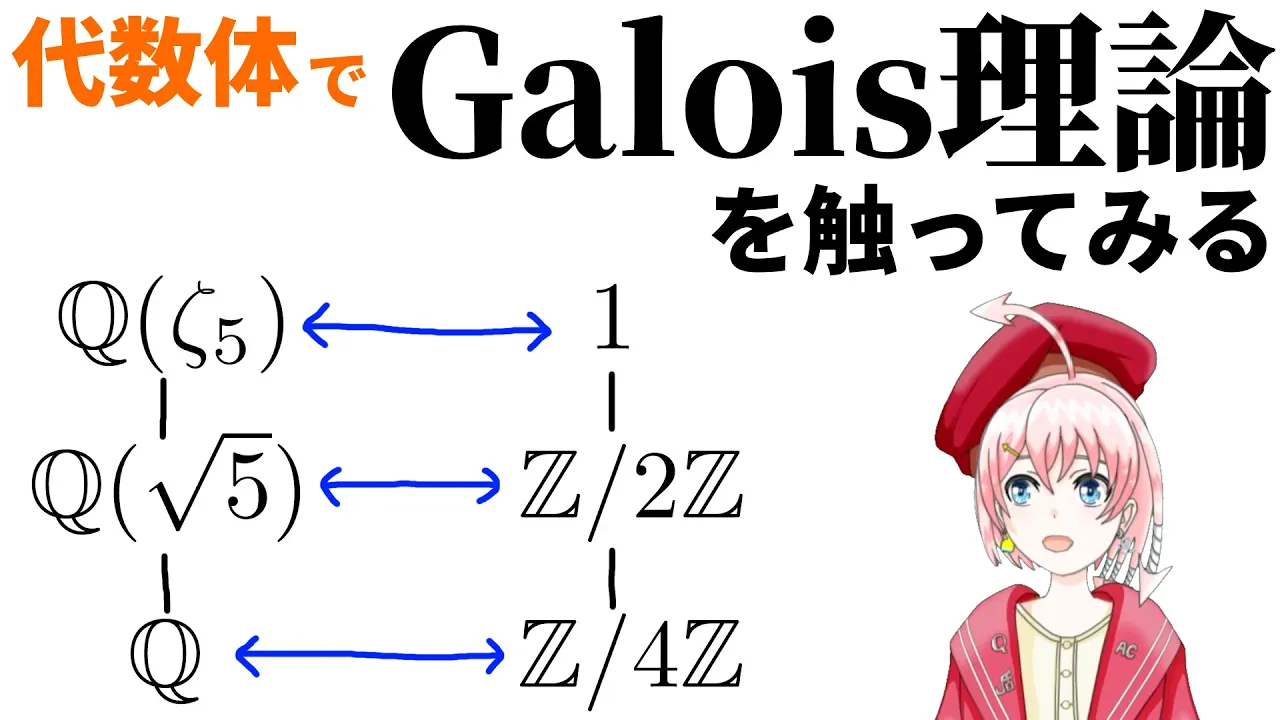








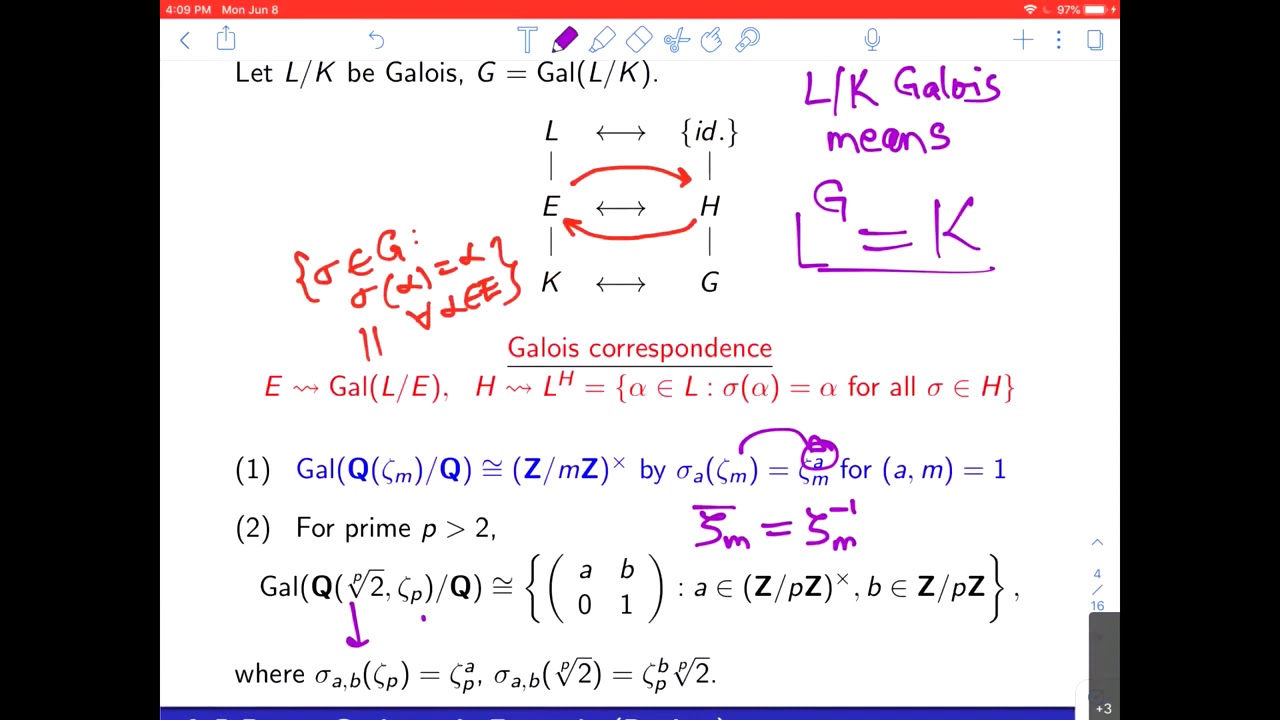



The Fundamental Theorem of Galois Theory establishes a one-to-one correspondence between subgroups of the Galois group of a Galois extension and intermediate subfields, where each subgroup corresponds to its fixed field and each intermediate field corresponds to its Galois group; this correspondence is bijective because the order of a subgroup equals the index of its fixed field, and vice versa, as demonstrated through counting automorphisms and analyzing the dihedral group structure in the example of the splitting field of 4th roots of 2.
Galois Theory: Main Theorem and Fundamental Correspondence | Graduate Course
Added:Basic Group Theory, including subgroups, normal subgroups, cosets, and Lagrange's Theorem.
The concepts of field extensions, degree of extensions, and the tower law [K:F] = [K:E][E:F].
Definitions of normal and separable extensions, and the definition of a splitting field.
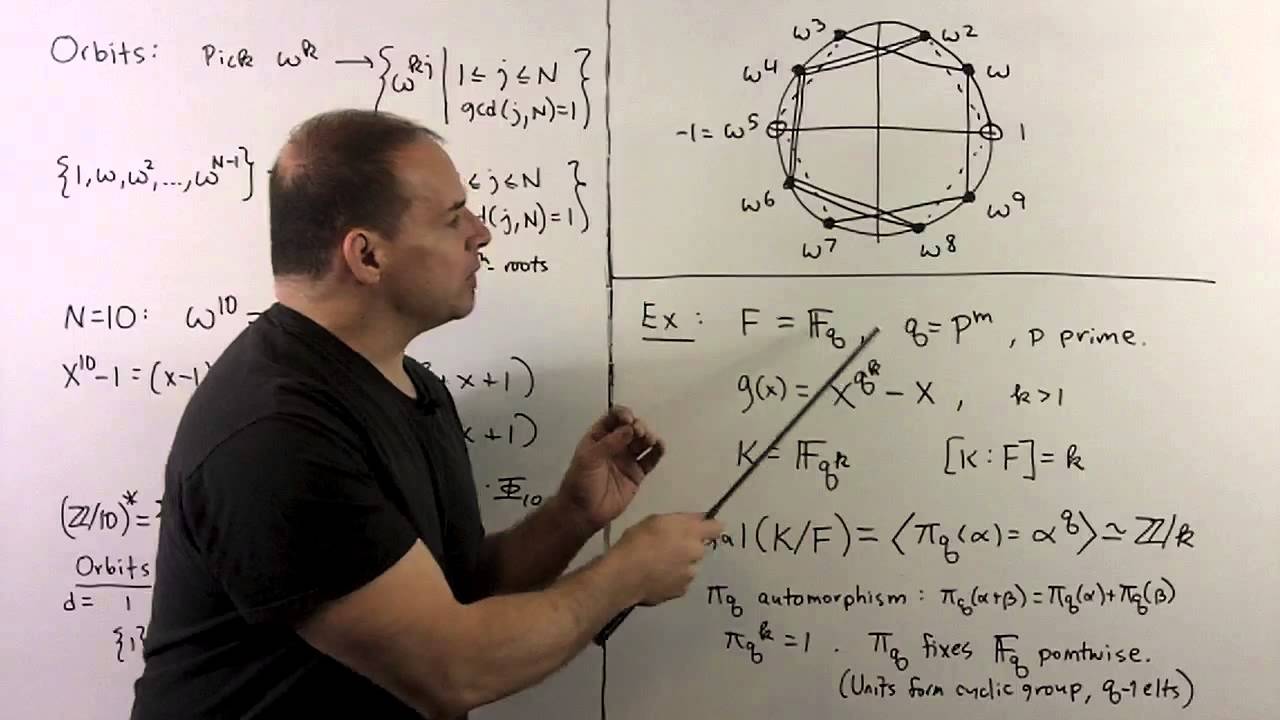
The definition of the Galois group of a field extension and the concept of fixed fields of subgroups.
Solvability of polynomials by radicals, leading to the Abel-Ruffini Theorem (insolvability of the general quintic).
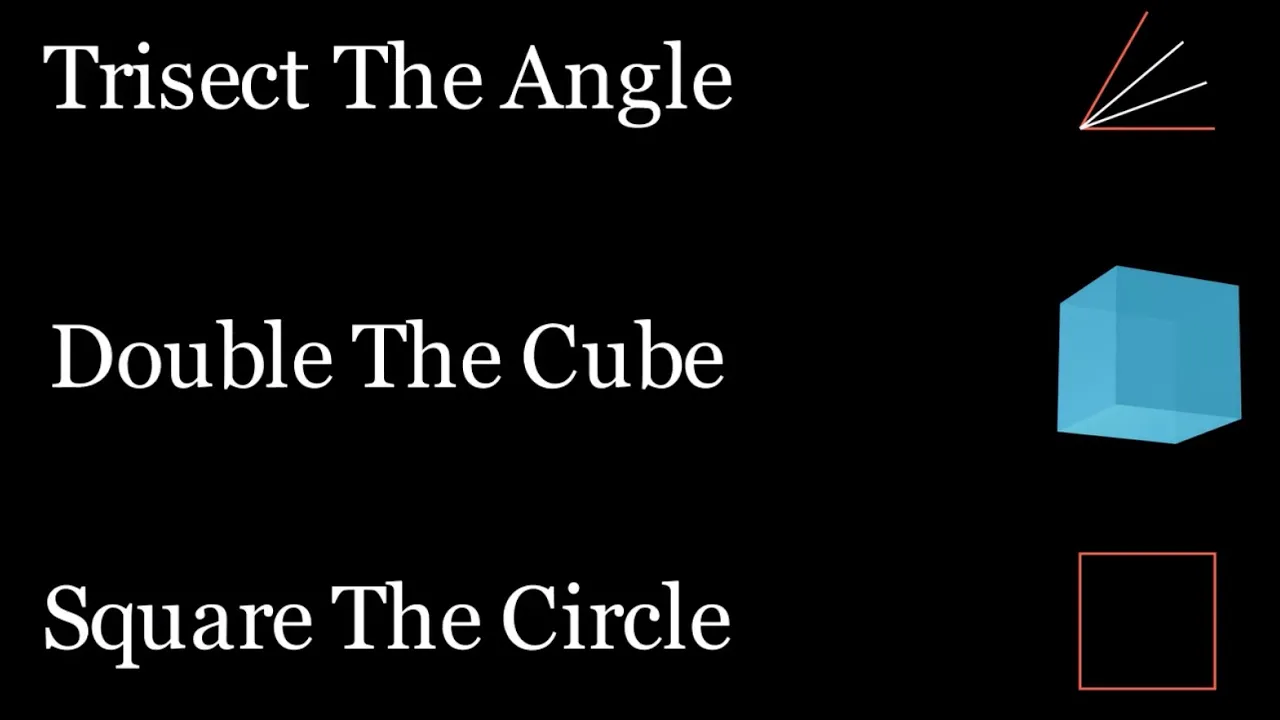
Applications to geometric constructions, proving the impossibility of doubling the cube, trisecting an angle, and squaring the circle.
Methods for computing Galois groups of specific polynomials over the rational numbers.
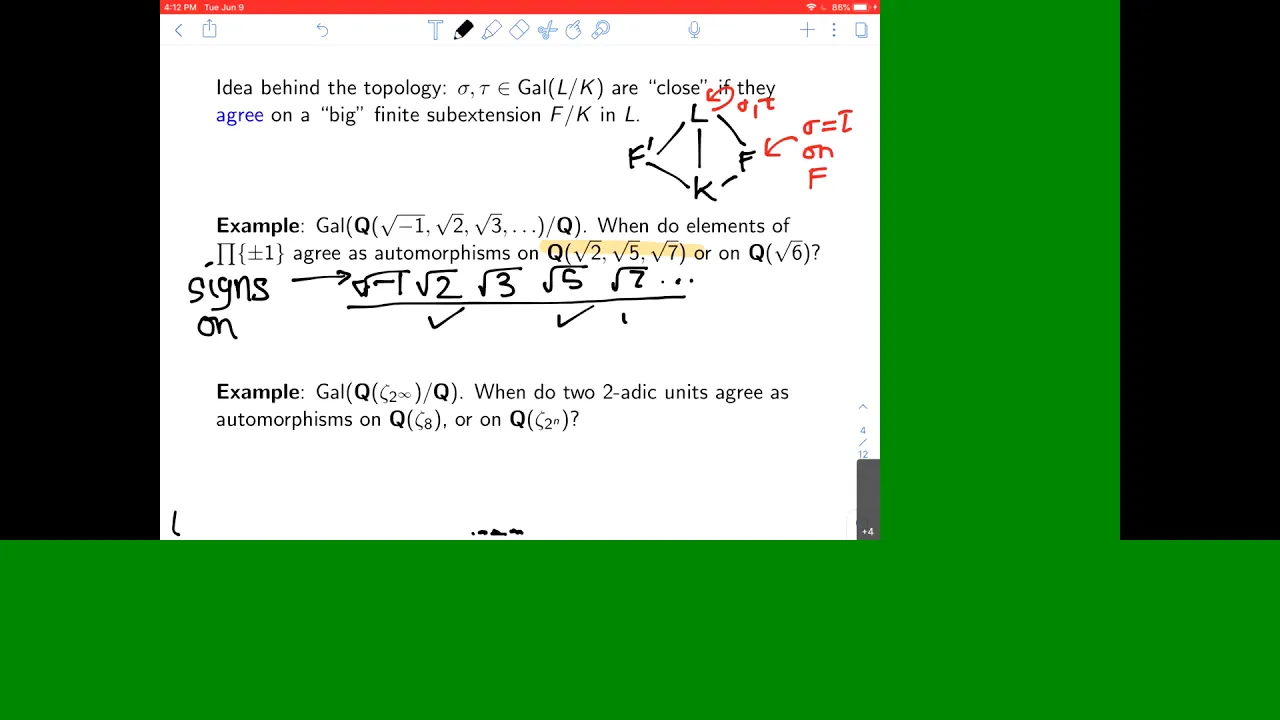
Infinite Galois Theory, which introduces the Krull topology to extend the correspondence to infinite algebraic extensions.
Algebraic Number Theory, focusing on how prime ideals decompose in Galois extensions and the study of the Frobenius automorphism.
13.6K views241likes18:39Original Release: 2021-01-04
this lecture is part of an online course on galway theory and we will be proving the fundamental theorem of galwa theory um so let's just recall what this says it says that if k contained an m is a galwa extension we're going to assume as usual that these extensions are finite then there's a one-to-one correspondence between intermediate fields l and subgroups of the galwa group so g is just the galway group of m over k and we recall this correspondence is given as follows so a subfield corresponds to the galway group of m over l so that's automorphisms of m fixing l and not as you might guess automorphisms of l and on the other hand a subgroup corresponds to the fixed field that's the set of elements of m fixed by h and what we want to do the fundamental theorem says that these maps are inverses of each other so in other words if we take a field l and we go to the corresponding group and then we go back to um the fixed field of this so we take the fixed field of m of gawa of m over l this should be equal to l well first of all it's obvious that l is contained in that um on the other hand if we start with the subgroup h then we go to the fixed field m h and we now want to go to the gamma group of m over m h and h is obviously contained in this and what we want to show is that these two are actually equal so so we want to say are these equal and if we can show that we will approve the fundamental theorem well in order to show their equal all we need to do is to show they're the same size because if we've got a group contained in another group and they're the same size then they have to be equal well what do we mean by the size well the size of h we just mean the order of h and by the size of l you might think we're going to mean the index of k and l but we're actually going to take it to be the index of l in m and this is a little bit funny because it means if l becomes bigger then its size becomes smaller and the reason we've done it is so the size of l will turn out to be the same as the size of the corresponding group i mean it seems more natural to say the size of l is the index of k in l but then we would find that the size of a group didn't correspond to the size of the field now if we can show that um the the size of a field is the same as the size of the group and the size of the group is the same as the size of the field there then this will show that these are the same size and these are the same size so they're equal so to summarize what we have to show to prove the fundamental theorem is we need to show two equalities first of all um if we go from h to m h we need to show the order of h is equal to the index of m h in m and the second thing we need to do is to show that um if we go from l to the gallowa group of m over l we need to show that the size of l is equal to the order of the galway group of m over l so let's just summarize in green these are the two things we have to prove and if we can prove these two inequalities we'll prove the fundamental theorem now this one is easy to prove because we know m over m h is galwa because we showed earlier that if you take the fixed points of a field m under a group h then that's a galway extension and since it's galway this implies that h must actually be equal to the order so this is automatically true so this is true so the problem is to prove this incidentally you notice so far we have not used the fact that um the extension is galwa so so we haven't used the fact that m over k is galwa so this is not used yet um however we need to use the fact that m over k is gawa in order to prove this inequality here so so um so in order to show this um what we do is we look at k contained l contained m and um we look at um the gallowa group of m over k so this is going to be all maps from m to itself that that fix all elements of k so the order of this is going to be equal to the sum over maps from l to m extending the map from k and for each of these we have the number of extensions from the image of l to m in other words you know to map enter itself we first map l to m and then we have to extend that to a map from m and then let's count and see how many we've got well the number of these is at most the index of k in l and each of these terms here is at most the index of l in m now um we know that since m over k is gawa this is equal to m over k so this is the key point at which we're using the fact that m over k is galwa now you see that this sum here we have most l over k things each of which is at most m over l so this side here is at most m over l well it's actually equal sorry m over k so well it's actually equal to m over k which means we must have equality here and equality here um so the fact that m over k is galwa implies we actually get an equality there and an equality there we don't really care about the equality here but we care about the equality here because this says that the number of maps from m to itself extending the identity map from l is equal to m over l so this says the galway group of m over l must have order equal to the index but um that's rather nice because it's exactly what we were trying to prove here so this proves the fundamental theorem of galway theory it says for galway extensions we get a one-to-one correspondence between subgroups and sub-extensions um you may wonder what happens if um k contained in m is not galwa well it's not too difficult to check what happens there and what we do is we look at k and we look at the field of fixed points of g and we look at m so g is going to be the galway group of m over k which is all automorphisms of m fixing the elements of k and we get a one-to-one correspondence between subgroups of chi and sub-extensions k contain l contained m with m g contained in l it's very easy to check this because this bit here is in fact a galway extension so the galway correspondence just tells us that subgroups of the group g correspond to fields between mg and m so so all that happens in general is is we can't see what's going on between k and the fixed the the fixed subfield of m um so let's just finish by giving a slightly more complicated example of a galwa extension and the intermediate fields what we're going to do is look at q and we're going to look at a fourth root of two rather than a cube root of two as we were looking in the previous example and this isn't galwa because we can multiply this by i so we'd better extend this by having the 4th root of 2 together with i and let's write down the obvious sub extensions well there's q with the fourth root of two there's q with i times the fourth root of two um and there are some obvious quadratic extensions because we can have the square root of 2 and we can have i and then we can multiply these together and we get the square root of 2 times i and then we can put these two together and we can get 2 with i and the square root of 2.
and of course there's q and q with the 4th root of 2 and i and it's not completely obvious that there are any other extensions i mean these are the ones that are easy to write down in fact there are a couple more and what we're going to do is to find these other two extensions by by using galwa theory so we need to know what the galway group is and the galway group isn't too difficult to work out what we do is we draw the um four fourth roots of two like here so so they form a nice square so here's the fourth root of two times i and here's the fourth root of two times minus i and here's minus the fourth root of two now the galway group must act as permutations of these and it must um um it must in fact um act as a group of symmetries of this square because this element is minus this element and the gamma group must always always preserve negation so the galway group is a subgroup of the group of automorphisms of a square on the other hand this extension is degree four and this extension is degree two so the galliva group is order eight and the group of symmetries of a square has order eight so so these are all the all the elements of the galway group so let's write down all subgroups of the group of symmetries of a square so this is just the dihedral group of order eight which is easy to write down so we've got the trivial subgroup and then we've got subgroups of order two and we can get most of these by reflections so so i'm going to draw a green line to say we're looking at reflections so here's a here's an element of order two it just switches these two elements and fixes these two so in fact this one is complex conjugation but whatever and then we have another element of order two which is just reflection in that diagonal and then we've got an element of order two that is just rotation by 180 degrees um and then we've got two more reflections because we can reflect in this line or we can reflect on that line so these are the subgroups of order two which are just correspond to the five elements of order two uh now we look at the subgroups of order four well um what we can do is we can sort of look at the group of symmetries of a rectangle which is obviously a subgroup of the group of symmetries of this square so this gives us um one subgroup of order four um then we can look at um the cyclic group of all rotations by a quarter of a revolution so this generates a group of rotations and finally we can look at the group of symmetries that preserve this rectangle so that gives us another uh the third group of order four and and finally we've got the whole group d8 and now we should draw which of these subgroups are included in others and the inclusions look like this so um these two groups here are z modulo 2 z times z modulo 2 z so they have three subgroups whereas this has is um a cyclic group of order four so it has only one subgroup of of order two so this is a complete list of all the subgroups now let's write in what are the fields corresponding to each subgroup well this is going to be the field q i times the fourth root of two rather obviously and this is going to be the field q so those are pretty easy um the cyclic one well if you think about it you'll see that this this rotation actually fixes i so we get q i here and here we get q with root two you see all the symmetries that fix the square just fix root two and here we get q of root minus two or q times root two i um and this one obviously fixes the fourth root of two and this one obviously fixes um i times the fourth root of two and rotation by 180 degrees well it it it obviously contains all these fields here so it's just q root two um i and now we see that there are two extra fields that we didn't notice when we were writing down the obvious fields so let's figure out what these other two fields are well the elements of this field are fixed by reflection this line here so it's sending the fourth root of two to the fourth root of two times i so if we add up these two elements that will be fixed by this reflection so this is the field cube where you take the fourth root of two and you multiply it by one plus i and this is kind of similar except you take the fourth root of two and multiply it by one minus i so the fundamental theorem of gallium here is found these extra two sort of slightly hidden um subfields of this field here we can also ask which of these extensions are normal well you notice that these two elements of order two are conjugate so let's put a ring around them to show their conjugate and these two are also conjugate and the subgroups are conjugate and obviously the corresponding fields are also going to be conjugate under the same element because sub subfields just correspond to subgroups so we see that almost everything is a normal extension except that these four fields here are not normal extensions of cube but pretty much every other sub extension is a normal extension of fields um so uh um next lecture we'll be giving a rather famous example of a galway extension which is um how to use galway theory to construct the regular 17-sided polygon as i mentioned earlier this was a amazing discovery gauss did as a teenager
Up Next

27:53
Abel's Theorem: Unsolvable Quintic Equations Explained
@richarde.borcherds7998
11.7K views•2021-01-08
4:43
Elliptic Curve Cryptography Explained: ECC, ECDSA, ECDH
@PracticalNetworking
28.5K views•2024-10-21

27:30
Galois Theory: Field Extensions & Algebraic Numbers
@richarde.borcherds7998
47.3K views•2020-12-27

6:00
The Mathematical Impossibility of Accurate World Maps
@Vox
23.3M views•2016-12-02
Related Study Plans & Knowledge Roadmaps
Structured learning paths in Mathematics
mathematics
Tensor Calculus: Vectors to Riemann Curvature
01Mathematical Foundations: Linear Algebra & Calculus
02Covectors, Dual Spaces, and Tensor Basics
03The Metric Tensor and Index Gymnastics
+ 2 more learning modules
40h5 modules
Explore Roadmap
mathematics
Gödel's Incompleteness: Logic, Proofs & Limits
01Introduction to Formal Systems & Hilbert's Dream
02Set Theory, Cardinality, and Cantor's Diagonal Argument
03Arithmetization and Gödel Numbering
+ 2 more learning modules
14h5 modules
Explore Roadmap
mathematics
Galois Theory: Fields, Groups & Solvability
01Foundations of Abstract Algebra: Groups & Fields
02Polynomials & Field Extensions
03Splitting Fields & Symmetries
+ 2 more learning modules
24h5 modules
Explore Roadmap
mathematics
Non-Euclidean Geometry: Models & Geodesics
01Euclid's Fifth Postulate and the Birth of New Geometries
02Hyperbolic Space and the Poincaré Disk Model
03Geodesics: Defining Straight Lines in Curved Spaces
+ 2 more learning modules
15h5 modules
Explore Roadmap