










![30강 현대대수학 프렐라이 제7판 갈로아이론의기본정리 (p.218~) [완강]](https://i.ytimg.com/vi/YAs-usTmNTc/maxresdefault.jpg)














Abel's theorem states that the general quintic polynomial (degree 5) cannot be solved by radicals; this is proven by showing that if a polynomial can be solved by radicals over a field of characteristic 0, then its roots lie in a solvable Galois extension, and since the symmetric group S₅ is not solvable, there exist quintic polynomials (such as those with exactly two non-real roots) whose Galois groups are non-solvable and therefore cannot be expressed using radicals.
Abel's Theorem: Unsolvable Quintic Equations Explained
Added:Basic Polynomial Theory: Understanding roots of polynomials and what it means to solve an equation 'by radicals' (using arithmetic operations and nth roots).
Introductory Group Theory: Familiarity with groups, subgroups, normal subgroups, and symmetric groups (specifically the structure of S_5).
Field Extensions: Concepts of algebraic field extensions, splitting fields of polynomials, and automorphism groups of fields.
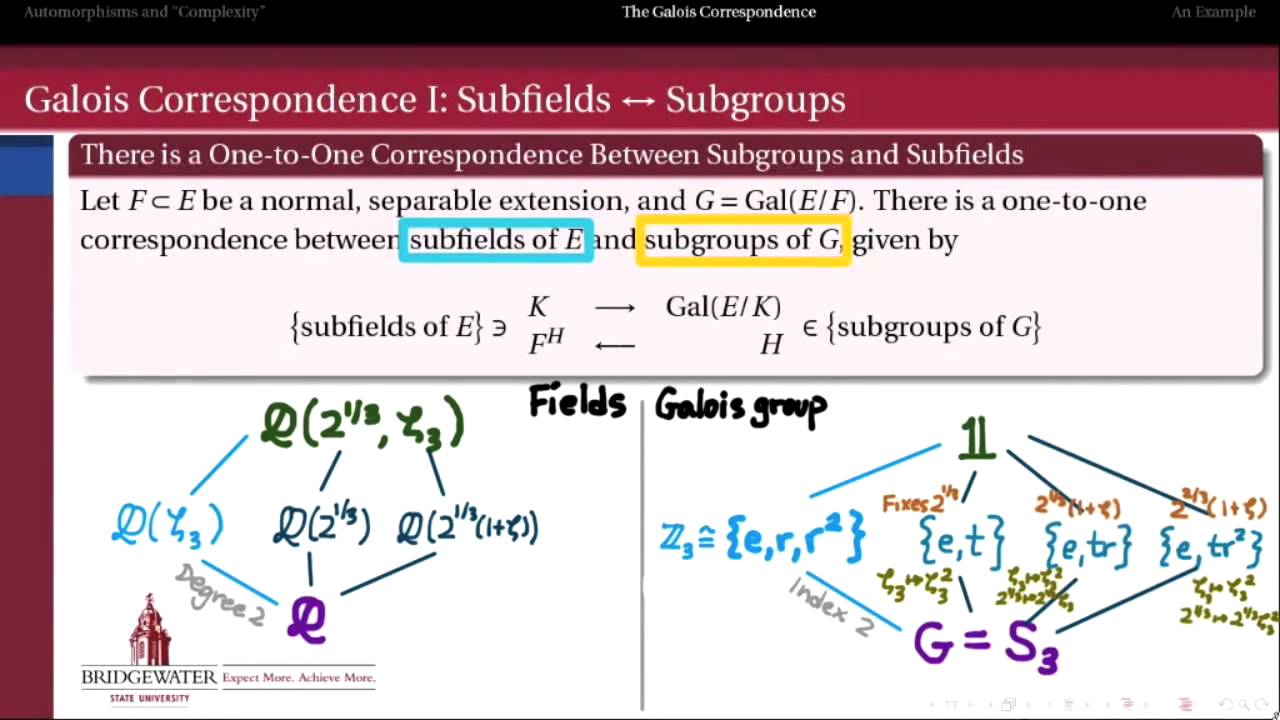
The Galois Correspondence: Understanding the fundamental theorem of Galois Theory, which maps field extensions to subgroups of the Galois group.
Insolvability of Higher-Degree Polynomials: Generalizing the proof to show that no general polynomial equation of degree n >= 5 is solvable by radicals.
Bring Radicals and Transcendental Solutions: Exploring alternative methods to solve quintic equations analytically using Bring radicals, Jacobi theta functions, or modular elliptic functions.
Numerical Root-Finding Algorithms: Studying computational methods (such as the Durand-Kerner method or Newton-Raphson) used to approximate roots of high-degree polynomials in practice.
Classification of Finite Simple Groups: Exploring the algebraic structures of non-abelian simple groups, such as the alternating group A_5, which underpins the unsolvability of the quintic.
11.7K views216likes27:53Original Release: 2021-01-08
so this lecture is part of an online course on galway theory and we will be talking about arbel's theorem this is the very famous theorem it's a general quintic cannot be solved by radicals so quintic just means an equate polynomial of degree 5 x 5 plus a x to the 4 plus b x cubed plus c x squared plus d x plus e and solvable by radicals means you can't write down the solutions explicitly in terms of a b c d and e using the field operations and taking nth roots of something where n is allowed to be anything at all so a little bit later we're going to show that you can solve polynomials of degree 3 and 4 by radicals of course everybody knows how to do degree 2 if you've got ax squared plus bx plus c equals naught then x is minus b plus minus the square root of b squared minus 4ac over 2a so the formulas for cubics and cortex are really rather messy to write out explicitly but um you you can do them and what arbol done showed is that you can't do this for degree five equations so what we're going to do is um well first of all we're going to work over a characteristic zero field such as the rationals um there are some additional complications for fields of characteristic greater than zero which i'll occasionally mention so um we'll usually be assuming have a default assumption the field is characteristic zero unless i say otherwise and what we're going to do is to show that if alpha can be expressed by radicals over a field k of characteristic zero then alpha is contained in a finite solvable galway extension of of k so sulfa ball just means the galway group is solvable and we recall from the earlier group theory course that what this means is there's a chain of subgroups one equals g naught contained in g1 containing g2 and so on containing g n equals g so that g i is a normal subgroup of g i plus one and g i plus 1 over g i is a billion um actually you you can also assume that cyclic if you want it doesn't really make much difference so in other words g can be kind of split up into a billion or even cyclic subgroups so in order to show that a fifth degree polynomial cannot be solved by radicals what you want to do is to find a polynomial of degree 5 whose gamma group is non-solvable and there's one easy way to do this that we had before you can take the rationals take x1 up to x5 and take the subfield fixed by the symmetric group of order 5.
so as we said earlier this will be q e1 up to e5 where these are the elementary symmetric function so e1 is x1 plus x5 and so on and um then if we take the fifth degree polynomial x to the five minus e1 x to the 4 and so on it has roots x1 up to x5 and since s5 is not solvable this means that x 1 up to x 5 cannot be expressed in radicals using e1 up to e5 so the key point is that the symmetry group s5 is not solvable and you may remember from group theoret the symmetric groups s1 up to s4 are solvable which is why we can solve polynomials of degrees one to four by radicals at least in characteristic zero well okay that that shows there's you can't write down a general formula that works simultaneously for all polynomials but it doesn't quite rule out the possibility of doing it for any particular polynomial with integer coefficients so some polynomials with integer coefficients you certainly can solve by radicals for example if we take x to the 5 minus 2 well i can certainly solve this one by radicals and just take x as the fifth root of 2.
um and you you could imagine that maybe by some sort of funny coincidence every single polynomial that happened to have integer coefficients would have a solvable galway group even though the general polynomial doesn't so we have to rule that out so can we find a polynomial with integer coefficients or rational coefficients but um with non-solvable galwa group um now normally working the out the galway group of a polynomial of degree five is a real pain but there's a there's a rather easy trick for finding a few examples with galway group s5 which is suppose that the polynomial f of x let's let's work over the integers is irreducible degree 5 and has exactly two non-real roots it's easy to find examples of such polynomials for instance x to the five minus four x plus 2 you can easily check that its graph sort of looks something like that it's got exactly three real roots it's irreducible by eisenstein um so um why if it's has these properties is its galway group s5 well the gamma group is contained in s5 which is just the permutations of all the roots and its order is divisible by five because the polynomial is irreducible so the first when you add one root of it you get an extension of degree five and you might get a higher extension by adding further roots you might not who knows whatever it's order is divisible by five so g has a five cycle now there are exactly two non-real roots so g contains a transposition that's just an element that exchanges two roots and fixes the others and this transposition is easy it's just complex conjugation since there are exactly two um non-real roots complex conjugation flips those and fixes the others and now we can see that any subgroup of s5 containing a transposition and a five cycle is the whole of s5 and that's easy to see we may as well take the transposition is one two and what's the five cycle going to do well it's going to map one to something and something to something else and what we can do is we can raise the five cycle to some power so that maps one to two so a power of the five cycle is one well it maps one to two and then we may as well re-label all the other elements so so so that the five cycle is one two three four five so by renumbering the five roots we can arrange the transposition and the five cycle are like those but then conjugates of one two under the five cycle well conjugates just mean you re-label these elements according to the cycle so its conjugates are going to be one two two three three four 4 5 and 5 1 but we don't really care about that and now it's well known and easy to check that these generate the symmetric group s5 details of that are in the course on on group theory if you want to look them up so we've found an explicit polynomial over the rationals that can't be solved by radicals by the way if you're wondering about this condition there aren't exactly two complex roots it actually is essential so we can ask what if there are zero or four complex roots well in these cases the the an irreducible fifth degree polynomial might indeed be solvable by radicals for example x to the 5 minus 2 has four complex roots and it's irreducible and it's obviously solvable by radicals in fact we can take a quick look at what what goes on because uh uh this this will be an example of um what we're going to do later so how do we find the splitting field of this well we do it in two steps first of all we add in the fifth roots of one and there are there are four primitive fifth roots um so you remember x to the five minus one over x minus one is x to the four plus x cubed plus x squared plus x plus one which is irreducible so if we write this out in the complex plane the the four we're going to add the four primitive fifth roots of one like that so we get an extension q contains and q zeta where zeta is say one of these primitive fifth roots of one and now we add in um fifth root of two so we get q contains q zeta contains q um the fifth root of two together with zeta and now this extension is normal and for that matter galwa um notice if we just added in the fifth root of two we wouldn't get a normal extension we first need to add in a fifth root of unity and now we can sort of see what the galway group is because the galway group of this we saw earlier is just the little abelian group of order 4 which consists of the units of the integers mod 5 whereas this bit of the galway group well we can multiply the fifth root of two by any fifth root of unity so the galloway group of this bit is z over five z so altogether we've got a group of order 20 and you can check it's actually none a billion because this group z modulo 5z star acts non-trivia on z modulo 5c by the way remember when you when you go to a galway group the the groups are sort of upside down to the fields so um if you have the galway group um the z over 5z is a normal subgroup of the galway group and the group divided by z over five z is this group of order four z over five z star so it's very confusing because the small here we have a sub fields which but the subfield doesn't correspond to the this subgroup it corresponds to a quotient group and in this particular case this quotient group also happens to be a subgroup but in general it won't be um so um we we're the the point of this example is that we're getting a solvable extension but we get in two steps we first add in roots of unity then we add in the the the radical that we're really interested in so that's an example of four complex roots what about an example with zero complex roots well this doesn't have to be non-solvable either for example we could take cosine of 2 pi over 11 which is equal to zeta plus zeta to the minus 1 where zeta is a primitive 11th root of um one so why are we taking 11 well see if i can draw 11 things correctly so we get one two uh wait one two three one two three four one two three four okay so here we've got 11 roots of unity and one of them is the number one which we're not really interested in and then we can project the others onto the real line and as usual we get these numbers cosine of 2 pi over 11 cosine of 4 pi over 11 and so on and all together we get 5 of these which is why i chose 11 because 11 minus 1 over 2 is 5. and we can ask what is the gamma group of the fields generated by these well we sort of did this for cosine of 2 pi over 7 and it's pretty similar here so the gamma group of q of zeta over q is just c over 11 z star which is cyclic of order 10. and the galway group of cosine of 2 pi over 11 modulo q um will be um a quotient group of this where we quotient out by the element plus or minus one so this is isomorphic to a cyclic group of order five so what we've got here is a polynomial with it's an irreducible polynomial with five real roots which are these numbers cosine of 2 pi over 11 4 pi over 11 and so on and it's um galway group is definitely solvable in fact it's even cyclic of order five so we really did need to assume there were exactly two complex roots if there are any other number of complex roots that doesn't force it to be non-solvable although of course it might be um well um so that's given some examples of fifth degree polynomials with non-solvable gamma groups but now we better explain why if an equation is solvable by radicals we get solvable galway extension so what i want to do is to sketch this implication um so suppose something is solvable by radicals we're going to construct the galway extension in several steps so first of all we add in all roots of unity we need um and um so so we're going to take our field k which might be the rationals and add in a root of unity of some high order it's it's it's going to be a root of unity of order n where n is big enough so that so that every radical we're taking is is a radical of order dividing n and we can ask what is the so so so we're going to take this to be a splitting field of x to the n minus 1 for some large n and remember we're working characteristic zero so this is actually a separable polynomial if you're working characteristic p one of the complications is that this polynomial is no longer separable in general um anyway the gamma group the elements of the gallery group all take zeta to some power of i so sorry to some power of zeta where i is in z modulo n z star now it's not necessarily true that all elements of z modulo nz turn up in the gallery group that depends on the field k we're going to show what they do for the rationals but in general they don't um so um and as usual the um zeta to the i times if if we compose the automorphism taking zeta to the ions eight of the j we get zeta of the ij so the galway group is a subgroup of z over nz star in particular it's abelian and therefore solvable as i said it may not be the whole of this group it's sometimes less but it doesn't really matter if it's smaller than this because it's still a billion and that's all we really care about um now once we've got once we've added in all the roots of unity the next step is to so so let's let's put k1 equals k with our root of unity then let's put k2 equals k1 together with some nth root of an element alpha in in k1 and let's put k3 to be k2 where we um apply some other route so this doesn't have to be an nth route it could be some other route so we built up a tower of fields like this except that's not quite right well we saw the problem with this earlier the problem is that k um n might not be so k m might not be normal um just recall a very simple example of this you might take q contains in q root 2 contains in q with square root of the square root of 2 and then this extension here is not normal well that's quite easy to fix the reason is this that this isn't normal is we only took the square root of of this number and we forgot to take the square root of all its conjugates so what we should really do is take q square root of the square root of 2 and then we take the square root of the square root of minus 2. so these are the conjugates of the square root of two so when we're building up these fields um we shouldn't take k2 to be k1 where we we take a root of alpha 1 we should take it k1 with nth root of alpha 1 and the nth root of all conjugates of alpha 1. and similarly we shouldn't take k3 to just take a root of alpha 2 but we should take it to be k2 with some root of alpha 2 and all conjugates under the galva group and and if we remember to put in all the conjugates this ensures that each of these fields is going to be normal and we also need to know what does the galway group of this look like well what's the galway group of um let's take a field l nth root of alpha over l where l contains the nth roots of one and we're assuming it contains exactly n nth roots of one so it's not in doesn't have characteristic dividing n or anything like that then the gamma group consists of elements taking the nth root of alpha to the nth root of alpha times zeta to the k for some k in z modulo n z because um any nth root of alpha must be the nth root of alpha we first thought of times times some power of our primitive nth root of unity and you can see the composition of these automorphisms corresponds to addition in z modulo nz so the galway group of this is a subgroup of z modulo nz as before it doesn't necessarily have to be the whole of z modulo nz but again this doesn't matter it's a subgroup of a cyclic group so in particular this group here is a billion so every time we add an nth root we get a normal extension with um a cyclic galway group so what happens is we can get a chain of fields um we get various fields like this up to k whatever it is such that each of these groups is a normal extension with galwa group a billion so it's either contained in z modulo nz star or it's contained in z modulo n z for some um where n is the largest possible where n is something big enough so that it includes all possible radicals we're taking so um but you remember by including radicals of all conjugates we could also arrange that this extension here was normal and therefore galway because we're working in characteristic zero so we've got a chain of fields such that each field is a is an abelian extension of the one earlier now if we look at the corresponding gallon groups i guess that shouldn't be an m now each of these is um so each of these groups is a normal subgroup of the earlier one and the quotient is a billion so it's one of these groups here so the galway group of the whole extension we've got is therefore solvable because we can break it up into a billion groups so this completes the sketch of arbel's theorem that fifth degree polynomials are not solvable by radicals we can ask the converse um if a galway group is solvable can we represent elements um in the field so suppose we've got k um can we represent elements of m using radicals and the answer this turns out to be no in general there are actually some problems in characteristic p that we're going to discuss um but it turns out to be true in characteristic zero and this is what we want to talk about next and you see that by if the extension is solvable we can split it up into a lot of extensions each of which has a galway group that is cyclic of order p so we have the following problem suppose um we have a gawa extension k over m with galwa group a cyclic group of prime order using p for that is probably bad since p isn't necessarily the characteristic but anyway then we can say what can we say about the extension l over k and this question is going to be the topic of the next lecture so we want to describe the simplest sorts of gallow extensions which are those whose galway group is cyclic of prime order
Up Next

45:04
Why There's No Quintic Formula: Arnold's Proof Without Galois Theory
@notallwrong
632.2K views•2021-07-05

4:43
Elliptic Curve Cryptography Explained: ECC, ECDSA, ECDH
@PracticalNetworking
28.5K views•2024-10-21
18:39
Galois Theory: Main Theorem and Fundamental Correspondence | Graduate Course
@richarde.borcherds7998
13.6K views•2021-01-04

6:00
The Mathematical Impossibility of Accurate World Maps
@Vox
23.3M views•2016-12-02
Related Study Plans & Knowledge Roadmaps
Structured learning paths in Mathematics
mathematics
Tensor Calculus: Vectors to Riemann Curvature
01Mathematical Foundations: Linear Algebra & Calculus
02Covectors, Dual Spaces, and Tensor Basics
03The Metric Tensor and Index Gymnastics
+ 2 more learning modules
40h5 modules
Explore Roadmap
mathematics
Gödel's Incompleteness: Logic, Proofs & Limits
01Introduction to Formal Systems & Hilbert's Dream
02Set Theory, Cardinality, and Cantor's Diagonal Argument
03Arithmetization and Gödel Numbering
+ 2 more learning modules
14h5 modules
Explore Roadmap
mathematics
Galois Theory: Fields, Groups & Solvability
01Foundations of Abstract Algebra: Groups & Fields
02Polynomials & Field Extensions
03Splitting Fields & Symmetries
+ 2 more learning modules
24h5 modules
Explore Roadmap
mathematics
Non-Euclidean Geometry: Models & Geodesics
01Euclid's Fifth Postulate and the Birth of New Geometries
02Hyperbolic Space and the Poincaré Disk Model
03Geodesics: Defining Straight Lines in Curved Spaces
+ 2 more learning modules
15h5 modules
Explore Roadmap