



![Imaginary Numbers Are Real [Part 13: Riemann Surfaces]](https://i.ytimg.com/vi/4MmSZrAlqKc/sddefault.jpg)









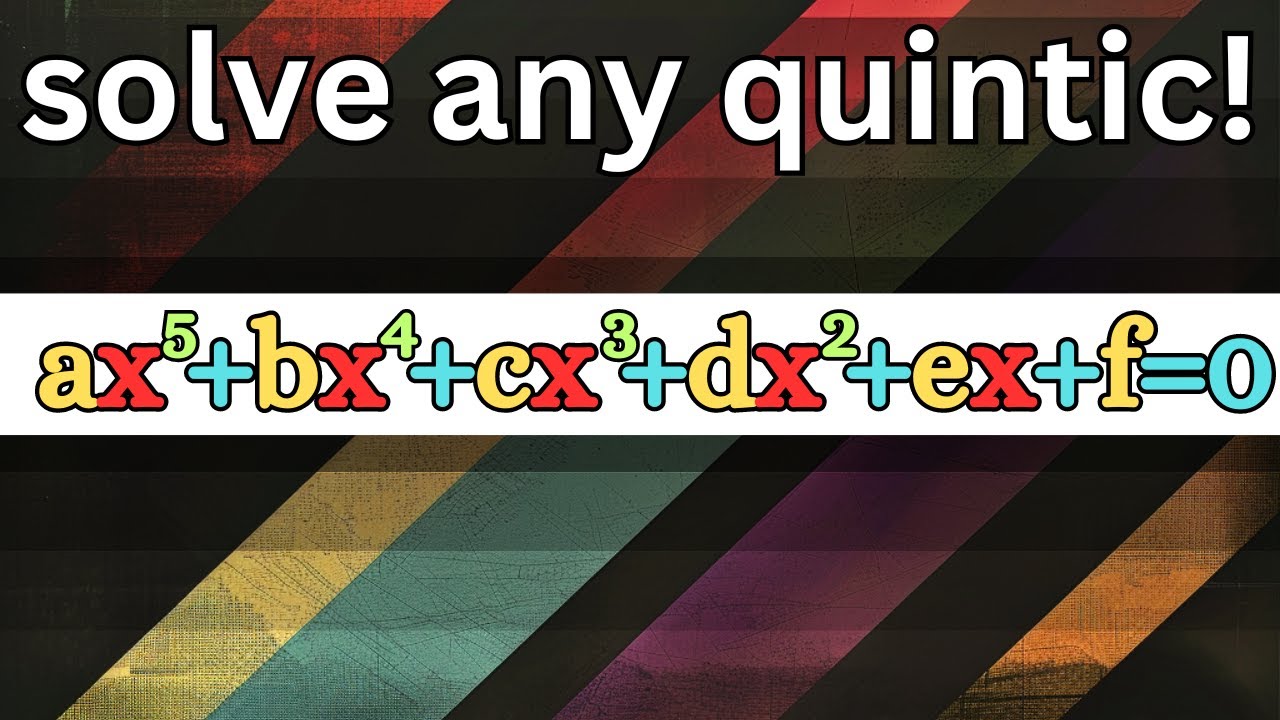




The quintic equation has no general algebraic solution using radicals because the symmetric group S₅ is not solvable—there exist permutations of five solutions that cannot be achieved by any finite nesting of commutators, meaning no finite combination of algebraic operations can reproduce the multi-valued nature of quintic roots.
Why There's No Quintic Formula: Arnold's Proof Without Galois Theory
Added:Basic polynomial algebra, including the concepts of roots, degree, and the historical formulas for solving quadratic, cubic, and quartic equations by radicals.
Introductory group theory, specifically symmetric groups (S_n), permutations, and the algebraic definition of a commutator.
Elementary complex analysis, focusing on how complex functions behave around branch points and how roots move along paths in the complex plane.
Classical Galois Theory, exploring how field extensions, automorphisms, and solvable groups provide an algebraic proof of the Abel-Ruffini theorem.
The topology of covering spaces and Riemann surfaces, generalizing the geometric ideas of Arnold's proof to more complex algebraic curves.
Alternative methods of solving the quintic, such as using Bring radicals, Jacobi theta functions, or Felix Klein's geometric approach using the icosahedron.
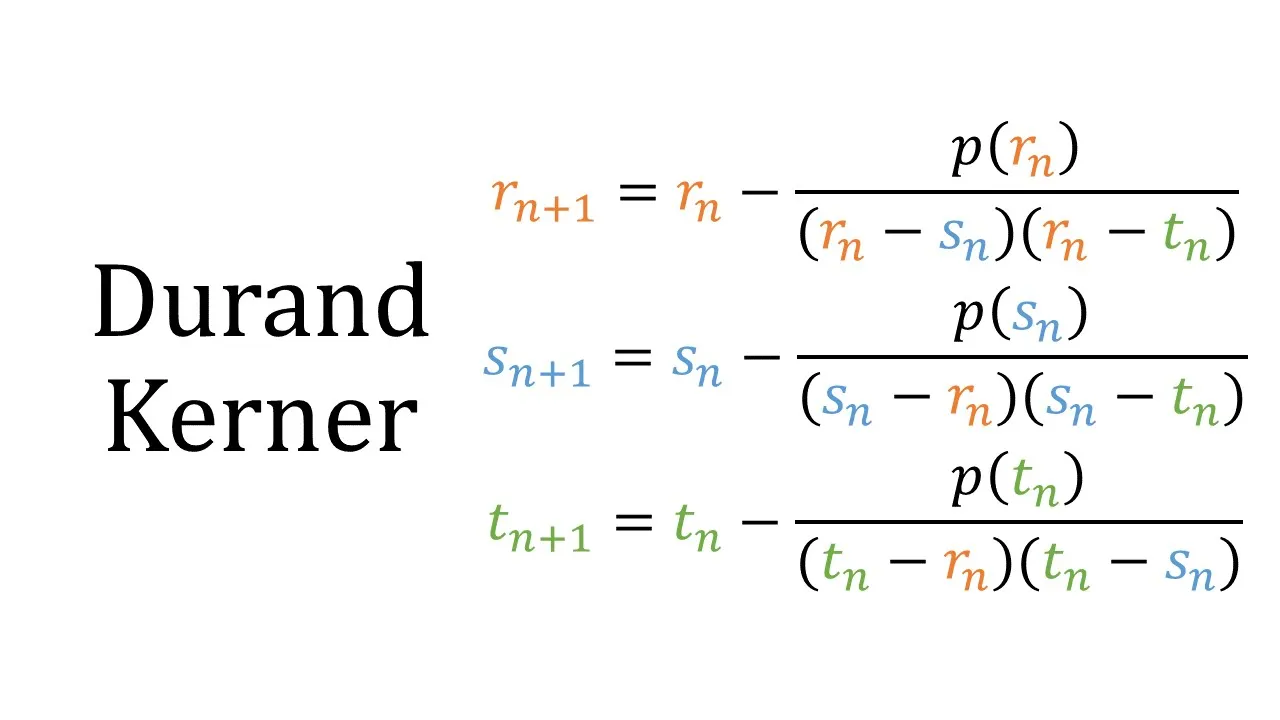
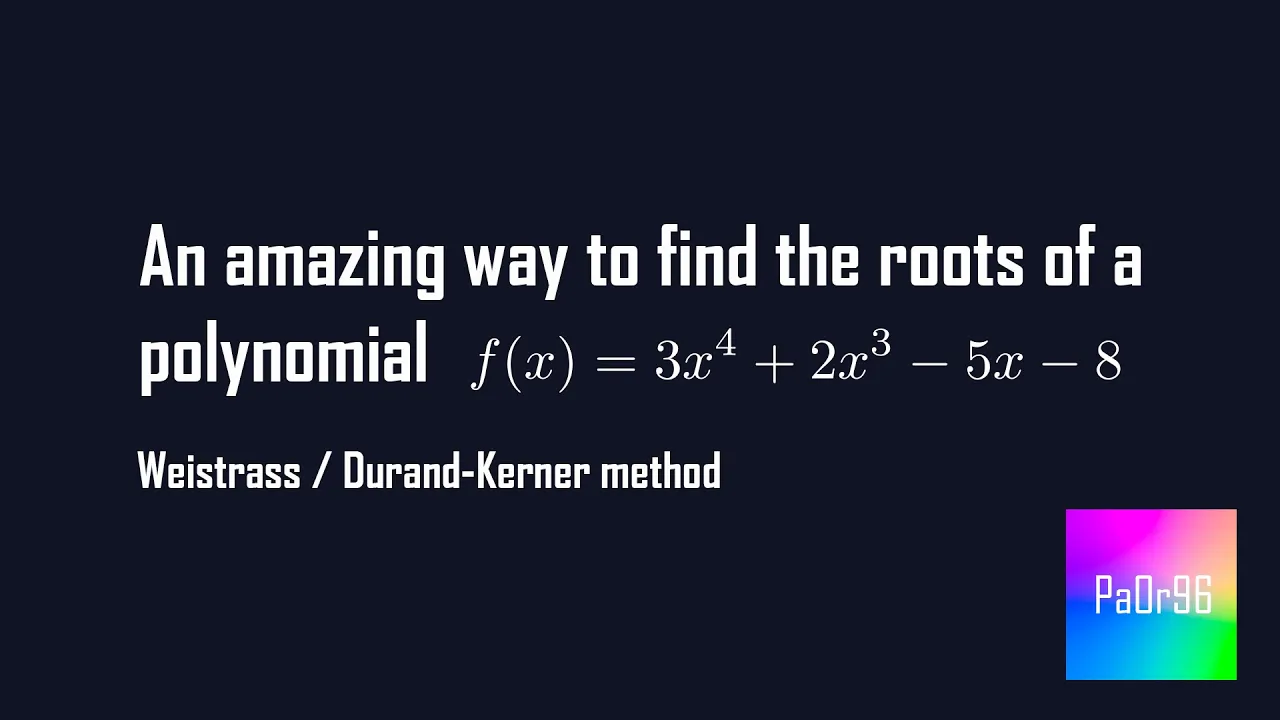
Numerical analysis techniques, such as the Durand-Kerner method or eigenvalue algorithms, used in practice to approximate roots of high-degree polynomials.
632.2K views19.4Klikes45:04Original Release: 2021-07-05
we all know and love the quadratic formula it tells us how to solve quadratic equations and all we need to know is how to add subtract multiply divide and take square roots you plug in the numbers and outcome two solutions pretty neat maybe it's less familiar that there is also such a formula for the cubic equation it's a bit longer but it's basically the same deal you just take the coefficients of the polynomial equation you add subtract multiply divide take some square roots take some cube roots and it tells you what the answers are i mean it's a bit longer it's not quite as useful and okay it's admittedly not mostly how people actually solve cubic equations in the real world but it's still pretty cool that it exists and there's even one for the quartic formula and that one really is quite a bit longer but it's still the same deal it's built out of plus minus times divide and taking roots expressions like this are called algebraic unfortunately not all patterns go on forever and this one actually stops at five i want to talk about the quintic equation there is no quintic formula okay so that's not strictly correct although roll credits it's not all wrong there's no algebraic quintic formula so there's no way of solving a general quintic equation with arbitrary coefficients just using addition subtraction multiplication and division and taking n roots or to give them their much cooler name radicals involving the coefficients and today we're going to see why using a really remarkable argument due to the amazing vladimir arnold i promise we're not going to use anything more than a little bit of knowledge about complex numbers in particular if you've heard of this subject before you may have heard of galwa theory being involved we're not going to need to touch galwa theory although the way that we approach the problem does have some deep relations with galwa theory and maybe we'll mention those a little bit later let's have a brief reminder of almost the only thing about complex numbers we're going to need throughout this entire video so when we first thought about complex numbers we usually think about them in terms of their real and imaginary parts so some coordinate x and some coordinate y and therefore we can plot them in the complex plane as a point [Music] but this representation makes it quite difficult quite ugly really to multiply complex numbers together it's much neater if we think about the product of complex numbers in polar form this means thinking about the distance that the complex number lies from the origin r and the angle that the point makes with the real axis theta so these are called the magnitude and phase most commonly of the complex number so this polar form is the way that we're going to mostly think about complex numbers and the reason why it's really neat is as i say that it makes multiplication a lot easier so if we take two complex numbers r e to the i theta and r primed e to the i theta primed and we multiply them together well we can just regroup these terms right we can take the two magnitudes those are just real numbers multiply those together so the new complex number just has magnitude r times r prime the product of the old magnitudes but the phases also collect together in a really neat way so e to the i theta times e to the theta primed actually factorizes together as e to the i theta plus theta prime in other words the phases of complex numbers add up when we multiply them and this fundamental factor is going to underline pretty much everything else that we use in the rest of the video actually it's really only a special case of this that we'll use most of the time which is just what happens if we square or cube or take some complex number to some power and we can see from the way that this phase is added that if we compute z squared for example r e to the i theta squared well the magnitude is just r squared and the phase gets doubled right it becomes e to the two i theta okay so you can see this pattern will continue right so if i compute z cubed for example the angle it makes with the x-axis will be three times the angle that z used to make with the x-axis and that's basically all we're going to need to know about complex numbers this result by the way is de moivre's theorem so i suppose the starting point for our study of polynomials or really to be to find out whether there are any solutions and if so how many and this is a very famous result and it goes by the name the fundamental theorem of algebra so it says that if we have an nth order polynomial equation in one variable then it has n solutions and okay there's a couple of little caveats we need here firstly they might well be complex right otherwise it's really easy to write down a quadratic equation with no real solutions the other slight caveat is that well actually when we write down a general polynomial it might have what we call repeated roots so for example z squared minus two z plus one it's a second order polynomial so it should have two roots but if we factorize it we get it in the form of z minus one squared equals zero and the only solution to that is z equals one but in some sense it has that solution twice right if we write it in this factorized form it has two factors of z minus one and that's actually really what we mean by this whole theorem it's that if we write down an nth order polynomial some leading term that's non-vanishing so a isn't ever zero then we can always just factorize it out so there's a factor of a outside the whole thing and then a product of n terms each of which looks like z minus something and those some things are the solutions of the polynomial equation okay so let's stretch our legs into the complex plane to see a proof of this so suppose that the biggest term in our equation is a z to the n since this is really what makes it an nth order polynomial right only if this term is present that it's nth instead of n minus 1th order it must be somehow that this term is the most important thing improving our result that this polynomial is going to have n solutions so where does this term really shine well thinking in the complex plane this term involves the highest power of z so it's going to grow most rapidly as z gets bigger so the idea is we should look at really large values of z and then this polynomial will be really well approximated by just that term alone a z to the n so let's think about moving z around a very large circle the idea is that well we want to think about where z has a large magnitude so that this term dominates but we also want to make use of the whole complex plane somehow so going around in a circle sort of seems to make some sense i guess as a starting point it's a good thing to play with okay so let's do that we take a z to the n or for example taking n equals two we'll just take a z squared and ask how that changes as we move zed around a large circle well firstly we're going to have to zoom out a bit because the magnitude of a z to the n is always going to be much bigger and even taking n equals 2 squaring a number makes it quite a lot larger so okay i'm going to zoom out we're going to fit that on our picture but the other thing we have to think about is what happens to the phase of the complex number now z squared remember has a phase which is always twice as large as the phase of z so if z goes around a circle once then z squared well its phase has to go up twice as fast and therefore it's actually going to make two complete circles around the origin in that time and that generalizes right if it was a z to the n then it would be some large complex number which goes around the origin n whole times i guess we need to remember that this isn't actually going to be exactly what the polynomial is it's not going to be exactly a z to the n there's going to be some correction term so just for an explicit example let's look at this quadratic polynomial and you can see that okay now as z varies around some large circle the whole polynomial does indeed still go around the origin twice but it's not a perfect circle anymore these other terms just slightly correct okay so now let's think about shrinking down the path that zed follows as we do that the path that the polynomial follows is also going to shrink quite rapidly and you know it's going to become a worse approximation to think of it as close to a circle that's traversed twice in this example okay so the shape has changed a bit but we still haven't got down to where the solutions actually lie so let's just start slowly shrinking it more okay this is the point at which there's actually a zero right the polynomial passes through zero so there's a solution and we can see what that solution is right it's just z equals two and indeed that's on the curve of z values that we saw okay and if we keep shrinking a bit more we'd find that there's another solution magnitude one and then if we keep shrinking it down eventually the polynomial also shrinks down to a single point right because once we've shrunk the z circle down we're just evaluating the polynomial z equals zero and that has a definite value okay so how could we have known for sure that we were going to come across some zeros when we did this process well it's precisely because we start with a circle or a not circle some sort of path that wraps around the origin multiple times and as we shrink that down it shrinks to a point and while either that point is the origin or in order to shrink down to a point it has to have passed through the origin this is the argument that there must be at least one zero of the polynomial right as we shrink down this complicated path that the polynomial follows it must intersect the origin eventually and that proves that there's at least one solution to the polynomial and that's actually enough to get the whole result so if we think about what happens for our quadratic polynomial we do this once we find a solution we can factorize it out right and the remainder has to be zero because the polynomial has to vanish so it must be possible to factorize out the z minus two term from this polynomial but what's left well it's a polynomial of degree one less and okay in our case it's just a linear polynomial and obviously that has a zero we can just see what it is and then we factorize the polynomial and found our two solutions but this would work for a higher order polynomial too right if we started off with an nth order polynomial we find one solution but we can factorize that solution out it'll give us an n minus one order polynomial and now we can repeat the same argument again we'll have another solution we can pull that out and then another solution we can pull that out and we can keep going until we get to this factorized form and that proves the fundamental theorem of algebra okay so we know that our quintic our fifth order polynomial has five solutions somewhere in the complex plane but what's the problem we're actually trying to solve well we're trying to go from the set of coefficients to the set of solutions and just dividing through by the leading term a in the polynomial because you know that just rescales the whole problem it's not really interesting we realize that what we're trying to do is go from five coefficients the b c d e f coefficients to the five solutions said one through z five say this is the thing that our you know our hoped for quintic formula would do right but we're going to claim that that doesn't exist of course going the other way is dead easy if i want to tell you what the coefficients are given the roots well i just expand the brackets right i just take this factorized form and i multiply it all out and i can just work out what all of the coefficients are but going the other way is somehow harder okay so do you notice anything about the way that we went from solutions to coefficients which suggests that it might be harder to go back the other way the thing which i notice is that if you swapped around two of the solutions say z1 and z4 then you'd still get the same polynomial right because you just rearranged the terms in this factorized form it's the same expression so b c d e and f are the same but the set of solutions has been switched around but that's fine surely right can't we just pick an order well actually one of the most interesting things about solving polynomial equations and this idea is at the heart of a lot of other things to do with polynomial equations including the traditional galwa theory approach to this whole topic is that there really isn't a natural way of ordering the solutions to a polynomial equation let me show you what i mean we'll study the more familiar quadratic case just to get some sense of what i mean by this so let's think about the equation z squared minus w equals zero or just z squared equals w a quadratic equation it has two solutions and for example if w is four there the two square roots of four which are plus two and minus two and maybe you will choose z1 equal to two and z2 equal to minus two the game we're going to play is i'm going to continuously change the equation and you're going to have to continuously change the solutions to the equation so i'm going to do this by increasing the phase of w now since z squared equals w and the phase of z squared changes at twice the rate of z you're going to have to change the solutions while changing their phase at half the rate that i changed the phase of w right so you'll have to choose this one to still be z1 on the right and this one to be z2 on the left so i'm going to keep doing that get round to w equals 4i and then all the way around to w equals -4 and at this point the two solutions are 2i and minus 2i like the two square roots of minus 4 but you have to choose z1 equals 2i and z2 equals minus 2i because well you started with particular choices z1 and z2 and it's smoothly changed so what am i now going to do you see the trick trick is just i'm going to continuously change w all the way back to where it started i'm going to change it back to being 4 but i'm going to do that by completing a circle around the origin when we're finished what's going to happen well z1 is going to be equal to -2 and z2 is going to be equal to plus 2.
i've tricked you into reordering your set of solutions the same set of solutions that we started with two and minus two but you've chosen them in the other order and that's what i mean when i say that you can't consistently choose an order for the solutions of this polynomial what i mean is that by smoothly changing the equation the solutions will change in a smooth way but they won't necessarily go back to same ordering as you started with so this property means that the quadratic formula which has to tell us what z1 and z2 are in terms of w can't be a proper continuous function right because it's multi-valued in terms of w by insisting that you change the solutions continuously that you change z1 continuously i've proven that it can have two different values at w equals four therefore it's not what we usually mean by a function so this is an important idea it's going to underlie a lot of the rest of what we're doing by going around the origin this root the square root that we're taking the quadratic formulas output if you like does not get back to where it starts even though all the coefficients inside that formula do get back to where they start so this corresponds exactly to the fact that the quadratic formula has a square root in it we even write it with a plus minus sign to remind ourselves that you know there's multiple options for which square root we might have to take and actually if you think about it we've proven that the quadratic equation this particular quadratic equation in fact cannot be solved using a formula that only involves addition subtraction multiplication and division mixed up with the coefficient w in some way because if it was of that form then it couldn't be multi-valued right then none of those are multi-valued operations so we would always just say if you give me this w then this is the value of z1 okay so since no such expression can have that weird multi-valued property it must be that the quadratic formula involves some additional ingredients and it does it involves square roots but if we are allowed to use any root we want write down some crazy algebraic expression that involves nested fourth roots of seventh roots added to fifth roots and all sorts of garbage like that how could we possibly argue that that couldn't reproduce multi-valued nature of the solutions of polynomial equations well it must be somehow if this is a helpful way of approaching the problem at least that algebraic expressions are somehow limited in how multi-valued they can be and that if we can show that a polynomial has solutions which are somehow more multi-valued than any algebraic expression we'll have proven that there's no quintic formula maybe that's the idea so remember we can commute the solutions of a polynomial in any way we want at all and we will get back the same coefficients at the end of the day so our formula written in terms of those coefficients must be multi-valued in such a way that it can reproduce the results of any process of exchanging the solutions of a polynomial so we clearly need to understand roots better nth roots if we want to show that they can't reproduce those arbitrary ways of mixing up the solutions of a polynomial so we're going to have a little bit of a think about the nature of the multivaluedness of nth roots let's visualize the fourth roots of two so the four solutions have the same magnitude which is about 1.19 something like that what you get if you press the square root button a couple of times on your calculator there are three other choices of course one that's just the negative of that one that's i times that and one that's minus i times that so this is the fourth roots of unity multiplied by 1.19 right they're the fourth roots of one but made a bit bigger they have phases zero quarters one quarter two quarters and three quarters of a full circle the reason for that is well when we take a fourth power they all get multiplied by four so they all become an integer number of multiples of two pi which means that they're all real numbers when we put them to the fourth power so this is a helpful way of thinking about the fact that they always end up being evenly spaced around some circle okay anyway so we're going to think about what happens as we smoothly change the quantity we're taking the fourth root of and just as before the phase of each root is also going to have to increase smoothly but now at a quarter the rate right of the thing that we're taking the fourth root of so you know if we for example move a whole time around the origin then you're simply going to end up rotating the four solutions one place around and if we go around again well they rotate one place further and as we go around the origin the opposite direction they just rotate back in the other direction and if we vary the quantity you were taking the root of in any other way changing its magnitude but without going around the origin well the roots just end up back where they started right so this is as you might hope for a kind of tame multi-valuedness right we can predict the way that any nth root changes just by asking how many times the quantity inside the nth root goes around the origin and we're going to avoid thinking about any path that takes the quantity inside the root to zero because then all of these roots sort of merge together and lose their identity so whenever we're choosing paths just imagine that we're choosing paths which keep everything inside roots non-zero how can we use this neat property this is probably the biggest idea in the video and it's really quite subtle so it's worth taking some time to get your head around our starting point is going to be the argument we made about quadratic equations just a few minutes ago so remember we claimed that the quadratic equation cannot be solved with just a rational function of the coefficients of that equation and the argument was just well imagine that there was such an expression and that it didn't involve any roots then it would be a continuous and single valued function of those coefficients right okay but then we thought about a particular example of a polynomial equation right we said let's think about an equation which has solutions plus two and minus two and then let's smoothly switch those two solutions around so if our formula for z1 is continuous as a function of all of the things in this equation well then it must end up swapping to the other root so if z1 is plus 2 at the start then it ends up being -2 but that's a problem right because the equation actually at the end of this process has got back to where it started since all we've done is switched the routes around the actual a b and c coefficients didn't change and therefore since z1 is a single valued function of all of those coefficients it must also have got back to where it started which is a contradiction and that's what guaranteed for us the quadratic equation must have some sort of nth root in its solution okay so that's all well and good but we want to think about the quintic equation and let's think about how we might try and prove for example that you can't solve it using an algebraic expression that contains just a single root of b c d e and f and well i guess we'd start by doing the same thing imagining that z1 was such a function and then asking what properties it has so we would still be continuous this nth root hasn't ruined that property but the nth root does mean that it can be multi-valued as a function of these coefficients okay so then we have to make use of these properties the first part i suppose goes the same right so we just have some polynomial with five solutions which are whatever we want them to be and then we can swap them around in whatever way we choose to and all we have to do to make an argument like this work is just make sure that at the end of the day z1 has changed to you know z3 perhaps but then what about the other stage well we need to guarantee that our formula for z1 hasn't changed in order to get the contradiction and prove the theorem and that's where we want to somehow use this tameness of this route right we want to argue that even though an nth root could be multi-valued for some reason the clever way that we've chosen to swap these things around means that it isn't multi-valued because if that's true then we have the same tension between the fact that z1 does change by continuity but that on the other hand it doesn't change because of some nice property of the function and then we get a contradiction and our result so now we know what the right question is question is how do we swap the solutions zi around without changing any nth roots of the coefficients b c d e and f so what permutations must leave an nth root of the coefficients unchanged so i want you to imagine that you know you're given some you're going to take the nth root say of some complicated function involving plus minus times the division rational function of the coefficients of a quintic formula and you want to find a cunning way of switching around the solutions to that corresponding polynomial such that that nth root doesn't change even though it's an nth root and can be multi-valued you want to prove that there's a particular permutation which leaves that nth root unaltered at the end of it let's say we pick two of these points z1 and z2 and we just swap them around in some smooth way and as we do that the quantity r that we're going to take in root of is going to change in some way and you know maybe it goes around the origin for example that would be the most interesting thing that could it could do it go around the origin some number of times and pick up some total phase like two pi times some integer m right at the end of the swap the coefficients are the same so the value of r must be the same but it can follow an interesting path as we're altering the actual solutions of that equation right okay so we need to now make sure that the nth root of r doesn't change but so far it might have changed right it can change by 2 pi m divided by n because it's an nth root it's like a power 1 over n it can change at one nth the speed of the quantity we're taking a root of so what could we do well the simplest thing we could do i guess is just exactly undo the permutation we did the same permutation of z1z2 but following the same path in reverse and as we do that r is going to follow the same path also in reverse and therefore it's going to pick up a phase which is just minus 2 pi m and that kind of works right the total phase change of r is zero so the phase change of the nth roots is also zero because it's gone around the origin m times one way and then m times the other way so the root doesn't actually change at the end of the day and that's kind of neat but of course it hasn't helped us because the set of solutions has got back to where it started so we've proven that the root isn't multi-valued but the set of solutions also hasn't changed right we haven't really labeled them so we don't need the nth route to be multi-valued in order to reproduce this set of solutions that hasn't helped us prove anything but can you see how this idea of doing and then undoing a permutation could be slightly generalized to something which does help us because it doesn't actually leave the set of solutions untouched so think about that for a minute can you find a slightly less trivial thing that involves doing and undoing permutations did you get it suppose we do one permutation pick up some phase like 2 pi m like before and then we do a different permutation we pick up a different phase in right so the r is going to follow a new path because we're changing a different set of solutions different pair of solutions around say um and you know we're going to wrap the origin maybe some different number of times as we do that but next what we do is undo the first permutation and then undo the second permutation that involves following those two parts that are followed in reverse right the same permutation process but done the opposite way round okay now this is what's called a commutator between a doing b undoing a undoing b and you can see on the left hand side it genuinely switches around the set of solutions right even though in some sense we've done and undone every permutation by doing them in a clever order we actually alter the ordering of the set of solutions but now think about how the nth root of r has behaved well we accumulated some phases and then we accumulated the negative of those phases and therefore the total phase change of r total number of times it's wrapped around the origin counting plus and minus signs for anti-clockwise and clockwise directions is zero the phase of r has net not changed at all and therefore an nth root of r also doesn't change and this is exactly what we wanted right we've managed to choose a way of switching around the set of solutions which does something interesting to r but at the end of the day guarantees that the nth root of r gets back to where it started and that is exactly what we need in order to move on with our argument so as i mentioned this is something called a commutator you do one thing called sigma you do another thing call it tau then you undo the first thing sigma inverse and then you undo the second thing tau inverse so do a do b undo a and do b this sort of operation is maybe most familiar to people who've played with rubik's cubes because quite a common kind of move is actually a commutator move it involves doing a rotation of one face rotation of another face and then undoing the rotation of the first face and undoing the rotation of the second face and it's kind of useful for the same sorts of reasons it's useful for us here it changes some stuff doesn't leave the cube completely unchanged but it doesn't change too many things it's very useful building block when you're trying to find interesting ways of permuting objects so where have we got to well actually what we've done is prove that no cubic or quartic authentic formula can exist that contains only basic algebra addition subtraction multiplication division and a single nth root right because we know how to change around the solutions such that they end up permuted around but the results of any possible formula that looks like this don't change around so it's quite a beautiful result quite a clever way of arguing it but didn't we write down a cubic formula earlier yeah we did but it looks like this and notice it involves complicated expressions involving nested roots and we haven't ruled those out yet we have actually ruled out things that involve adding together or multiplying or dividing roots because we can choose a path which individually makes each one of those roots get back to where it started and then when we add subtract multiply and divide them well that doesn't help us build anything more multi-valued so we've ruled out anything that doesn't involve nested roots so why is it that nested roots uh somehow evade our argument well think about what happened before we firstly argued that expressions involving the coefficients get back to where they started as soon as we switch around a pair of solutions right any permutation of the set of solutions leaves an expression involving the coefficients unchanged but doesn't necessarily leave an nth root of those coefficients unchanged on the other hand if we follow a commutator move so that means the coefficients get back to where they started after sigma get back to where they started after tau and then we undo those with sigma inverse and sigma tau and so the coefficients have actually been back to where they started like four times that guarantees that an nth root of that expression gets back to where it started but now that works for the inner root but it doesn't work for the outer root because whilst the coefficients that were in the original equation the b's and c's have been back to where they started four times in this clever commutator pattern this nth root the inner nth root only just got back to where it started or at least that's all we can guarantee right at the end of the commutator this nested root is the same as where it started but that's just like a single path that wraps around the origin maybe and then this outer root may be multi-valued in terms of that so the outer root can have changed at the end of our commutator but this kind of suggests what we might like to do in order to prove that there isn't an expression involving nested roots for example for the quintic right we need to rule out nested roots to prove that there's no quintet formula can you see what might be a sensible idea so we've shown that you know an expression involving the coefficients is single valued an expression involving a net through to those coefficients is single valued after a commutator so an expression involving a root of a root of the coefficients is single valued if we follow a commutator of commutators that is to say imagine we do one commutator that leaves the inner root unchanged now we do a different commutator which also leaves the inner root unchanged then we undo the first commutator and then we undo the second commutator it's quite an elaborate process but at the end of it this outer route must have been left invariant by exactly the same argument as before you just think about the inner root as being a quantity which gets back to where it started after each of these commutators and because it's a commentator of commutators the root of that quantity must also get back to where it started so that's quite cool i think but you know a competitive commentator is quite complicated right you could write it out in terms of permutations and it'd be a real proper mess but okay what can we do we know that a commentator of commutators is going to leave expressions involving once nested roots unchanged but there is such a formula for the cubic equation so therefore it must be that all commutators of commutators when we have three solutions to move around are actually trivial because the cubic formula will be single valued when we follow a commutator of commutators therefore it must be that the set of solutions to keep equation go back to where they started so there's a little challenge for you can you prove that all commutators of commutators involving three points are trivial they get the points back to where they started have go at that it's quite a fun do you exercise a hint a hint would be to first show that all commutators of three points are a cyclic permutation so whenever you do any commutator of any kinds of permutations of three points you always just get a cyclic permutation that maps one to two and two to three and three to one or same thing in reverse or just leaves everything where it started okay so if you follow that hint what you should find is that the possible three-point permutations that you can write down there's six of them you should find that whenever you do one another undo the first one and do the second one you get a cyclic permutation we already showed the commutator of two swaps said one z2 and z2z3 for example we know that that's a cyclic permutation because we saw it earlier so you only need to check um a few other cases really in order to prove that first result and then the other result is just well what happens when we take a commutator of those cyclic permutations well psychic permutations actually commute with each other right it doesn't matter what order i do cyclic permutations of three points in it has the same result so for example if i commute them one way clockwise and then one way anti-clockwise and then undo the first thing one way anti-clockwise then one way clockwise everything ends up where it started right and if you just think about that that's basically the only case that you need to worry about and so all commentators of commentators just leave the set of three points exactly where they started and that you know is why there can be a cubic formula with once nested roots because combinations of commentators are three points don't actually change them by the way if you do want a little bit of group theory and to make some connections with galwa theory this is where that starts becoming really clear because this is what's called the derived series of the group of permutations of three elements so if you take all possible mutations to the elements you get this thing on the left that's the group s3 itself the next thing along is what you get by doing commutators so if you're only allowed to do commutators of elements and you can do a few computations of elements if you want then you find that you get another group which is the first element in the derived series of group s3 and it happens to be the group of cyclic permutations c3 and if you do that one more time you ask what can you build out of just commutators of commutators then you find there's only this trivial permutation and this set of three groups is called the derived series and this is exactly the sort of thing you worry about when you do gawa theory to prove this same result but okay i promised no advanced scour theory no group theory so that's just a little note for the interested amongst you okay so what's next on our journey well there was a quartic formula right that had roots of roots of roots inside it so that suggests that there may be a couple more challenges i can give you which are firstly to show that if you have four points the four solutions of a quartic equation to mix up then there is a commutator of commutators that mixes up those four points in some non-trivial way it challenges to find such a thing and that would rule out something that looked like the cubic formula where you just have one level of nesting going on so a root of a root that is indeed true have a go and the other thing to check is that there's no commutator of commutator of commutators which mixes up four points and that allows this uh formula to exist this quartic formula exists with only one extra level of nesting so you have a little bit of a play with drawing permutations of four points out on the piece of paper and see if you can prove those results what about the quintic i claim that there's no way to express its solution using any small print finite number of nested roots how could we possibly prove this result well actually all we need to do is prove that there are commentators of commutators of commentators of commutators that genuinely mix up switch around a set of five solutions if there are such arbitrarily nested commentators then well if you give me a possible quintic formula that involves say nothing deeper than an m level nested root then i can just look for commutative combinations of context also m times nested and that will prove that your formula is not multi-valued when i follow that complicated commutator pattern but since there is such a commentator that does mix up the points again i've ruled out the possibility of such a quintic formula so can we actually find commutators or commentators communities etc of five points which genuinely mix up a set of five points yes we can and i totally challenge you right now to go and have a go at arguing that yes there is a way of doing a combination of communication communication and so on of five points which leaves them changed at the end of it okay have a go and there's a hint if you want it which is to think just about three points at a time so in particular suppose that you want to obtain a cyclic permutation of three points i claim that it's possible if you have five points not if you have fewer than five points to obtain that cyclic permutation as the commutator of two other cyclic permutations of three points so give that a try it's quite a satisfying result to derive and it's just drawing out some pictures and working out how certain permutations act on a set of five points go ahead okay i hope you had a go at that i think it's a very fun satisfying thing to see play out and let's just illustrate it and i'm going to make it slightly neater just by ordering the points neatly okay so that's better let's see how we can obtain a permutation of one two three cyclically around as a commutator so the first thing i'm going to do is take these points on the left hand side i'm going to switch them around one place and now i'm going to go over here do something different i'm going to switch these three points around also one place and it's a commutator so i have to undo the first thing and then the second thing which happily gets four and five back to where they started and lo and behold one two and three have been permuted one place and this is exactly the result i said i wanted right i've now managed to obtain a cyclic permutation of three points it's a commutator of cyclic permutations of three points and that's actually pretty much the last stage of the proof all we need to do is just use this to build arbitrarily nested commutators but can you see how i do that i know how to write cyclical permutations of three points as commentators but now since they were commentators of cyclic permutations of three points i know how to rewrite each of those commutators as a commutator itself so this sigma as a representation as a commutator of cycling permutations of the points and so does tau and therefore actually i have a representation of this one two three permutation as a commutator of commutators and i can just keep going right i now have a way of finding a representation of a one two three cyclic permutation as an arbitrarily nested commutator and therefore i can mix up the set of solutions whilst leaving an arbitrarily nested root completely untouched and therefore there is no quintet formula qed i think that's a really beautiful argument well done that'd be a good job i mean i always used to think you needed galwa theory to prove this result and it's a lot more machinery to develop to understand that proof whereas this approach that just involves complex numbers thinking about basic properties of those and some clever reasoning about multi-valuedness and continuity somehow much more satisfying it's a little bit less powerful in some ways than galwa theory because galway theory allows you to hold up a particular example of a polynomial and say this polynomial with these numeric coefficients doesn't have a solution in terms of radicals of nth roots of rational numbers but you know our approach has its advantages too it for example rules out um adding any exponential for example into this you know some e to the z type function you can't have a quintic formula that involves nth roots some basic algebra and e to the z because that's also a single valued continuous function so by the same arguments you can't build a quintic formula using it but okay whatever your your tastes i hope that you think this is a nice argument and you know it leads on to develop a bunch of the ideas that you you sort of study in more advanced group theory in quite a satisfying way you know it really tells you why you should be thinking about commutators what's interesting about them what's special about them and yeah i think it's really valuable for that i think maybe it's nice just to give you some additional maths words to drape around what we've looked at today what we've shown is that the permutation groups called the symmetric groups s1 s2 s3 and s4 which just the different ways you can permute one two and three and four objects are all what's called solvable which means that taking commutators of commutators of combinations of communities eventually you only get trivial operations from doing this and that's not true for s5 it's not a solvable group um and yeah so there's instead you know you get stuck right you take conversations of communicators but there's a whole bunch of different permutations of five points which can be written as arbitrarily nested commutators it's not quite all of them so if you'd like to try something out you could try showing that it's actually exactly half of all possible permutations of five points you can realize um by taking quantitative computations of combinations of computators multiplying those together you can only get half of the possible permutations of five points trying to work out how to describe which half you do and don't get is quite a nice challenge if you've not seen much group theory before um but anyway so the the you do get a group out of this so it's just a you know a particular set of permutations with some structure and it's called a5 the things which you can get using this approach and that's what's called a perfect group so it's its own commutator subgroup if you take that particular collection of permutations then anything within it can be realized as a product of commentators of things in that group that's what we call a perfect group okay so i think that's that's maybe enough jargon for one day okay i hope you enjoyed hearing this argument i thought it was a beautiful argument when i first learned about it from a video and paper which i'll link to below i encourage you to have a look at those um yeah it's just such a nice way of approaching this problem and so clever as an argument and quite hard to get your head around the first time so if there's anything i could clarify if i made any mistakes please do let me know in the comments below and i'll hopefully come back to you quickly and be a little bit more helpful um but yeah please do like the video subscribe if you enjoy this sort of content and see you soon goodbye
Up Next

9:18
The Mating Ritual: Stable Matching in Algorithmic Game Theory
@mitocw
8.8K views•2016-09-12

4:43
Elliptic Curve Cryptography Explained: ECC, ECDSA, ECDH
@PracticalNetworking
28.5K views•2024-10-21
10:44
Fourier Series Introduction: The Big Idea Explained
@DrTrefor
387K views•2021-05-03

6:00
The Mathematical Impossibility of Accurate World Maps
@Vox
23.3M views•2016-12-02
Related Study Plans & Knowledge Roadmaps
Structured learning paths in Mathematics
mathematics
Tensor Calculus: Vectors to Riemann Curvature
01Mathematical Foundations: Linear Algebra & Calculus
02Covectors, Dual Spaces, and Tensor Basics
03The Metric Tensor and Index Gymnastics
+ 2 more learning modules
40h5 modules
Explore Roadmap
mathematics
Gödel's Incompleteness: Logic, Proofs & Limits
01Introduction to Formal Systems & Hilbert's Dream
02Set Theory, Cardinality, and Cantor's Diagonal Argument
03Arithmetization and Gödel Numbering
+ 2 more learning modules
14h5 modules
Explore Roadmap
mathematics
Galois Theory: Fields, Groups & Solvability
01Foundations of Abstract Algebra: Groups & Fields
02Polynomials & Field Extensions
03Splitting Fields & Symmetries
+ 2 more learning modules
24h5 modules
Explore Roadmap
mathematics
Non-Euclidean Geometry: Models & Geodesics
01Euclid's Fifth Postulate and the Birth of New Geometries
02Hyperbolic Space and the Poincaré Disk Model
03Geodesics: Defining Straight Lines in Curved Spaces
+ 2 more learning modules
15h5 modules
Explore Roadmap