














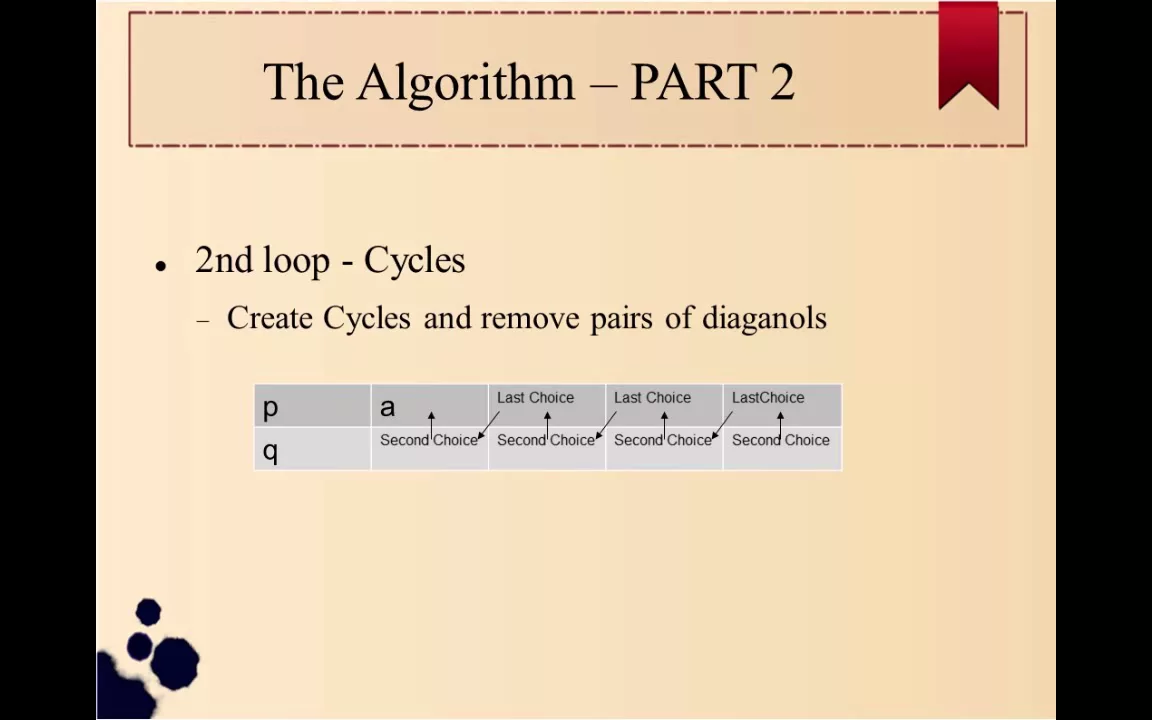









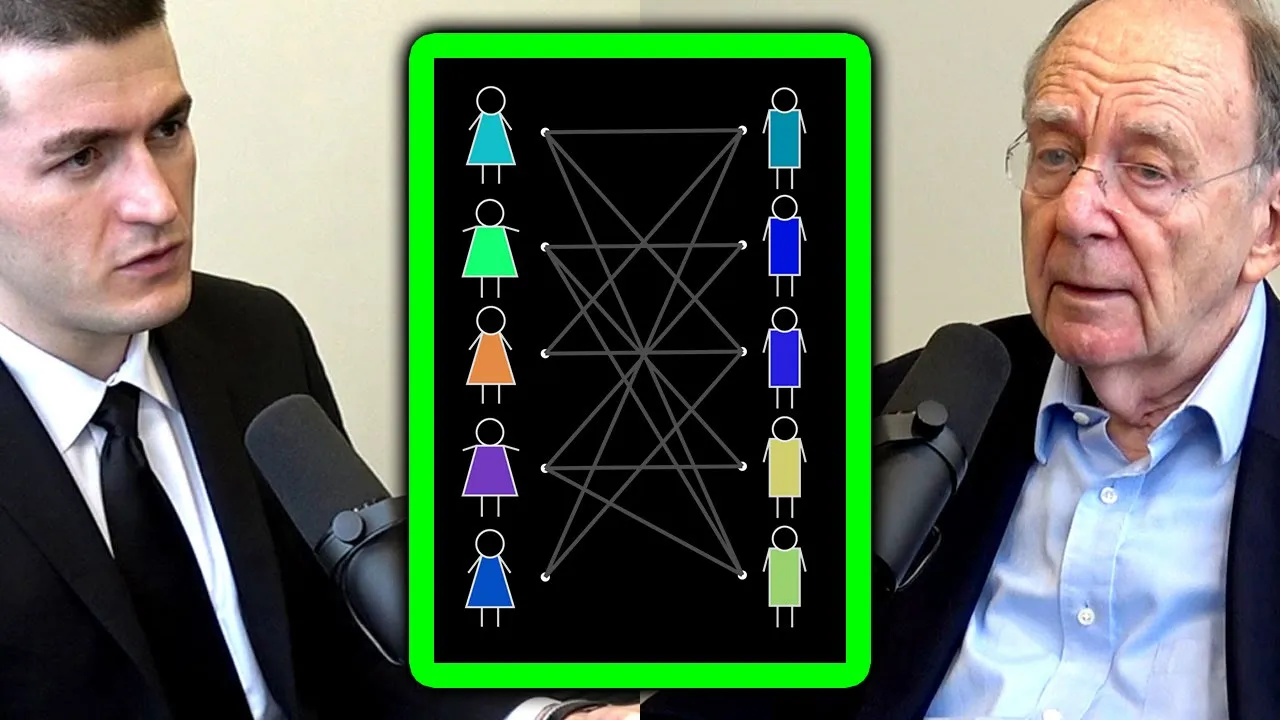
The Gale-Shapley algorithm solves the stable marriage problem through an iterative process where each man proposes to his highest-ranked woman who hasn't rejected him yet, and each woman accepts her favorite proposal while rejecting others; this procedure terminates because the number of remaining suitors decreases monotonically, and the resulting marriages are guaranteed to be stable (no rogue couples exist) due to the invariant that any woman who rejected a man will eventually marry someone she prefers more.
The Mating Ritual: Stable Matching in Algorithmic Game Theory
Added:Basic Discrete Mathematics: Familiarity with sets, relations, and preference orderings (strict vs. weak preferences).
Fundamental Algorithmic Thinking: Understanding of iterative processes, step-by-step execution, and algorithm complexity.
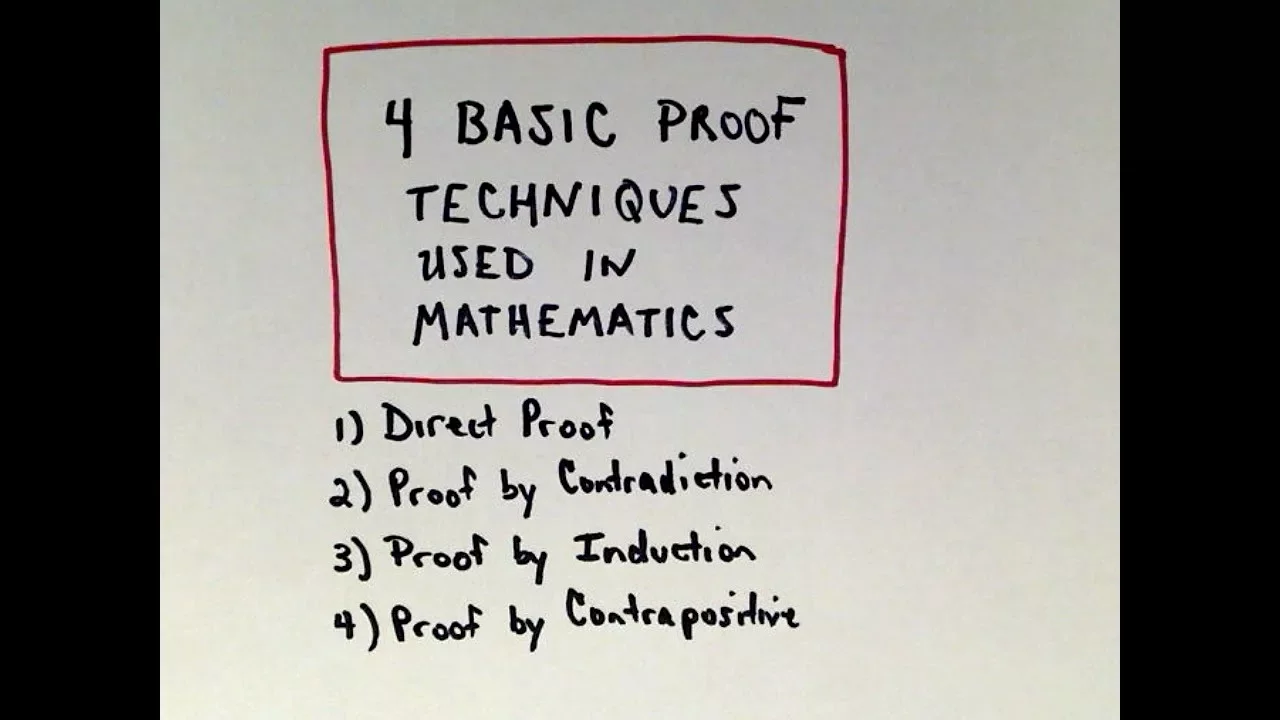
Basic Proof Techniques: Comfort with proof by contradiction and induction, which are crucial for proving algorithm stability and termination.
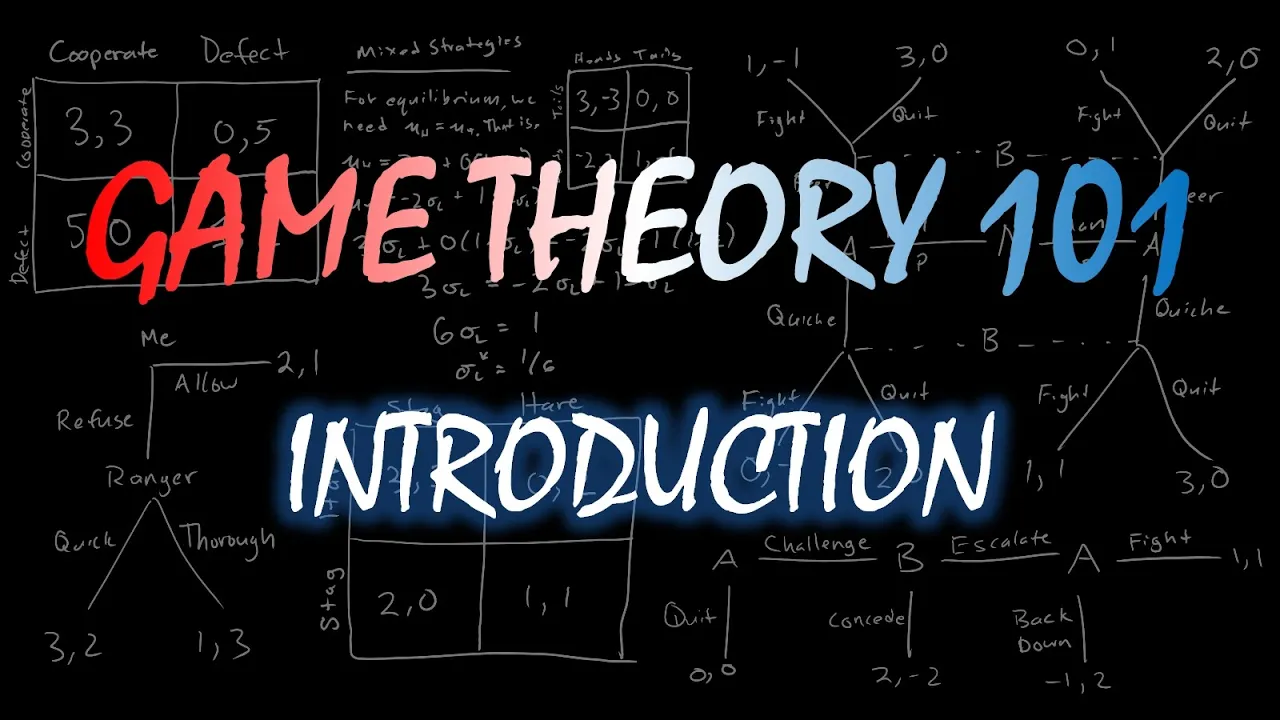
Introduction to Game Theory: Familiarity with the concepts of agents, preferences, and stable outcomes.
Mechanism Design and Strategy-Proofness: Analyzing whether agents have incentives to lie about their preferences (incentive compatibility).
The Stable Roommates Problem: Studying matching in one-sided (non-bipartite) markets where a stable matching is not guaranteed to exist.
Many-to-One Matching and Applications: Exploring the Hospital-Resident problem and its real-world implementation in the National Resident Matching Program (NRMP).
School Choice and Market Design: Investigating how stable matching algorithms are adapted for public school allocation systems, considering priorities and ties.
8.8K views92likes9:18Original Release: 2016-09-12
okay so how do we find these stable marriages well there's a procedure for doing it which is kind of elegantly described as a day-by-day mating ritual that the boys and the girls cooperate in so let's see what happens on the first day um on the morning of the first day each boy looks at his list of girls and picks the one that he likes the best at the top of his list and he goes off and serenades her or proposes to her so here we have Billy Bob and Brad proposing to Angelina that means that on the first day uh Angelina was at the top of both Brad's list and Billy Bob's list and they're both going to be proposing and asking if she's willing to marry them well in the afternoon uh each girl rejects all but her favorite Suitor so in this case Angelina likes Brad best ofal so she says to everybody else if you're not Brad take a hike and that's what happened at that stage and then in the evening here we look at rejected Boy Billy Bob a boy who's rejected crosses off the girl who rejected him so Billy Bob is going to cross Angelino off his list and then the whole ritual is going to repeat starting the next morning except that now Billy Bob will have a different woman at the top of his list because Angelina is gone forever okay this uh mating ritual continues until nothing changes and that's going to happen exactly when each girl has at most one Suitor cuz if she has more than one Suitor she's going to reject the less favorite ones so that is the definition of the stopping condition and on that day by definition no girl can have more than one Suitor so she will marry the one Suitor she has and that's the definition of the marriages that result if and when the mating ritual stops and we claim that they are going to be stable marriages now if we think about this process it's really a state machine in fact if you think about it what the states are is the is the set of girls on the boys list on any given morning and then uh those States evolve to a new list after the crossing out happens on the next morning so this is kind of a a memorable way to tell a story about the transitions of a state machine and we can bring our state machine Concepts to bear so the first thing we want to prove is that this state machine terminates that is to say there exists a wedding day um then we want to prove that this uh State machine is partially correct and what that means that uh when the machine stops everyone is married and that the marriages are stable so that's our task well termination easy because if you look at the state the state is the boys lists on a given morning and things evolve because boys get rejected and they cross girls off the list so what that means if we take the total number of names remaining on the boy lists On Any Given morning that is a strictly decreasing and non- negative integer valued variable so by the well- ordering principle that's strictly decreasing well-ordered um uh derive variable will reach a minimum value and by definition that's when the algorithm has to stop because it's strictly increasing so it can't move once it's reached its minimum so there's a wedding day all right so now let's examine correctness of this procedure and figure out what's supposed to happen on the wedding day we want to show that everybody's married and that the marriages are stable and in order to do that we're going to look at some more derive variables and an invariant that explains why the mating ritual works so the first remark is that the girls improve uh day by day or at least they don't get any worse namely a girl's favorite tomorrow will be at least as desirable to her as her favorite today that's for any given day if you look at a girl's favorite on this day and if there is a tomorrow then her favorite tomorrow is going to be at least as good as the one she has and why is that well because today's favorite will keep serenading her until he gets rejected and he only gets rejected when the girl that he's serenading gets yet a better Suitor and so the girls are always going to improve we could reformulate this uh in in state machine Language by saying that the rank of a girl's favorite where she uh rates the boy that's serting her on her own list of preferences is a weekly increasing variable it never gets any worse from one day to the next by the same reasoning or similar reasoning a boy's favorite uh tomorrow is going to be uh no better than today's it might be worse and so it's no more the woman that he going to say tomorrow is no more desirable to him than today is basically because he works straight down his list if he hasn't been rejected he'll keep Serena the same woman tomorrow if he has been rejected then uh he's got to be working on somebody lower on his list that's less desirable so again the rank of a girl on a boy that a boy serenades is a weekly decreasing deriv variable of this process and these observations lead us to an invariant that holds for the mating ritual and the invariant is that if you look at any girl G um and if there's a boy B and G is not on B's list that is g must have been crossed off by B at some point then uh the invariant is that the girl G has a favorite that is uh better than than b and the reason is that again when G rejected B she had a better Suitor than b and her suitors keep getting better by the uh weekly increasing property of her suitors and therefore uh she's going to have a Suitor that she likes at Le better than be whose list she's not on this holds for all G's and B's uh and that is an invariant from one day to the next so let's look at what happens on the wedding day and use the invariant to prove that everybody's married and that stability holds so the first remark is that each girl has at most one Suitor and we've observed that's by definition of a wedding day and now what we want to prove is that um uh each boy gets married well what's going on with a boy um a boy is either married because he's seraing the top woman on his list or maybe all the all the women on his List have been crossed off then he's not seren Serena anybody so that's the only way that he could be not married now the reason that this is the case is that there's no bigamy here so um boys serenate only one girl at a time so um if a boy uh is married there's only one possible woman that he can be married to and a woman's only married to one possible boy so let's now put these facts together and ARG AR that everybody is married on the wedding day and the proof is by contradiction suppose there's some boy be That's not married well that happens exactly when his list is empty otherwise he'd be serenading somebody and be married to her but if his list is empty by the invariant every girl has a a Suitor that she likes better than be which means she's going to be married to somebody that she likes better than be every girl's married but there are the same number of boys and girls so in fact given that there's no bigamy all the boys have to be married too and that settles that one so the next crucial property that we're interested in is stability that in fact this set of marriages which must come into being on the wedding day um are all stable and the argument for stability uh has two cases both of them trivial and that follow immediately from the invariant um first of all let's look at an arbitrary boy Bob uh I claim that won't be in a rogue couple with case one any girl G that's on his final list because if a girl is on his final list then uh he's already married to the best of them he marries the girl at the top of his list so he's not going to be tempted to switch uh to be part of a rogue couple with some girl that's uh still on his list case two is he's not going to be in a rogue couple with a girl that's not on his list Because by the invariant she's married to somebody she likes better than him so there's no available girl either way for Bob to be in a rogue couple with Bob of course is an arbitrary um uh boy and therefore no boy is in a rogue couple and indeed there are no roog couples
Up Next
7:56
Stable Marriage Problem: Algorithm & Beauty | Richard Karp
@LexClips
4.2K views•2020-07-27

8:17
JEE Maths | Circles: Pole & Polar Explained with Equations
@TargetPublications
14.4K views•2019-02-23

20:22
Cantor's Theorem: Proof & Diagonal Argument | MIT 6.042J
@mitocw
33.1K views•2016-09-12

6:00
The Mathematical Impossibility of Accurate World Maps
@Vox
23.3M views•2016-12-02
Related Study Plans & Knowledge Roadmaps
Structured learning paths in Mathematics
mathematics
Projective Geometry: Coordinates & Conics
01From Euclidean to Projective Space
02Homogeneous Coordinates
03Duality and Projective Transformations
+ 2 more learning modules
14h5 modules
Explore Roadmap
mathematics
Tensor Calculus: Vectors to Riemann Curvature
01Mathematical Foundations: Linear Algebra & Calculus
02Covectors, Dual Spaces, and Tensor Basics
03The Metric Tensor and Index Gymnastics
+ 2 more learning modules
40h5 modules
Explore Roadmap
mathematics
Gödel's Incompleteness: Logic, Proofs & Limits
01Introduction to Formal Systems & Hilbert's Dream
02Set Theory, Cardinality, and Cantor's Diagonal Argument
03Arithmetization and Gödel Numbering
+ 2 more learning modules
14h5 modules
Explore Roadmap
mathematics
Galois Theory: Fields, Groups & Solvability
01Foundations of Abstract Algebra: Groups & Fields
02Polynomials & Field Extensions
03Splitting Fields & Symmetries
+ 2 more learning modules
24h5 modules
Explore Roadmap