





























The stable marriage problem involves matching two equal-sized groups (such as men and women) based on mutual preference lists, where a matching is stable if no two individuals prefer each other over their current partners; the Gale-Shapley algorithm guarantees a stable matching exists for any preference configuration and can be computed efficiently through an iterative proposal process where one group proposes and the other accepts or rejects tentatively, with the proposing side achieving optimal outcomes while the receiving side achieves pessimal outcomes.
Stable Marriage Problem: Algorithm & Beauty | Richard Karp
Added:Basic Graph Theory: Understanding bipartite graphs and the concept of matching elements between two disjoint sets.
Fundamental Algorithmic Thinking: Familiarity with step-by-step procedures, execution flows, and basic time complexity (Big-O notation).
Mathematical Proof Techniques: Comfort with proof by contradiction, which is essential for proving the stability and termination of matching algorithms.
Preference Rankings: The concept of strict orderings and how agents rank alternatives from most preferred to least preferred.
The Gale-Shapley Algorithm: Deep-diving into the mathematical formulation, implementation, and the asymmetry of proposer-optimal vs. rejecter-optimal outcomes.
Real-World Matching Systems: Studying practical applications of stable matching, such as the National Resident Matching Program (NRMP) for medical students and public school choice systems.
Mechanism Design & Strategy-Proofness: Exploring game-theoretic aspects of matching, specifically whether agents can benefit by misrepresenting their true preferences.
One-Sided Matching & Kidney Exchanges: Investigating matching markets that do not have two distinct bipartite sets, such as Alvin Roth's work on kidney donor exchange networks.
4.2K views140likes7:56Original Release: 2020-07-27
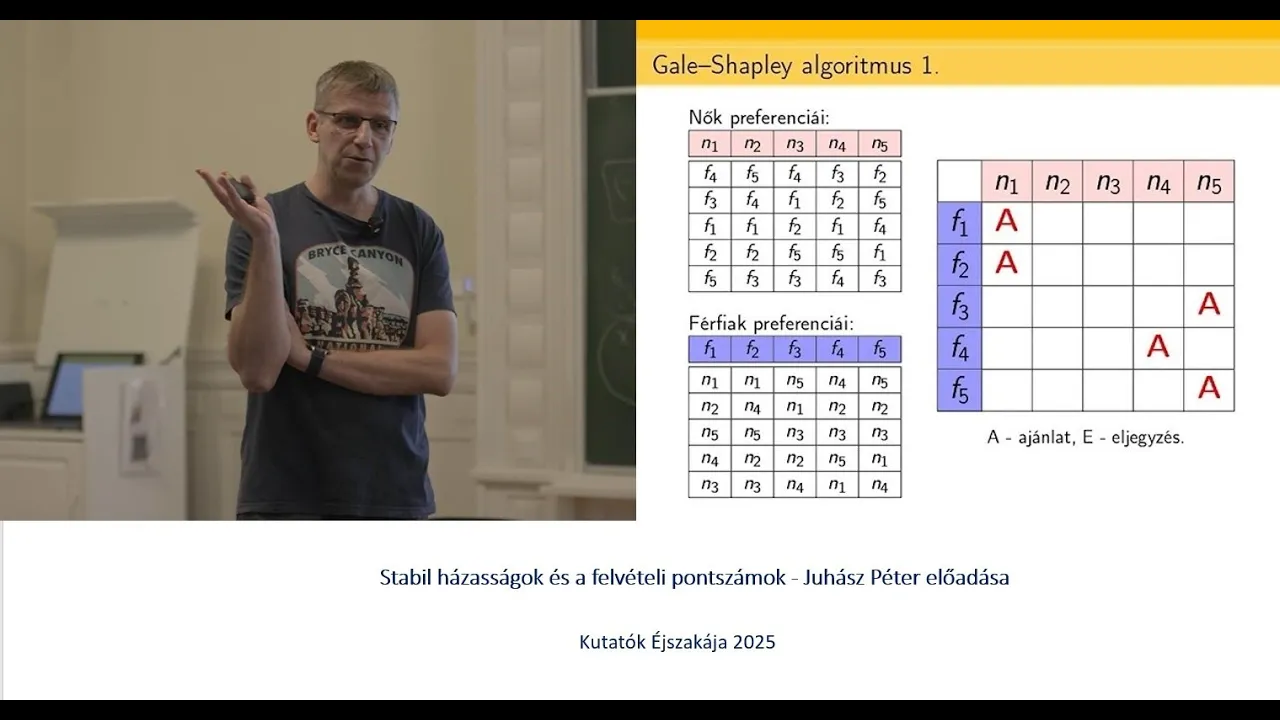
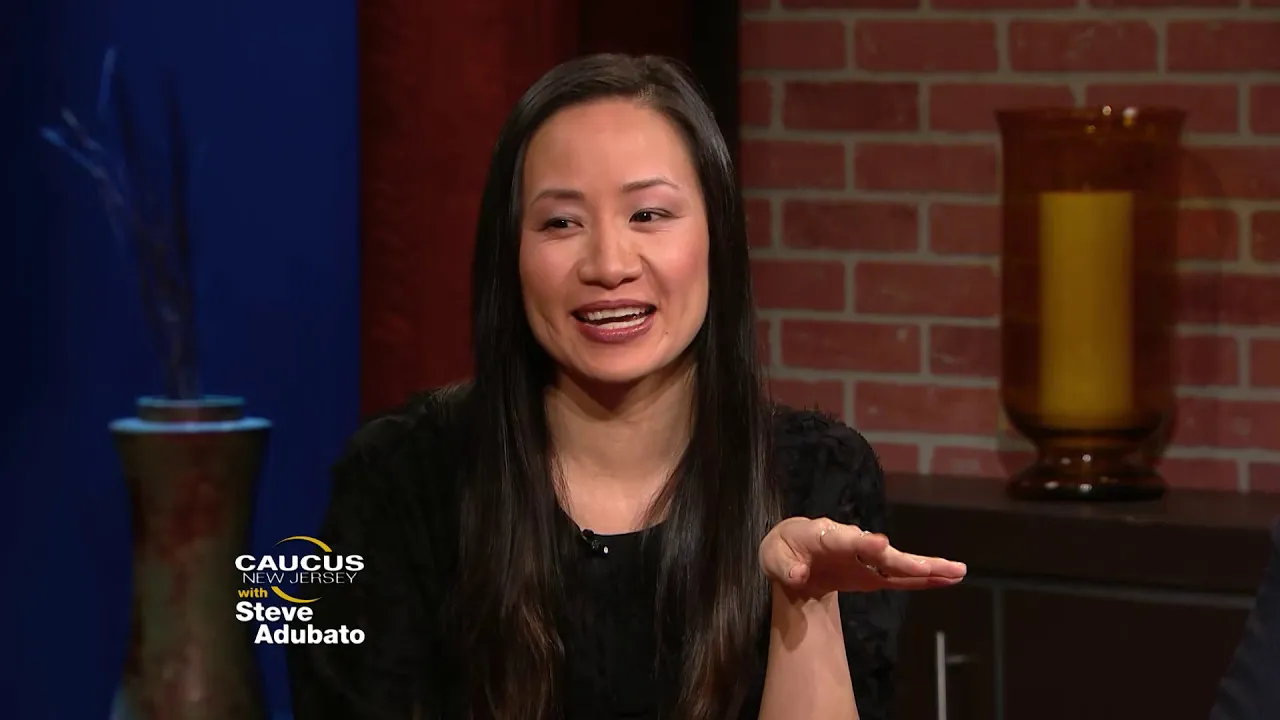
okay so let me ask a romanticized question what to you is one of the most or the most beautiful combinatorial algorithm in your own life or just in general in the field that you've ever come across or have developed yourself oh i like the stable matching problem or the stable marriage problem uh very much what's the stable matching problem yeah imagine that you want to marry off end boys with uh and girls and each boy has an ordered list of his preferences among the girls his first choice is second choice through her nth choice and um each girl also has a an ordering of the boys first choice second choice and so on and we'll say and we will say that a matching one-to-one matching of the boys with the girls is stable if there are no two couples in the matching such that the boy in the first couple prefers the girl in the second couple to her mate and she refers the boy to her current mate in other words if there is the matching is stable if there is no pair who want to run away with each other leaving their partners behind gosh yeah [Laughter] yeah actually this is relevant to matching residents with hospitals and some other real life problems although uh not quite in the form that i described so it turns out that there is that a stable for any set of preferences a stable matching exists and moreover it can be computed by a simple algorithm in which each boy starts making proposals to girls and if the girl receives the proposal she accepts it tentatively but she can drop it if she can end it she can drop it later if she gets a better proposal from her point of view and the boys start going down their lists proposing to their first second third choices until stopping when a proposal is accepted but the girls meanwhile are watching the proposals that are coming into them and the girl will drop her current partner um if she gets a better proposal and the the boys never go back through they never go back yeah so once they've been denied they don't try again they don't they don't they don't try again because the girls are always improving their status as they get more as they receive better and better proposals the boys are going down their list starting with their top preferences and one can prove that that the process will come to an end where everybody will get matched with somebody and you'll you won't have any pair that want to abscond from each other do you find the proof or the algorithm itself beautiful or is it the fact that with the the simplicity of just the two marching i mean the simplicity of the underlying rule of the algorithm is that the beautiful part both i i would say um and you also have the observation that you might ask who is better off the boys who are doing the proposing or the girls who are reacting to proposals and it turns out that it it's the boys who are doing the doing the best that is each boy is doing at least as well as uh he could do in any other stable matching so there's a sort of lesson for the boys that you should go out and be proactive and make those proposals go for broke i don't i don't know if the this is directly mappable philosophically to our society but uh certainly seems like a compelling notion and like you said there's probably a lot of actual real world problems that this could be mapped to yeah well you get you you get uh complications for example what happens when a husband and wife want to be assigned to the same hospital so you uh you you have to take those constraints into account and then the problem becomes np hard or uh why is it a problem for the husband and wife to be assigned to the same hospital no it's desirable so desirable or at least go to the same city so you can't if you really i think if you're assigning residents to hospitals and then you have some preferences uh for the husband and wife for for the hospitals the residents have their own preferences references residents both male and female have their own preferences um the hospitals have their preferences but if if resident a the boy is going to philadelphia then you'd like his wife be also to be assigned to a hospital in philadelphia so which step makes it a np-hard problem that you mentioned the fact that you have this additional constraint that it's not just the preferences of individuals but the fact that the two partners to a marriage have to go to have to be assigned to the same place i'm being a little dense uh the sort of the perfect matching no not the stable matching is what you refer to that's when two partners are trying to okay what's confusing you is that in the first interpretation of the problem i had boys matching with girls yes in the second interpretation you have humans matching with institutions and there's a coupling between within the gotcha within the humans any added little constraint will make it an empty heart problem well yeah okay by the way the algorithm you mentioned wasn't was one of yours no no that was due to gail and shapley and my friend david gale passed away before he could get part of the nobel prize but his partner shapley uh shared in a nobel prize with somebody else for economics for ideas stemming from this stable matching idea you
Up Next

31:44
The Math Problem With Music Tuning and Its Solutions
@FormantMath
852.3K views•2022-08-12

4:43
Elliptic Curve Cryptography Explained: ECC, ECDSA, ECDH
@PracticalNetworking
28.5K views•2024-10-21
10:44
Fourier Series Introduction: The Big Idea Explained
@DrTrefor
387K views•2021-05-03

6:00
The Mathematical Impossibility of Accurate World Maps
@Vox
23.3M views•2016-12-02
Related Study Plans & Knowledge Roadmaps
Structured learning paths in Mathematics
mathematics
Tensor Calculus: Vectors to Riemann Curvature
01Mathematical Foundations: Linear Algebra & Calculus
02Covectors, Dual Spaces, and Tensor Basics
03The Metric Tensor and Index Gymnastics
+ 2 more learning modules
40h5 modules
Explore Roadmap
mathematics
Gödel's Incompleteness: Logic, Proofs & Limits
01Introduction to Formal Systems & Hilbert's Dream
02Set Theory, Cardinality, and Cantor's Diagonal Argument
03Arithmetization and Gödel Numbering
+ 2 more learning modules
14h5 modules
Explore Roadmap
mathematics
Galois Theory: Fields, Groups & Solvability
01Foundations of Abstract Algebra: Groups & Fields
02Polynomials & Field Extensions
03Splitting Fields & Symmetries
+ 2 more learning modules
24h5 modules
Explore Roadmap
mathematics
Non-Euclidean Geometry: Models & Geodesics
01Euclid's Fifth Postulate and the Birth of New Geometries
02Hyperbolic Space and the Poincaré Disk Model
03Geodesics: Defining Straight Lines in Curved Spaces
+ 2 more learning modules
15h5 modules
Explore Roadmap