![[MATHS & MUSIQUE #1] L'Introduction](https://i.ytimg.com/vi/CVf4hhqDS40/maxresdefault.jpg)











![Муз.Ликбез - (НЕ)-ТЕМПЕРИРОВАННЫЙ СТРОЙ [Сравнение]](https://i.ytimg.com/vi_webp/aaOZC_PnZ2c/maxresdefault.webp)









The mathematical problem of musical tuning arises because the frequency ratios of perfect fifths (3:2) and octaves (2:1) cannot simultaneously be satisfied in a finite scale, as proven by showing that 3^n = 2^(n+k) leads to a contradiction since powers of 3 are always odd while powers of 2 are always even; this fundamental incompatibility has driven the development of various tuning systems throughout history, including Pythagorean tuning (using only pure fifths and octaves), Just Intonation (using pure thirds for smoother harmonies), Meantone temperament (compromising fifths for better transposition), and finally Equal Temperament (dividing the octave into 12 equal semitones with ratio 2^(1/12)), which sacrifices perfect intervals for the ability to transpose freely between keys.
The Math Problem With Music Tuning and Its Solutions
Added:There is a serious mathematical problem with the tuning of musical instruments, a problem that some of the world's greatest scientists tried to solve.
This video is about this problem and about some of the ways to tackle it. We will start from the basic physics of sound, will then see mathematically why some musical instruments can never be perfectly in tune, and, after looking at some of the solutions to this problem, we'll understand the equal temperament, which is the tuning system almost everybody uses today.
This video has some audio demonstrations of subtle differences between tones, so you're advised to use good headphones.
Let's start at the very beginning - what is sound?
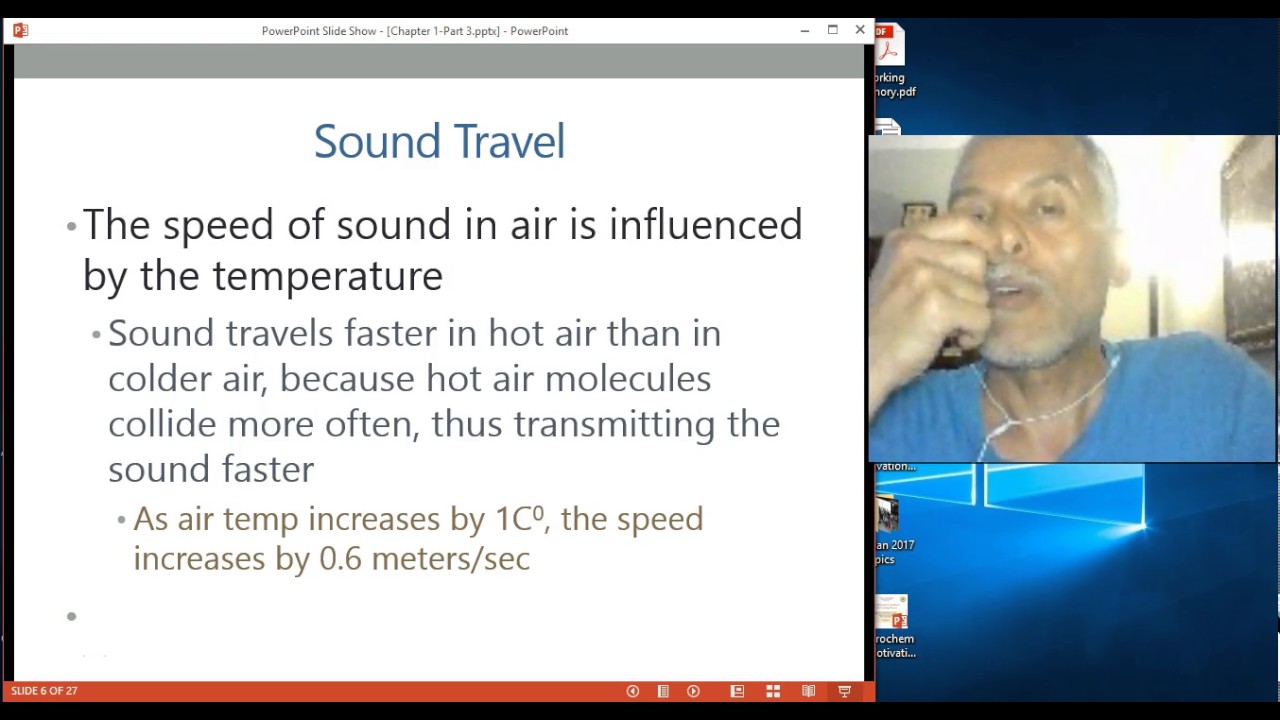
Well, physically speaking, sound is vibrations in air pressure, which are vibrations in the density of the air molecules, that we can sense with our ears.
The rate at which these vibrations hit our eardrums is called the frequency of the sound.
And frequency is measured in Hertz, which is the number of vibrations per second.
The frequency of musical tones is typically from about 50 hertz to a few thousand hertz, meaning that sound vibrations hit our ears hundreds and thousands of times per second, so this animation is actually in very slow motion.
Our ears and brain perceive tones with a higher frequency as having a higher pitch.
So for example, that's how a 200 hertz tone sounds like, and this is a 1000 hertz tone.
It turns out that all musical tones are, in a sense, made in a very specific way out of building blocks called "pure tones", which are tones that behave according to the mathematical function sine.
Here is how a pure tone sounds.
Now there is a lot to be said about what exactly it means for a tone to be made out of other tones, but for the purpose of our video, when we hear a tone that has a certain frequency, let's call it f, then this tone actually contains several pure tones, where the frequencies of these pure tones are f, 2f, 3f, 4f, etc. Always integer multiples of f.
These pure tones are called "harmonics". There is the first harmonic, the second harmonic and, so on.
So keep these harmonics in mind, because we will need them later.
Now in music we have melodies, which are sequences of tones,one after the other.
Here is a melody that uses only three tones, with frequencies 440, 660, and 733.3 hertz.
And here's another melody, that also uses three tones, but this time the frequencies are 550, 825, and 916.6 hertz.
Now are these two melodies the same? Well, strictly speaking, they're not, because they don't have even one note frequency in common. But on the other hand, we all feel strongly that they are essentially the same melody. What exactly made us feel that?
The answer is that both melodies have the same ratios between the frequencies of their tones.
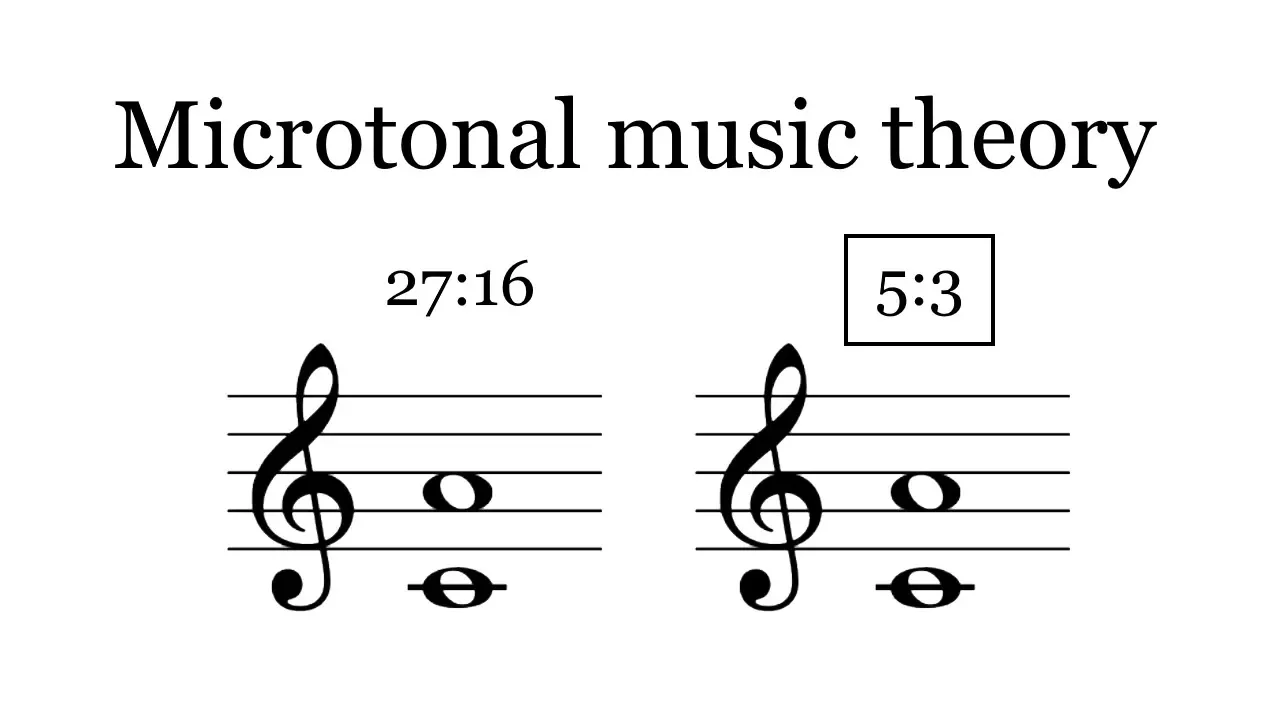
In melody 1, the frequency ratio between the second tone and the first is 3:2, and the ratio between the third tone and the first is 5:3.
In melody 2 the frequencies are different, but the ratios are the same: 3:2 and 5:3.
It turns out that our brains perceive two such melodies, which have the same ratios between their note frequencies, as essentially the same melody. And the act of changing all the frequencies of a melody by the same factor, so that the ratios stay the same, like changing melody 1 to melody 2, is called transposition from one key to another.
And transposition is extremely important in music.
For example, if a singer who has a certain vocal range wants to sing a song, but cannot reach some high notes, then he better transpose the song to a lower key, which mathematically means that he should sing all the notes with frequencies that are lower than the original frequencies by the same factor. It would sound essentially the same song, but in the lower key. And hopefully now the notes are within his range.
The next thing to discuss is intervals. Between any two tones there is a musical interval.
An interval is the musical distance between the two tones. And by what we've just said, it is determined by the frequency ratio of the two tones.
One important interval is called the octave, and it corresponds to a frequency ratio of 2:1.
For example, two tones with frequencies 880 and 440 hertz are an octave apart.
The octave is very pleasant to the ear.
Did you hear how the two tones sounded harmonious when they were played together?
Octaves are especially important in music, because of a psychological phenomena called "octave equivalence", where people perceive two tones that are an octave apart as highly similar. So similar, that musicians call them by the same name, and musicologists say that they belong to the same pitch class.
For example, a 440 hertz tone is called an "A", and so is the tone one octave above, with 880 hertz , or two octaves above, one octave below, and so on. And all these A's belong to the same pitch class.
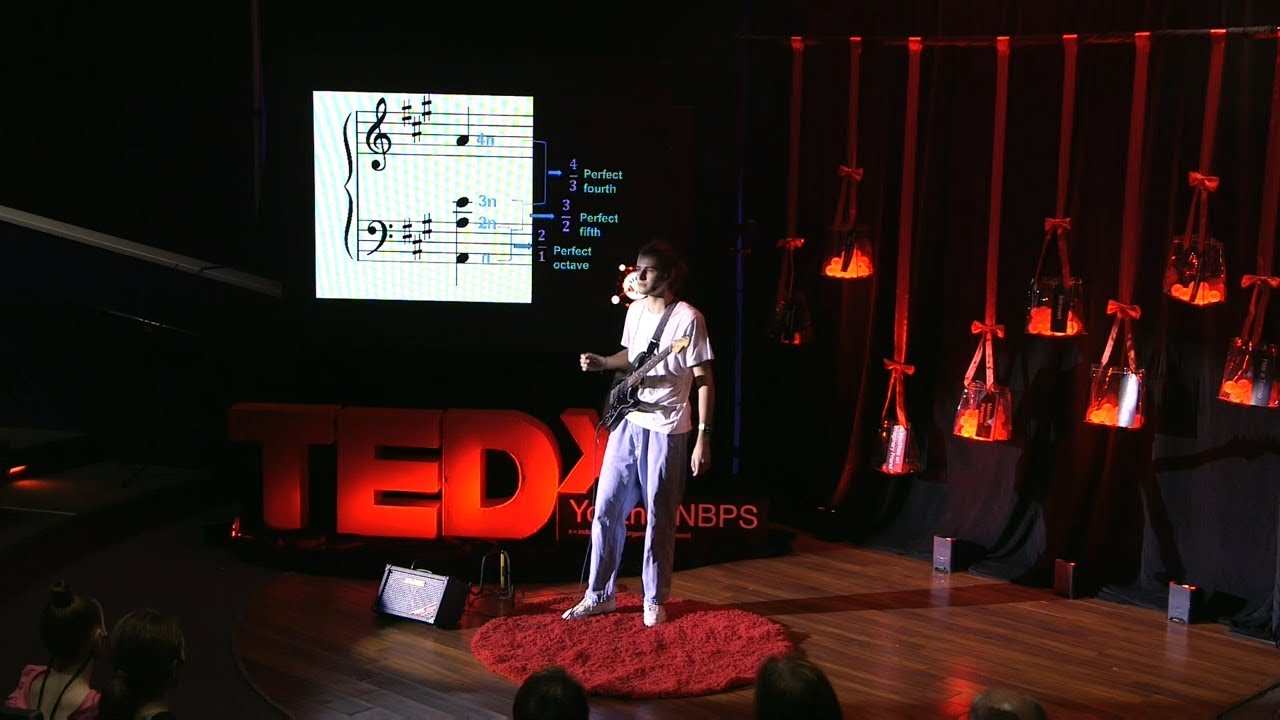
Besides the octave, another important interval is called the fifth, and it corresponds to a frequency ratio of 3:2. For example, to tones with frequencies 660 and 440hz.
Fifths are ubiquitous in music from all cultures, and they're also very pleasant to the ear.
The discovery that there is some mathematics behind musical tones, and how we perceive them, is attributed to Pythagoras. And if i got my history right, it is the first law of nature that was stated in numerical terms, more than 200 years before Aarchimedes and his law of the lever.
But we are here to discuss the tuning of musical instruments. So, some instruments can produce a continuum of infinitely many different pitches. On a violin, for example, the violinist can place her finger at some point on the fingerboard, to produce one note, can place it at another point, say one inch away, to produce another note, and can also place her finger at any of the infinitely many places between these two points, to produce infinitely many different note pitches.
But some other instruments are limited in the number of notes they can produce.
A standard piano, for example, has only 88 keys, so it can produce only 88 different notes.
The big question is - which note should they be? Let's focus on the octave between 440 and 880 hertz, and create a list of note frequencies in this range that we want our piano to be able to play. Now, it's enough to consider only a single octave, because of octave equivalence: once we decide on the frequencies in this octave, we can multiply them all by 2, to get the frequencies in the next octave, or divide them all by 2 to get the previous octave, and so on. We said that the octave and the fifth are highly important intervals, so a minimal requirement from our piano is that it will be able to play octaves and fifths.
Let's start with 440 as the first frequency in our list. A fifth above for 440 we have 660, and we want our piano to be able to play fifths, so we add 660 to our list. Another fifth up we get to 990.
Now 990 is outside our range, but an octave below 990 we have 495, which is inside the range, and we want our piano to be able to play octaves, so 495 is also in. A fifth above 495 we get 742.5, so we add it too. So we continued this way, repeatedly going up by fifths and occasionally going down an octave, if we hit the frequency above 880.
Now when should we stop this process? Well, if at some point we'll hit exactly 880, then after going down an octave, we will return to our starting point, 440, and there will be no more new notes to get from the process. But that won't happen. We will prove it mathematically in a moment, that we will never make it back exactly to 440, not even in a million steps. So our list will have infinitely many note frequencies. Now this is terrible news, because it means that our piano needs infinitely many keys, for the single octave between 440 and 880, and that's of course impractical.
To prove that we will never make it back to 440, we will use an approach called "proof by contradiction" which says that something is true if its opposite cannot be true, because it leads to a contradiction. So, if we do return at some point to 440, that happens after a certain number of times, let's call this number n, in which we went up a fifth. And there was also some number of times, let's call it k, in which we went down an octave. Starting from 440, going up n fifths means multiplying 440 by 3/2 n times, which is multiplying it by 3/2 to the nth power.
And going down k octaves means multiplying this by 1/2 to the kth. And that supposedly takes us back to 440. Now the two 440's cancel out, and if we rearrange what's left, we get that 3 to the n equals 2 to the power of n plus k. But any power of 3 is an odd number, and any power of 2 is an even number. So we got a contradiction - a number cannot be both odd and even.
And that means that it cannot be true that we have returned to 440, and we have proved our proposition.
So a piano that can play exact fifths and octaves, above or below any of its notes, requires infinitely many keys for a single octave. And this is not some theoretical concern or a mathematical curiosity, but a serious practical problem in the design of musical instruments, which kept busy some of the greatest minds in history, including Pythagoras, Galileo, Kepler, Newton and Euler.
These people, and many others. came up with dozens of ways to tackle the problem.
Each way results in a certain choice of note frequencies for a single octave, and such a choice of frequencies is called a "tuning", or an "intonation", or a "temperament". And I will use these three terms interchangeably.
We will discuss in this video only a few of the main temperaments, and the first one is called Pythagorean tuning.
This tuning is often credited to Pythagoras himself, and it was common in western music until the late middle ages.
The idea behind Pythagorean tuning is to use octaves and fifths, which are exact 2:1 and 3:2 ratios, but not too many of them. Just enough to play some simple melodies.
As before, it's enough to consider only a single octave range, and because we care only about frequency ratios, the actual frequencies don't matter, and we can conveniently denote the lower note in the octave by 1, and the upper note by 2.
To get the actual frequencies in some specific octave, like between 440 and 880, we just multiply all the values we'll have by 440. We now need to fill this range with notes, and it turns out that seven notes before the octave is enough for the simple melodies we are aiming for.
So let's repeat our previous process, but only for a few steps. A fifth above the lower note we have 3/2.
Another fifth up and one octave down, we get 9/8. So we continue this way, and also go down one fifth from the octave note, but then stop.
Let's listen to the notes we got.
They may sound to you like the usual notes you get from today's musical instruments, but they're actually slightly different, as we'll see later.
Still, they sound OK, and they're enough to play simple melodies.
One drawback of Pythagorean tuning is that even for simple melodies, transposition becomes a problem. For example, if we want to transpose the melody we've just heard, which started with this note, and start it instead with this note, we just won't have some of the required notes. But if we use again only an octave and a fifth, and add just one more note between two of the notes we already have, we will be able to play the beginning of our melody.
And if we add this way a few more notes, things improve even further. But there will always be transposition issues with this approach, no matter how many notes we add.
The picture we now have looks similar to a piano keyboard, and this is not a coincidence.
Early keyboard instruments had only the so-called white keys, and later gradually evolved to have more and more black keys.
Our next temperament is called Just Intonation, and it is associated with the late middle ages and the early renaissance, even though its roots are much older. Just Intonation keeps some of the Pythagorean ratios, but replaces others with new ones. This is how it sounds.
The new, Just ratios are numerically pretty close to the Pythagorean ones.
For example, the Pythagorean third note, 81/64 is only 1.25 percent above the just third note, 5 /4.
And there is also a 1.25 percent deviation in the sixth note, and in the seventh note.
Can we even hear such a small difference? Let's find out. In a moment, I will play the Pythagorean third note and the Just third note, but i'm not telling you in which order.
So listen carefully, and try to hear if the second note is lower than the first, meaning that it's the Just one, or if the second note is higher. Ready? here we go.
You can rewind the video to hear again, or let me reveal that the second note was... higher.
It was the Pythagorean one. Now 1.25 percent is a small difference, but still large enough that under good listening conditions, most musicians, and many non-musicians, can hear it.
But what's the point behind Just Intonation? Why change some of the Pythagorean ratios?
It's because when we play together certain note combinations, they sound better in Just Intonation.
The combination of the first, third, and fifth notes is an important note combination in music, called a major chord. Let's listen to it first in Just Intonation and then in Pythagorean tuning.
Did you hear that the Pythagorean combination sounds a little bit more rough? There's a reason why the just combination sounds more smooth, and it has to do with the harmonics that tones are made of.
We saw that a tone with frequency f contains harmonics with frequencies 2f, 3f, 4f, etc. Let's think of f as the frequency of the first note in a temperament. If we take a Pythagorean third, for this temperament, and look at its harmonics, then the fourth harmonic of this third note will be a little bit above 5f, so it's a little bit above the fifth harmonic of the first note.
And these two close frequencies, when played together, clash in our ears and create a rough sensation. But if we take a Just third for this temperament, which is 5/4, then the fourth harmonic of this third note will be exactly 5f, right on the fifth harmonic of the first note, and there is no clash. And something very similar happens with the third and fifth notes. There is a clash of harmonics in Pythagorean tuning, and it disappears in Just Intonation. This ratio of 4:5, which eliminated the clash, appears in three key places in Just Intonation, and that's why many note combinations in Just Intonation sound more smooth. But a downside of just intonation is that transposition becomes even more problematic.
For example, in Pythagorean tuning, the interval between the first note and the second is 9/8, and it's the same as the interval between the second and the third notes. So if we have an extremely simple melody, which uses only the first two notes, we can perfectly transpose it up a bit, and play it with the second and third notes. But in Just Intonation, these intervals are not the same - they are 9/8 and 10/9, so we can't even transpose properly such a ridiculously simple melody.
Our next temperament is called meantone temperament, and it was used mainly around the baroque period. We will discuss the most common version of this temperament, called quarter-comma meantone.
Just intonation taught us that it's a good idea to have 5/4 as the third note, so we keep it. But there was a transposition problem in just intonation with these three notes, because these two intervals were not equal. So to avoid this problem, the meantone temperament makes the interval between the first and the second notes equal to the interval between the second and the third notes. They both equal to some a. So we get that one times a times a equals 5/4, and the solution of this equation is that a equals the square root of five over 2, and this is the meantone second note. Now in mathematical language, this second note is the geometric mean of the first and the third notes. Usually, when we have two numbers on the number line, let's call them x and y, their midpoint is their usual average - x plus y over 2. This type of average is called in mathematics the arithmetic mean, and we use it when we measure distances through differences, through how much we need to add to the point on the left, to get to the point on the right.
For example, if x equals 100 and y equals 400, their midpoint is 250. We need to add 150 to get from 100 to 250, and the same number, 150, to get from 250 to 400. And indeed, 250 is the usual average of 100 and 400. This notion of distance is usually the right one in real life.
For example, when x and y are the physical locations of two buildings along some road, and our number line represents miles. But musical distance, as we saw, corresponds to frequency ratio, so when the number line represents frequency, the musical midpoint between two tone frequencies is the point that is an equal distance in the ratio sense between them. And in our example it happens to be two 200: we need to multiply 100 by 2 to get to 200, and multiply again by 2 to get from 200 to 400. And the formula for calculating this type of midpoint is the square root of x times y, which is called the geometric mean of x and y. And indeed, 200 is the square root of 100 times 400.
So back to our meantone temperament, we wanted our second node to be in equal musical distance from the first and the third notes, so we used a little bit of math, and found out that it should equal the square root of five over two. But hopefully now we understand that because we're dealing with musical distance, what we're looking for is actually the geometric mean of 1 and 5/4, so we can use our formula for the geometric mean, and get directly that the second note should be the square root of one times 5/4, which is indeed the square root of five over 2.
But what about the other meantone notes? And in particular, what about the fifth note, which we know is especially important? Recall that in Pythagorean tuning, we went up two fifths and then down one octave, to get the second note. And the fifths we used were exact 3:2 ratios.
A key idea in meantone temperament is to compromise a bit over the fifths, and to slightly deviate from this exact 3:2 ratio. So let's denote by b the number for the fifth.
If we now go up another such fifth, and then down an octave, we get that our second note, which is the square root of five over 2, should equal b squared over 2, and the solution of this equation is that b equals the fourth root of five, which can be written also as five to the power of one fourth.
So this is the meantone fifth. Now this meantone fifth is less than a third of a percent away from the exact 3:2 fifth. Can you hear such a small difference? Let's play our game again.
Try to hear if the second note I'm about to play is lower or higher than the first.
The answer is that the second note was higher. It was the Just fifth. Now this difference is much smaller than the difference in our previous test, and much more difficult to hear.
We can now fill the remaining notes using our meantone fifth, the fourth root of five, and get this set of notes for our octave, which sound fine.
We still get the ratio 4:5 in the three key places we did in Just Intonation, which is good, and our tiny compromise over the fifths is not too significant.
To improve things further, we can add more notes, still using the meantone fifth, but there will necessarily be one interval, which in this layout is between these two notes, that sounds horribly out of tune.
This interval is called the wolf interval, and it's a thorny problem in the meantone temperament.
Around the baroque period, people sometimes improved things a bit by adding even more keys to their keyboard instruments, but that's not a perfect solution, and there will always be a wolf interval somewhere in this approach.
Now how in practice did people tune their instruments according to such ratios, hundreds of years ago, and without the modern technology of tuners and calculators?
That's an interesting question, but beyond the scope of this video.
I'll just say that the results in practice were often only an approximation to the theoretical temperaments we discuss here.
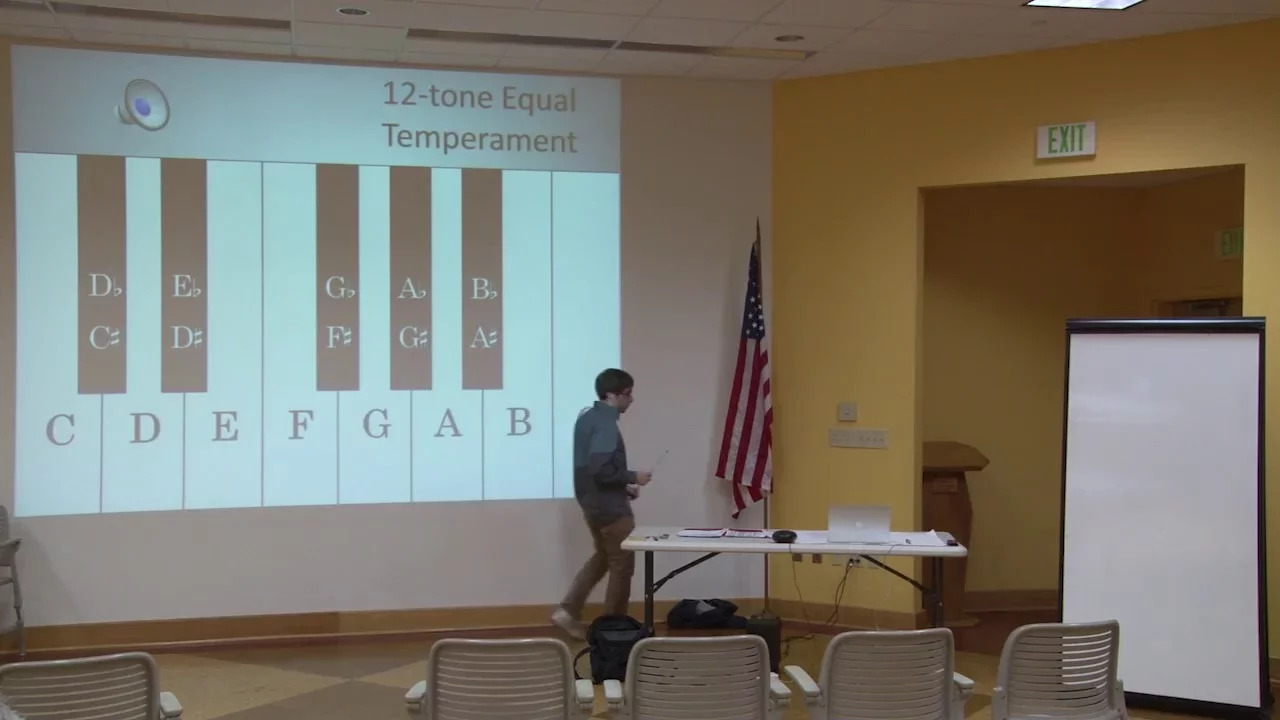
Finally we've reached the equal temperament, which is the temperament almost everybody has been using in western music since the mid 19th century. A key observation is that if we go up 12 exact fifths, and then down 7 octaves, we get almost exactly back to 1, our starting place. Just a tiny bit higher.
So if we slightly shrink all the fifths, we will return exactly to 1, after passing through 12 different notes, or more precisely, through 12 different pitch classes. So the idea behind the equal temperament is to divide the octave into 12 equal intervals. Equal intervals means equal ratios, so if we let r be the ratio between any two adjacent notes, we get that multiplying 1 by r 12 times should take us exactly to 2, or that r to the 12th power should equal 2.
So r is the 12th root of 2, which is about 1.06. We can write the 12th root of 2 also as 2 to the power of 1/12, and using this notation, the 12 notes of the equal temperament can be laid out this way.
The interval between any two adjacent notes in the equal temperament which is the 12th root of two is called a semitone. Now the fifth in the equal temperament is 2 to the power of 7/12, and it is only about one tenth of a percent away from the exact 3:2 fifth. Can you hear such a tiny difference? Let's see in the usual way. Is the second note lower or higher than the first?
The second note was lower, but it's extremely difficult to hear such a small difference, even for expert musicians under ideal conditions.
A huge upside of the equal temperament is that it allows perfect transposition of any melody from any key to any other key. And that's because there is the same ratio, our 12th root of 2, between any two adjacent notes. This is not only practically useful, for example for accompanying a singer in whatever key that fits his range, but it also freed composers to compose more complex pieces, which change keys in their middle. But there are also downsides to the equal temperament. Except for the octave, which remained at 2, all intervals of the equal temperament are off, relative to any of the other temperaments we discussed, and in particular, relative to Just Intonation.
We saw that the equal temperament has an excellent approximation to the just fifth, but things are not that good everywhere. The third note is especially bothersome, because it's almost eight tenths of a percent away from the Just 5:4 ratio. So one last time - can you hear this difference?
This time the second note was lower. It was the Just third, and this difference is relatively noticeable, so many musicians rightfully complain about the equal temperament third.
Another problem with the equal temperament is that around the baroque period, before it became popular, there were other temperaments in use, that also divided the octave into 12 intervals, but these intervals weren't exactly equal. That means that each key had a unique character, which is lost in the equal temperament. And some people today regret this loss.
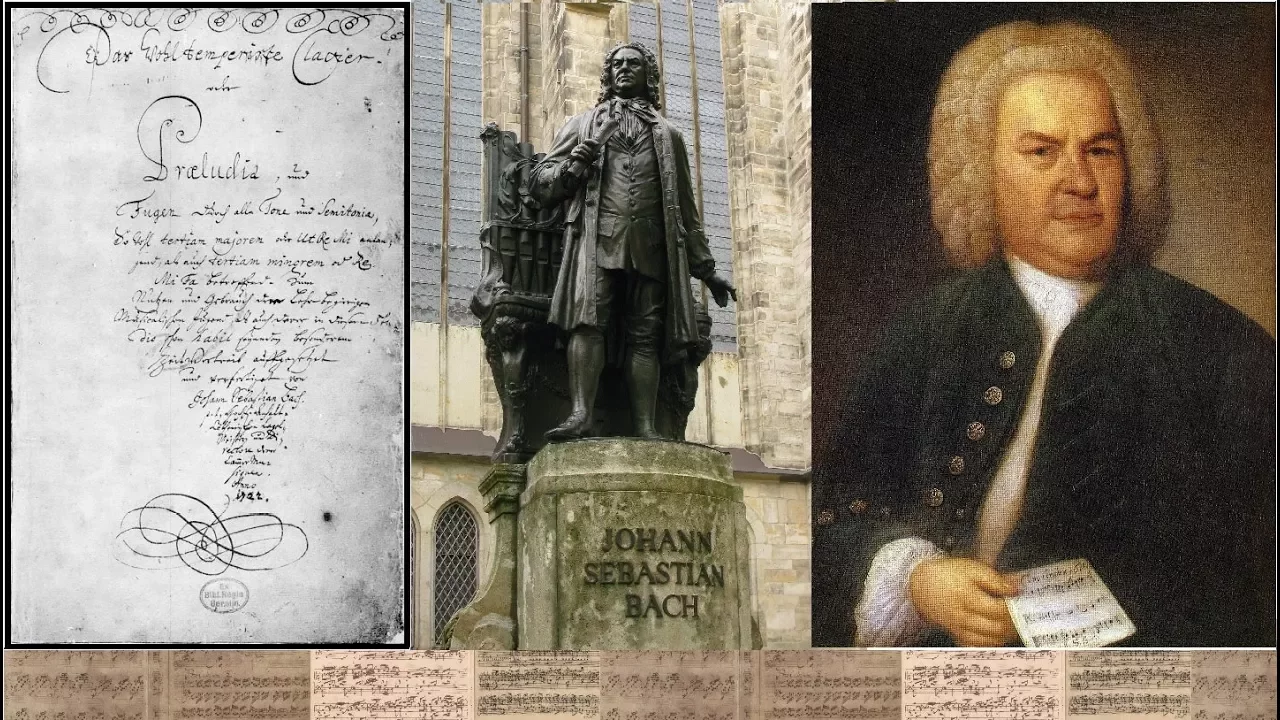
Bach's famous "well-tempered clavier" was probably written for one of these temperaments, and not for the equal temperament, as some people think. Let's listen to the first few bars of the first prelude from the well-tempered clavier, played in its original key and in equal temperament.
Try to hear the slight roughness that is coming from the non-just intervals.
Here is the prelude again, still in the original key, but now in Just Intonation, and try to hear how the notes blend more smoothly. Well, at least in the first and last bars, which contain the notes of a major chord.
Next, let's listen to it again in the two temperaments but now transposed to another key.
The equal temperament version still sounds only a little bit rough, because the equal temperament allows for perfect transposition.
But the Just Intonation version, which is played on a piano tuned to the original key, sounds absolutely horrific, because of the transposition limitations of Just Intonation.
The equal temperament is by far the most popular system used today and in the recent past, but it's not the only one. In the so-called historically informed approach to music performance, the musicians often use the temperaments that were common when the pieces they play were composed.
Arab, Turkish, and Persian music uses microtonal intervals, which are intervals based on a finer division of the octave, compared to the 12-tone equal temperament. A common approach to accommodate this, is to divide the octave into 24 equal intervals, called quarter tones, but not everybody in these musical traditions is happy with this strict 24 tone equal partition, and practices vary a lot.
Some music theorists and composers came up with other microtonal temperaments, and divided the octave to 19 equal intervals, 31 equal intervals, 41 equal intervals, and many other numbers, with various mathematical and musical justifications behind them.
A whole different approach to temperaments is to forget about equal divisions of the octave, and return to the pure integer ratios of Just Intonation. The Just Intonation network has been promoting this approach for several decades, and some of the problems of just intonation can today be overcome using modern technology.
There is plenty more to say about the math of musical tuning, but this is it for this video. Check out the description for links to further reading and further youtubing. Thank you for watching, and... stay tuned!
Up Next

Logic: Propositions & Predicates | Geometry of Physics 01
@FredericSchuller
455.1K views•2015-09-21
Elliptic Curve Cryptography Explained: ECC, ECDSA, ECDH
@PracticalNetworking
28.5K views•2024-10-21
Fourier Series Introduction: The Big Idea Explained
@DrTrefor
387K views•2021-05-03

The Mathematical Impossibility of Accurate World Maps
@Vox
23.3M views•2016-12-02
Related Study Plans & Knowledge Roadmaps
Structured learning paths in Mathematics