




![[Undergraduate] Contract and organization theory 2020.9.3](https://i.ytimg.com/vi/VJenWaAlxDU/maxresdefault.jpg)












![ЩО ТАКЕ ДИЛЕМА В'ЯЗНЯ? 🤔 [VERITASIUM]](https://i.ytimg.com/vi_webp/HnjVSCnPYCU/maxresdefault.webp)





In sequential strategic games where players take turns deciding whether to act or wait, the optimal strategy involves working backward from the end of the game (backward induction) to determine a critical point at which action becomes optimal, rather than simply acting based on relative skill levels or preemptive instincts; this approach reveals that neither the better shot nor the weaker shot should necessarily act first, but rather both should wait until reaching a specific distance threshold where the combined probability of success equals one, at which point the player whose turn it is should act.
Game Theory: Strategic Decision-Making Explained
Added:The concept of economic rationality, assuming that decision-makers act to maximize their own well-defined payoffs.
Fundamental components of a game, specifically the distinction between players, available actions, and payoff structures.
Basic probability theory and expected utility, which help in assessing outcomes under uncertainty.
How to read a basic payoff matrix or decision tree representing sequential or simultaneous choices.
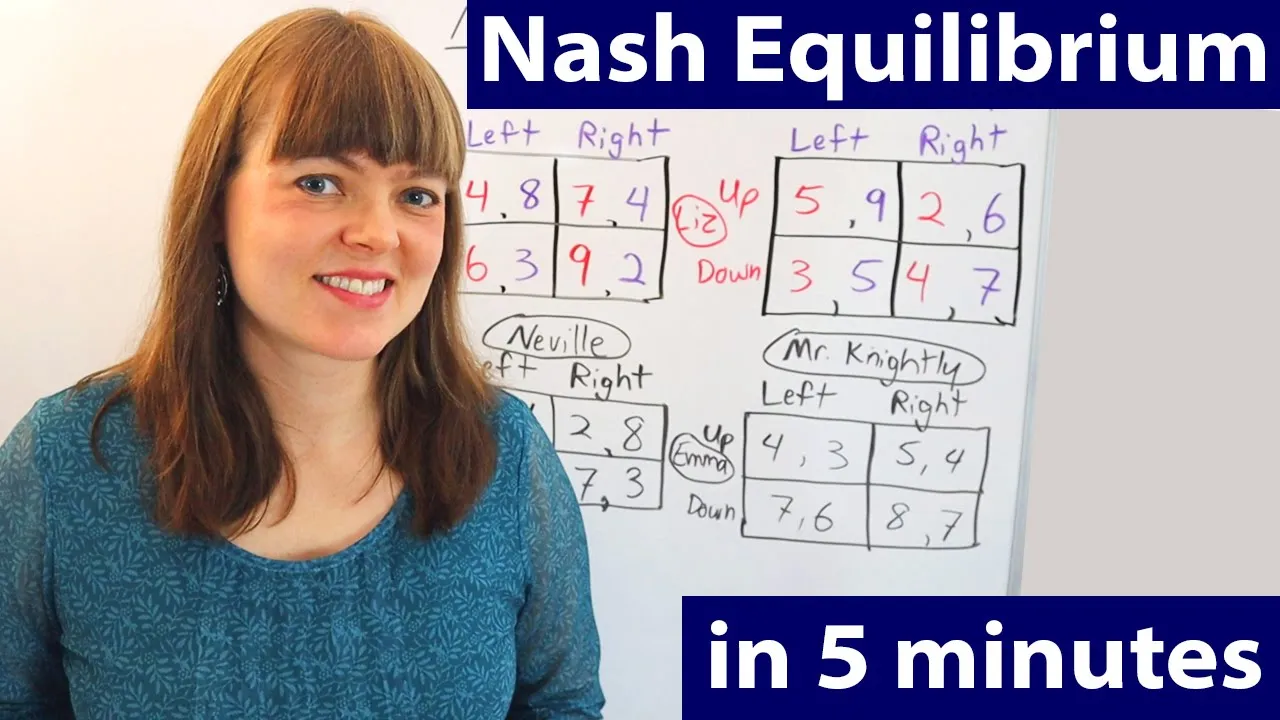
Nash Equilibrium, exploring how players arrive at stable strategies where no player has an incentive to unilaterally deviate.
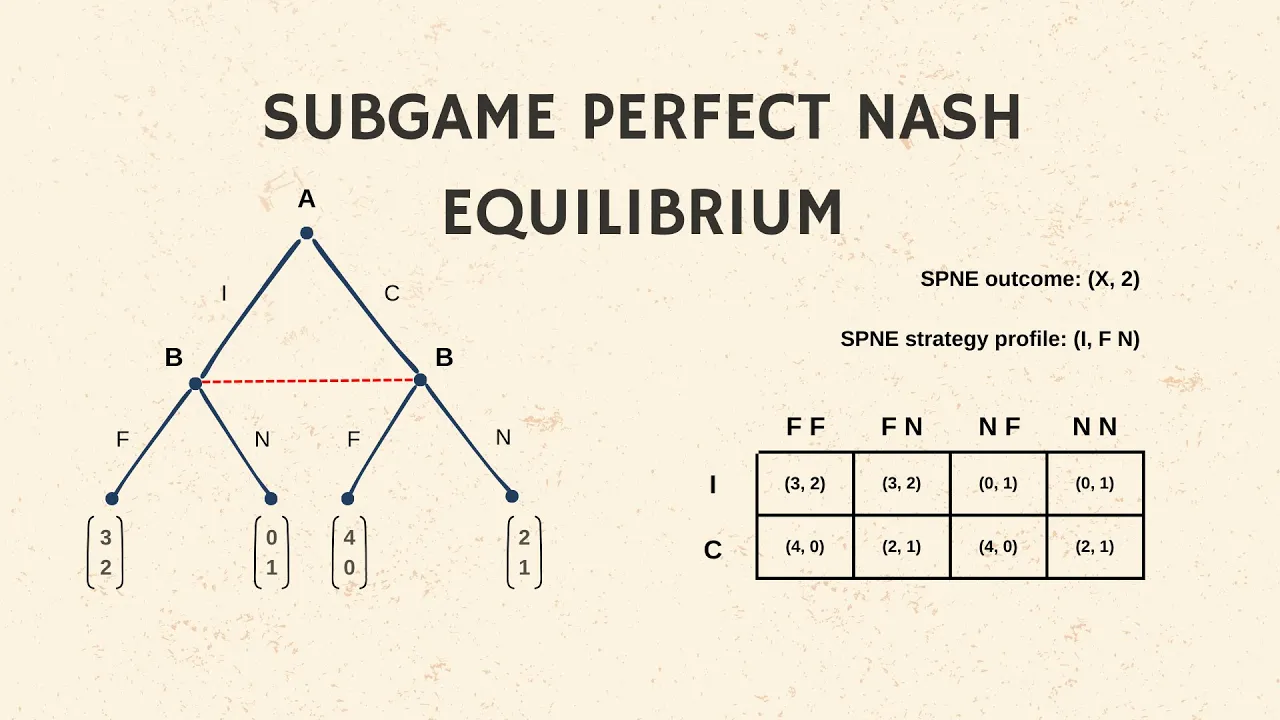
Subgame Perfect Equilibrium, applying backward induction formally to multi-stage games of complete information.
The analysis of repeated games and the emergence of cooperation, such as the Prisoner's Dilemma played over multiple rounds.
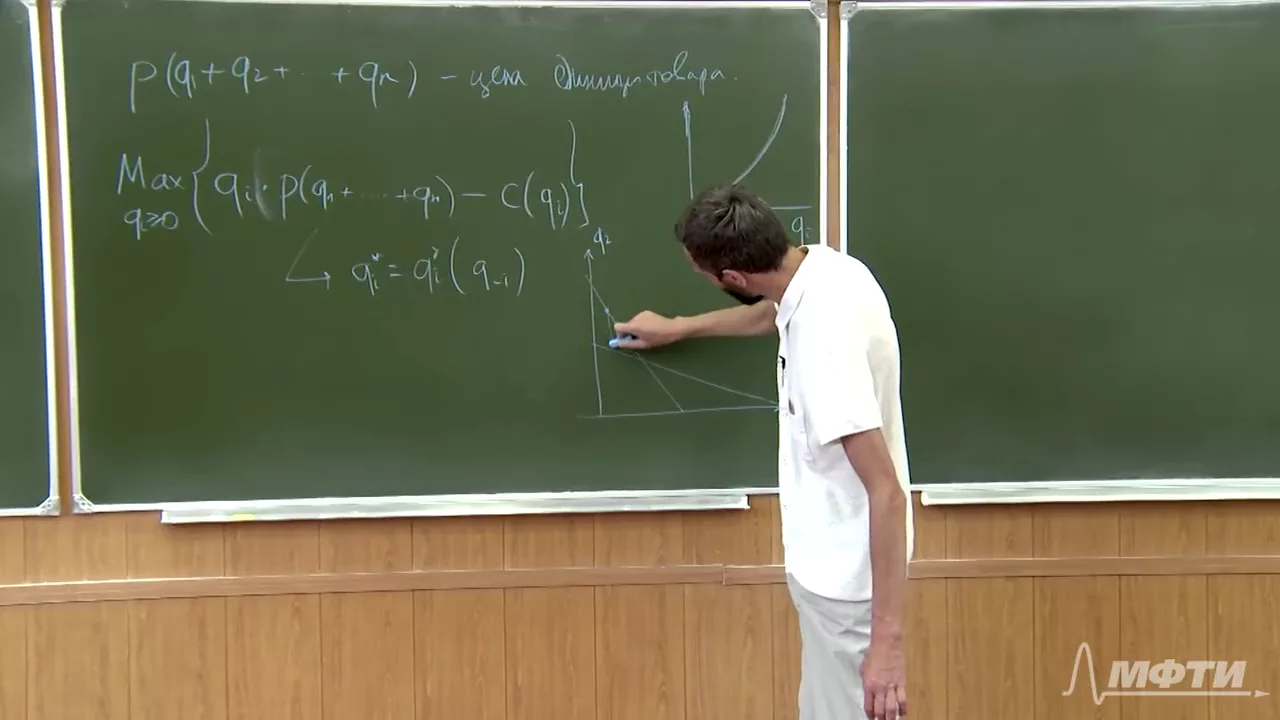
Real-world strategic applications, such as oligopoly competition models (Cournot and Bertrand), auction design, and evolutionary game theory.
670.2K views13.8Klikes1:07:08Original Release: 2013-10-30
uh I'm Ben poac I'm proost of Yale but in real life I teach economics I teach Game Theory um so I'm actually going to get rid of the jacket if you don't mind um and go back to my life as a professor for a for an hour um I've actually never given a talk in anything like this before uh kind of amazing Church a church with a small group of people in it make me think of the Church of England so that's probably appropriate for me we're going to talk about Game Theory um game theory is the analysis or a way of analyzing strategic situations so what are strategic situations strategic situations are any setting where the things that you care about the outcomes you care about depend not just on your own actions but on the actions of someone else all right so let's think of some examples but we won't stay along with examples uh in economics the an obvious example would be two firms who are competing in the same Marketplace so think of Apple and Google Apple and Samsung right they're both competing in the market to make uh telephones to make these things whoops just knocked off the mic make these things and they have various strategies available to to each other pricing quantity innovation suing each other bribing jewes whatever else they do all right so that's a game involving players where they're competing but it isn't only competition that we can model we can also model settings of cooperation so think about teams working on in the same firm or uh looking around the room groups of Deans and vice presidents of Yale who are working together uh to try and get things done so so game theory is also the way you analyze how to herd cats all right roughly speaking all right so when we teach game through at Yale uh what we do uh is we try to play games in class and we analyze them as a way of seeing uh you know teaching the technique but also learning about the game that's a technique of teaching that's now spread uh pretty much worldwide uh and it's what we're going to do today so today I'm going to play a game we're going to analyze that game we're going to play the game we're going to analyze that game and we hope I hope we're going to learn something as we're going along okay so that's what we're going to do um uh if some of you have seen this game being played online if you've seen my online courses uh and uh if you haven't uh a a plug in for looking at the L online courses not just mine but everyone else's as well so I need two volunteers for this and uh rather than embarrass people I'm just going to pick people out so I'm going to pick two deans who happened to be here who didn't know this was going to happen uh I'm going to pick Robert post who's here and I'm going to pick James Bundy who's there and I'm going to drag them out the front uh so so uh and the reason one reason for picking on these two deans is this is a day to celebrate Yale and uh Robert post is the dean of the law school uh which is quite simply the best law school in the world and he is quite simply the best Dean of the best law school in the world and James Bundy is the Dee of the drama school which is the best drama school in the world and he is quite simply the best Dean of the best drama school in the world so why don't we have a little plug for our our wonderful schools while we're here okay so the audience provides the volunteers I'm going to provide the props which in this on this occasion is uh two wet sponges all right we're going to have a sponge fight all right so these are the sponges and I'm going to wet them and this being Yale I will use nothing but the best I'm going to use Yale University spring water did you know that Yale University had a spring I don't and we're going to we're going to wet these and uh the people who who are custodians to this building are look away for a second cuz I'm going to dribble water on the floor and Bruce is back there and he's thinking the facilities bill is going to us so don't look for a second Bruce right and I'm going to squeeze these out and try and make sure they're roughly equal weight right so Joan are they roughly equal right yes okay okay so we have a blue sponge and a green sponge I'm going to give the blue sponge to James Bandy and I'm going to give the green Spong or post and a minute I'm going to position them at either well I'm going to do it now I'm going to put Robert here here here and I'm going to put James here okay I'm GNA move my coat out the way all right here we go so we're GNA have a sponge fight or if you like a duel and the rules of the game are this we're going to have alternating moves all right and when it's your turn to move you are going to have to make a choice and the choice is going to be whether to throw your sponge at your opponent or whether to take a step forward all right if you throw the sponge and hit your opponent you win if your opponent throws the uh in case his sponge and hits you you lose right simple simple rules we'll need a few specifications one important specification uh is uh well the most important spe is this each player only has one sponge and once they've thrown their sponge if they miss the game continues all right so we could work out the strategy this in great detail but let's not let's just realize what's going to happen so if you throw your sponge and you miss since you have to keep on stepping forward uh eventually uh the other player is going to be right on top of you and it's going to basically plon his sponge on your head right so if you throw a sponge and and Miss you're GNA lose all right but we will play that through and see what happens two other rules minor rules each step has to be about a yard right to keep things fair and this is a rule that I don't know will work in America but let's see uh gentlemen never duck okay all right all right okay all right so we'll see that okay so everyone understand the rules all right so we'll make James player one and robot player two I'm exploiting you rather I apologize but Dean's are meant to be exploited by provos get fit hit in the role so uh James you want to throw your sponge or or a step take a step take a step okay so so a step and now it's Robert's turn and he's also going to step and now it's James turn he's also going to step all right now it's Robert's turn step at this point let just pause a second and let's ask people what they think people should do so it's James's turn you can all see the situation one of the things we think about in game theory is how to put yourself in the shoes of other people so imagine you're in james' shoes right now would you throw or would you step step everyone step okay they're all saying they don't trust your arm I don't know I don't know how you are at baseball as a all right let's have the same question now for Robert who who thinks he should throw who thinks he should step step they don't really trust their the arms of the Deans okay all right all right and now yes yes are they allow Doge no dodging no dodging not allowed not all again gentlemen never do things like that this is a strictly gentlemanly game all right so uh James's turn who who thinks th it's James's turn who think who thinks throw who who thinks uh you should throw you think throw shano shano says throw who raise your hand if you think throw raise your hand if you think step well it's up to you don't know know we don't know that we don't know that we don't know and it's a pretty it's a pretty light sponge we we'll we'll get there we'll get there hold that thought but we will get exactly that idea right so so uh throw a step now what people think throw or step who who thinks throw now who thinks step now well well up to you get more even J throw or step who now it's have a poll again who thinks throw who thinks step it's interesting the people at the front are saying throw back got be a coincidence but but but uh you know David Swinson is saying anywhere on the body anywhere on the body D David is saying throw it he is the best judge of uncertainty in the in the room so is he on aerodynamic oh not about his aerodynamics we have to find out all right ready oh game continues uh sorry I assume going to step and step and step and step all right so uh why I get you guys to sit here for a minute because I'm going to use you in a second um all right so I'm going to victimize our our volunteers a little bit more later um let's talk about this game a little bit and see we can learn something from it and we were already begin to draw out some lessons there and we we'll draw out more as we go along so first why is this game interesting so one reason this game is interesting is uh it corresponds to a duel a duel with with uh uh with muskets I guess bit more serious than sponges and uh uh for the people in in the room who are Russian literature Specialists you'll know that there are plenty of duels in 19th century Russian literature a little bit in French literature uh probably the most famous I'm guessing are the one in War and Peace all right uh and the one one in anen the Pushkin one um or chaikovsky if you prefer that version uh there are many many others uh in the uh war in peace version uh there are other examples better examples oh yes up yeah better better more up okay higher higher better it's a big room is that better good okay so in the uh toy in the war and PE peace version I think we are led to believe believe that the hero Pierre throw not throw his on shoots his musket too early and he kind of gets lucky and kind of wings dollar off and and uh uh I know that's a spoiler alert I just but that actually happens about page that's about page 300 in the novel which means it's in the first half of the book right so there's plenty more after that uh in the uh Pushkin version anden uh anden kills lsky it's really the critical event of the of the poem um and I think the main lesson we should get from this for dueling is don't duel right rather than how a duel just don't duel but if you did find yourself in a time machine in 19th century Russia this might help but there's more to this idea than just duels there are games elsewhere where the critical decision is when to do something there are games when what matters is what you would do and there are games where what is matter what matters is when you would do it so in this game there's no question about what you're going to do you're going to throw the sponge but the critical question is when you would do it let me give an example how many of you have watched the tour France on TV a fair number of you actually surprisingly few but in the tourto France is a bike race right uh in the T of France in each stage of the Tor Frost one of the critical decisions that each Rider has to make is they have to decide when to try to break away from the palatin from the pack right and if you break away too early uh in these long stages uh for sure you're going to be reeled in because over very long distances the the paleton will go faster than you can go and if you break away too late then either someone else will break away or just one of the sprinters will win right so the key decision then is is is when to go not when to throw the spish but when should I break away there's even a movie American movie called breaking away all right so this is one of the main uh games within a game in bike racing it isn't the main game within the game in bike racing the main game within the game in bike racing is trying to figure out where to hide your steroids but this is this all right but this is important uh let me give you an e economic example uh in in or business example in business you can imagine two firms who are both developing a new technology and that technology could be a new way to uh uh uh book uh uh air tickets online for example a better way of doing that than the existing one so both companies are busy doing R&D and trying to perfect this new software or Hardware whatever happens to be and they have to decide when to launch uh their software and the problem here is if you launch too early when the thing hasn't been perfected yet it might not work correctly and you're not going to get a second chance right basically if it doesn't work no one's going to trust you and if you launch too late in this particular Market the market I mean you can think other examples but this particular market then the other guy will have launched already the other firm will have launched already uh his or her firm will have established a foothold and probably is going to going to end up becoming the standard and and being the whole market so this is an example of a market where probably at the end of the day there's only going to be one player so getting the critical foothold matters but if you go too early you launch too early you're going to not be trusted by customers if you launch too late someone else will have established them established the standard so that's about launching a product not launching a sponge but basically the math of it is the same all right so we're going to analyze this game um we're going to use um these to analyze the game uh and I'm going to do a little bit of work on the board but I I I want everyone to realize that when I say we I mean we so I'm going to help along but you're going to solve this with me okay so this is not going to be me lecturing that's what we do it yeah we get people to participate we just did so we're going to try and learn this together so just to get set things up before we do that let me just establish a tiny bit of notation uh and draw a picture all right so just a very simple bit of notation I'm writing kind of small I'm hoping it's going to be visible uh let uh P1 of D this is the only notation I'm going to use this is the only kind of mathy thing let P1 of D be the probability so I'll call that prob uh that one hits at distance D all right so I'm going to use p1d to say having to write it every time p1d is the probability that player one who I guess was who was player one was was James hits were he to shoot sponge at distance D and similarly let P2 of D be the same thing for player all right so I'm going to draw what I think these probabilities look like I'm going to use a picture all right we're going to use this picture for a while all right so the notation is not as important as the picture how low can I go before I going to lose the back of of the r oh higher higher okay is that okay Charles no higher still way high okay in that case I'm going to delete the Top Line and I'm going to everyone know what p1d is now all right I'm also going to push this back perhaps so you have little bit of angle of you to hold it up on the stage that better at all uh all right so let's try and do it right at the top here that okay is that okay Charles yeah okay good all right so on this axis I'm going to put D which is distance and on this axis I'm going to put probabilities and I'm going to make some assumptions about the way in which these probabilities of hitting depend on distance and at least two of these assumptions I think are inoffensive and the third one is offensive all right so uh the first thing I'm going to assume is that if you were at distance zero and you shot at distance zero what would what would be the probability that you hit if you shoot at distance zero one okay so one so that's an assumption but it seems a reasonable assumption so I'm going to assume that these probabilities start at one if we were at distance zero remember I'm drawing this as a as distance but of course the game is really going in this this direction right so we're starting far away and getting closer but I'm going to draw it with distance in the standard way going left to right all right so the second assumption I'm going to make is that as you get further away the probability of your hitting goes down right so the further away you are the less likly you are to hit if you if you shoot at that distance so I don't know it could look like it could look like this say right it doesn't have to be exactly like this I'm just going to assume it slopes downwards all right now I'm not going to assume that both players are the same here all right so it could be the case that the other person has a different shape curve that does this all right and actually for what I'm going to say today it wouldn't matter if these things crossed right but all I care about is that they're both downward sloping so in this case perhaps this one is P1 of D it's player one's probability of hitting and this is player two of D all right the way I've drawn it who who is the better shot player one or player two player two everyone okay that player two is the better shot because at any distance we happen to talk about were they to shoot at that distance player two has a higher probability of hitting they were okay with that so player two is the better shotting now again I don't need that assumption uh I just need them to be down and sloping it could be that player one is better at shooting at close distances and player two is better at shooting at long distances that's fine but we'll use this one today doesn't it w m all right so so far I haven't assumed anything particularly difficult I think here's the difficult thing I'm now going to make an assumption that's not real uh but I'm going to make this assumption so we can analyze it today in what is most of your first ever gain three lecture okay so I'm I'm going to make an assumption that's not true but will help us analyze it it's hard enough even with this assumption all right sometimes it's useful to make a simplifying assumption I'm going to assume that each player not only knows their own probability of hitting but they also know the other person's proberbly fitting so I'm going to assume actually I'm assum even more than that I'm going to assume that these are commonly known so I'm going to assume that player one knows their own ability they know the other person's ability and they know that the other person knows their ability and so on and so forth right so I'm going to assume that's all know all right so that's a big assumption but it's it's enough for today to solve all right I'm going to assume that these are known all right now imagine it in fact is the case that one of these players is known to be a better shot than the other player let's ask ourselves a question who should shoot first the known better shot or the known less good shot who should shoot first the known better shot or the known plk shot well um um who we are playing the game who should meaning uh normal you put them in their shoes if you put have in their shoes uh when you're in that person's shoes from that person's point of view who do you think should shoot shoes first who thinks the better shot should shoot first so hang on let's have a poll who thinks the better shot should shoot first raise your hand who thinks the less good shot should shoot first who is hedging their bets all right so uh let me try and talk it through so the people I'm guessing people who thinking the better shot should shoot first they're thinking something like this they say well the better shot has a better shot of hitting the other person at this distance so uh you compare two people at equal distance the person who's more to hit as the better shot so the better shot should shoot first don't know exactly where they should shoot but they the point at which they should shoot is earlier since the better shot all right and then the people on the other side I'm guessing tell me are thinking something like this they're saying well the other gu is a better shot than me so I better shoot first to preempt him from shooting me is that right and we could take this further then the the better shot could think hang on a second I know this is all known right so I know the other guy knows that I'm the better shot and therefore thinks I'm going to shoot first and therefore he's going to shoot first to preempt me shooting him so maybe I should move even earlier to preempt him from trying to preempt me all right and and we could go on with this discussion for a while and I think once we've opened up this particular Pandora's Box you can see it's not going to be that easy right it's not obvious who should shoot first at first it seems obvious got to be the B shot but it's not obvious at all all right so here's what we're going to do we are going to figure and I'm going to emphasize that word we again we are going to figure out who should shoot and we are going to solve this exactly we're going to figure out exactly when they should shoot all right so we're going to figure that out all right for for the physicist and mathematicians in the room and I can see some you know the answer already but pretend you don't all right all right so all right on the way I'm going to point out two ideas I hope I remember to do this that are more General than thus this game all right so we're going to work through this game but since I want to use this as an illustration for ideas you might use elsewhere in Life or when you're playing games or wherever I'm going to try and draw out two larger ideas as kind of take home things for you all right so remind me to do that if I forget okay oh I brought Pushkin with me somebody can have a copy of I was going to read it out but I guess we haven't got time all right so to do this uh we're I said we're going to do this so one of the things we're going to learn this is not one of my big General ideas that isn't a bad one one of things we should learn is when you have a difficult problem like this it's a good idea to try to break it down into some smaller problems because the whole problem just seems unmanageable so what I'm going to do is I'm going to break it down into two pieces see if we can figure out what to do in two kind of easy pieces and then use those pieces as building building blocks to try and get the general answer okay that's going to be my strategy here all right so the first building block uh we'll call it a building block a and building block a is going to be a question all right so uh so for both these building blocks I'm going to assume I don't write this bit I'm going to assume that no one has shot yet all right so assuming no one has I could write that top assuming no one has shot yet right then if player I knows at distance D say there they are at D that the other person let's call the other person J that J Will will not shoot or throw if you prefer uh next turn can I use the word tomorrow for next turn it'll save it save us having to write next turn every time we we we will not shoot tomorrow when it's player J's turn then what so your player I let's say you're Robert and you've got your sponge and James still has his sponge and it's your turn and for some reason you know you Robert know that James is not going to throw next turn assuming that no one's throwing it should you throw now or not no you should not throw right you should not throw why should you not throw now in that second you got a better chance next time right because if you knew that the other guy is not going to shoot next turn tomorrow then you're going to get a better shot The Day After Tomorrow doesn't mean you should necessarily shoot the day after tomorrow but you're certainly shooting the day after tomorrow is better than shooting now is that right everyone okay with that this this this is meant to be the easy fact let's make sure this one's this this is good y so if I know the other person's not going to shoot tomorrow I should not shoot now I should wait till the day after tomorrow we're good David we're good on that okay I'm checking because he's my teacher all right then do not shoot all right all right so that was fact a so fact B you can kind of guess what it's going to say it's going to say assuming no one has shot yet suppose that I knows at distance D that J will shoot tomorrow same thing with Will with Will with will not replacing will right so again suppose you're Robert no one shut the sponge yet no one's thrown the sponge and you for whatever reason you know that if you don't shoot now James is going to shoot tomorrow what should you do all right it depends it depends it does indeed depend what does it depend on depends on distance what else does it depend on okay so we're getting better than that depends on distance and the reason it depends on distance it depends on the probabilities and it indeed depends on who's the better shot all right so it's going to depend on all those things can we be more precise so that's right it it does depend on distance it depends on distance because the probabilities depend on distance and the prob is themselves depend on who's a better shot so it's right it depends on those things can we be more precise probility get stward close oh I guess you're 100% if he misses so second again he's an engineer doesn't shouldn't allow the engineers here that's right so okay so here here's the answer that's right so so what do you have to compare you have to Jo yeah go ahead true that that's a good point actually but but notice I've assumed I've assumed that I've done that here so the assumption that you know these curves means you really do know what these probabilities are so in some sense even we didn't play it that way we've assumed that you know the weight of the sponge so so here's our difference between reality and the Assumption so in reality James probably doesn't know his own ability or the weight of the sponge but we're going to assume for today that he does just to keep things simple all right so let's let's come back to that it depends again so what does it depend on if I throw now's State the question again before I answer it the question is if no one has thrown yet and if I know that you are going to throw tomorrow if I don't throw today sorry I know that you are going to throw tomorrow if I don't throw today what should I do that's was the question and the answer is it depends and they then it's what does it depend on well what do we need to compare we need to compare what happens if I throw if I throw then my probability of winning the game is the probability that I hit the other person all right if I wait knowing that he's going to shoot me tomorrow or shoot at me tomorrow then my probability of winning the game is the probability that he misses tomorrow is that right so I have to compare the probability of my hitting if I throw today with the probability of him missing if I leave it and let him throw tomorrow that make sense right compare apples with apples or oranges with oranges so the answer is then shoot or throw shoot if all right so let's let's use our notation Pi d That's the probability that I hit if I throw today is uh bigger we'll make it bigger than equal let's not worry about the equals for now doesn't really matter so we make it bigger than equals as for today uh uh p is greater than equal two the probability that he misses tomorrow and that's 1 minus P J D minus one because we'll be closer together tomorrow all right so this is the probity that I hit today if I if I shoot and this is the probability that if I wait if I don't shoot and he then shoots at me this is the probability that he misses tomorrow am okay that one minus makes it the probability of him missing and D minus one because we're closer together tomorrow all right everyone okay with that yeah somebody can wave if they're not it's okay it's okay to should I do it again Jo good good again yes on okay so this is the probability of winning by my hitting and this is the probability of me winning by his missing okay now I'm actually going to do some real math and I know that some of you are not you know didn't excel in math in college and pretty math nervous so this is the only actual math I'm going to do uh so those people are nervous can you please hold on to your seats underneath the cushions just for a second I'm going to add uh I'm going to add p J D minus one to both sides of this thing all right okay is that's the only math I'm going to do here okay okay so so this is the same as saying shoot if and only if p d plus PJ D minus1 is greater than equal to one okay everyone okay with that bit of math I just added something to both sides of an inequality yeah I know the physicists are okay with that I mean everyone else going to be hard to see in the last is that too is that going to be too hard to see so drag it back all right let's can people Charles can Charles can you see that up it need to be higher okay we're going to raise it up how much higher if it was here it would be okay okay so uh we'll just rewrite it uh shoot if and I'm going to rewrite this rearrange equation which is p D+ P J d-1 is greater than equal to one there it is Char okay yeah okay all right so what do we know now we know what you should do if you know the other person's not going to shoot that is to say you should step and we know what you should do if you know the other person is going to shoot which is you should shoot if and only if this sum is bigger than one let's go back to our picture let's put some steps in so these are very little steps because it's a very little picture I'm I'm not insulting the foot size of the Deans it's just you know I've scaled it down okay and uh let's see where would this be roughly so me just probably here guessing all right right so um let's ask the question when is this equality inequality met and when is it not met okay so at the beginning of the game when people are out here if we ask the question is P or p1d at the beginning P p1d plus P2 2 D minus one is it bigger than one is it bigger than one out here no it's small these are two small thing so it's it's going to be smaller than one on the other hand once we're in here once we're in really close the sum of these two probabilities is bigger than one okay everyone okay with that and there's going to be a critical point when for the first time the inequality switches from being incorrect to correct from being false to being true all right and we're going to call that distance D star all right so I I've already drawn it approximately here but pretend it pretend it's accurate right so what are we saying here we're saying this inequality which I'm claiming is going to be important but none of you know why yet I'm claiming is important this inequality is not met not met not met not met not met not met not met not met not met and then it's met met okay okay good so now let's CL make a claim and then prove the claim so I claim that the following is true I claim that nobody should throw their sponge until D star but whoever's turn it is at D star should throw and were it to be the case that they didn't throw at D star then the next person should throw at D starus minus one okay so so here's my claim nobody throws before D but at D St you throw whoever it is okay that's what we're going to try and convince you try and convince you that that's true all right to convince you that this is true we're going to use these two facts and these two stooges all right so so I'm going to bring my Stooges up again and convince them we're going to if this was ESPN we would be playing things in slow-mo I don't have actually in the drama school they probably have that but I don't have slow-mo in here so we're going to play slow-mo in kind of uh imagine slowmo here we are back back at the beginning of the game and we're going to do slow-mo and here we are who first I forgotten so James was first he's player one and he is thinking what should he do should he throw or step now we know the answer but let's just walk through it slowly all right so James can think the following way suppose suppose Robert was not going to throw next go suppose it's the case that Robert is not going to throw next go then which fact should he use should he use fact fact a or fact B A and what would his conclusion beep step okay that's one thing that Robert could think uh so one thing that James could think but the other thing James could think is he could think suppose Robert is going to throw next turn right so if James thinks that Robert is going to throw next turn then he should use fact B and the conclusion should be well he if he's using fact B James should throw if his James's probability today plus Robert's probability tomorrow there it is I've just draw those lines is bigger than one is it bigger than one no so he should step so in this case whether James thinks that Robert is going to throw tomorrow or thinks that Robert is not going to throw tomorrow you arrive at the same conclusion namely you should step and therefore you should step okay so all right all right so let's do this once more in Robert's shoes but you'll see the same idea so I'll do it faster I can speak fast uh here's Robert Robert is thinking what James is going to do if Robert thinks that James is not going to throw tomorrow then by fact a Robert should step and if Robert thinks that James is going to throw tomorrow then should use fact B and look at these lines on here and say Throw if this line plus this line is bigger than one but they're not bigger than one they're smaller than one and therefore either way he should step so he should step okay everyone okay with that argument okay okay so just I I promise I'd point out some things I'm going along that are more General lessons right so the thing we just saw was an example of what's called a dominance argument a dominance argument says if I think a if I think I don't use a if I think P then I should do X and if I think not P then I should do X therefore I should do X all right dominance arguments pretty straightforward but people get them wrong okay so so if if you do the same thing whether P or not p is true then you should do that thing okay if I had time I'd give you examples of movies where they don't do it but never mind okay so all right so fine so so Robert should step and then James will go through the same argument it'll still be a dominance argument so he should step and then Robert should step we're going to go in fast motion for a second uh and this will go on being true until we get to about here come come come come come come come stop okay okay so here they are so we're going to get so we're going to get uh not shoot not shoot not shoot not shoot not shoot not shoot not shoot not shoot not shoot not shoot so uh let's see two one two one two uh so uh uh here we are finally at D start all the way through this argument including the last step which was which was uh James's argument at D Star Plus One the dominance argument said no matter what I think I should step so I step now however we arrive at Dar and here's Robert at Dar and Robert's thinking through the same reasoning so here we are we're in Robert's head this is a good head to be it I i' read some of stuff so managing yourself in Robert's head and Robert is is putting himself in James's head trying to think this through and Robert is saying if I think that James is not going to shoot tomorrow then I should use fact a and that tells me not to shoot today but if I think that James is going to shoot tomorrow then I should use fact B and this time for the first time when I work my way through fact B it tells me I should shoot today right because I'm at D star so now these two arguments are pulling in opposite directions if I think the other guy isn't going to shoot I should step if I think the guy is going to shoot uh then I should shoot so I'm stuck I'm stuck all right so it was easy up to now we had don't shoot but now we're at D star now if Game Theory could say nothing other than these dominance arguments you probably shouldn't take my course all right so it better be the case I've got some way out of this dilemma this is a dilemma but I way out of it so here's here's how we're going to get out of this D we're going to figure out remember we're in Robert's head all right echo in there right we're in right here we are it's like a church right so in Robert's head we're going to try and remember this dilemma would be solved if Robert knew what James was going to do tomorrow so we're going to work out what James is going to do tomorrow but we're not going to do it as was suggested just now uh uh by by by Mr Mor by just taking one step forward we're going to take lots of Step forwards in fact we're going to go to the end of the game so what's the end of the game The Last possible step in the game so come forward come forward no one shoots no one come come come on personal space but further forward all right okay all right so this is the end of the game all right no one shoots no one shoots no shoots eventually they're on top of each other their noses are touching it's uncomfortable all right all right okay and here we are at the end of the game and this turns out to be Robert's Turners again and so if Robert finds himself at distance Zero from James if we get here what should Robert do sorry yeah what should Robert do he should shoot why should he shoot because he's going to hit with probability one so he should shoot is that right all right so that was easy so if we get to this stage Robert's going to shoot let's go one stage back in time no no no no it was must have been his turn it's your turn now so the previous turn must have been James's so James is going to go back in time okay so here we are one now we the distance one apart by the way we had a shoot here right can now their distance one apart and it's James's turn and now what does James know that Robert's going to do tomorrow if James doesn't shoot he knows we just put it on the picture he knows that Robert is going to shoot and therefore James should shoot he should make that decision based on fact B is that right James knows Robert's going to shoot tomorrow so James should shoot if his probability of hitting now plus Robert's probability of Tomorrow is bigger than one and since Robert's property on his own is one for sure one plus something is bigger than one that was another second bit of math I lied okay there two bits of math in the course right so one plus something is bigger than one so he should shoot is that right right so so James you would shoot at this point right all right so so now let's go back one more stage so now so here we are now we're at stage two two away all right and now we're in Robert's head and what does Robert know what does Robert know he'll shoot he'll shoot and therefore what should you do shoot right because why why should you shoot because you go through fact B and you find the some of the prob is bigger than one so he should shoot so let's go back to another step all right and here we are at stage uh one two three here we are at stage uh uh three which is actually our D star minus one here's James this is what we were worrying about right right so what does James know at distance three what have we just worked out he knows that James knows that Robert's going to shoot and so James should use fact B and using fact B he should he should shoot okay so now let's go back one more stage and now we're back where we were where our dilemma was now we're back at D I've worked my way back to DAR and but what's difference now now when I arrive at Dar from the end remember last time I was at D star I had a dilemma in Robert's head because I didn't know whether James was going to shoot or not but now I do know what he's going to do what's he going to do and therefore what should you do there we go so we've just we've just shown we've shown that at D star Robert shoot in fact what have we shown we've shown until D nobody should shoot but at D and if you get there any stage afterwards you should shoot all right so thank you to my my two doas again sit them down again thank you you can go just seat thank you all right thank you you expect them to be great actors and great interpreters of the law so that's that's good this is the the law of Game Theory all right so what did we just show let's just make sure we understand what we just show we show that what I claimed we showed that no shot should occur until D and that at D which of course depends on people's abilities but at the star whoever's turn that happens to be should shoot and we use two big Ideas I didn't point out the second one so I forgot so I'm going to do do so now the first big idea was this dominance idea and the dominance idea was if you if if in circumstance P you should do X and if in circumstance not p you should do X then you should do X right I'm saying that adamantly because it seems obvious right and that was one big idea and the other big idea was when you get stuck in this thinking this way a really good way to solve out a game is to go to the end of the game and work backwards right it's good to anticipate what people are going to do and the best way to do that is to go to the very end of the game and then work yourself back forward again all right now that idea is called backward induction backward induction and backward induction is the most important thing you're going to learn if you take a game through class it's hard to do actually it's hard to do because it's hard to make yourself do it it's hard to have the Instinct that I really should work backwards and not forwards time works forward right our logical way of thinking works for forward but when you're trying to play a game with somebody trying to put yourself in other people's shoes whether putting yourself in your shoes TR to anticipate what they're going to do while they're anticipating what you're going to do it's easier to work backwards so backward induction combined with dominance tells us when we should shoot here all right so let's just go back to the beginning and just make sure we understand the game before we draw out any more General lessons people okay at this point have I you don't particularly look like deer in the headlamps which is a good sign say I haven't lost too many of you is that right good okay so yeah it always happen that when you get stuck that if you reason from the other end yes yes it's because if you look at those inequalities it's monotone so I'll show you after but basically as you get closer both people's probabilities are getting higher always so that pair of probabilities you're always you're always going to cross one out and replace it one of them will survive and the other one get will will be crossed out with something bigger so once you cross D star once you cross this inequality you can't go back it's it's it's it's it's a strictly mon sequence that was a physicist asking the question so I assume I answer is in the appropriate language okay all right good so okay so what do we show we showed that it isn't as simple as asking should the better shot shoot first or should the worst shot shoot first and it isn't even a question of preemption and preempting preemption it's a question of understanding both probabilities working the thing backwards and finding out that there's a critical moment to shoot now be careful here I'm not saying that that critical moment to shoot doesn't depend on abilities it does depend on abilities so it's very tempting to say look a critical point to shoot here and this corresponds to when you see the white in the other person's eyes not quite true right CU you know when you see the whes in other person's eyes depends on your eyesight and when you should shoot depends on both your abilities right so so I'm not saying there's a unique time to shoot but I am saying it isn't a question of who the best shot is it's a question of both abilities put together now let's throw in some dust let's make this harder all right so we now all know that if you're playing this game you should shoot at D if you knew everything you knew and if you taken the course but you might say that's fine but in in it's fine if I'm reasoning I'm playing this game against another person who's in the room who's taken the course but what if I'm taking the what am I'm playing this game you know it's life and death it's it's nen and lsky uh neither of them took the game three class it's as far as I know they didn't take the game three class I'm looking around for a Russian scholar I see a German scholar but not a Russian score so but as far as I know they hadn't taken a game three class before the beginning of a all right so and you might might think what if I'm playing against somebody who's a little crazy right so what if I'm playing against a crazy person right I could be I may have gone to Yale but I could be playing against somebody who went to Harvard right who who never had a chance to take a decent game three class and so so um how would it how would it change our argument if I thought the other person was a little crazy let's still assume that we know each other's abilities but now I suspect the other person just isn't capable of reasoning through in the way we just did how does that change the argument would that make you shoot earlier would that make you shoot later would that make you you think good good so even if you're playing against a crazy person even if you're not confident in the other person's rationality or even not confident in the other person's confidence in your rationality or any other statement of that form which is often true in the real world even in that circumstance where you don't know you're playing against a sophisticated person it doesn't change the argument it doesn't change the argument in here it doesn't change this argument and it doesn't change that argument because that argument was a dominance argument that argument said I don't care who I'm playing against whether I'm playing against a Yale student or a Harvard student I don't really care if the person's human right the person could be a Ballard for all I care right all I care about is whatever is going to happen I should I should not shoot therefore I should not shoot right that right so in in the first part of the argument the dominant part of the argument there was no interesting thought of the form if the other guy is rational and if the other guy knows I'm rational like that it was just a dominance argument it's incredibly robust argument right but in here while we were doing the backward induction argument there I was thinking the other guy is rational and I was kind of thinking that he can figure out that I'm rational or that he can figure out that I can figure out that he's rational or she right so it's used he and it easier so uh in in this piece of the argument Robert at D Star had to figure out what James was going to do at darar minus one and that argument required him to have confidence that James would figure out what Robert would do at D star minus 2 etc etc etc so not did it require thinking the other person putting myself in the other person's shoes and thinking they're rational it required putting myself in the other person's shoes while they're putting themselves in my shoes and they know that I'm rational and so on so forth right so the backward induction argument is much more um fragile to irrationality right so lorri sanis gave a talk yesterday about irrationality which is an incredibly important topic these days you know it's possible that on Monday they might give the Nobel Horizon economics to Robert sh which be very nice who's worked on on such topics in finance irrationality here doesn't affect this part of the argument it does affect this part of the argument all right now nevertheless nevertheless the fact you should not shoot before here is a pretty strong argument right because frankly by the time you figured out the other guys's irrational it's too late you don't really care if he shoots early here you're perfectly happy if he shoots early here all right so this argument this particular example even if I think the other guy isn't rational I shouldn't shoot before d now let's push that idea further I've played this game in class with undergraduates I've played it in U my business school class with business school students I've played it with parents I've played it with alumni I've played it with Deans uh and uh uh so I have some idea about how people do on average in this game now assuming that people are following the reasoning I just said and assuming that ability is distributed roughly randomly and also making this somewhat unreal assumption that people know each other's opposes how often should I how often do I expect to people how often do I expect to see people hit on average well D could be the weaker person shooting it could be the stronger person shooting if it's happening at D star one is uh the sum is one all right so what's on average on average how many hits should I see 50% right so if I get a large enough sample there's a bit of hand waving in that argument someone was going to point out allowing me a little bit of hand waving right for discreet versus continuous roughly speaking 50% should hit I see far fewer than 50% massively fewer than 50% I would say I see 10% hits why why do I see 10% hits when the when we just agreed that even if everyone's crazy and irrational no one should shoot between before D star and D star is telling us that half half the shots should be hits why do I see such a low hit people aren experienc people aren't experienc although that might make them shoot later I mean you know in some sense right so I think there's two things going on let me take them in turns this one first overestimate so I think I think people do two things they they overestimate their opponent they also overestimate their own abilities all right so there's a well-known psychological bias that people overestimate their own ability to do something they probably also overestimate the other person but they certainly overestimate their own ability things so there's an overconfidence bias and there's stacks of literature on the overconfidence bias right so if you if you Google overconfidence and start reading papers you can be there a long time right so it's pretty well established that people are overconfident in their abilities amateur golfers will try that shot which they've seen Tiger Woods do where he slices it between the trees right and I don't play golf but I'm told amate golfers are never going to hit that sh all right uh I don't actually I don't know the answer to that Meg it's possible um uh there probably is a literature on that because almost all these things have been tried uh uh uh with uh gender in there uh if I had to has a guess I would say men are more over confident but I don't know the data so I without seeing the data I I have the same suspicion you have so one thing is overom that's a well-known bias I think there's another thing going on here and I think it's going on specifically in America and I think is is what's going on is another thing going on here I think that at least in America there is a thing I want to call the proactive bias right people like to be proactive when your kids in America you are taught that being proactive is a good thing I know this because I have kids I have a 10-year-old and an eight-year-old I have a one-year-old too but he hasn't gone to school yet my 10-year-old and my eight-year-old both of whom are girls are being told uh uh being proactive is good seizing the bull by the horns is good I also have more evidence about this so just to make it clear being proactive would be throwing the sponge rather than letting things happen to you right so people think being proactive is good and you see this on on Sports Center for those people watch sports center you'll see these guys in the sweaty um usually it's guys it could be actually I don't want to be sexist about this think it's males or females they're in this s sweaty locker room afterwards and they make this statement and they say uh it's great because we control our own destiny and coming from England controlling my own destiny just kind sounds kind of scary to me I have to say if if if I wanted to control my own destiny I wouldn't have got married I didn't say that I didn't say that so I I worry that this proactive bias causes people to throw the sponge too early right that that taking the bull by the horns sounds like a good idea but when you think about it running away is an awfully better idea right right so uh if I have one last lesson for you other than you know the takeaway lessons from today's today's talk go through them one is dominance arguments I won't R what they are the second is backward induction sometimes it's worth going to the end of the game and working backwards and the third is this and it's really just for the Americans I think the Europeans in the room don't make this mistake and that is this the point is not to go down swinging the point is not to go down I'll leave it that I'm done I can take a few minutes questions but I want to make sure you get me make it to the next talk so I won games I have solved completely if the opponent is Gandhi then I know he won't sh that's right so Gandhi you just wait and plunk it on his head the question yeah so the question was what if you're playing against Gandy right so gandi is not going to shoot you cuz he's a saint so if you're were going to win the game and you are so inclined and Shan is a cical kind of guy he just wait and plunk the sponge on Candy's head an image I'm now going to have when I go to bed tonight do I like the casino I never go to a casino um um um I yeah I don't really like Ian out of interest I'm not a big Casino Player I kind of like playing cards casino I mean roulette wheels seem a little bit too random to me but I I also I worry a little bit about irrationality in the casino so I had a student once who was studying uh behavior in uh not not roulette but in uh 21 Blackjack thank you and and and it turns out that people do exactly the wrong thing there uh they they uh um what do they do uh they um they quit when they're behind uh rather than quitting when they're ahead and it turns out since you since you use five packs and so random sample if you've been doing well you know any sensible updating will say you're going to do worse in the future and if you're doing badly you're actually going to do better there's actually a regression to the mean so people do exactly the wrong thing and I'm scared I would do the wrong thing too and and my wife would not like it are examples of nature yes it's a good question it's a very good question so the question is can we see games like this in nature so let me as as like a politician let me answer a slightly different question we come back so so so uh game theory is enormously used now in biology in in behavioral biology it's it's a major tool and uh it turns out that there are wonderful connections between the game theory we developed in economics uh and Notions of equilibrium in economics and Notions of evolutionary stability in in in in uh in biology and uh they're not exactly the same idea but one is kind of a sub of the other and uh what you can do uh in evolution biology which is kind of cool is if you if you know the basic form of a game that a particular uh species is playing be careful because the actors now aren't rational they're it's Gene selection but still if you know the form of the game but you don't know the exact payoffs of the game you can actually uh look at the behavior look at the behaviors you see in the population and back out what the exact payoffs must be which is a lovely example example of what's called identification in economics right so so biologists do incredibly cool things with Game Theory actually at this point they do cooler things than frankly economists do with game three it's really cool now this particular game I don't know there's some biologist in the room I'm looking at Tom I I don't know exactly what game this would correspond to in nature but there are games that uh a better example for nature is the game rock paper scissors and the rock rock paper scissors so rock paper scissors everyone know that game rock paper so rock beats uh scissors and scissors beats paper and paper beats rock that game right so rock paper scissors is a nice little zeros some game that you can find examples of that look a lot like that in nature and you can twiddle them a little bit so not exactly Rock pus is and they actually have no evolutionary stable uh point and you can show in examples of that uh Cycles occurring in in populations of actually the most famous example is uh uh tree lizards uh and meeting behavior of tree lizards and you can show you can predict out from those Cycles what the exact payoffs of the rock paper scissors game they were playing was so you can do really cool things in biology with this but Tom knows more about that than I do so I'm going to I'm going to I'm on dangerous territory Tom do you want to comment ah how do I use Game Theory in my day-to-day work as a Provost I I um yeah so it's a good question so I I I I do a little bit I mean I think I think I've been doing this so long that it's kind of hardwired for me to think this way so I do tend to lay out things and kind of work them backwards and I do tend to sort of try to go down one branch of the tree at a time and see if they're all the same if there's a dominance argument there I can see a hold of but also a large piece of Game Theory as applied to economics or to organizational behavior is the theory of incentives and as you well know Tom is the dean of the graduate school he's a wonderful dean of the graduate school and he steers the graduates in a wonderful way uh some of that is about incentives that's the game theory part and some of it is about your relationship with the grad students which is more the psychology part so I'd say Peter and I have the combined have the skills but Peter has the more important skill from me and well in this example you use you know the shape of the the skill curve that each play yeah but let's say I go in the game and I know my skill curve but I don't know my opponents now my opponent may have a average skill curve may have a highly skill curve may have skill curve right how do I develop a strategy good good so so it's it's harder but not impossible so it's harder because now we'd have to think about the population of skill curves out there and I I I want to be a to think of my opponent as being drawn perhaps randomly drawn from some population of skill curves and uh so I'm going to have some I'm going to index each skill curve and I'm going to take I'm basically going to take expectation at every point in the game over those skill curves so essentially the reason I didn't do it here is I need to carry a whole bunch of integrals and I'm taking I'm taking distributions over curves which is a messy thing to try and do but basically the basic idea is still the same I'm there's going to be I'm going to be carry some expectations around uh because now I'm not now it isn't that I know what the probability of this guy hitting tomorrow is it's that I I I know only the expectation of that I know with expectation what that what their probability of hitting is if they were to shoot tomorrow uh so that means that the math is a little harder but the basic idea of looking forward and working it out is still runs through I I'm I'm underselling the math a little bit uh because not only do have to worry about the distribution of the distribution of skills out there and worry about taking expectation over those skills but that distribution is going to change as the game progresses I'm going to be able to infer from the fact that the guy hasn't shot yet that he's not a skilled as I thought he might be right so that distribution you think about some bell-shaped distribution of skills where these are the High skills and these are the low skills some of those High skills are going to I'm going to be able to conclude that they're not in the game as the game proceeds when I see the guy not shoot so I have to but so I have to keep track of all that stuff I have to do B in updating on this distribution I have to get some expectation and so on but up to a lot of kind of math nice math but out of math the basic reasoning still goes through that's so so the reason I didn't do it here is you can kind of hear there's a lot more math involved but it's going to be okay well doesn't it change if if it's a life or death game my objective is don't lose that's let and it great if you don't win it yeah so so doesn't that change my my it actually so that's an interesting point so so in this example if there's just two monetary prizes one for winning and one for losing and the winning one is strictly better than the losing one then it actually doesn't change the strategy in in in this simple game but but that's too quick an answer imagine there's three outcomes imagine there's an outcome uh so imagine the game is not is being played not exactly as we played it with sequential moves but with simultaneous moves right so in each period people simultaneously have to decide whether throw or not right so now a third outcome is in the game now there's the outcome win there the outcome lose and there's also the outcome both Miss tie or Draw right now now it's more complicated why is it more complicated because when there are three outcomes we have to take into account things like risk aversion just as we would the many money outcomes if there's only two monetary outcomes or two outcomes this analysis is fine but as soon as we go from two to three we have to start worrying about risk aversion and things like it again kind of in David's territory we have to do a little bit of of what David does for a living to solve those things but it's it's a great question yeah proba make this the last question because you have other talks to go to but sh distinguishes among three levels odd relation thech very illustr TS to be fragile so the amount of on a lot exista yes I agree with that I of course this is appology so we're talking to a sociologist now as you can hear so uh I agree with that so so by the way today was high church because well look around you so uh so what are we thinking so so so what we're doing in in mathematical economics or the more mathy end of the social sciences is trying to tease out our intuitions and trying to tease out how different assumptions lead to different conclusions we are not and you're absolutely right we are not trying to say this is a tight prediction of what's going to happen some things will be pretty robust this this argument about dominance is pretty robust right but most arguments are not that robust and one of the things we have to do in in in in most areas of theoretic economics but the same is true in theoretical areas of sociology is we need to tease out exactly what are the assumptions we're making and would these results be robust to changing them so the great thing that and this is not the most inspiring things to end on but I'll end on it despite that the Great thing about doing mathematical social sciences which I I guess is what I've done in my career is is it allows you to think through a kind of thought experiment rather than experiment it says I can't really um so I'll be having some discussion let's say with my wife who's an English professor and she'll say yes but you've assumed this this and this and it allows me to say okay you're right all those I did assume this this and this a b and c but look the argument still works if I drop assumption a the argument switch is exactly at this point if I drop assumption B and if I drop assumption c yeah you're right the whole thing's completely nonsense right that's a great conversation for uh scientists and humanists or in this case social scientists and humanists to be having it shouldn't be a hostile discussion it's a discussion about focusing in on the details of an argument it's a great Yale scholarly thing to be doing and Martin schik did it much better than I ever will he's a Yale Professor one of the founders of Game Theory there are many people around Yale doing things better better at that than I will but you have a chance to see some of more some some more of them later on this afternoon so thank you for coming uh and we'll see you later on this afternoon thank you
Up Next

20:05
Game Theory: Dominant Strategy & Nash Equilibrium Explained
@nishantmehraecopoint
23.4K views•2021-05-23

5:07
Impact of Yuan in Indo-Russian Trade Amid Sanctions
@WION
261.9K views•2022-07-01

71:32
Monetary Policy Explained: Central Banking & the Fed
@YaleCourses
249.5K views•2012-04-05

113:18
The Age of Easy Money: Fed & Inflation | Full Documentary
@frontline
21.2M views•2023-03-15
Related Study Plans & Knowledge Roadmaps
Structured learning paths in Economics
economics
Sovereign Debt: Defaults, IMF & Restructuring
01Introduction to Sovereign Debt & Government Bonds
02Debt Sustainability & Credit Ratings
03Anatomy and History of Debt Crises
+ 2 more learning modules
12h5 modules
Explore Roadmap
economics
Market Design: Matching Theory & Gale-Shapley
01Introduction to Market Design and Price-Free Markets
02Two-Sided Matching & The Gale-Shapley Algorithm
03School Choice Systems and Mechanism Design
+ 2 more learning modules
10h5 modules
Explore Roadmap
economics
Impossible Trinity: Forex, Capital & Policy
01Introduction to Monetary Policy and Central Banking
02Exchange Rates and International Capital Flows
03The Mundell-Fleming Model
+ 2 more learning modules
8h5 modules
Explore Roadmap
economics
Healthcare Economics: Market Failures & Systems
01Introduction to Healthcare Markets and Market Failure
02Asymmetric Information and Adverse Selection
03Moral Hazard and Insurance Design
+ 2 more learning modules
12h5 modules
Explore Roadmap