


![МАТЕМАТИКА МОЖЕ ВРЯТУВАТИ ВАМ ЖИТТЯ 🤯 [VERITASIUM]](https://i.ytimg.com/vi/c6zxT14L-G8/maxresdefault.jpg)












![[Pedagogical Lectures] Knots and Quantum Field Theory-II](https://i.ytimg.com/vi/XCWqCuU3_D8/maxresdefault.jpg)



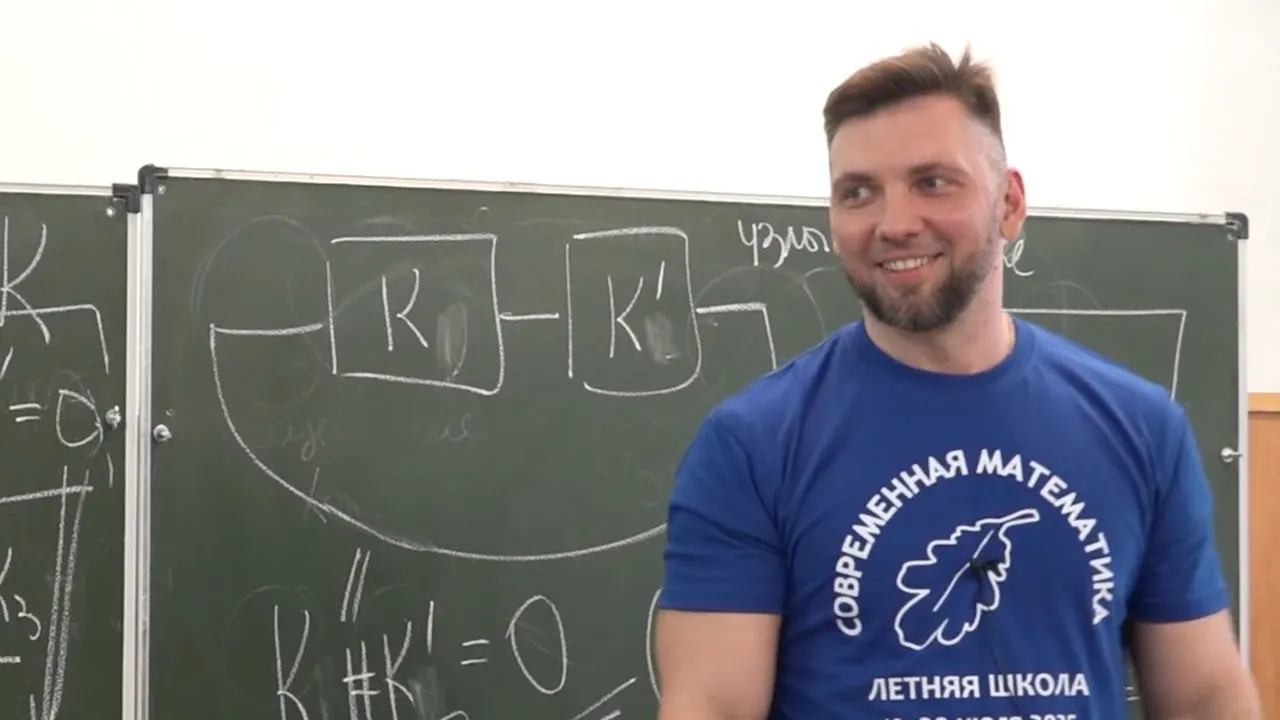
In knot topology, two knots are considered the same (ambient isotopic) if one can be transformed into the other through Reidemeister moves (three basic manipulations of knot diagrams: twisting, crossing over, and sliding). While Reidemeister moves provide a theoretical framework for determining knot equivalence, they offer no practical algorithm for distinguishing knots because the required number of moves could be astronomically large. Instead, mathematicians use knot invariants—calculations that remain unchanged under Reidemeister moves—to distinguish between different knots. Tricolorability is a simple invariant that determines whether a knot can be colored with three colors following specific rules at each crossing; if two knots have different tricolorability properties, they are guaranteed to be different. The Alexander Polynomial is a more sophisticated invariant that assigns a polynomial to each knot, providing a much finer distinction between different knots. If two knots have different Alexander Polynomials, they are definitively different knots. However, the Alexander Polynomial is not perfect—for example, the Conway knot and the unknot both have the Alexander Polynomial equal to 1 despite being fundamentally different knots. Modern knot theory continues developing increasingly sophisticated polynomial invariants to distinguish between more types of knots.
Introduction to Knot Theory: Understanding Invariants and Polynomials
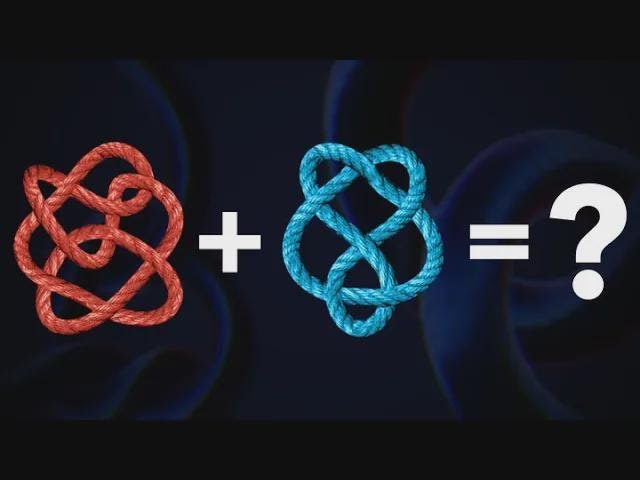
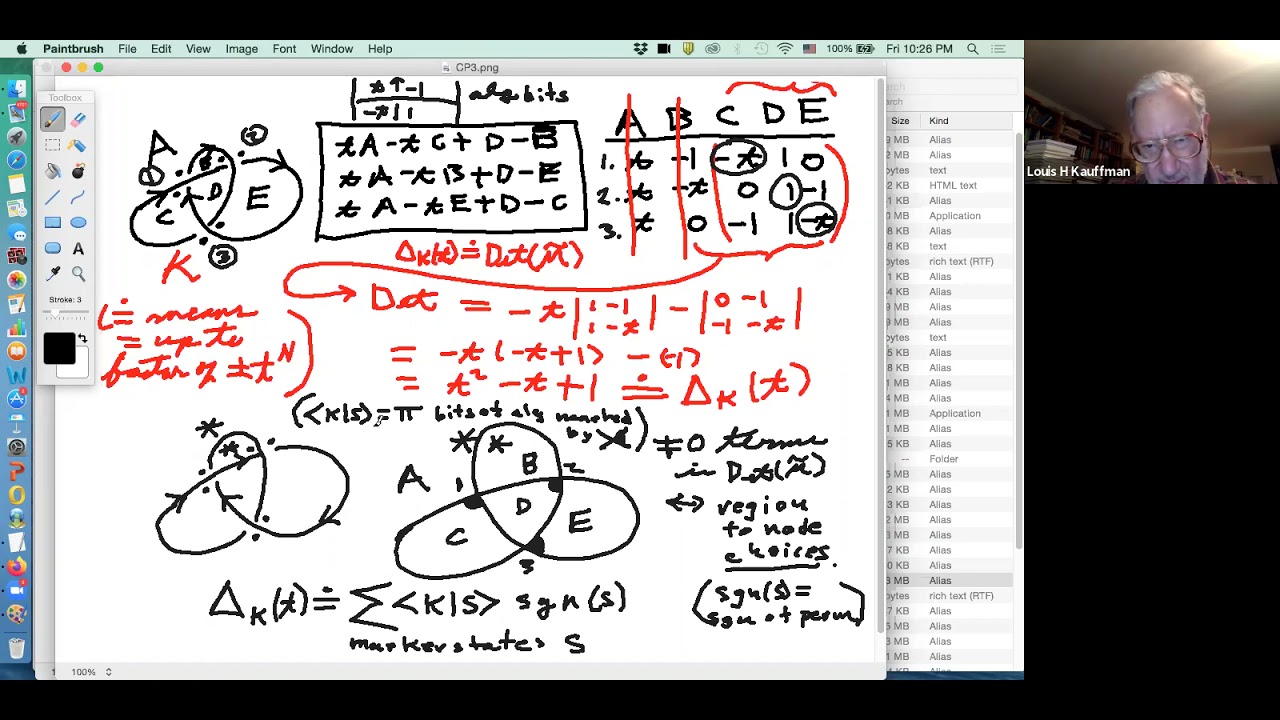
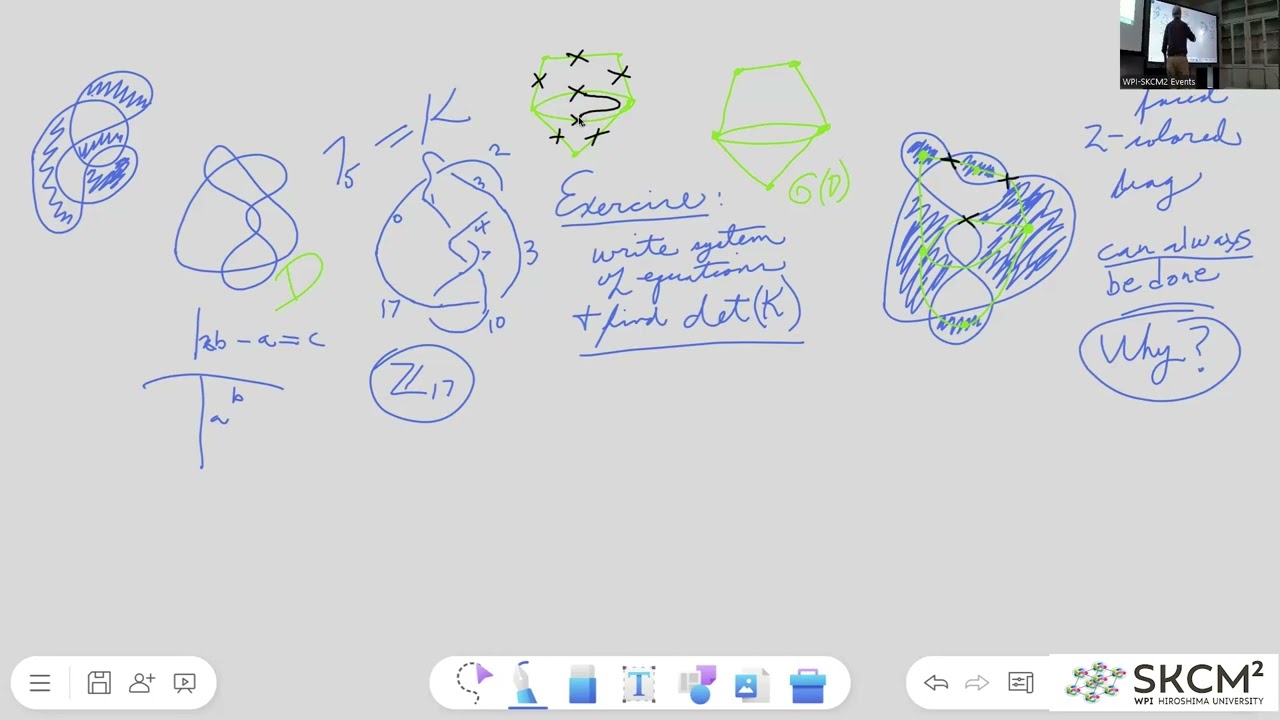
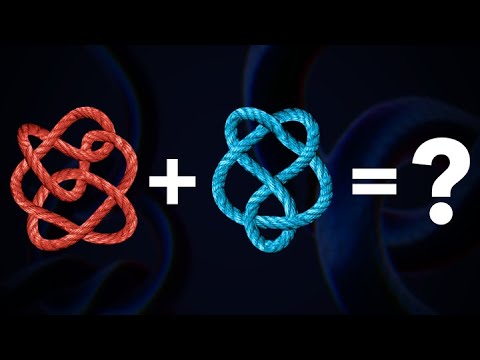
Added:here i have two knots but the question is are they the same knot or are they different knots if i try and untangle the first i end up with just a circle what we sometimes call the unknot but if i try and untangle the other no matter what i do i always end up with some not remaining this one is called the trefoil in not topology we develop mathematical tools that allow us to answer questions like this one of whether two different looking knots are truly the same my thanks to brilliant for sponsoring today's video more about them at the end to be a bit more precise a not like this one is a continuous embedding of a circle into three-dimensional space together with the provision that i'm allowed to wiggle it around a little bit i can't cut it but otherwise i can maneuver it like you'd imagine that i could with an actual piece of rope then a knot diagram is a projection of this three-dimensional knot down into a two-dimensional plane like this one where it's not quite a projection because if i take any crossing and zoom in on it then i want to be clear about which portion of the rope is on the top and which portion is on the bottom and i did indicate that in my drawing as i've done here so then the equivalence problem is if i start with two different knot diagrams like this did they originate from the same knot or from a different knot remembering that i could have taken that original knot and moved it around with my fingers projected it perhaps onto a different plane so it could be the case that these two knot diagrams despite looking very different actually started from the same knot but how could i know how could i program a computer for instance to be able to distinguish between these two different knots now fortunately we have a very powerful tool in knot topology called ridermeister moves and the idea of a rider byster move is it's a very precise way that i can manipulate a knot diagram and there's basically three different moves the first writer meister move is that if somewhere in my knot diagram i have just an isolated twist i can untwist it makes sense this is a perfectly logical move that i can do i've sort of eliminated a crossing from the knot diagram but i clearly haven't changed the actual knot the second writer measure move is if i have two loops that are getting close to each other i can actually send one over top of the other thus creating two different knot crossings that's exactly the same thing as well i can undo it in precisely the same way third one is if i have three different threads crossing over but there's one on the top like this green one here is clearly on top of both the blue and the yellow then i can slide the one on top to the other side likewise if the green one was on the bottom of the blue and the yellow i could slide it underneath to the other side so the point is i have three different manipulations that i can do to a knot diagram and each of those manipulations seems entirely reasonable and if you apply a sequence of rider meister moves in succession you can begin with a complicated knot apply all of these ridermeister moves one after another and end up with hopefully a simpler knot and it turns out that i only need these three ridermeister moves that is there is a theorem that says two different knot diagrams both represent the same knot if and only if there is a sequence of writer meister moves that goes from the one to the other using writer bytes removes we can construct a whole table of different types of knots the idea of this table is it's indexed by the number of crossings in the knot for example there's only one knot with no cross it's the unknot there's only one knot that has three crossing that's the trefoil but as you go up in the number of crossings there's more and more knots that are actually distinct from each other for example knots with 23 crossing there's actually over a hundred billion possible examples of just 23 crossings and it's been shown that none of these knots on this table are representing the same knot every one of them is different but how exactly that is we know that if we can find a sequence of rider meister moves between two different knots then certainly they're the same but what if you just haven't found a sequence yet how can you show that in fact it's not possible that these these two knots cannot be the same consider for example these two knots the top one is 10 crossing the bottom has nine but that's not necessarily a problem because we know the rider meister moves can change the number of crossings now you could pause and try to think about rider meister moves you could do and see if you can take one and manipulate it to the other but suppose you've never found a sequence of ryder meister moves how would you know when to stop looking for such a sequence so what would be really nice is if there was an upper bound a maximum limit on how many sequences of rider meister moves we needed to test until we could say that no these two knots were different and in fact there is an upper bound it just really sucks the upper bound is a power tower 2 to the 2 to the 2 to the 2 all the way up to n plus n prime where n is the number of crossings in the first diagram and n prime is the number of crossings in the second here's the special part how many 2s in this power tower well it's got a height of 10 to the million to the power of n plus n prime this is an outrageously enormous upper bound this upper bound gives us just the length of the possible sequences and you have to check all the possible sequences of length less than this upper bound it's enormous it's completely impractical to do in any number of universes that you could imagine so the problem of taking two knots and deciding whether they're the same or whether they're different is not yet solved just because rider meister moves exist and they have an upper bound on how many ridermeister moves you might have to test for so instead i want to introduce something called a not invariant some type of calculation or manipulation i can do that inputs two different knots and outputs well something maybe a number maybe a polynomial and if those outputs are different then it's going to imply that the inputs are different as well i'll show you the first one the first one is called tri-color ability here again is the trefoil knot this is the only knot with three crossings up to our ability to do ridermeister moves and so forth and it is a kind of fancy feature i can try coloring i can put three different colors on it and this is the property that at every one of these crossings all three of the colors are present technically the rules of tri-color ability are that for a single link it uses all three colors and secondly that any crossing uses all of one color or all three colors you're just going to eliminate the possibility of two colors so this trefoil knot is a tri-colorable knot this is a different knot it now happens to have four crossings but that's not going to eliminate the idea that it's tri-colorable but it isn't tri-colorable nevertheless if i try for example i'm going to put the blue i'm going to put a yellow i'm going to pink in i then get this final strand that i've left in white that i need to color one of those three colors but i can't do it without violating the rule if i look at the one intersection i've got pink and blue here that would mean the white strand should be painted yellow but if i look at the other one there's yellow so i can't paint it yellow i get a contradiction so this one is not quite colorable now here's where the real magic is try colorability this binary yes it is or no it is not is a not invariant that is if one knot is tricolorable and the other is not tri-colorable it's kind of funny saying the word lt and k-n-o-t all the time in this video regardless if those have different values of the properties then they are different knots how do i show something is a not invariant well i can use my right advice or moves let's take the second for example i have these two different strands and the second rider meister move is that i can cross them over like this this looks right now like it's violating tri-colorability each process is supposed to have three colors not two right but if i take this region in the middle and i paint it pink then the rest of the knot that i haven't drawn here is all the same but this bay's tricolor ability the two different crossings that i have now are tri-colorable so the point is if i begin with the knot that is tri-colorable and i do a ryder meister move to it it also remains tri-colorable that is what i mean by being a not invariant and i would encourage you to argue maybe down in the comments why the first and third ryder meister move also is going to be invariant under this tri-colorability now tri-colorability is great but it's kind of limited there's tons of knots that are tri-colorable there's tons of knots that aren't tri-colorable and so this first invariant is not particularly sensitive between different types of knots so i want to do better and i'm going to come up with something called the alexander polynomial which is a much more sophisticated invariant to be able to tell two different knots apart i'm going to begin with an oriented knot it's the same trefoil we've seen before except i put an arrow on it to indicate the direction so this is going to apply to oriented knots that have an orientation like this so here's how i'm going to define it the first thing is i'm going to number the crossings in this case i have three different crossings and i'm going to give them specific labels one two and three i then note that i have five different regions defined by this nod in this plane there's one two three four and five the fifth being the whole region outside of it this is a general property that if you have a knot with n crossings there's n plus two different regions so i've labeled my crossings i've labeled my regions i'm just going to keep track of them with those labels now what i want to do is i want to construct a matrix this is going to be a three by five matrix where i sort of think about the rows as being the crossings and the columns being the regions so the feeling i want you to get is that i'm trying to come up with something very algorithmic something that really encodes the data of this particular knot into this mathematical structure of a matrix and it's nice because if i wiggle my knot around you know maybe that region one gets bigger or smaller but because i'm sort of dealing with the combinatorics of how the regions relate to each other and the crossings that kind of change is going to be okay okay so how should i fill in my matrix i'm going to give you a little bit of a cheat sheet here up in green and the idea is i want you to look at which of the strands is the top one and which of the strand is the bottom one so basically the region to the left of the top thread before the crossing gets a t region to the right before the crossing gets a minus t and so forth according to that diagram we're going to go one by one through the crossings let's focus on crossing number one first and i've painted in which is the purple and which is the yellow so i can use my diagram and so if i bring those numbers down you can see the four regions that are going to happen here and basically here's how i fill up my matrix i'm looking along the first row for crossing number one in region number one there's a minus one so i can move the minus one up region number two there's a t so i can move it up region number three there's a minus t in it i move that up and region number five there's a one the only thing is there's five regions but there is no region four because region four has nothing to do with crossing number one so i'm just gonna put a zero in there for the matrix do the exact same thing for region number two i'll pull in all the numbers according to my cheat sheet i put them into a matrix add the zero in the remaining spot and likewise for crossing number three i'm going to get a matrix like this so the details don't really matter all that much what i really want you to focus on is that i began with a naught and i ended up with a matrix now that i have this matrix i'm going to do two remaining things to it the first is i'm going to get rid of two different columns you can get rid of any ones you wish here there's choices involved but you just need to make sure that they're consecutive regions so fourth and fifth are consecutive i'm just get rid of those ones then i left with the matrix the final thing is i'm going to take the determinant of that matrix and that gives me this polynomial minus t plus t squared minus t cubed this is the alexander polynomial of the trefoil not but why why why do we care we have this polynomial well it's because of the following theorem the alexander polynomial is one well defined and to a not invariant so what do i mean by well-defined there were a lot of choices involved i could label the regions differently i could label the crossings differently my choice of which two columns to cut out i could have done that differently so basically the first thing you have to prove is that under all of those choices you get a well-defined polynomial actually what you get is well defined up to possibly a multiplication by negative t to some particular power but other than this it's a well defined polynomial the second piece is also crucial it is a not invariant and you prove it the same way we did with our other non-invariant tricolor ability if you take each of the three rider meister moves and you think how is that going to influence the knot diagram well it turns out to not change the alexander polynomial something that you need to prove and something you can do down in the comments if you so wish regardless i now have a great answer if you input two different knots and they have different alexander polynomials they have to be different and unlike tricolorability this alexander polynomial can tell the difference between an enormous number of knots very sensitive and so it is great for allowing us to tell two different knots apart if they have different polynomials they're different knots but it's still not perfect consider for example these two knots the top is called the conway knot the bottom is the unknot and they both have alexander polynomial perhaps surprisingly in the first case of one but they're not the same there is no sequence of rydermeister moves that takes this complicated top one and makes it into the unknot but the alexander polynomial cannot tell the difference so what can we do well mathematicians have improved significantly on the alexander polynomial that first came out in 1923 there is an upgrade to something called the alexander conway polynomial that actually helps its computability it allows it to be computed in a bit of a different way there's new polynomials called the jones polynomials that have different properties in terms of what kinds of knots it can tell the difference of and work continues to the present day on these kind of polynomial not invariants for example a former professor of mine george barnatan and his colleague roland vanderdean proved a new polynomial invariant that is very strong in the fence that it can look at all different knots of crossing number 10 or less and it can distinguish all of them apart but it's also able to be computed in polynomial time and this is just scratching the surface of all the body of work that can be done and the questions that remain in the field of not topology for example things that could be looked at are links like this one where multiple different ropes are all tied together or you could look at knots or links that had sort of specific requirements like all living on the edge of a torus like this one or you could consider high dimensional analogues like instead of taking a one dimensional circle embedded in three dimensions what about a two sphere embedded in four dimensions what kind of interesting properties does that have so there are a lot of interesting questions for the future as great as math videos can hopefully be to really improve as a mathematician you need to be actively wrestling with problems and that's why i think that brilliant which is the sponsor of today's video is just really effective for your learning they have a ton of courses on all kinds of subjects but i was really enjoying working through this course on cool things to do with infinity and it's just delightfully interactive here with the candor set you get to be the one playing around with this fascinating mathematical object or here with the hilbert curve it isn't just that it is beautifully animated so that you can understand it visually it puts the students in the driver's seat because you get to test and self-assess your learning as you go along and you get meaningful help and feedback when you make mistakes as a math professor i know that this is extremely effective pedagogy and that's why i'm so proud to be sponsored by brilliant so go to brilliant.org turbobasset and sign up for free or the first 200 people to use that link will get 20 off an annual premium subscription with that said if you have any questions or comments about not topology leave them down in the comments below and we'll just do more math in the next video
Up Next

Knot Theory: Diagrams and Reidemeister Moves Explained
@richardhepworth1441
4.9K views•2015-01-16
Elliptic Curve Cryptography Explained: ECC, ECDSA, ECDH
@PracticalNetworking
28.5K views•2024-10-21
The Euler Product Formula: A Beautiful Bridge Between Sums and Primes
@DrTrefor
60.3K views•2024-08-06
The Mathematical Impossibility of Accurate World Maps
@Vox
23.3M views•2016-12-02
Related Study Plans & Knowledge Roadmaps
Structured learning paths in Mathematics