



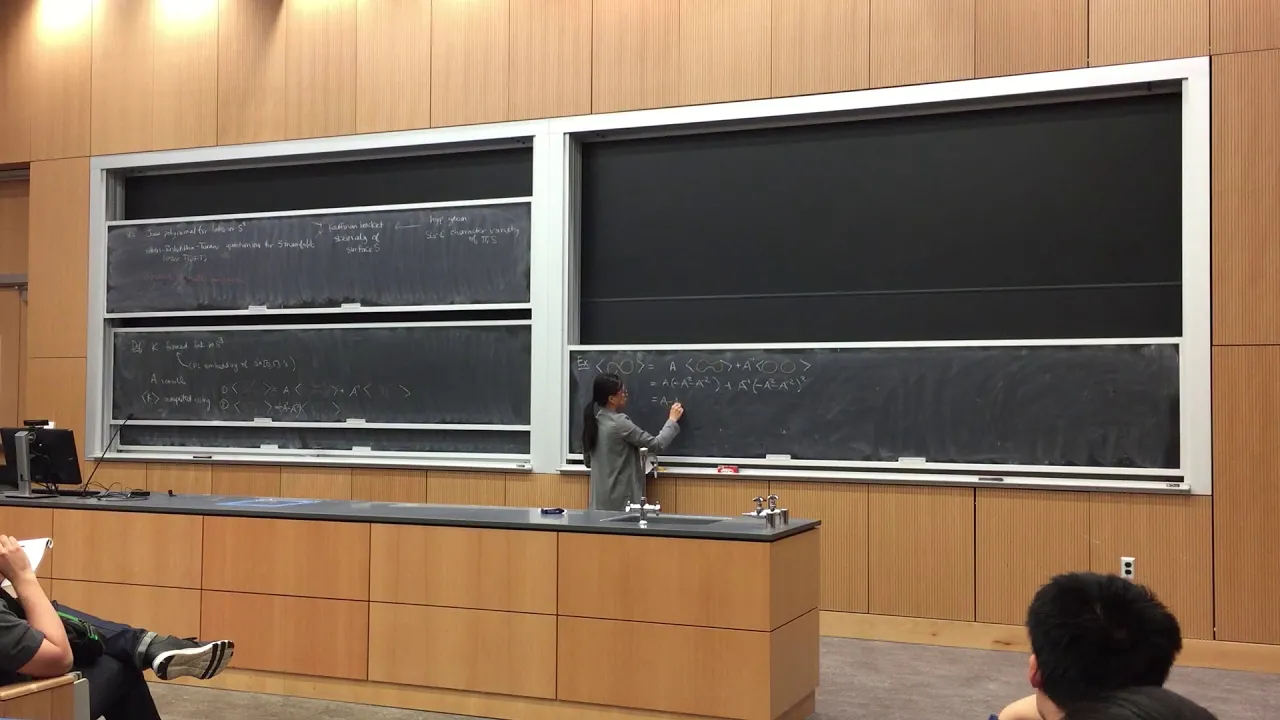















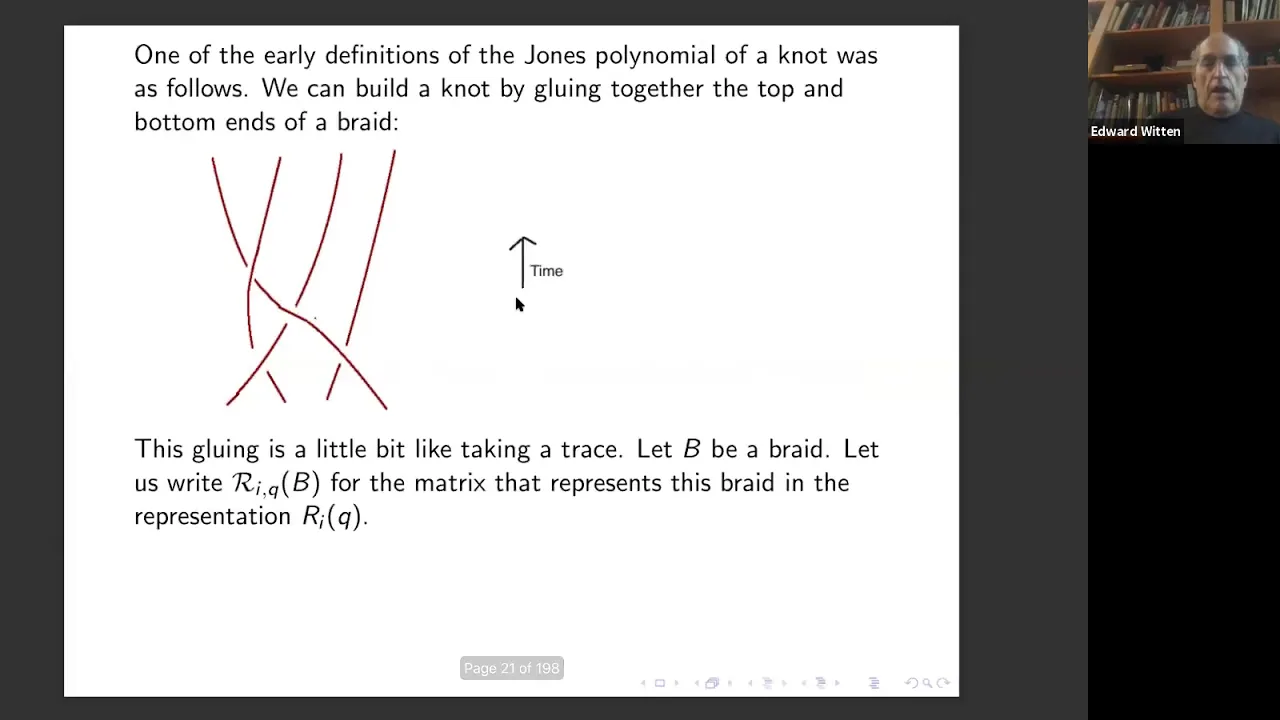
The Jones Polynomial is a Laurent polynomial invariant of oriented links defined by the skein relation: T⁻¹V(L+) - TV(L-) + (T⁻¹/² - T¹/²)V(L₀) = 0, with V(unknot) = 1; it satisfies V(L)(1) = (-2)^(c-1) where c is the number of components, detects knot chirality (left/right-handed trefoils have different polynomials), and is invariant under ambient isotopy but not under orientation reversal on single components or mutation operations, making it a powerful but incomplete knot invariant.
Knot Theory 9: Jones Polynomial - Definitions & Properties
Added:Basic knot theory concepts, including the mathematical definition of knots, links, diagram crossings, and orientation.
Reidemeister moves (I, II, and III) and the concept of knot invariants under ambient isotopy.
The Kauffman bracket, which provides the combinatorial foundation for defining the Jones polynomial.
Familiarity with Laurent polynomials, particularly handling variables with fractional and negative exponents.
Using the Jones polynomial to detect chirality, specifically proving that the left-handed and right-handed trefoil knots are distinct.
The HOMFLY-PT polynomial, which generalizes both the Jones and Alexander polynomials into a two-variable invariant.
Khovanov homology, a deeper 'categorification' of the Jones polynomial that yields a richer algebraic invariant.
Applications of quantum knot invariants in mathematical physics, such as Chern-Simons theory and topological quantum computing.
9.2K views135likes59:54Original Release: 2019-03-20
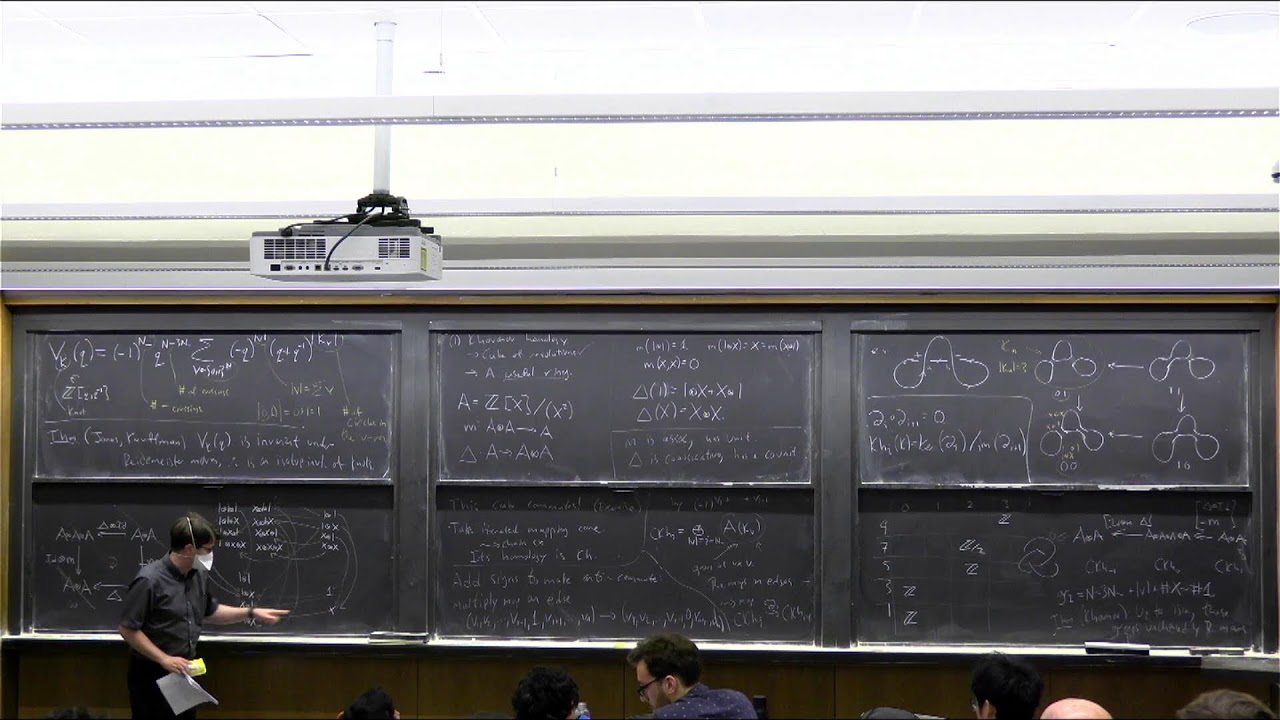
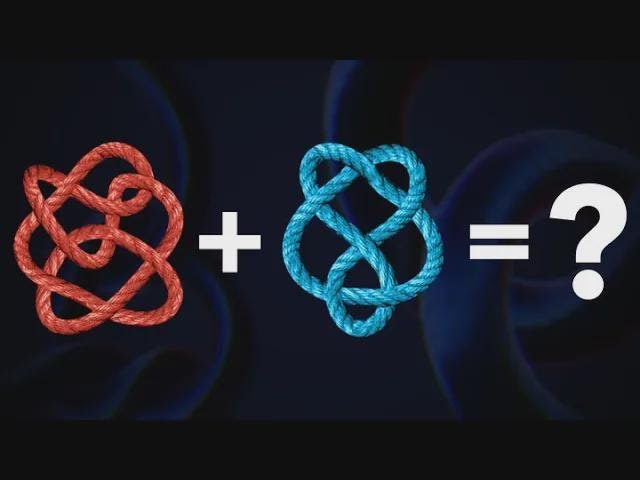
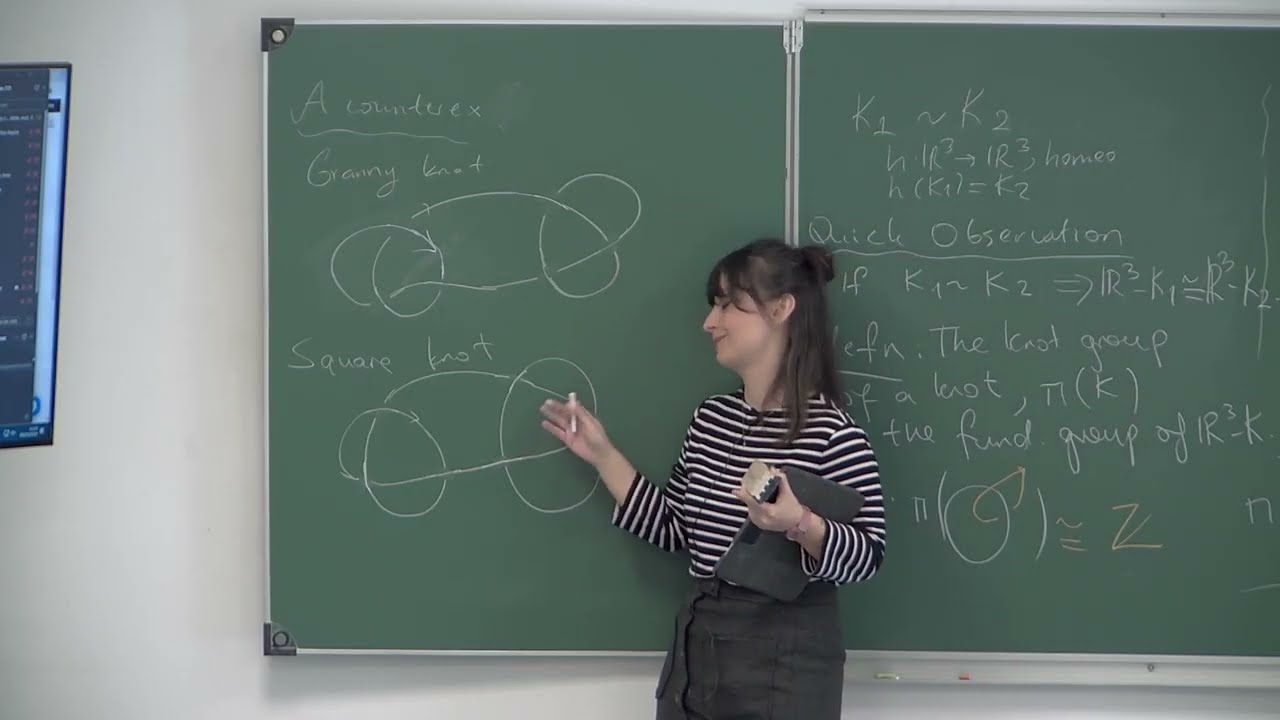
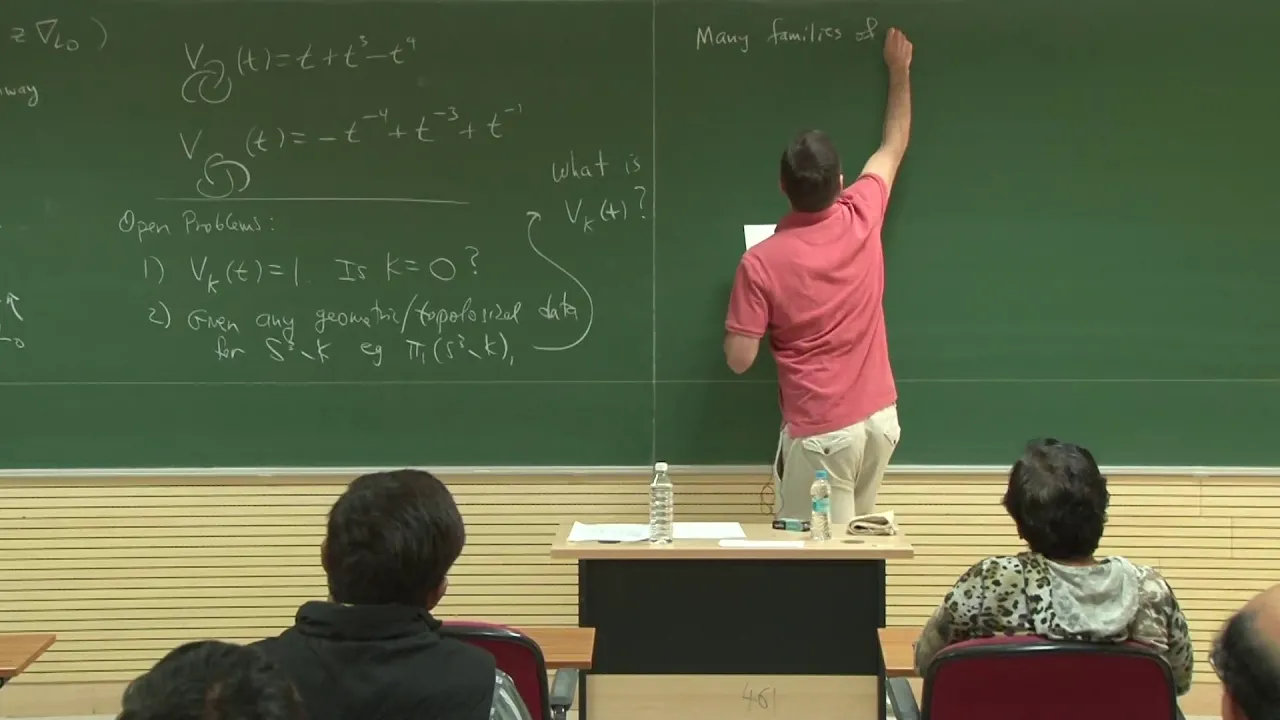
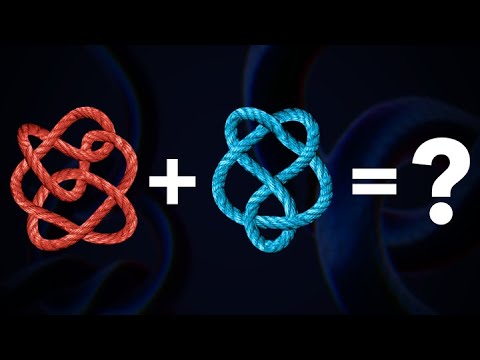
so today I won't introduce you to the Jones polynomial so the Jones polynomial now I'm just gonna dive right in with a definition of it and then we can see how to calculate it in some properties so this is pretty similar to the Alexander polynomial and you remember when we did the Alexander polynomial we saw a couple of different ways to define it but we landed upon the skåne relation a way of like resolving the crossings and we change the crossings you record how that change to the Alexander polynomial and so I'm just gonna define the Jones polynomial in terms well that's right we did define the component over that way and then we saw that there's a way to go from the Conway polynomials to the Alexander polynomial so you can give a definition of the Alexander polynomial that way and so I wouldn't do the same thing I just want to begin by defining the Jones problem in terms of scale relation we could define it some other ways I'm gonna something call these Kauffman brackets that are kind of similar and you define it that way the smother ways to do it but I was want to begin by defining it this way so I'll say V is my polynomial it's going to eat in some some link some oriented link and it's gonna spit out some polynomial with integer coefficients but instead of just being powers of T it can be like half powers so I can be like t to the 1/2 or negative half powers PT to the negative 1/2 so it's going to spit out a Laurent polynomial in T to the half and to the minus 1/2 and then it's going to satisfy the following relationship satisfies when you feed in the unknot so this this right here is the unknot it's gonna spit out one it's the first property and the second there's kind of a recursive definition you say how it begins and then you give this like recursive frothing the Conway that's right that's exactly right until it's very similar to that although it predates it the recursive relationship the scan relationship is going to be this is a variable of T's it's a function of T then it's going to be T of V of a positive crossing so L plus is going to be a link where I have some positive crossings are right-handed crossing so satisfied is your right hand role minus T of the polynomial at a left handed crossing so that's going to be you change that cross and you keep the rest of the link of the same keep the rest of L of the same B has changed the one crossing from right-handed to a left-handed crossing and keep the rest of the link the same plus T to the minus 1/2 minus t to the 1/2 V at that crossing smooth the doubt so this is a resolve the cross and it's smoothing it out that's l0 but keep the rest of the link the same that should equal zero so I make a couple claims my first claim so note my first remark is going to be that this is well defined for all knots and links so why is that the case why is it well let's just think about four knots for now why will this always give you some that something for naught yeah we know that given any not just by changing finitely many crossings you can get down to the UH not right so you just have to do finitely many moves just to end up with a bunch of diagrams that all are knots and those are well defined now you might scratch your head for a second and be like wait a second how do i how do i define this in something has two components so in a second we'll show how to do that but then once we show that you can do for two or three components then it doesn't matter how it's crossing because you can always resolve crossings to get down to a trivial link or to a nun not on the second note is that this is actually a not slash a link invariant so no matter how I transform my link via ambient isotopy out I'm gonna have i deform it the Jones polynomial is always going to stay the same well the second we need to maybe think of of perhaps perhaps our choice orientation may impact something so when you think about choice of orientation so you know up to choice orientation and we'll give that some thought in a second to see how orientation may change things but aside from those concerns how would you show that it's invariant under this isotope you move under under these days uh under this deforming of the link but not letting it pass through itself yeah so not up to local moves this is just under up to not yeah so use the right a master moves yeah so two knots are equivalent if you can go from one to the other via semi domestic moves and so you'd have to do some kind of argument about showing that changing things up to write a master moves preserves the polynomial and we're not going to do that now we've done arguments like that before but you can you can think about how you would do that actually it's a little tricky in some the details but but you can make that arguments not too hard to show that it's a link invariant and what I want to do now is some examples of calculating some things to build an intuition of how it works and then we try to note some properties of it so first of all let's do the the link of two components so here's a two component link I know oh if it's a link of just one component that the unknot then it has zero one the the Jones polynomial is one what if I have two components I should give it some orientation so let me orient it like this oh that's it makes sense technical difficulties yeah so what if I have a link of two components and I'll give it some some orientation so how might we calculate this using our scan relationship well so far it seems like really only understand how to do ones one one component not too well there's a way to make this into one component take this part right here and think of that as being like u l0 right l0 then the accompanying diagram when you have an l plus or an L minus would just be where you modify that to be added and over cross in your under crossing so I think L plus should look like yeah I think that's right should look like this let's check out orientations work out you comes over that's a right-handed crossing that looks good and oh minus should look like this nope how about orientation backwards right I'm taking just this little local part and changing it to either plus crossing a right-handed cross you know a - crossing a left-handed crossing and then you can use your scam relationship oh by the way note this is just the UH not it's on twisted that's just the UH not and this is also just the UH not so no the Jones polynomial for this guy is one and the Jones polynomial for this guy is one so now we can use a scan relationship so our scaling relationship tells us that T inverse of the Jones polynomial of L plus so times 1 minus T times the Jones polynomial of L - which is 1 plus T to the minus 1/2 minus T to the positive half times the Jones polynomial of L plus so with the Jones polynomial of this two component trivial link is just going to come out to be zero yeah that's so not know L should be that's really L not this was calculating the Jones polynomial of L plus the Jones polynomial of L minus and this right here is the Jones polynomial of L not that's our scanning relationship right yeah so then you can solve for the Jones polynomial of the two component trivial link and it should come out to be all these will go to the other side so you get negative T inverse plus T negative T universe minus T over T to the minus 1/2 minus T to the one half but that's just negative T to the minus 1/2 plus to do the half because this Guyana top factors as T to the minus 1/2 times this guy on top factors as T to the minus 1/2 minus t to the 1/2 times T to the minus 1/2 plus T to the half right and then those cancel okay so we use calculating the Jones polynomial for a two component link in general whenever you have some link let's say you have some some link owl so I will just I'll call it L and then say you want to add another unknotted component to it so i have l and then I'll say the disjoint Union so then I add some amount of components or some link and then I add another component you can do an exact exact same argument he's like you know I have some L so this is part of some link some link owl and then over here I have some on out of component and you can do the same thing you can be like okay so then what I can do is I can say like this is my I could say like this is L Prime it's like L prime 0 and then I'm going to say well then I can resolve this crossing so this this is the same as I have some plus Prime some o - prime that would look something like this and is a plus crossing yeah and you should be going under this time and this and notice this guy now is just L plus prime is just L and this guy now is just L like before where there was just the UH not in the uh not and so then you can do like the exact same argument as before and you can show that the Jones polynomial the link when you add an extra component is just the Jones polynomial of what it was before times this these times negative t to the 1/2 plus t to the 1/2 me double check yeah so in particular the Jones polynomial for like the M component on link unlink so this is just the trivial link with M components so this is just like on link trivial components as M of M is just going to be what would it be well you start out with when you just have one of them it's 1 and each time you add one you multiply by a factor of this and so yeah it's that thing negative 1 to the power of M minus 1 times T to the minus 1/2 plus t to the 1/2 to the power of M minus 1 times x the nonono times V 1 times V of the unknot which is which is 1 yeah yeah that's right ok oh this is actually a really nice result because from here can I aah-aah I can I can show something else so let me just remark this I I want to make sure I tell you what is what is V of well some link but you evaluate it when t equals 1 so some link but I evaluated when T equals 1 so I'm evaluating plugging in T equals 1 what is that going to come out to be so if you plugging in T equals one come look at your scan relation and see what happens if I plug in T equals one well this is just going to be a 1 so I have just V of L plus this is just going to be a 1 so V of L plus minus this just a 1 V of L minus this is this is at I should probably write this like this like V Plus but at 1 and this is this is that L minus but at 1 and this whole thing becomes 0 right there's no plug in 1 it's 1 and 1 so it's 0 so that equals 0 that tells me that when I plug in 1 V of L plus is the same as V of L minus so let me come back over here and write that when I plug in 1 V of L plus at 1 is the same thing of V of L minus at 1 so what does that say that says as I change crossings the value of my Joan's polynomial 1 does not change so so the value of any link at 1 should be the same as well just change crossings to make this the trivial link so it should be the same as the Joan's polynomial of the trivial link evaluated at 1 where this trivial link has the same number of components as L and so what is that well when I plug 1 into this this becomes a 2 and a negative its negative 2 to the M minus 1 where m is the number of components in my link so given any link if you plug in 1 it counts the number of components of your link well it gives you a way of seeing you know how many components any link granted you can just look at your link and see how many components are in it but there's some connection where the Joan's pointing about one is detecting the number of components of your link so if you ever have a not just has one component so a not it's Jones polynomial ax l1 will always have to come out to be 1 negative 2 to the 0 is 1 and so we'll be sure to test some examples we do to make sure this property holds let's go ahead and do some examples so we've done the link with two components how about we do a link with two components linked together this guy which called the the Hopf link and I'll give them some orientation on these components and now we want to figure out the Jones polynomial of this guy so I gave it a oh that's uh that's a left-handed orientation let me give it a right-hand orientation let me give it a right-handed orientation so here's a hop link how would I how could I begin figuring out the Jones polynomial first guy what's Y you just pick a crossing so like here's a crossing will let's focus on this one that's a right-handed crossing so that's a L plus and so I'm going to see what happens as I resolve this crossing so there's two ways I could resolve it I could change it from a plus crossing to a minus crossing so that's just moving it from an over cross into an under crossing so he would end up looking like this now step going over goes under and I change the handedness because now this is a no it is crossings going under oh yeah and it's not right-handed so it's left-handed that's right this under crossing is a left-handed under crossing yeah this is this is working out so that's l- now or you could resolve it by smoothing it out and so you'd smooth them out in a way that's consistent with the orientation and so you should get something that looks something like something like that and that's gonna be our o zero notice this top guy is just the UH knot and this bottom guy's a trivial link of two components and now what you can do is you can calculate use our scan relationship so I have that T inverse times V of L plus so V of L plus is V of my hopped link this this is my L plus what do I have minus T times V of L minus so of this guy V of minus plus T I believe it's to the minus 1/2 correct me if I'm wrong plus t to the 1/2 what's up - you're saying yeah - that's right times V of L 0 which is the unknot so this is my L 0 should give me 0 and since I know what these two are I can use them to solve for this so I get t inverse V of my HUF link this guy becomes what did we say he is he's minus so plus T to the we just calculated it oh that's right T to the negative 1/2 plus t to the 1/2 plus this piece T to the minus 1/2 minus T to the 1/2 times 1 should equal 0 okay you can think a little bit T times this gives you a positive T to the one-half and then here you have a minus T to the one-half so those pieces will cancel leaving you with V of the half link I'm going to move these pieces over and multiply them by T so this is T to the three-halves comes over us T to the minus three-halves or minus 3 to the 3 half minus T to the three-halves but then I'm multiplied by a copy of T so that's T to the 5 halves and here I have T to the negative 1/2 so minus T to the minus 1/2 but then I multiplied by a copy of T so it's just T to the 1 half so there you have it the alexander the jones polynomial of the Hopf link is minus T to the 5 halves minus T to the 1 half let's just check a previous result what is this guy evaluated at t equals 1 well it has two components so it should come out to be negative 2 right because negative 2 to the 2 minus 1 and what is it if you plug in 1 you get minus 1 minus 1 negative 2 just like we expected so that confirms the previous result cool well something you might want to worry about though is what happens if you change orientation of these guys we're picking an orientation and it seems like it really matters but what if we were to change orientation so well first convince yourself if you change orientation on both components what would that do nothing that's right if you change them both components then so so changing so I'll say reversing orientation reversing the rotation on all components well what happens before you had something like this and that crossing is going to become what well it now is going to be going down like this and down like this before it was a right-handed crossing before this is a right-handed a positive crossing and what is it afterwards still a right-handed so nothing changed right and similarly if you had a left hand across in us to be left-handed crossing so reverse annotation and all components a preserves preserves you Jones polynomial but what if you just reverse the orientation on one component like right here if I just reverse the orientation on this one component well let's track through and see what happened so I need to reserve some data let me hold on to this I'm going to preserve this data here that when the orientation was like this we came out with the Jones polynomial of minus T to the five halves minus T to the one-half but I want us to run this again reversing the orientation on just one component so now instead of this being a right handed crossing this has become a left-handed crossing so that's now my L - and over here let's think what happens this guy is just going to be facing well the orientations don't matter on these guys does the trivial so there's a matter which reorient same so they're the orientation wouldn't matter but this has changed from an L - to an hour-plus and so these two guys have traded places so this should be my minus T and that should be my plus T to the minus one because they switched roles and so let's calculate this again see what we get here we get this is still this is still going to be T to the negative one half plus T to the one half but it's - and you have a T inverse in front this is still unknown it was just one so this is plus te to the minus half minus te to the one half equals zero here I still have a minus T times the thing we're trying to solve for him with reversed orientations now the rest orientation on one component because anything cancel well here I get a minus T to the negative one-half and you know a positive T to the minus 1/2 so those pieces will cancel and so I'll be left with minus T times the Jones polynomial of this half link new orientation is going to be he'll come over us plus so plus T to the minus three-halves i believe and this is also coming over as plus plus T to the positive 1/2 I now divide through by minus T so the Jones polynomial for this Hopf link comes out to be negative T to the minus 2/3 minus five-halves I don't know no why is that 2/3 I was yeah minus T to the minus 1/2 is that we have okay so how is that different from this guy yeah these these are quite the same right subsonic both have changed they different by a factor of well if you multiply this by T this is minus 1/2 and you want to get up to like five halves senior x factor of T cubed and you've multiplied by fact of T cubed this will become 2 and 1/2 and this would become 1/2 right so changing the changing the orientation of one component gave T cubed or we can write this result in general so let me let me do it on the next board but you remember that we change the component the orientation on one component and it gave us a factor T cube in general if you change the orientation on just one component will say like component L I of some link L so I have a first component of the second component or something then you know two gets to get a new link to get we call it we'll call it L prime then the Jones polynomial of L prime is going to be the same as it was before except you get a factor of T 2/3 times the linking number of how many times that component links with the rest of the link of how many times Li links with all the link accepts itself you know the link of minus itself so just how often the link component Li links with the rest of the link so in the halfling can only link to once so he got one factor of T cubed if there was something that went through and linked twice you're good a factor of like T to this so something no no we you're not going to say I care with the polynomial is now the polynomial add some special values tells you special information and that's what is trying to tell you the one so the polynomial out one records how many components you have but there's like infinitely many other numbers you might plug in that give you other infamy interesting information as well yeah but you're right that at one it doesn't make any difference at all okay let me see if there's anything else I want to say oh okay let's talk about yeah yeah yeah yeah we should talk about mere images so that's how orientation changes it what if I have some knots or some link and I take the mirror image of it so I have some knot or some link and I take its mirror so let's see if I could draw this effectively oh that's gonna look something something kind like that something like this right how is that going to impact your Jones polynomial so let's think what's happening to our crossings when I have a crossing like this what happens when I mirror it well it becomes like this right so here on the right is a right handed crossing like an L plus and when I mirror it it becomes an L - so L plus and L minus with changing roles so if you go and you look and and you can like you know L zero staying the same right like L 0 is still just an L 0 so L is 0 there's still an LZ row so when you have your scan relationship you have T inverse times the Jones polynomial at L plus minus T times the Jones polynomial at L minus plus T to the minus 1/2 minus T to the one-half V of L 0 is 0 and now I'm gonna go I'm gonna replace L with the Miravalle so LM replacing with the mirror of L I'm a placing with the mirror of L I'm replacing with the the mirror of L and so what what's going to happen when I replace everything with the mirror of so this will still be true for the mirror of that guy but the mirror of L minus izz is an L plus right and like the mirror of a plus is like an L minus and that stays the same so what happens is just these two terms of switching which you can achieve that just by switching your T inverse and T and so the way we can write this let me rewrite it here as I can say that my Jones polynomial of the mirror of a link at T is the same as the Jones polynomial of the link at T inverse where where L bar is the mirror image so this is different movie for the Alexander polynomial it was the same it was the same polynomial well that was because Alexander polynomial had a symmetry so that if you plugged in T university plug in T you got like the same thing it was like symmetric but here here it seems like well maybe maybe it won't have that symmetry well let's do it let's have to calculate what the Jones polynomial is of the of the this is the right hand left handed trefoil and let's see if we can just English them with the Jones polynomial so I'll do that right over here so take some truffle oil give it some orientation now it doesn't matter what you choose because if you reversed it reversed on all the components so it's too so still state stays the same so something like this and now let's pick some crossing at this crossing what kind of crossing is that it's uh yeah it's a right-handed so that's not l+ and so I can resolve that so one way I always all of it is to make it a l- and the other way we resolve our crossing is to smooth it out and make it a zero so this one looks like looks like this and this one looks like looks like that's right okay and I'll keep track of my orientations on this guy so he's going around like this and she's going around like this notice l0 is just a anot I'm sorry l- is the uh not l0 is the Hopf link so here my my V here of L - is just going to come out to be one but my V of L 0 is going to come out while we have to make sure I picked the right one this is this is a left-handed oriented on left hand away and so that's going to correspond to is it is if this one does do it wrong oh yeah you're totally right it's right handed this is a right-handed Hough link and so not this one but the original one the original one that's that's oriented and the same right hand direction so it's - this one is minus T to the what was it five five halves minus T to the one half okay so let's uh let's calculate this really fast so that's my so we only figure out what L plus is so I know that T inverse of V of L plus plus T times L minus of T times one so that's T or a minus minus T plus T to the minus 1/2 minus t to the 1/2 times this guy so here what I'm gonna do is I'm gonna factor out something maybe no no that doesn't help hmm I can factor out like a negative T but maybe doesn't help too much okay I'll just factor out the - and leave it as T to the five halves plus T to the 1/2 should equal zero oh we have to do algebra ok I'm going to move those to the other side so that would be plus and equals and I'm going to multiply through by a T so that'll be T squared times T and so you end up with okay here we go T squared plus T to the minus 1/2 times that stuff which makes it t to the 4 halves or T squared and plus 1 minus T to the 1 half times that which is 2 cubed minus T to the 1 half times that which is T all times to eat I think this is right right so this comes out to be well I have a I have a negative T to the fourth I have a T cubed I have no T scratch those cancel plus a T ok let's do a couple Santee's check to make sure this makes sense like like what happens you plug it in 1 it should come out to be 1 and I plug in 1 I get 1 so that's good this is a reasonable answer I don't know if we have two other mean other tools to check but that seems like a good answer to me okay but here's the point if that's the polynomial of this guy then what is the Jones polynomial of the mirror image of this guy should take its mirror image and so now he looks like this it's like we don't have to calculate it because we just showed right here the Jones polynomial of the mirror image is just the Jones polynomial of the original so it's just gonna be instead of instead of this Jim smiley no meal here you have Jones polynomial of of minus T to the fourth plus T to the third plus T here it's going to be minus T to the negative fourth plus T to the negative third plus T to the minus 1 those are different polynomials all right like like that's not the same thing of that right the first two components below the last one when you do mirror image you just reversing all the L minuses without pluses mm-hmm yeah that's staying the same but T to the naked yeah which is where you want to happen I think this is right yeah I'm gonna plug that in and plug that in and it should work it does I mean I'll just write out the stimulation belief Aston and see it if it wasn't clear before so you start out with some T inverse times of some V of L plus minus T V of L minus plus T to the minus 1/2 minus T to the half V of L naught equals zero now what happens if i instead plugged in a T inverse well this guy would now be my T and this guy would be a T inverse so it's the negative of what I was before and this guy would become t to the 1/2 and to the minus 1/2 so what's the negative or whatever what is before all right but the whole thing's the negative what it was before and equals zero yeah so you have to switch these to make it the same as was before but that's what a mirror image does is just switching those two for the mirror image these guys are switched yeah that's that's what I was saying that when you take the mirror image it's the same as plugging in T universe instead of T yeah okay good so I mean you know you could check you could calculate this out and you'd see you would come out to be exactly where you get just by plugging into universe okay so we just showed for the first time that the left and right handed chef rails are not the same and we hadn't seen that before no yeah this yeah you sure you should be proud this is this is an accomplishment none of the other invariants we had genus Alexander polynomial determined none of them could attack the difference where the Jones polynomial can detect the difference so this probably leads to like two natural questions the first is like okay when is a not different from its mirror image like is that always true answer no it's not always true we'll see this in a little bit do you know or not that's the same it's mirror image yeah the figure-eight knot that's right so let me it's like the next the next simplest knot and so if you took a figure eight knot and you should convince yourself of this like it's a really good activity maybe I'll put it in the the activity if you take some some figure eight knot let's see if I got this right I think there we gots my figure eight now right and you mirror it so now this Superman s is gonna go backwards right and then he's gonna go like this and like this and like this right you mirror it you should convince yourself that these are equivalent that you can move from one to the other by ambient isotopy and it's not it's not obvious like like you have to like moves and strands around for a while until you get a series of you know via ryder meister moves or pulling strands over to move from one to the other so these are equivalent knots well sure enough have you checked the jones polynomial on both of them they'll come out to the same thing but but that enough to know the two knots are the same so we know that if if K is equivalent to J then that implies that the Jones polynomial of K is equal to the Jones polynomial of J but you might wonder is the converse true that'd be really nice if the converse was true because then we would know that whenever two knots have when John's partner mows are different the equivalent if and only if they have the same Jones polynomial but you're shaking your heads no because you know that's too good to be true and so it's true that the converse is not true and I can give you a an example let me let me find my picture I'll make sure I draw this correctly so here's an example that comes from something called mutation so I'm gonna take a nought and I hopefully I'm drawing this correctly yeah there we go and I want to give up but I already started drawing this much so I might as well continue so there you go take take this knot and then what we're going to do is we're going to mutate this knot so mutation is a move I'm weak on we introduced it what you do is you take a little bit of a piece of the knot and you surround it by some ball and then what you do is you is like imagine this like a three-dimensional you know not and there's a ball I've captured that with and then what I'm going to do is I'm going to rotate the pawl by PI by 180 degrees so that piece inside the ball gets flipped and the rest stays the same knows there are four points here so these two points on the left will get moved to these two on the right hand vice versa it's going to rotate around I guess three-dimensional is like you oh yeah you could have a mutation that way as well yeah you could mutate out but I'm gonna mutate it this way and so when I mutate it I give myself a little more room outside of the ball everything stays the same so outside of the ball and I mention this because mutation is kind of an interesting way to deform a link or a knot and get a related link or not to have a lot of the same properties but some of them may vary and so you get something like this and this and oh oh this guy gets flipped inside of here let me come back and draw that a second okay so the outside is the same but the inside you know this little-ass gets moved to the other side so he ends up looking like okay he looked something like this now you have to kind of think like what happens when you rotate him around this arc that was like going over is now going under what's going under behind so it still looks like it's going over right so it takes some some thinking in three dimensions right so I'm rotating this rotating this what what you convince yourself though and it's not too bad of an argument you probably like began to think why it's true is that when I mutate it's like if I want to know what the Jones polynomial of the sky is I would I could began just by resolving crossings inside the ball and I could resolve crossings inside the ball and when I do that for both of these they would end up looking the same inside the ball and then the same for outside and so this move that's called mutation these are mutants of each other so mutants have the same Jones polynomial but they're different different knots there's a couple ways that you could show they're different we could spend lecture talking about these two knots but we could show that they have like different they have different genus for example they also have different fundamental groups pi one of the two knots are different and so there's a couple of different ways you could show that they're different even though they are the same Jones polynomial which is kind of interesting because over here these two knots had the same genus but different Jones polynomial so it's not necessarily that one is stronger than another here the genus could not detect the difference but the Jones polynomial could hear the Jones polynomial cannot detect the difference between them but the genus can so it's not always that one invariant is stronger than another you need a toolbox of invariance and there hope you study them okay that reminded me of a couple other things I wanted to say really fast we do know okay so you know if you you know if you're not is the unknot the the unknot like like like you know if the uh not then then we know that the Jones polynomial what did we say comes out to be one and so you can ask is the converse of that true Athey of Jones polynomial one are you the uh not so in general there are two different knots that may have the same Jones polynomial but can there be something other than you're not that also has Jones polynomial one answer we don't know so that is an open problem that is that's an open conjecturing that hasn't been solved yet so sometimes it's said that you know does the Jones polynomial detect the UH not and not by calculating Jones polynomial and seen that it's one we're not sure there may be some other not but but as far as I know this has not been solved yet so yeah the loss of this really bakes a question right but it hasn't hasn't even been solved yet I think so but I have very little reason to think that there's lots of times where you can detect the UH nought but in general you fail two strings behind knots and so lots of invariants are pretty good at acting beyond knots and so it seems like that's really true that would be huge if you could show that's true yeah yeah yeah yeah yeah because all these invariants are related and so if you understand some like deeper structure about what kind of information the invariants telling you about the knots and the links that's that's a really useful thing detecting unknotting is a really cool thing so we've mentioned the genus remember we talked about how genus plays well with connects um so you like if you have two knots k and j when studying genus we said well genus plays well the genus of the connect some is just the genus of the some the some of the genesis of each knot well you have a similar result from Jones polynomials the Jones polynomial for K connect some J well what is that and the way you should think of it is I'm going to calculate my Jones polynomial by beginning to just resolve all my crossings on this K guy and so as I do that I'm gonna get some data out that's going to tell me what V of K is because I was in resolving the crossings on on him he becomes V of K and typically he becomes V of K and then you have if there was no J you just have a you would just have a unknown piece left and you say well V of him is 1 so this just gives you V of K but now as you resolve the crossings of K you still have this J piece left and so what you end up with is all this V of K data but then you left without the end all of these copies of J and so you have V of K times V of J you can see if you can work through the details of that proof but that's the daisya you work with one at a time and kind of keep track of what happens you left of all these copies of j at the end so you have V of the connect some the Joan's Ponte limit of the connected sum is the Jones volume of K times the Jones parting of J so that's a nice relationship so it plays well with connect some is there anything else I want to tell you about the Jones polynomial I don't think so so maybe the last thing I'll tell you right now is something called the hump fly two last things let me tell you about the something called the hump fly polynomial polynomial so what this is is it's a generalization of the Jones polynomial end of the Alexander polynomial so so far we've seen two polynomials we've seen the Alexander polynomial Jones polynomial and so a group of six guys or like hey can we take the data from those two polynomials and stick them together into a new one and so what this is is it's going to be a polynomial of two variables I'll use it alpha and Z there's a couple different ways that sometimes expressed but the polynomial of two variables it's also defined by a scan relation so define by if you plug in the unknot you get out one and if you have some positive crossing then you can resolve it to get a negative are left handed crossing and this smooth the doubt resolution and they're related by alpha times the positive minus alpha inverse times the negative is Z times the smoothing so you can define it just like we define ours with a scan relation you can begin calculating this there's two variable so this is this is a two variable polynomial but then this generalizes the Jones and Alexander in this way the Alexander polynomial at T of some of some not or of some link just comes out to be the Jones polynomial the hum fly polynomial where you plug in alpha equals one and you set Z equal to t to the 1/2 minus T to the minus 1/2 and the job's polynomial at T is just this two variable polynomial where you plug in alpha equals T inverse and Z equals t to the 1/2 minus T to the minus 1/2 yeah yeah alpha equals 1 of this this is alpha equals 1 so oh I think this is the same relationship as the comic ponyville isn't it yes yeah I think you're right I think like if this was just see that's the car I need to review the definition I think that is the conversion from Conway to Alexander so yeah that's right so Alexander and Conway recording the same information but we should think like why would you want to do this it's because it's a single polynomial but it records all the information that the Jones polynomial accords and it records all the information in the Alexander polynomial slash comma polynomial records because you can recover them from this one right so like that information is hit it inside of this and from inside this polynomial and so it's a it's a very powerful invariant it's able to do a really good job of distinguishing it still again it won't give you a not a total invariant there is some knots or some links there are the same - polynomial but it's a really powerful one that usually does a really good job at distinguishing things so like it's a good if you want to test the two things equivalents you know in addition to genus and determinant this is a good way to go okay enjoy your holiday [Music] you [Music]
Up Next
12:26
What Are Knots? An Introduction to Geometric Topology
@VisualMath
1K views•2022-08-09
4:43
Elliptic Curve Cryptography Explained: ECC, ECDSA, ECDH
@PracticalNetworking
28.5K views•2024-10-21
50:51
Knot Theory 1: Coloring, Equivalence, and the Trefoil Knot
@MathatAndrews
37.2K views•2019-01-09

6:00
The Mathematical Impossibility of Accurate World Maps
@Vox
23.3M views•2016-12-02
Related Study Plans & Knowledge Roadmaps
Structured learning paths in Mathematics
mathematics
Tensor Calculus: Vectors to Riemann Curvature
01Mathematical Foundations: Linear Algebra & Calculus
02Covectors, Dual Spaces, and Tensor Basics
03The Metric Tensor and Index Gymnastics
+ 2 more learning modules
40h5 modules
Explore Roadmap
mathematics
Gödel's Incompleteness: Logic, Proofs & Limits
01Introduction to Formal Systems & Hilbert's Dream
02Set Theory, Cardinality, and Cantor's Diagonal Argument
03Arithmetization and Gödel Numbering
+ 2 more learning modules
14h5 modules
Explore Roadmap
mathematics
Galois Theory: Fields, Groups & Solvability
01Foundations of Abstract Algebra: Groups & Fields
02Polynomials & Field Extensions
03Splitting Fields & Symmetries
+ 2 more learning modules
24h5 modules
Explore Roadmap
mathematics
Non-Euclidean Geometry: Models & Geodesics
01Euclid's Fifth Postulate and the Birth of New Geometries
02Hyperbolic Space and the Poincaré Disk Model
03Geodesics: Defining Straight Lines in Curved Spaces
+ 2 more learning modules
15h5 modules
Explore Roadmap