








![[GS#2] Théorie des nœuds (Introduction)](https://i.ytimg.com/vi/g7HSdT6-YJU/maxresdefault.jpg)


![МАТЕМАТИКА МОЖЕ ВРЯТУВАТИ ВАМ ЖИТТЯ 🤯 [VERITASIUM]](https://i.ytimg.com/vi/c6zxT14L-G8/maxresdefault.jpg)



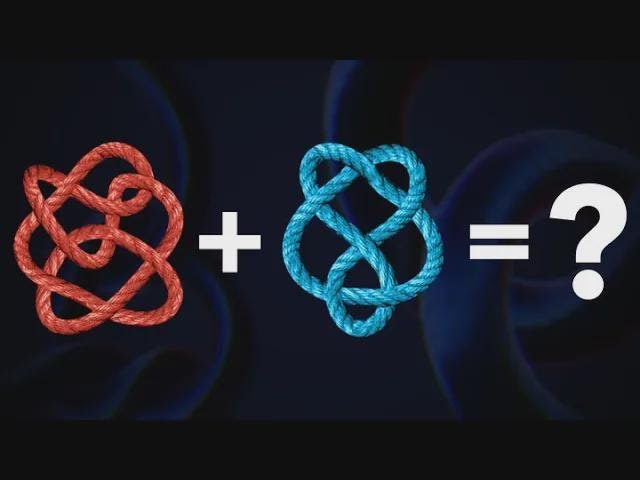
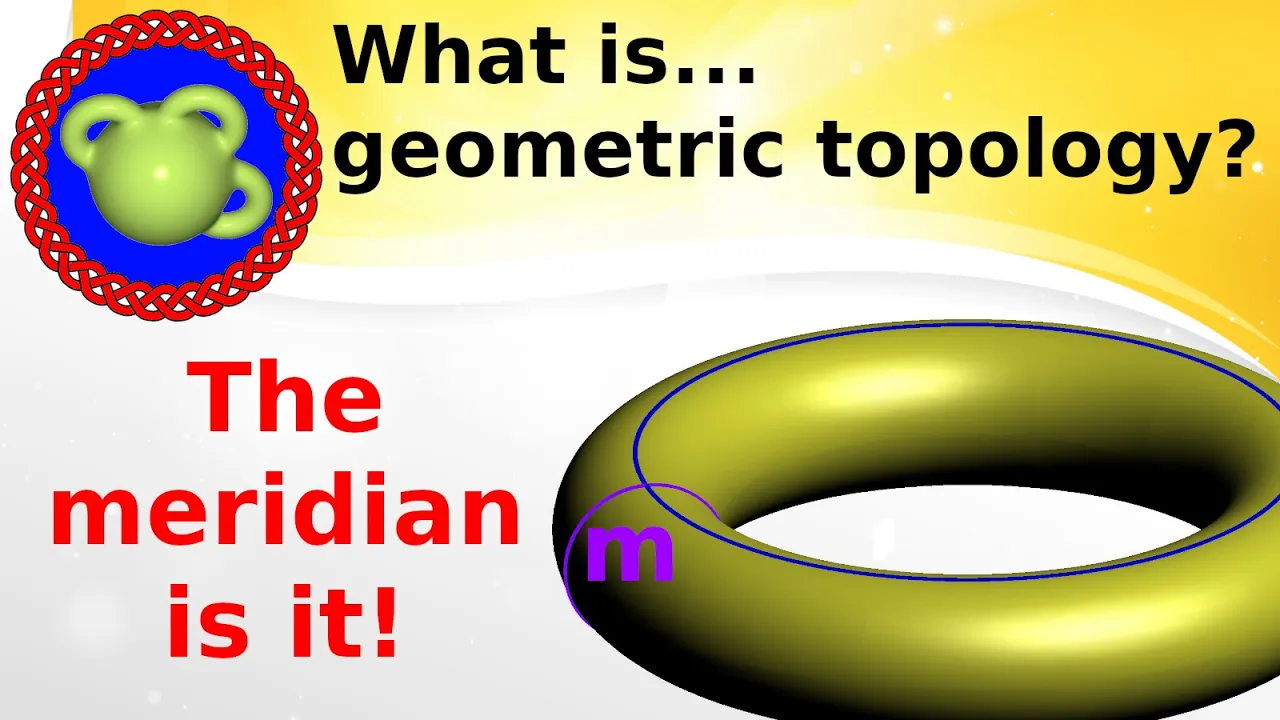

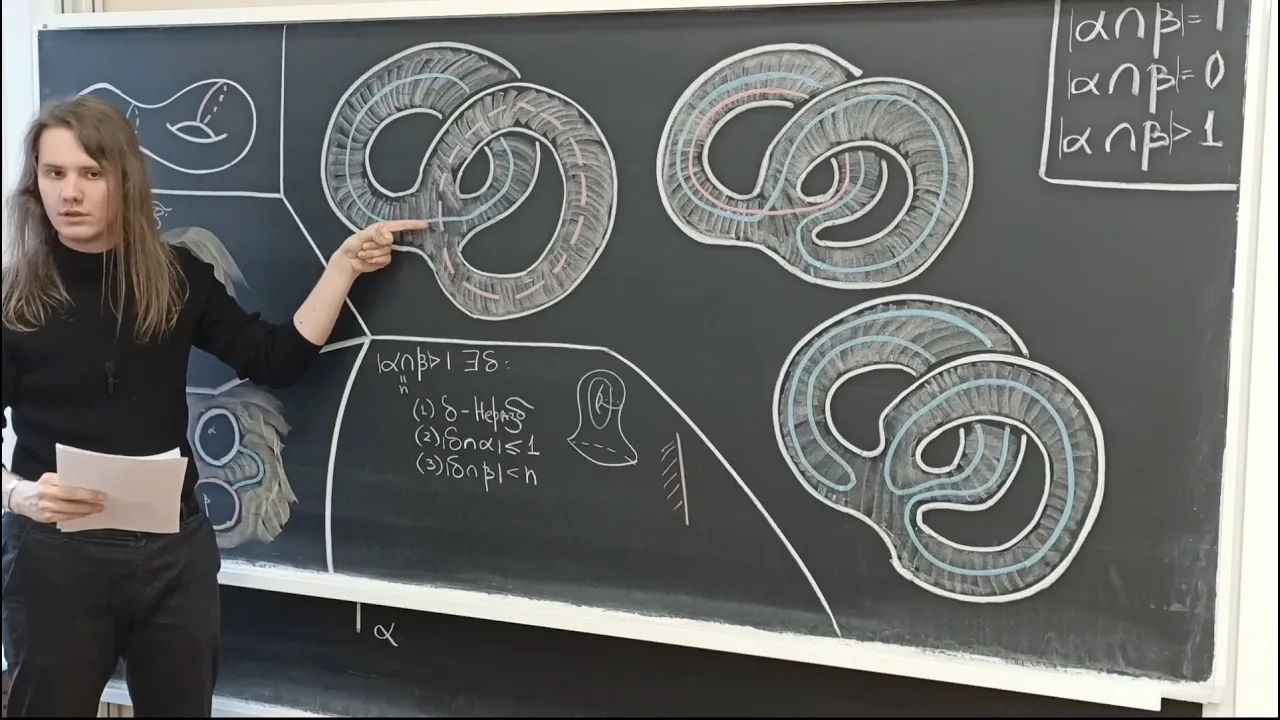


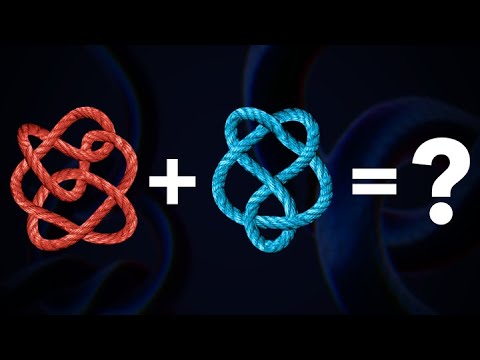
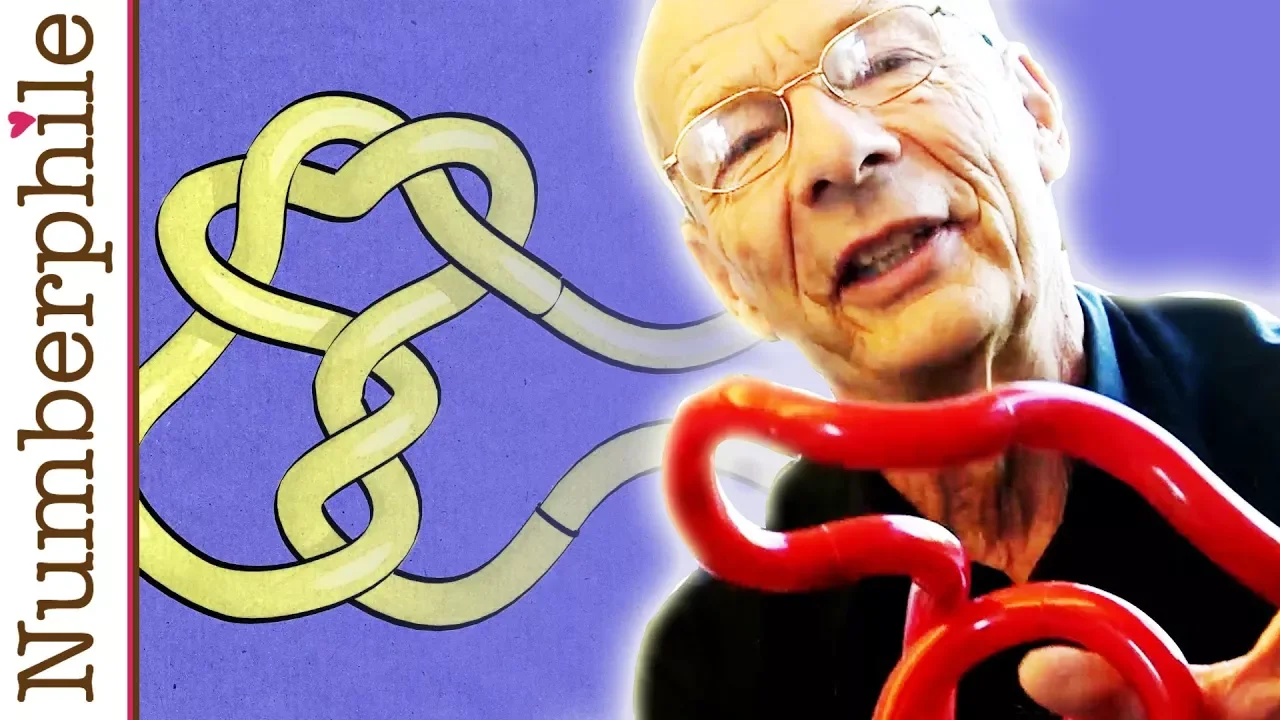
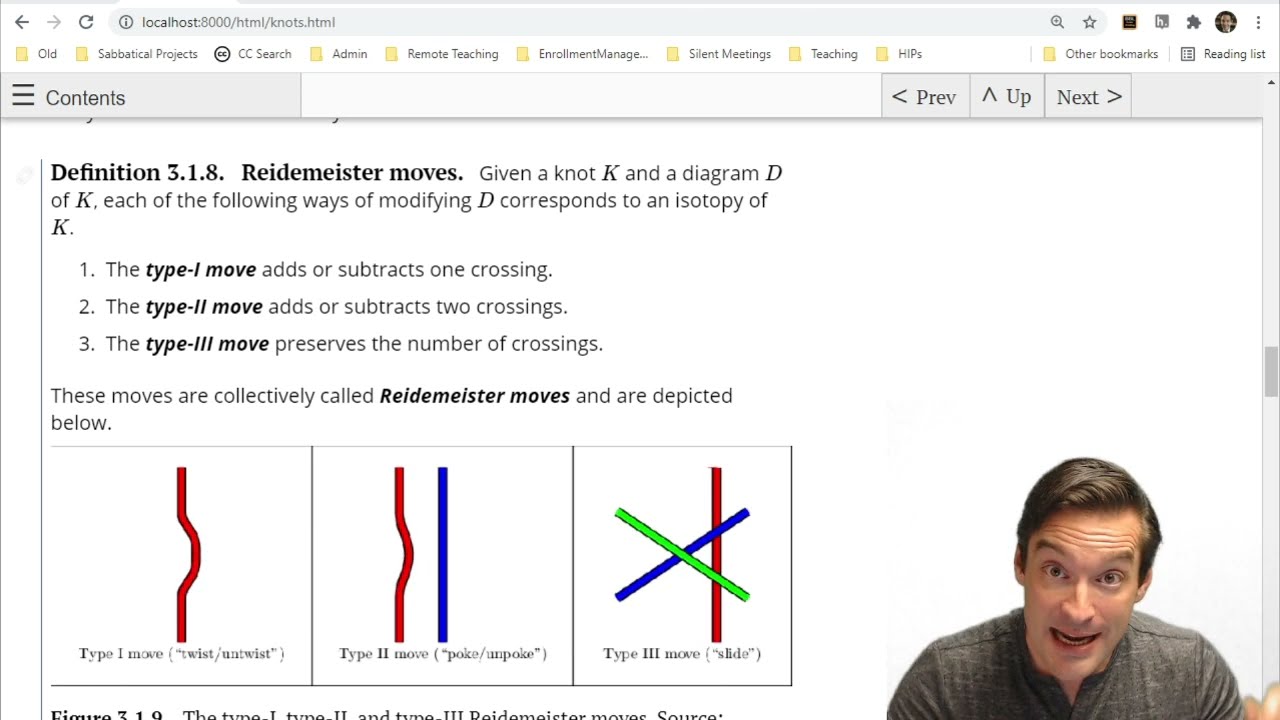
In geometric topology, a knot is formally defined as an embedding of a circle (S¹) into three-dimensional space (ℝ³), but to make the theory tractable and avoid pathological counterexamples like wild knots with infinitely many knottings, mathematicians typically restrict their study to polygonal knots—piecewise linear embeddings of polygons—which are equivalent to tame knots that can be thickened to solid tori. Knots can be studied either geometrically as three-dimensional objects or diagrammatically through their projections onto two-dimensional planes, where equivalence is determined by Reidemeister moves (R0, R1, R2, R3), allowing mathematicians to distinguish between different knots using combinatorial invariants.
What Are Knots? An Introduction to Geometric Topology
Added:Basic concepts of topology, specifically the informal idea of 'rubber-sheet geometry' and how topological equivalence differs from geometric rigidness.
The concept of mathematical dimensions, particularly visualizing 1D curves embedded within 3D Euclidean space.
The mathematical definition of a closed loop (a topological circle) and the concept of an 'embedding' (injecting one space into another without self-intersection).
An intuitive understanding of functions, mappings, and the concept of continuity.
Reidemeister Moves, which are the three fundamental local operations on knot diagrams that preserve the underlying knot's identity.
Knot Invariants, including algorithmic tools like tricolorability, the Alexander polynomial, and the Jones polynomial used to prove two knots are distinct.
Dehn Surgery and the topology of 3-manifolds, exploring how drilling out knots and gluing them back in shapes higher-dimensional spaces.
Physical applications of knot theory, particularly in molecular biology (DNA replication and supercoiling) and statistical mechanics.
1K views36likes12:26Original Release: 2022-08-09
okay welcome everyone to my continuation of what is geometric topology we start off easy today with uh knots uh which i'm going to explain and how to define them properly uh it's kind of a little bit painful you could find not quite surprisingly painful to define something simple as a knot um but i would like to do it because knots are cool in other words why not right so it's the usual joke why not i hope i'm not going to do this job all that often but once i definitely need to do it once so why not why not studying knots yeah exactly um so here's the main idea and what i'm going to try to to cover are basically a few not environments and then maybe a few applications and eventually these knots will play a huge role in constructing higher dimensional manifolds um and we can also think of them as surfaces and so on we'll see some kind of fun stuff uh but today just a knot is something very simple it's a string uh in three space whatever three space means three space can means r3 like in all the pictures i'm going to show you or it's s3 which is just r3 and the compact fight at one point at infinity you just bend well basically this idea this is r and you can go to s1 by just bending the two sides together and just put them together at the point at infinity and you could try to do the same in high dimensional spaces and yeah you can go from r3 to s3 but anyway so let's today just think about r3 so not to something like this picture here i really like this picture and what we can try to study is the knot as a knot which is a three-dimensional object or we can try to study knots by looking at their projections which has these shadows that you see here so a knot can have different shadows so this a little bit more crazy not actually it's a knotted protein so protein can form knots as well and again in kind of biology or wherever you study proteins i actually have no idea but anyway so in biology you will see again shadows of the protein and you need to do some not theoretical techniques to distinguish well different kind of proteins or to read off their properties or whatever so this is the knot let's call it k and this is another protein let's call it k basically it's a multi as well and well that's basically it so it's a string that you put into three space and you would like to um identify its ends i'll show you in a second why you need to identify its ends but basically is is your computer cable that is knotted in free space so here's why you really mathematically speaking want to identify the ends or at least or to fix them somehow because otherwise you could just undo all knots um here's an animation that i like a lot uh it's produces mathematica it will create a knot for you a highly non-trivial knot but it won't close it and as soon as you don't close it or kind of to fix the two ends of the knot you can always undo it as you will see now so mathematica here produces a knot which is definitely highly non-trivial not a lot of not muttings and as you can see it doesn't close it and as soon as you can't do don't close it you can undo it continuously without breaking operations or whatever um and that's not what we want and that's the real reason why knots are closed circles and not what they are in real life like cables that are not but that's kind of a tactical glitch it's totally fine and i do that all the time to think of notes as being cables that are not but anyway so making notes precise is a bit annoying so let's have a look actually uh it's not so bad as long as you don't want me to prove anything because that's a bit annoying yes i said it's not hard but it's annoying um so basically what you need to do because we are doing topology and there are just some crazy counter examples everywhere just like everywhere everywhere counter examples you kind of embedding in a knot is just an embedding of s1 into three space a circle into r3 it's not quite what you what you want to do you get some crazy counter examples that i'm going to show you on the last slide what you rather would like to do is and that's what we will do in the sector series we only consider not set equivalent to a polygon so here's an example so this is really what you should think a lot is but secretly i'm only working with those guys here um i will get rid of this description in a second but basically it's a polygon and it's a knotted polygon in three space again uh which is not quite the same as not it's a more restricted notion but this is what i recall or not and the point is as soon as you restrict your setup to those guys you can talk about nice projections so they have nice regular projections without silly points so you can think of a projection which has some stupid triple points or even worse and you can just slightly uh value them slightly twiggling them and you can get rid of the stupid triple points or the worst points and to ensure that this works in general you kind of want to have those slightly restricted notion of a knot so secretly here a knot is always a polygon um it's still not it in three space but it's it's a polygon and the point where i would like to do this is that it's equivalent to the following description that's kind of what's kind of a geometric description of a knot and now comes the diagrammatic the shadow description of the knot and what we can do is we can just think of a knot as being a projection right so define the knot as being a projection it doesn't quite work because two different knots certainly can have different one nodes can has different projections so two different projections can correspond to to the same knot so we need to correct an equivalence relation on knots and it turns out that these are the to moves uh so r0 r1 are like writermeister are two uh three and they're really really simple like r2 is just just put one string on top what's over the other just pull it over the other and you can undo it uh r1 is something like an i'm kicking operation getting rid of this little king here and r3 is just value of the 20 and on uh in the front and you can just pull it downstairs and that's it and the point is that this is enough so if i would def i'm doing it right now i define a knot as being a projection which is easier to think about it's a two-dimensional object and it's modulu these relations are randomized one two and three and the often forgotten randomized zero relation which is an isotopic so you can basically straighten and move around strings and that's what i can do i can define the knot in this way and those two pictures are basically what i'm going to work with a geometric description of a knot which is not quite the same i say it again as just putting it in three spaces it doesn't quite work we'll see in a second why and this a diagrammatic description of a knot and then you could think of well did you certainly have something um diagrammatic invariants for example associated to a northwest workforce randomized that moves or your geometric uh invariants associated to north which work as with the knot itself in street space but the point is under the correct notion of equivalence for polygon knots which basically is something like if you have something like this a little polygon like this and you have a full triangle that you could put here in three space and you can straighten it out and it's just a polygon like this something like that so the appropriate equivalence of polygonal nuts and you can show that's written master theorem and it's equivalent to the combinatorial description of mods in other words we have now two different ways to think about knots and if you want that's why you want the polygonal description of notes because the shadow description is just so powerful as you will see and the main task of not theory which i'm going to address in the first few videos in this video series is to kind of distinguish knots and that's as i said usually not very easy because one shadow can represent two shadows can represent the same knot in this case he has a very silly shadow which is just a circle as a shadow in r2 and there's a little bit of a more complicated shadow there's this beast here and there's the same actually and it's not so easy to see that they are the same so um what you really want is some kind of way to tell whether two diagrams present the same not or not and that's what's called not invariant right so you just want to look at the diagram combinatorially and just tell the diagram has an associated number five and this would tell me it's not number five on his own list for example it's not as easy as just not number five on the third list but roughly that's what i have in mind and i should have said actually that projection here as a shadow really means i take care of which strength went over and which strength went under so it's not really a projection it's kind of a label projection if you want but um i will always draw those diagrams here anyway and you will always see visually see uh which side goes over and which strength goes under and it's kind of a funny fact of our brains is that kind of as long as the picture is not super super complicated like like this one here actually it's not so hard to imagine a three-dimensional picture doing the same for example here this is kind of easy to imagine in three space it's a very knotted diagram a slight comment here is like catch something i always hate and i have no idea how to avoid it so i just don't avoid it i just don't think about it at all um so there's a different notion it's called the link and that's just a not with two components something like this beast here which is called the hop fling uh or this beast here and i just hate the fact that they're not just all support knots they're just not and the only the only solution i know reports for myself is that i just ignore their quarterlings and i call them notes anyway so if i say nots i implicitly uh almost always unless i specified otherwise uh almost always i also include links as well just just that's just a little bit silly uh but maybe it's silly of me i should just say leans from the beginning you might say but i kind of feel like notice a more well-known word and it sounds correct to me while link is a little bit like a made-up word i don't know um but anyway i will just say not i hope that's that's okay and it works for you as well anyway so let's come back to uh this description of and also of course i told you we want it because it's equivalent to the combinatorial description but there's a top well topological geometric reason why you actually want that and if you just think of an embedding of s1 into whatever three space or whatever you want to embed it in this gets pretty crazy you can have what is called a wild knot so basically a knob with infinitely many knottings that kind of converge up to a certain point and these are really really bad so kind of they ruin almost all of your theory there's a theory of wild knots which is not as far as i know not really well developed um but at least for this video series and for most uh parts of not there we want to avoid them and the way to avoid them is to just make them polygonal and then you're good because um in the end what you want is what is called a tame knot and i'm going to use that several times and a tame knot is something that you can thicken up to a taurus and then it's really an embedded taurus um in three space and tame knots is again one of these equivalences is the same as polygonal nodes that's why we really want polygonal knots because those wild knots so not tame equals wild they have some pathological behavior which we just don't want just it's just painful painfulness we don't want it so we roll it out as usual trick in various parts of mathematics and topology in particular because if you just consider topological spaces there are just so many crazy topological spaces and there's almost nothing you can say so you restrict your class appropriately such that you can kind of get rid of all the crazy counter examples and only have some nice spaces left and that's what i'm doing here and that's why we consider polygon elements anyway i hope you enjoyed the video and also to see you next time
Up Next
24:03
What Linear Algebra Is | Machine Learning Foundations
@JonKrohnLearns
206.6K views•2020-07-09
4:43
Elliptic Curve Cryptography Explained: ECC, ECDSA, ECDH
@PracticalNetworking
28.5K views•2024-10-21
20:20
Normal and Separable Field Extensions Explained | Abstract Algebra
@VisualMath
957 views•2021-07-13
6:00
The Mathematical Impossibility of Accurate World Maps
@Vox
23.3M views•2016-12-02
Related Study Plans & Knowledge Roadmaps
Structured learning paths in Mathematics
mathematics
Tensor Calculus: Vectors to Riemann Curvature
01Mathematical Foundations: Linear Algebra & Calculus
02Covectors, Dual Spaces, and Tensor Basics
03The Metric Tensor and Index Gymnastics
+ 2 more learning modules
40h5 modules
Explore Roadmap
mathematics
Gödel's Incompleteness: Logic, Proofs & Limits
01Introduction to Formal Systems & Hilbert's Dream
02Set Theory, Cardinality, and Cantor's Diagonal Argument
03Arithmetization and Gödel Numbering
+ 2 more learning modules
14h5 modules
Explore Roadmap
mathematics
Galois Theory: Fields, Groups & Solvability
01Foundations of Abstract Algebra: Groups & Fields
02Polynomials & Field Extensions
03Splitting Fields & Symmetries
+ 2 more learning modules
24h5 modules
Explore Roadmap
mathematics
Non-Euclidean Geometry: Models & Geodesics
01Euclid's Fifth Postulate and the Birth of New Geometries
02Hyperbolic Space and the Poincaré Disk Model
03Geodesics: Defining Straight Lines in Curved Spaces
+ 2 more learning modules
15h5 modules
Explore Roadmap