













![МАТЕМАТИКА МОЖЕ ВРЯТУВАТИ ВАМ ЖИТТЯ 🤯 [VERITASIUM]](https://i.ytimg.com/vi/c6zxT14L-G8/maxresdefault.jpg)




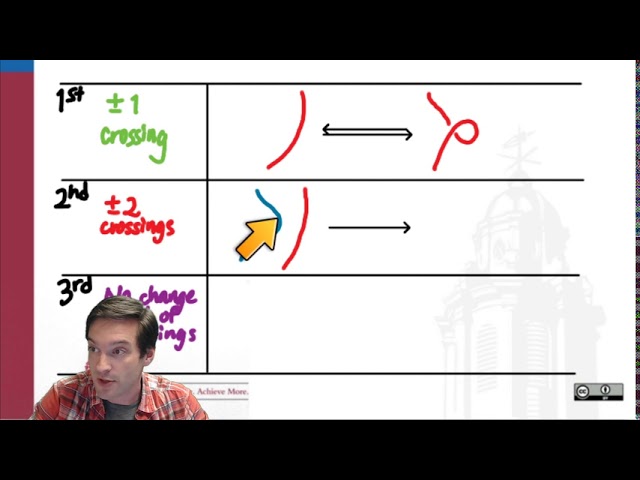
In knot theory, any two diagrams of the same knot can be transformed into each other through a sequence of three fundamental moves called Reidemeister moves: Type I (adding or removing a single crossing by twisting a strand), Type II (adding or removing two crossings by creating a 'sheet bend' and passing it under or over an adjacent strand), and Type III (sliding an arc that passes under or over both strands of a crossing from one side to the other). These moves, proven by Kurt Reidemeister in 1927, are the only ways to change a knot diagram that correspond to isotopies (continuous deformations) of the underlying knot in three-dimensional space, providing a complete characterization of when two diagrams represent the same knot type.
Knot Diagrams and Reidemeister Moves Explained | Isotopy and Invariants
Added:Basic concepts of topology, specifically continuous deformation, homeomorphisms, and the properties of topological spaces.
The mathematical definition of a knot as a continuous, non-self-intersecting embedding of a circle in three-dimensional space.
The intuitive and mathematical concept of ambient isotopy, which formalizes the idea of moving a knot without cutting it or letting it pass through itself.
The translation of 3D curves into 2D regular projections, including the concept of crossings (overcrossings and undercrossings).
Specific knot polynomials, such as the Alexander Polynomial and the Jones Polynomial, which use Reidemeister moves to prove their invariance.
The concept of tricolorability and n-colorability as simple combinatorial invariants of knots.
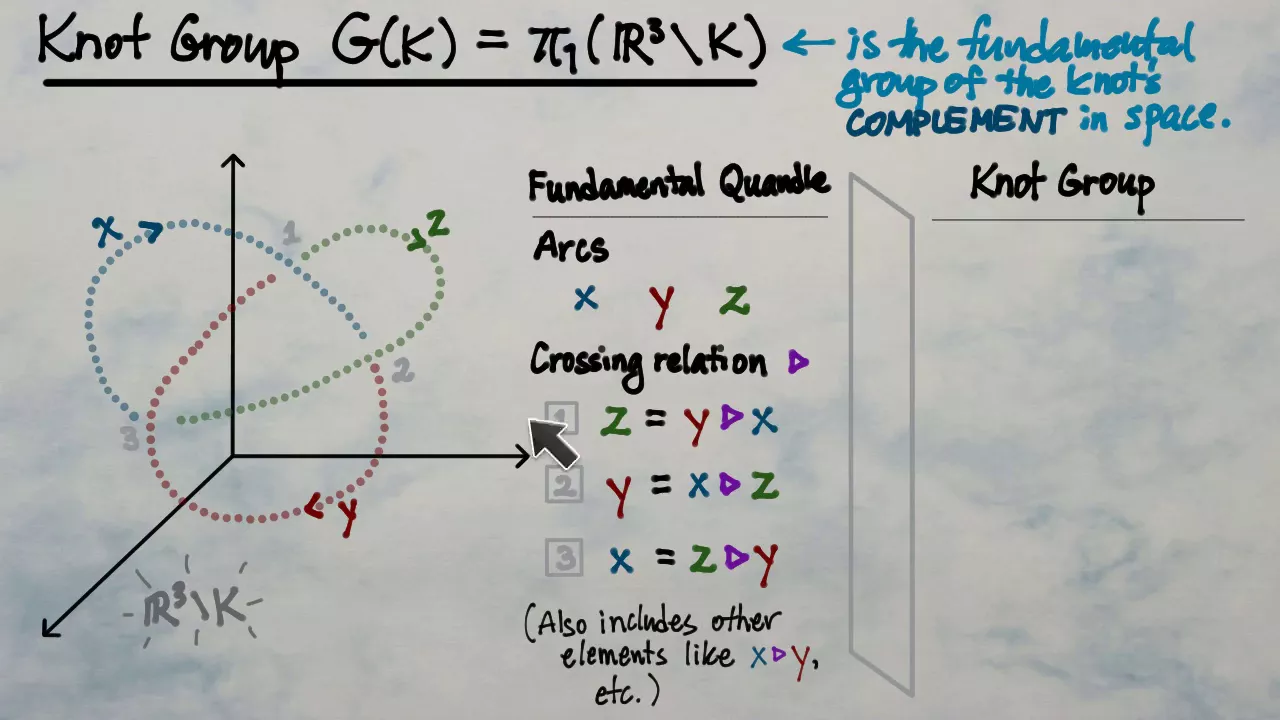
The algebraic structure of knots, specifically the fundamental group of a knot complement (the knot group) and the Wirtinger presentation.
Applications of knot theory to molecular biology, such as understanding DNA supercoiling, replication, and the action of topoisomerase enzymes.
1.1K views23likes18:53Original Release: 2021-07-29
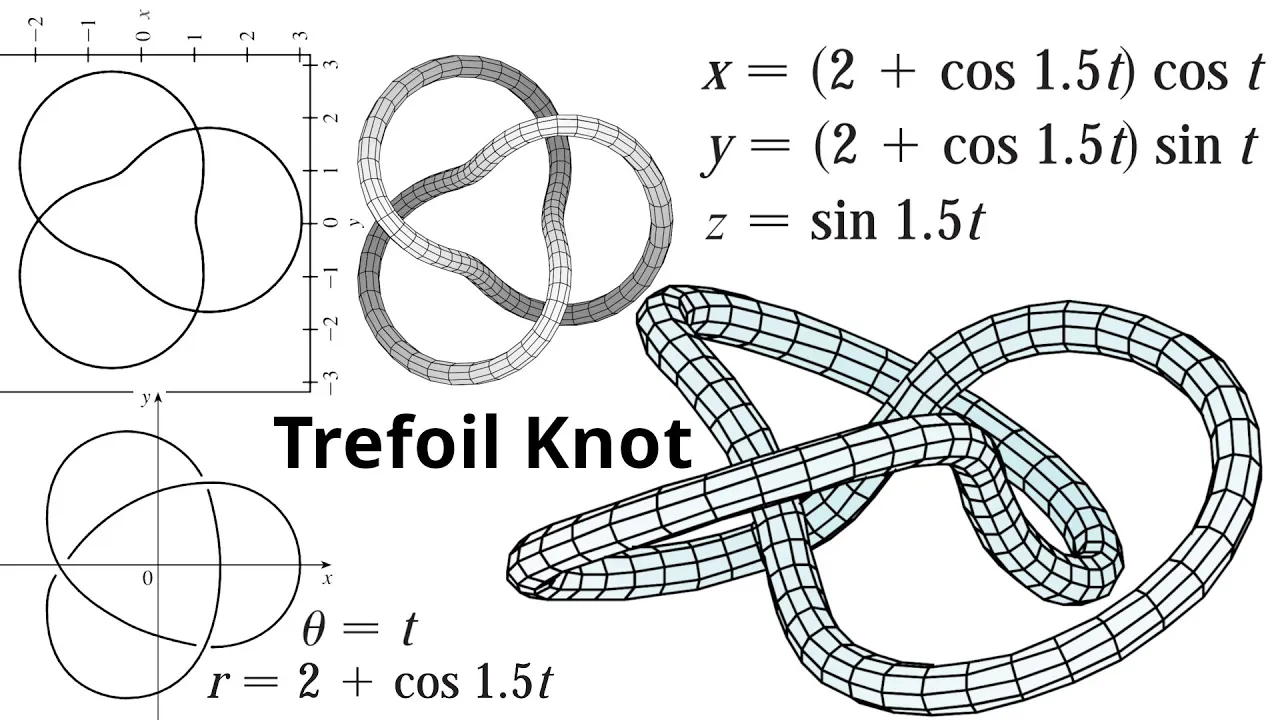
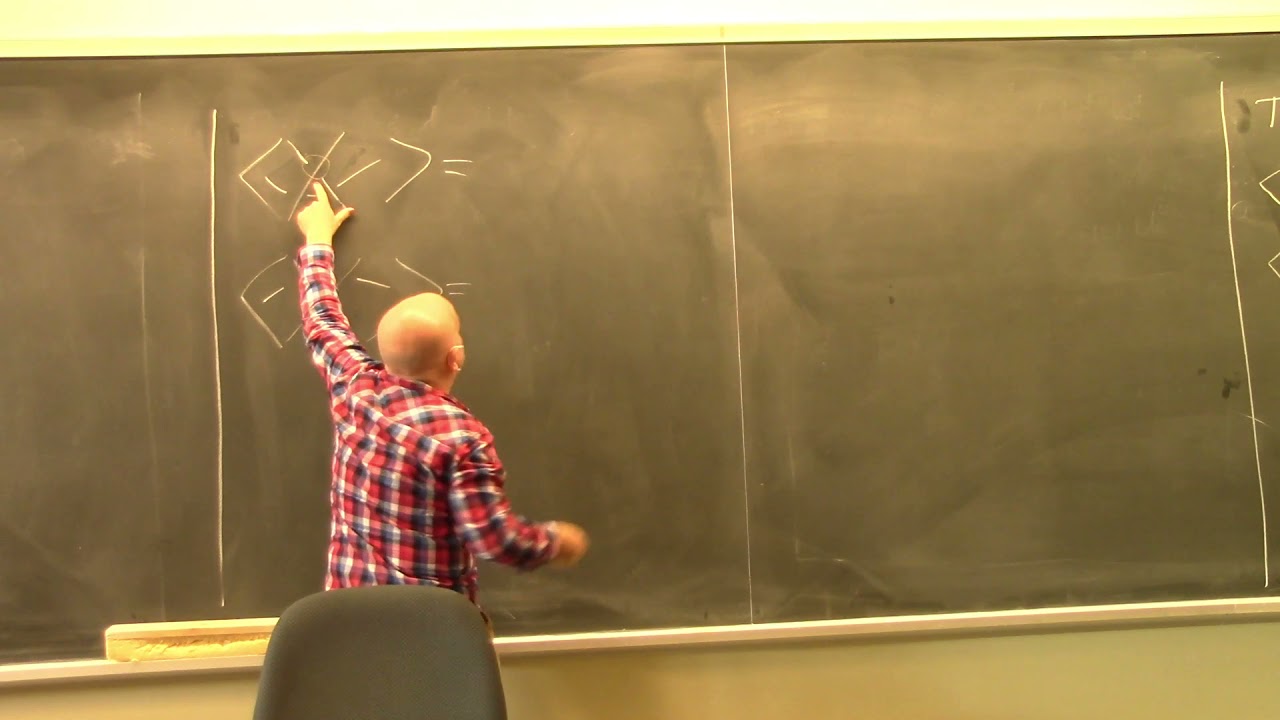
so given that us the same knot can have sort of infinitely many different diagrams that can represent it we want to we want to to reclaim diagrams somehow we want to we want to see them as something that's intrinsically valuable we want to be able to study knots using their diagrams but in order to do that we're going to have to get a little bit more specific about how all of the different diagrams for a given knot what all of them have in common what all of them must have in common any property that all of the diagrams of a given knot must have in common is called a not invariant and so not invariants for us today are going to be our goal the thing that we're going to try to get to and so to get us a little bit closer to not invariance let's start by studying the simplest knot in the universe called the unknot the unknot by definition is any not which has a diagram with exactly zero crossings in it so as you might imagine an unknot probably looks something like this right it's not knotted whatsoever and yet it still meets the mathematical definition of being a knot so go figure but we call it the unknot because there exists a diagram of it that has no crossings in that diagram whatsoever of course there exist a bunch of other diagrams for the unknot that have multiple crossings in them like here's one such example right i didn't i didn't untie this thing to make this diagram i just took my unknot in space and i just sort of bent it around a little bit you know smoothly changed it from one place into another place perform what we came to know in a previous week as an isotope right an isotope of a knot is just any way of sort of pushing it around inside of three-dimensional space without breaking it without untying it and re-tying it whoops this one just came apart but you get the picture right so clearly i can make really complicated diagrams of an unknot just by taking an unknot and sort of wadding it all up making its arcs and crossings all over the place i start with a big unknot i can do a lot of different stuff to make a more complicated diagram for myself right i can loop this thing around itself a bunch of times can create a whole bunch of arcs and crossings that we didn't have before right and you could imagine that if i sat down and i sketched out a diagram for this thing that i'm looking at it's going to have i could barely even count maybe like 12 crossings or something and you know 10 different arcs who knows right um and so the question of course is if you gave me that diagram would i be able to tell that in fact it was the diagram of the simplest not in the universe the unknown so this is going to be an opportunity for you and your team to kind of take that wadding up process that i just that can make a diagram more complicated and make it a little bit more systematic so in this activity what i want you to do is start with an unknot and this one really does work best if you have a physical copy of i'm not in front of you and perform an isotopia on your knot to discover and sketch a diagram of it that has exactly one crossing so that's where we're going to start right go from zero crossings to one crossing and sort of describe what it was that you did what isotope is it that accomplishes that then return back to the beginning and perform an isotope to discover and sketch a diagram that has exactly two crossings so what isotope would would result in adding two crossings to your diagram and then this is probably the trickiest one what i'm asking you to do here is to return to the braid relation back from section 2.1 that was this formula here the s i s i plus 1 s i equals s i plus 1 s i s i 1. this was the tones to notes bradogram that we had in the very first chapter back in activity 2.1.2 you came up with that braid relation so go back to your tones to notes sketch and see if you can figure out what isotope of a diagram for a knot for example would be used to establish that this one's going to be a little bit harder to describe so sketching pictures of it is probably the best way to do it so start with a diagram of your unknot that has three crossings or more in it and see if you can figure out how to use that tones to notes three-strand isotope to change the diagram in a meaningful way but not actually change the underlying knot that's underneath it so in this exercise you're just coming up with three different ways of manipulating your knot either add a crossing add two simultaneous crossings or to sort of manipulate a region that has three crossings in a way that reflects that braid relation so i want to give you a good 15 minutes to do the work on this and then we'll come back and discuss what you found but this ties right back into the discussions we had about braids and the discussions we had about permutations so definitely do look back at your uh your responses to those activities as you're doing this one so the task was to start with an unknot and then figure out some ways of adding either one crossing or two crossings to this diagram without changing the fact that we're looking at a diagram of an unknot so the first thing that you notice is that there's a quick way to add a single crossing it's just to kind of do this right make a little figure eight loop like that we do that we get a new diagram of the unknot that has a single crossing in it so i think that we can agree that if ever we see something that looks like this in a diagram we can simplify that diagram without changing the knot itself just by kind of untwisting that knot right and and ending up with a diagram that has fewer crossings than it did before so this is one way that we can kind of add or subtract a crossing from a diagram it's just to create one of these little loops um there was an interesting thing that happened on the second part where i asked how can we create a diagram with two crossings instead of one because certainly one way to create a cross to create two crossings in an unknot is just to do this thing that we did to create one crossing and then just do it again so make a loop and then make another loop see if i can get this to actually lie down here of course this shoelace has like a permanent kink in it so it really doesn't want to cooperate maybe if i do it sideways so create one loop and then create another loop there we go nope it doesn't want to do it all right i'm going to use the beautiful diagram that your team team number two here is sketch so this diagram here in part a this is this is one way to do it do two of those same twists in a row we create two crossings only by doing that same maneuver that we did to create one just doing it twice in a row but there's another and fundamentally different way of achieving the same end and this is the other team's diagram of what that looks like in this example what we're really doing is we're kind of we're doing a twist in one direction to create a new crossing but then the second twist that we add we're doing kind of in the opposite orientation as the first one so in total what we're kind of doing is making a little sheet bend in my knot and then just sort of pushing that sheet bend across one of the other arcs in my diagram so that what i'm looking at here in my diagram is kind of two crossings that both kind of look like over so they both kind of look like unders in a row in this example if i look at the east to west strand in my diagram that east to west strand is passing over and then over again the crossings that it's encountering right and so if i look at this i can say well i can remove both of those crossings at the same time just by performing an isotope that looks like this just slide out the underneath strand from the stand that was going over it and now we have our zero crossing and not back again so that is a fundamentally different way of creating or destroying two crossings at the same time besides just creating one crossing and then doing that same thing to create a second crossing um so that accounts for the the first two of these diagram maneuvers that we can use to simplify a not diagram if i ever see a place on a knot diagram where we have a figure that looks like this where we have two crossings that are both overs or both unders in a row or something like that then we can simplify that diagram just by sliding that sheet bend out from underneath the other one and so the tricky one of the bunch is the one that i was trying to get us to get to in question number three which is what does the tones to notes braid relation what can that kind of tell us about about diagrams for knots so back when we first were talking about positive braids um we were able to convince ourself that the braid diagram on the left here which exchanges the first and third positions in a five strand braid right the t and the n trade places in the word tones and we get notes at the end and we make it all into a positive braid and we found out that this diagram on the left and this diagram on the right really should represent the same braid there should be an isotopy of braids that connects this one to that one and the reason is that there's this one strand it's the t strand which is lying on top of both the o strand and the n strand that are underneath it so if i could just grab a hold of this t strand and slide it to the south and west and slide it to the other side of this o n crossing i'd get a new diagram that looks like this one the t strand is still passing over the o and the n strand and the o n crossing is still a positive crossing right but when i read the braid language for this i'm seeing s2 s3 s2 in the first case but s 2 s 1 s 2 in the second case no i guess it's 1 2 1 and 2 1 2. sorry so the braid language is different right but there is an isotope between these two braids so what might that look like with our unknot this was the the tricky part of where i was trying to get us to and i just don't think i need to maybe phrase this question differently in the future but i think the closest that we got is one of one of your teams figured out we can make a diagram of the unknot having three crossings it looks an awful lot like the trefoil and one way that we might do it is by first creating a single crossing by doing the thing we did in part one just just make a twist and then i can sort of take this loop it under itself and pass it underneath the other bend over here so what i get here of course i'm still fighting against this permanent kink in my shoelace see if i can straighten it out a little bit so again we'd make a twist to create a single crossing and then we sort of pull that loop underneath the opposite side so we're sort of sticking together a move of the first type with a move of the second type and so we get this new diagram all right this looks kind of like what we're trying to see here we get a new diagram that has three crossings and it looks an awful lot like a trefoil but we know it can't be a trefoil because i didn't untie and retie this thing i just started with an unknot i created one new crossing by using the first move i created two more crossings by using the second move and i get this diagram i'm going to try and work with the sketch that team 2 used for this situation here so in the tones to notes example what we were doing is taking a string that lied over two other strings and just sliding it back over to the other side of another crossing right so i'm going to try and notate that on this diagram i'm going to take this strand right here this over strand and i'm just going to move it over to the other side of this crossing i'm just going to pull it out if i were to do that my this crossing is now going to be on the other side of that strand so let me try and sketch that crossing in first so it's got kind of this geometry going for it but now my red strand has moved over to the other side of it um yeah i think i can just use it that way right so my old red is now my new red over here on this side so again all it took was to do an isotope i just took one of these over strands and just moved it back over to the other side of its adjacent crossing and i end up with something that only has this one twist in it and so i guess actually i moved this a little bit too far let me try and draw this in a way that illuminates hopefully even a little bit more what i'm trying to communicate here if i were to really do this the way that that the diagram kind of shows here's what would end up happening i would end up with something looks more like this uh nope it's an over sorry i'll get this right one of these times [Music] so it needs to be an over strand still so it would look something like this because i also need a loop on this side there we go so this is more what i had in mind because we both begin and end with a diagram that has three crossings in it right the only thing we're doing is we're moving this one arc from the left side of this crossing over to the right side of this crossing right and so it still has two more cross you know there's still two more crossings with these arcs after we move it over to the right but all we're doing is moving the location of that strand start with three crossings end with three crossings but we've pushed this red strand the over strand from one side of this crossing over to the other side but now in this format i think it's easier for us to see why this thing actually is an unknot if i wanted to unknot this diagram over here on the right i can notice that each one of these three little loops is just an isolated loop of the kind that we sort of convinced ourselves in the one crossing example was a trivial matter right this one single little loop with itself is something that we can always just kind of untwist so if i wanted to actually untwist this diagram all i would have to do is kind of untwist each one of these by itself and that would give me zero crossings left right so what's the point of all of this work that we just ended up doing the point of all of this is that we discover these three different moves that we can use to change the diagram of a knot that actually correspond to isotopes of that knot and so they're not actually changing the knot itself they're just changing the diagram in one case they're changing the diagram by either adding or subtracting one crossing by just doing this little twist or untwist maneuver this was the first example that you did this is called the twist move or sometimes it's called the type one move that either adds or subtracts one crossing from the diagram the second where we make this little sheep's head and then pass it underneath or over an adjacent strand right this is called sometimes a poking or an unpoking maneuver in a diagram it adds or subtracts two crossings but it doesn't change the knot because it's an isotopy right that's called the type two move and then this third one this was the most challenging one the one we just finished talking about doesn't actually change the number of crossings but it can move an arc which passes under or passes over both of the strands of a certain crossing from one side of that crossing to the other side we call it a slide it doesn't change the number of crossings of the diagram but sometimes it can make the diagram simpler to understand as it did in this example where we started with something that looks an awful lot like a trefoil but after we do that slide maneuver with this arc and push it over now all three of my crossings are isolated all of them are just single twists that we can then use a type one move to untwist so these three diagram maneuvers are ways of changing the diagram of a knot without changing the knot type itself because they correspond to isotopes they're called the ridemeister moves type one move type two move and type three move and we can use them to simplify diagrams to reduce the numbers of crossings try and understand what is the simplest possible number of numbers of crossing for a diagram or sometimes it's possible sometimes it's useful to actually use them to add crossings because sometimes that actually helps to illuminate the structure of a knot later on down the line but what's wonderful about the ridemeister moves is that the the main theorem that kurt reitemeister approved um in 1927 he was one of two mathematicians who proved this result kind of within one year of each other and somehow he got it named after himself and i don't remember what the other folks were named um i can look that up but what he proved is that these three moves are in fact the only ways of changing a knot diagram that correspond to isotopes of that knot in other words any two diagrams of the same knot will be related to one another by some combination some sequence of just these three moves so if ever in doubt with whether one or two diagrams of a knot represent the same knot they represent the same knot if i can change one of those diagrams into the other one by doing some sequence of these three maneuvers i might have to do a lot of these maneuvers to do it and it might be impossible for me to tell which ones i need to do in which order this is a very computationally difficult problem but rydermeister's triumph here is showing that even if it would take a computer a million years to compute it any two diagrams of the same knot could be said to be the same diagram of the knot because they would be related together by some possibly long sequence of these three maneuvers so this is the open and shut case these are the only ways we can change knot diagrams that correspond to isotopes of that knot and so they represent the same knot
Up Next
50:51
Knot Theory 1: Coloring, Equivalence, and the Trefoil Knot
@MathatAndrews
37.2K views•2019-01-09
4:43
Elliptic Curve Cryptography Explained: ECC, ECDSA, ECDH
@PracticalNetworking
28.5K views•2024-10-21

9:41
Tower Law in Field Extensions | Degree Multiplication Theorem
@MatthewSalomone
5.7K views•2014-04-10
6:00
The Mathematical Impossibility of Accurate World Maps
@Vox
23.3M views•2016-12-02
Related Study Plans & Knowledge Roadmaps
Structured learning paths in Mathematics
mathematics
Tensor Calculus: Vectors to Riemann Curvature
01Mathematical Foundations: Linear Algebra & Calculus
02Covectors, Dual Spaces, and Tensor Basics
03The Metric Tensor and Index Gymnastics
+ 2 more learning modules
40h5 modules
Explore Roadmap
mathematics
Gödel's Incompleteness: Logic, Proofs & Limits
01Introduction to Formal Systems & Hilbert's Dream
02Set Theory, Cardinality, and Cantor's Diagonal Argument
03Arithmetization and Gödel Numbering
+ 2 more learning modules
14h5 modules
Explore Roadmap
mathematics
Galois Theory: Fields, Groups & Solvability
01Foundations of Abstract Algebra: Groups & Fields
02Polynomials & Field Extensions
03Splitting Fields & Symmetries
+ 2 more learning modules
24h5 modules
Explore Roadmap
mathematics
Non-Euclidean Geometry: Models & Geodesics
01Euclid's Fifth Postulate and the Birth of New Geometries
02Hyperbolic Space and the Poincaré Disk Model
03Geodesics: Defining Straight Lines in Curved Spaces
+ 2 more learning modules
15h5 modules
Explore Roadmap