





![[GS#2] Théorie des nœuds (Introduction)](https://i.ytimg.com/vi/g7HSdT6-YJU/maxresdefault.jpg)
![МАТЕМАТИКА МОЖЕ ВРЯТУВАТИ ВАМ ЖИТТЯ 🤯 [VERITASIUM]](https://i.ytimg.com/vi/c6zxT14L-G8/maxresdefault.jpg)
![[London Learning Lean] Tori, by Amelia Livingston](https://i.ytimg.com/vi/A7DlX78ApCQ/maxresdefault.jpg)


![Узлы и косы [3] // Алексей Сосинский](https://i.ytimg.com/vi/ubqM1Frhz1s/hqdefault.jpg)

![Writhe, The Lost, Is Here - Don't Starve Together Guide [MOD]](https://i.ytimg.com/vi_webp/O6egTZmXWAM/maxresdefault.webp)

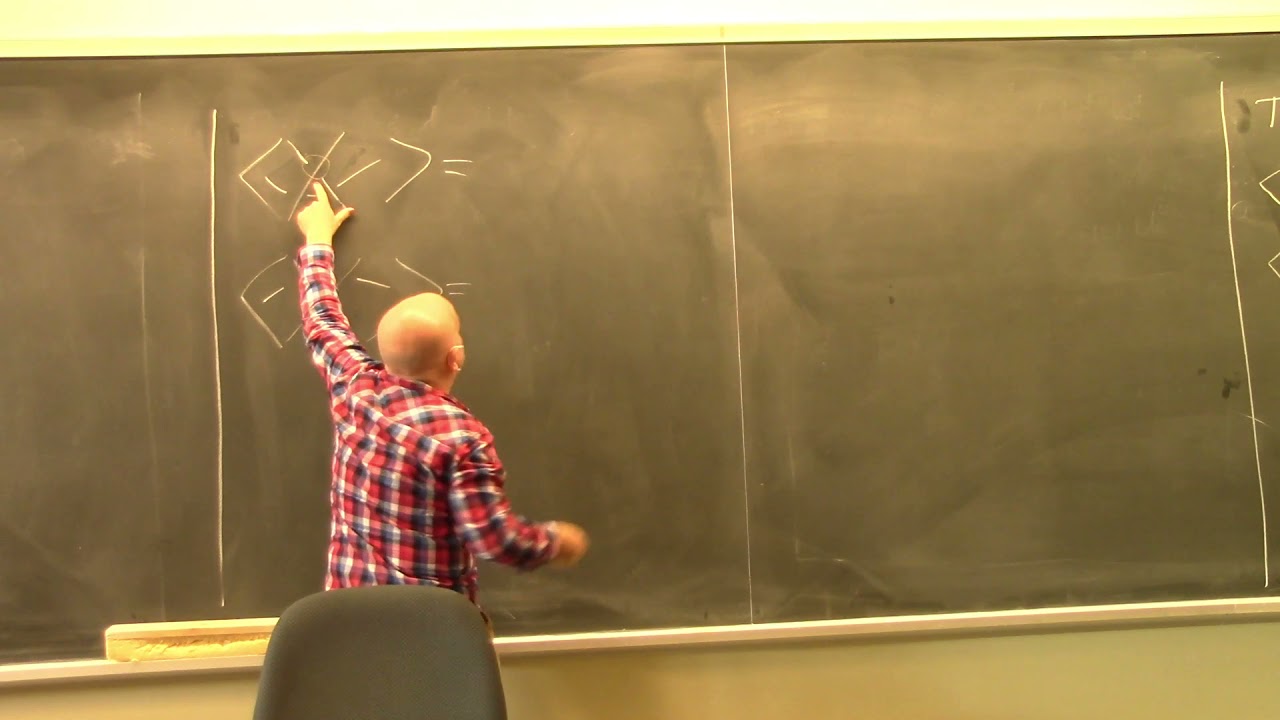





The Kauffman bracket is a Laurent polynomial invariant of link diagrams defined by three axioms: K1 states that the bracket of the unknot equals 1, K2 states that the bracket of a diagram union with the unknot equals the original bracket multiplied by (-a² - a⁻²), and K3 states that at any crossing, the bracket equals a times the positive smoothing plus a inverse times the negative smoothing; this bracket, while not invariant under Reidemeister moves, serves as a crucial tool for understanding the Jones polynomial by allowing the two invariants to cancel each other's changes under these moves.
Introduction to the Kauffman Bracket (Definition and Axioms)
Added:Basic Knot Theory Concepts: Familiarity with knots, links, knot diagrams, and crossings.
Reidemeister Moves: Understanding the three types of Reidemeister moves used to manipulate knot diagrams without changing the underlying knot.
Knot Invariants: The fundamental concept of a mathematical invariant and what it means for a function on knot diagrams to be invariant under ambient isotopy.
Laurent Polynomials: Algebraic familiarity with polynomials containing both positive and negative integer exponents, which represent the output of the bracket.
The Jones Polynomial: Learning how to normalize the Kauffman bracket using the writhe of an oriented link to construct the famous Jones polynomial.
Writhe and Orientation: Understanding how to assign directions (orientations) to knot components and calculate the writhe of a diagram.
Khovanov Homology: Exploring the categorification of the Jones polynomial into a richer, homological invariant.
Applications in Statistical Mechanics: Investigating the deep connections between the Kauffman bracket state-sum model and statistical mechanics models like the partition function of the Potts model.
5.8K views75likes9:57Original Release: 2015-03-11
hello and welcome to a mini lecture about the calman bracket um what's going on here is that uh we're moving towards the definition of the Jones polinomial and the way you define the Jones polinomial is you define two not quite inv variance of links one is the calman bracket that we're going to talk about now and the other is the Ry uh that we'll be talking about in the following week um now neither of these things is really an invariant you check how they change underneath the rizer moves and um they're not invariant they change however you can play the two invariants off each off against one another and uh make the way they change under the Romer moves cancel each other out anyway uh this is the cman bracket is the most difficult ingredient in the Jones polinomial so here's how we proceed with it so on the left we've got the definition and on the right we're going to do a little example so what's the definition the calman bracket it's written brackets d uh it's an invariant of a link diagram D so D is a diagram the calman bracket is going to change if you change the diagram by romed moves D is not a link it's a diagram okay the Cal bracket of this diagram it's a it's a laurant polinomial in some variable a um it's invariant under defamation of diagrams uh in the sense that if I change the diagram smoothly don't change the number of Crossings don't lift anything up or down um maybe rotate it maybe Bend things around a little bit as long as I don't change the crossing data and the arc data then the C bracket doesn't change and it's characterized by three axioms called K1 K2 and K3 so what's K1 uh it tells us that Cal bracket apparently my drawing skills are too poor uh K1 tells us that the Cal bracket of the onot is one K2 tells us that if I take a d and take its distant Union with the standard diagram of the unot sorry I should have said very carefully in K1 this symbol is not the unot it's this diagram of the unknot right okay so here in K2 if I take any diagram take its distant Union with the standard diagram of the unot and when I say distant Union I mean you draw a line in your plane your D is on one side of it your unot is on the other uh then the Cal bracket of that is just the Cal bracket of d Times by this thing - Aus 2 - a^ 2 and then K3 says that if we've got a diagram that's got a Crossing in it that looks like that then it's C bracket is a times the diagram that I get by smoothing The Crossing one way plus a inverse times the diagram I get by smoothing the crossing the other way um and so that's what's written down here these little symbols are diagrams uh represent diagrams that are equal everywhere except in some little region where they differ as shown so it's really important you're going to have to remember that there's no arrows going on on this picture right um so how do you know uh which way to go to get this thing which is called the positive smoothing and this one to which is called the negative smoothing well you just have to remember it sometimes somehow so this is the positive and this is the negative smoothings um so well if I Orient it if I if I rotate the page so that my up Direction uh would be giving me a positive Crossing if my uh orientations both went up then the positive smoothing is the one that lets me drive straight through what's left uh whereas uh the negative smoothing is the one that causes an accident okay so you simply have to try and remember this somehow in a way that you can live with um but let's actually leave this down here and let's draw some up arrows on it just to sort of make things clear so these are the up directions for us okay so let's work out the Calin bracket of this diagram of the hotlink well we're going to apply K2 K2 tells us uh that the C bracket of this is equal to the sum of the C brackets of the smoothings with those coefficients so it's going to tell us that we're going to get uh coming in One Direction let's do this this way it's can tell us we're going to get a times the thing smooth one way and a inverse times the thing smooth the other way and what am I going to smooth well I'm going to smooth this crossing here which is my up direction for this Crossing have a think which way is up this way is up if I if I Orient myself that way then the crossing inside the circle looks like the Crossing in the uh relation at the bottom of the page there so that uh my positive smoothing which is the one I multiply by a that's what I get by smoothing in such a way I can drive through and my negative smoothing that's the one B that's the direction that causes us trouble okay so this C bracket is a * this one plus a inverse time that one okay let's keep going um so now we can apply the relation to this C bracket on the left left it tells us we're going to get a * something plus a inverse time something else and what are the something and the something else well I am going to apply the relation at this crossing here uh which way is up at the Crossing it's still this way so that the positive smoothie the one I multiply by a is this and the negative smoothing the one I multipli by a inverse that's this here there okay let's do the same thing on this side a * something a inverse time something else oh that was delete that was not copy uh there we go no that's the wrong thing okay try again there we go and once more right over so if I decide I'm going to smooth at this Crossing it's the only one remaining uh then again up is that way there and so my smoothings are this with coefficient a and this coefficient a inverse so these arrows were all K2 and then uh what do I get well this is equal to one because that diagram is the unot diagram this is equal to I can apply K2 to tell me that this is min - a^ 2 - A- 2 - a^ 2 times the calman bracket of because this is the dist well this is the distant Union of uh two uh things so I can just get my unot left there uh which is just- Aus 2 - A S uh this guy is just one because that's the standard diagram of the unot this is min - a - 2 - a^ 2times the unlock diagram on the right hand side which is just - a - 2 - a^ 2 okay so what do we get we get that our original C bracket is equal to uh what's the coefficient down here it's a s multiply by a multip by a so it's a 2 into - a - 2 - a^ 2 uh plus uh that's a * a inverse which is one so that's just plus one uh a inverse * a so that's just plus one again a inverse * a inverse that's A- 2 * - a - 2 - a^ 2 uh so what do I get I get uh a 2 * - A 2 that's - 1 - A 2 * a 2 that's a 4 + 1 + 1 - a - 4 -1 uh which is just a 4 - A to Theus 4 so if you wanted to you could use uh these rules to work out the Cal bracket of any diagram we're actually not going to do that um we're just going to work out how it changes under the romis moves and the reason we're going to do that is that this Camp bracket is a tool for understanding the theory of the Jones polinomial it's not a very good tool for computing Jones polinomial Okay so that's the end of the mini lecture
Up Next
14:19
State Sum Formula in Kauffman Bracket for Link Diagrams | Math Tutorial
@richardhepworth1441
1.5K views•2015-03-24
4:43
Elliptic Curve Cryptography Explained: ECC, ECDSA, ECDH
@PracticalNetworking
28.5K views•2024-10-21

6:20
Jones Polynomial Definition: Invariance Proof
@richardhepworth1441
3K views•2015-03-13
6:00
The Mathematical Impossibility of Accurate World Maps
@Vox
23.3M views•2016-12-02
Related Study Plans & Knowledge Roadmaps
Structured learning paths in Mathematics
mathematics
Tensor Calculus: Vectors to Riemann Curvature
01Mathematical Foundations: Linear Algebra & Calculus
02Covectors, Dual Spaces, and Tensor Basics
03The Metric Tensor and Index Gymnastics
+ 2 more learning modules
40h5 modules
Explore Roadmap
mathematics
Gödel's Incompleteness: Logic, Proofs & Limits
01Introduction to Formal Systems & Hilbert's Dream
02Set Theory, Cardinality, and Cantor's Diagonal Argument
03Arithmetization and Gödel Numbering
+ 2 more learning modules
14h5 modules
Explore Roadmap
mathematics
Galois Theory: Fields, Groups & Solvability
01Foundations of Abstract Algebra: Groups & Fields
02Polynomials & Field Extensions
03Splitting Fields & Symmetries
+ 2 more learning modules
24h5 modules
Explore Roadmap
mathematics
Non-Euclidean Geometry: Models & Geodesics
01Euclid's Fifth Postulate and the Birth of New Geometries
02Hyperbolic Space and the Poincaré Disk Model
03Geodesics: Defining Straight Lines in Curved Spaces
+ 2 more learning modules
15h5 modules
Explore Roadmap