


![[Pedagogical Lectures] Knots and Quantum Field Theory-II](https://i.ytimg.com/vi/XCWqCuU3_D8/maxresdefault.jpg)







![[FULL] KAIX Introduction to knot theory](https://i.ytimg.com/vi/Zd2RcW3Kwd4/maxresdefault.jpg)






![МАТЕМАТИКА МОЖЕ ВРЯТУВАТИ ВАМ ЖИТТЯ 🤯 [VERITASIUM]](https://i.ytimg.com/vi/c6zxT14L-G8/maxresdefault.jpg)


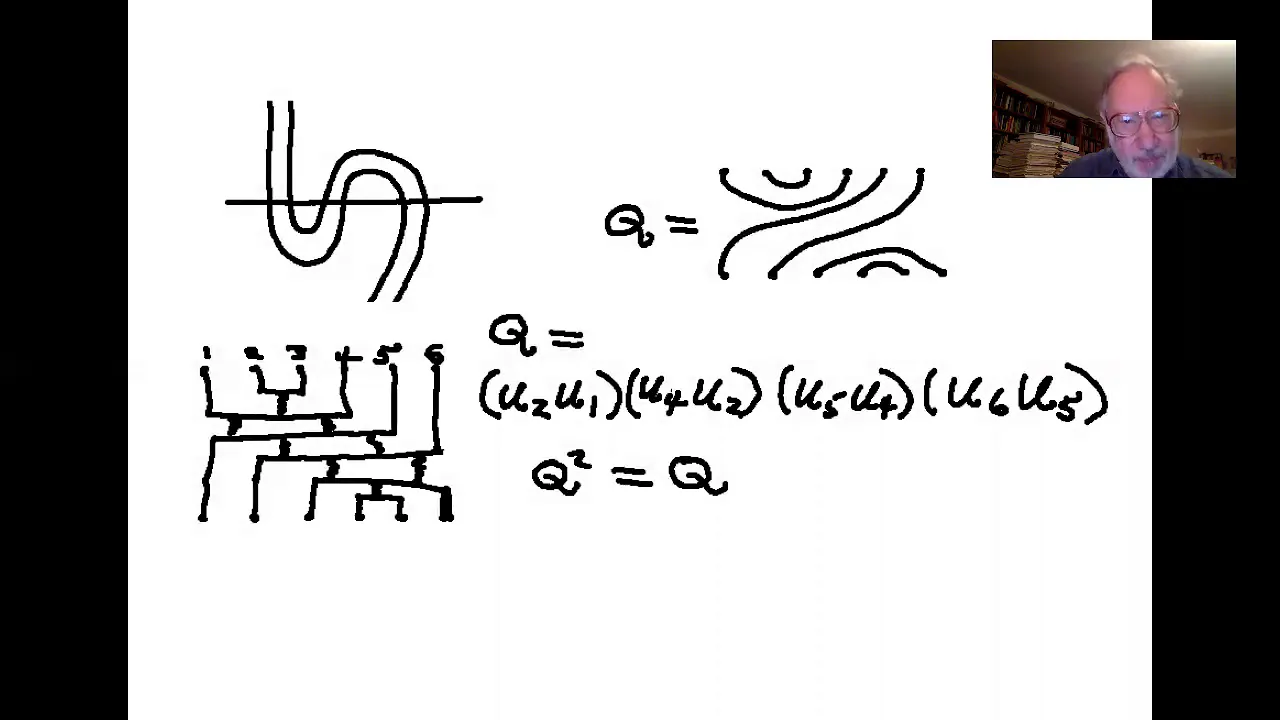


The state sum formula provides a method to compute the Kauffman bracket of a link diagram by summing over all possible states, where each state assigns a +1 or -1 sign to every crossing, and the contribution of each state is calculated as (-a² - a⁻²) raised to the power of (number of components in the smoothed diagram minus one) multiplied by a raised to the sum of the signs in that state.
State Sum Formula in Kauffman Bracket for Link Diagrams | Math Tutorial
Added:Basic concepts of knot theory, including knots, links, link diagrams, and the geometric representation of crossings.
Understanding of Reidemeister moves and how they define ambient isotopy for link diagrams.
Familiarity with polynomial algebra, specifically manipulating Laurent polynomials, as the bracket calculation yields polynomial expressions.
Elementary combinatorics, particularly summing over a set of binary choices (the A-smoothings and B-smoothings of crossings).
Normalizing the Kauffman bracket using writhe to construct the Jones Polynomial, a famous topological link invariant.
Proving the invariance of the Kauffman bracket under Reidemeister moves II and III mathematically.
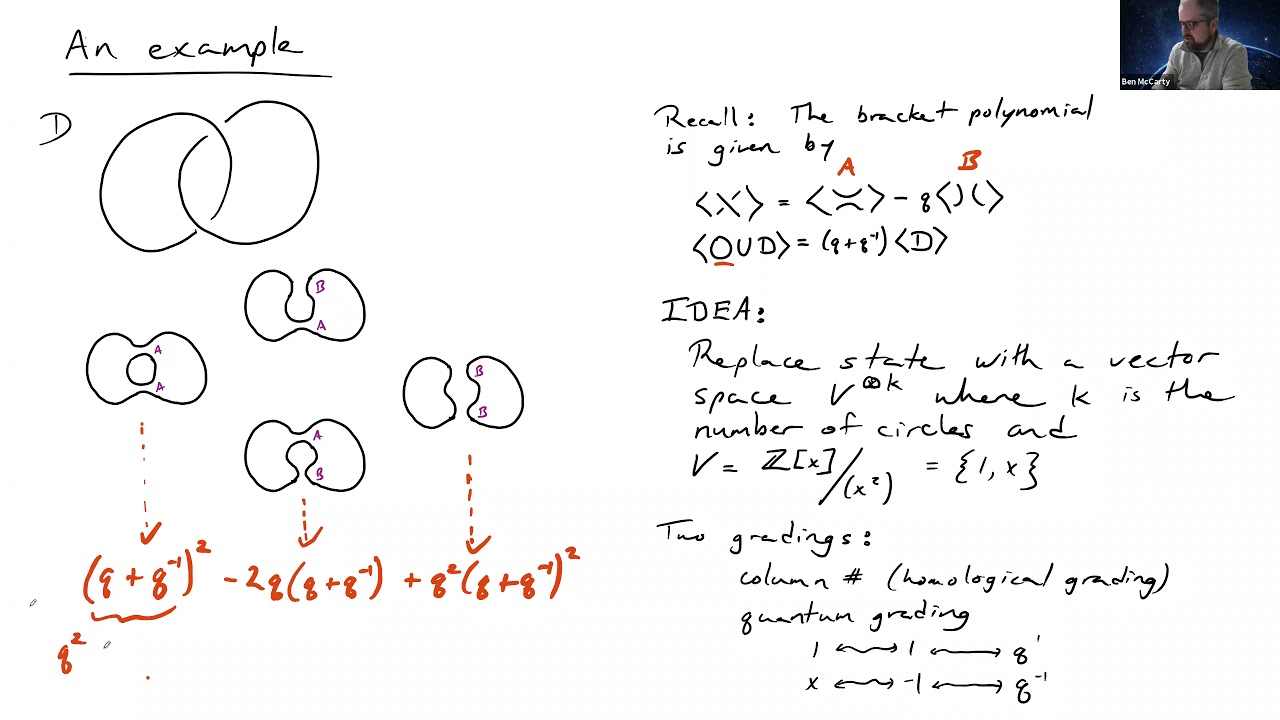
Exploring Khovanov Homology, which categorifies the Jones polynomial into a sequence of homology groups.
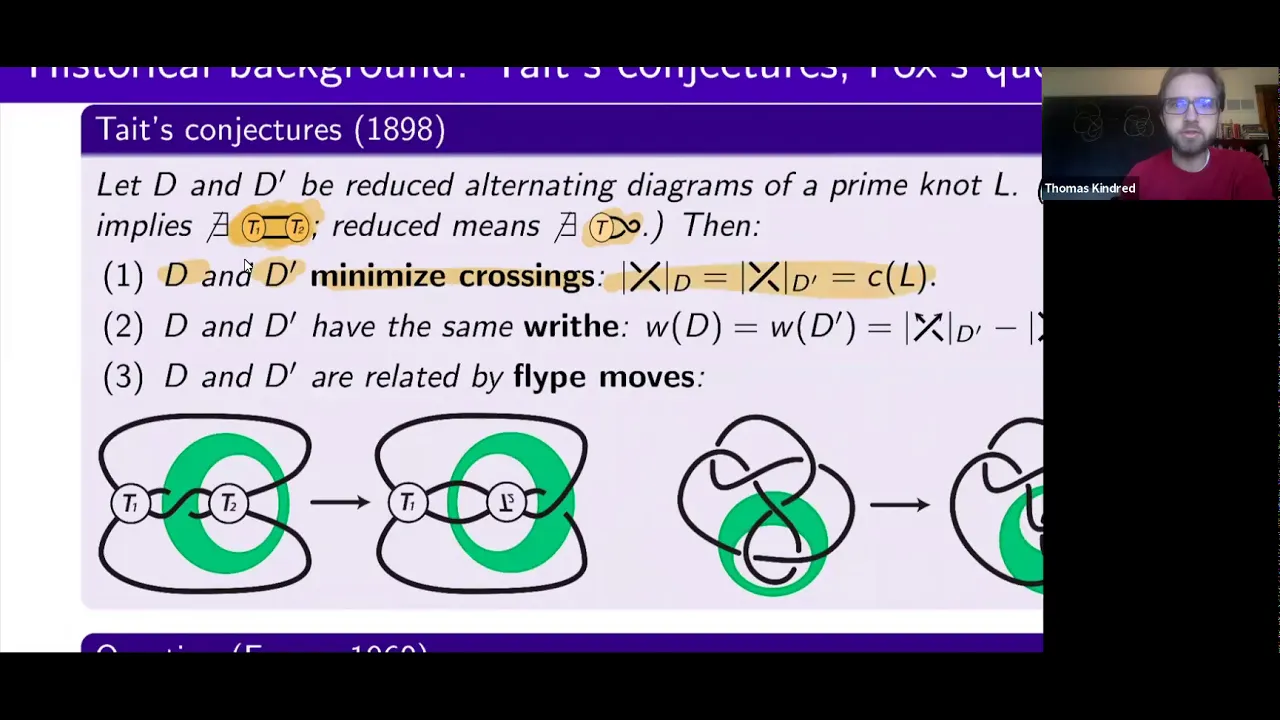
Applying the Jones polynomial to solve classical problems in knot theory, such as Tait's conjectures on alternating knots.
Investigating connections between state sum models in topology and partition functions in statistical mechanics (e.g., the Potts and Ising models).
1.5K views15likes14:19Original Release: 2015-03-24
Hello and welcome to a mini lecture about the states sum formula. The states sum formula is a formula for the calfman bracket of a diagram. And uh rather than being a recipe for for computing the calfman bracket, it's simply a formula that tells you what it is exactly. um and we need to learn about this in order to understand uh the theorem about the span of the Jones polomial which is why this is important. Okay. So let's begin.
I'm going to start by telling you what is a state.
Well, what is a state something of? It's of a link diagram D. I'm going to tell you about the states of a link diagram D. Um so definition a state of D is a function S that goes from the crossings of D into the set plus and minus one.
So what does that really mean? That means that S little S is going to give us for each crossing in D a sign either plus one or minus one. In other words, a state is really nothing other than a recipe for writing a sign at every crossing.
So let's give an example of a state plus minus let's make them plus one minus one plus one minus one + one uh minus one.
There we go. That's a state. And how many states are there altogether? Well, in this diagram here, this is a diagram of the figure 8. Um, there are four crossings. So, we could each give each crossing two signs. So, that means that there are two to the four, which is 16.
16 possible states. Um, uh, which is why I'm not going to list them all, but we're just going to talk about this one little S. Okay. So, if I've given if I'm given a state, I define S of a diagram D. I'm going to define this thing SD. What it is is it's the smoothing of D by S.
What is that? Well, suppose I'm given a crossing C.
Well, at that crossing, there's some sign, right? The state gives me a sign S of C, which is either plus one or minus one. Well, if it's plus one, then I remove the crossing I've got and I replace it with this smoothing here.
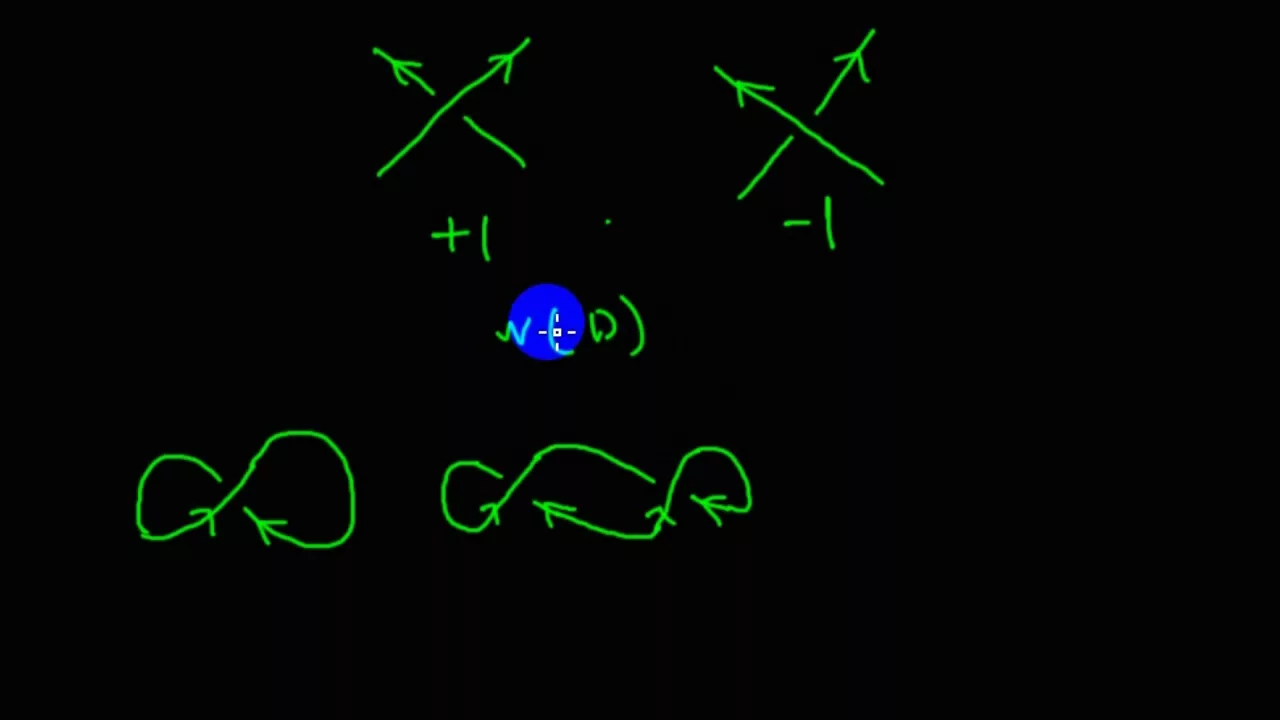
And if the sign of C is minus one, then I remove the crossing I've got and I replace it with this thing here. So big warning, you need to find yourself a way to remember which is the plus one smoothing and which is the minus one smoothing. My way of remembering it is that I say to myself, well imagine the arrows were pointing up and that this was a crossing with sort of linking number sign plus one. Then the positive smoothing would be the obvious one that preserves the orientations and the negative smoothing would be the other one. That's my way.
You do the thing that's best for you um that you feel you can remember. Okay. So let's do the smoothing.
So let's define for ourselves uh SD.
Okay. Well, uh, actually, I think you should pause.
You pause the video, decide what you think the smoothed diagram SD should look like. Pause it and have a go.
Well, here is my answer. Um, actually, no, I won't give you my answer. I'll give you some clues. So let me draw an up arrow uh that tells you which way is up according to uh the sort of standard diagrams of the smoothing. Well, for this Whoops, this isn't working.
Uh for this crossing up is this way.
For this crossing up is this way. For this one, well, it's this way.
And for this one here, it's this way. Well, I could reverse up and down. It would still be fine. But anyway, now have a go at the smoothing.
Pause it. Try.
Okay. So, for a plus one, my smoothing is I decide which way is up. I erase the crossing and then I join things up in such a way that the arrow can drive through. That's for a positive smoothing there.
Whoops. Okay. Ah, let me start again.
There we go. Positive smoothing here.
Another plus. So, I erase my crossing and join everything back up in such a way that my red arrow could drive through the crossing.
Uh, this one's a minus one. So, I delete it and join it up in such a way that it breaks the arrow, the up arrow. There we are.
And the same thing here. I'm going to join it up so that it breaks the arrow.
There we go.
Okay. So, that's SD.
Uh next definition bar SD SD with bars on it. Well that's the number of curves in SD. So what what happens is that well um this resulting diagram that you get here after you've smoothed it's got no crossings in it. So that means it's a bunch of curves. In this case there's only one curve. In general there could be several. So just to show you how there could be several.
If this sign here oops let's get rid of that. If this had been a minus one, then here I would have done the other smoothing which would look like that and I'd get two components, right?
Okay, let's put everything back how it was. So in this case, all we get is one component. So bar SD is one.
Let's move it everything up a little bit. So finally the final quantity I need to define for you is bar S. That's the sum of the signs in S. What is that here? Well S had two pluses and two minuses in it, right? Plus plus minus minus. So I add those up and I get zero. So bar S equals Z.
Okay. So that's the state and that's all the uh terms we need to know here on the new slide is the state sum formula.
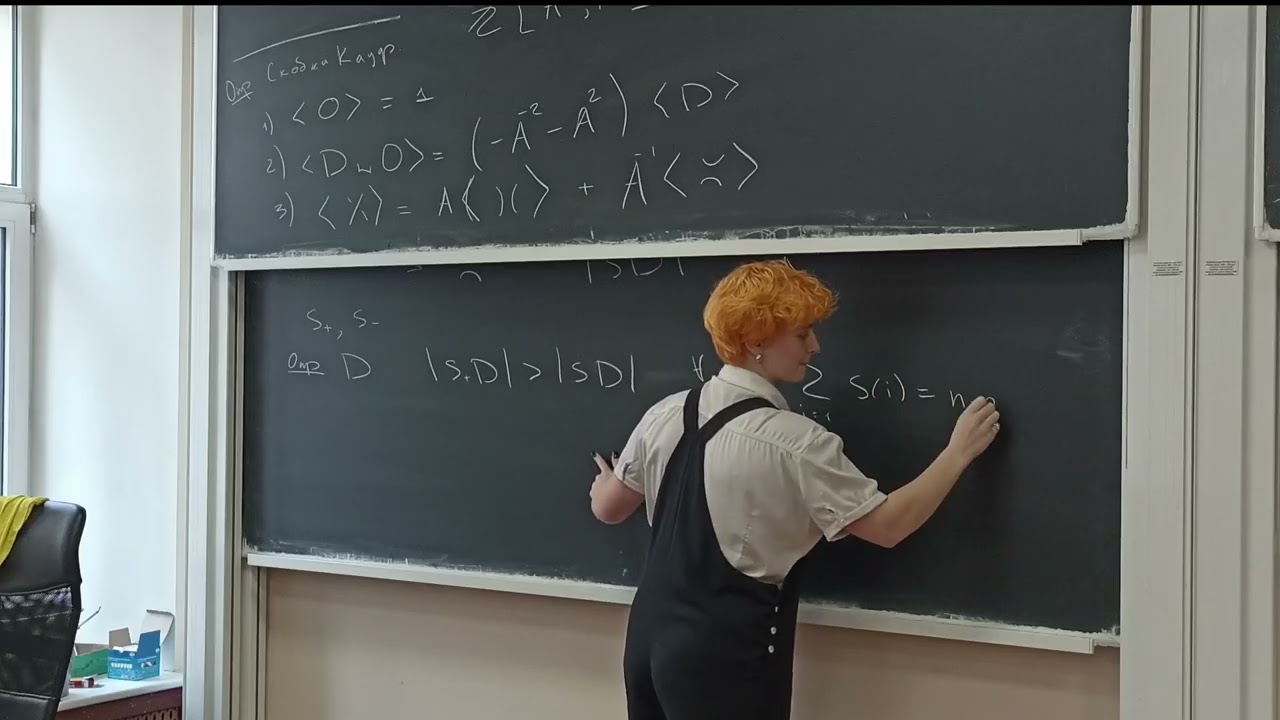
It says that the calman bracket of a diagram D is the sum over all the states of that diagram of the following quantity. I take minus aus 2 - a^ 2 to the power uh number of components of sd minus one and then I multiply it by a to the sum of the signs of s. That's the states on formula. It's a big theorem in the notes. It's theorem 7.7.
Uh it takes some proving to do but let's illustrate with an example. And my example is going to be this entirely ridiculous diagram of the unnot here. So let's do the state sun formula. I'm going to take me four copies of this diagram. Why four?
Because the diagram has two crossings.
And so I need uh two to the sorry two to the two which is four states. So let me draw all the states on for you. Um, let's call the first state s uh let's just call it s1. And let's let s1 be the one with two pluses. Let's let s2 be this one with a plus and a minus.
Sorry, I should have plus one, shouldn't I? + one minus one. Here's I'm going to call it s3. That's going to be minus one. + one. And here we're going to have s4. uh that's going to be minus one minus one. Okay. So in order to do the state sum formula in order to use it I need to sum over all the states that means I need to list them and then for each one I need to work out this quantity after the sum. So I need to know bar SD and I need to know bars. So let's work that out. Let me work out the smoothing of all of these guys here.
Actually let's do that in a short while.
Let's start by doing the sums of the signs.
So bar S1 is two bar S3 that's zero plus one minus one bar S3 no bar S2 that's zero and bar S4 that's minus two.
Now let's do the smoothing. Um so I'm just going to do it. Uh I'm going to take the positive smoothing of this crossing which is this.
And I'm going to take the positive smoothing of this crossing, which is this.
And I'm going to keep doing the rest.
Pause if you like.
Here I take the negative crossing, which is like that.
And here I still take the positive crossing, which is like this.
Uh on the left, I take the positive crossing. That's that.
And here I take the negative uh smoothing, sorry, that's that.
No, I made a mistake.
Back up. Oops.
I should take the negative smoothing, which is there.
And down here, I should negatively smooth both ones. Well, that means this, and it means this.
Okay, I hope you believe me. uh you can check that for yourselves. Okay. So in this case bar SD that's equal to two because there's two circles in this smoothing bar. So that's bar S1D uh S2D in bars how many components are there?
One bar S3d how many components are there? There are three. And here bar S4D how many components are there? There's two again. There we go. So the state sum formula says that calma bracket of d is equal to right. So for s1 I have minus a - 2 - a^ 2 to uh mod bar s1 d minus one that's one time a to the bar s1 which is two. Okay. - a minus 2. Whoops.
- a^ 2. I should have bar s 2d - one. A to the bar s2. Well, bar s 2d is one.
So 1 - 1 is zero.
And bar s2 is zero as well.
Okay, let's get you guys uh closer together.
Um, so next term plus - a - 2 - a^ 2 should be bar s3d uh minus one a to the bar s3.
Now what is bar s3? That's three. 3 - 1 is two.
What is bar s3? That's three. No, that's zero. Okay, better.
And there should be one more term. Let's just make more space. Sorry about that.
Plus - a minus 2 - a^ 2 to the bar s4 d minus one a to the bar s4. Well, what's bar? What's bar s4d? That's two. So, this thing all becomes one.
What's bar s4? That's minus two - 2.
Okay, let's try and be brave and work this out. Um, I'm going to get -1 - a 4 uh + 1 + a minus 4 + a 2. No. Plus a 4 minus It's not minus, it's plus 2 uh - a - 4 - a 0. Okay. Now + 1 - 1 - a 4 + a 4 + a - 4 - a - 4 + 2 - a 0. Well, a to the 0 that was just one, right?
And all I get is one.
Check. Check. by looking at the rules for the ridermeister moves.
Okay, that's the end of the video. You can see the proof of the state formula for state sum formula for yourself in the notes.
Up Next

13:11
Kauffman Bracket, Writhe & Reidemeister Moves in Knot Theory
@richardhepworth1441
3.5K views•2015-03-13
4:43
Elliptic Curve Cryptography Explained: ECC, ECDSA, ECDH
@PracticalNetworking
28.5K views•2024-10-21

6:20
Jones Polynomial Definition: Invariance Proof
@richardhepworth1441
3K views•2015-03-13
6:00
The Mathematical Impossibility of Accurate World Maps
@Vox
23.3M views•2016-12-02
Related Study Plans & Knowledge Roadmaps
Structured learning paths in Mathematics
mathematics
Tensor Calculus: Vectors to Riemann Curvature
01Mathematical Foundations: Linear Algebra & Calculus
02Covectors, Dual Spaces, and Tensor Basics
03The Metric Tensor and Index Gymnastics
+ 2 more learning modules
40h5 modules
Explore Roadmap
mathematics
Gödel's Incompleteness: Logic, Proofs & Limits
01Introduction to Formal Systems & Hilbert's Dream
02Set Theory, Cardinality, and Cantor's Diagonal Argument
03Arithmetization and Gödel Numbering
+ 2 more learning modules
14h5 modules
Explore Roadmap
mathematics
Galois Theory: Fields, Groups & Solvability
01Foundations of Abstract Algebra: Groups & Fields
02Polynomials & Field Extensions
03Splitting Fields & Symmetries
+ 2 more learning modules
24h5 modules
Explore Roadmap
mathematics
Non-Euclidean Geometry: Models & Geodesics
01Euclid's Fifth Postulate and the Birth of New Geometries
02Hyperbolic Space and the Poincaré Disk Model
03Geodesics: Defining Straight Lines in Curved Spaces
+ 2 more learning modules
15h5 modules
Explore Roadmap