Complex Analysis: Residues & Contour Integrals
Learning Goal: Master complex analysis from geometric foundations to advanced analytical techniques. By the end of this curriculum, you will understand the geometric behavior of holomorphic functions, verify and apply the Cauchy-Riemann equations, compute Laurent series, classify isolated singularities, and systematically evaluate real-valued integrals over semicircular and trigonometric contours using Cauchy’s residue theorem and conformal mapping.
- Prerequisites: Multivariable Calculus (partial derivatives, line integrals, Green's Theorem), Linear Algebra (linear transformations, determinants).
- Estimated Total Study Time: 18 Hours
Module 1: Foundations of Complex Numbers
This module establishes a deep geometric and algebraic foundation for complex numbers. You will move beyond treating as a mere algebraic trick to visualizing complex numbers as geometric transformations (scaling, rotation, and translation) in the complex plane (Argand diagram). You will derive Euler's formula and master the conversion between rectangular, polar, and exponential forms.
Recommended Videos
1. Understanding Euler's Formula | BetterExplained
- Why this video: It bridges the gap between algebraic manipulation and raw geometric intuition. By treating multiplication as scaling and rotation, this video explains how Euler's formula represents continuous, perpendicular growth that naturally traces out a unit circle in the complex plane.
- Knowledge Checkpoint:
- Explain how multiplying by physically translates to a rotation in the Argand diagram.
- Describe "perpendicular growth" and why it prevents a trajectory from growing outward, keeping it on a circular orbit.
- Reconstruct the intuitive proof that links continuous compounding to circular rotation.
2. Complex Numbers and Euler's Formula | MIT Differential Equations
- Why this video: Hosted by MIT, this lecture provides the analytical rigor needed to connect complex arithmetic to differential equations. It defines the Cartesian form and demonstrates how polar form simplifies multiplication, division, and exponentiation.
- Knowledge Checkpoint:
- Compute the modulus and the argument of an arbitrary complex number.
- Convert a complex number from rectangular to exponential form () and vice versa.
- Utilize Euler's formula to solve algebra problems involving high-power exponentiation of complex coordinates.
3. Complex Numbers 2 - Argand Diagram (Modulus and Conversion from one form to another)

- Why this video: This video offers an extensive, highly practical walkthrough of working inside the Argand diagram. It details quadrant-by-quadrant adjustment for calculating arguments, which is a common source of mathematical errors for students.
- Knowledge Checkpoint:
- Sketch any complex coordinate onto the Argand diagram and determine the correct quadrant-adjusted principal argument .
- Calculate the distance between two complex numbers using the complex modulus definition.
Module 2: Complex Functions and Holomorphic Properties
Here, you will transition from static complex numbers to mapping spaces through complex functions. You will define complex differentiability and realize why it is immensely more restrictive than real differentiability. You will master the Cauchy-Riemann (CR) equations, analyze their geometric implications, and learn to prove whether a function is holomorphic (analytic) or merely differentiable at a point.
Recommended Videos
1. The intuition and implications of the complex derivative
- Why this video: It presents an outstanding visual and conceptual overview of why a complex derivative is far more rigid than a real derivative. It demonstrates how complex differentiability implies a localized linear transformation consisting of uniform scaling and rotation, leading directly to the Cauchy-Riemann equations.
- Knowledge Checkpoint:
- Explain why a complex derivative requires the limit definition to yield the same result from any of the infinite directions of approach in the complex plane.
- Describe how complex differentiability forces a function to act as a localized scale-and-rotate transformation.
- State why the existence of a first derivative on an open region guarantees that a complex function has infinitely many derivatives (unlike real functions).
2. Complex Analysis 6 | Cauchy-Riemann Equations
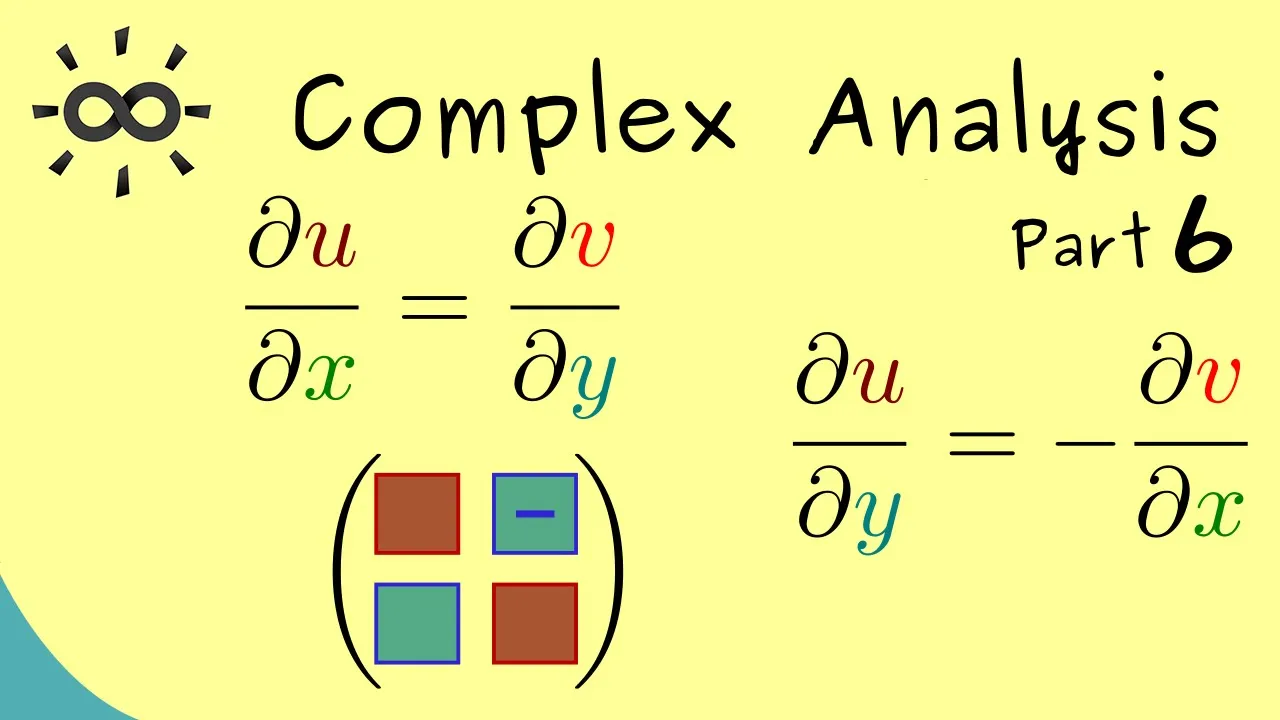
- Why this video: This video provides the explicit mathematical derivation of the Cauchy-Riemann equations. By decomposing into real and imaginary components , it shows how equating the limits along the real and imaginary axes yields the classic partial differential equations: and .
- Knowledge Checkpoint:
- Derive the Cauchy-Riemann equations from the limit definition of the derivative.
- State the exact mathematical conditions under which satisfying the CR equations guarantees differentiability at a point (e.g., continuity of partial derivatives).
- Define what it means for a function to be holomorphic (or analytic) on an open set.
3. Problem No.1 on Cauchy Riemann Equation in Cartesian Co-ordinates - Engineering Mathematics 3
- Why this video: To address the first gap identified in review feedback, this video is a step-by-step tutorial verifying the CR equations with real calculus equations. It guides you through calculating partial derivatives of complex transcendental expressions to prove analyticity.
- Knowledge Checkpoint:
- Verify if a given function satisfies the Cartesian CR equations: and .
- Calculate partial derivatives of composite exponential and trigonometric terms with high accuracy.
4. Mod-02 Lec-04 Cauchy-Riemann Equations and Differentiability

- Why this video: This lecture dives deeply into the formal analysis of differentiability. It showcases pathological examples where the CR equations are satisfied at a point, yet the function fails to be differentiable due to discontinuous partial derivatives.
- Knowledge Checkpoint:
- Construct an argument explaining why satisfying the CR equations is a necessary but not sufficient condition for complex differentiability.
- Outline the proof of sufficiency of the Cauchy-Riemann equations when the partial derivatives are continuous.
Module 3: Complex Integration and Cauchy's Theorem
This module moves from differentiation to contour integration. You will learn to parameterize curves in the complex plane, compute line integrals, and master the core theorems of complex analysis: Cauchy's Integral Theorem (integrals over closed loops vanish for holomorphic functions) and Cauchy's Integral Formula (evaluating interior values using boundary integration).
Recommended Videos
1. Complex Analysis - Computing Line Integrals
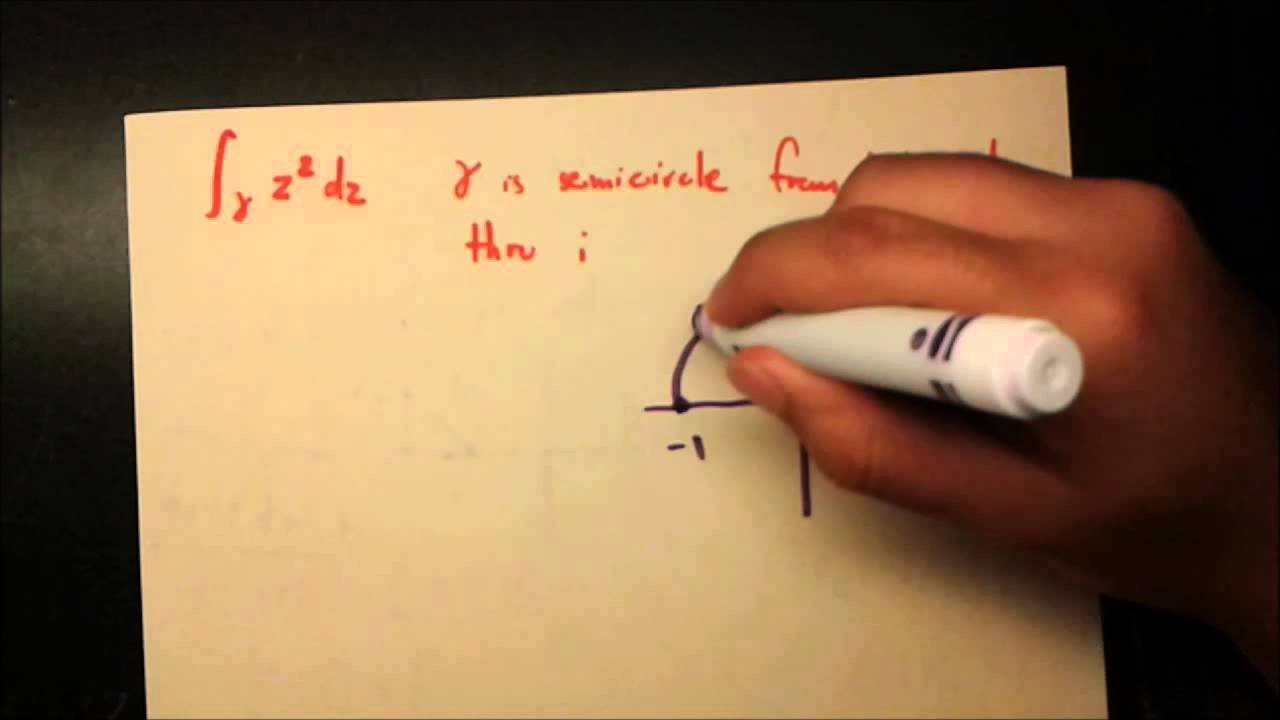
- Why this video: This video provides a streamlined, highly functional 3-step system to compute line integrals: drawing the curve, parameterizing the path using , and converting the entire integral into a single real-variable integral in terms of .
- Knowledge Checkpoint:
- Parameterize straight lines, circles, and curves in the complex plane using .
- Set up and evaluate by substituting .
2. Complex integration, Cauchy and residue theorems | Essence of Complex Analysis #6
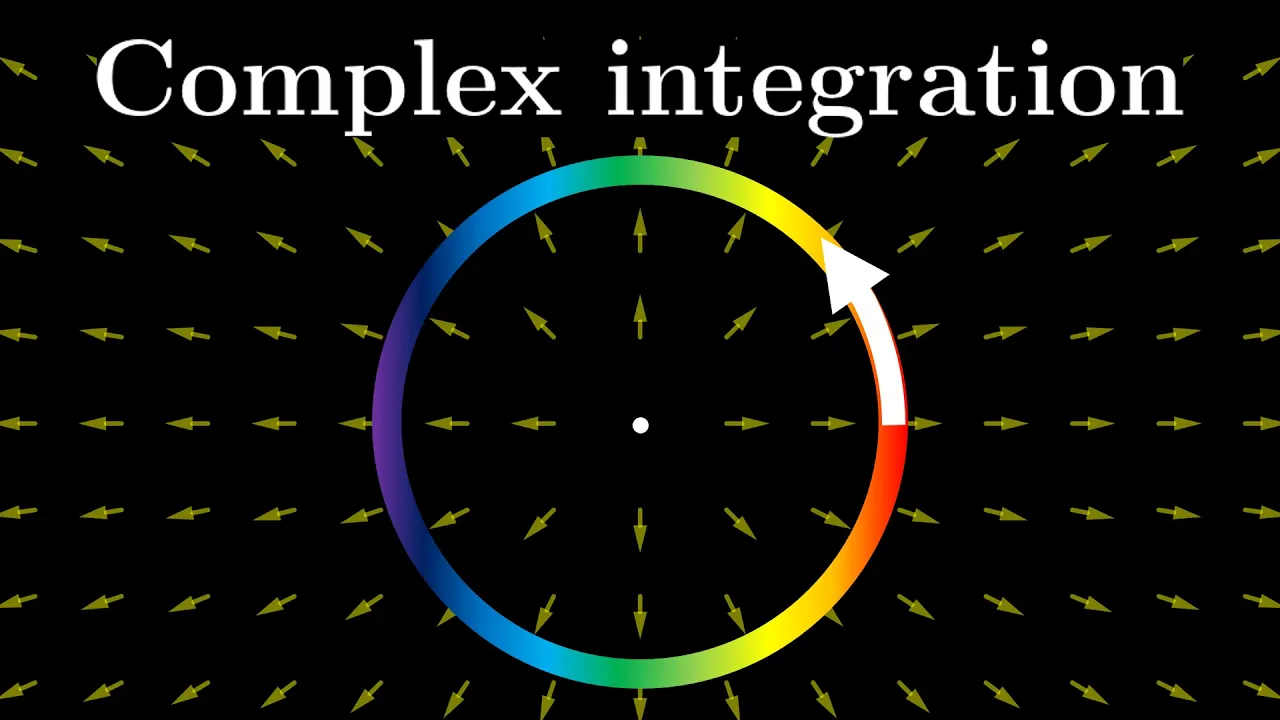
- Why this video: A beautifully produced animation explaining the physical and geometric intuition behind Cauchy's Integral Theorem. It shows how "shrinking" a contour around a holomorphic region yields zero, and how a contour wrapping around a single singularity isolates the "pole," laying the groundwork for residues.
- Knowledge Checkpoint:
- State Cauchy's Integral Theorem and identify when a contour integral evaluates to zero.
- Explain how Cauchy's Integral Formula, , retrieves the exact value of a function at an interior point using only its values on the boundary.
- Explain how shrinking a contour towards a singularity isolates the term .
3. Cauchy Integral Formula-Complex Integration | Group B&C GYMAT301 S3 Module3 KTU 2024 Scheme|Part9
- Why this video: This is a comprehensive problem-solving session showing how to systematically evaluate integrals of the form . It explicitly contrasts cases where the singularity lies inside vs. outside the contour.
- Knowledge Checkpoint:
- Identify which singularities of an integrand lie inside a given closed curve .
- Apply Cauchy's Integral Formula to evaluate integrals where the denominator has simple poles inside the contour.
- Use Cauchy's generalized formula for derivatives to evaluate integrals of the form .
4. Mod-1 Lec-3 Cauchy's Integral Theorem

- Why this video: This video offers the analytical proof of Cauchy's Integral Theorem using Green's Theorem. It discusses topological properties of domains (simply connected vs. multiply connected) and path independence.
- Knowledge Checkpoint:
- Distinguish between simply connected and multiply connected domains.
- Prove Cauchy's Integral Theorem using Green's Theorem under the assumption that is continuous.
- Deform a contour around multiple singularities without changing the value of the integral.
Module 4: Singularities Classification, Laurent Series, and Residues
This renamed and expanded module focuses on what happens when a function fails to be analytic at isolated points. You will learn to construct Laurent series (including negative powers) in concentric regions, rigorously classify isolated singularities (removable, poles, and essential), and compute the "residue" (the coefficient of the term) using direct limits and power series.
Recommended Videos
1. Singularities \Group B&C GYMAT301 S3 Module 4 KTU 2024 Scheme| S3 2019 Module 4 | Part 6
- Why this video: Direct-targeted at filling the second feedback gap, this video focuses entirely on classifying isolated singularities. It explains how to determine whether a singularity is removable, a pole of order , or an essential singularity by inspecting the Laurent series expansion and local limits.
- Knowledge Checkpoint:
- Define the principal part and analytic part of a Laurent series.
- Classify a singularity as removable (no negative powers in Laurent series), a pole of order (finite negative powers ending at ), or an essential singularity (infinitely many negative powers).
- State Picard’s Great Theorem regarding the behavior of a function near an essential singularity.
2. Complex Analysis 15 | Laurent Series
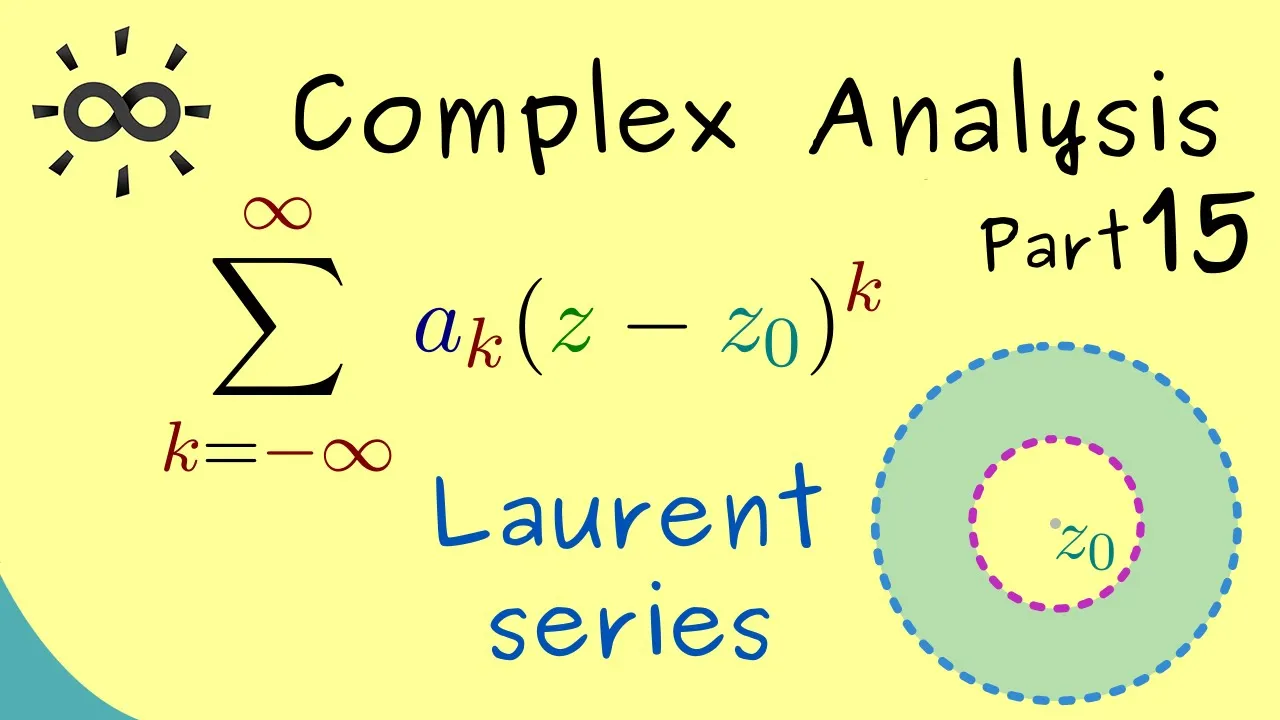
- Why this video: A precise conceptual video showing how Laurent series generalize Taylor series to encompass domains containing holes (annular regions). It demonstrates the structure of the series: .
- Knowledge Checkpoint:
- Define an open annulus and determine its boundaries of convergence.
- Distinguish between the Taylor series expansion (valid in a disk) and the Laurent series expansion (valid in an annulus).
3. Week7Lecture4: Finding Residues
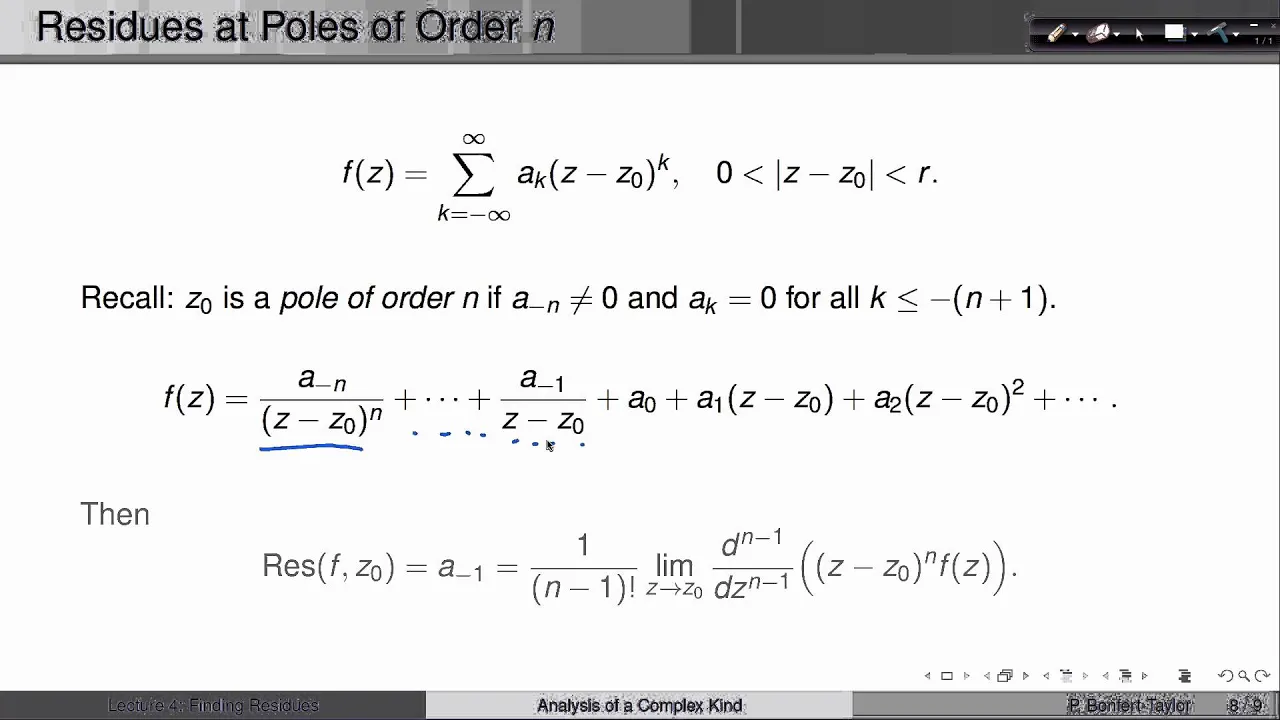
- Why this video: It teaches systematic, highly efficient mathematical formulas to calculate residues at poles without having to fully compute the Laurent series. It covers residues at simple poles and poles of higher order.
- Knowledge Checkpoint:
- Compute the residue at a simple pole using the limit formula: .
- Compute the residue at a pole of order using the derivative limit formula: .
- Calculate the residue for quotient functions where has a simple zero using the formula .
4. PYQs on Singularity | Complex Analysis | CSIR NET 2011 to 2023 | GATE 2000 to 2023| Short Cut Tricks

- Why this video: A marathon problem-solving session tackling advanced university and competitive-level exam questions. This provides the ultimate stress-test of your ability to identify, classify, and compute residues for highly complex algebraic structures.
- Knowledge Checkpoint:
- Apply "shortcut" tricks to classify the singularities of complex products and composite functions.
- Rapidly determine poles of infinite order or non-isolated singularities (such as branch points).
Module 5: Contour Integration and Conformal Mapping
This final module integrates everything you have learned. You will apply Cauchy's Residue Theorem to compute challenging real-valued integrals by transforming them into complex contours. You will cover both real trigonometric integrals mapped to the unit circle and improper rational integrals mapped to semicircular contours. Finally, you will explore Conformal Mappings, discovering how holomorphic functions preserve angles between intersecting curves.
Recommended Videos
1. Using the Residue Theorem to Evaluate Real Integrals (2/2)

- Why this video: This video directly addresses the third review gap (evaluating real improper integrals over semicircular contours). It demonstrates how to integrate rational functions by forming a closed semicircle in the upper half-plane and taking the limit using Jordan’s Lemma.
- Knowledge Checkpoint:
- Construct a closed contour consisting of a real interval and a upper-half-plane semicircle .
- Use Jordan's Lemma or direct estimation to prove that the integral over the circular arc vanishes as .
- Solve real improper integrals by calculating residues of poles in the upper half of the complex plane.
2. Application of Residue| Evaluation of Real Integral Using Residue |L56|Residue Theorem @ranjankhatu
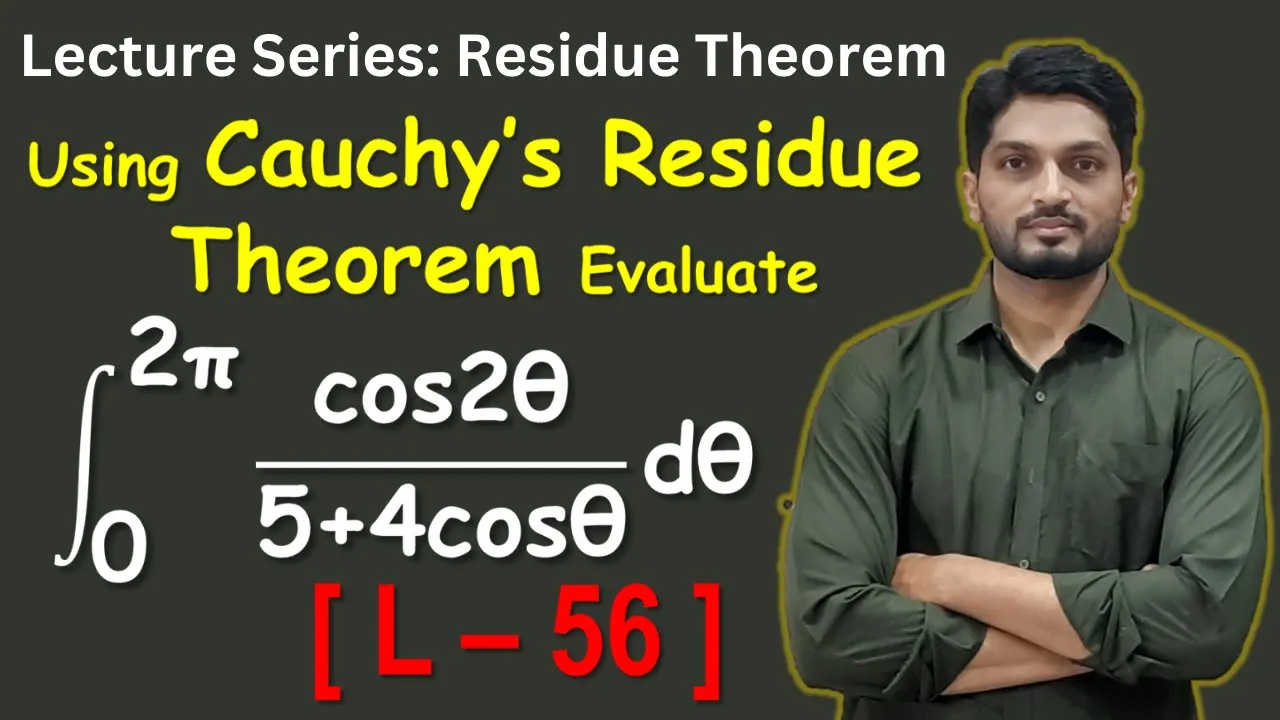
- Why this video: It bridges the gap on trigonometric integrals. It teaches you how to evaluate integrals of the form by parameterizing the unit circle using , converting trigonometric terms into expressions of , and solving via residues inside the unit disk .
- Knowledge Checkpoint:
- Substitute and to convert a real trigonometric integral to a complex contour integral.
- Substitute correctly in the integration process.
- Determine which poles of the transformed complex integrand fall inside the unit circle .
3. Part I: Complex Variables, Lec 3: Conformal Mappings

- Why this video: A masterclass lecture from MIT explaining conformal maps. It proves that any analytic complex function with a non-zero derivative is conformal (i.e., it preserves both the angle magnitude and orientation between any two intersecting curves).
- Knowledge Checkpoint:
- Define conformal mapping and prove why holomorphy with implies angle preservation.
- Explain how a conformal map transforms a grid of orthogonal lines in the -plane to orthogonal curves in the -plane.
- Recognize standard conformal transformations, such as the Möbius transformation.
Course Map
Below is the recommended visual learning path. Ensure you satisfy the milestones of each module before progressing to the next.
Key People Index
- Leonhard Euler (1707–1783): Swiss mathematician who formulated , linking complex exponentiation to trigonometric functions.
- Augustin-Louis Cauchy (1789–1857): French pioneer of mathematical analysis who formulated Cauchy’s Integral Theorem, Cauchy's Integral Formula, and the Residue Theorem.
- Bernhard Riemann (1826–1866): German mathematician who co-formulated the Cauchy-Riemann equations for complex differentiability and introduced Riemann surfaces and conformal mappings.
- Pierre Alphonse Laurent (1813–1854): French mathematician who discovered the Laurent series (1843), expanding functions around singularities using negative powers.
- Camille Jordan (1838–1922): French mathematician whose lemma (Jordan's Lemma) provides the boundary bounds needed to evaluate infinite semicircular contours.
Final Self-Assessment
Complete this comprehensive self-assessment to verify your mastery of the curriculum.
- Draw the geometric mapping of and describe how it affects angles and distances in the complex plane.
- Convert to exponential form () with principal argument .
- Verify if (complex conjugate) is differentiable at any point in using the Cauchy-Riemann equations.
- Prove whether is an entire function (holomorphic on the entire complex plane).
- Parameterize and evaluate over a circle of radius centered at the origin.
- Use Cauchy's Integral Formula to evaluate where is the circle .
- Construct the Laurent series for in the annulus and identify its principal part.
- Classify the singularity at for the functions: , , and .
- Calculate the residue of at its double pole .
- Evaluate the real trigonometric integral using unit-circle contour integration.
- Evaluate the real improper integral using a semicircular contour and the Residue Theorem.
- Explain why a mapping is guaranteed to be conformal at all points where is analytic and .