![Nombres Complexes - Cours sur les Nombres Complexes - 2 Bac SM S.ex- [Partie 2]](https://i.ytimg.com/vi/2QJRogoyziM/maxresdefault.jpg)









![[s4 | 2026] Математический анализ, Горшанова Анастасия, практика 8](https://i.ytimg.com/vi/I2eh1IrUin8/maxresdefault.jpg)



![[Old Syllabus] 2nd Semester B.Sc. Complementary Mathematics| Module- I |Part- 06 |Calicut University](https://i.ytimg.com/vi/3SpR8anilr4/maxresdefault.jpg)






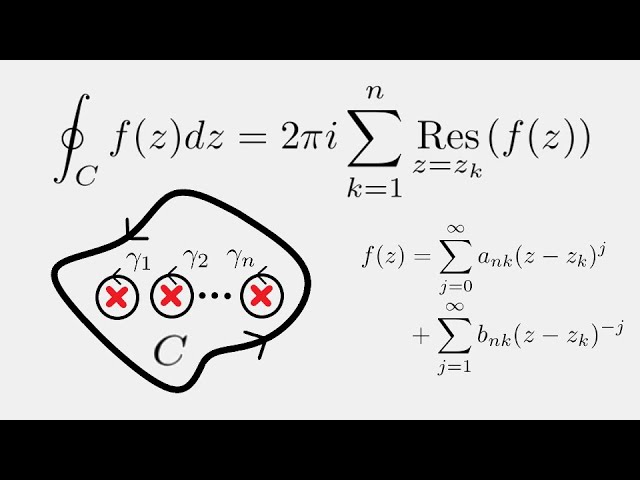
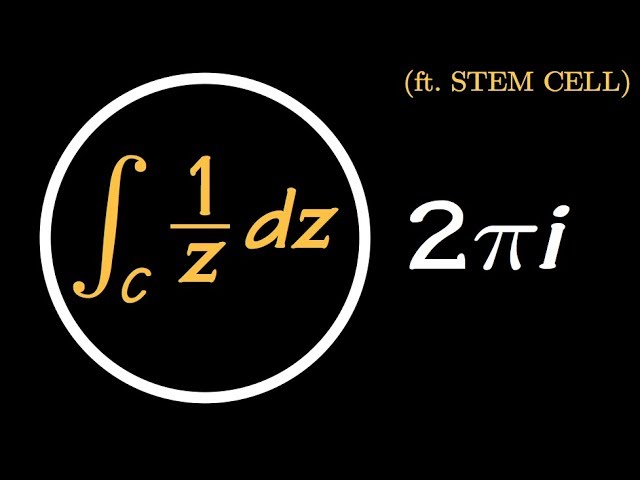
To evaluate real integrals of the form ∫₀²π f(cosθ, sinθ) dθ using the residue theorem, substitute e^(iθ) = z, which transforms the integral into a complex contour integral over the unit circle |z|=1; identify the singular points (poles) of the resulting complex function, compute residues only at poles lying inside the unit circle, and apply the residue theorem formula I = 2πi × sum(residues) to find the integral value.
Evaluating Real Integrals Using the Residue Theorem | Complex Analysis
Added:Euler's Formula and Complex Exponentials: Understanding how to represent trigonometric functions like cosine and sine in terms of complex exponentials (e.g., cos(θ) = (e^{iθ} + e^{-iθ})/2).
Cauchy's Residue Theorem: Mastery of the theorem itself, including how to locate singularities (poles) and calculate residues of complex functions.
Contour Integration on the Unit Circle: Familiarity with the parametrization of the unit circle (z = e^{iθ}, dz = i e^{iθ} dθ) and integrating complex functions along a closed path.
Classification of Singularities: Knowing the difference between removable singularities, poles (and their orders), and essential singularities.
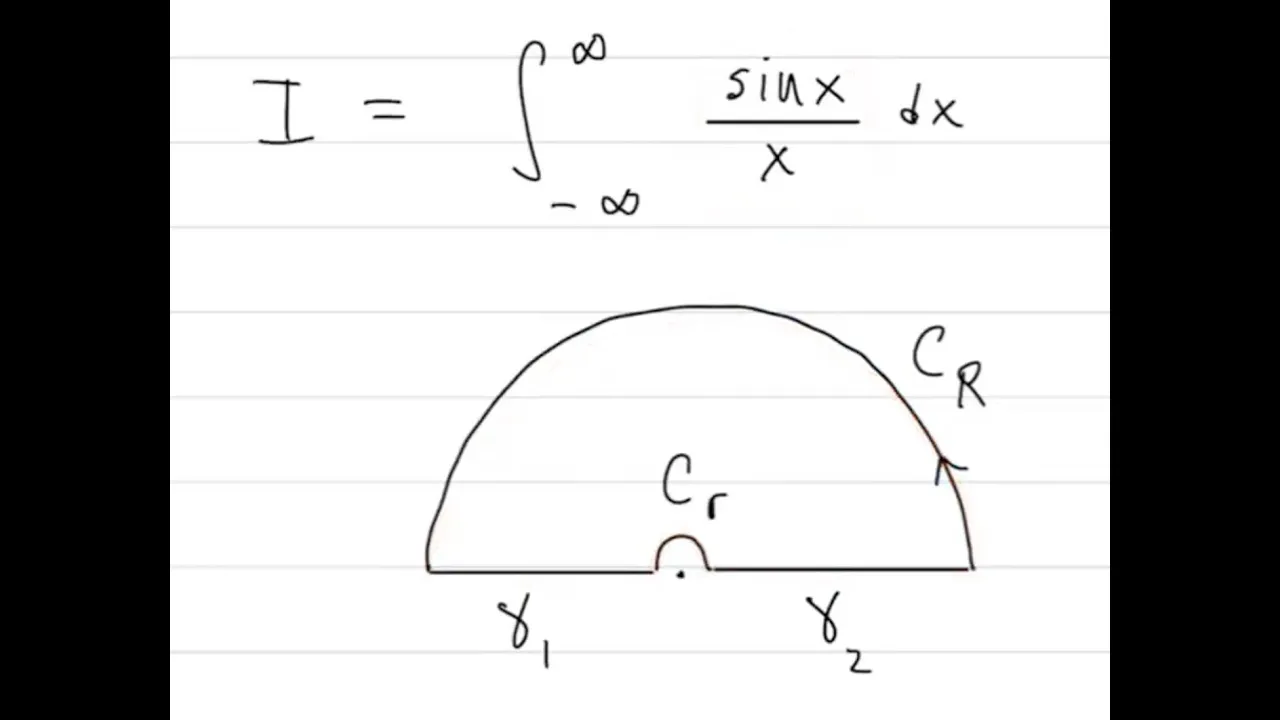
Evaluating Improper Real Integrals: Applying the residue theorem to evaluate integrals over the entire real line (from -∞ to +∞) using semicircular contours.
Jordan's Lemma and Fourier-type Integrals: Learning how to evaluate integrals of the form ∫ f(x)cos(ax)dx or ∫ f(x)sin(ax)dx using complex exponentials and bounding arcs.
Branch Cut Integrals: Handling multi-valued functions (like logarithms or fractional powers) using specialized contours such as keyhole contours.
Physical Applications in Physics and Engineering: Using these integration techniques to solve problems in fluid dynamics, electrostatics, and performing inverse Laplace or Fourier transforms.
11.8K views230likes18:59Original Release: 2024-07-13
hi everyone in this video we are going to discuss this example okay so what have they given to us one real integration integration of one real valued function we have to find its value with the help of residue actually the residue concept is related with complex valued function but we have to use this concept to find the value of this integral okay this real integral so let us see how to find the value I will explain the procedure first and the same procedure I'm going to use to solve this problem the first step is we use this substitution e to I Theta isal Z whatever the problem we have doesn't matter our substitution is fixed e to I Theta is equal to Z so in this case generally we have the integral like this 0 to 2 pi F of theta D Theta and what we put e to I Theta is equal to Z this substitution will convert the given integral into complex integration integration over c f of Z DZ f is a function of Z it's a complex valued function and here C is a curve mod Z isal 1 because of this substitution always we get the same curve mod Z is equal to 1 it is a unit circle okay circle with Center 0 0 radius 1 after that what we do we find the singular points of f of Z singular points of f of Z singular points that means a point where the function is not analytic or generally we say the denominator is zero so those points can locate anywhere in a complex Place those can be anywhere getting this circle we have at the center this circle right some points some singular points can lie inside the circle some can lie outside a circle right so we are not interested in the singular points which are lying outside we are more interested in the singular points which are lying inside Circle getting the point so at those singular points we find residues and after getting residue okay residue only at these points which are lying inside the circle then the value of this integration is 2 pi I sum of residues so this is a simple formula we have to find the value of this integral okay but for that we need to follow the entire process so the same procedure I'm going to follow to solve the given problem also so let us call it as I whatever the integral we have let us call it as I so let me write we have I is equal to see same limits we have 0 to 2 pi 0 to 2 pi but the problem is that here we have cos 2 Theta which we should have just cos Theta sin Theta e to I Theta like that but see what we have cos 2 Theta so twice angle okay 2 Theta we have so for that I will not take directly cos 2 Theta instead of that I will write e to 2 I Theta 2 I Theta getting if you have cos 3 Theta or sin 3 Theta then I should write e to 3 I Theta okay please keep in your mind in denominator I will keep as it it is 5 + 4 cos Theta D Theta that means the integral which we assume it is different from this one what is the difference instead of cos 2 Theta I wrote e to 2 I Theta then it will be very simple to solve and at the end with the help of value of this integral definitely and easily we can find the value of this integral also let us move further I will follow the procedure first of all I should put e IA is equal to Z let us do putting e to I Theta is equal to Z okay so when we put anything first task is to find derivative and the second task to find a curve okay over this integral we are finding or sometimes we find the limits also so let us take derivative with respect to Theta derivative of e to I Theta derivative of Z with respect to Theta derivative of exponential function is same its derivative will be e to I Theta but by Chain rule again we need to find derivative of I Theta which is i d z upon D Theta e to I Theta means Z so this is i z is equal to DZ upon D Theta so let us take all terms of theta on one side of this equality okay and this all terms of Z will be shift on other side so we will have D Theta is = to DZ upon i z okay so finally we got the value of D Theta this value I'm going to put in this integral I okay so let us continue here see we want some more space to write so let me remove this part and then we'll go further so as you can see easily we have cos Theta so let us find the value of cos Theta also in terms of Z okay so let me write now cos Theta is equal to see cos can be expressed in the form of exponential function in this way e i theta plus eus I Theta upon 2 it means e to I theta plus see minus sign is there in the power so that's why we can write 1 upon e to I Theta so power will be positive if you shift at denominator e to Y Theta means Z here also I can put we can cross multiply right Z into z z s + 1 upon Z divided by 2 actually Z and 2 both are in denominator so we can write simply cos Theta is equal to Z 2 + 1 upon 2 Z so finally we got the value of cos Theta okay so let us talk about the curve now okay so what I do I consider mod Z I'm going to find its value mod Z so Z is e to I Theta e to I Theta means cos Theta + I sin Theta so we know well how to find the value of mod of any complex number okay so the formula is root square of real part plus square of imaginary part cos square + sin square is 1 so root 1 is one that means we get we started with mod mod Z and we got one so this is a curve we have right so this is the Circle Center 0 0 and radius 1 radius one okay so let me draw a circle here getting so this type of region we have real imaginary AIS real AIS right let us have some scaling okay right so we get a circle here with Center 0 0 radius 1 so this circle we have got here right okay so now the everything is ready we have we found out the value of D Theta we found out the value of cos Theta as well as we have got the curve also which is a circle with Center 0 0 radius 1 okay so now I'm going to put all those things here in I okay so just make a screenshot of it then I will go further so let us write therefore therefore okay therefore this I is equal to integration over C this curve we have right mod Z is equal to 1 E to uh 2 I Theta actually e to I Theta means what z e 2 I Theta means z s upon 5 + 4 this is cos Theta Z 2 + 1 upon 2 Z D Theta is DZ upon i z okay so I have substituted all values so let us simplify it further so what will happen this z z will get cancel integration over c z will get cancel so Z upon 5 + here 2 two will get cancel that means 2 Z 2 + 1 upon Z DZ upon I so this is equal to integration over see let me remove all this part so we'll get a more space to write okay so what will I do Z as it is I will cross multiply in denominator so 5 Z + 2 Z 2 + 2 upon Z DZ upon I see this Zed is in denominator of denominator we shift to the numerator okay so let me do that thing here this is equal to integration / c z s this I in denominator I'm just writing it here I 2 z s + 5 Z + 2 DZ okay so this is a given integral this is our I so we are interested in that function f of Z so let us write the F of Z here here F of Z is z s upon I 2 Z 2 + 5 Z + 2 now we have to find a singular point of this function that means a point where the function is not analytic generally we say the point where the denominator is zero if we have the factors of this denominator we can easily find find a singular point so I will try to find the factors of denominator okay let us see how to find the factors Z 2 upon I 2 into 2 4 okay what we have 2 into 2 4 so we have to express four as a product of two numbers whose sum is 5 okay whose sum is 5 so 4 into 1 4 and 4 + 1 5 okay so that's why we can express 5 Z as 4 Z + 1 Z 2 Z 2 + 4 Z + 1 Z that means Z + 2 so this is equal to z s upon I tell me what can I take common from first two terms what can I take common from these two terms we can take 2 Z common 2 Z common so if you take 2 Z common Z + 2 here we cannot take anything common so I'm simply writing 1 Z + 2 did you notice one one thing that is z + 2 Z + 2 okay at both places we have got the same bracket we can take that bracket common so that means Z 2 upon i z + 2 first bracket and this is 2 Z + 1 2 Z + 1 second bracket so this is our F of Z so I express the denominator as a product of two brackets we found out the factors so the singular Point means a point where the denominator is zero if I put Z is equal to -2 denominator will be zero or if I put Z equal to -1 by 2 getting the point or you can simply solve in rough 2 Z + 1 is = 0 that means 2 Z is = -1 that means Z is = -1 by in that way also you can find okay so Z is equal to -1 by2 and Z is equal to -2 these are two singular points so let me clearly mention here okay so let me remove this part it is not required so here here Z is = -2 and Z = -1 by2 are singular points actually both are simple poles huh both are simple poles I'm clearly mentioning here so let us find those points are lying inside or outside - 1 by2 now - 1 by2 will be here and -2 -2 will be here -1 this is -2 so that min-2 lying outside a circle and -1 by2 lying inside a circle we are more interested in this point which is lying inside so at Min - 1x2 we have to find race let me mention but only Z is equal - 1x2 lies inside C okay the second point lies outside C so we have to find residue only at Z is equal to - 1 by2 okay there is no more space to write make a screenshot of it first so now our Target is to find the residue of F at Z is equal to - 1 by2 but now the question is how to find find residu the definition of residu involves Lauren series expansion it will take more time to find a residu with help of definition but fortunately both are simple poles that means Z is equal to minus1 by2 is also simple pole if you have a simple pool we have very simple formula to calculate residue and same formula I'm going to use so let us write residue of f of Z at Z is = -1 by2 that formula is limit z t to -1 by 2 Z minus actually Z minus z z is - 1 by2 minus- plus and I can write + 1 by2 getting the point F of Z actually we have a minus sign here but it has already minus sign so double minus you will have minus minus plus this is equal to limit z t to -1 2 we can easily cross multiply so 2 Z + 1 upon 2 F of Z this F of Z we can easily put since we found out the factors no so it is very easy to calculate Z + 2 and 2 Z + 1 so will you tell me what can we cancel here yes anyone can easily say that 2 Z + 1 2 Z + 1 will get cancel now in the remaining part of this function we can apply the limit apply the limit that means at the place of Z I'm going to put this - 1 by2 let us see what will happen so here at numerator - 1x2 s in denominator 2 i - 1 by 2 + 2 - 1X 2 s means 1X 4 2 I right here we can cross multiply 2 into 2 4 -1 + 4 upon 2 so this is 1x 4 getting 2 2 cancel i 4 - 1 3 3 I so 4 basically it is in denominator so that 4 into this 3 that means 12 I okay so this is a value of residue only see only two singular points we had one point lied outside the circle second Point Li inside a circle we finded the resid at that point then we can easily find the value of integration let us see how to find okay just make a screenshot of it then I will go further then the value of integral will be okay so let me write there therefore that I is equal to 2 pi I sum of residues so this is 2 pi I only one residue we got which is 1 upon 12 I so I I will get cancel right 2 two cancel so we'll get < by 6 so this is value of integral I but actually this integral is different from the given integral since instead of cos 2 pi we consider e to 2 I Theta so that thing also I should mention so I means what 0 to 2 pi we had consider e to 2 I Theta upon 5 + 4 cos Theta D Theta is equal to < / 6 we know that how to express e to I Theta in terms of cos and sin using that I can write 0 to 2 pi cos 2 Theta + I sin 2 2 Theta cos 2 I Theta can be expressed in this way denominator will be same 5 + 4 cos Theta D Theta is equal to < by 6 my mistake huh < by 6 so let us divide separately cos Theta cos 2 Theta upon denominator sin 2 Theta upon denominator and we can make separate separate integrals that means those will look like this 0 to 2 pi cos 2 Theta upon 5 + 4 cos Theta D Theta + i 0 to 2 pi sin 2 Theta upon 5 + 4 cos Theta D Theta so I divided separately I consider when you know when we have addition we can easily take separate separate integration so with the help of that I got this one < by 6 which is purely real number so < by 6 + 0 I since in left hand side we have got a complex number I is there so I tried to express the right hand side also in the same form see did you notice one thing whatever the integral we have that is nothing but the real part of this left hand side so that means we are more interested in a real part instead of imaginary part so if you compare the real part getting and if you compare the imaginary part so the real part is equal to < by 6 and the imaginary part is equal to Zer but we are not interested at all in imaginary part so that's why simply compare real part only just make a screenshot of it so if you equate real parts we get 0 to 2 pi right 0 to 2 pi cos 2 Theta upon 5 + 4 cos Theta D Theta is equal to the real part is < by 6 that means the value of given integral is < by 6 so in this way we solve this problem make a screenshot of it then we will stop thank you see you in next video you
Up Next

36:00
Conformal Mappings in Complex Variables | MIT OCW Lec 3
@mitocw
152.6K views•2012-03-29
4:43
Elliptic Curve Cryptography Explained: ECC, ECDSA, ECDH
@PracticalNetworking
28.5K views•2024-10-21
10:44
Fourier Series Introduction: The Big Idea Explained
@DrTrefor
387K views•2021-05-03

6:00
The Mathematical Impossibility of Accurate World Maps
@Vox
23.3M views•2016-12-02
Related Study Plans & Knowledge Roadmaps
Structured learning paths in Mathematics
mathematics
Tensor Calculus: Vectors to Riemann Curvature
01Mathematical Foundations: Linear Algebra & Calculus
02Covectors, Dual Spaces, and Tensor Basics
03The Metric Tensor and Index Gymnastics
+ 2 more learning modules
40h5 modules
Explore Roadmap
mathematics
Gödel's Incompleteness: Logic, Proofs & Limits
01Introduction to Formal Systems & Hilbert's Dream
02Set Theory, Cardinality, and Cantor's Diagonal Argument
03Arithmetization and Gödel Numbering
+ 2 more learning modules
14h5 modules
Explore Roadmap
mathematics
Galois Theory: Fields, Groups & Solvability
01Foundations of Abstract Algebra: Groups & Fields
02Polynomials & Field Extensions
03Splitting Fields & Symmetries
+ 2 more learning modules
24h5 modules
Explore Roadmap
mathematics
Non-Euclidean Geometry: Models & Geodesics
01Euclid's Fifth Postulate and the Birth of New Geometries
02Hyperbolic Space and the Poincaré Disk Model
03Geodesics: Defining Straight Lines in Curved Spaces
+ 2 more learning modules
15h5 modules
Explore Roadmap