




















![16 - Curso TEORÍA CUÁNTICA de CAMPOS [Integrales de contorno]](https://i.ytimg.com/vi_webp/PP8E4Zu-_y0/maxresdefault.webp)
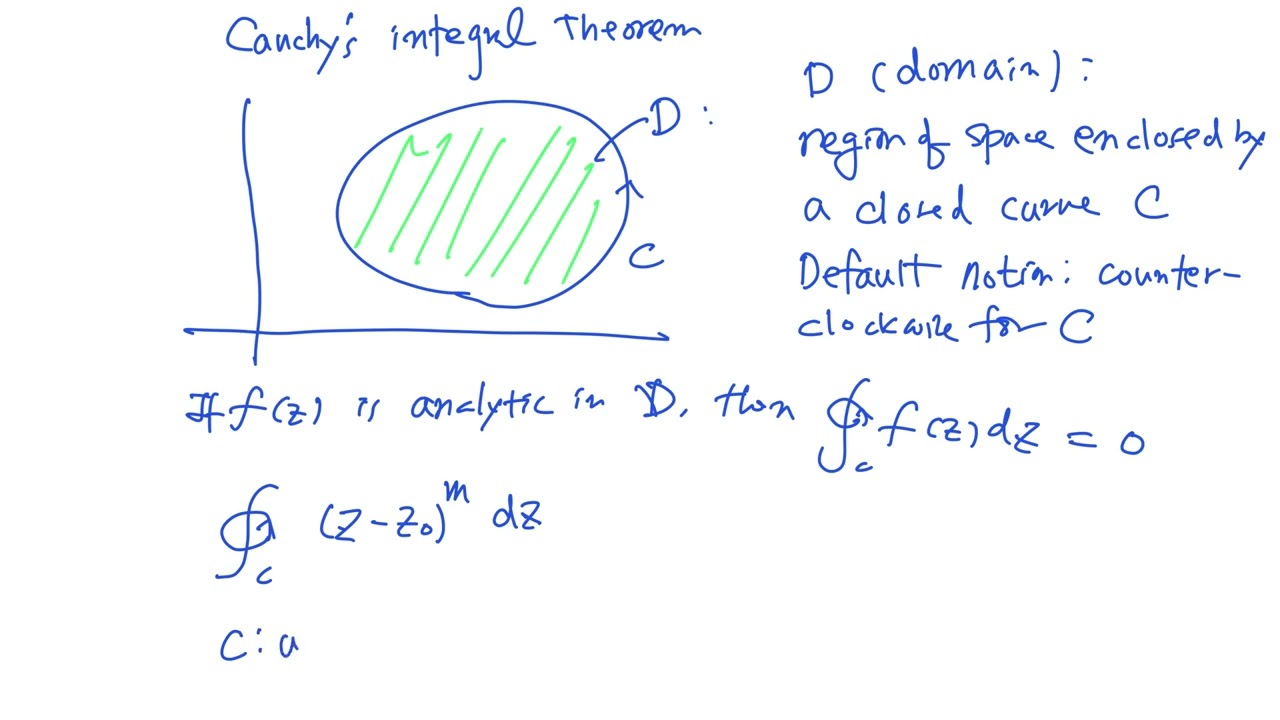

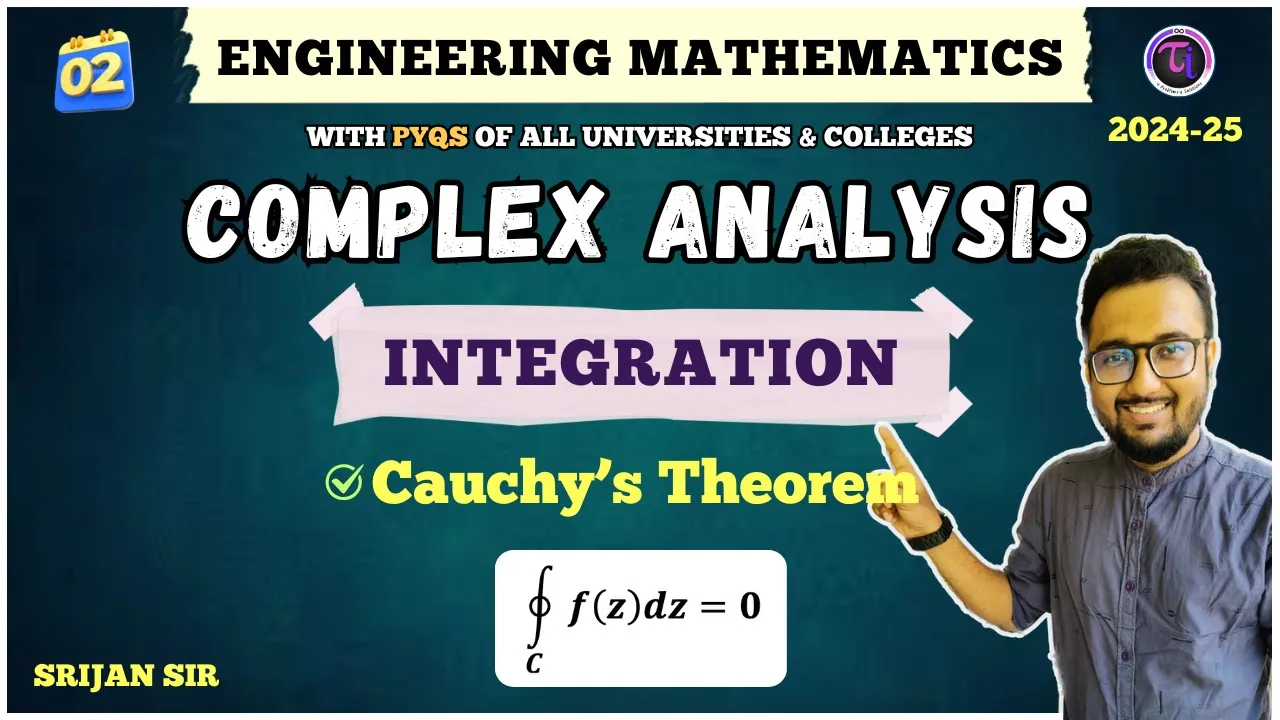
Cauchy's Integral Theorem states that if a function f(z) is analytic at all points interior to and on a simple closed contour C, then the contour integral ∮_C f(z) dz = 0. This theorem implies that for analytic functions in a simply connected domain, the integral is independent of the path connecting two points, and an antiderivative exists such that ∫_z1^z2 f(z) dz = F(z2) - F(z1), where F is the antiderivative of f.
Cauchy's Integral Theorem: Complex Analysis Lecture
Added:The definition of analytic (holomorphic) functions and the Cauchy-Riemann equations.
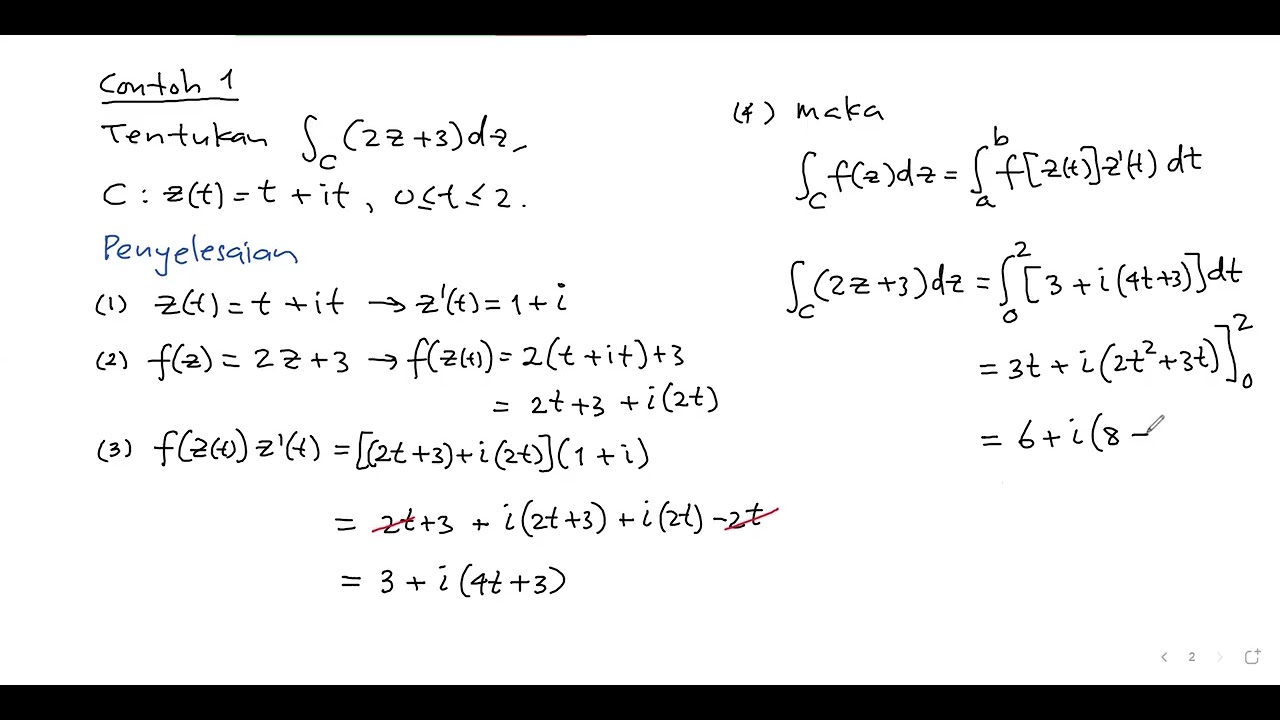
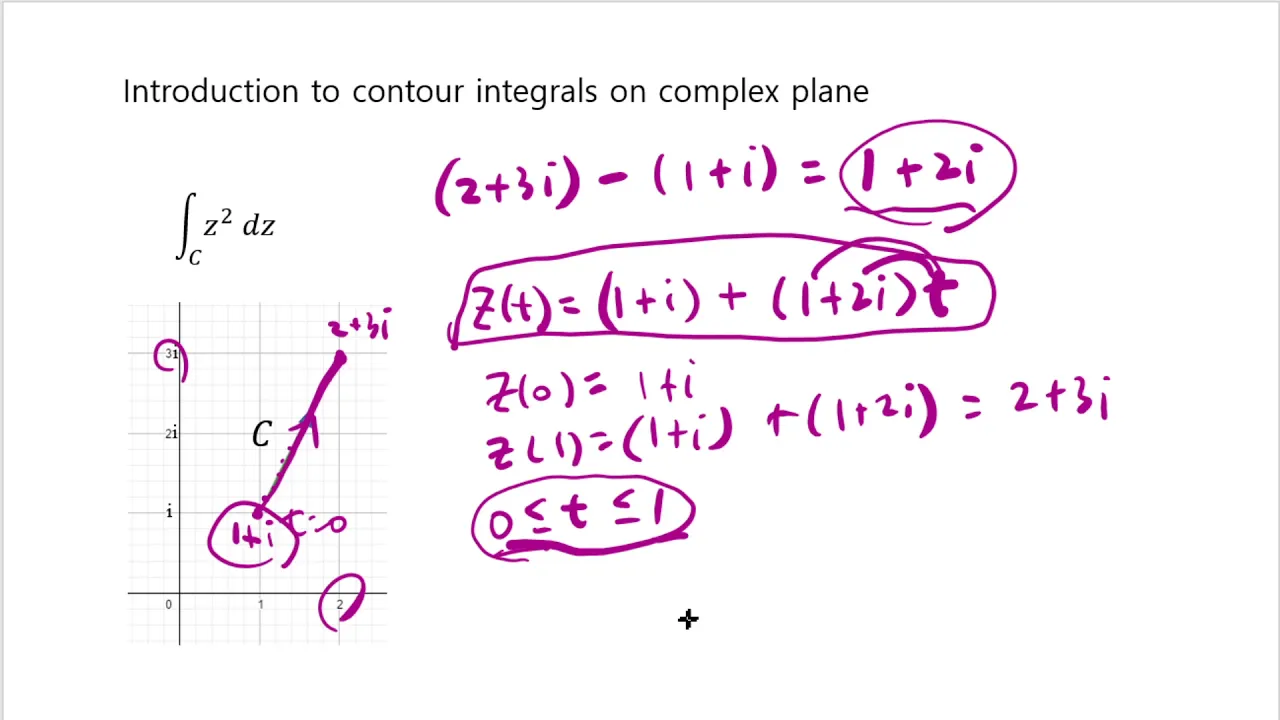
Basic contour integration, including the parameterization of curves and paths in the complex plane.
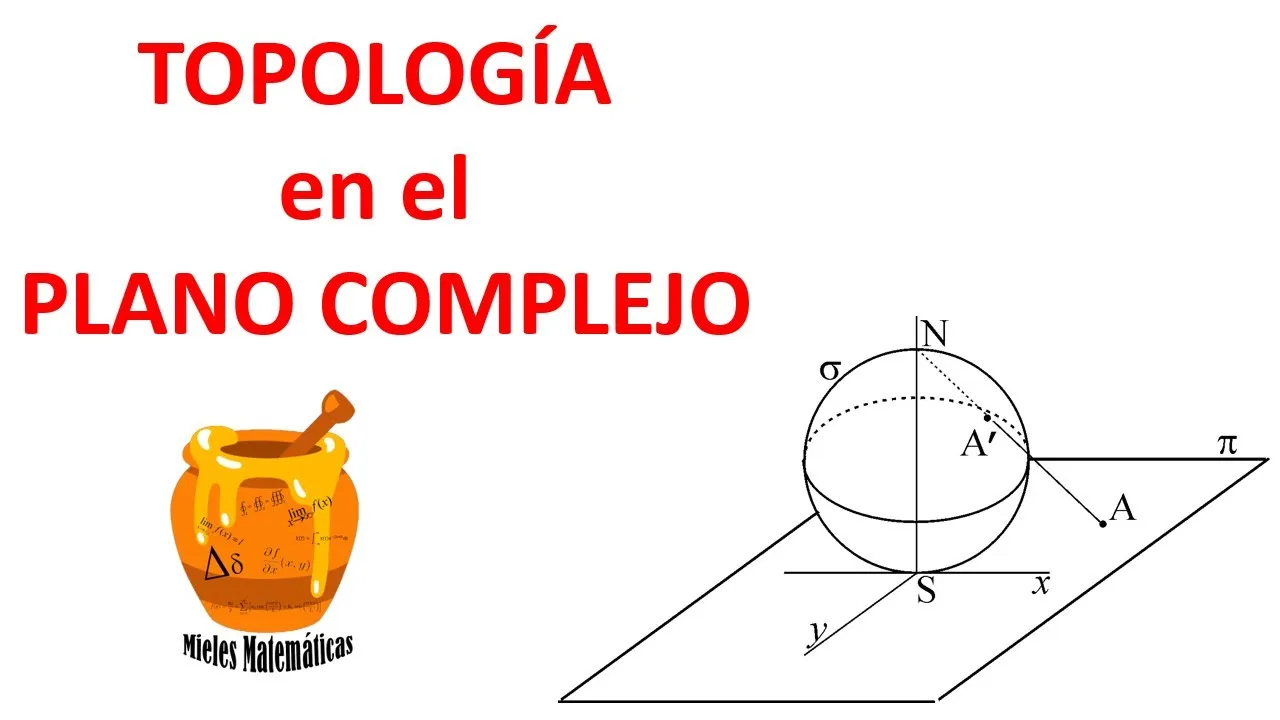
Fundamental concepts of topology in the complex plane, such as open, closed, simply connected, and multiply connected domains.
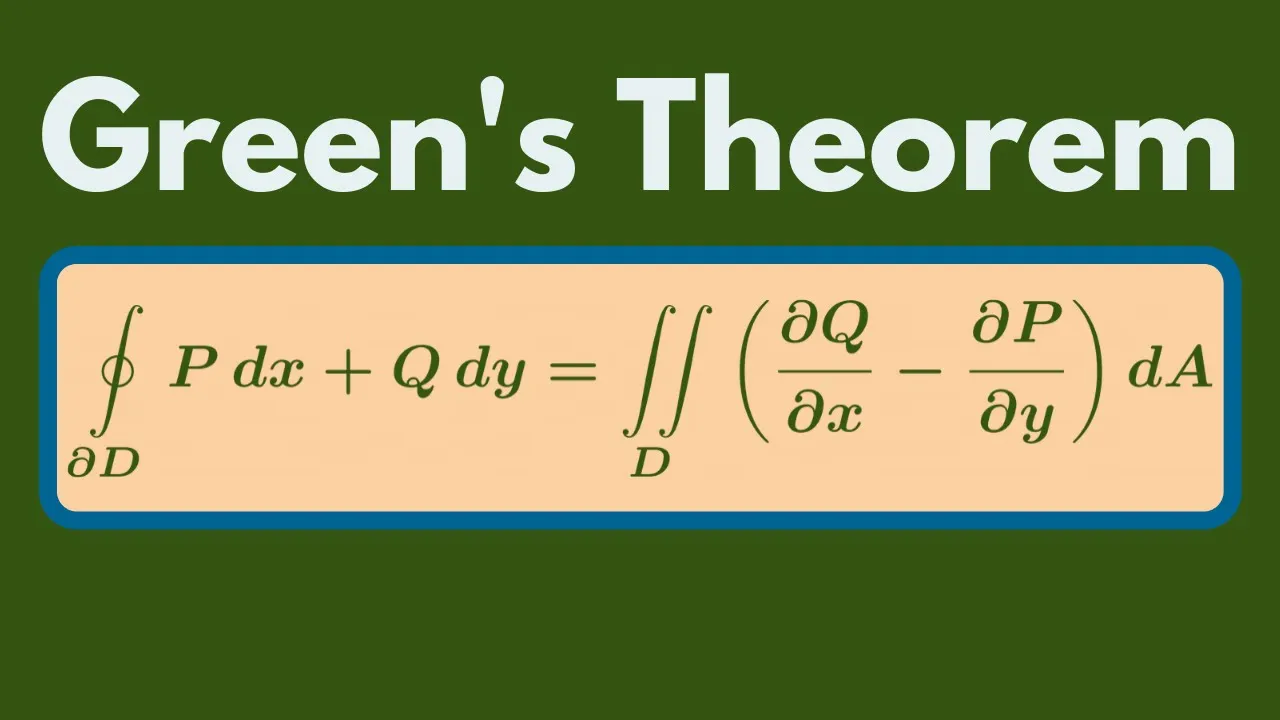
Multivariable calculus concepts, particularly Green's Theorem, which provides the foundational proof for Cauchy's theorem under certain conditions.
Cauchy's Integral Formula, which allows the evaluation of integrals of analytic functions with singularities.
Taylor and Laurent series expansions, which represent complex functions near points of analyticity and singularities respectively.
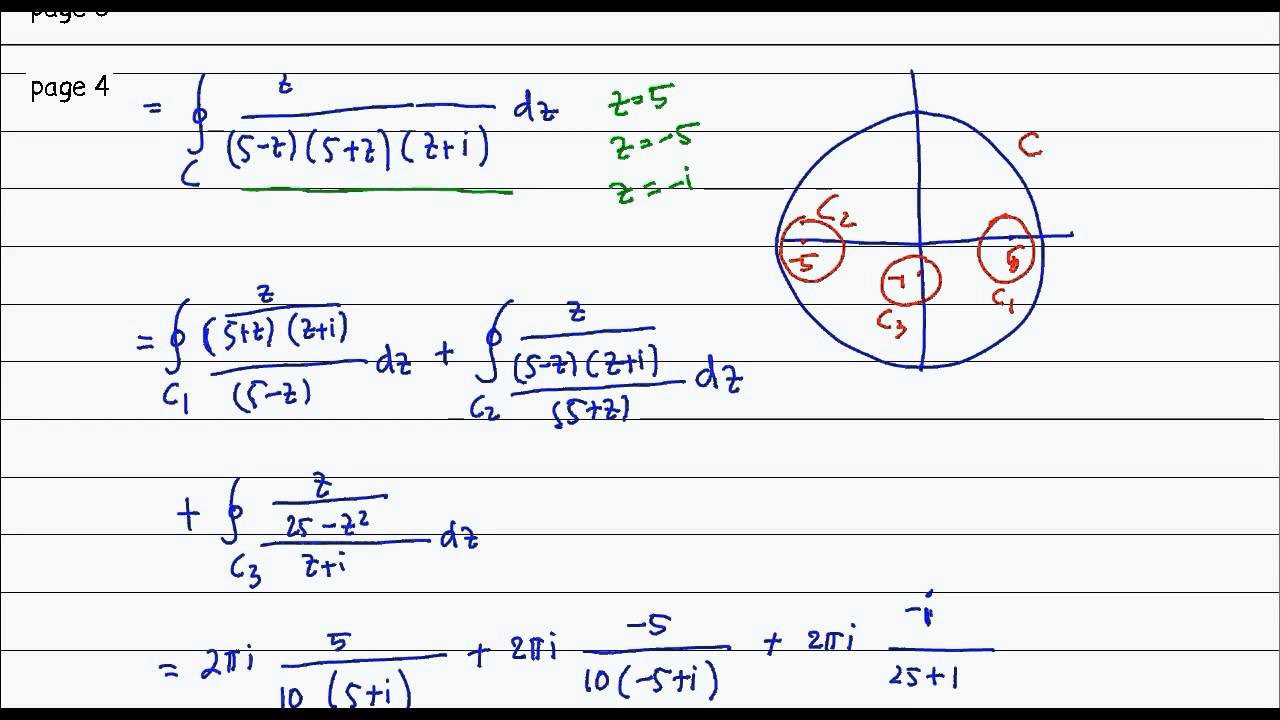
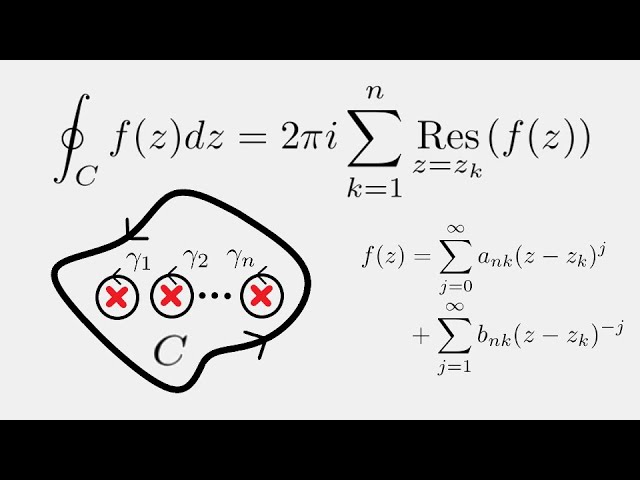
The Residue Theorem, a powerful generalization of Cauchy's theorem used to evaluate complex contour integrals.
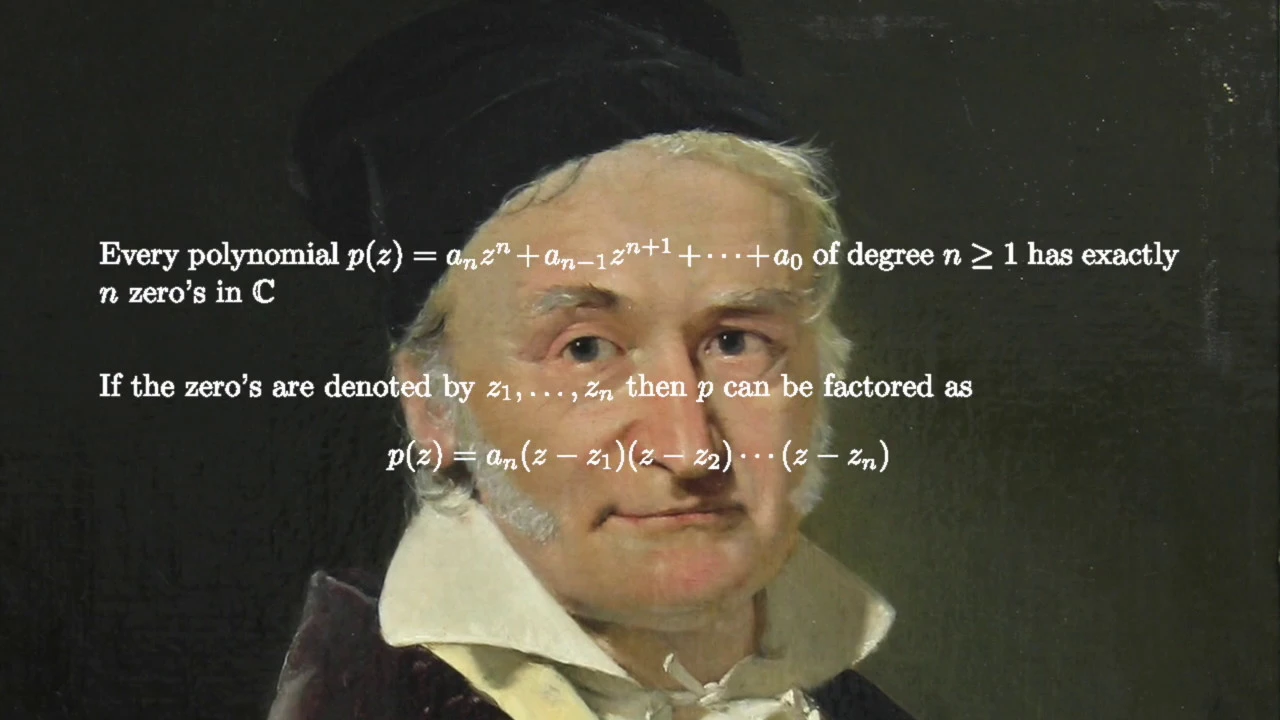
Liouville's Theorem and the Fundamental Theorem of Algebra, which are key theoretical consequences of Cauchy's integral formulas.
Practical applications of contour integration, such as evaluating difficult real-valued improper integrals in physics and engineering.
47.2K views147likes49:43Original Release: 2010-05-03
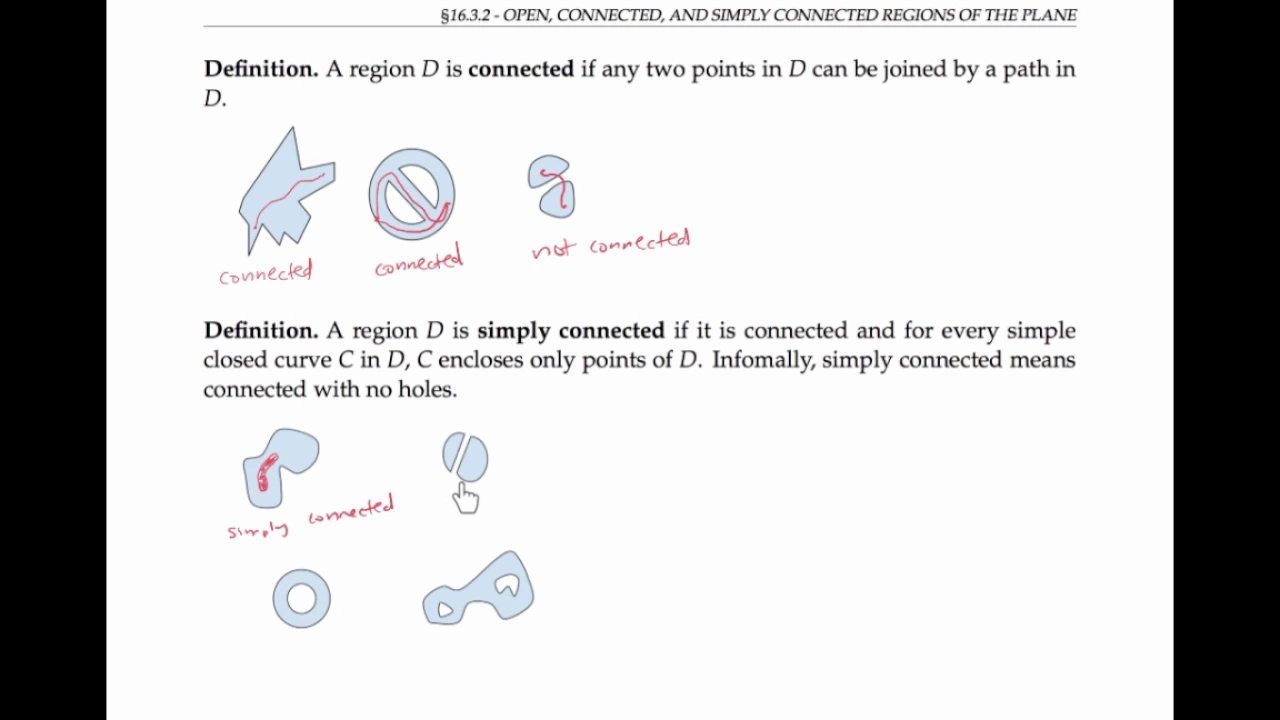
[Music] [Laughter] welcome to the lecture series on complex analysis for under graduate students today's lecture is on ki's integral theorem we have learned about the Contour Integrations that is the integration of complex function in complex domain till now what we have done the Contour Integrations we had find out that for some functions the integral depends on the Contour while for some functions integral does not depend on the Contour in the case when it is not depending on the path we can use the indefinite integral of the function and then in um then we can use the limits for that the from Z KN to Z1 what is our two points and we can calculate the integral independent of any path now today we would let us find out the reason why for some functions the integral depends on path and for some function it does not depend so let us first see suppose that pxy and qxy are two real Val functions which are continuous with their first order partial derivatives are also continuous in some closed reason R which contains points interior to and on a simple close contr C then according to the greens theorem in advanced calculus we do know that about line integral that integral along the Contour C of P DX + qdy is same as the integral over the reason of QX - p with respect to DX Dy let's see that is what it is saying this is the reason XY so this is XY domain or that is a cartisian plane or you could say is the Jet Plane here is some reason R which is enclosed by a contour C this is the Contour C we have taken this Contour in positive orientation that is in anticlockwise so that every point which is interior to this C is left to this one so we are saying is that the integral along this Contour of two functions p and q p with respect to x and q with respect to Y is same as that double integral in this complete reason of QX is the partial derivative of Q with respect to X while py is the partial derivative of uh p with respect to Y with respect to both the variables X and why that is this reason uh double integral now let us use this result in our complex functions so we have started with the complex function FZ which we could say is that uxy + I vxy that we could write we had seen in the cond integration that is integral FZ DZ in the last lectures we have done it can be given as integral c u DX minus V Dy + I * integral over C vdx + U Dy when we have presented our function FZ as uy + I vxy and we said Z is x + i y and the Contour C can be presented on that line on that Contour C uh the jet we are giving in the parametric form then we have done in the last lecture this formula now in this formula we could apply the uh greens theorem y we are assuming is that function f is analytic f is analytic that means f is continuous if f is continuous then certainly u and v would also be continuous and its derivative if uh is continuous analytic that means u and v if F Dash is continuous then u-h and V Dash with respect to partial deres with respect to X and Y they would also be continuous so now we would apply the greens theorem in this result what it says is if you remember the green theorem says is the line integral along the Contour U DX plus uh q p DX plus qdy we have done is QX minus py that is its partial derivative with respect to X and its partial derivative with respect to Y and this would have with the minus sign so now we could write it out this one this would be minus U Yus VX DX Dy similarly this could be given as its part partial derivative with respect to Y and its partial derivative with respect to X so uxus VY DX Dy so what we have got the integral in the region R where this Contour C is inclosing this regon r that uh integral of - ux- u y - VX and of u v ux minus v y this integrant Min - uy- VX and this integrant U x - VY both are zero why because f is continuous analytic so kashian equation says ux is VY and uy is equal to minus VX so ux is equal to v y and uy is minus VX this G gives both integrants to be zero and it is a closed uh reason R so the integrant when both the integrants are zero this would give zero so what we have got actually that now if uh here I have taken the orientation as the positive one that is counterclockwise but actually this orientation doesn't matter because we have got this integral to be zero so if the orientation has been reversed then we do know that integral CF Z DZ can be given as is same as minus of minus C of Z DZ minus c means that is orientation has been changed to the reverse to this one so this is minus of this one because this is zero so this will also be zero that says this orientation is not mattering what we have got now let us State the result which we have got from here we have got the result if a function if is analytic at all points interior to and on a simple close Contour C then integral C FZ DZ is zero that is for any analytic function we do get that for the close Contour simple close Contour integral of FZ DZ would be zero so we could verify it the proof is as such we have actually find it out that is that is the proof you can go ahead with this f z is analytic we write it f as u x + i v y and write this cont integral using that formula and this just in the last slide what we have done that we could call the proof of this theorem actually this theorem has been given by kosi and uh the proof has also been given there we had used the continuity of the uh F Dash next this goset has done it that is without using the continuity of f Dash he has given more General result which said is that only f is analytic and he had also shown that F Dash is also analytic actually any derivative of f would be analytic in this reason that we will do later on so here we just first verify this result for our examples you do remember in cont integral we have done one function J Square J Square we do know is an entire function that is it is analytic everywhere so uh and f- Z is 2 Z which is continuous everywhere so the all these uh conditions are being satisfied that says if I do take any close Contour simple close Contour I must get integral to be0 now if you remember in the last lectures we have done one example where we have taken the integral of J squ from the point 0 to 1 + I if you do remember we have done this example using different Contours one we have done is using this uh line straight line from 0 to 1+ I another we had used is using the 0 to one and then 1 to 1 + I and we had got that in each case our integral has come up same so now you see I'm making this a close control this c is now my close control from 0 to 1+ I then to one and then to this one now since the integral along this line as well as this plus this line they were same so if I'm changing this uh direction for these two integrals whatever integral we have got over here that would be negative of that one and that gives that is in this direction it should be zero and that we had verified it actually we had find out in the last example that it is coming out to be same so the sum of both these integrals would be zero and this theorem also says if I take any close control so this is the example because we have done in the last lecture so I have taken actually you can take any close control you can take any Circle and ellipse or any closed Contour this will always give you the integral as zero because of this theorem since J sare is an entire function now let us uh move to the general results which we are calling is the cautious theorem how do we find it out that when we could say it would happen so let us move to some more results one definition we are defining connected domains connected sets we mean is that is the set which cannot be partitioned further with uh limits not being uh uh common to all so uh we are not very much interested in Connected set definition as such if you are not remembering or if you have not done that over there here we'll Define it simply in two manners one we would call Simply Connected domain and another we would call multiply connected domain what is Simply Connected domain a Simply Connected domain D is such that every simple con close Contour within it encloses only points of d what it is saying is if I take any simple Clos Contour its interior points are only points of D let us see some examples here this is uh our domain D if I take here any close Contour simple close Contour suppose this close Contour I have taken now you see the interior points are only the interior points of this domain D now suppose if I shift this uh uh uh Contour to little bit this side then it will become outside this one so this will not be inside the domain D if I take any Contour in this domain D it will always take the interior points would be only the interior points of D now you see another example here is a domain if I take any close contouring over here you can just check with yourself also this is also a Simply Connected domain similarly you see this this is also a Simply Connected domain because if I take any Contour over here which is inside this domain D that will contain only the points of D certainly dis is not a Simply Connected one see this is also an example of connected Simply Connected domain here is also example so any close bounded Circle or Elipse or this would be your Simply Connected domains this is also a Simply Connected domain this is also a Simply Connected domain this is also a Simply Connected domain now if a domain what is multiply connected domain so multiply connected domain the domain which is not Simply Connected is called multiply connected we had seen that is in the last uh examples all the bounded domains we have taken about for the Simply Connected domain so if we are talking about all the bounded domains in that case what the multip L connected domain could be we could actually rewrite this definition if bounded domain D is called B fold connected similarly we call Simply Connected as one connected and multiply connected as P connected also if its boundary consists of P Clos connected sets without common points in the last example I said is that disc is not as Simply Connected you see what is the disk this disk is having the points we are having this complete disk as a domain the points which are interior to this inside Inner Circle they are not in the domain D so now if I take a close Contour over here say let's says uh this uh Circle then the interior points are the points which are not in D so of course it is not a Simply Connected domain but we can call it doubly connected or two connected why because you see in this domain we do have two boundaries one is this outer boundary and another is this inner boundary the points on these boundaries are these points and points on this boundaries are this so the set of these points on the two boundaries they are disjoint so we do have this domain has two disjoint boundaries that is doain the boundary cons consist of two sets which are disjoint so it is doubly connected similarly you see this is a triply connected domain why we do have here one boundary this is outer boundary another is this inner boundary and then third one is this inner boundary certainly this is not a simply connector because if I do take a contour just like this kind of circle so this Contour is completely inside the domain but it's in interior does not contain all the points which are interior points of the domain so this is a triply connected because the boundary consist of three boundaries and each boundary is disjoined to each other so we do have this triply connected similarly this is you see is that is we are having the 1 2 3 4 and five five boundaries so we will call it five connected this is one outer boundary 2 three and four so we'll have this four connected what we have got one more simple uh uh conclusion from here if it is a bounded domain we'll call it P connected if it has P minus one holes so it is doubly connected one hole triply connected two holes four connected three holes five connected four holes so if it is having P minus one holes then it will call it P connected so this is the definition of multiply connected domain now in the reference of the Simply Connected domain let us see we have defined the Kashi theorem which says is that for a simple CLA Contour the integral will always integral of an analytic function will be zero so now rewrite this theorem in Simply Connected domain we'll call it C integral theorem if a function f is analytic in a Simply Connected domain then for every simple close Contour C in D integral along that close Contour C of FJ is zero now we have not taken any other condition that is whether F Dash is uh continuous or anything we are just taking is that it is it is in lying in the Simply Connected domain now so this is simple Contour now if it is not this thing this theorem can be extended to any close Contour rather than simple close Contour simple close Contour means is that is it is not intersecting itself at any point if I do have any Contour that is it is not a simple close Contour C and D can be replaced by any closed Contour so suppose this is a closed Contour which is intersecting itself at a finite number of times even then this theorem would hold or this result of this theorem that is integral along this close Contour C of FZ would be zero if this Contour is lying inside a Simply Connected domain why we could do is if it is lying inside the Simply Connected domain say for example if I'm talking about this Contour this close Contour I can break into three parts one is this close Contour another is this close contour and then another is this close contour for each close Contour this is a simple close contour for each simple close Contour the Kashi theorem will hold true that says is if I add up all these three I would get the final integral as zero and then we would say is that any Clos Contour it would be zero so here the Kashi theorem is actually about the simple Clos cont but we can extend this result to any close Contour in this manner let us see that is what it is actually referring to we are actually basically interested in finding it out in what sense we could say that for a function the integral will depend upon the path and for what functions the integral does not depend on the path so now we are talking about analytic functions we had find out if it is on any simple Clause contol the integral along that contol will always be zero for analytic function if this says is that our independence of path so I'm writing that result in form of theorem if a function f is analytic in a Simply Connected domain D then integral of FJ is Independence independent of path in D let's say J 1 and J2 be any two points in a simply connected domain D so let's see this is my Simply Connected domain D Z1 and J2 these are any two points now I want to say that integral of f f is analytic in this whole domain I want to say that integral along this uh integral of f from the point J1 to J2 would be same whether I reach in this manner or I reach from this manner R I go with any other path it should be independent of path see what we are saying is I would use this Kashi integral theorem this is a Simply Connected domain I had made one simple close Contour passing through these two points J 1 and J2 I have taken it positively oriented then according to this C integral theorem I do have that integral FZ DZ is now this Clos integral this close Contour the integral should be zero now this close Contour I dividing into two parts one is from Z1 to J2 this C1 and another is from J2 J to J 1 as C2 so I could write it as C1 FZ DZ plus C2 FZ DZ that we do know by simple definition of the our uh integrals we we could write it out that is the path we can write as the summation of these paths so this is equal to zero according to the theorem now what it says is from here integral C1 FZ DZ should be minus of integral C2 FZ DZ now if I take the sense reversal property then minus of integral along C2 that could be given as integral along minus C2 so what we do get integral from on the path C1 is same as integral on the path minus of the integral on the path C2 which is same as integral on the path minus C2 that says is whether I'm using this path or I'm using this path this would be same now here I have taken this close Contour actually we can make infinite many close Contours passing through these two points and for each path I would get it like this one now here I have taken the simple uh close Contour so my paths are not intersecting each other now if suppose the path from J one to J2 I do talk about the two paths such that they are intersecting each other so see what we could say is suppose these are the two points J 1 and J2 and we do have that the one path is this red path and another path is this green dashed path these paths are intersecting each other at a number of points now here for example I have taken that they are intersecting at three points we want to say even if this is happening is still the integral of an analytic function from J 1 to J2 will remain independent of path so we are taking it that it is intersecting at three points a b and c so crosses each other at many points now what we will do is as I said is that is the Ki theorem is holding true even if I do take the path not simple Contours but the Contours which which any Contour so here I'm taking this as any Contour rather we will just use this Ki theorem for different segments so let's say uh first this uh from J 1 to a this is a close contour and for this the Ki theorem holds true that is along this path of this close Contour this integral will be integral of analytic function f would be zero similarly along this path from A to B this Contour close Contour then from B to C this close contour and then from C to J to this closed Contour now so I'm writing this complete Contour that is complete with the red and the green from containing both both J 1 and J2 this complete Contour this I can break into four Contours this first Contour from J 1 to a we are calling C1 the second Contour from jet2 to B in this again I'm taking all the positively oriented that is the inside points interior points are on the left of this one and then this is from B to C this Contour when we are talking about this close Contour C3 and this is close Contour C4 now you see so all these fours are the simple closed Contours in a Simply Connected domain so integral along this of any analytic function along these closed Contours would be zero that says this final integral would be zero now I'm writing this first integral that is first this simple close control first I'll take this red path from J 1 to a this is C11 and then this green path from A2 back to J1 in this direction this is C12 similarly for C2 I will take this red path from A to B in this direction and then I'm taking in this direction so you see is here I'm actually changing my direction according to uh my convenience that is in this one I'm taking this positive direction in this I'm taking the negative Direction why because I want to keep the direction same direction for One path that is why I'm making it and we do know that this CI theorem is holding true whether we are taking is the direction is immaterial when the function is analytic on this SLE close Contour so here I'm taking this first uh first this direction and then C2 two is this one similarly for B to C I'm taking again the positive direction that is from c31 is this red one and C32 is this green one in this direction then c41 is your this red one in the negative Direction now you see and then c42 is Green Path from this direction since the complete sum has to be zero so what it says is uh from here what I would get it actually that C11 now I'm writing it in the two different manner now I would break up the red path and the Green Path red path I would keep on the left side and the Green Path on the right side red path you see all the second um indices as one that is what is our red path and all the second indices two that is our Green Path so C11 this one plus c21 you do see is that is how we have taken c21 we have taken this path connecting from A to B so C11 c21 c31 c41 the path from J 1 to J2 this path this would be same as now if I take C12 C12 is this path so minus of C12 means the path from J 1 to a then c22 c22 is the same path uh c22 was we have taken is that the second one we have taken in this this orientation so c22 was actually from C uh from B to a so now minus c22 would be again from A to B then we do get from this side and minus of C32 then minus of c42 this one so what we are getting is actually you can rewrite it by your manner uh and see it clearly we would be getting that the integral along this path would be same as integral along this path so whatever be the path if the function is analytic in this whole domain D which is simple L connected then for any analytic function the integral is independent of path if it is independent of path then in last lectures we had seen is if indefinite integral does exist r that is also we are calling this anti-derivative we could write the uh integral very easily that is we don't have to see from which path and we don't have to find out the uh function along this path or we don't have to write the parametric equation of the path we just have have to know the points J1 and J2 and the function and its anti-derivative and that we can write the integral value what does this CI theorem also makes that anti-derivative exist you see the Ki theorem also says is that we can use the Ki theorem to say that anti-derivative exists you see one more thing in between we are talking about principle of De deformation of path as we are seeing is it is independent of path so if the function is analytic on every path here whatever the paths I have talked about from C1 to C2 these are two points we are talking about and keeping these fixed ends if we just take any path we can we are you see is that is we are changing our paths in this one this is one example you could say is you can make it any other manner integral of any analytic function when the function is analytic on these path and it's Interiors or rather you could say only on the paths we do find out that these integrals will remain same this is called actually the principle of deformation of path that is we can deform the path from C1 to C2 so just I'm writing this thing path C2 is obtainable from C1 by continuously moving with fixed ends hence for analytic F value of integral does not change this is called the principle of deformation of path so now come to this existence of indefinite integral if a function f is analytic in a Simply Connected domain D then there exist an indefinite integral Capital FJ of a small FJ which is analytic in D and for all points in D joining any two points J KN and J1 in D the integral is independent of path and can be given as integral from J KN to J1 now you see I'm not writing it that is integral along the path C I'm just writing from J KN to J1 of FJ DJ is as capital F of J1 minus capital F of J2 you see we had proved the Ki theorem when we had assumed that derivative of f was continuous as I told you that f- the continuity of fdh was not required that the proof was given by gset but that I have not done here because it is little bit more involved so you see now we are moving towards that is when this FJ is only analytic we are not talking about any condition on the uh F Dash uh being continuous but what we have added up that is we have added of the condition that it is a Simply Connected domain so here what we are seeing is of course we do know along any close Contour the integral is zero from there we had obtained that it is independence of path so these points we have got that is because f is analytic in the Simply Connected domain then any path if J KN to J when I do take a close Contour we do get is that the integral along that would be zero that gives our us independence of path now the thing here what we are seeing is that indefinite integral capital cap FJ of FJ is existing this Capital FJ sometimes also we call anti-derivative so let us see the proof of this theorem how we are going to do let us uh have this two points that is a fix Point J knot and I'm having any path in that domain d uh from J KN it's moving one to Jet so be this one and I Define now Capital FJ this is being defined as integral from J KN to J FS DS along this path this path is in that domain D now we want to show that this function is actually existing this function will exist because this is a path in Simply Connected domain D it's integral along along any path from J KN to Jed either I take this path or this path or that path it will always be same that says is since the value for each one would be same so existence you could say from here we are just saying is that this does exist so I have defined that this is existing now the thing which we want to say is that is this is actually anti-derivative of if that is if I do not take this limit I should say Capital FJ is integral of a small FJ DJ for that what we have what we will do is we'll take this function FJ and we'll show that the derivative of this function Capital FJ is a small FJ that for that we will use the first definition of derivative so for that what we will take we'll take one point J plus Delta J in the neighborhood of J and we'll extend this path straight line you could say till this one now this I have taken in a small neighborhood in a neighborhood of J so it is again inside our domain and the function is analytic because function is analytic in whole domain so we are saying is the function is analytic in that path on that path extended path also so if it is happening then according to this definition how we have defined this Capital FJ I could write this capital F j+ Delta J as integral from J KN to j+ Delta J of FS DS now for using the first definition I want the difference of FZ plus Delta J with FJ what will be that Difference by this definition it would be simply integral J to J plus Delta J F FS DS minus integral J to J FS DS that is integral from here to here minus integral from here to here we do know from this Contour integration that this would be nothing but the integral of f is that function f on this small path from J to Delta J so that is what we are writing is it is nothing but J2 J plus Delta J FS DS and if I'm dividing it by Delta J so I should have this 1 upon Delta J outside now what we have to show that this limit of this is a small FJ how do we do go again we'll go with the first definition that is I'll take its difference with small fjet and show that this difference can be made arbitr arbitrarily small when Delta jet is made arbitrarily small or when Delta J is this J plus Delta J is approaching to Z or this small this Delta J is approaching to zero the difference of this function with a small fjet can be made very very smaller that can also approach to zero so let us try for that one let us first see from jet to Delta jet uh jet plus Delta jet this uh length of this path is only Delta jet so now write this uh the length of path formula we do get Delta J is integral of j+ Delta J DS that says this now if I take F of J that is at this point that is independent of all the points which are inside this on this simple line from J to Delta J so from here what we could write F of Z I can write as 1 upon Delta J integral j+ Delta jet FJ DS right this FJ is independent of any points that is it's it's not integrable over this integral is Con this FJ is constant with respect to the all the uh path of integration that can be taken out and this integral would be nothing but Delta J so so Delta Z upon Delta Z is 1 so this is f z that we could write now come to this f z + Delta Z minus FJ upon Delta J minus FJ you see both I am getting is one upon Delta J is uh common both and in both the things I'm having the integral from jet to J plus Delta jet of course here is the function fs and here is the function FJ again with the pro using the properties of this Contour integ ation you could say uh we could rewrite it as the same integral from Z to Delta Z and we would write FS minus FJ so let's see that is how we are writing it we are writing it as FJ plus Delta J minus FJ upon Delta J minus FJ as 1 upon Delta J J integral J to J plus Delta J of FS minus FJ DS now you see we want want to make it arbitr small so we take the modulus of this one modulus of this one would be modulus of this one with the modulus property we could write one upon mod of Delta Jet and then mod of integral absolute value of the integral jet to J + Delta J FS minus FJ DS now for uh finding out the absolute value of this one what we actually we have to show that this is arbitrarily small so for this now what we will do we'll use this ml inequality if you to remember now you see FS minus FJ what is my reason of integration jet to J plus Delta J and we are talking about this path so uh what we are talking about in this path you see any s over here it's difference with J that will always be less than Delta J since I'm taking a small neighborhood so let's take this Delta J is is small enough since f is analytic so this is small f is analytic so if would be continuous in this domain by the definition of continuity if I'm taking any small neighborhood of the jet then the difference between the two points is small that says is that the fs minus FJ would also be is small let us say this is Epsilon so what we are saying is that FS minus FJ mod of this would be less than Epsilon 1 upon Delta J is as such this is less than Epsilon and then the length of path is Delta J so using this ml inequality I'm getting is this is less than Epsilon how we have done I'm just rewriting it since FS minus FJ would be less than Epsilon whenever we are having is that s is in the small neighborhood of J because of the continuity of f what it says is that now this I have taken in this part Direction this path now because I said is that is I'm taking J plus Delta jet as in the neighborhood so it's not necessary that I do take only this way I can take here also I can take here also till it is inside that domain D that Simply Connected domain D so whatever b side we could take it here I'm just using this condition whatever Direction I do take this uh J plus Delta jet all the times the path I would be having is that a straight line over there and it would be always the independence of path says is that it will always be the all the definition of FZ plus Delta J and FJ will remain same and we will always get because of the continuity of a small F that this thing would be holding true that says this this would be can be made this difference can be made arbitrarily is small for any Delta jet that is in whole neighborhood of J what it says is now use the first definition of the derivative it says is that limit as Delta J approaches to zero of FJ + Delta Z minus FJ upon Delta J would be small FJ what does it says it simply says by the definition of derivative that the derivative of capital FJ is small FJ or in other words we write that Capital FJ is nothing but the anti-derivative of small FJ so we have got J is also arbitrary so we have got that uh and the Jed also we have taken the arbitrary so now we have got this Capital FJ is analytic in whole of the domain D and its anti-derivative is uh and is the anti-derivative of small FJ that is we could say FJ is integral FJ J DJ now you are seeing is that is I'm not taking it J not to J now what we are seeing is that since my J I have taken arbitrary the J KN also have taken arbitrary point so now I can use it in general and I can write this anti-derivative does exist anti-derivative does exist that say is my function capital F is analytic in that whole domain D now if it is happening and Suppose there is another Suppose there is some other anti-derivative of this is small F which is capital GJ then what will happen uh we would say is because GJ is anti-derivative that means g-j will also be small FJ so the difference of G Das and F Dash that would be a small f j minus a small f j that will always be zero for all J if I because they are anti-derivatives and this uh they are the derivatives of F and capital F and capital G if I integrate it we do know that GJ minus FJ should be a constant now here because we are talking about the complex one so this should be a complex constant what we say if there does exist any other anti-derivative capital G of a small F that would be nothing but addition of a complex the difference of these two would be nothing but a complex constant that says is what will happen the uh output of the our theorem which said is that integral along from J KN to J 1 of FZ DZ that is f of J1 minus F of J2 now you see if why I'm talking about this one if capital G is some other anti-derivative then what it will happen it will be have it will be actually capital G of J 1 minus capital G of J2 so how do I say is this capital F of J1 minus capital F of J not only you see what is Capital GJ Capital GJ would be nothing but FJ + a so G of J 1 minus G of J2 When J not whenever I'm writing I would again write substitute it as FJ plus a because a is a con fixed constant so whether we are changing is J KN or J1 that doesn't make change in the a I will always get this one that says this the anti-derivative is existing and the definite integral or that integral between the two point Point J not and J1 in that Simply Connected domain of this is small FJ can be given as capital F of J1 minus capital F of J KN where Capital FJ we are defining as the anti-derivative of small FJ without a complex constant so thus we have got C theorem says this if my f is analytic in a Simply Connected domain D then it's anti-derivative does exist and the integral is independent of path and then we can use this simple formula that says this now explains our example which we have done in the last lecture so let us do one example evaluate the integral Z squ digit from 0 to 1+ I you to see that this we have done the example in the last lecture and we had done it along some paths here we do know that Z Square this function is actually entire function so whatever because this is an entire function so whatever uh domain I'm taking where this Z and 1 + I is lying this FJ would always be analytic so and the anti-derivative of this J Square we do know is J Cub by 3 that you have done in some simple um some lectures on this uh derivatives of this one so if I take the derivative of J Cube by 3 it would be actually J squ so according to this result which we had find it out integral from 0 to 1 + i² DJ should be J Cub by 3 integral uh the evaluation from 0 to 1 + I that says is 1 + I CU by 3 or it is 2x 3 - 1 + I you can compare this result which we have done in the last lecture similarly if I do take the function e to the power jet or any uh integral power of J or any other analytic function uh any other entire function then uh the derivative of anti-derivative of all those functions we do know because in the differential equation uh derivatives chapters we you have done the derivatives of these functions and since they are entire function function so whatever the two points we are taking we can write it out but it's not necessary that we do talk about only entire functions of course for entire functions we do not have to see any other thing that is for entire functions we will not see where the points of Integrations have been given or whether they are lying the function is uh inside that one is uh in a Simply Connected domain or not for entire functions we don't have to see those things but it's not necessary that we do apply it only the entire function we could have analytic function in some domain if that domain is Simply Connected and the points are inside that domain is still this theorem is applicable so today we had learn that when the function is analytic in any domain then its integral is independent of path moreover we had learned that its derivative is existing and uh it's anti-derivative is existing are we called it indefinite integral and then the integration can be find out using that anti-derivative or indefinite integral evaluated at that the points or that is the limits and this is very simple as we have done in the definite integrals in the real analysis so we have come across the similar result as in the real analysis for the complex functions in the complex domains also so very nice result that is all for this today's lecture we'll move little bit more from here that if function is not analytic it's analytic everywhere but at some points it's not analytic uh in the domain but it's analytic on the path what will happen and all those things we'll discuss little more about this one till here here we had come to that it's complex analysis or integration of the complex function is similar to that of the real integrals or whatever we have done in the first course and the analysis so that is all for today's lecture thank [Music] [Music] you [Music] [Music]
Up Next

32:43
Complex Analysis: Singularities & Laurent Series | KTU Maths GYMAT301 Part 6
@RVSMathsAcademy
142.1K views•2020-12-30

4:43
Elliptic Curve Cryptography Explained: ECC, ECDSA, ECDH
@PracticalNetworking
28.5K views•2024-10-21

50:04
Uncountable Sets & Cardinal Numbers in Real Analysis
@iit
51.9K views•2016-01-19

6:00
The Mathematical Impossibility of Accurate World Maps
@Vox
23.3M views•2016-12-02
Related Study Plans & Knowledge Roadmaps
Structured learning paths in Mathematics
mathematics
Tensor Calculus: Vectors to Riemann Curvature
01Mathematical Foundations: Linear Algebra & Calculus
02Covectors, Dual Spaces, and Tensor Basics
03The Metric Tensor and Index Gymnastics
+ 2 more learning modules
40h5 modules
Explore Roadmap
mathematics
Gödel's Incompleteness: Logic, Proofs & Limits
01Introduction to Formal Systems & Hilbert's Dream
02Set Theory, Cardinality, and Cantor's Diagonal Argument
03Arithmetization and Gödel Numbering
+ 2 more learning modules
14h5 modules
Explore Roadmap
mathematics
Galois Theory: Fields, Groups & Solvability
01Foundations of Abstract Algebra: Groups & Fields
02Polynomials & Field Extensions
03Splitting Fields & Symmetries
+ 2 more learning modules
24h5 modules
Explore Roadmap
mathematics
Non-Euclidean Geometry: Models & Geodesics
01Euclid's Fifth Postulate and the Birth of New Geometries
02Hyperbolic Space and the Poincaré Disk Model
03Geodesics: Defining Straight Lines in Curved Spaces
+ 2 more learning modules
15h5 modules
Explore Roadmap