



![[지식in] e란 무엇인가? / [Eng sub] What is constant e ?](https://i.ytimg.com/vi/ELArhsyt4MA/hqdefault.jpg)



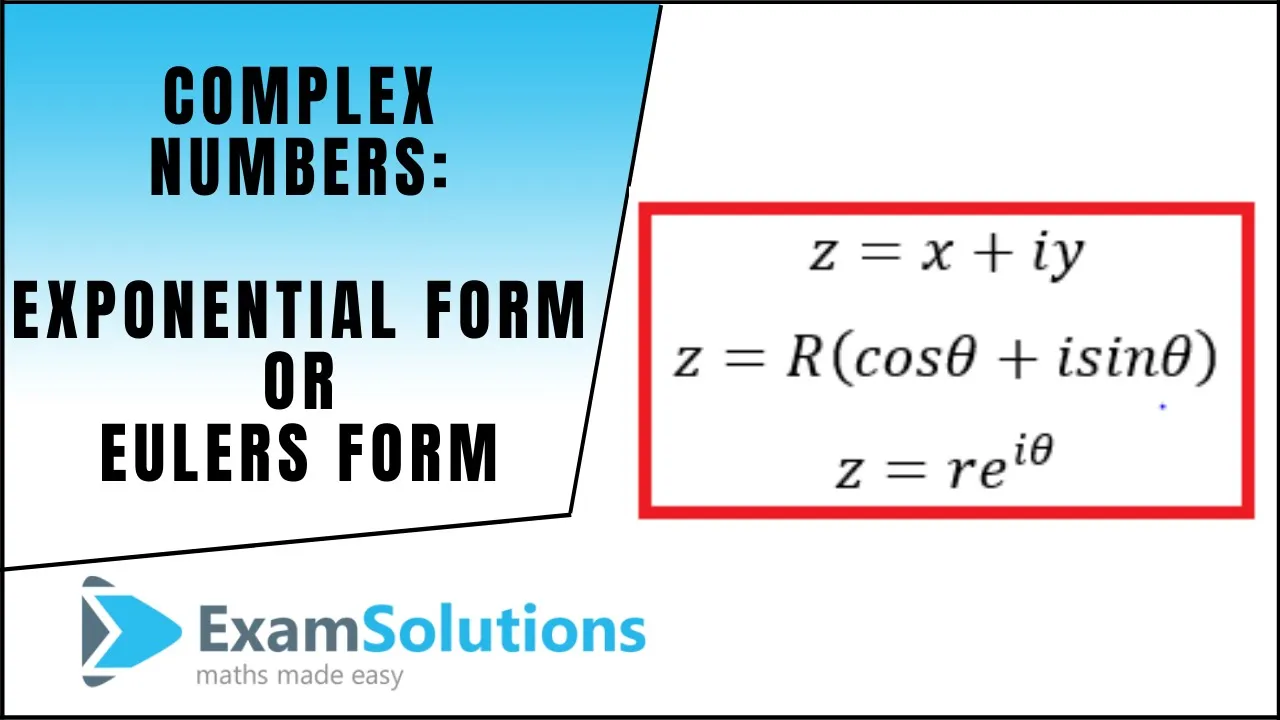












Complex numbers can be represented in rectangular form (a + ib) or polar form (r × e^(iθ)), where r is the modulus (√(a² + b²)) and θ is the phase angle (tan⁻¹(b/a)), with Euler's formula e^(iθ) = cos(θ) + i sin(θ) enabling conversion between these representations; this framework allows computation of complex operations like reciprocals and roots through manipulation of modulus and phase rather than direct algebraic manipulation.
Complex Numbers and Euler's Formula | MIT Differential Equations
Added:Basic algebra of complex numbers, including the definition of the imaginary unit 'i' and operations in Cartesian form (a + bi).
Fundamental trigonometry, including the unit circle, sine, cosine, and converting Cartesian coordinates to polar coordinates (r, theta).
Properties of exponents and familiarity with Euler's constant 'e'.
Understanding of Taylor/Maclaurin series expansions, specifically for e^x, sin(x), and cos(x), which underpin the proof of Euler's formula.
Solving second-order linear homogeneous differential equations with constant coefficients that result in complex roots.
Applying De Moivre's Theorem to find the general n-th roots of any complex number.
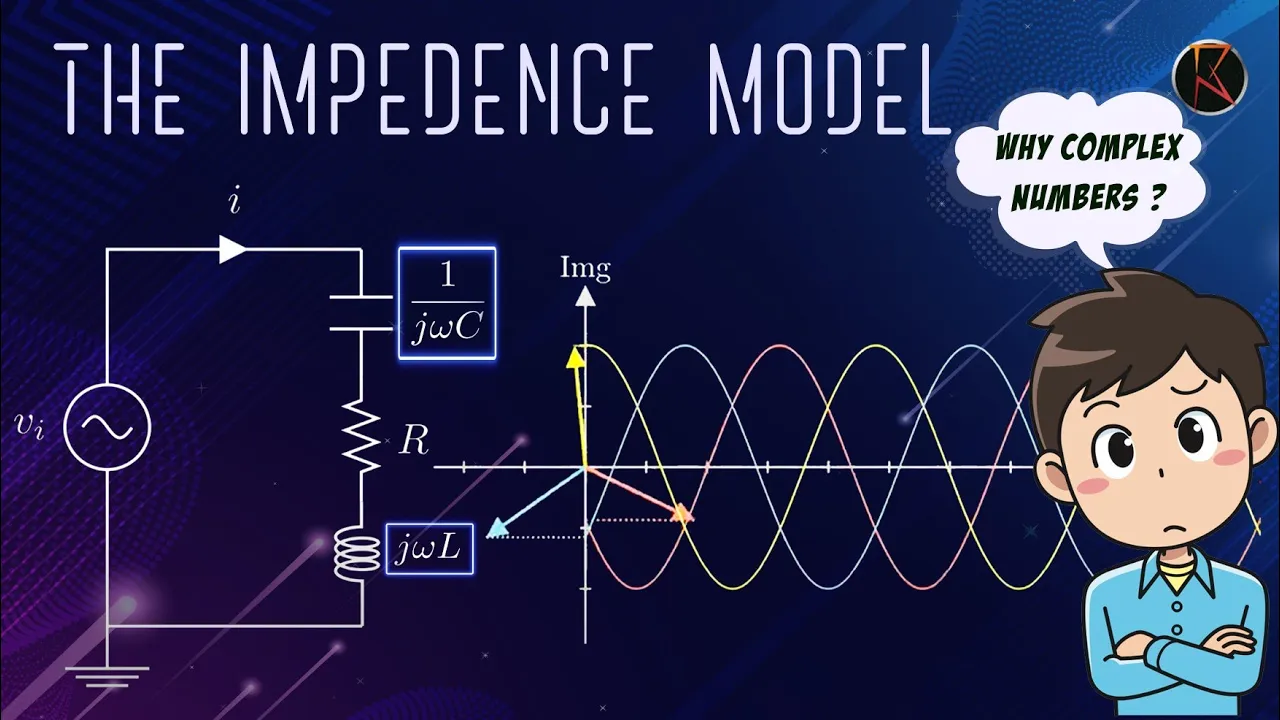
Using complex exponentials to simplify the analysis of alternating current (AC) circuits and mechanical oscillations.
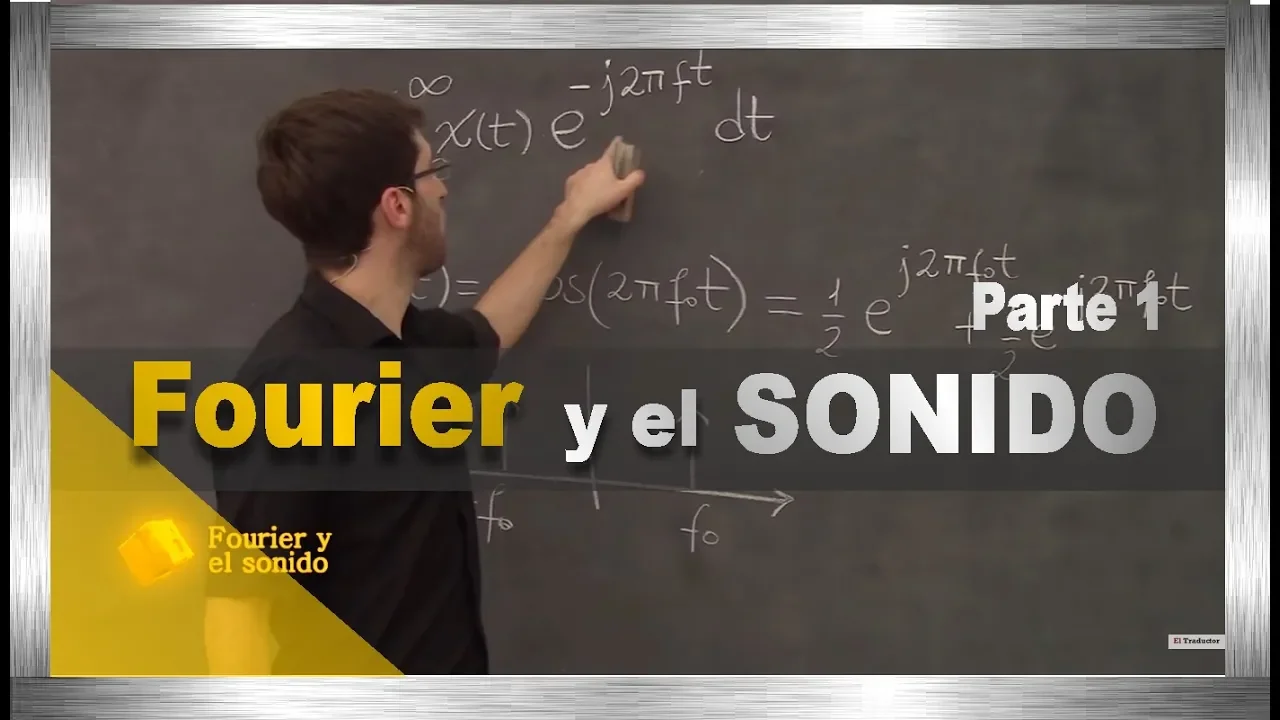
Transitioning to Fourier Analysis and Fourier Transforms, which rely heavily on complex exponentials to represent frequency domains.
170.8K views1.3Klikes11:30Original Release: 2012-01-04
Hi, today we will explore the complex numbers and ear formula. So the first part of the problem is to write this complex number min - 2 + 3 3 I in polar form which and at this point it's written in rectangular coordinate form.
The second question asks you to do the reverse to write 3 exponential to the i pi over 6 in rectangular coordinate form. Question C asks you to draw and label the triangle relating the rectangular coordinates to the polar coordinate form. D asks you to compute one over this reverse complex number that we already saw in question A. And E ask you to find the cube root of one. And in all these questions you'll be using earlier formula. So why don't you pause the video, take a few minutes to work out the problem and we'll come back.
Welcome back. So, we're asked to throughout the problem to go back and forth between coordinates in polar form and in rectangular form. So, key thing to remember is earlier formula from the start. So, we're just going to write it up here.
allow us to express a complex exponential into the sum of its cosine plus i sin theta. So how do we tackle question a? Question a gives us a complex number in rectangular form. So in this form a + i and we are asked to write it in polar form which is which imp introduces the modulus of the complex number r and its phase theta. So r is the modulus of the complex number that we can compute when we know its rectangular form with its real form square plus imaginary uh part square. the whole thing under the root. So in this case we have four + 9. So we end up with root of 13 for the modus of of the complex number z. So now for the phase using formula we can see that we can relate the rectangular form to the polar form by just introducing I'm going to keep R. And you can see now that we can extract the sign and the cosine of the angle theta and relate that to a ratio of A and the modulus R that we just found. B modulus R that we just found or in one move just express it as the tangent of the angle theta is just s cosine just becomes basically uh B / A which we have here.
So we have the modulus r which is now root of 13 and the angle theta that we can now extract by using the reverse of the function theta uh 10. So just to before we move to the next question this is not one of the classical angles that you learned. So just to have an idea of where this angle lies on the trigonometric unit circle just re recall here that the sign is positive and the cosine of this angle is negative. So we are bound to be in this region where basically theta is between pi and pi / 2. And that ends the rep the answer to question A. So now for question B, we're asked to do the reverse expressing the polar number 3 I pi / 6 in rectangular coordinates. So now this is just a straightforward application of the other formula that we just saw by just expanding the exponential as I already wrote there.
+ i 3 sin pi / 6. And on the same trigonometric circle here, that's roughly where pi / 6 lie.
And you can just reexpress this as 3 roo<unk> of 3 / 2 + i 3 over2. So that ends the solution for question B. So now question C. Let me just add a line here. Question C, we're asked to draw and label the triangle relating rectangular to polar coordinates. So that's what we already had a sense with when we wrote this formula going from a plus i to r exponential of i theta. So in the complex plane we have the real axis imaginary axis and a complex number lying on this plane written in this form in a rectangular coordinate would have a projection of a on the real axis projection of value B on the imaginary axis and in polar form this would be its modulus or distance from the origin and its phase theta that would come in the polar form. So that's roughly that's the the the triangle that allow us to go back and forth between the rectangular and polar coordinates. So to finish or almost finish question D now asked us to compute the reverse of the original complex number that we used. So 1 over -2 + 3 I. So to do this we can stay in complex in a in rectangular form and basically multiply the numerator and the denominator by the complex conjugate of the number. But clearly now that we learned how to use polar numbers, polar uh coordinate expressions of this number, it's much easier to just write it directly in this form. And in in one step, we basically arrived to the results where we expressed that the angle was the reverse tan of - 3 /2 and that's done. So now for the last question we are asked to compute the 1/3 root of one. So basically one to the 1/3. So here obviously we're treating one as the complex number and if we go the complex plane and I just introduce here the number one we see that in polar form one is just basically complex number with modulus one and angle 0 modul modulus 2 pi right so we can write one as exponential 2 n pi Oops. Because it's basically angle 0 modulus 2 pi. And from here we know that we're looking at third roots. So we're going to have three roots. And these roots are going to be expressed by changing the value of n. First one is n equals to zero is just going to give us back root of one because we're going to have exponential to 0 is just one power 1/3 is just one.
n= 21. We're going to have exponential of 2 pi over 3, which we can express again using the ear formula also in coordinate form and then just write down the values. And for the third root we take the value n equals to 2. So we have i 4 pi over 3 which again we can express as the cosine plus the s of 4 pi over 3. So where do where do these roots lie? So we have root one for n equals to zero. The second root exponential 2 pi over 3 basically in polar form would be here where we would have the angle 2 pi over 3 and here. Okay. So 1 pi over 3 would be here. 2 pi over 3 would be here. 3 pi over 3 would be here. And 4 pi over 3 is our third root would be here.
So this completes so then we can just write down the values and you can do that when you know the the angles or just keep it in either form when you don't know the the directly the expression for the angles. So this completes the problems in overall in all of these problems what we kept using is earlier formula to go back and forth between coordinate in rectangular form to coordinate to expression of complex number in polar form and that's the key formula that we kept using and you will be using this uh repeatedly when we will be solving other odes for which we can use complex number as a trick for solutions and this end this session
Up Next
41:17
Deriving the Fourier Series Coefficients | Oxford Calculus Guide
@TomRocksMaths
70.7K views•2022-12-13
4:43
Elliptic Curve Cryptography Explained: ECC, ECDSA, ECDH
@PracticalNetworking
28.5K views•2024-10-21

20:22
Cantor's Theorem: Proof & Diagonal Argument | MIT 6.042J
@mitocw
33.1K views•2016-09-12

6:00
The Mathematical Impossibility of Accurate World Maps
@Vox
23.3M views•2016-12-02
Related Study Plans & Knowledge Roadmaps
Structured learning paths in Mathematics
mathematics
Tensor Calculus: Vectors to Riemann Curvature
01Mathematical Foundations: Linear Algebra & Calculus
02Covectors, Dual Spaces, and Tensor Basics
03The Metric Tensor and Index Gymnastics
+ 2 more learning modules
40h5 modules
Explore Roadmap
mathematics
Gödel's Incompleteness: Logic, Proofs & Limits
01Introduction to Formal Systems & Hilbert's Dream
02Set Theory, Cardinality, and Cantor's Diagonal Argument
03Arithmetization and Gödel Numbering
+ 2 more learning modules
14h5 modules
Explore Roadmap
mathematics
Galois Theory: Fields, Groups & Solvability
01Foundations of Abstract Algebra: Groups & Fields
02Polynomials & Field Extensions
03Splitting Fields & Symmetries
+ 2 more learning modules
24h5 modules
Explore Roadmap
mathematics
Non-Euclidean Geometry: Models & Geodesics
01Euclid's Fifth Postulate and the Birth of New Geometries
02Hyperbolic Space and the Poincaré Disk Model
03Geodesics: Defining Straight Lines in Curved Spaces
+ 2 more learning modules
15h5 modules
Explore Roadmap