













![[s3 | 2025] Математический анализ, Трифанова Е. С., лекция 26](https://i.ytimg.com/vi/M99caw-_nC8/maxresdefault.jpg)


This lecture teaches systematic methods for finding residues in complex analysis: (1) For removable singularities, the residue is always zero; (2) For simple poles, use Res(f, c₀) = limₙ→c₀ [(z - c₀)f(z)]; (3) For double poles, use Res(f, c₀) = limₙ→c₀ [d/dz((z - c₀)²f(z))]; (4) For poles of order n, use Res(f, c₀) = [1/(n-1)!)] × limₙ→c₀ [dⁿ⁻¹/dzⁿ⁻¹((z - c₀)ⁿf(z))]; (5) When f(z) = g(z)/h(z) and h(z) has a simple zero at c₀, use Res(f, c₀) = g(c₀)/h'(c₀).
Finding Residues: Poles, Derivatives & Formulas | Complex Analysis
Added:Understanding of holomorphic (analytic) functions and basic complex differentiation.
Classification of isolated singularities, specifically distinguishing between simple, multiple (double), and essential poles.
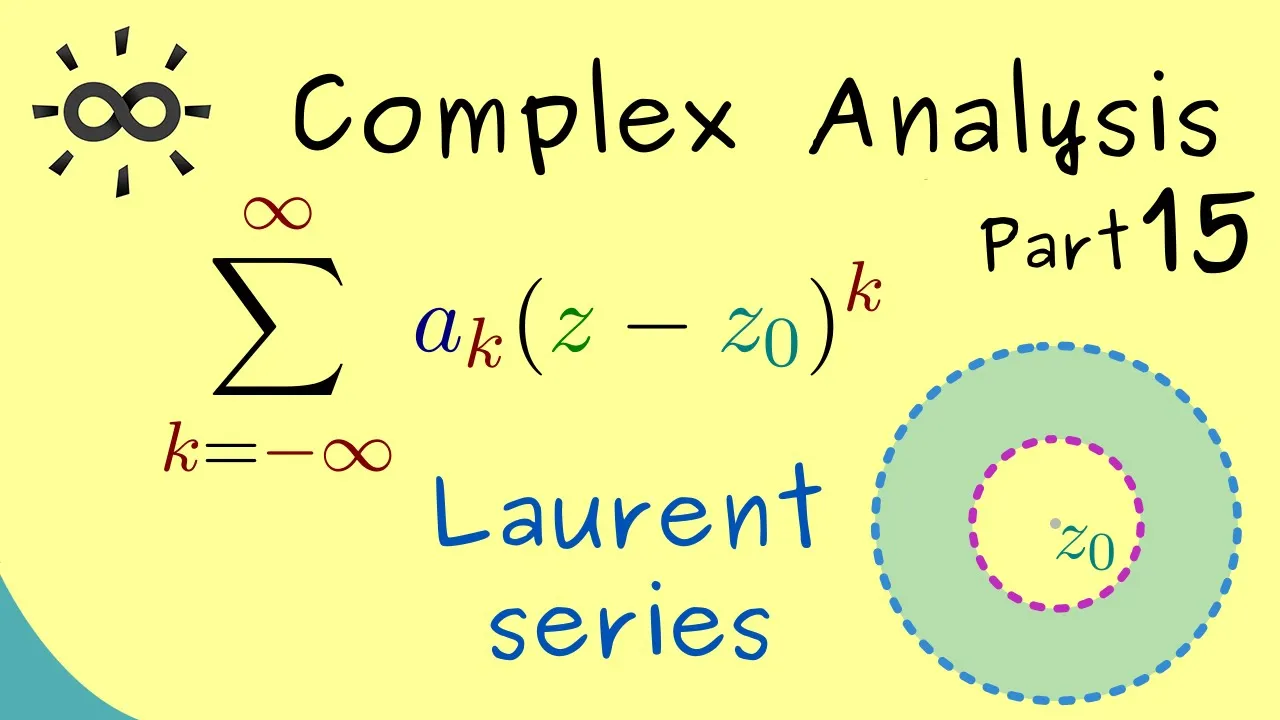
The concept of Laurent series expansions and the fundamental definition of a residue as the coefficient of the (z-z_0)^(-1) term.
Applying the Cauchy Residue Theorem to evaluate complex contour integrals over closed paths.
Evaluating real definite integrals, including improper integrals on the real line and trigonometric integrals, using contour integration techniques.
Exploring advanced theorems of complex analysis, such as the Argument Principle and Rouché's Theorem, to locate roots of functions.
Learning how to calculate and use residues at infinity to simplify the integration of certain complex functions.
6.5K views119likes13:12Original Release: 2015-07-13
welcome to the fourth lecture in our seventh week of our course analysis of a complex kind this lecture will focus on new tricks to find residues now that we have the powerful residue theorem we need new techniques to find residues more easily let me remind you of the residual theorem suppose f is a function that is analytic except for an isolated singularity so that means f is analytic in a punctured disk centered at c0 with the exception of c0 in that case f has a laurent series representation in that punctured disk which is a doubly infinite series of terms a k these are the coefficients times d minus a zero to the k where k runs from negative infinity to positive infinity we say the residue of f adds to 0 is the a minus 1 term this is the term for which k is equal to minus 1 and that is the coefficient of the 1 over z minus c 0 term let's start by finding residues and removable singularities recall that a removable singularity is a singularity for which you find out that after finding the laurent series there are actually no terms that have negative powers of c minus c zero so all the aks are actually equal to zero for k less than zero one particular then a minus one must be equal to zero which is the residue so in that case the residue of f and c zero is zero let's look at an example the function sine z over c sine z over z has an isolated singularity at the origin because that's where we're dividing by zero otherwise the function is analytic sine z itself has a taylor series representation centered at the origin namely z minus z cubed over three factorial plus z to the fifth or five factorial and so fourth that you see right here if i divide that by z i find myself with 1 minus 1 over 3 factorial times z squared plus 1 over 5 factorial times c to the fourth and so forth that's the level series representation of sine z over z which we use to show that z equals 0 is actually a removable singularity for this function f therefore the residue of f at 0 is equal to 0.
next let's consider residues at simple poles recall that zero is a simple pole if the a minus 1 term in the laurent series representation is non-zero but all other ak's for case less than negative one are equal to zero so there's exactly one negative power of c minus a zero in the laurel series expansion so f has the form a minus one divided by z minus c zero and then all non-negative powers so z minus c zero how do we find this a minus one term here's the idea we multiply through by z minus c zero if we multiply both sides of the equation by z minus two zero we find that z minus c zero times f of z is z minus c zero times a minus one over z minus c zero so that's just a minus one and then each term gets an additional z minus c zero so a zero times c minus c zero a one times c minus zero squared and so forth now if i let z approach c zero and take the limit then as z approaches c zero this term goes away this term goes away and all i'm left with is this term right here so the residue of f and c 0 can be found by taking the limit as z approaches c 0 of z minus c 0 times f c let's see if we can use that in an example let's look at f of c equals 1 over z squared plus 1. we've already looked at this function before we know it has simple poles it's a 0 equals i and z 0 equals negative i we'll focus on i right now and try to find the residue and see 0 equals i by our formula we can find that residue by first multiplying the function f by z minus i that's what you see right here we multiply f by z minus i and then we need to take the limit as z approaches i but 1 over z squared plus 1 is actually equal to 1 over z minus i times z plus i because we can factor the denominator the z minus i in the denominator cancels out with this t minus i so that we're left with simply 1 over z plus i the limit as z approaches i of that fraction can be found easily by simply plugging in i for z and if i plug in i for z i get 1 over 2i and 1 over 2i is the same thing as negative i over 2. so the residue of this function at i is negative i over 2. that's the same residue we found last class with a very different method next let's look at double poles a double pole is one for which the a minus two term is non-zero but all further a k is for k less than or equal to negative three or equal to zero so f has the form a minus two over z minus 0 squared then maybe there's an a minus 1 term or maybe not and then all the rest of the terms are non-negative powers of z minus 0.
how do we isolate a negative 1 the idea is very similar this time we multiply through by z minus c zero squared the largest denominator we have so z minus the zero squared times f of c gives us simply a minus two and the a minus one term gets an x to z minus c zero a zero gets a z minus a zero squared and so forth we can't simply let z approach c zero because if we did that we would isolate a negative two but we're not interested in a negative two we're interested in a negative 1.
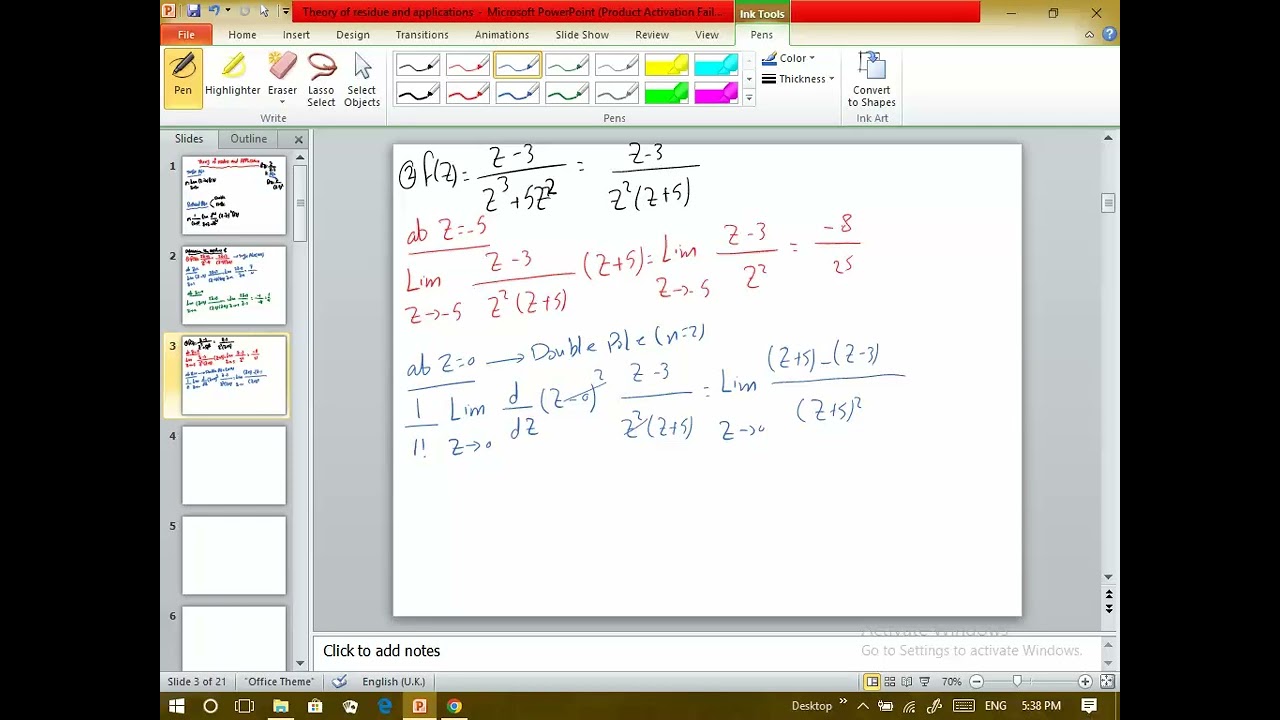
that's why we have an additional trick right here we take a derivative if we take a derivative of this equation then the a minus 2 term goes away we're left with an a minus one term the derivative of a zero times c minus c zero squared is two a zero times c minus c zero and all the subsequent terms have some power of c minus a zero now if we let z approach to zero all these subsequent terms go away and we're left with a negative one so we found our formula for double poles the residue of the double pole can be found by first multiplying the function by z minus c zero squared and then taking a derivative and then taking the limit as z approaches c zero let's look at an example let's look at f of z equals one over z minus one squared times c minus three that function has a double pole at c zero equals one it also has a simple pull at three but we're not interested in that pole right now we want to find the residue of f at one by our formula we need to multiply this function by z minus one squared that's what's happening right here then we need to take a derivative and finally the limit as z approaches one we see right away multiplying by z minus one squared is very convenient because the z minus one squared term will simply cancel out so that we're left with having to find the derivative of one over z minus three and then the limit as z approaches one but the derivative of one over z minus three is minus one over z minus three squared and the limit of that as z approaches one we simply have to plug in one for z one minus three is negative two negative two squared is four and so that the residue of our function at one is negative one-fourth let's try to generalize these ideas suppose now we're dealing with a pole of order n that means the a minus n term is non-zero and all other ak's for k less than or equal to negative n plus one those are equal to zero so my function looks like this i have a minus n over z minus c zero to the n and then terms with the denominator gets better and better all the way through a minus one over z minus c zero and then the non-negative powers of c minus c zero the idea is the same thing we're going to multiply through by z minus c 0 to the n and if i do that i'm left with a minus n plus a minus m plus 1 times c minus c zero all the way through a minus one times c minus c zero to the n minus one plus a zero times z minus zero to the n and so forth i want to isolate the a minus one term so i can't simply let z approach c zero i need to isolate this term and therefore i need to take an n minus one full derivative if i take a derivative n minus one times this d minus c zero to the n minus one will go away all these terms in the front will also go away under differentiation and only terms to the right will be left so if i differentiate this n minus 1 times i find the following the first time i take the derivative of the a minus 1 term i get that n minus 1 from the exponent then an a minus 1 times c minus a 0 to the n minus 2.
the next time i differentiate i get the factor n minus 2 up front and so forth if i differentiate n minus 1 times the z minus c 0 term is gone entirely and i have an n minus 1 times n minus 2 times n minus 3 and so forth all the way down to 1 times a minus 1 term left the a0 term also has all kinds of things up front here but it has a z minus c zero term left and so do all the subsequent terms now if i let z approach c zero all these subsequent terms will go away so if i now take a limit as z approaches c zero then i can isolate my i minus 1 term if i simply divide by this number right here which happens to be n minus 1 factorial so we just found the following formula the residue of f at a pole of order n is one over n minus one factorial times the limit as z approaches c zero of the n minus one full derivative of z minus c zero to the n times f of c this formula clearly contains the two cases that we already considered earlier the simple pool and the double pole but now you can use it for higher order poles as well to finish i want to show you one other very useful little fact suppose you have a function f that is a quotient of two analytic functions g and h for h the denominator has a simple zero at c zero then the residue of f at c zero can simply be found by taking g the numerator function evaluated at c zero and dividing that by the denominator derivative adds to zero let's get back to the example that we looked at when we looked at a double pole f of z equals one over z minus one squared z minus three has a double pole at 1 but also a simple pull at 3. this time we want to find the residue at 3. we can look at this function as the function 1 over z minus 1 squared divided by the function z minus 3.
the function g which is 1 over z minus 1 squared has an isolated singularity at 1 but is otherwise analytics so in particular near 3 it's very much analytic for example if i look at a little disk around 3 in that disk the function g is entirely analytic the function h of z which is z minus 3 is also analytic it's analytic everywhere and has a simple 0 at 3.
why the fact we can therefore find the residue of the function f which is g divided by h by simply plugging in 3 into g and plugging in 3 into the derivative of h well g of 3 is 1 over 3 minus 1 squared 3 minus 1 is negative 2 square that you get 4 so this is 1 4 and h prime of 3 is equal to 1 because the derivative of h is simply equal to 1 everywhere therefore the residue of this function f adds c zero is one-fourth we could have just as well found the residue of f using the fact that three is a simple pole we could have applied that formula the calculation would have been quite similar this is just another way of finding residues in the next lecture we'll use the residual theorem to find some interesting integrands
Up Next

104:42
Singularity PYQs: CSIR NET 2011-2023 | GATE 2000-2023 Shortcuts
@DrHarishGarg
51.4K views•2024-06-20

4:43
Elliptic Curve Cryptography Explained: ECC, ECDSA, ECDH
@PracticalNetworking
28.5K views•2024-10-21
10:44
Fourier Series Introduction: The Big Idea Explained
@DrTrefor
387K views•2021-05-03

6:00
The Mathematical Impossibility of Accurate World Maps
@Vox
23.3M views•2016-12-02
Related Study Plans & Knowledge Roadmaps
Structured learning paths in Mathematics
mathematics
Tensor Calculus: Vectors to Riemann Curvature
01Mathematical Foundations: Linear Algebra & Calculus
02Covectors, Dual Spaces, and Tensor Basics
03The Metric Tensor and Index Gymnastics
+ 2 more learning modules
40h5 modules
Explore Roadmap
mathematics
Gödel's Incompleteness: Logic, Proofs & Limits
01Introduction to Formal Systems & Hilbert's Dream
02Set Theory, Cardinality, and Cantor's Diagonal Argument
03Arithmetization and Gödel Numbering
+ 2 more learning modules
14h5 modules
Explore Roadmap
mathematics
Galois Theory: Fields, Groups & Solvability
01Foundations of Abstract Algebra: Groups & Fields
02Polynomials & Field Extensions
03Splitting Fields & Symmetries
+ 2 more learning modules
24h5 modules
Explore Roadmap
mathematics
Non-Euclidean Geometry: Models & Geodesics
01Euclid's Fifth Postulate and the Birth of New Geometries
02Hyperbolic Space and the Poincaré Disk Model
03Geodesics: Defining Straight Lines in Curved Spaces
+ 2 more learning modules
15h5 modules
Explore Roadmap