















![[복소2] 7.13. 무한급수의 합 계산 예제](https://i.ytimg.com/vi_webp/-OSs2ax1wBA/maxresdefault.webp)
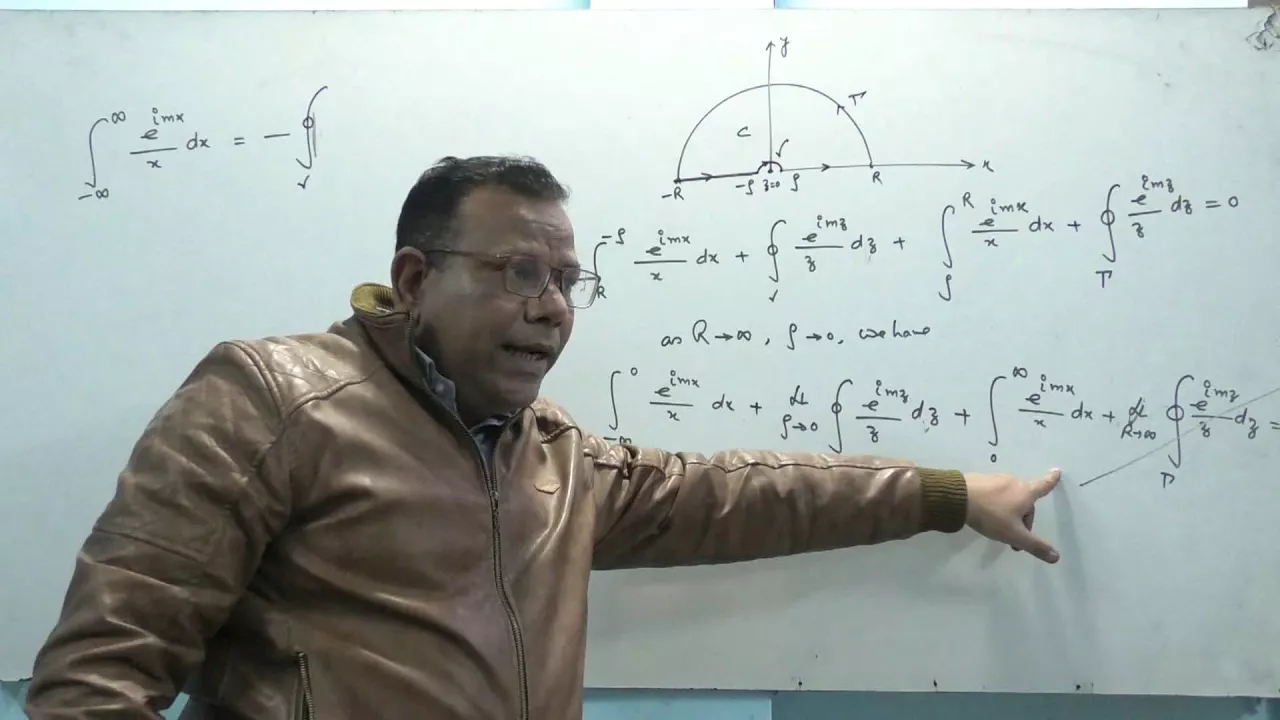



A Laurent series is a generalization of a power series that includes both positive and negative powers of (z - z₀), consisting of a principal part with negative powers and a regular part with non-negative powers, which together define a holomorphic function on an annular domain (a ring-shaped region) centered at z₀ with inner radius r₂ and outer radius r₁, where the residue is the coefficient of the (z - z₀)^(-1) term.
Laurent Series Explained | Complex Analysis
Added:Understanding of holomorphic (analytic) functions and the Cauchy-Riemann equations.
Familiarity with complex power series, specifically Taylor series and their radii of convergence.
Core concepts of complex contour integration and Cauchy's Integral Formula.
Basic awareness of isolated singularities where a complex function fails to be differentiable.
Classification of isolated singularities (removable, poles, and essential singularities) based on the Laurent series expansion.
The Residue Theorem, which utilizes the $a_{-1}$ coefficient of the Laurent series to evaluate contour integrals.
Application of the Residue Theorem to compute challenging real improper integrals and summation of series.
Advanced topological results in complex analysis such as the Argument Principle and Rouché's Theorem.
52.4K views974likes8:22Original Release: 2022-04-06
hello and welcome back to complex analysis and as always before we start i want to thank all the nice people who support me on study via paypal or by other means now in today's part 15 we will talk about so called la ror series here you should immediately remember that these objects will be a generalization of power series and moreover they also give us more examples for holomorphic functions okay now in order to understand a lore series we first have to start with an ordinary power series so we have coefficients a k and as always without losing anything we can fix the expansion point at 0.
moreover we also know each power series has a well-defined radius of convergence we usually call r in the worst case this number would be zero and the best case would be that this number is given by the symbol infinity so maybe let's visualize this again in a complex plane which means we find an open disk where we have convergence for example the radius of convergence could be 2.
then we know for a complex number that with absolute value less than 2 we know that this power series is convergent however on the other hand the series is not convergent when we put in a number w that lies outside the disk so if the absolute value is greater than 2 we have divergence however now the overall idea is that we could also look at the inverse of w indeed it could happen that 1 over w lies inside the disk this means that the absolute value of 1 over w has to be less than r hence the absolute value of w is greater than 1 over r and of course this is simply equivalent therefore we could say that one of the two conditions here implies that the series with a k times 1 over w to the power k is convergent therefore in our picture here we would find the second circle with radius one half however now you should see we are not interested in the inside but in the outside so you see for this formulation here we get an inverted domain of convergence in this case here it stretches from one half to infinity in other words this defines a new function with this new domain and moreover we also know it's a holomorphic function of course this is simply a consequence of the chain rule simply because we have the composition of two holomorphic functions hence in summary if we write the series with negative powers we get a holomorphic function and as we have already seen in the example the domain is given by c without the closed disk with radius 1 over r okay so here please note everything came from a power series but the resulting function here is not a power series anymore so maybe you could call it a power series with inverse powers or alternatively you could write it using only negative powers this means that we would start with the constant term a0 and then we would go to -1 minus 2 minus 3 and so on and then we can make it look like a normal power series again when we use coefficients b k and maybe z instead of w again however the front part tells us it's not a power series because we have negative exponents okay now when you look back to the picture you see we could combine an ordinary power series with this new series here and what we get would be a holomorphic function defined on this ring here hence i would say let's define this new function so as i said before we just want to combine the two series we had above so first we have the ordinary power series that starts with zero and goes to infinity and second we have this new strange series that starts with -1 and goes to minus infinity now of course what we use is that each power series has a well-defined radius of convergence however now we have two therefore let's call the first one r1 okay for the second part we already know we first have to look at the power series which means we just invert the powers and then we get a well-defined radius of convergence as well now as before when we call this one r the corresponding radius that is important for us here is 1 over r and exactly this is what we can call r2 so in summary we have two zeros with two corresponding numbers r1 and r2 and both can lie between zero and infinity where zero and infinity are included now as before the visualization in the complex plane is that we have two circles and moreover we have two different domains of convergence and depending on the values of r1 and r2 they could overlap in such a ring okay now in summary this is exactly what a law series is hence i would say let's put this into a formal definition and indeed formally we will write the slow raw series as a series that goes from minus infinity to plus infinity then we have coefficients we now just call a k times z minus zero to the power k now of course without any problems now we are able to introduce an expansion point this is simple because it's just a shift in the plane okay now from above we already know such a large series is simply a pair of two series essentially we just have two power series the first has the positive powers and the constant and the second part has all the negative powers and as we have seen above the two radii of convergence define our ring okay and now you might see the second part here is the essential new thing of the loro series therefore this series is often called the principal part of a lower series moreover as we will see soon the part with the index k is equal to -1 is very important for calculations and for this reason the number a minus 1 gets the name residue okay now another important fact you really should remember is that a large series is always a holomorphic function defined on this ring so formally this means the domain is given by all complex numbers that which satisfy that the absolute value of z minus zero is less than r1 and bigger than r2 now the worst case would be that this is the empty set which means that r2 is bigger than r1 and the best case would be that this is almost a complex plane you see by definition the expansion point z0 is always missing however later you will see that we often have this best case scenario therefore i would say we use the next video to look at examples of floral series so i really hope that i see you there have a nice day and bye [Music] you
Up Next

24:22
Residue Theorem for Real Integrals: Session 2 | Complex Analysis
@michaelbarrus9935
85.7K views•2015-11-30
4:43
Elliptic Curve Cryptography Explained: ECC, ECDSA, ECDH
@PracticalNetworking
28.5K views•2024-10-21
12:39
Complex Analysis 6: Cauchy-Riemann Equations Explained
@brightsideofmaths
48.5K views•2022-01-18

6:00
The Mathematical Impossibility of Accurate World Maps
@Vox
23.3M views•2016-12-02
Related Study Plans & Knowledge Roadmaps
Structured learning paths in Mathematics
mathematics
Tensor Calculus: Vectors to Riemann Curvature
01Mathematical Foundations: Linear Algebra & Calculus
02Covectors, Dual Spaces, and Tensor Basics
03The Metric Tensor and Index Gymnastics
+ 2 more learning modules
40h5 modules
Explore Roadmap
mathematics
Gödel's Incompleteness: Logic, Proofs & Limits
01Introduction to Formal Systems & Hilbert's Dream
02Set Theory, Cardinality, and Cantor's Diagonal Argument
03Arithmetization and Gödel Numbering
+ 2 more learning modules
14h5 modules
Explore Roadmap
mathematics
Galois Theory: Fields, Groups & Solvability
01Foundations of Abstract Algebra: Groups & Fields
02Polynomials & Field Extensions
03Splitting Fields & Symmetries
+ 2 more learning modules
24h5 modules
Explore Roadmap
mathematics
Non-Euclidean Geometry: Models & Geodesics
01Euclid's Fifth Postulate and the Birth of New Geometries
02Hyperbolic Space and the Poincaré Disk Model
03Geodesics: Defining Straight Lines in Curved Spaces
+ 2 more learning modules
15h5 modules
Explore Roadmap