




















The residue theorem provides a powerful method for evaluating real integrals of rational functions over the entire real line by extending them to complex integrals over closed contours. The process involves three key steps: (1) choosing a closed contour that includes the real axis segment from -R to R (typically a semicircle in the upper half-plane), (2) applying the residue theorem to compute the contour integral by finding residues at enclosed poles, and (3) showing that the integral over the semicircular arc vanishes as R approaches infinity using the ML inequality or degree comparison theorems. For integrals involving trigonometric functions like cosine or sine, Euler's formula is used to replace them with complex exponentials, and the real or imaginary parts of the resulting complex integral provide the desired real integral values.
Residue Theorem for Real Integrals: Session 2 | Complex Analysis
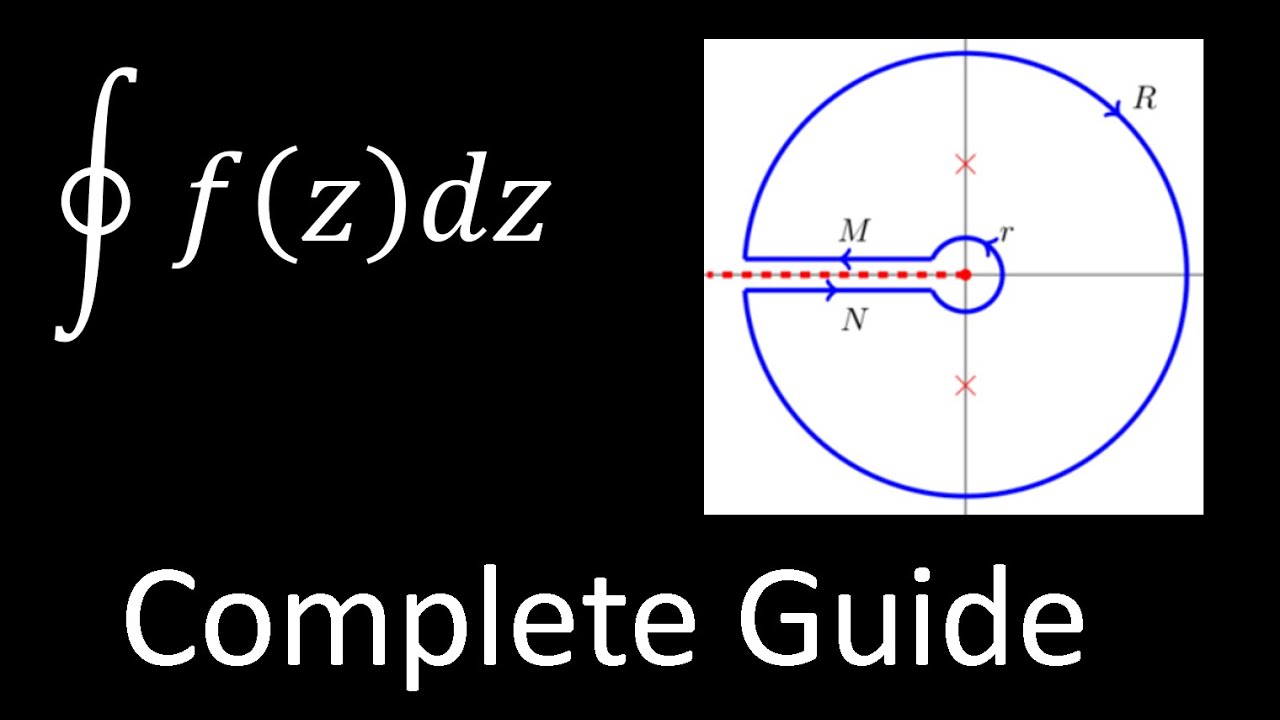
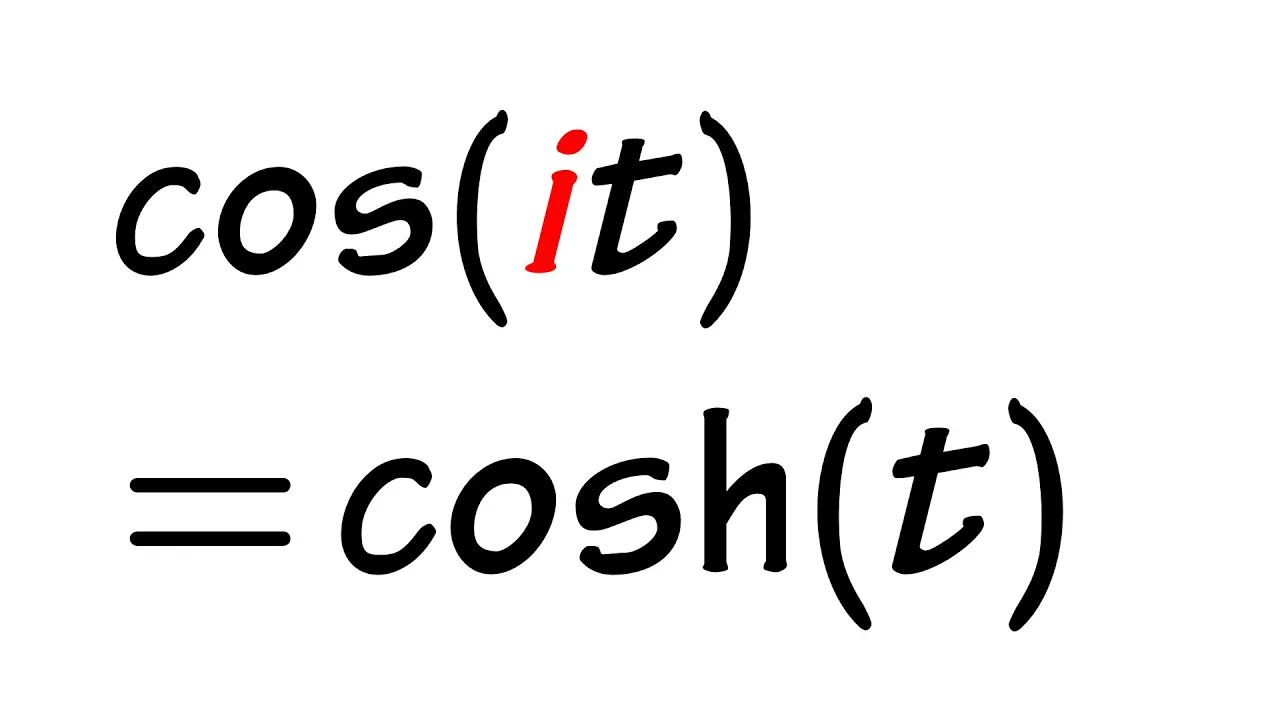
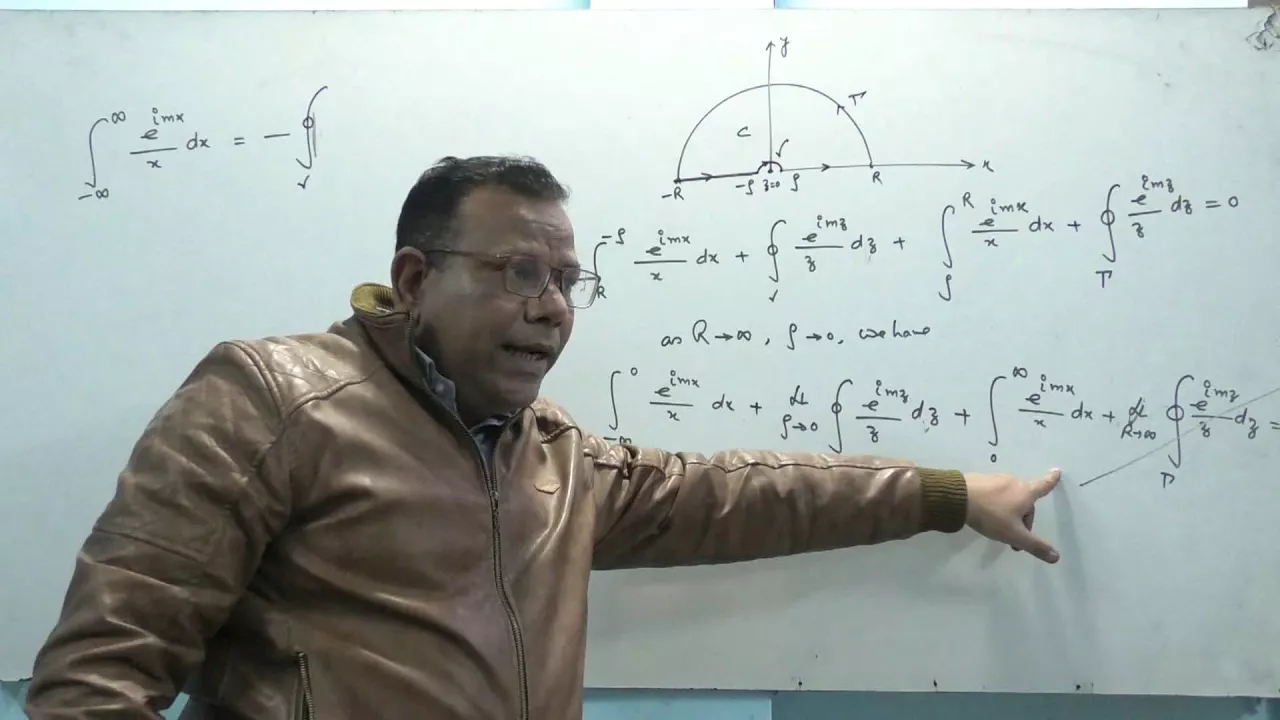
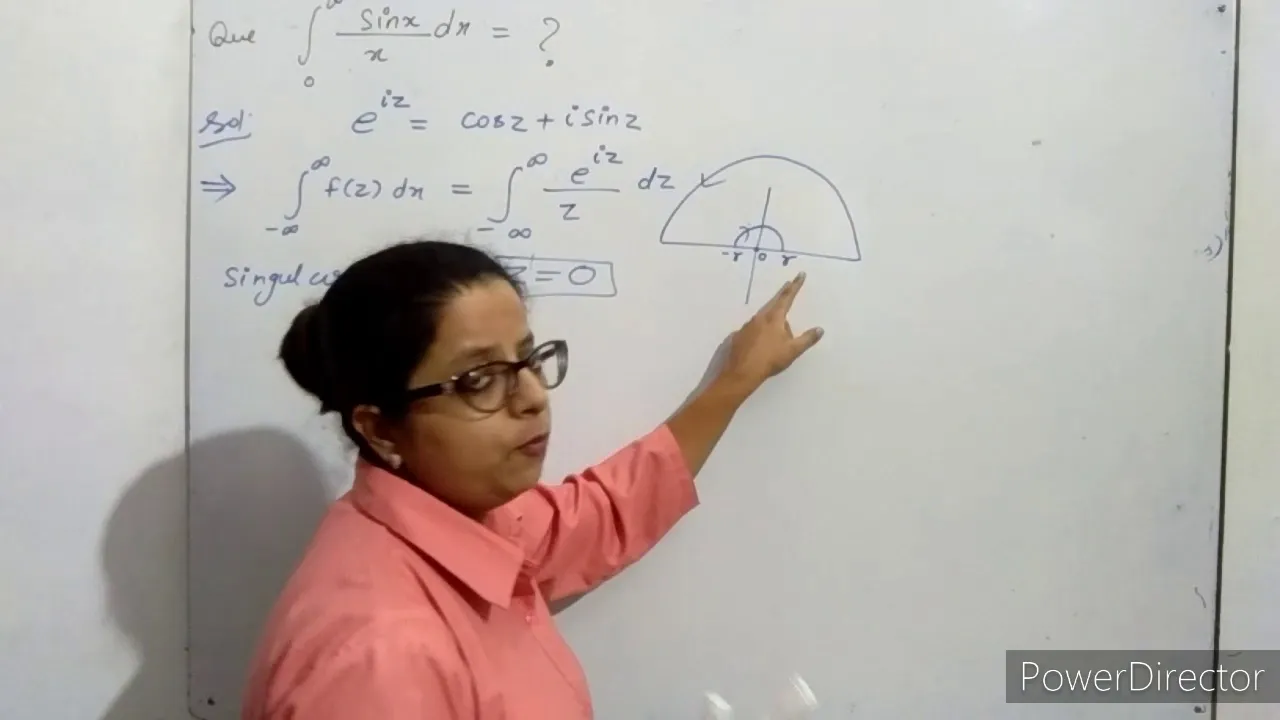
Added:welcome back in this second video we're going to resume our discussion of how to use the residue theorem to evaluate certain real integrals now let's take a look at integrals of the form F ofx uh the integral of of f ofx where f ofx is a rational function in terms of the real variable X and the integral is from minus infinity to positive Infinity it's an improper integral now before we can really answer this we need to talk about what exactly do we mean by an integral from minus Infinity to positive Infinity in calculus we always uh make a precise definition of what we mean by having an Infinity in there now you may have seen this before in your second semester Calculus class we're going to define the integral from minus infinity to positive Infinity to be the sum of the integrals from minus infinity to 0o and from 0 to Infinity now why did we actually do that well we have a definition for the integral from 0 to Infinity it is the limit as R approaches Infinity of the integral from 0 to R now presumably say if R is a finite number we can definitely uh find a value for this it should exist anyway and we can take the limit of that as R approaches infinity and so instead of dealing with infinity we're actually dealing with a limit which we can handle rigorously we have a similar limit for the uh the first integral there now this may not seem all that uh interesting to talk about but we are actually going to be using something a little bit different called the Koshi principal value of an integral now the definition of the principal value of an improper integral like this is the limit as R approaches Infinity of the integral from minus r to positive R now as you imagine minus r and positive R um changing as as R goes to Infinity you'll say that maybe this is ending up to be the same as it is there but there are some examples where the Koshi principal value does not exactly equal the actual integral you'll notice for instance if we take the integral from minus infinity to positive Infinity of the S of X DX if we tried to anyway we would have to find the limit as our approach Infinity of the integral from 0 to R of the sin of X now because s of X is oscillating this limit doesn't actually exist and neither does the other limit so the integral from minus infinity to positive Infinity of the S of X does not exist however as we take the principal value we're going to be looking at the limit from minus r to positive R of the S of X now since s of X is an odd function it's symmetric about the origin and all the area contributions between Z and R will be exactly opposite the area contributions of the function between minus r and0 and so this integral will equal zero no matter what R is as long as we go from minus r to positive R now because the integral is always zero as R approaches Infinity the limit will equal Z as well and so the principal value of the integral will exist it will be a limit of zero although the original integral did not exist so there are some weird cases like that where the principal value does exist and the original uh integral does not however it is true that if the first one does exist if the integral for minus infinity to positive Infinity does converge then it will equal the principal value sometimes you can find a principal value where the integral does not exist but if the integral does exist it will equal this principal value now why are we mentioning this well the principal value is actually going to be what we're going to find using the residue theorem let's take a look at a specific example let's suppose that you wanted to find the principal value of the function 1 over 1 + x^2 cubed of the integral of that function from minus infinity to positive Infinity now again you'll notice this is a real integral this one would have made sense uh in your second semester Calculus class in fact you may even have some ideas about how you would handle it using techniques from second semester calculus we're going to see how to use the residue theorem though and you can decide which which uh method you prefer now we're going to be finding the principal value here we're going to choose as our Contour a contour that goes from minus r to positive R because the definition of the principal value has an integral along that portion of the real line so this uh Contour will match up along that line segment which we'll call C1 now because we're supposed to choose a closed Contour we'll need to have a way of getting back from R to minus r and we'll go ahead and just choose a semicircular Arc that's uh that's what we'll call C2 and c will be made up of these two portions now having chos a contour we need to choose an integrand I'm going to go ahead and just replace the X's by Z's and in that way my uh integrand when I break it up onto the real line part and the semicircular part the real line part will coincide exactly with um the original integral I'll be integrating 1 over 1 + x^2 cubed because as I integrate along this expression uh this function is exactly equal to this function and integrating with respect to Z is exactly the same as integrating with respect to X now I can't really say much right now about this other integral but this seems to be a good choice for the integrand now we know that the limit as R approaches Infinity will be the uh the limit of these integrals along these two Contours we know that the first limit uh would be the Principal value and I know that if these two pieces have limits that exist individually then the limit of their sum will just be the sum of their limits so I'm going to go ahead and see whether these limits exist I'm also going to take a look at what the uh the value of the integral should be using the residue theorem Let's uh look at that first integral um using the residue theorem we've got the function 1 over 1 + z^2 cubed now the residue theorem says I need to take a look at where the singularities are and evaluate the residue at those the uh expression can be factored I can take that denominator and break it up into a z minus I and a z plus I and so I'll have those cubed and we'll see that the poles are minus I and positive I now as R goes to Infinity because of the uh where we've drawn our Contour you'll see that only the pole I is enclosed uh for larger values of of R and so I can find the uh the residue at I if I can do that I will multiply by 2 pi I and that will give me the value of this contoured integral now I is a poll of order three so to find its residue I'm going to multiply the expression by Z minus I cubed take two derivatives and divide by uh take the limit of that and then divide that limit by 1 over 2 factorial now going through that I won't actually show all the steps but we end up with 3 over 16i and you're invited to verify that for yourself but taking that that residue of 3 over 16 I putting it in for the residue here timesing by 2 pi I will end up with an answer of 38 Pi all right so we're done with step two we have used the residue theorem to find the value of a our Contour integral now the the way to finish is to see whether this 38 Pi is closely related to this real integral which is slightly different from our conter integral or or or not hopefully it is we're going to remind ourselves of uh what we did in choosing our Contour our Contour integral was equal to the Sum along C1 plus the Sum along C2 now the Contour C1 was exactly the real line between minus r and r and so the expression we get there will be the Principal value we we care about and then if we can find the uh limit of that second integral and if that limit exists exists then I can use that value of that limit and plug it in with my residue theorem value we found and we'll know exactly what the principal value I was asked for is now I'll I'll just jump right to the end I'll tell you the the limit here is equal to zero and because of that our our principal value we asked for is exactly equal to 38 Pi now that's the answer and uh you maybe be surprised to see that uh this uh integral which had nothing to do with with signs or cosines or anything like that actually ends up having a pi as an answer all right now how did we actually get a zero uh here how did we know that that was zero so we could then finish the problem well let's go back and remind ourselves what C2 was C2 was the semicircular Arc we traced out a circle with radius R centered at the origin and um as we do that we're going to bound the value of this integral using the ml inequality now remember that m is going to represent a upper bound on the value of the integran function along that Contour L is going to be the length of that Contour now as I try to bound this expression this fraction I'm going to take a look just at the denominator the absolute value of that denominator will be equal to the absolute value of 1 + z^2 cubed I'm using a power of that absolute value function a property of that function and I can use the triangle inequality on the inside to say that the absolute value of 1 plus z^2 is on the one hand less than or equal to the absolute values of the individual pieces and I can again pull the the two outside the uh the absolute value I can use the other version of the triangle inequality to get a lower bound here now I'm going to note that on this semicircle the absolute value of Z is exactly equal to R so I can go ahead and put that in I can also use the uh the fact from the line above that what we're looking at in the denominator is actually this quantity cubed and I'll find that the denominator is going to be bounded above by R2 + 1 cubed and Below by r^ 2us 1 cubed now because I am actually interested in the function one over that denominator I I see that the uh M I can work with is one over this expression on the left 1 over R 2 - 1 cubed now taking that as M using L to be the length of that semicircle which is 1/2 the circumference it's uh it's pi r I'll find that the value of my integral is bounded by P pi r * this fraction from the line above now the absolute value of the integral is certainly greater than or equal to zero but now let's take a look at what happens as our approaches Infinity because the denominator here has a larger degree it's going to be growing large uh very quickly a lot faster than the numerator will approach infinity and therefore uh the limit of this expression on the right is zero now since the integral is sandwiched between something that's approaching zero and zero we'll determine that the value of that limit is itself zero all right now taking that I can uh satisfy myself that this is zero which means that the principal value I was asked for is exactly what the residue theorem gave me it's 3 pi8 all right now taking a look at the uh the overview of what we did we used those same three steps we took our original integral we found a contour integral here we ended up just replacing the X's by Z's in order to uh mimic this uh principal value idea of going from minus r to positive r we chose a semicircular a half circle Contour now we used the residue theorem as before we found the singularities we used our techniques for finding the residues and then we found out the value of our principal value by examining how it fit into the bigger picture um it turned out that using the ml inequality we could show that this residue sorry this integral along C2 was equal to zero and that allowed us to to figure out uh the value of our principal value we started with now as you go along and you work problems like this you will run into um many of these same situations where you'll be evaluating along a semicircular Arc and the limit will turn out to be zero now to see that it's zero you could use the ml inequality every time but there's a fact that will save you a lot of effort as you go through examples like this that fact is a theorem in your textbook it says simply that if you have a rational function whose denominator has degree at least two more than the degree of the numerator then that integral along that upper semi circle is going to be zero every time no matter what the function is as R goes to Infinity in this particular example we saw that the degree of the denominator was six the degree of the numerator was zero and so we certainly satisfied the conditions and so the theorem would allow us to just look at that right away and say well that's zero so keep that in mind as you're looking at other examples of this type all right for our next type of integral we're going to take a look at what happens if you modify what we've seen before we're still going to be going from minus infinity to positive Infinity with the rational function of X but this time we're going to look at what happens if there's a cosine or a sign attached to it now in this particular example we're going to take a look at cosine of x over x^2 + one as we integrate from minus infinity to positive infinity and uh I think that you'll you'll convince yourself that there was no real uh good way of evaluating this in your second semester Calculus class that cosine really messes things up as far as a trigonometric substitution goes um it's just hard to know how you would handle that the residue theorem is going to allow us to do it though now before we talk about choosing a closed contour and a related integrant we're going to sort of lay out uh a fact that will help us you'll remember Oilers formula we said that if you have e raised to the I alpha x that's going to be the cosine of alpha x plus I sin of alpha x this was our definition back in the day of what it meant to raise e to an imaginary power now if we were to write the integral of f of z e to the I Alpha Z around some Contour C we know that uh we can write this as the integral of f of Z cosine of alpha Z plus I * the integral of f Al z s of alpha Z and you'll notice that uh the expression in the first integral kind of matches what we want and the expression in the second integral would kind of match the uh the other form we might run into so what we'll do then is take a look at the real and imaginary parts of in an integral of f of Z time e to the I Alpha Z we'll do this because eval ating this integral might be a little bit easier than it would be if we had a cosine or a sign in in place of that exponential function all right well moving along with our example here we're going to follow that trick we're going to replace the cosine by e to the uh Iz we're also going to take a look at our Contour uh we're going to mimic the uh the real line aspect of our integral Again by taking this semicircle we had before now as we substitute u e to the Iz in place of that cosine and we just put Z's in place of x's everywhere else and as we integrate along this particular Contour we'll see as before that this Contour integral can be broken up into its part along the real line and it's part along the semicircular Arc we can further break up e to the Iz in terms of its real and imaginary parts and if we can find the individual limits if the limits exist individually then this overall limit will just be the sum of those you'll see that the cosine of x over x^2 + 1 from minus r to R will correspond to the principal value as we let R approach Infinity uh we'll have I times the principal value of this s part over the x^2 + 1 and then we'll need to again figure out what the value of this uh portion of the integral is along the semicircular Arc now we also need to in step two figure out what the value of the uh integral as a whole is using the residue theorem so let's do that now taking our e to the i z over z^2 + 1 we're going to use the residue theorem um noticing that this function has poles at I and minus I and that as before as R goes to Infinity our Contour is only going to include the pole Z equal I we'll find the uh integral R by taking 2 pi I * the residue at I now we're going to use our our tool for finding the residue we'll take Z minus I times it onto our function and evaluate the limit as Z approaches I here the Z minus I will cancel out and when we plug y plug I in for the Z's we'll get e to minus one all over 2 I now that is the value of the residue let's put that in to our expression here we'll end up with a value of pi over e for this Contour integral now having found the value for the Contour integral we're going to remember how it related to the value of our desired integral the expression uh 1/ z^2 + 1 e to the i z can be broken up in that way we we've seen before uh we do know that the integral on the left is equal to pi over e we do know that that will equal the sum of these integrals assuming that these individual limits exist and as before uh we'll just jump right to the end I'll tell you that these two integrals or these two limits are equal to zero and therefore the principal value we care about is itself equal to that pi over e all right now how do we actually determine that these were equal to zero well there are two different ways depending on uh which integral we take a look at as we take a look at that inner integral the sin of X over x^2 + 1 is is an odd function that means that it's symmetric about the origin It means that if you were to integrate this thing from minus r to posit r no matter where you started and stopped if you went from minus r to positive R the parts below the xaxis will have the exactly the same area as the parts above the x-axis and so the integral will equal zero no matter what R is and as you take the limit as R goes to Infinity the principal value will be zero just because this uh integrand is an odd function now that's a trick that comes in handy quite a bit actually uh for kinds of problems you'll be running into in your textbook so please be aware of that now as we um identify that that part is equal to zero we turn our attention to the last integral and remind ourselves that C2 is this semicircular Contour so as we did in the previous example we can use the ml inequality um just briefly skimming through that we'll notice that the points Z on this semicircular Arc uh can be parameterized as re e to the I Theta and if we substitute that in for Z and take take the uh absolute value we'll get e to Theus R sin of theta we'll take the absolute value of the denominator as well now omitting some of the details we'll see that the numerator is less than or equal to one the triangle inequality tells us that we can replace the denominator by r^ 2us 1 finding the length of C2 that's P pi r again timesing them together the ml inequality tells us that this integral has an absolute value trapped between zero and this expression and as before as R goes to Infinity the fraction on the right also approaches zero so the value of the integral is going to be zero the the limit will be zero now as in the last example there's a theorem that will allow us to simplify these things a little bit more quickly we don't have to break out the ml inequality every time if you have a function whose denominator has degree at least one larger than the degree of the numerator and that function is Times by e to the I Alpha Z along a semicircular Arc of the form we've talked about then that integral will approach zero no matter what the rational function was no matter what Alpha is the limit will be zero as our approaches Infinity now you might get an idea of why that will be uh we actually are not going to go through the proof of this your your textbook admits it as well but it's something that you can use uh you'll notice here since we had a denominator with degree 2 and the rational function had degree zero up top uh this would have allowed us to conclude right away that that was equal to zero all right now with those uh two strategies in mind looking for odd functions and uh looking for functions with that particular particular form uh we can conclude that these two are zero we'll find that the principal value we were asked for is equal to the value that the residue theorem gave us and that concludes the problem you'll see that just as in the others we chose a closed contour and a related integrand we used the residue theorem and then we found out how our desired integral related to the the value of the integral we found in step two a bit more specifically what we did was replace our cosine or S by e to the Iz and replaced all the other AES by Z's in the integrand we chose a a contour that followed the x-axis between minus r and r and then used a half circle for the rest of it and um then we used the residue theorem we figured out uh these these values okay all right now these uh these are uh pretty standard problems for finding real integrals using the residue theorem um they're not the only problems that can be asked though we're going to stop the video here but one thing that you'll find as you go through and and look in textbooks and so on you'll find that there are ways to Tinker with what we've done to find integrals from between Z and Pi for instance instead of 0 to 2 pi of a rational function of ss and cosiness maybe you've got a function that is actually not defined everywhere along the real axis uh but you can still find the integral using a different Contour and maybe you'll have to do an integral where the Contour you choose has to avoid some sort of Branch cut like we run into when we deal with uh square root functions and so on take a look at those um you'll follow the same three steps uh but the details will be a little bit more interesting than some of the ones we've seen so far all right well that's it for us here let me know if you have any questions and I'll talk to you later
Up Next
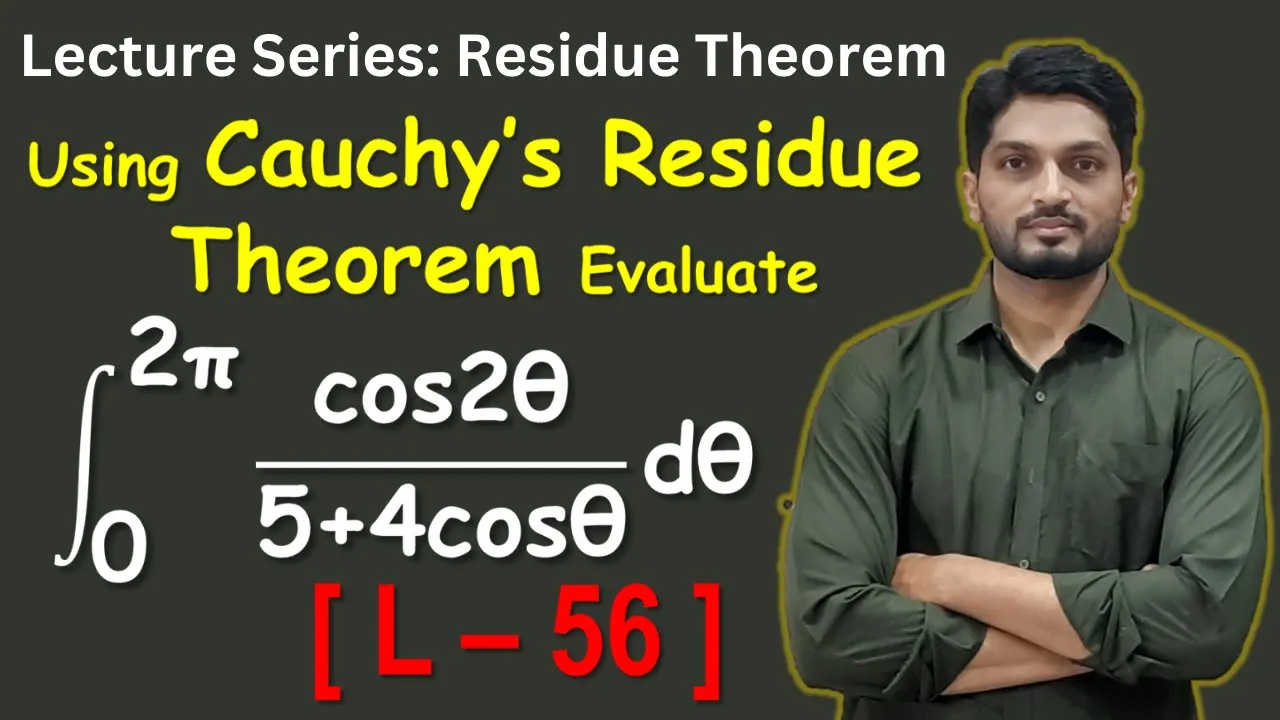
Evaluating Real Integrals Using the Residue Theorem | Complex Analysis
@ranjankhatu
11.8K views•2024-07-13
Elliptic Curve Cryptography Explained: ECC, ECDSA, ECDH
@PracticalNetworking
28.5K views•2024-10-21
Fourier Series Introduction: The Big Idea Explained
@DrTrefor
387K views•2021-05-03

The Mathematical Impossibility of Accurate World Maps
@Vox
23.3M views•2016-12-02
Related Study Plans & Knowledge Roadmaps
Structured learning paths in Mathematics