




![[s3 | 2025] Математический анализ, Трифанова Е. С., лекция 18](https://i.ytimg.com/vi/atrksCtTATA/maxresdefault.jpg)








![[s3 | 2025] Математический анализ, Трифанова Е. С., лекция 26](https://i.ytimg.com/vi/M99caw-_nC8/maxresdefault.jpg)



![[복소2] 6.11. (2/2) essential point 근방에서 함수의 변화 : Casorati-Weierstrass theorem](https://i.ytimg.com/vi_webp/q6Uw8QA9420/maxresdefault.webp)


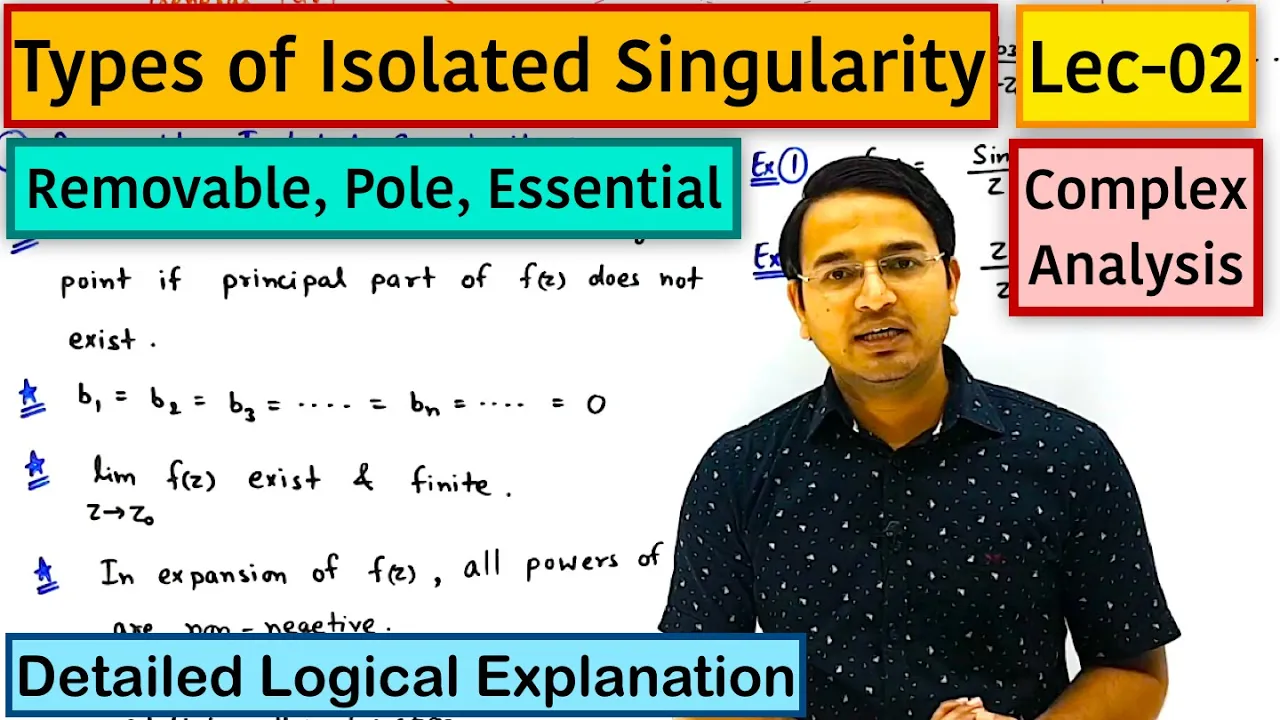
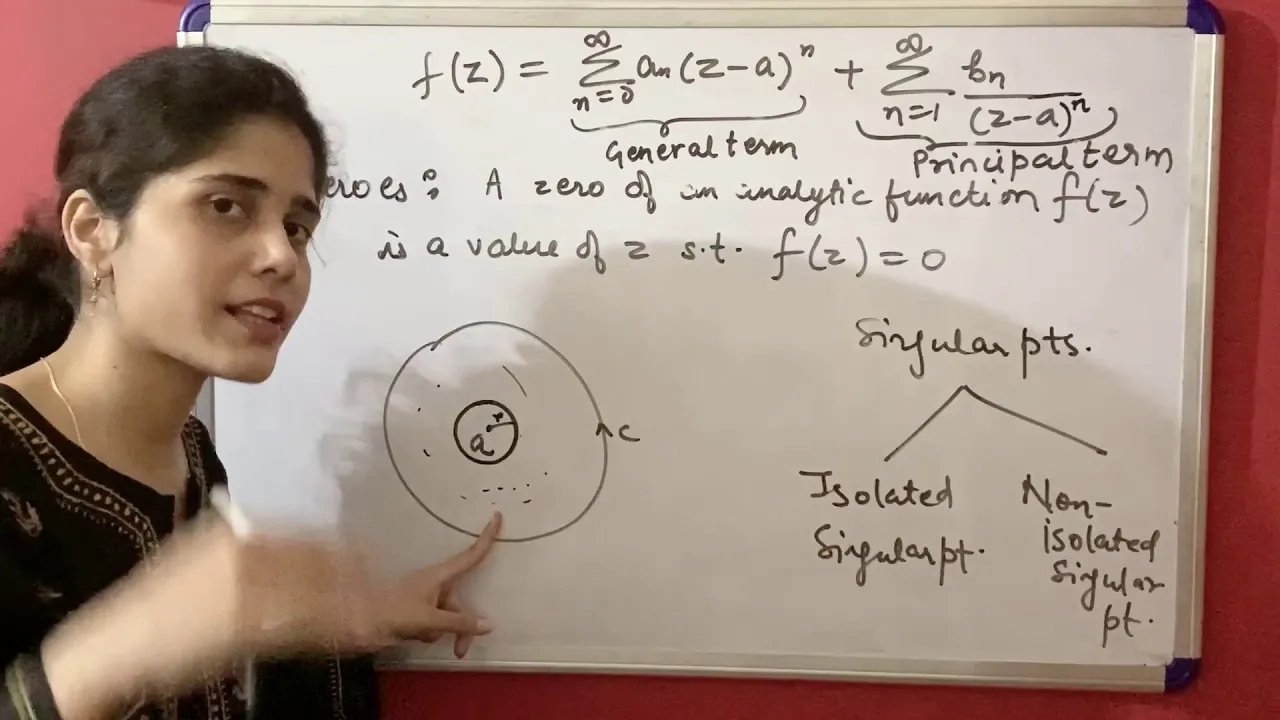
In complex analysis, singularities are classified by examining the limit of the function at the singularity point: if the limit exists and is finite, it is a removable singularity; if the limit is infinity, it is a pole; if the limit does not exist, it is an essential singularity. Isolated singularities are further categorized as removable, poles, or essential based on the Laurent series expansion (no negative terms, finite negative terms, or infinite negative terms respectively). For rational functions P(z)/Q(z), the order of the pole at a point depends on the difference between the orders of zeros of the denominator and numerator.
Singularity PYQs: CSIR NET 2011-2023 | GATE 2000-2023 Shortcuts
Added:Fundamentals of complex variables, including analytic functions and the Cauchy-Riemann equations.
Understanding of Taylor and Laurent series expansions, specifically the significance of the principal part.
Basic definitions of isolated singularities (removable, poles, and essential singularities) and non-isolated singularities.
Introduction to Cauchy's Residue Theorem and the basic calculation of residues at simple and multiple poles.
Evaluating complex real-valued integrals using contour integration and Cauchy's Residue Theorem.
Application of the Argument Principle, Rouche's Theorem, and their roles in determining the location of roots and poles.
Advanced concepts in complex analysis, such as Picard's Great Theorem regarding the behavior of functions near essential singularities.
Conformal mappings, bilinear transformations, and their applications in solving physical boundary value problems.
51.4K views1.4Klikes1:44:42Original Release: 2024-06-20
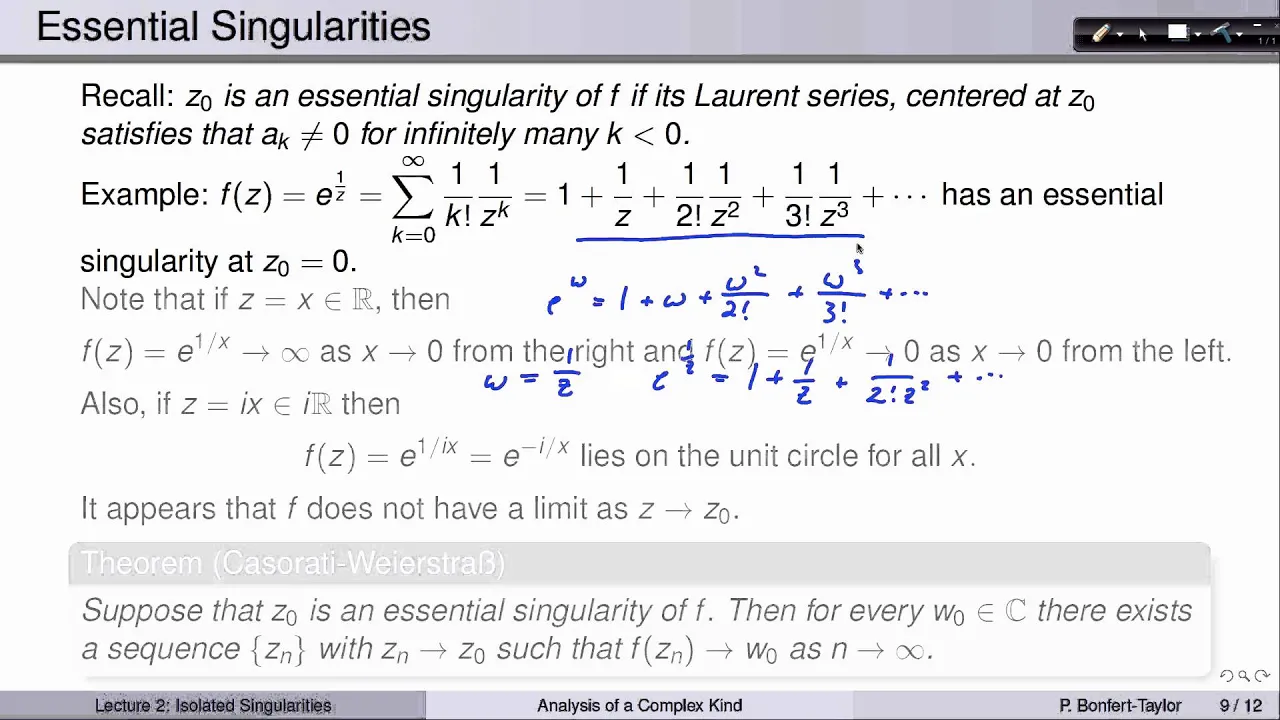
hello everyone welcome to the next lecture on the py question Series today I will explain you 50 plus questions related to The Singularity topic I will cover all those questions from the CSR net and the gate examination in this video myself Dr Harish Kar you can find me on my YouTube channel where you can find the playlist of the CSR ugc net in this playlist you can see the various lecture related to the py question series all are available with the help of the shortcuts I hope you can subscribe my YouTube channel to support my efforts as well as the videos now whenever there is a concept related to The Singularity asked in the examination then the first question then the first thing come in your mind is always about the zeros and the pole remember whenever there is a zero you always think about the numerator of this function Whenever there is a poll you always think about the denominator how you can find the zeros that means you have to find the roots of of the numerator part and the g pole means you have to find the roots of the denominator fine once you can find the roots how you can find Roots if for example if my polinomial if my P is this then you can easily solve this this will give you my plus minus Iota but if this is not in the form of the polinomial it will be like of this manner then you are unable to find the roots by using this quadratic form cubic form in that case you can use the concept of the numerical analysis a function is said to be of the order M at the point Alpha if the MTH derivative is my non zero while all its preceding derivatives are my zero that means if I say F of Z at zal 1 has order two what does it means that means the second derivative at the point one is my non zero while the first derivative at the point one is zero and the function itself at the point one is z another thing whenever you have the function of this complex number that's F of Z you have to find all those points at which the function is not analytic and that function is called as the nonanalytic and that point is called as the singularity how you can find that you can substitute denominator as a zero and the numerator as my Infinity find all those points after solving these two equation and that point is called as my Singularity and apart from this Singularity the function is said to be analytic and the function which is analytic apart from the singularity point is called as meromorphic function what is the meaning now this Singularity is categorized into the two parts that is isolated and nonisolated what is the meaning of the isolated and nonisolated a Point Z equal to z0 is said to be the isolated Singularity if if it does not include any of the other Singularity points like what is the denominator zero you can see zal to 1 is my singular point then is there any other singular Point occurs no that means if you consider the circle of any Delta it does not involve any other singular point that means that point is called as the isolate if all those points which are not isolated is called as the nonisolated singularity isolated singulari is again discretized into the three categories and this is the backbone of this today's that is a removable Po and isolated every time in the examination a question will ask from these topics how you can check about the removable Singularity we tell you the two different method the first method is by using the definition if you find the lowend series of the function F of and if you find that there is no negative term involved that means the BN coefficient of the BN are zero then we call as the removable Singularity if you find there are the finite number of the terms then we call as the pole and if there are infinite number of the terms then you can call as the essential Singularity for example if I write this is 1 / Z then clearly say if I expand this by the series of the exponential and you can see these are the infinitely many terms of the negative power of the J that means this is my isolated singular similarly if you write of the sign of J then clearly say it again it is my up to the infinite term but we need a finite term this is the first but I always suggested you can op by this second method that is a quite interesting and easy for you any point is said to be the removable Singularity if you find the limit and if it exists finely what is the of the existence that means limit is my unique remember that you have to watch my py question series of the limit you must watch about by the py question of the limit to understand the meaning of this existence on the other hand if you find the limit as a Infinity then you can say it's a pole and if you say limit does not exist what is the meaning of the limit does not exist that means not unique then you can say it is my Essential singular and this is the method I have used throughout my this lecture s on the other hand if you find the limit point of the numerator if you find the limit point of this zeros then the point then the point is called as the isolated essential if you find the limit point of the zeros of of the pole then we call as the nonisolated essential make sure once you prove that it's essential Singularity then you will check about that the limit point if you find the limit point of the numerator then call as the isolated if you find the limit points of the denominator then we call as the non isolated another very beautiful shortcut tips for you whenever you have a function complex function p z over qz if you find the zeros of the P if you find the zeros of the C then you can say at the point Jal to Z is called as a pole if this condition hold otherwise we call as the removable Singularity on the other hand if you want to find The Singularity at the point Jal to Infinity there is interchange of these results pole when m is less than one m is less than n then pole when m is greater than n and you can see this point how you can check the singularities of this this another very very important concept for you how you can find the singularities of these kind of the functions always remember my shortcut you can find the similarities of the FJ this Singularity may be removable this Singularity may be the pole or this Singularity may be my Essential so if I say the point Jal to J not is my removable Singularity of the FJ then then this function also has the same removable singular on the other hand if I say Jal to J node is my pole is the pole Singularity of the FJ then this implies this zal Z not is my Essential singularities of these all cases similarly if it is essential Singularity then J is again is the essential Singularity make sure you have to remember this if it is a pole of the FJ then s cosine hyperbolic exponential has the essential singular the last concept is if you have the entire function that is an analytic function then the limit will be G Infinity if it is a polinomial if it is a finite then it's a constant if does not exist then we call as the transrenal function if you want to find some another lecture on the complex analysis py question you can watch by this playlist and all these are available at my YouTube channel if you are new to my YouTube video you can subscribe and like and comment on these videos and you can scan and join my WhatsApp group as well so now let's start with this py Cod Ser remember first question is you have to talk about the J is infinity fine now firstly whenever they are talking about the essential pole always always find the limit whatever the point is given to you that is equal to Infinity of f z what is the answer is infinity that means if this is infinity that means it will give you the pole but he said analytic fine this is infinity po fine this is infinity essential wrong remember always essential means when this limit does not exist fine now we can see about so first and third option fourth option cancel now we can check about the limit atal to Z this value will be F of Z is my Z Cube It's a zero what does it means zero that's a unique and existence once it's a unique and existence what does it means that means this is my removable singularity but he said P this option is also cancel only left option is B is my correct answer of this problem and you can see within the 10 second you can get your answer in a simple man this is the first method second method is you can whenever there is a target at Infinity you can convert into the zero how you can convert into the zero change the function to be 1 / Z so that is 1 / Z Cube Clearly say the pole of 1 / so pole means denominator as a zero if you substitute denominator as zero then it is of order three because the power is my three so if Z isal to 1 / Z has this that is implies also is of the pole three so again the right answer is B is my correct answer now again you are talking about removable essential nonessential firstly check about the limit at this Singularity what is the value of this it will be my cos Z minus sin of Z so clearly say when you substitute cos Infinity any number which are lies between minus1 to 1 sin Infinity is any number lies between minus1 to 1 that means limit does not exist once the limit does not exist that means we call it the essential Singularity removable is cancel none of this is canel essential Singularity is the right answer of this look at this one again the essential pole and this you can find the limit at the point thatal to Z of f z fine clear if it is a unique then we call as the removable Singularity if it is a Infinity then we call as a pole if it is does not exist then we call as the essential Singularity can you find this limit it is a 0 by0 form so what you can say it is a s is COS of R into derivative of this divided 1 / < tk2 root Z Limit Z approaches zero Clearly say this quantity will be canceled cost zero will be one that is my unique number so unique means removable Singularity rest of the options are cancel always remember whenever the question is related to Singularity always compute the limit first I hope you can like and comment on my video to support my effort again you can see you can find the limit limit Z approaches zero e to power 1/ Z so clearly say if you taken as a limit get approach is zero negative of 1 / Z so that will give you E power minus infinity that is zero but if you take the limit as Z approaches 0 positive then it will be 1 / 0 is infinity so clearly say you have the two different limits that mean limit does not exist once the limit does not exist that means we call as the essential sing right so poll because the limit is not Infinity removable this option is answer make sure if you substitute this limit E power 1 /0 E power infinity is infinity then you may think about that it's a PO but that is not true this the first method second method is how you can solve that again because of the exponential part I can simply choose f is my 1 / Z Clearly say the pole is occurring at Z is equal to Z so once we can say zal Z is my pole then e^ 1 / Z is my Essential Singularity at Z is equal to zero so again you can get as Singularity essential so right answer is a is my correct answer don't forget to like and comment on my video you can share this video with your friends as well consider the function this firstly zero pole zero this can you find the limit at zal Z firstly it is p COS of into Z / z s sin of Pi Z so when substitute Z is 0 cos 0 is 1 it is 1 /0 that is infinity once this is infinity that means we call as the pole fine so that's either the pole of this fine now as J approaches zero fine we all knows sin of X is approximately equal to the X fine then my function this is a shortcut quick you can solve like this manner it's a pi COS of pi divided by this number is my Pi Z so it's a pi J Cub I pi and Pi will be cancel out cos Pi z/ Z CU now clearly say this value is finite at the point Z equal to Z so that means this function has a poll of order three fine so it's a poll of order three this function is cancel now another way how you can check about the pole if I consider the this is my Q denominator is my Q fine it is z CU now I what is the order how you can check about the order I can find the derivative and compute the values at z z this value is my zero it's a 3 z s again zero you have to find until it becomes a non zero 6 Z again zero and the third derivative is my six which is non zero so that means the third derivative is my non zero so that means order is my three since we are solving the denominator that means it's a poll of order three the second method one more method third method is whenever you have the function ra to power n whatever the N fine always find the zeros of this part if I say the order of this component is my Alpha then the order of this will be Alpha into n so look at that it is a j Cube fine what is the order of this J one fine because is z is the one Ro because if you Tak is single J Das is my one which is my non Zer so therefore it's a 1 1 into 3 that is Al into n 3 now is the simple only simple p is the only n = 1 2 3 are the only simple po that's wrong because zal to0 is also the how you can find the residue so again you can see let me clear this one now you will obtain this expression what is your my f is pi will be cancel out cos Pi j/ Z Cub now your target this is the poll of order three so how you can find the residue how you can find the residue is 1 / 3 - 1 factorial fine second derivative of remaining quantity that is a COS of Pi into J if it is of the third order then you have to find the second derivative then what is the second derivative of this - < sin of Pi Z is the first derivative then it's 1 / 2 1 / 2 is the second derivative will be minus 5 S cos Pi Z compute the values at the point Z cos 0 is 1 the answer is - pi sare over 2 but is a pi Square 3 so right answer is C is my if the value is not defined atal a that means the function is my this case but limit Z approaches a of f z is existence what does it means if the limit is existence we call as removable Singularity fine so then it's a removable Singularity essential and none of these are my answer I throughout the video I will always use this concept limit existence removable limit Infinity we call as a pole if limit does not exist we call as the essential Singularity you can also solve any kind of this Singularity problem with my this concept now again you can p essential first you can find the limit at Infinity limit Z approaches Infinity is^ 4 sin of 1 + so you can see that Z is infinity 1 / infinity 0 is a z^ 4 into 0 that means Infinity power 4 into 0 that is in determined form so what you can do what you can do is first of all this limit is my not finite or but we can't say that it's not a finite I can change this function into 1 / Z so this will be 1 / z^ 4 S of z/ Z + 1 now instead of the infinity we need to calculate the value at zal to0 now we all know at the point Z is equal to0 s of Z is approximately equal to Z so this quantity will be my Z + 1 / z^ 4 I can say it's a cub Z + 1 so what is the pole because it's a denominator so pole is minus1 pole is my zero what is the order of this because the power is one what is the pole of this power is three so the order is my three so po of order three po of order four cancel now once it's a pole it can never be removable it can never be intial make sure Singularity is either the pole either the removable or the essential so the right answer of this problem is B is my correct answer of this problem the function f of Z is Z power M at zal Infinity now what is the value of z z is not give m is not given to you I can choose m is my one then this number will be J into E power sorry it will be my J fine now firstly we can check about the limit at Z equal to Infinity so Z into E power Z it will be Infinity no Infinity into E power Infinity but we can't say so you can see about 1 / Z so it is e^ 1 / Z over Z because you can't say about that because this is my Essential simularity fine now you can see about this what does it means nonisolated firstly you can check about the this is now at the point J is equal to Z how you can check about that first of all if you ex you can see that this is 1 / Z if you expand the series of the 1 / Z exponential term 1 + 1 J square and so on how many infinite how many terms of the negative power of the J they have the infinite terms fine infinite terms of the 1 / J so that means what does it means that means it is my Essential Singularity so what is that now you have two essential Singularity it means it is not fine once it is not a PO then you can cancel out now how you can check about the isol or non isolated isolated means you can find the limit point of the Zer nonisolated means you have to find the limit points of the PO now firstly I can see this is my function E power 1 / Z is zero what will happen can you find this quantity then it will be zero E power Z will be it is not possible now you you are unable to find now what is the definition of the isolated and nonisolated you can see J equal to Infinity is my Essential Singularity now once it's a Infinity you can see the only Singularity of this function is equal to Infinity since it is my singleator only so that means this is my isol it can never be known isol if it is more than one essential singularities then then only you can say it is a non isol otherwise the function f of Z which is 1/ E power zus 1 is entire entire means there is no pole but clearly say E power zal 1 is my pole when the value of the J will be one it is my 2 N Pi Iota 1 means that is my cos of 2 N pi plus iota sin 2 and Pi will be my 1 right so that means you have this number of the poles so once you have the pole it can never be entire fun now removable Singularity now you have to find the limit at J approaches 2 N Pi iota of this function now if it is a unique and existence then only you can say this is my removable so if you substitute e to^ Z is 1 1 - 1 is z it is infinity once this is infinity that means it is not a removable singular once it's Infinity that means it is my pole fine now it's a pole can you find the residue so how you can find the residue that means limit J approaches 2 N Pi Iota okay if you have the function f z over g z and G is my simple pole in this case also you can see this is single pole then you can find the residue as F divided by its der directly or you can find because we need to find add the value of 2 N Pi Iota into FJ over g j that's on your choice fine but since it is a single simple pole then I always press effort to use this value now what is the f is my this first of all F over G that means this the numerator and denominator what is the value of this j/ 2 N Pi Iota f is my one this is my F this is my g 1/ e to power J if you substitute 2 N Pi Iota it is my one that is so that's a residue is one correct since we have obtained limit of 2 and now it's a z z what is the value of the Z Z Limit Z approaches zero of f z what is the value 1 / Z is a Infinity essential means limit does not exist so that's a wrong answer that is also the PO but it is essential that's wrong C is my right answer on this problem okay now it's a essential Singularity countable of this now clearly say E power if you look about the pole that is only for the denominator that means that is my plusus Iota but if you look about this I can found the singularity of the tan of J fine what is the singularity of the T of I can substitute this as a zero that means will be my n fine now I will check whether this is my pole whether this is my removable or it's essential I will check about J approaches n Pi of f j fine so what is the value of this Z approaches n i this is the this is the numerator that means we are talking about the zeros fine so once you can talking about the zeros can you limit point of this what is the limit point of the zero as an approaches Infinity is infinity so therefore limit point of the zero that means we call as the isolated essential Singularity fine once Z is equal to Z not is the essential Singularity then e to power tan of J is also has my Essential singular now it is my for all n belongs to the J so what is the countable uncountable is can only singularities are my simple poll but they are not po they are my Essential singularities so the right option is only my a is the now it's a g 20 again is equal to Z we will firstly find the limit and then we will see what will be the result so if you substitute Z is a 0 by0 form then I can apply the alopa rule it's a minus- plus over 1 when you substitute zero it is my 1 which is unique unique and exist once it is a unique and existence that means this is called as removable singularities so pole is cancel out essential cancel out only right option is removable Singularity is my correct answer problem the function zal to Z again we can take about this Z minus sin z/ Z Cub fine you can't say directly that Z cube is a pole firstly we will see whether it's a pole or not clearly say it's a 0 by0 form I can apply the allocator rule 1 - cos z/ 3 z s again you can see when you substitute 0 again it's a 0 by 0 form if you again Define that it's a 1 / 6 Z again 0 by 0 form cos z/ 6 as limit Z approaches zero is a 1 / 6 1 / 6 is my unique and finite that means we call as the removable Singularity essential pole all are my canc again at the point zal Z so limit Z approaches at point is infinity e 1us again it's Infinity by Infinity I can apply the alopa rule this is e to power J which comes to be minus1 which is my unique and finite so once is a unique and finite we call as the removable Singularity so removable is fine all is cancel now you can see they are not talking about the essential or something fine so we will check about the isolated or nonisolated so how you can do that I will check about the pole fine can you find the zeros of this what is the zeros of this E power Z is it's a minus one so when Co value will be negative then it will be the two and or numbers of the pi fine so J will be my 2 n + 1 of Pi iot now clearly say because I need a j Infinity as n approaches Infinity Z approaches Infinity now since we are talking this number as a pole so what is the limit point of the pole limit point of the pole will map to the nonisolated singularity so that's a nonisolated singularity is isolated cancel B and D are my correct answer of this problem the simple pole first of all pole that means Z - 1 s z + 2 now clearly say the power is two that means it has minus1 is my pole of order two this Z = min-2 is a pole of order 1 so one means there is a single simple so Z equal minus 2 is my simple P of this don't forget to like and comment on my video to support my f f of Z is my S hyper olic Z so what is the formula for the sign hyperbolic J so that is E power Z minus e^ minus Z over 2 so I can write this number is 1 over so that will be 2 over E power Z minus E power minus Z number of these singularities I can found the pole F E power Z which is equal to E power minus z e to^ 2 Jal 1 so when it will be 1 cos 1 will be my that's the even number 2 N Pi iote so that means J will be my n Pi iote F then the number of number of the singularities of this that means we are talking about the order so if I consider H is my this number fine clear say h of 2 N Pi Iota will be zero what is the H Das e^ Z Plus E power minus Z what is the value of the N Pi Iota this will be my non zero because of this positive sign it's a non zero that means order will be my one so the right answer of this problem is D is the right answer for the function Z is equal to Z now you can see this is there is no denominator denominator is my one so we are talking about the zeros fine when it will be so that means 1/ cos 1 / Z it is my n Pi this is my zero what is the zero of the sign this is my zeros sin Z will be my n Pi can you find the values of cos 1 / J is 1 / n 5 fine so once it will be this number as n approaches Infinity this number will be zero this number will be zero as n approaches Infinity again you can see also you can see cos 1 / Z will be zero what is the value of the Z 1 / Z will be my cos 0 will be 2 n + 1 P / 2 so that means Z will be my 2 over 2 n + 1 5 but there is no need I think they are talking about this I can simply start with the limit what is the limit Z approaches zero of f of Z firstly we will check Always by this manner so that will be sin 1 / cos Infinity cos Infinity means that is a number lies between minus1 to 1 so that means the limit does not exist so once the limit does not exist that is always be then essential Singularity all this option cancel because it's not a nonisolated once we get as essential singular so the right answer is C is my correct answer of this problem the example of the nonisolated non isolated essential Singularity remember nonisolated means you have to find the limit points of the poles fine the mid point of the pole that means the denominator you can see about that there is no essential what is the definition of the instantial is you have infinite number of the terms which involve 1 / Z minus z0 but if you expand this series it will be 1 + Z Plus z s upon 2 factorial and so on so clearly say there is no term term which involve 1 / zus 2 so that means this is not essential so once it is not essential it is not a non isolate similarly look about that at the JAL 2 we will check about the limit firstly firstly I will check about this sign term what is the S of 1 / zus 2 this will be 0o S of infinity does not exist that means this is essential fine now look at the T of zus 2 Z if you again look about the limit firstly we will check about whether it's essential or not as the limit J approaches 2 tan of Z - 2 / Z so that will give you the tan of Z that is a zero that is a finite term once is a finite we will call as the removable Sy Singularity but we need a essential Singularity look at the first option what is the limit at Z equal 2 that will be tan of infinite uh tan of infinity that is not defined so this is a essential singular now you have the two options either A or B now how you can find the non isolated so from this we obtain that this is my Essential Singularity this is my Essential Singularity now we need a non isol that means we need to find the limit point of the pole but you can see from the second point there is no denominator component this is my one if you substitute this as a zero this will give you the limit points of the zeros once you will get the limit point of the zero you will get as the isolated essential Singularity so this option is also cancel only left option left is my a is the correct answer you can remember that limit point of the pole is always give you the nonisolated singularities pole means denominator zero theid point of the zero means isolated singular but if you want to check how you can do that I can see I can write this form P / Q fine now what is the limit point of the pole I can substitute denominator as a zero cos value will be zero only when it's is a 2 n + 1 > / 2 so can you find the value of the Z Z will be 2 plus 2/ 2 N -1 Pi so what is the value as n approaches Infinity as n approaches Infinity this will be zero it goes to my two so yes a is my nonisolated Essential sign remember first your target to find the essential how you can find the essenti check the limit and it must be does not exist in this case you can see also the third part if you take the limit of this quantity it will be my one which is a unique that means it is my removable but we need a essential singular look at this another one again you target is z firstly we will check about the limit Z approaches zero so that will give you the sign of infinity that means limit does not exist fine if limit does not exist that means we will get as the essential singular removable not because limit is not finite simple pole not because limit is not Infinity essential Singularity is my right answer of this problem let f is my maror function given by F is z/ 1 - e^ Z of sin z zal z is a pole of order two firstly we will check whether it's a poll or not what is the limit at Z equal to Z it is Z over again we we again I can use the same concept when Z approaches zero s of Z will approaches toward the Z so this is my Z so this value will be cancel out when Z is zero it will be Infinity that's is a four fine now how you can check about the order because my denominator is J minus Z into E power Z Now what is the meaning of the order two that means K of Z is also zero Q Das Z is my no zero then only it's a PO of order two so what is the derivative one it will be Z into e^ Z minus E power Z it will be minus z e Z minus E power Z now at the point Z equal Z this value will Zer this value will be zero this value will be minus of 2 which is non zero so the second derivative is non zero that means the poll of order two is my correct answer now look at the second one is Jal to 2 pi Iota is a simple form now since this result we can never use because it is not a zero then it's a simple po I can take it as a denominator part this is my S of Z I can open this bracket it's a sin Z minus E of sin what is the meaning of this simple PO is that means K Das will be my non zero at the point this can you find the K Dash It's a COS of J it will be e j cos J Plus e of sin now at the point J = 2 pi Iota this value will be zero because K is my integer s of 2 pi 0 this is my Z COS of this value will be my 1 whatever the value of this this value will be my e^ 2 pi Iota 1 COS of 2 pi Iota will be 1 minus E power 1 this is zero so clearly say it will be my zero so that means is a simple poll option cancel fine because we will get as the double poll first derivative is my non zero so that means it is not my simple look at the Jal K1 how you can check about the KY let me again k k so again K I can takeen as a sin J minus E power J sin Z of all those apart from the C zero it's a COS minus e^ Z sin Z minus E power Z cos Z so what is the value of this at the point K Pi K is my integer sin k z sin k z cos K Pi is a minus1 power K E power K Pi fine s of K pi E power K pi and sin cos is my-1 power K which is my non Z so yes it is my of simple four also you can check whether it's a PO or not you can see limit J approaches K Pi of this function so it's a k Pi is a finite it's a finite sin K Pi will be zero so that goes to Infinity that means it's my PO and the order is my 1 fine now look at that J + 2 pi iot is a PO or not now you can see whether it's a poll or not we will check about the limit firstly Z approaches Pi + 2 pi Iota if you substitute this value in this given function it's a pi 2 pi Iota it's a 1us e^ pi e^ 2 pi Iota sin what is the value of the sin + Theta it is my minus sin Theta it's a negative s of 2 pi Iota Clearly say this value will be one it is my non Infinity so once is not Infinity that means it is not a p so the right answers are A and B are my right answer of this problem let me quickly check whether it's a simple po or not because if it is a k Pi I have obtained this derivative let me quickly check at the 2 pi Iota 2 pi Iota K sin 2 pi Iota is the integer zero is a zero cos 2 pi Iota is Iota also just wait this is my cos it's not a 2 pi it's a 2 pi K Iota also E power 2 pi Iota is 1 s of 2 pi K iota minus E power is 1 and COS of 2 pi so this value will be cancel out what is the sign of 2 pi Iota is a non zero because of Iota if it is only 2 pi k then it's a zero so that is a non zero so once it's a non zero that means yes it's a simple f as well so the right answer is this is my correct this value will be zero because this value will be my one so sin minus is z this is non zero yes is a simple po a b c are my correct answer of this problem look at this another one the function FJ is defined like f is integration from 1 to 2 1 / x - Z 2 into d z there is a meromorphic function that agree with the this is agree with the F so now what does it means by the identity theorem both have the same value can you integrate them integration with respect to X that will be -1 / x - J fine now if you substitute this upper limit it's a 2 - J + 1 - Z fine or I can say it's a z - 2us Z 1 one and infinity are the pole now this is my f f and g conside now how you can check about the infinity pole Clearly say when you take limit as Z approaches Infinity what is the value zero which is finite but for the pole we need Infinity that means Infinity is my removable Singularity so this option cancel this option cancel fine once you take as a limit Z is 1 and two once you take the limit one it goes to the infinity find 1/ Z is infinity so one is my pole fine once you take two again the limit will goes to the zero yes it is my PO fine and again you can see the powers are my one so the order is also one one means my simple po C and D are my correct answer of this prodct don't forget to like and comment on my my video to support my f f of Z is 1 / E power Z minus one then is a maror Maric means that is the function is entire except at the four fine remember this condition is defined is given to define the function like we can say one/ is my 1 / Z where Z is non zero this it doesn't means that e of Z can never be equal to one this condition is only imply to Well define the function what is the PO can you define the pole E power Z is 1 so that means Z will be 2 N Pi I fine so these are my pole fine outside this pole it is my entire function so yes this is my neomorphic function the only singular of the f are my PO so let me check whether they are Pole or not we will check the limit at 2 and Pi iota of f z so since the numerator is finite this is my 1 minus 1 Z that is infinity once this is infinity we can say it is my pole the only Singularity is my pole correct there are infinitely many poles on the imaginary axis you can see my answer of the poll is 2 pi I 2 n by Iota where n is my integer Clearly say because of this n n is my integer it has infinitely many values and it lies on the imaginary axis yes you can see the real component is zero imaginary component is 2 N Pi Iota if you like the graphically this is the point of 0a 2 N Pi Iota so it all lies on the imaginary AIS each pole of the f is my simple how you can check about the simple the first way is because the power is one but because this is not a polinomial I can choose denominator one simple po means this value must be my non zero then only the order is one what is the derivative is now clearly say at the point J is 2 N Pi Iota this value will goes to the Z 1 minus one but this value will goes to the one which is non zero that means it is my order one so order one means that's a simple for so the right answer of this problem is a b c d are my correct answer at the next one at the point Jal Z is removable pole isessential so firstly we can find the limit exponential Z / 1 - cos Z that means exponential it is 0 by Z form cos0 is 1 so I I can apply the differentiation this into or otherwise it's a 0 by4 otherwise what I can do I can find the pole of this fine if I got the pole as j0 then I can apply the rule for the exponential I can choose the G of this quantity fine now what is the limit as Z approaches Z of G it is my 0 by0 form I can apply the alope rule is 1 / sin Z so as Z approaches Infinity sin 0 Infinity that means 4 so zal to Z 0 is the pole of G of Z so what does the meaning of this case this is my Essential Singularity fine so that means this is my Essential Singularity all is cancel fine clear now luren series Once is essential Singularity you can expand in the Laurent series with the infinite terms of the negative Powers fine so once is say infinite terms of the positive and negative power so the right answer is C and D are my correct answer always remember my simple tips that you have to find just the limit and make sure for the limit you have to watch my this part py question of the limit now f is my entire function and limit Z approaches Infinity F of Z is my Infinity what does it means that means it's a pole that means Z equal to Infinity is my PO fine because it's Infinity but this is not at zal to Infinity so that means zal to Infinity is the of f of Z I can change into the zero that means zal Z is the pole of f of 1 / Z so F of 1 / Z is a pole at the point zero 1 / Z is the essential simility cancel now now what is another shortcut tricks as I mention you once the function is my entire fine plus limit as Z approaches Z of FJ is if it is infinity if and only if this is my polinomial if it is my finite if and only if the function is my constant and if the limit does not exist if and only if the function is my transal you can see about my this shortcut fix the function is the entire function is at Point Infinity then it's a polinomial otherwise finite is a constant otherwise transal now you can see that means the function FJ is my polom fine so F cannot be polinomial can once is a polinomial how many zeros are there finite zeros always any polinomial you can choose say 1 + z so clearly say it is my finite number of the G make sure you have to remember my shortcut tricks it's a very simple tricks are there I have used only the one method this the first method there is one more method there's one more method second method is can you think about any of the function which will satisfy this property you can see F of Z is z this is my entire function fine also limit is infinity so again F can't be the polinomial cancel out now one Z is 1 / Z Clearly say this is my poll of order 1 at zero why pole if you calculate the limit at Z approaches zero of 1 / Z it's Infinity so Infinity means po this option is the correct or this option is the canc once is a polinomial definitely it has the infinitely many zero so C and D are the correct answer look at this another one again removable pole essential of this we can found the limit get approaches Zer of f j when you take zero it's a e^ 0 1 E power 0 that is infinity once is infinity that is a four so that is po is the right answer fine so removable because it is not Infinity it does not exist not possible so this is my now how you can find the residue residue at Z is equal to 0 what is the p uh this function so that means you have to find limit Z approach is z z - 0 into F this + 1 / e z minus 1 or because Z isal firstly we can about the order so if I choose about the denominator this is H what is h Das E power Z Clearly say h of0 is my Z h- of0 is my non zero that means Z equal to0 is my simple poll fine so once it's a simple pole then instead of writing this quantity how you can write that you can write the numerator divided by the derivative of this Den denominator fine now at the Jal to 0 1 + 1 / 1 that is 2 is my right answer of this problem B and D are my right answer you can also solve the same way this is the 0 by0 form you can apply the alop rule again you will get the two answer but once it's a simple poll then if your function is p z/ q Z then you can found the residue as PJ ided k - of J at the given if f is a meromorphic function f and g theoric function if F has a zero f has a zero of order K fine this is the meaning of this G has a pole of order M at the this is the meaning of this Z minus Z then what is the G of f z if you substitute this value this is J minus a power km now clearly say this is my pole what is the if I just simply consider Z minus a what is the order of this pole order is my one because if you consider as a h h d is my one which is non zero so this quantity has a pole of order one the power is KM so the pole is my order km this is my order poll having order km at the point Z is equal to a and you can see it's all about the CSR night examination you can solve in a couple of second don't forget to like share and comment on my video okay there are the two method to solve first method by the definition that is equal to Zer I can choose the values of the M and N firstly I can choose m is one n is my 1 fine which case will satisfied this case one is less than of the two fine 1 is greater than 2 no so that's a pole we will see what is my FJ it is sin Z over 1 - cos Z Now check whether Z is equal to Z is a poll or not it's a 0 by0 form I can apply the alopa rule it's a plus s of J which is infinity because it's a 1/ infinity infinity means four so whenever m is less than of 2 N it is my four look at the second case if I choose n m is 2 N is my one Clearly say equality satisfied then what is my FJ sin s j over 1 - cos J then check about the limit Z approaches Z again it's a 0 by0 form I can apply the alop rule it's a 2 sin Z into cos Z over sin Z so clearly say which is my two that is finite number once is a finite number that means it is my removable Singularity so it is not a four fine now that means this case is when m n is greater than this is m is equal to n fine now the third case I will consider when m is less than of n so I can choose m is 1 n is 2 fine then what is my FJ this is my sin of J over 1 - cos j s then let me clear this screen then I can found the limit again limmit Z approach is zero again it's a 0 by0 form I can apply the alop rule a twice 1 - cos into sin Z so clearly say it's a COS 0 is 1 it is a zero so it will go to the infinity that is my four fine so again you can see I have taken m is one n is 2 again this case satisfied so therefore whenever m is greater than n whether m is less than n or M is equal to n so in all the three cases we have obtained either as a pole or either as a removable Singularity but we never get as the essential Singularity so the right answer is a and b are my correct answer this is the first method second method is you can find the zeros of this numerator if I choose the numerator is my this is my numerator okay of Z is my denominator fine so can you find the zeros of this p and Q fine forget about the m so if I simply take p is my s j what is my P Das is cos Z at the point zal zly say this number is zero this is my non Zer that means what is the order of p is 1 so this power M so that means order of p is I have obtained 1 ra to power so 1 into m is M fine similarly I can think about the coet if I simply take this is q q Das will be my sin Z this value will go to the zero as Z approaches zero this is also zero K Das is cos which is non zero that means order is my two that means the order of Q is my 2 into power power is my n power is n so that means 2 N fine now what is the now your target is to find the J is equal to zero so what is my shortcut fix if M what is the m is m is the zeros of this numerator so you can see let me clear this so what is the order of the P power is M what is the order of this is 2 N now whenever m is less than of the N then it's a pole that means whenever m is less than of the 2 N we call as a pole and whenever m is greater than equal to n that is m is greater than equal to 2 N we will call as the removable singular fine this the shortcut text I have given so you can see m is greater than equal to 2 and removable all rest options are cancel A and B are my correct option but make sure if you forget to remember this shortcut tricks then again my usual method is take the limit check whether it's a Infinity finite or does not exist don't forget to like comment and share on my videos okay then function is given to you many is zeros firstly we can check about the z f of Z is z that means exponential is my one when the complex number will be one when it's a 2 N Pi Iota that means 1 / Z + Iota will be 2 N Pi Iota so that means J will be 1 / 2 N Pi Iota minus iot 4 all and in my J Clearly say it has infinitely many values but he said finite values that's a wrong answer the sequence of the zeros converges so can you find the limit point the limit point will converges to minus Iota and we all knows we all knows this is the zeros limit point of the zos will converges to the isolated essential singularities so that means essential Singularity converges to the pole converges to the removable that's wrong that's wrong that's only correct option of this limit point of the Z will always converges to the essential singular or particularly isolated singular okay look at this another one which of the following statements are my true the function is given as a tangent I can return this function is sin J over cos which of the following is the entire function entire means there is no pole but that's a wrong because the function has a pole when cos Z is zero that means Z is my 2 n + 1 < / 2 these are my polls fine the first option is cancel second option is meromorphic function yes because apart from this sin is my entire Fun Tan of is isolated Singularity nonisolated Singularity you can check the now you can see they are not talking about the pole removable or essential what is the meaning of the isolated that means if you consider any of these Singularity J not fine if you consider this circle then no other Singularity involveed no other Singularity involve in this circle but you can see when you take J is infinity what does it means Z minus infinity whatever the Delta you can consider your interval will be my this there is no other Singularity involved in this case or moreover once you can talk about the isolated or once you can take about the nonisolated but come in your mind that is always about the limit point fine so now if I take this is the limit point of the PO what is the limit point of the pole limit point of the pole is approaches to Infinity as n approaches Infinity so once the limit point of the pole limit point of the pole will converge to the nonisolated essential Singularity or nonisolated Singularity is the right answer B and D are my correct answer of this problem okay remember Z isal to Infinity is not because limit point Zer is not the singular Infinity is not the singularity of this s consider the function which of the following pole all even so how you can check about the pole firstly I can take the denominator as a zero but before that I can make on the parallel line it's a j by two I can also write the denominator in terms of J by 2 fine so that will be 1 / 2 cos Pi j/ 2 now how you can find the poles the poll means the denominator part you can put them as a zero so cos0 will be my only when the cos0 will be zero that is 2 and + 1 < / 2 so < / 2 will be cancel so Z will be my 2 n + 1 that is my OD number for All N in the Z all integer cancel even cancel OD is the right answer all the integer of the form 4 n plus 4 k + 1 Clearly say 2 n + 1 fine so now all those integer o integer also lies in this case yes it is also this one so that is C and D are my right answer of this that F of Z is my this function is entire function is not entire because you can see these are my poles fine so that means the pole is my 2 N Pi I so once you can once you obtain the pole it is not an enti the only singularities are my PO we can check about the limit 2 N Pi Iota if we con conclude as Infinity then it is a four E power Z so what is the answer if you substitute numerator is a 1 and 1 minus 1 is a zero yes it is my four fine it has infinitely many po yes because you can see it is an approaches to and because of this n n is my integers it has infinitely many is it Li on the image inary AIS yes again because J is my 2 N Pi Iota it is a purely imaginary number each pole is simple how you can as a simple I can substitute the denominator as a h then I can found the H dash Clearly say this number will goes to the zero at the point 2 N Pi Iota fine because e^ 2 N Pi Iota is 1 this goes to the 1 which is non zero so the first derivative is non zero that means order is one once the order is one that means it's a simple b c and d are my right answer of this problem F of Z then isolated Singularity z0 firstly we can check about the limit Z approaches one removable if goes as a finite once is a one is a 1 - one0 e^ 2 pi I 1 a 0 by0 form I can apply the alop rule fine so it's a e power 2 pi Iota into J into- 2 pi i/ j s minus Z then I can substitute the value of the Z is 1 E power is 1 it is my - 2 pi Iota which is my finite number once this is a finite number yes it is my removable Singularity isolate Singularity infinitely many pole each pole of order one so firstly we can check about theal Z fine or isolated how you can check about the isolated we can find the limit point of the zeros fine at Z equal to zero so firstly we will see uh how we can say about that if okay firstly because the zeros has only the J minus one it has no limit points if I simply find the limit point of the pole that means e^ 2 pi IA Z is equal to 1 that means 2 pi Iota over Z is I will think about this part firstly 2 N Pi Iota 2 pi will be cancel P will be cancel it is 1 / n where n is my integer so because n is my integer it has infinitely many values yes third option is also correct option now what about the other one now each pole this is my pole now we will see each pole is of order one if I choose the H is my denominator part fine what is the h d e^ 2 pi iot into J minus 2 pi i j now clearly say when whenever Z is 1 / n e^ 2 N Pi iot is 1 1 - n0 this component this value will be 1 this value will be my - 2 pi n Iota which is non zero so at first derivative is my non zero that means order is one each pole is of order one is the right now whether it's isolated now you can see at Z is equal to Z can you find the limit point so limit point of the pole is when n approaches zero it goes to the zero fine so that means we obtain this part but the limit point of the pole will always give you the nonisolated singularity but he said isolated Singularity that option is cancel so b c and d are my correct answer of this problem okay it's a recent year again you can see it's a recent year paper I Sol the same way the function is 1 / Z minus z s fine function is entire Clearly say it is not entire because you can find the pole I can easily find the poll of this function fine this is my - b + - b 2 - 4 a c/ 2 these are my pole so once is a pole it is not an in now clearly say it has a two and one is my positive fine and second is my negative so both are my distinct yes it is my simple no simple pole at Z equal to Z sorry not at this point how you can check about the pole I will found the limit Z approach is zero so this will goes to 1/ one which is finite so finite means removable Singularity not the pole F if it is a pole then it must be Infinity now look at the third and fourth case they are talking about the tailor series tailor series of a n j power n so that means Center is my G fine because I can write this value as zus 0 power n then your target is to find the A1 a and so this is the case fine now firstly a z a z will be function value at the point 0/0 factorial what is the function values 1 1/ 1 is 1 a0 1 a01 A1 first derivative of this -1 / 1 - Z - Z 2 into -1 - 2 Z fine over 1 factorial at the point Z equal to0 what is the value at the point zal to 0 it is 1 / 1 so A1 is zero is the wrong answer only left option is a is my sorry D is my correct answer because you can see this is the f it's a December 2023 again I will solve the similar manner it's a meromorphic function f has no zero and no pole NP and the N NP and the NC are the number of the poles and the number of the zeros of f then okay remember always what come in your mind when you think about this quantity f d over f that is my argument principle n minus P what is the n is number of the PS sorry number of the zeros and P is my number of the PO number of the zeros and P is my number of the PS of F this quantity now in this case if I choose H is my J into F then your target is to find the this value fine again this will be my n minus P the only difference is you have to find the number of the zeros of h p is my number of the poles of H now how you can find that now clearly say if H is my multiply by J so number of the poles are same because pole is always related to the denominator the denominator is still one so the number of the poles is still NP what is the number of the zeros because I have multiply with the Z so Z power 1 so that means if the previous one is NC n z n z is my number of the zeros + one now you can substitute the answer it will be n0 + 1 minus NP is the right answer of this problem a is my correct answer now look at this another one again June which of the following has the zeros what is the function is j s 1 minus cos J now because it's a product sign I can find the zeros of this separately I can found the zeros of this separate that will be the easier one fine I can choose the H1 and H2 are the two function the zeros at the point zero so it is my 2 H2 2 Das is my two which is non zero that means this value will goes to the Z at the point Z this value also goes to the Z it is not Z that means order is my two in this case this is my s j this will goes to the zero this will goes to the zero H2 Das is co which is not goes to the zero so again the order is my two corresponding to the point0 so since it is a multiply so the total order is my four but he said order two cancel order four right otherwise you can also think about that F dash fouble dash F Tri Dash F4 Das F5 and that will take a very lengthy calculation so that's why I've taken as a two separate now add the point 2 and 5 now again I will check again I already take the derivatives now I will check about there at the point 2 and Pi this value at the two and Pi is my non zero so it means there is no order order is zero fine at the point of the 2 and Pi cos 2 and Pi is 1 1 - 1 0 cos 2 N Pi 0 this value will goes to the one which is non Zer so order will be two this has a zero this has a two so total order is my two this is one wrong C and D are my right answer which of the following functions are the entire simple zero they're not talking about the PO first option I can choose any value of the N I can choose n is my one A1 Z + a fine at the point J is equal to Iota K so clearly say F Das f is my A1 which is my non zero and for sum fine so this value can be zero because I can choose I can choose any value of the a note like A1 Iota K plus a0 if I choose k equal to 1 fine A1 is my Iota this is my minus1 a0 I can choose as a one so then this part will go to the zero but this part will not go zero because A1 is iot so yes this is my simple form look at the second option f is my a sin 2 pi Iota J When J is equal to Iota K it is my S of minus 2 pi K sin 2 pi K will be zero we will find the derivative a 2 pi Iota a COS 2 pi Iota J cos 2 pi K will not goes to the zero yes again it is my simple for simple means order one look at the third case this will be f is B cos I can open this bracket it is 2 pi Iota J minus < / 2 cos < / 2 will be my S 2 pi Iota J which is the same of this previous one so yes it is also the simple form fourth case if FAL to E power c z Clearly say which is not goes to the zero as Z is equal to i k fine then or if it is goes to zero it is not goes to zero so that means it is not simple pole a b c are my right answer this of this problem okay or if if you think about that it goes to the zero then again you can think about in another way like E power C of Iota k for some C if I choose C is my say 2 pi then exponential will never goes to the zero fine so that means this will never goes to zero that means no zeros so if it is there is no zero there is no simple zero okay so this number which are the followings 0 0 0 they are not talking about the fs remember there is no need of this case this is only applicable when you are talking about the zero singularities or the essential how you find the zeros you can substitute this value as a zero so that means E power Z is 1 / E power Z that means e^ 2 Z is 1 so 2 Z is 2 N Pi Iota so J will be n Pi Iota for all n in my J now since finitely many zeros cancel because n belongs to the no zero only right option is B is my correct answer kindly like share and comment on my videos to support my effort F of J has a zero of order again a very simple it's a coet I can take the LCM minus sin z/ Z then you can find the derivative how you can find the derivative I can take the definition of this that could be easy at the point Z fine so f of0 is my Z if you substitute them it will be J cos Z minus sin z/ z s fine now firstly we will see whether Z is the order or not this value will as the Z approach is z 0 0 0 so that's a0 or you can see this value will be 1 sin Z by Z is 1 1 - 1 0 so zero can never be out now I can again it's a 0 by0 form I can apply the allocator rule so it's a minus Z sin Z Plus cos plus cos Z minus cos Z cancel out over 2 J fine so what is the answer of this it will be zero so that means f d is zero I need to find the second derivative how you can find the second derivative so I need to firstly find the first derivative what is the first derivative is- sin Z - cos Z / Z Plus sin z/ z s now this this is my first derivative can you find the second derivative fine so if the first derivative is also zero that means the order one is not possible fine now can you find the second derivative so I think that that I will give you the excise fine you can find the second derivative and you will see this will not be zero so once the second derivative is not zero that means C is my right answer of this problem again FJ is given to be this one G is my S hyperbolic then it has a pole at zal Z it is already given as a poll what we need only as a order so this is my poll denominator I can substitute the value of the F this will be my cos minus sin J now you can find the derivative it is my J minus Z sin Z plus cos Z minus cos Z 0 so clearly say this value will goes to the zero as Z approach is z this value goes to the z h Das is- Z cos Z minus sin Z this what is the derivative is J kindly check the calculation whether it's a zero or not it's a sorry j into Co if you take the into- sin plus cos minus cos that will be cancel out H Das will be this number so then this is my again it will be zero if you take the third derivative this will be minus jus- plus sin of J minus of cos Z minus of cos Clearly say which is my non Z because cos0 is one this is one this is z so the third derivative is my non zero order will be my three so C is my again right answer okay now look at this one is a unit disk analytic of this I can divide it by firstly n on the both side 2 over 3 by this now it's a unit circle I can Define the new function G such that Z will be 1 / n fine so it is 2/ 3 + z limit point of this is my zero fine limit point of this conside so that means f and g both are conside by the identity theorem so once this identity theorem conside then we can look about these options F of 0 is 2x3 both are same what is the G of 0 2x3 simple poll what is the poll firstly we will see Z approach is minus 3 of G it is my Infinity yes it's a pole how you can check about the simple because the degre is one is a simple poll F of 3 is my 1 / 3 2/ 6 1 over 3 fine if some student think about that 3 is not the part of the domain but make sure this is the identity theorem that they are the equivalent fine no such function exist but we already exist the function so the right answers are a b c are my right answer again you can Define the function corresponding to this if I divide by J fine so by the identity theorem both are my same so F of Z which is same as my G of 0 g of0 is my half again P we will check about the limit at J approaches minus 2 of G which is my Infinity yes it is my p f of2 is my 1/4 yes no morphic function that's a wrong answer a b c are my correct answer okay look at this one this is the Mobis transformation f is said to be the mob transformation it's a very very simple but this is only one question I have seen in this mob transformation but if you want to find the more lectures or the question the M transformation look about my this lecture available at my YouTube channel now what is the question suggested you H is a mapping function H is a map from this on to fine all those Y is might greater than zero this is the mapping from the h this map on the unit circle of radius 1 fine such that F of 2 Iota where is a 2 Iota this is my 2 Iota fine it map to the zero fine that means this is my upper half plane upper half plane map to the unit disk so by the M transformation what kind of the function is my obtained E power Iota Lambda z- Alpha over zus Alpha transpose that's only function which transform the unit which transform the upper half to the unit dis now what is the given to you f of 2 Iota is zero so clearly say Alpha will be my 2 Iota so that means E power Z - 2 Iota over Z + 2 Iota where Lambda can be any real fine now this is my function function now first one is a simple poll what is the definition of the poll we will check about the limit at Z approaches minus 2 Iota When J approaches minus 2 Iota it is my finite this is zero which is infinity that is my four fine how you can check about the simple because the power is my one or if you consider the J is my denominator then clearly say h- is my one which is my non zero first derivative is non zer that is my simple now now once it's a pole it it can never beessential that's a wrong answer now look at the second option F of Iota I need to calculate the F of Iota this is E power it will be my -3 Iota over plus Iota that means - 3 E power Iota * Lambda what is the value of the f minus Iota it is E power Lambda it's a minus of 3 sorry it's a minus Iota it's a sorry it will be F of Iota so it is minus Iota over 3 Iota so that will be -1 / 3 when you take minus Iota then it's a minus of 3 Iota over plus Iota that means minus of 3 iot time this then what is the value of the F of Iota F of minus Iota complex conjugate so - 1 / 3 E power Iota into Lambda minus of 3 e powerus Iota Lambda this will be cancel out this is cancel answer is one correct option now look at the last option absolute value of 2 + 2 Iota so that is is E power when you take 2 + 2 Iota the numerator is 2 denominator is 2 + 4 Iota this value is my one numerator is 2 denominator will be 4 + 16 so 2/ 20 2 overun 5 1 /un 5 a b and d are my correct answer of this problem for more detail about the mob transformation you can watch about my this lecture if you are interested to find the entire function identity theorem all are in this my playlist of the YouTube channel Dr Harish kindly like share and comment on my video to support the resid of the function at the isolated Singularity of the upper half can you find the poles because Singularity means pole Z into z s + 1 Z that means Z is z z is Iota Z is minus Iota only this case the Y is my 1 which is greater than Z in this case x equal to 0 Y is equal to 0 but we need a y greater than 0 this case Y = minus1 which is less than Z now clearly say zal to Iota is my simple pole fine so once it's a simple pole how you can find the residue that means either because I have to find the J into E power over Z into z s + 1 fine I can cancel out this it will be E power Iota z z into Z + Iota now add the limit zal to Iota it is e^ minus1 this is my 2 Iota S 2 Iota square is my minus 1 / 2 e is my right answer of this problem right this simple way you can solve this problem as a otherwise or what is the other way you can take the derivative of this function E power divided by the derivative J Cube 3 z s plus Z that's 1 substitute the value at J is Iota e^ minus Iota 3 - 1 that's a minus of 2 again you will get the same answer f is analytic function as a simple Pole at Z equal to Z this is my f g is my analytic function you can choose any analytic function let's say G equal to 1 then what is the residue of F into J fine can you find the residue of this is a single pole so that means limit Z approaches zero 1 / derivative of this function that is one denominator is residue of FJ again this is same so if you substitute this value it is 1 if you look about that z0 is z z fine G Dash G Das is my zero but we need a one so G of Z is my one a is my right answer of this problem if you think about that you can substitute J into 1 / J is my G of J again you can see G of Z is my one then in that case you can choose G is my any other number let's say Z + one this is also the entire function and then you can substitute this you will get as the one again you can see these option will be cancel f is a function has a simple pole at zal a such that so pole is given to you at zal a your target is to find the residue at once is a simple pole what is the shortcut trick as I told you this divided by its derivative now you can substitute this value F of a over G Das of a b is my right answer this problem look at this another one 1 / Z into Z - 1 Q has a pole of order P can you find the poles pole is zal 0 Z equal 1 the order is 1 the order is 3 fine so P has order one that Z equal to Zer so can you find the residue at zal to0 that means 1 / this value will be my min-1 so that means R is equal to -1 when P isal 1 fine then when p = 3 can you find the third order so that means 3 - 1 2 factorial second derivative of Z -1 Cub into FJ that's the definition of the residue so that is 1 / 2 second derivative of 1/ is z so what is the second derivative of this minus-- + 2/ z CU add the Point J is my 1 when p isal 3 Ral 1 C is my right answer look at this function pole = -1 minus I is the pole of order look at the denominator z s + 2 Z + 2 I forget the power 4 whatever the order of this whatever the order of this I can multiply by four fine so I can sub divide them 2 Z + 2 when Z = -1 minus Iota what is the value of this -1 minus Iota we will see whether it's a zero or not it is 1 plus Iota square + 2 Iota - 2 - 2 Iota plus of 2 this is cancel this is cancel it goes to the zero look at this value it's a -2 - 2 Iota + 2 it is not goes to the zero that means this H has the order one fine this PO has order 1 then this power four has order 4 1 into 4 is four is the right answer of this there is one more method instead of consider the power four separately what you can do you can think about this SP then you can find the h d hou Dash that will take a slightly lengthier Val so that's why I always suggested you this one if J is a pole at F is a pole at J is equal to then what is the value of this if it is pole then it goes to the infinity then only it has a f is analytic G is my analytic you can choose G's analytic at you can choose gal one f is a pole of order k j minus a fine then you can substitute this value your targets to find the residue of G is my one so it's FD over F fine so can you find the f d over F you can use the argument principle number of the PS minus number of the zeros also fine so that that also you can do like n minus p number of the zeros of this zero number of the poles is my K so answer is minus K so what is the G is my 1 it's a plus K it is minus K minus K factorial but we need a k k derivative wrong so the right answer is C is the conect or you can calculate the derivative it will be- k / zus a of k + 1 ided by jus K of this so this will be - k/ Z minus a so clearly say if you find the residue residue will be minus K so again the right answer is C is the right option the residue of this function E power residue at zal to Z because the denominator is not be given in a proper manner the other definition of the residue is coefficient of 1 minus so what is that it's a zero that means my target is to find find the coefficient of 1 / Z I can expand this series is 1 + 1 / 2 factorial and so on fine I can write E power 1 separately then E power -1 / J - one / fine again I can expand it is exponential 1 minus plus 1 / 2 J 2 and so on plus 2 / 2 factorial whole Cube and so on now can you equate the coefficient of 1 / J so you can see this coefficient is one sorry this is a minus one there is no coefficient of the one over there because the square every quantity will be at least the square the only coefficient is -1 / Z into E power min-1 and that is my residue of this problem so this is the way you can solve all these Singularity question in a very very simple manner I hope you can like comment and share my this video to support my efforts best of luck students happy learning always
Up Next
8:22
Laurent Series Explained | Complex Analysis
@brightsideofmaths
52.4K views•2022-04-06

4:43
Elliptic Curve Cryptography Explained: ECC, ECDSA, ECDH
@PracticalNetworking
28.5K views•2024-10-21
10:44
Fourier Series Introduction: The Big Idea Explained
@DrTrefor
387K views•2021-05-03

6:00
The Mathematical Impossibility of Accurate World Maps
@Vox
23.3M views•2016-12-02
Related Study Plans & Knowledge Roadmaps
Structured learning paths in Mathematics
mathematics
Tensor Calculus: Vectors to Riemann Curvature
01Mathematical Foundations: Linear Algebra & Calculus
02Covectors, Dual Spaces, and Tensor Basics
03The Metric Tensor and Index Gymnastics
+ 2 more learning modules
40h5 modules
Explore Roadmap
mathematics
Gödel's Incompleteness: Logic, Proofs & Limits
01Introduction to Formal Systems & Hilbert's Dream
02Set Theory, Cardinality, and Cantor's Diagonal Argument
03Arithmetization and Gödel Numbering
+ 2 more learning modules
14h5 modules
Explore Roadmap
mathematics
Galois Theory: Fields, Groups & Solvability
01Foundations of Abstract Algebra: Groups & Fields
02Polynomials & Field Extensions
03Splitting Fields & Symmetries
+ 2 more learning modules
24h5 modules
Explore Roadmap
mathematics
Non-Euclidean Geometry: Models & Geodesics
01Euclid's Fifth Postulate and the Birth of New Geometries
02Hyperbolic Space and the Poincaré Disk Model
03Geodesics: Defining Straight Lines in Curved Spaces
+ 2 more learning modules
15h5 modules
Explore Roadmap