




















The sum of interior angles of a triangle equals π plus the total curvature enclosed by the triangle. In Euclidean plane, this curvature is zero, so the sum is exactly π. For curved triangles in the plane, the sum of external angles plus the total turning angle equals 2π. On a sphere of radius R, the sum of interior angles equals π plus (Area of triangle)/R², demonstrating that the angle sum discrepancy directly measures the total curvature contained within the triangle.
Sum of Angles in Triangles: Curved Surfaces & Curvature | Riemann Geometry
Added:Basic Euclidean geometry, specifically the classical proof and understanding that the interior angles of a triangle on a flat plane sum to 180 degrees.
The concept of a geodesic, which generalizes the notion of a 'straight line' to curved spaces as the path of shortest distance between two points.
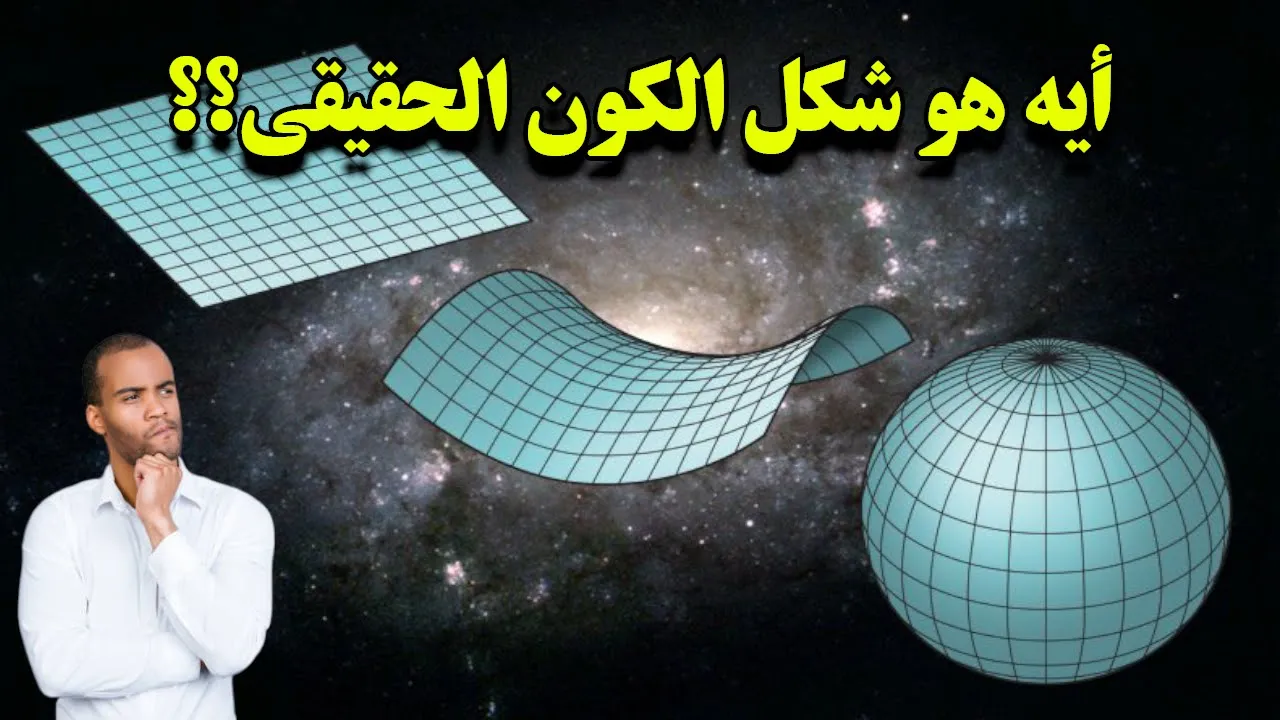
An intuitive understanding of surface curvature, specifically distinguishing between positive curvature (like a sphere), negative curvature (like a saddle), and zero curvature (like a flat sheet).
Basic vector calculus concepts, particularly how tangent vectors behave and rotate along a curve, which relates to 'total turning' or angular deviation.
The Gauss-Bonnet Theorem, which formally connects the local geometric curvature of a surface to its global topological structure (the Euler characteristic).
A deeper exploration of Non-Euclidean Geometries, analyzing the specific trigonometry and properties of Hyperbolic and Spherical spaces.
The physical application of Riemannian geometry to Einstein's General Theory of Relativity, where gravity is described as the curvature of spacetime.
Advanced topics in Differential Geometry, such as parallel transport, holonomy, covariant derivatives, and the Riemann curvature tensor on higher-dimensional manifolds.
2.8K views96likes35:14Original Release: 2025-12-24
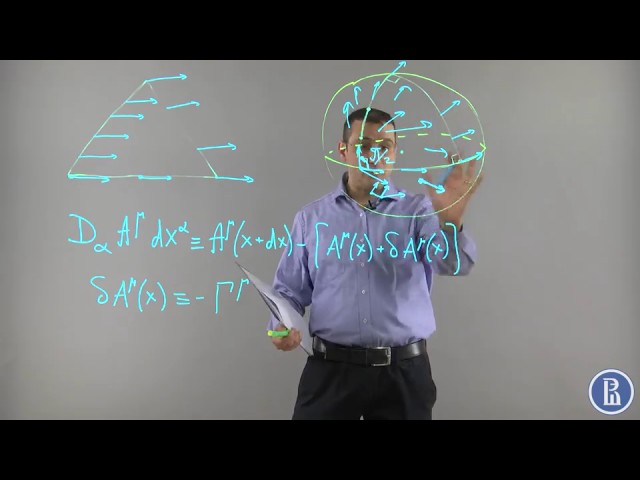
Hello everyone. Uh I'm V Datar uh faculty member in the department of mathematics at uh the Indian Institute of Science. So uh welcome to the first lecture of uh the NPL course on Romanian geometry. So since uh this is the first lecture, I thought we'll uh start with something very basic. U one of the main uh sort of objects of interest in this course is going to be to understand curvature of Imanion manifolds. So I thought in the first couple of lectures let me just uh start with uh essentially multivariable calculus and a little bit about uh you know curvature of curves and surfaces uh in in the ukidian space.
So today to begin um I wanted to do something I wanted to really go back to one of uh possibly the first theorem that we ever learn in uh in high school.
I I remember when I was in 8th standard I think uh I had first come across this theorem namely the sum angle property of triangles right so I think that's a good starting point and from there I'll um I'll explain a little bit in the next couple of lectures how to try to extend that to more uh general spaces and I think that would be a good starting point for us to uh to begin this course with okay so uh so as I said I mean today I'll I'll first talk about the sum angle property of triangles.
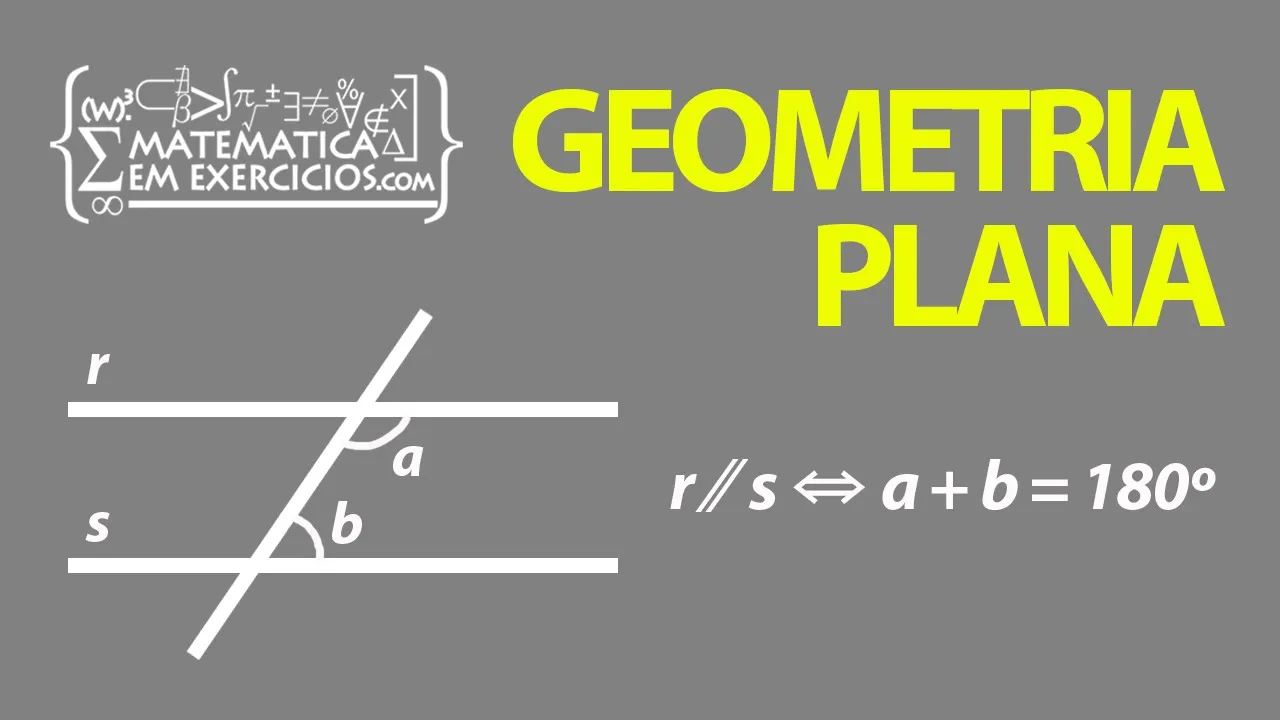
All right. So let's begin with uh uh sort of the main uh main theorem that we learn about in in uh high school. So consider a triangle let's call it A1 A2 A3 in the ukidian plane which I'll denote by R2 and let's say with interior angles alpha 1 so the angle at A1 is alpha 1.
The angle at A2 is alpha 2 and the angle at A3 is alpha 3. So let me maybe draw a picture.
So this is a1 a2 a3.
This is alpha 1 alpha 2 alpha 3.
Then the sum of angles of the triangle is 180° or in terms of radians it's pi radians, right?
Okay.
So actually u it's possibly uh more useful sometimes to uh to state this theorem in terms of the external angles.
So let the external angles be um epsilon 1.
Sorry I this should be epsilon 2 and epsilon 3. Then this statement is equivalent to the statement that the summation of the external angles is exactly 2 pi.
Okay.
So now uh I want to consider the following two u generalizations.
So firstly I want to try to see if uh one can generalize this to curved triangles.
Okay. So of course uh triangle by definition is made up of three vertices uh and the vertices are connected by straight lines. But instead one could one could try to connect the vertices by some curved smooth path let's say and try to understand if there is an analog of uh the some angle property for such triangles and the second uh way in which I would like to generalize this is to try to um understand this property for triangles on curved surfaces. this.
So a key assumption in this theorem is that a triangle lies on the ukidian plane right. uh on the other hand uh one can you know for instance uh think of triangles on spheres right uh of course an important question to first address is what do you actually mean by a triangle on on the sphere right so I I'll get to that uh later in this lecture but presumably one could have uh one could make sense of triangles on such curved surfaces and then ask if the sum angle property is correct or or if there's an analog of the sum angle property Right. So um all right. So so let me first uh start with uh curved triangles curved triangles in the plane. So in R2.
Okay. So let me maybe draw two pictures.
Oh, sorry.
So let me draw a sort of fat triangle and let me draw a thin triangle.
Okay. So let's uh instead of again looking at the uh sort of interior angles, let's look at the exterior angles. So the exterior angle is the angle made between the tangent vectors to these curves at these two points.
And let's call uh call the thin triangle as a1 prime, a2 prime and a3 prime.
Okay. So let's mark out the uh the external angles.
Uh sorry.
So for the uh fat triangle it's it's kind of clear that u that if you sum up the exterior or the external angles it is clear that the sum is now going to be less than 2 pi. Right? So if you compare this figure to the figure of the regular triangle that I drew earlier it's clear that these external angles for this fat triangle will tend to be smaller than the external angle if if the edge was a straight line. Right? On the other hand, let's do the same exercise for the thin triangle.
Right? So here you see that the external angles tend to be bigger. And so if you now sum up the external angles, the answer would likely be bigger than 2 pi. Right?
Okay. So let's try to understand whether there is some correction term one could add so that one would again get the answer as 2 pi. So, so for instance, one can one add some positive correction term here so that the sum total is is 2 pi and similarly can one add a negative correction term here so that the sum is again 2 pi. So now if you notice uh in in this picture uh right so so look at the uh the the tangent vector at a1 to this curve joining a1 and a2 and look at the uh tangent vector at a2.
So you see that the tangent vector has actually turned. On the other hand, if if these were connected by a straight line, then of course there's no way that uh I mean the the tangent vector doesn't turn, right? As you as you uh move along the uh the curve. Similarly, uh let's let's do the same thing for um for this. So again, the tangent vector has has curved.
So I I'll denote this by theta12. So that's the amount the tangent vector curves as you or turns as you move from a1 to a2. Similarly as you move from a2 to a3 the tangent vector again turns and you do the same exercise here.
Okay. So I'll denote this by theta 31.
So in each case you notice that the tangent vector is always turning in an anticlockwise direction. So whenever my tangent vector turns in an anticlockwise direction I call that u change of angle uh I keep the sign of the change of angle as positive. On the other hand let's come come to the picture of the thin triangle. So here uh at a1 you start off with this tangent vector. At a2 you have this tangent vector.
So it has moved from from this to uh to to this right. So so this is the tangent uh the the change of or the turning angle of the tangent vector which I'll call by theta12 prime. Now you notice that for the thin triangle the tangent vector is actually turning in a clockwise direction.
Okay. Similarly, one could uh do the same exercise for for the other tangent vectors.
So, it turns from here to here.
So, again, it turns clockwise in a clockwise direction. I'll call this theta 23. And then at this point, the tangent vector is this. And it turns to this.
Right? So that's theta 31.
So here uh theta i i i + 1 prime I want it to be negative because uh the uh the tangent vector is turning in a clockwise direction. Whereas here the turning angles I my convention is that I I I I call them positive. Okay.
So now if you do a little bit of bookkeeping, this is a simple exercise.
If you do a little bit of bookkeeping, the following is not hard.
that if you take the sum of uh all the external angles plus if you take the sum of all the turning angles then that is actually going to be 2 pi.
So if you take into account this sort of turning uh the fact that your uh tangent vector to the curve actually turns and if you do careful bookkeeping actually calculate the angle that it turns and then add that back into your uh sum angle formula then you actually get 2 pi right similarly so so for the fat triangle you get this and similarly for the thin triangle also you can do the bookkeeping that summation I going from 1 to 3 epsilon I prime plus summation I of the turning angles that is actually 2 pi and the point is our convention forces this to be a positive term and this to be a negative term. So this explains our earlier observation that for the fat triangle if you add up the external angles uh then the sum of angles is actually less than 2 pi. On the other hand for a thin triangle the sum of angles is actually bigger than 2 pi. Right?
Okay.
So to summarize what we have now observed for a curved triangle in R2.
We basically have that sum of the external angles plus the total turning angle.
This is actually equal to 2 pi. Okay. So this is a uh a fairly nice uh generalization of the sum angle property to very general curved triangles. You no longer need the sort of edge connecting the uh two vertices to be a straight line.
So this is all well and good except given a general curve how do you actually calculate this? How do you calculate the turning angle?
Okay, this is a question I I'm going to address in the next lecture. So that the turning angle is actually going to be computed by calculating the the total curvature of the plane curve. Okay. So so u the turning angle in some sense turns out to be the uh integral of the curvature of a plane curve. Okay. So I'll get to that uh in the next lecture.
All right. So, so this is about curved triangles.
I mean, let me now see if I can uh I can address my second question which was namely what happens to the sum angle property on curved surfaces, right?
Sorry.
Oh, sorry. I wanted the blue color.
So let's take the simplest curved surface that you're all familiar with.
So let's talk about the sum angle property on on the sphere.
Okay. So uh so I want to understand triangles on on a sphere. But uh a natural question is what is really a triangle right? So let's go back to our original definition of triangles.
A triangle is basically a figure made up of uh three vertices. So maybe let me write this down. So recall a triangle is a figure with three vertices and three edges.
where the edges are shortest paths. I mean they're straight lines in the plane. But what is really a straight line? Uh a straight line is basically the shortest path joining any two points. Right?
Uh so so the edges are the shortest paths between the vertices.
Okay.
So, so the key point is the shortest path between the vertices. So, this happens often in in math that you have a certain theorem that works well in a certain regime and then if you would like to uh generalize it to a a different situation, you need to have the right kind of definitions. Right? So uh so in this case I mean we need to really make sense of straight line paths on curved surfaces like the sphere and the way to generalize the definition of a straight line is exactly this that a straight line is precisely the shortest path uh between the vertices. Now let's look at the sphere.
So now consider the sphere.
So I'm going to take the two-dimensional sphere of radius R sitting inside R3. So this is just the set of points XY Z and R3 such that X^2 + Y 2 + Z 2 is R 2.
So it turns out that uh given two points P and Q.
The shortest path from P to Q is a meridian or a longitude or it's also called a great circle.
Okay. So just to draw a picture, you have a sphere here. Uh the sphere is very symmetric. So I can always assume that one of my points is actually the north pole and let's say uh your other point is here. Then uh if I denote the south pole by P prime there is a unique longitude going from P to P prime which uh passes through passes through Q and of course then it goes around uh on the back side of the of the sphere. So in this case the shortest path between P and Q is basically going to be this uh uh the small segment in this uh great circle in this meridian. Right? So if it's actually not very difficult to show from basic calculus that if you take any other sort of path connecting P and Q that's actually going to be uh going to be a longer path. So it's actually also of great practical use because uh for instance if you want to fly from uh Mumbai to New York uh you basically the airplane essentially follows the path that that is obtained by connecting these two by a by a meridian or a great circle. Of course uh in actual life there are also headwinds and you know the wind might change directions and so on. So uh but approximately the plane follows this um uh sort of great circle path.
Okay. So now uh now that we so uh a triangle on a sphere is a figure made of three vertices and three edges such that the edges are the shortest paths.
Okay. So now one can ask whether the sum angle property uh also holds for uh uh for the sphere. So let me just give you an example. Let's consider the the sphere. Let's say a1 is is a point here and this dotted line let's suppose that's a um that's the equator. Let's take two points two of the other vertices on the equator such that so now you join them by longitudes or or meridians such that the angle that they make with the equator is uh is 90° and I mean uh the angle with the equator will always be 90° because uh I that's basic geometry but we choose the points a2 a3 so that this angle is also uh 90° Okay. So u so in this case let's uh measure the sum of angles. So clearly the sum of angles of this triangle is 3 *<unk> by2 which is obviously bigger than pi.
Right? So in the sphere we have now a triangle whose sum of angles is actually bigger than u than pi. and the discrepancy. So the discrepancy is precisely um pi /2 right so it's it's pi /2 above pi pi would be the correct answer in the plane so on the sphere you now have a triangle which whose sum of angles is actually p<unk> by2 bigger than pi okay so uh let me u there's one sort of curious this thing if you look at this triangle what is the area of this triangle so note that the area of the triangle well how do you calculate that the area of the full sphere is 4 pi * r 2 because r is the radius so surface area of a sphere is 4 pi * r 2 the triangle that I have is basically 1/8 uh covers 1/8 of the surface area why because uh you can imagine that if So uh if you make these angles of pi you you can have four such triangles in the upper hemisphere and four in the uh bottom hemisphere. So that makes eight triangles. So it's actually 1/8 of 4 pi r 2 which is<unk> by2 * r 2. So the discrepancy I'll call this delta. So this discrepancy delta is precisely 1x r 2 * the area of this triangle.
Okay. So now what is this curious factor of 1x r²? Imagine you have a sphere of really large radius.
Then uh essentially if you if you live on that sphere so think of you know humans us living on the earth. uh our ancestors thought that the earth is flat, right? Why is that? It's because the radius of the earth is much larger than uh than the size of any human being, right? Uh so so if you take a sphere of really large radius, uh it actually appears almost not curved, right? On the other hand, if you take a really tiny sphere, let's say a table tennis ball, clearly you can see the curvature of that sphere, right? So that means that this 1x r 2 essentially measures how curved the the sphere is.
Okay. So uh so this discrepancy is actually essentially the total curvature inside the triangle.
Okay.
So uh this turns out to not be a coincidence. Um I'll state a very general theorem and I'll uh uh I'll I'll indicate how to prove that and maybe u uh the point of the next two lectures is going to be make going to be to make sense of uh of whatever I've written here that the uh sum of angles the discrepancy with pi is essentially related to the total curvature contained inside a triangle. Uh so of course we need to define what curvature means and that's going to be the point of um at least for these simple surfaces that's going to be the point of the next two lectures. So let me state the general fact about about um spheres.
So let A1, A2, A3 be triangle on the sphere of radius R with interior angles alpha 1, alpha 2, alpha 3. Okay. So then the sum of alpha i's is going to be pi plus some positive number. And what is that positive number? That's precisely going to be 1x r² * the area of the triangle.
Okay.
So let me uh maybe in the next uh five minutes let me indicate how to prove this.
So let me draw a picture.
It's actually completely elementary geometry proof. So I thought it'll be a nice uh thing to actually work this out together.
So this is uh this is our sphere of uh radius r. Uh let me take a triangle. So uh in order to make the picture look better, I think I should should carefully choose my uh great circles.
Actually, let me uh use different colors.
Okay. And for the third one, um, let me choose blue.
Okay. So, so this is going to be my triangle A1, A2, A3 with these angles alpha 1, alpha 2, alpha 3. Okay.
So I want to calculate what the sum of angles of this triangle is. I do the following. I continue my uh my great circles on the other side of the of the sphere.
Okay. So you notice that on the other side of the sphere there's another triangle formed. which I'll label as a1 prime, a2 prime, a3 prime. So one way to think of this is uh let's say your sphere is is really a bulb and your original triangle you basically put some solid material there and shine a torch light. Then essentially this other triangle is basically the shadow that's formed on the other side. Right?
Right. So, so you have this uh sort of shadow triangle here.
Okay. So, now uh I want to do the following. I want to consider this sector. So, so I take alpha 1 and I consider this sector which goes to the back of the of the sphere. I call that uh S1. And I want to take the other sector formed by this angle alpha 1 and I want to call that S1 prime.
Okay. So, so, so this sector is S_sub_1.
The other sector is S1 prime. And I similarly do the same thing to the other angles. Now what will be the area of s_sub_1 plus the area of s_ub_2 uh s1 prime.
So you can imagine that if if if I open up alpha 1 so that alpha 1 is equal to pi. So so if if alpha 1 were where pi then uh these two sectors would combine to cover up the entire sphere. Right? So then the uh area covered would be 4 pi r 2. Right? Now my angle is alpha 1. So then by the usual ratio uh thing that we learn in in in high school the area is going to be 4 r² * alpha 1 right so this area is going to be 4 r² * alpha 1 similarly area of s_ub_2 + area of s_ub_2 prime is going to be 4 r² * alpha 2 area of S3 plus area of S3 prime is going to be 4R 2 alpha 3. But now you notice that if you take all these sectors, they essentially cover up I mean they basically cover up the entire sphere, right? On the other hand, these two tri each of these triangles is counted once in each of the sectors, right? So if you if you add up the uh add up the areas of these sectors, that's basically going to be the full area of the sphere.
But this original triangle is counted thrice instead of being counted once. And the shadow triangle is also counted twice instead of being counted once. And of course the shadow triangle and this triangle are congruent to each other. So that means you're actually counting four times the area of the triangle in excess.
Right? So you get this formula. On the other hand, what is this? This is precisely 4 r² * the sum of angles. What is the area of the sphere? That's 4<unk>i r 2 and plus 4 * the area a1 a2 a3.
Now if you cancel out four and divide by r² you get precisely this formula.
Okay.
So uh so this is an elementary proof of this very general sum angle uh formula for triangles on the sphere.
Okay. So maybe uh this is a good time to stop the first lecture. Um in the next lecture I'm going to uh talk about the curvature of plane curves uh in an attempt to extend to generalize uh this thing that we saw with the fat and the thin triangles. So that's the goal for the next lecture and in the third lecture I'll uh then try to extend the sum angle formula to curved triangles on curved surfaces. Okay. So so that that will be a generalization of this formula for the sphere that we we proved.
Okay. So that's the aim for the next two lectures. All right. Thanks for your attention and I'll see you um in lecture two. Thank you.
Up Next

68:02
James Simons on the Origin of the Chern-Simons Invariant
@simonscenter
64.4K views•2021-12-14

4:43
Elliptic Curve Cryptography Explained: ECC, ECDSA, ECDH
@PracticalNetworking
28.5K views•2024-10-21
10:44
Fourier Series Introduction: The Big Idea Explained
@DrTrefor
387K views•2021-05-03
6:00
The Mathematical Impossibility of Accurate World Maps
@Vox
23.3M views•2016-12-02
Related Study Plans & Knowledge Roadmaps
Structured learning paths in Mathematics
mathematics
Tensor Calculus: Vectors to Riemann Curvature
01Mathematical Foundations: Linear Algebra & Calculus
02Covectors, Dual Spaces, and Tensor Basics
03The Metric Tensor and Index Gymnastics
+ 2 more learning modules
40h5 modules
Explore Roadmap
mathematics
Gödel's Incompleteness: Logic, Proofs & Limits
01Introduction to Formal Systems & Hilbert's Dream
02Set Theory, Cardinality, and Cantor's Diagonal Argument
03Arithmetization and Gödel Numbering
+ 2 more learning modules
14h5 modules
Explore Roadmap
mathematics
Galois Theory: Fields, Groups & Solvability
01Foundations of Abstract Algebra: Groups & Fields
02Polynomials & Field Extensions
03Splitting Fields & Symmetries
+ 2 more learning modules
24h5 modules
Explore Roadmap
mathematics
Non-Euclidean Geometry: Models & Geodesics
01Euclid's Fifth Postulate and the Birth of New Geometries
02Hyperbolic Space and the Poincaré Disk Model
03Geodesics: Defining Straight Lines in Curved Spaces
+ 2 more learning modules
15h5 modules
Explore Roadmap