




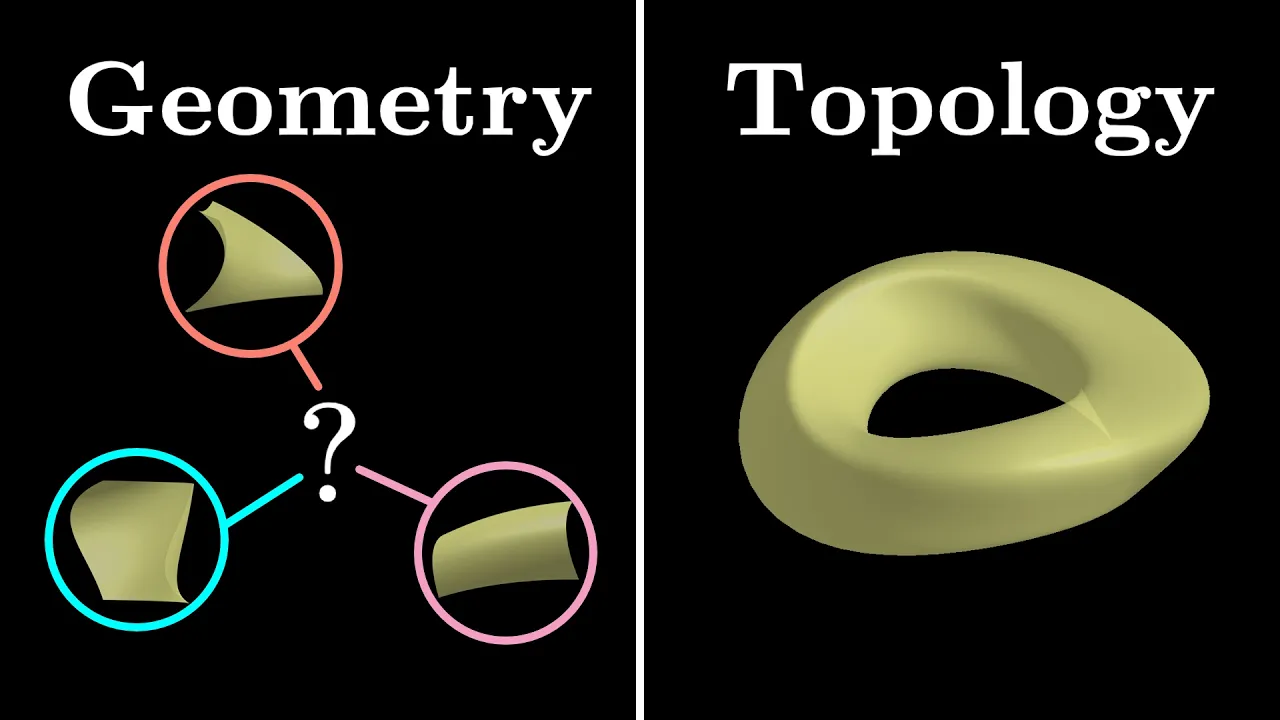












Chern-Simons forms are differential forms that arise from the Chern-Weil homomorphism, which maps invariant polynomials on Lie algebras to characteristic classes in de Rham cohomology; they were originally developed by Shiing-Shen Chern in 1943 as a simple intrinsic proof of the generalized Gauss-Bonnet theorem, where he showed that characteristic forms on principal bundles become exact when pulled back to the bundle itself, with their integrals over fibers equaling one, thereby establishing a deep connection between differential geometry and topology.
James Simons on the Origin of the Chern-Simons Invariant
Added:Basic differential geometry, including smooth manifolds, vector bundles, and the concept of a connection and curvature.
The classical Gauss-Bonnet Theorem, which establishes the fundamental relationship between a surface's geometry (curvature) and its topology (Euler characteristic).
An introductory understanding of characteristic classes (such as Chern classes and Pontryagin classes) in algebraic topology and how they measure the non-triviality of vector bundles.
De Rham cohomology and the calculus of differential forms, which provide the integration and algebraic framework used to define these invariants.
Chern-Simons Theory in mathematical physics, particularly its formulation as a 3-dimensional Topological Quantum Field Theory (TQFT).
The profound connection between Chern-Simons theory and knot invariants, specifically Edward Witten's work relating it to the Jones polynomial.
Applications of Chern-Simons invariants in condensed matter physics, including the fractional quantum Hall effect and topological insulators.
The study of anomaly cancellation in string theory (such as the Green-Schwarz mechanism) and the role of Chern-Simons terms in supergravity.
64.4K views1.4Klikes1:08:02Original Release: 2021-12-14
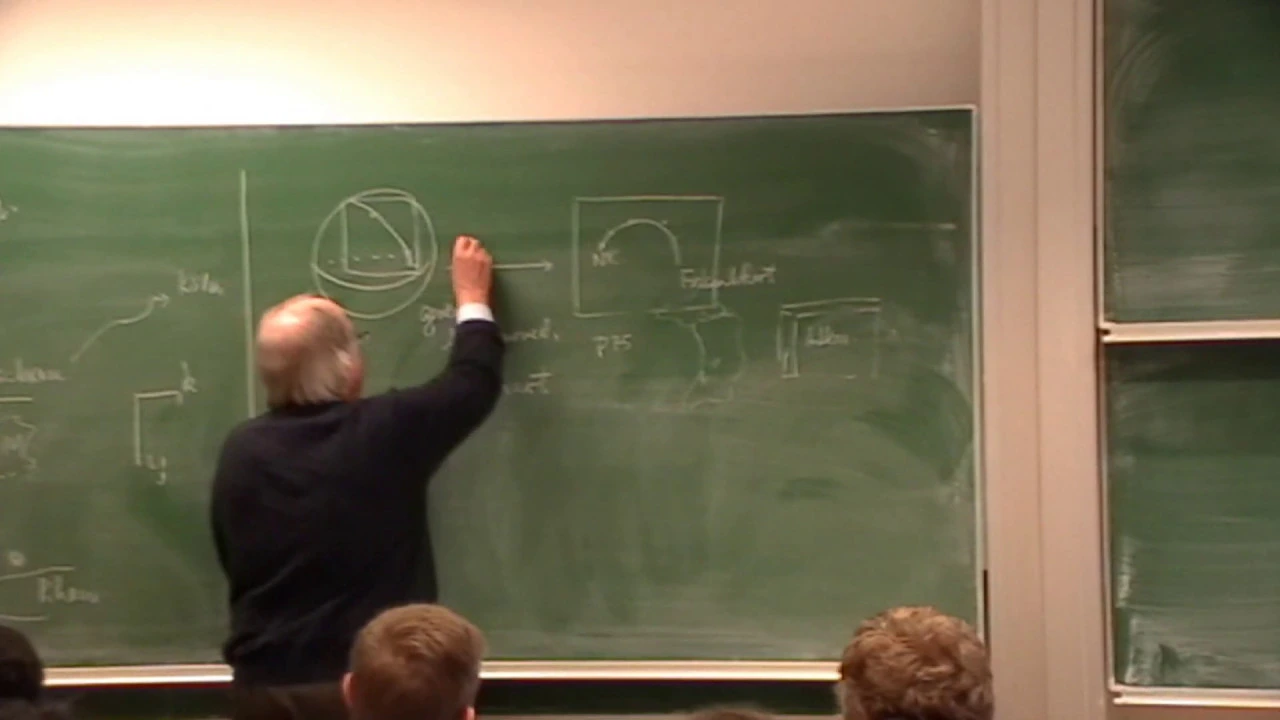
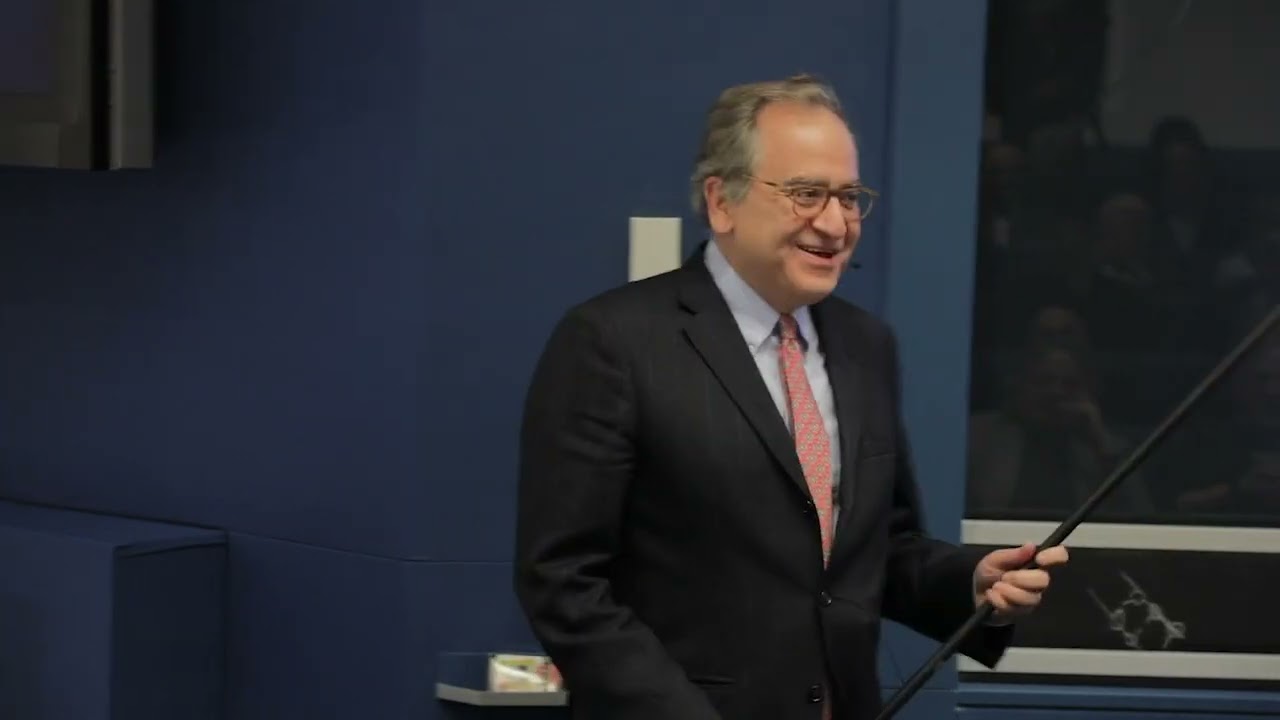
geometry and gauge theories and we already have seen at least a couple talks where sharon simon's term figured prominently and as you know that's one of the most important developments that has affected a lot of aspects of physics especially geometry and low dimensional topology in the connection between math and physics so we are very pleased that jim agreed uh taking some time off from his busy schedule to give us a talk about the origin of turn science okay well i first want to say that this is a talk designed for physicists uh in that and only in that i assume they don't know all the math that i'm going to display however they may well the mathematicians certainly do and i recommend they either leave or doze those so uh there's a lot of the stuff i i want to try to get at the how we got to these terms why these uh so-called churn science terms of how they arose and why they're important but to do that we need to start at an earlier at an earlier stage so i'm going to start with i'm going to start with the euler characteristic of a manifold or space so we're going to call chi of x the euler characteristic of x and for a simple definition i'll say it's the sum of the odd beta numbers b sub i so probably you know what the baby numbers are alternatively in the way it was uh originally uh you think everyone doesn't know it do you know beatty you know no okay bi is the rank of the ice homology group and if you want an even simpler definition it's if you take a simplicial complex like this and you count uh well if it's two dimension you would count the number of faces minus the number of edges plus the number of vertices and in general you could just take the alternating sum of all the numbers of all simplices of different uh dimensions so you take the number of k simplicities minus the k minus 1 so on that's the other characters obviously from this definition it's a topological invariant because the homology doesn't depend on how you you know homologous number halls of a certain type in various dimensions so it's a topological invariant this does not make that clear the second definition uh but on the other hand um it's a it's a nice theorem but that's true but so but i want to give i want to state a theramis that's due to poincare and hopf so i think i'll try to work on this board a little bit and this is a very famous theorem so suppose you have some closed manifold smooth and so on turns out you can always make a vector field on this manifold with at most a finite number of isolated singularities see there's one right there see this vector field doesn't know where it's going right here but you can the number of such points is finite there's a finite number you can do that never mind why but you can do that the the uh you can do that now each one of these has not only a singularity but the singularity has a degree associated to it and why is that well below this we'll blow this singularity up here this particular this particular one and we'll note that any such gives you a map of the sphere surrounding this thing into itself so uh so this point in this well uh so you look at the the you look at this thing as it marches around the sphere let's let's put it marching around the outside of the sphere for a moment out here out here out here and out here now so you map this point to actually itself this is the id this is the identity map but if it pointed in it would be halfway around and if it curved around as it was going around this sphere in different ways it would give a map of the sphere to itself so you always got a map of the spear to itself and that's called it's called the degree of the singularity and the so these are mi this is the degree of map and well the degree of the map yeah sort of a number of windings but of course this is a sphere it could be in any dimension so but goes over itself a nice a nice such just in the two dimensions is something that starts out like this ends up like this over here it's here over here it's here and it sort of slides around halfway it's tangent over here it's tangent and i think let's see i guess over over here it's tangent and what this one does what this one does this singularity it flips the the circle around so that's that has degree minus one you see because it holds these two points fixed it reverses these two it flips the circle that's an orientation reversing but if this could have been a much busier vector field it could have wrapped a circle around itself in either direction a lot of times so that's the degree okay and theorem yeah which is due to poncare and hopf is that the sum over i of a degree of mi the just the sum of the degrees no alternation because there's nothing to alternate is equal to the euler characteristic of x now that's a beautiful theorem and it's not obvious you can't say ah yes of course there's no it's not obvious at all uh there's a proof there's an outline of a proof in in in steenrod's book uh and where you can take a simplisal complex and subdivide it a couple of times and then make a vector field and then you can count with prescribed singularities and you can count their degrees and see that you really get those edges minus faces plus vertices and so on as a result so that's a proof but it's yeah the other character can be negative you just take the absolute value of it sure it can be negative but not with that the left-hand side is positive no no because the degrees could be negative sorry sorry the degrees could be negative orientation reversing uh map or so the degrees can be negative yeah the other characters mean anything you like i mean any sign that you like and uh everyone is standard that the ordinary two-sphere has all the characteristic two and a torus is zero and every time you add a handle it drops by another by a negative two and so on so so here's this here's this great theorem and we're going to use this this theorem to prove another great thing so well it's going to be used so so now i'm going to have a a uh x's closed we'll just make this two dimensional oriented two two manifold two dimensional manifold fact and orient orient or romanian as romanian structure and indeference to the physicist i will call the curvature f see this is usually it's not called f the mathematics balance but we'll call it f so a wonderful theorem called the gauss-monette theorem is that if i take the integral over x of 1 over 2 pi curvature i get the euler characteristic of x okay i mean there it is now i'm going to sketch a proof of this using that and then we're going to go to higher dimensions and look at churns great proof of the generalized uh uh gauss-beneath theorem and therein lies the first hint of one of these churn simon's forms or whatever you want to call them because they were those forms existed long before my name got attached to them so uh i don't know anyway there it is so let's look at how one might one might prove this this formula so so we'll choose a vector field you choose a unit vector field v with isolated singularities and orthogonal complement w so that v wedge w is oriented okay so all i'm doing here is picking a framing there's v and there's w and they're hopping all around here moving around except that one place it gets all confused let's say this particular place here it doesn't it doesn't know what it is right over here it's a singularity okay so now let's look at a one form a a of x which is just the covariant derivative in the x direction of the vector field v and you'll dot that with w so that's connection kind of thing just yep it's crucial that we show that the similarities are always it is crucial okay you know i said you could always choose so you can always find such a vector with a finite number of singularities and finite number means they're isolated right okay but but if i didn't say that i should so here's a differential one form ax and note that it's exterior differential d a is equal to f okay so this is really the connection form if you like and in this very simple case its differential is curvature so now i'm going to integrate here's what i'm going to do i'm going to integrate f i guess i have to take 1 over 2 pi yeah okay 1 over 2 pi f i'm going to integrate this over x well i might as well just integrate it over over uh well to do this i'm gonna excise the so i'm gonna well okay here let me write up here for a minute so here's a singularity mi and i'm going to let u i up a t equal the ball of radius t around m i so before i write down this integral let's just look at this sort of swiss cheese thing that i've i've created here's the manifold here's some singularities and here are these little balls little discs around them okay perfectly clear so now i can say okay the integral over x who buys a chalk around here morgan i'll approve an expense for stronger chalk [Laughter] okay so we can subtract so the integral of one over two pi f over x is equal to the limit as t goes to 0 of the integral the same integral but it's going to be over x minus these balls minus these balls the collection of ui up a t right so i'm going to make these balls smaller and smaller and integrate over what's not there and i'm going to integrate 1 over 2 pi f but of course here it's it's d a it's d a so that's going to be the limit as t goes to zero of the integral of a over the boundary of this thing x minus this collection of balls right and if you uh uh now the boundary of this collection of balls is a collection of spears or collection of circles uh in this case so this is really equal to the integral of now a over uh uh a bunch of circles so what we'll call it uh s up a t sub i over the set of over the set of circles because that's the boundary of all this is just these circles and limit as t goes to zero and it's not easy it's not difficult to see at all as you integrate this around a circle it's nothing but the degree of the vector field so this is this is equal to uh the sum of the degrees of the vector field at these points so uh and this is a very easy calculation so okay that's a that's a good proof of this gauspinate theorem using uh this theorem of of hop and and poncare now i will say that one could also have proved this theorem simply by triangulating the space looking carefully at what happens to curvature as the as and then flatten it out so you have this sort of polyhedra it's flat it has edges and vertices and just and you look at what happens as that flatness develops and and you could have done it that way and gotten a formula that said faces minus edges plus vertices but this this is a pretty cool way to do it with the proof that yes outlined is it clear that that f does not blow up so fast as you go it doesn't blow it up f doesn't f just the curvature see the f has nothing to do with the uh vector field f has nothing to do with the vector field at all uh okay but and of course uh and uh you you might worry about this well this is this is this is defined everywhere except except there but you can see but it's really its differential at least is very well controlled because it's differential didn't have anything to do with those vector fields so so it's so it's all okay it's all okay you just see what happens obviously a in order to integrate over something smaller and smaller and get an integer a has to be blowing up somehow because you know otherwise you wouldn't you get zero when you integrate around something teeny weeny so uh a is blowing up but d a is well as well behaved so so now we're going to talk about the generalized gauss-spending theorem so this was a theorem that was more or less proved by allendorfer and vay uh some years ago and so now i should point out that this euler characteristic business is always zero for odd dimensional manifolds the reason is there's a duality that the i baiting number is always equal to the n minus i beta number if the dimension is n and so when you look at that alternating sum it all cancels but for even dimensional manifolds it does not so one normally looks at the euler characteristic for even manifolds because otherwise it isn't so interesting it's always zero so so now we'll have x compact oriented romanian two n dimensions now we're going to look at so2n and it's the algebra as of the algebra i don't think i have to give this name and we're going to look at a polynomial p when i'm going to call it p sub chi on the li algebra which is skew symmetric matrices on the lee algebra which is invariant under oh goodness under inner automorphism you know such a these are skew symmetric matrices look at their determinant you could do various things but this one's called the faffian and i'll just say what it is as a polynomial so this is a polynomial so i'll i'll say what it what it does uh when the variable is all the same so if we look at if we look at p sub x piece of chi of this canonical form lambda 1 minus lambda 1 0 this are just little boxes here zero lambda n minus lambda n zero and zero's everywhere else right p of this is simply lambda 1 times lambda just the product of those guys and you can see that it's really the square root of a determinant okay this is a polynomial i've just shown it in polarized form when i have the variable just repeated all the time but it's a it's a symmetric it's what polynomial it's symmetric linear transformation from the tensor product of the only algebra with itself into the real numbers there it is called the fabian i won't write that down and i'll write down this theorem without quite telling you what i'm doing but the theorem is that i can the integral over x now i'm going to stick some curvature in so p sub chi of f bunch of f's and n of them equals the only characteristic of m of x so i'm saying is take this polynomial stick the curvature in in a way i'm not going to really tell you but stick n copies of the curvature tensor hand mush it all up and you'll get a 2n form right you got a 2n form you integrate that over x and you get the other characteristic and of course in simply two dimensions this is just the curvature itself this is just the uh just the curvature itself now this theorem was proved as i say more or less by allendorfer and vay i don't know if they had the whole thing they did need to embed it in euclidean space there was a lot of work and i don't think they proved that via the vector field method but i don't know the answer but they did sort of torturously prove it more or less and i'm told but not by churn himself but by someone churning bay got to be good friends shortly thereafter and and they urged chern to look at this unattractive proof which was not necessarily even completed or in all in all details on all generality and turn it into something simpler and he certainly did he certainly did uh so what did he do he turned it into really a one-pager but uh sort of sort of a one-pager let me let me find my one page here so i can tell you what it is so he did this in 19 1943.
and the name of the paper was a simple intrinsic proof of the gospel a theorem and it was a very it's really a seminal paper primarily because of his of a technique so let's look at a bundle now i'm presuming a little more knowledge with fiber the two n minus 1 sphere and the going into the sphere bundle of x that's a bundle of all unit vectors the whole sphere over every point maps down to hit x and the base and i have my connection form a connection so there's a romanian manifold now and this map is pi now i can find one can find a 2n minus 1 form which i'm going to call t p sub chi and it depends on f and a i won't say how many copies of each but there it is such that when you this form is on the sphere bundle itself on s of x such that pi star when i lift it pi star of p sub chi of f's i lift it up it's the differential of its d of t p chi of f and a of f and a so this form downstairs which is a top dimensional form as it turns out right because x is two n dimensional this form when you lift it up here is just a form it's going to be closed because it was closed downstairs if you lift up a closed form you've got a closed form but that it's exact is not obvious and that there's a nice formula for what it's exact what makes it exact is not obvious but there it is it's a differential upstairs and not only that a very convenient fact is that the integral over the fiber itself can you see down here the integral over s2 n minus 1 of t of this thing t p sub chi of equals 1 equals 1.
okay now here we go we just start with a vector field downstairs with isolated singularities and just almost to say this oh but i'll sort of write it down here so i'll take v a unit vector field unit vector field on x so so that that uh with isolated singularities well m subari now no okay so now i'll start out with trying to integrate over x p sub chi of f of the f's okay i'm going to try that well i might as well just leave out the singularities there's no i don't know anything don't have any measure so that's equal to the integral over x just minus this bunch of mis of the same thing piece of chi with the f's in there right but over this downstairs i can lift up to here because this is the vector field down here really defines a cross section in this bundle so it's really a map from x up there except at those little bad points so i can say oh well well this is equal to the integral over what i'm going to call v star of uh it's the push-up of x minus the singularities of tp of uh of of of of the pull up pi star of uh p sub chi of of x right but up here it's a boundary so that's equal to the integral over this stuff minus two these guys of d of p sub chi of d of t p d p sub chi and that equals the integral of t p sub chi over the boundary of this thing over the boundary of v star of x minus all its those little points okay well if you look carefully the boundary of this is just a set of spheres it's the whole sphere over the isolated singularity because this thing comes into those points it's all blowing up it's not but it covers the whole sphere and in fact this is really it's really the integral over these spheres over the sum if you like as a cycle over the sum of the degree of each mi times the sphere based at m sub i over the fiber of this tpx and but we just said oh when you integrate over a fiber you get one so this is equal to summation mi so now you know that made it sound like honestly this is pretty simple and in fact it said that was the title of the paper a simple intrinsic proof and it is pretty simple but the level of sophistication that went into this i think had to have been considerable uh for the time uh you know what is a sphere bundle i don't think everyone knew it's not about sphere bundles what's a connection on the sphere bundle how do you you know write the curvature properly how do you so all this stuff uh which even physicists uh probably know today uh about curb connections and curvature and that stuff and uh i'm i'm not even joking uh i don't mean to get a laugh but this is stuff nobody knew about that stuff or very few people knew about it uh and uh so uh it was it was it was really intuitive force and th this theorem uh this theorem really led to a tremendous amount of mathematics and it was it was a it was you know it was a revolutionary it was kind of revolutionary anyway there it was churns proof of the government a theorem now this thing this tp kai sitting up there in the sphere bundle was really a forerunner so tp chi of f and a is a forerunner god i can't spell at all well four all right i never mind forerunner of this stuff this turn simon's stuff because it's one of those forms that turns out to be uh very important so uh i don't have as much time as i hoped i'd have can you guys stay another couple of hours what's the uh actually sometimes take your break after one hour all right well um i'm gonna let's take a chance so uh let's see what happened i want to talk about the bay homomorphism the churn bay homomorphism so this is a big generalization in a way so now we're going to look at a g bundle a principle g bundle e over a space x again with the connection which i will out of deference call a and the curvature f is equal to d a plus a half or minus plus a half a bracket a in the abelian case if if g was a circle a bracket a would be zero and it would just f would be d a but in the general case it's not a billion and the brackets of the obviously algebra so a takes values and only algebra of g and so on so so this makes sense and we're going to talk about i l of g equals invariant polynomials all of them of degree l acting uh on the algebra of g so this is well they're invariant polynomials they're invariant polynomials under the indorado automorphism action and for any one of these polynomials one can make if i have such polynomial i can make a form p and i want to be careful it's going to be exactly lfs so i'm going to use the curvature l times contained in wedged 2 l of the base so it's a 2l form on the base you can just i won't tell you how to construct it but you can do it okay now the john vay theorem homomorphism says that there's a theorem it says one that d p of x is 0.
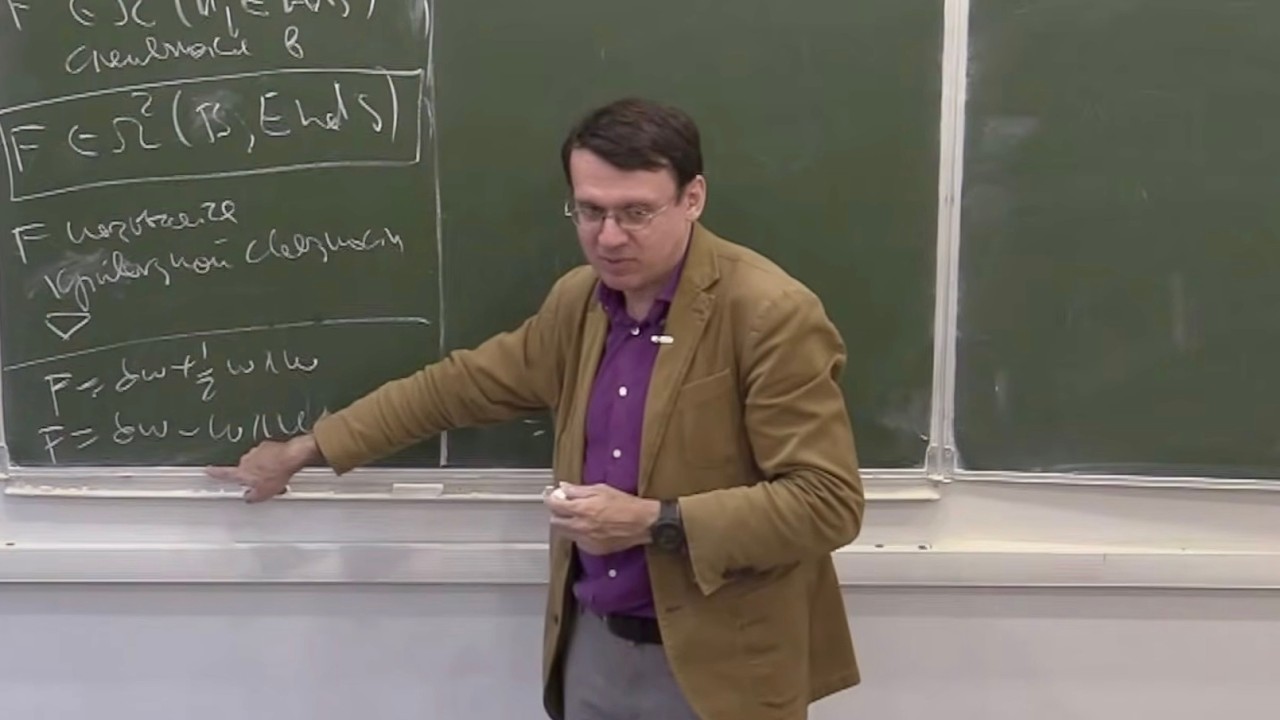
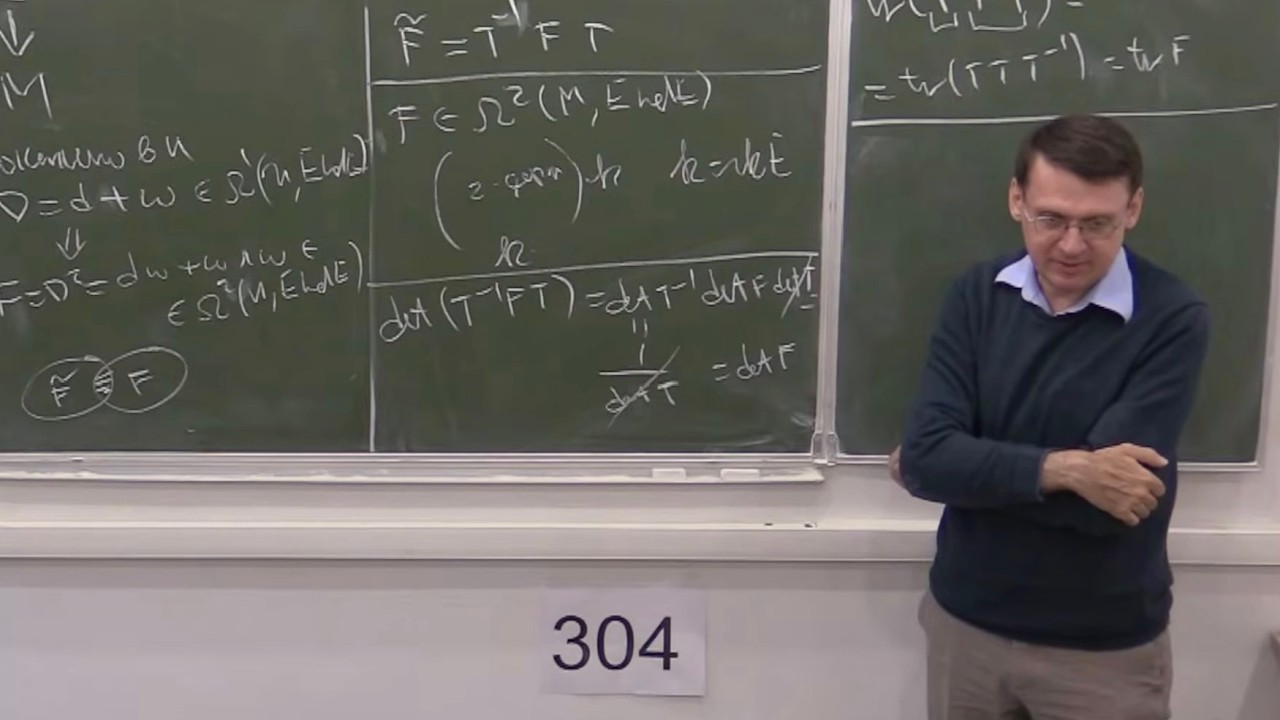
it's a closed form 2 the co homology class is independent of a any old connection would have given you the same co-homology and you know that comology is closed forms modulo exact forms which is finite dimensional uh on a compact manifold so the homology class is independent of a and the map from p goes to the homology of p of f is homomorphism in fact it's a ring homomorphism from did i say that i give this a name i am oh no i didn't yeah i allergy ring homomorphism mapping il of g into the even homology of x with real coefficient so so this is this is great anytime you have an invariant polynomial algebra of a of a bundle with connection you get a homology class and guess what it didn't depend on the connection after all but you got a nice form that represented it okay that's that's uh i will i won't prove that the proof is not it's not terrifically hard what you have to do is show when you vary the connection there's a canonical way to make the difference of these two forms exact so as you vary the kavisca pens on the curvature of the connection you vary it a form comes up that's also related to this cs stuff and d of that form is the difference between these two things and that and that that proves uh uh and that that proves two one is just a calculation and three is just a calculation two is the is the guts of it and uh it's not a very hard step but on the other hand again when chern and vay did it you know it probably didn't seem exactly trivial so no all of these are obstructions they're called characteristic classes and they're obstructions i'm going to write all this down there are obstructions to getting cross sections in certain associated bundles over certain skeleta in other words lower dimensional uh parts of the of the manifold for example the oil characteristic uh you you can get to anywhere in the even case except finally to the to the whole thing and that then you get stuck you don't get stuck in any three-dimensional subset sub-manifold let's say of of the four manifold you could always get a vector field over that but at a certain point you get stuck and uh the and for doing all kinds of cross sections in these associated bundles bundles associated to g uh there are obstructions they're called characteristic classes and these and these represent uh uh i think maybe all of the real characters they must represent all the real characteristic class what is that is that right yeah so all of the real there are some integer characteristic classes obviously you can't necessarily get this way and uh z2 you can't get this way but you get you get a lot so uh let's just look quickly at uh examples of these of these polynomials and then say it again it's only a couple years after 1943 i think jack is is jack here you don't know right yeah they were working closely together in prison so maybe right after the war 4748 could have been it could have been yes but i'm sure it was in the 40s i'm sure it was in the 40s and uh so so uh let's just look if the bundle if the if the if the group is u n a favorite group uh then the invariant polynomials i of u n is generated by trace powers generated by actually just the trace of g to the l so you take a skew hermitian matrix raise it to l power take its trace every polynomial could be written every invariant polynomial can be written by a a linear combination uh a well a hey not a linear combination but anyway pro sums of products of things like this and in particular you get this leads to the so-called churn classes and if it's uh s o n uh it's also generated here it's generated by trace of g to the 2l notice the trace of an odd uh an odd pro product of g with itself an odd number of times is is zero because excuse me doesn't have any trace but even traces and and that leads to the uh pantry argan classes so familiar classes for these two familiar family of groups an event happens to be even you get one more which is not a trace power and that's that faffian polynomial that i wrote down before that's not a trace power as far as i know well someone's very very clever but it isn't now one important thing and then we can move move along one important thing is is the naturality i'm very eager to get to to get to the punch line here one important thing is is naturality and it goes like this that if you have one of these bundles with connection e down to x pi and so on g well i'm going to move it even to the left here e i x g and then suppose i have a map a smooth map of y some other manifold into x call that f well and then it turns out i can pull back everything so over here there's there's another g bundle principle g bundle and that goes into what we'll call f star of e and it has and that maps down down here to a pi and uh there's a the connection over here and it pulls back to a connection f star of a and here's the here's the punch line of this that if i take for a given polynomial p of f an invariant polynomial and i pull it back f star of this over here that equals uh p of the o of the pulled back curvature and effect or the of the pullback curvature p of f star of f f star of f so everything is natural in this in this business okay push it over pull it back the polynomials the forms pull back so now let's do something funny let's pull a principal g bundle back to itself under the projection map so let's use this neat fact uh about the thing itself so here i have e goes down to x by g etc all very nice and now over here i have e and this was the map pi and now i'm going to make this map we'll call this map pi so here i get g again but here i get pi star i think i didn't write yeah i did now here i'm going to get pi star of e mapping down to e and the connections and all the rest okay now when i but a bundle principal bundle pulled back to itself is trivial right think about it a minute if you the the fiber was the fiber below below the point this point is already in that fiber the base is now the bundle and i can say oh uh in itself is the base itself being a point in the fiber gives me a cross-section in the pullback bundle so if you pull back a principal bundle or any bundle over the bundle itself you get something trivial and because it's trivial this pullback all the characteristic classes vanish because there's no obstruction to anything in a trivia bundle and in particular that means that when i pull back under pi if i pull back pi star of one of these characteristic things p of f f the coromology class must vanish and therefore it's exact equals d of something okay it has to it has to be d of something and that's something we're going to call t p of a and f we'll just call it t p of a so what i'm saying is i have a form down here a characteristic form p of these things i lift it upstairs innocently i just pull it up and all of a sudden it cracks open and becomes exact just as in the sphere bundle that characteristic form was was open was it was exact when we raised it up we pulled it back up to the sphere bubble that phenomena is very generally true that when you so now it's these forms that are uh are interesting and uh were the w with the root of uh i and i can write down the formula for this in fact i i will just so you can get a flavor of it so so tp of a is equal to the well it's a degree l so degree l it's you can integrate it integral from zero to one of the polynomial itself with a plugged in and something called phi sub t to the l minus 1 plugged in dt dt so i'm just i have this sort of one parameter family of differential forms and i'm integrating it to get a new one and phi sub t is uh what is for i sub t it's uh t times the curvature uh plus t squared minus t times a a wedge a is whatever exactly that means so again okay so you do that and and now we'll we'll look at at one example where l eq l is equal to two so if l is equal here i'll do it over here if l is equal to two uh you get something that is going to start looking even more familiar so for l is equal to 2 l equals 2 tp of a turns out to be p of a wedge f take these wedges with a grain of salt minus 1 3 p of a wedge a wedge a so now this is beginning to look like the classical form uh so you can see that just one example of these tps and there's a formula for all of them and the polynomial is also is uh applied to all different combinations of a's and f's and so on and and with the coefficients in each place and that and that's what that is so so now when i came to stony brook here in 1968 i wanted to learn about characteristic classes and i thought that a good way to do that would be to attack a problem the difficulty of which i had no idea and i didn't solve the problem uh was it would track the following problem the euler characteristic is one invariant of an even dimensional manifold but for a manifold of dimension 4k let's say dimension four there's another interesting numerical invariant called i think it's called its signature and it's when you take the two-dimensional commonology cup it together you've got a quadratic form on the two-dimensional columnology of a compact-oriented format if i'll just cut two two guys together you gotta and that quadratic form has a signature to re it's a it's a real quadratic form so it has some positive eigenvalue if you diagonalize it has some positive guys and some negative guys and uh that signature the difference between the number of positives and the number of negatives is a topological invariant obviously because it just comes from the homology but it's not like just adding up the baby numbers or something but you have to do some work to cup and then calculate this this quadratic form so it's it's it's not a simple algorithm for just it just tells you how to do that so i said okay i want to learn this stuff i'm going to look at a c try to get a combinatorial formula for that form for that uh index by integrating what turned out to be a characteristic form a well-known character in fact the first pantry argan form first pantry argon class divided by three i believe is gives you the signature so i said oh i'll just integrate that thing i'll let it get corners and edges and faces i'll see what the limit is and uh there there will be i'll get a nice formula well that did not work it didn't work it didn't work because there was this thing that i'll call a pesky term so and this this pesky term i couldn't figure out how to take the limit of it so when integrating over this this thing uh as it got smoother and smoother i i had this sort of boundary of a vertices of the star of a vertex and a form in its frame bundle came up which not surprisingly d of which was the pontriograph i didn't quite realize all that at the time and that form seemed very interesting so i'm just gonna write this down and then i think so i'm going to have to stop but it's kind of at the penultimate point so ah this is now so now what we're looking so then i decided just to study see by the way this is a three this is a four-dimensional thing and this is a three-dimensional boundary here this boundary is m3 although it's really a sphere but i got this term and i decided i look at this term since i couldn't do any it's a typical mathematical mathematician's trick i couldn't make header tails of it on the sphere so i decided to try to make header tails of it on any three-dimensional manifold making the job perhaps harder but on the other hand there it was so i said okay i have this form which i'm going to show you in a minute on this boundary the form seemed to have interesting properties i thought so i'm going to look at it so so here is the frame bundle of a three mana so so this is the frame bundle i'll call it e again frames and tangent frame bundle and down here is a three manifold which i'm now going to call m3 and here is the romanian connection a okay so that was my setup a romanian three manifold and upstairs here in e there was well there is there's a for the first pantry argon class tp1 and that's equal to one over four pi squared times now i'll really break this up because this is just a skew symmetric valued skew symmetric value matrix value thing and i'll write it in the way that i originally saw a12 wedge a13 wedge a23 uh plus a12 wedge f12 plus a 1 3 wedge f13 plus a 2 3 wedge f 2 3.
there it is now d of this is supposed to be the pantry argan form but the pancreas form is four-dimensional so d if it's going to be it's a form up there but it's automatically closed because d of it's going to be zero so there's two important things about this tp1 d tp1 equals zero and if i integrate over the fiber which is really so3 or less i integrate it over so so3 if i integrate even one half of tp1 i get one okay so here's a closed form up here and it's when restricted to the fiber it's an integral class one and but m3 being a three-dimensional manifold is paralyzable you can always find a framing of it at least if it's oriented all three manifolds are paralyzable so therefore i could get a cross section so i could go up there and get a cross section and pull back this so i can integrate over m is a cross section let's call it alpha so i can integrate over m3 alpha star of this tp1 and get a number well what would happen if i did a different cross-section well let's just look remember this is a closed form so i'm just pulling this down so here's one cross-section and here's another cross-section but they only differ homologically by a multiple of the fiber which is so3 they only differ homologically so one of them could be written as so if i looked at alpha this is alpha and this is beta so beta equals alpha plus some number times the fiber this is all homological so therefore this integral is well defined up to an integer right because either the alternative would have been to integrate it over the thing too i got n there so if i reduce this modulo the integers is well defined so this is a function of ramani and three mountain fold gives you a number so we'll call it phi so that i'll just call this phi of m three equals that so it has two two nice properties that were very useful first of all five m3 is a conformal invariant that's one and two uh two see how i wrote it down here a necessary condition that m3 be conformally immersed in r4 so could you realize the stream manifold conformally for is is that phi equals zero of course congruent to zero now any three manifold is immersible in r4 but going to be conformally immersible only if five is equal to zero and here's a very nice example the real projective three space r p three phi of r p three with its usual metric is a half so here's rp3 locally it just looks like the sphere it could be i said locally isometrically embedded in r4 globally it can be immersed in r4 because every three manifold but isometrically or even conformally you can't do it so this was sort of a a very nice application of this form there just in the tangent bundle in the manifold now those forms exist for all principal bundles su-2 bundles they tend to be you tend to get our mod z invariants out of them because of the ambiguities but as whitten cleverly did you raise it e to the i 2 pi i times this number and then it didn't matter uh up to an integer you got 1.
so that was all cool and that became an action of which uh many of you are with which many of you are familiar i've already gone 10 minutes over i was going to write down what i just said but there it is so this is anyway how i got into this act and how i think these invariants uh starting with some results like this got taken seriously that's it [Applause] uh some of this morphed into things called differential characters which i did with but i was always i was here and in fact it's this work that led me if you look at this for flat bundles you've got some really interesting questions and they have to do with whether certain numbers are rational or not and i went two years without any appropriate technology not i think it would have mattered uh try to prove certain numbers were rational and it drove me irrational and i left and went into business and never never turned back for quite a while any other questions anyway i hope you're all having a good time at the conference and all right thanks [Applause]
Up Next
28:10
Gain Recalibration in Hippocampal Path Integration: Math Theory
@1024kyz
144 views•2020-07-02
4:43
Elliptic Curve Cryptography Explained: ECC, ECDSA, ECDH
@PracticalNetworking
28.5K views•2024-10-21
10:44
Fourier Series Introduction: The Big Idea Explained
@DrTrefor
387K views•2021-05-03
6:00
The Mathematical Impossibility of Accurate World Maps
@Vox
23.3M views•2016-12-02
Related Study Plans & Knowledge Roadmaps
Structured learning paths in Mathematics
mathematics
Tensor Calculus: Vectors to Riemann Curvature
01Mathematical Foundations: Linear Algebra & Calculus
02Covectors, Dual Spaces, and Tensor Basics
03The Metric Tensor and Index Gymnastics
+ 2 more learning modules
40h5 modules
Explore Roadmap
mathematics
Gödel's Incompleteness: Logic, Proofs & Limits
01Introduction to Formal Systems & Hilbert's Dream
02Set Theory, Cardinality, and Cantor's Diagonal Argument
03Arithmetization and Gödel Numbering
+ 2 more learning modules
14h5 modules
Explore Roadmap
mathematics
Galois Theory: Fields, Groups & Solvability
01Foundations of Abstract Algebra: Groups & Fields
02Polynomials & Field Extensions
03Splitting Fields & Symmetries
+ 2 more learning modules
24h5 modules
Explore Roadmap
mathematics
Non-Euclidean Geometry: Models & Geodesics
01Euclid's Fifth Postulate and the Birth of New Geometries
02Hyperbolic Space and the Poincaré Disk Model
03Geodesics: Defining Straight Lines in Curved Spaces
+ 2 more learning modules
15h5 modules
Explore Roadmap