

















Euler's characteristic (V - E + F) equals 2 for spheres and convex polyhedra, but 0 for tori, and this topological invariant determines the total curvature of a surface through the Gauss-Bonnet theorem, which states that total curvature equals 2π times the Euler's characteristic; this explains why a sphere must have at least one zero vector in any continuous vector field (hairy ball theorem) and why geodesic triangles on curved surfaces have angle excess or deficit equal to the enclosed curvature.
Euler's Characteristic: Topology and Geometry Applications Explained
Added:Basic Graph Theory and Polyhedra: Familiarity with vertices, edges, faces, and Euler's classic formula (V - E + F = 2) for convex polyhedra.
General Topology: A conceptual understanding of topological equivalence, homeomorphisms, and topological invariants.
Elementary Differential Geometry: Knowledge of smooth manifolds, tangent spaces, and the concept of Gaussian curvature on surfaces.
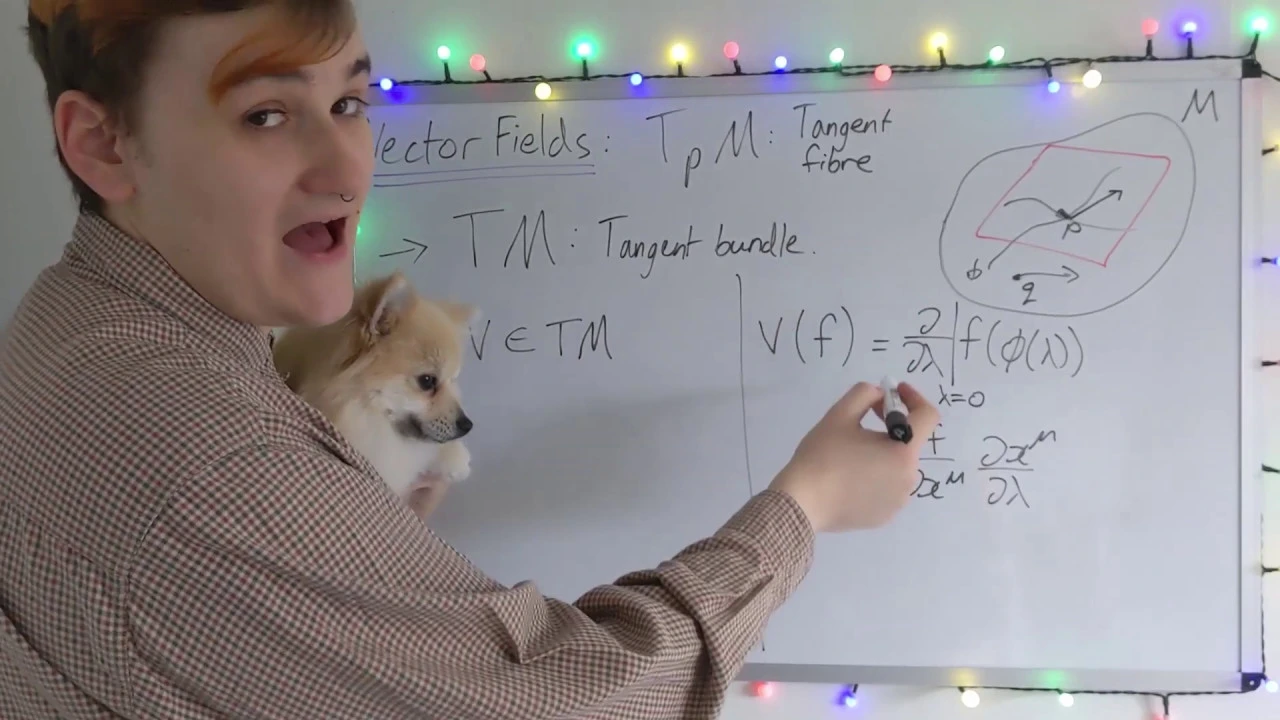
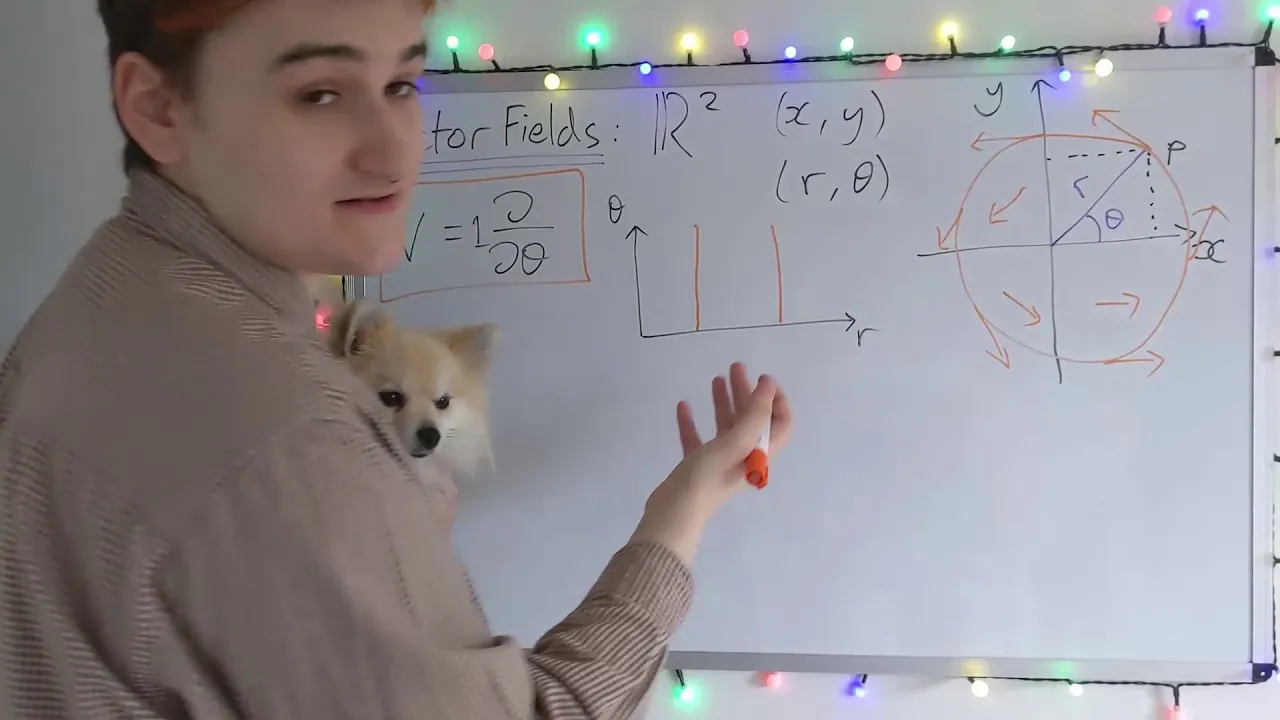
Vector Fields on Manifolds: An understanding of vector fields, critical points (singularities), and the index of a vector field.
Homology and Cohomology Theory: Studying how the Euler characteristic is formally defined in algebraic topology using Betti numbers and chain complexes.
Characteristic Classes: Exploring vector bundles, Chern classes, Stiefel-Whitney classes, and how the Euler class generalizes the Euler characteristic.
The Atiyah-Singer Index Theorem: Understanding this landmark theorem of modern mathematics that unifies differential topology, geometry, and analysis.
Topological Data Analysis (TDA): Applying topological invariants like persistent homology and the Euler characteristic curve to analyze high-dimensional shape data.
448.2K views14.2Klikes22:59Original Release: 2019-09-13
This video is sponsored by Curiosity Stream.
Home to over 2,500 documentaries and nonfiction titles for curious minds.
This here is Euler's identity and is considered by many to be the most beautiful equation in mathematics as it very surprisingly relates e, i, Pi, 1 and 0 altogether.
But when you look up the second most beautiful equation, well, there's really not a specific answer.
However, in one survey when a bunch of mathematicians were asked this question many said that this was their second favorite.
This here is Euler's characteristic.
Well a specific case where it equals 2.
And this says that for any convex polyhedron the vertices minus edges plus faces will always equal 2.
Now the applications of this and really the more general equation actually run deeper than you may think.
But first to just get a visual sense of everything let's first look at the five platonic solids.
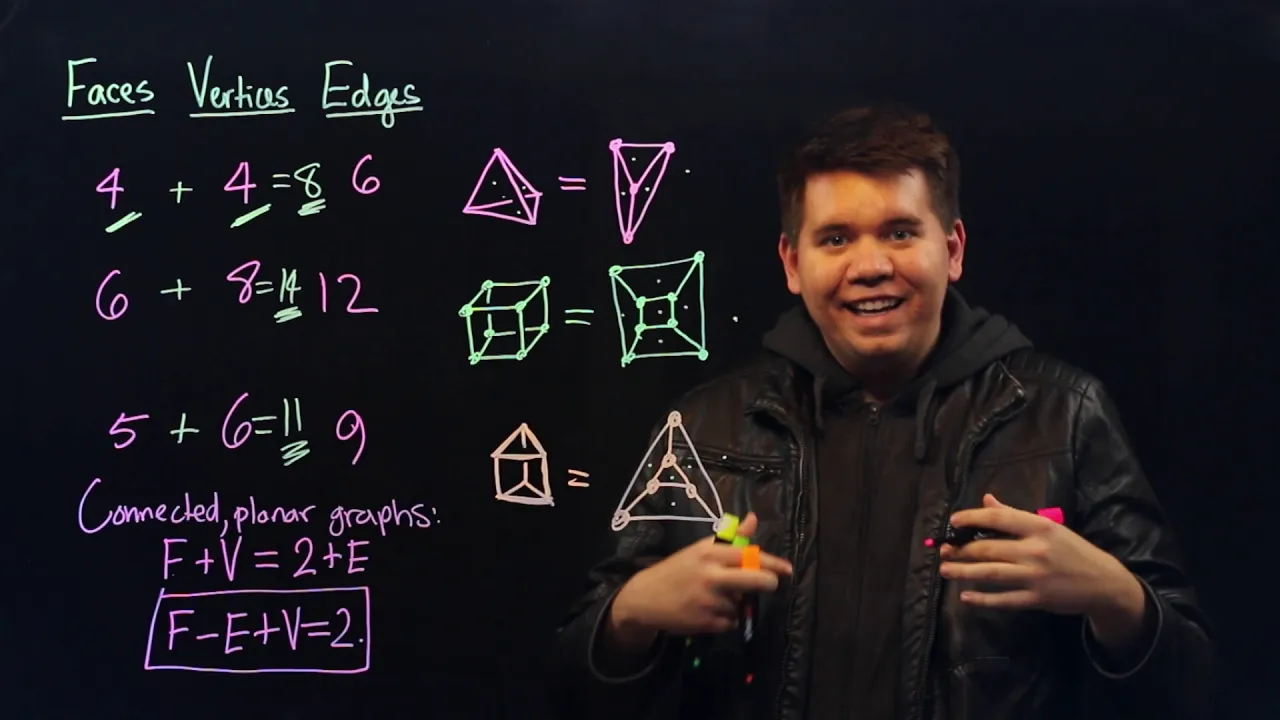
A tetrahedron for example has four vertices or corners, six edges that connect them, and four faces.
For the other shapes, I'll just put those values on the screen and you'll notice that they all differ.
However, when you subtract the edges from the vertices and add the faces everything comes out to 2.
This would be the case for any convex polyhedron.
In fact even for a sphere the Euler's characteristic is 2.
Which a lot of people will comment saying 'What are you talking about? There's just one face. It should be one.'
But consider this.
If we draw great circles around here and then one round here which I'm going to represent with rubber bands you'll notice that there are two points one here and one on the back where the rubber bands intersect so that's like two vertices.
Then the edges would be what connects those.
So one here, one here, two and three and I went along the back four.
So there are four edges. And then there are four faces one here, two, three and four.
So when we apply Euler's characteristic the value comes out to two as expected.
In fact even for a globe with all the longitude and latitude lines if you were to count the vertices edges and faces for the entire thing that implied Euler's characteristic you'd again get two.
And this would always be the case in how you partition the sphere.
So essentially if you allow edges and faces to be curved rather than flat Euler's characteristic holds just like it does for the convex polyhedra.
So the more official rule for this is if you take something with an Euler's characteristic of two and morph it through continuous stretching then the Euler's characteristic will still be two.
As in the Euler's characteristic is preserved under homeomorphisms.
We're not allowed to poke holes or tear the object.
But in general if you can deform one shape into another continuously like they're made of clay then the Euler's characteristic will remain the same.
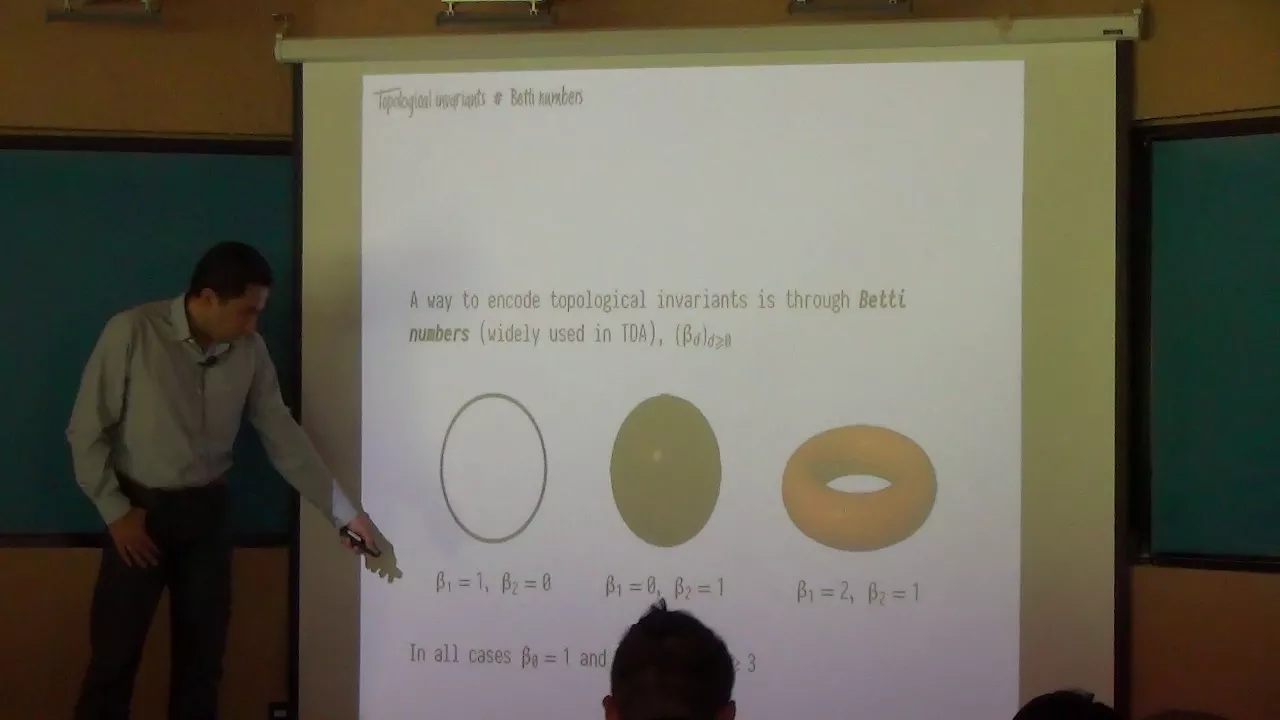
But not every shape has an Euler's characteristic of two like take a doughnut or torus.
This has an Euler's characteristic of zero.
To see why just like with the sphere we can draw circles around the torus in different sections.
There are four points where these all intersect thus four vertices.
There are eight edges that connect them.
And then four faces.
Sorry if that's hard to see but we have two reds on the top and two blues on the bottom.
Then just apply the Euler's characteristic and we get zero.
Another way we can define the Euler's characteristic is to minus twice the number of holes.
The fact that we have an Euler characteristic of zero means I definitely cannot morph a doughnut into a sphere or vice versa.
Because in order to do so, I would have to puncture a hole or fill one in which isn't allowed when dealing with homeomorphisms.
And although Euler's characteristic began with polyhedra it applies to flat surfaces as well.
Here we can see there's two vertices one edge and no faces.
If we had another segment we have three vertices two edges and no faces.
And once we connect two vertices we have three vertices three edges and a face.
So notice that the vertices minus edges plus faces in every case is 1.
However, if we claim that the outer section is also a face like we're writing on a sphere then all these face values go up by one.
And we have the Euler characteristic from before which never changes no matter how many edges we draw assuming no intersections.
Ok, now we're going to move on to the applications.
Pretend for a second instead of a sphere we're living on a giant torus.
And there's a constant wind blowing around the world which we can represent with this vector field.
Ignore the cause of this just realize this would definitely be possible.
And no matter where you are on the surface you're going to feel that wind.
But if you start to close the hole and maintain the wind, we notice something happens once it closes.
We now have a zero vector here a place where there's no wind.
But remember, this is three dimensional since we just closed the hole and a torus as if we're just looking at the top view right now.
But if I just squish this back to a sphere and maintain that vector field this is what we're really looking at.
You'll see that zero vector on top like we just saw.
But now from this view we can see there's another one here on the bottom.
So for the sphere there are two points where there's no wind.
And for the donut that were zero.
And if you remember the donut had an Euler's characteristic of zero, while the sphere was two.
Hmm. I wonder if there's some relationship there.
Well there is but a fact bite is simple.
And that's because these zero vectors come in different flavors.
Like there are some called centers which is what we just saw with the sphere or closed torus.
And the wind kind of spiraling into a zero point.
But there's also saddles sources and sinks.
These aren't the only examples but in general just realized that continuous vector fields can behave differently near their zero vectors.
Now each of these vector fields has an associated index which is not too difficult to find.
To find it for the sink let's say just draw a circle around the zero vector and place a dial somewhere on the circle pointing the direction of a vector at that point.
We're then going to move the dial around the circle just one time counterclockwise while always having a point in the direction of the vector at its location to see what the dial does.
You'll notice that it will do one counterclockwise spin during that time as shown here.
One counterclockwise rotation of that dial corresponds to an index of plus one.
Have the dial spun around two times, then next would be plus two and so on.
Then if we look at the source and again do the same thing with the circle and dial you'll notice the dial will again make a single counterclockwise rotation.
Meaning its index is plus one as well.
And if we go to the center again, we see the same thing with one counterclockwise turn.
So we've only seen indices of +1 so far.
However for the saddle when we do the exact same thing, you'll notice this time the dial will make a single clockwise turn.
And one clockwise turn corresponds to an index of negative one.
So in summary of these four kinds of continuous vector fields with a zero point all but the saddle have an index value of +1.
Now the reason we need to do all this is so we can understand the Poincare-Hopf theorem.
This simply says and yes I'm going to kind of oversimplify that for a continuous vector field with isolated zeroes on a surface that some of those indices we just saw will equal the Euler characteristic of that surface.
So like for the sphere we saw it had two centers one on top and one on bottom which each have an index of one and that sums to the sphere Euler characteristic of two.
This means we could also have a sphere with the source like you see here at the north pole.
Since this is an index of +1 it means there must be at least one other 0 vector somewhere though which there is.
In this case would be the south pole where we find a sink also with an index of +1.
And these add together still come out to 2 as expected.
So we can say that for any sphere with a continuous tangent vector field There must be at least one 0 vector.
Because if there were none then the index values would sum to 0 contradicting the Poincare-Hopf theorem.
This means on earth right now there's at least one spot where there's no wind.
It could be an extreme case like the center of a violent cyclone, but it doesn't have to be.
There's a more official theorem for this and I'm not kidding. It's called the hairy ball theorem.
Yes. That's the thing.
What's cool though is this was the first rigorous proof that mathematicians have a sense of humor.
But really it's just a special case of the Poincare-Hopf theorem.
Instead of referring to win the hairy ball theorem gets its name from the fact that you can't comb the hair over a sphere without getting a cowlick aka a zero vector, where the comb hairs can be considered tangent vectors.
Also, if you do a google search for the theorem you'll find an old reddit post with this picture.
Which isn't even a math related subreddit, but the top comment that does mention the theorem.
Anyway here you see the sculpture created with rocks, which fit together very nicely kind of like a smooth vector field.
But we see an exception had to be made at the pole which is like a zero vector or a cowlick.
This is expected since the sculpture is spherical.
And while this may not exactly reflect the theorem you can see the similarities.
Now going back to that torus from earlier it makes more sense now why there were no zero vectors.
By the Poincare-Hopf theorem the left side will be zero as there are no index values to add.
Which corresponds to the Euler characteristic on the right of zero for the torus.
So everything checks out.
But a torus could have a source and sink like you see here with the source on top and sink on bottom.
Now that was kind of difficult to draw in here, but note that by adding a source and sink we also get two saddles here and here.
And since those each have indices of negative one they cancel out the source and sinks indices, which are both positive one yielding a total value of zero, the Euler characteristic of the torus.
And with that we're now going to slightly shift gears to the topic of curvature.
I've discussed some of this in a previous video in general activity, but there is lot I didn't get to.
For a plane curve the physical intuition of curvature is how much the tangent vector rotates as we move along the curve.
Meaning that this straight line has zero curvature as expected since the tangent vector never has to turn as we move down the segment.
However for this curve the tangent vector does turn between nearby points.
Basically, if you start at some location and move the tangent vector just a little along the curve you'll have to rotate it a little to maintain that tangency.
Thus there's curvature.
We defined this section has positive curvature.
While this section has negative curvature.
Kind of like concavity but more officially if the curve bends in the direction of the normal vector then that's positive curvature and away would be negative.
Now it can be complicated to determine the value of this curvature as we need some couch I'm not going to go into.
However for a circle it's easy.
We just say that the curvature any point is 1 over the radius of that circle.
So when the radius is large we get 1 over a large number which means small curvature.
Which makes sense because if you walk around a very large circle you don't curve as much.
To find the total curvature of a circle you just multiply 1 over R by the circumference which yields 2 pi.
Which will always be true regardless of the size of the circle.
But the cool thing is that when you deform a circle into any non intersecting curve the total curvature remains 2 pi.
And the positive regions will be completely canceled out by the new negative regions maintaining that 2 pi curvature.
This also means that any polygon has a total curvature of 2 pi since we can deform the circle into it.
A polygon is flat along its edges, but carries its curvature at the vertices.
And as most of you guys probably know the external angles of any polygon will add to 360 degrees or 2 pi radians regardless of the number of sides.
So this matches that total curvature we just found.
A visual way to see this is to first realize that an external angle like a here measures how much a car would need to turn if it drove around that corner.
So if a were 60 degrees, then the car would have to turn 60 degrees to go around that corner.
Then for any polygon going around one loop corresponds to a 360 degree rotation as the car will turn 360 degrees or 2 pi radians back to the original configuration.
So that total curvature is kind of like how much the car will turn in total which explains the two pi curvature for shapes homeomorphic to a circle.
Since you always turn through 360 degrees as you go around a single loop.
so what we've seen so far is that total curvature is not determined by geometry and things like angles and lengths.
And actually depends on the topology of the shape.
Since these are homeomorphic to one another they have the same topology and thus that same total curvature.
But where things get more interesting is with surfaces because now we have to do with Gaussian curvature, which I have touched on before.
In that video I mentioned that a flat sheet of paper predictably has zero Gaussian curvature.
The reason for that though is because at any point a straight line segment does not curve at all.
Meaning that has zero curvature.
And the same goes for another perpendicular segment.
Then when you multiply those you get zero, of course, which is the actual Gaussian curvature at that point.
The two individual segments are each the principal curvatures, but for a Gaussian curvature, you're required to multiply them.
So on a sphere at any point a small segment curves outwards a little which we say has positive curvature.
And the same can be said for a perpendicular segment to that.
Thus the sphere has positive Gaussian curvature at any point because it has two positives multiplied.
And for negative curvature I use my shaver because at one point it curved outwards in one direction but inwards when going perpendicular to that.
So you get negative times positive curvature which is negative overall.
And that part brought in a few comments. Four people said 'Why didn't you just use that thing behind you?'
But this doesn't have negative Gaussian curvature.
In fact, although it is curved it has zero Gaussian curvature pretty much everywhere.
And that's because yes right here at this point we could say it is curved, this is negative curvature.
But we got to account for that perpendicular segment.
And as I move perpendicular to that, it's not curving at all.
So this is zero curvature. And zero times anything is zero.
That's why this is zero Gaussian curvature pretty much anywhere.
But the thing I didn't talk about in that last video was the actual value of these of the Gaussian curvature of these surfaces.
So like for a sphere the value of the Gaussian curvature at any point is 1 over the radius squared.
Then to find the total curvature we can integrate over the entire surface or really just multiplied by the surface area which gives us 4 pi again regardless of the size of the sphere.
Ok, so now that we know that what I've done is added a third rubber band to our soccer ball.
And what you'll find is there's now a bunch of geodesic triangles along the surface.
What I mean by that is rule triangles with 3 edges - 1, 2, 3, and 3 vertices.
But those edges run along geodesic curves.
Basically, the fastest route from point A to point B.
Which for a sphere is always part of a great circle or the largest circumference you can draw around the sphere.
Now there are total eight of those geodesic triangles on here four on the top and same on the bottom.
And because we know the total curvature of this is four pi then the total curvature enclosed by each one of those geodesic triangles should be that over eight or pi over two.
Which it is. And I'm gonna keep that number on the screen.
Now if we analyze these triangles just a little mor you'll notice that their angles don't add to 180 degrees.
In fact, if we analyze any angle like this one here, it actually is 90 degrees.
That'll be the case for any one of these angles.
So for any one these triangles, we have 90 plus 90 plus 90, which is 270 degrees.
90 more than a typical triangle on a flat plane.
So we can say there's an excess of 90 degrees or pi over 2 radians.
And that excess in radians matches the total curvature enclosed by that geodesic triangle.
And it turns out this will in fact always be the case.
As in the total curvature enclosed by any geodesic triangle will always equal the angle excess of that triangle.
We just saw for a sphere that has positive curvature.
But for a surface with negative Gaussian curvature, the angles will add to less than 180 degrees.
Which means there's angle deficit that can be thought of as negative angle excess which matches that negative curvature enclosed by the triangle.
And on a flat surface the angles will always add to 180 degrees.
Thus no excess and no Gaussian curvature since again we're on a flat surface.
But where does Euler's characteristic come in to all this?
Well that takes this is something called the Gauss-Bonnet theorem.
To again kind of oversimplify this says that the total curvature of a surface, aka the integral of the Gaussian curvature equals 2 pi times the Euler characteristic of that surface.
This theorem is interesting because it links two branches of math.
Curvature is more of a geometric property that depends on local characteristics like angles or arcs.
and how the shape is bent in space.
While the sum of those is what gives as the total curvature.
But the Euler characteristic has to do with the topology of the object a global property that won't change by those continuous deformations.
So geometry and topology or local and global properties the Gauss-Bonnet theorem links these together in a fairly simplistic way.
So for a sphere that has an Euler characteristic of two the total curvature by the equation above should be that times 2 pi or 4 pi which is exactly what we had just found.
And if we deform the sphere into something else the Euler characteristic and total curvature do not change.
Any new regions that don't curve as much now are balanced out by other regions that curve even more.
This also means that all the platonic solids have a total curvature of 4 pi since they have an Euler characteristic of 2 as well.
These are flat on their faces, but hold all their curvature at the corners.
Now if we look into cube, you'll notice that the angles at any corner add to 270 degrees.
I'm then gonna subtract that from 360 which gives us 90 degrees or pi over 2 radians.
Because this is considered the angle deficit.
Unlike the triangles from before this deficit tells us by how much the angles fail to sum to 360 degrees or two pi radians.
If we multiply that deficit of pi over two at each corner by the eight corners we get 4 pi which is the total curvature of the surface.
For a tetrahedron the angles at any corner add to 180.
Thus the angle deficit is 108 degrees or pi radians.
Then if we multiply that deficit by the four corners we again get 4 pi the total curvature.
This will be the case for the other solids as well.
And I just wanted to really highlight that there's this direct relationship between angle deficit or angle excess and total curvature.
Then if we look back up at the Gauss-Bonnet theorem you'll note that if the Euler characteristic of a surface is 0 like for a torus then the total curvature must be 0 as well.
If we look at a torus this makes perfect sense.
Its outer portion has positive curvature because at any point those principle curvatures both curve outwards.
But inside at some point you'd have one curved inwards while the other curves outwards thus negative Gaussian curvature.
But as you sum everything up the positives and negatives will all cancel giving us a total curvature of zero just like the Gauss-Bonnet theorem says.
The most famous application of curvature probably has to do with general relativity and how our universe is curved.
But again, you can find all that in the video link below.
Now moving on from curvature has a more random example Euler's characteristic can be used to prove pics theorem.
A formula that finds the area of any polygon on a grid of equally spaced points.
Which is only dependent on the number of points along the boundary and on the interior of the polygon.
So the area of this is 15, which you can find by just counting the red and blue dots.
Or another examples Euler's characteristic can be used to prove the five color theorem stating that only five colors are need to cover an entire map such that no two bordering regions have the same color.
Although this was surpassed by the four color theorem, which is just much harder to prove.
Up and Atom did a great detailed video on that which I'll link below if you want to see the actual proof.
And there are so many more examples that I'm just not going to get to due to how long this video already is.
But if you guys enjoyed learning about topology and graph theory and Euler's characteristic then I highly recommend checking out this book Euler's Gem pretty much covers everything I talked about and way more from the history of Euler's characteristic to knot theory to higher dimensions and so on.
So I'll link that below for anyone who's interested.
And then for anyone who's looking to learn about well anything else from science to technology to history and more you can head on over to curiosity stream of the sponsor today's video Curiosity stream is a streaming service that hosts thousands of documentaries and nonfiction titles spanning subjects like I said such as physics in the universe to technology to nature and so on.
If you're like me and love learning about physics in our universe, there's series on amazing gravities when I would definitely recommend.
In these videos you'll see exactly where gravitational waves were first discovered and how space-time doesn't just curve but it Ripple.
You'll learn more about Einstein's general theory of relativity and the consequences that come from the underlying curvature of our universe.
They cover some of the latest theories that are helping us understand the cosmos, groundbreaking experiments and of course plenty more.
The service is available on a variety of platforms worldwide including Roku Android Xbox one Amazon fire Apple TV and more and only comes out to $2.99 per month.
Plus if you go to curiosity stream comm slash major prep or click the link below and use the promo code MajorPre who get your first month membership completely free. So no risk and just giving it a try.
This gives you unlimited access to top documentaries and nonfiction series.
I know many of you will find very interesting.
So again links are below and with that I'm going to end that video there.
If you guys enjoy be sure to like and subscribe.
Don't forget to follow me on Twitter and join the major Facebook group updates on everything.
Hit the bell if you're not being notified and I'll see you all in the next video.
Up Next
60:24
Differentiable Manifolds | General Relativity Lecture 4
@thewe-heraeusinternational2060
102.6K views•2015-02-10
4:43
Elliptic Curve Cryptography Explained: ECC, ECDSA, ECDH
@PracticalNetworking
28.5K views•2024-10-21
14:54
Complex Derivative Intuition: Geometry and Conformal Mapping
@zachstar
221.1K views•2020-11-05
6:00
The Mathematical Impossibility of Accurate World Maps
@Vox
23.3M views•2016-12-02
Related Study Plans & Knowledge Roadmaps
Structured learning paths in Mathematics
mathematics
Tensor Calculus: Vectors to Riemann Curvature
01Mathematical Foundations: Linear Algebra & Calculus
02Covectors, Dual Spaces, and Tensor Basics
03The Metric Tensor and Index Gymnastics
+ 2 more learning modules
40h5 modules
Explore Roadmap
mathematics
Gödel's Incompleteness: Logic, Proofs & Limits
01Introduction to Formal Systems & Hilbert's Dream
02Set Theory, Cardinality, and Cantor's Diagonal Argument
03Arithmetization and Gödel Numbering
+ 2 more learning modules
14h5 modules
Explore Roadmap
mathematics
Galois Theory: Fields, Groups & Solvability
01Foundations of Abstract Algebra: Groups & Fields
02Polynomials & Field Extensions
03Splitting Fields & Symmetries
+ 2 more learning modules
24h5 modules
Explore Roadmap
mathematics
Non-Euclidean Geometry: Models & Geodesics
01Euclid's Fifth Postulate and the Birth of New Geometries
02Hyperbolic Space and the Poincaré Disk Model
03Geodesics: Defining Straight Lines in Curved Spaces
+ 2 more learning modules
15h5 modules
Explore Roadmap