


![[직장인과 문과생을 위한 수학교실 4기] 31. 가우스 곡률과 가우스의 위대한 정리](https://i.ytimg.com/vi/vG9wfiKYbws/maxresdefault.jpg)










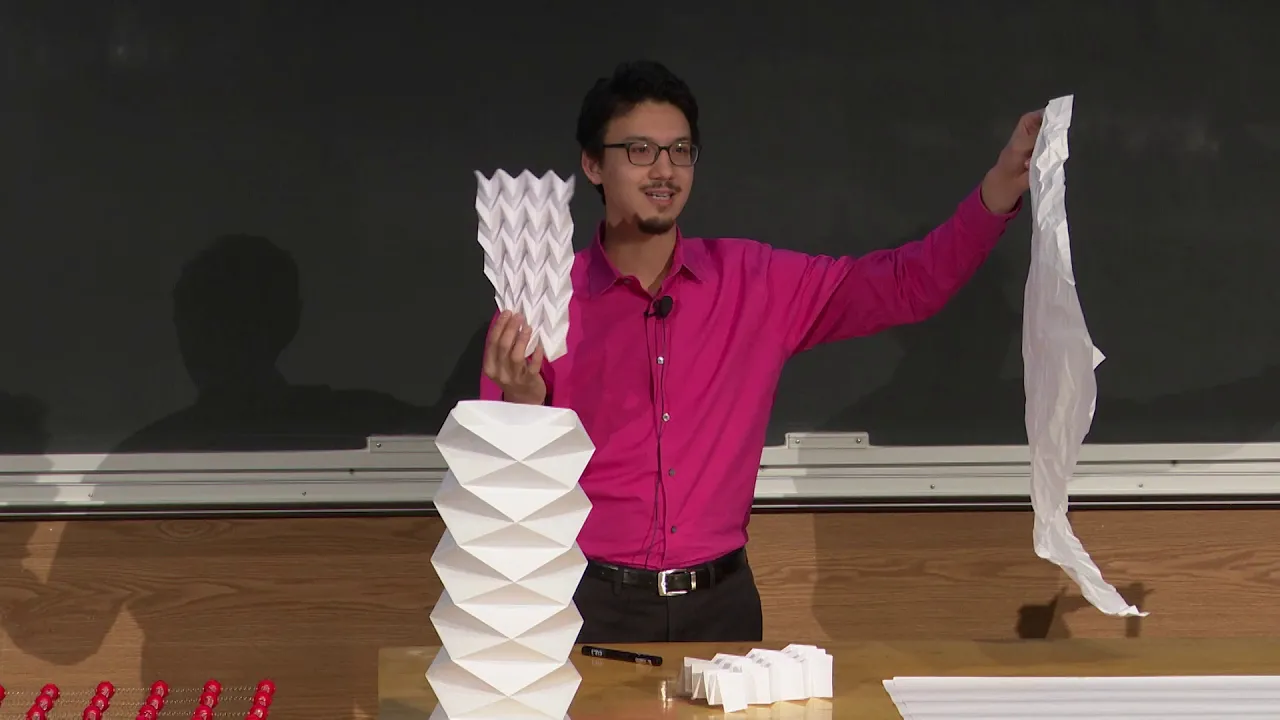



Gaussian curvature, an intrinsic property of surfaces discovered by Gauss, explains why we eat pizza by folding it: when a flat pizza is curved along one axis (creating negative curvature), the perpendicular axis must remain flat (zero curvature) to conserve the total Gaussian curvature, preventing the pizza from flopping over.
Understanding Gaussian Curvature Through Pizza: A Mathematical Insight
Added:Basic concepts of differential calculus applied to curves and surfaces, including tangent planes and normal vectors.
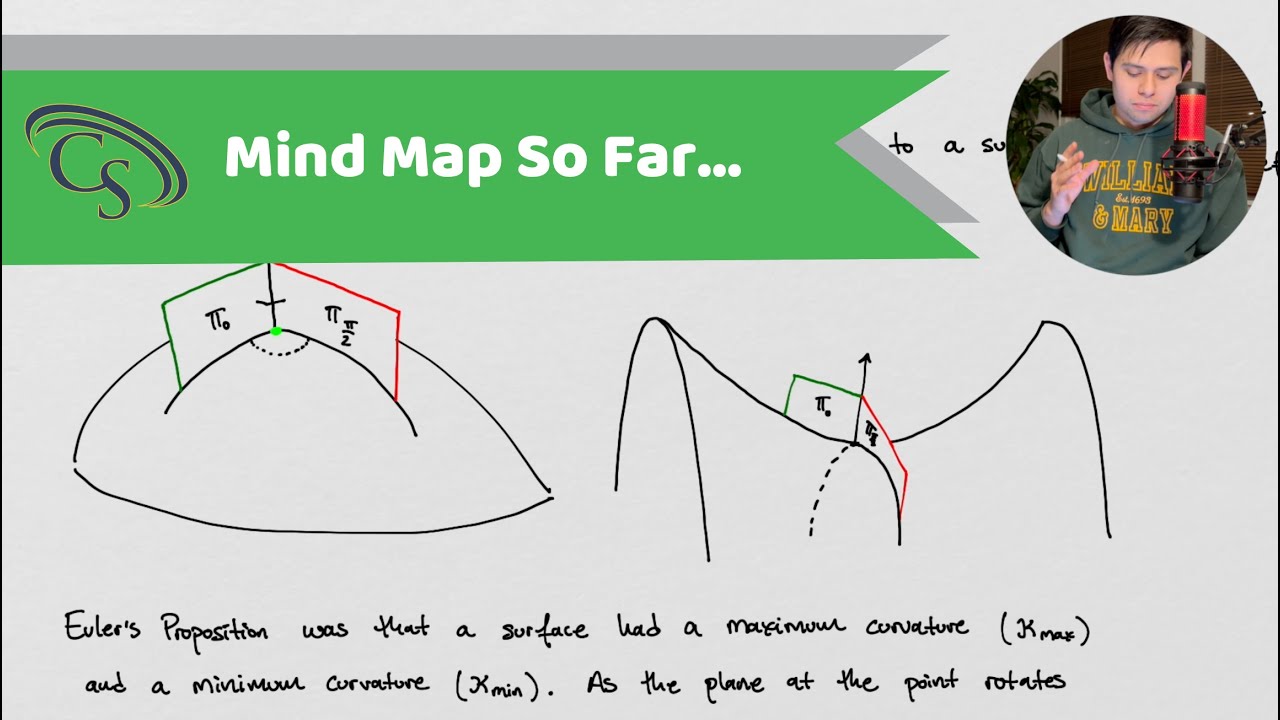
The definition of principal curvatures, which describe the maximum and minimum bending of a surface at a given point.
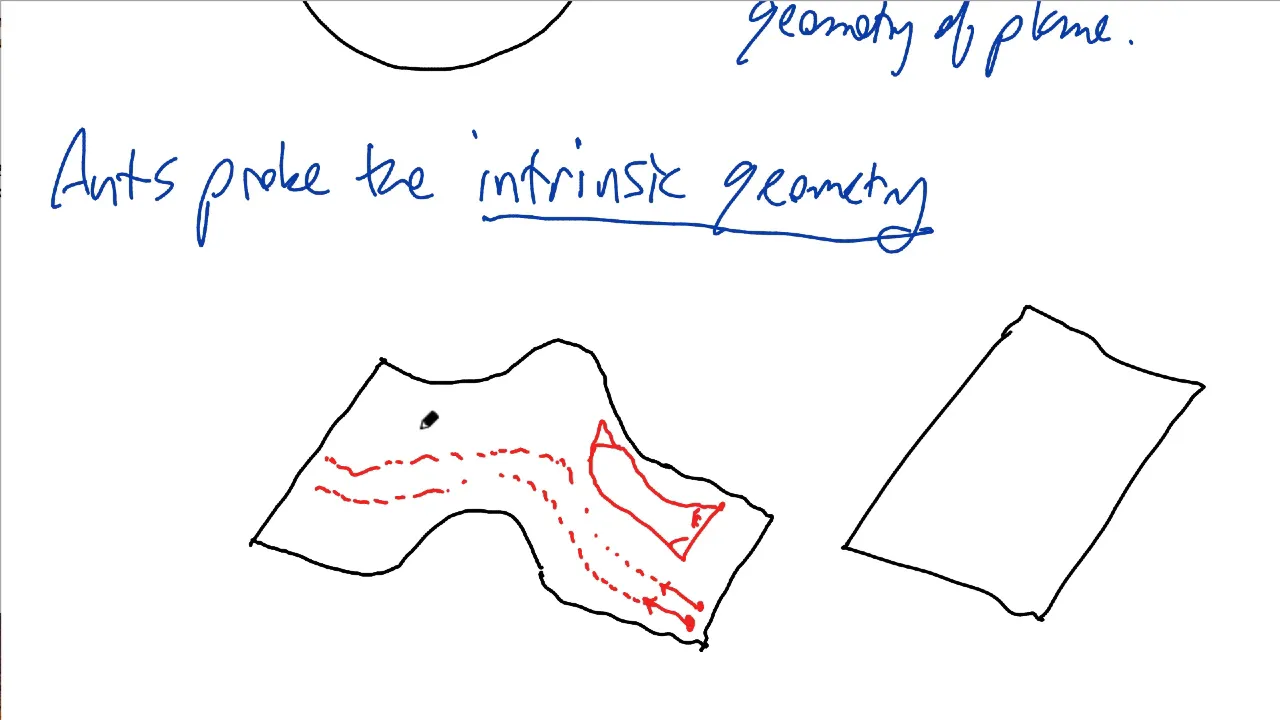
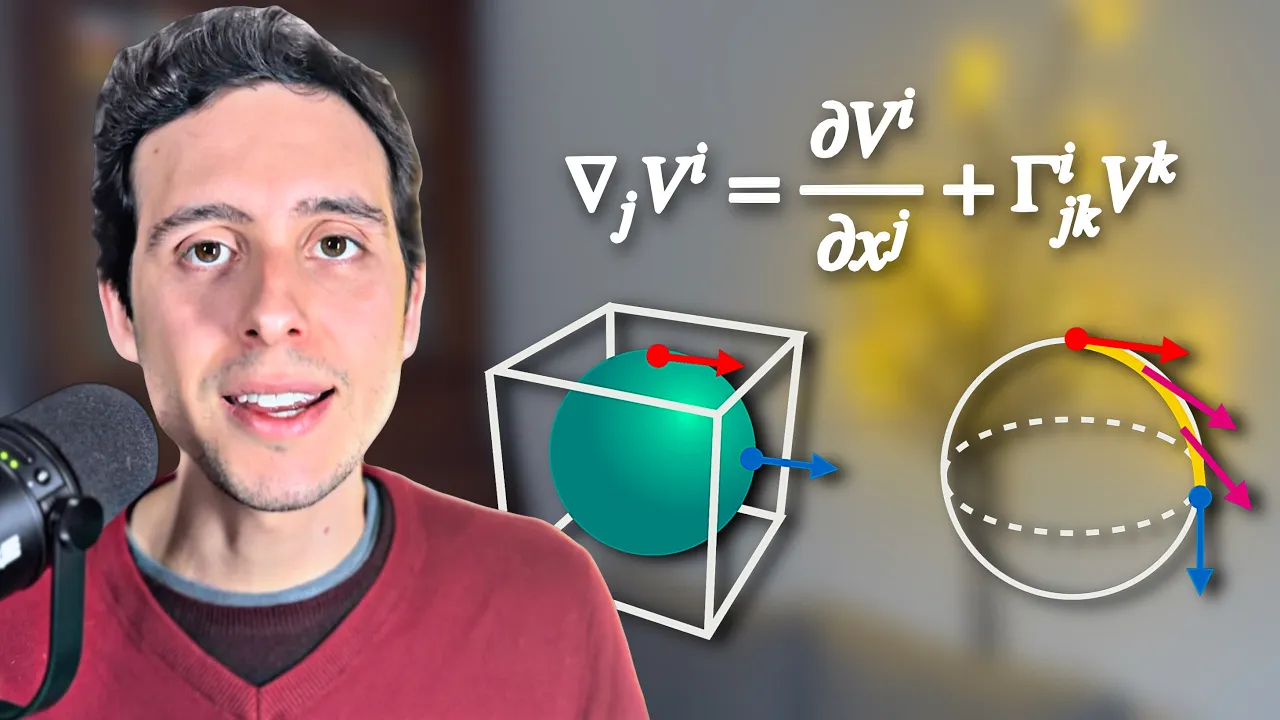
The conceptual difference between intrinsic geometry (properties measurable within the surface) and extrinsic geometry (properties dependent on the surrounding space).
The mathematical definition of Gaussian curvature as the product of the two principal curvatures.
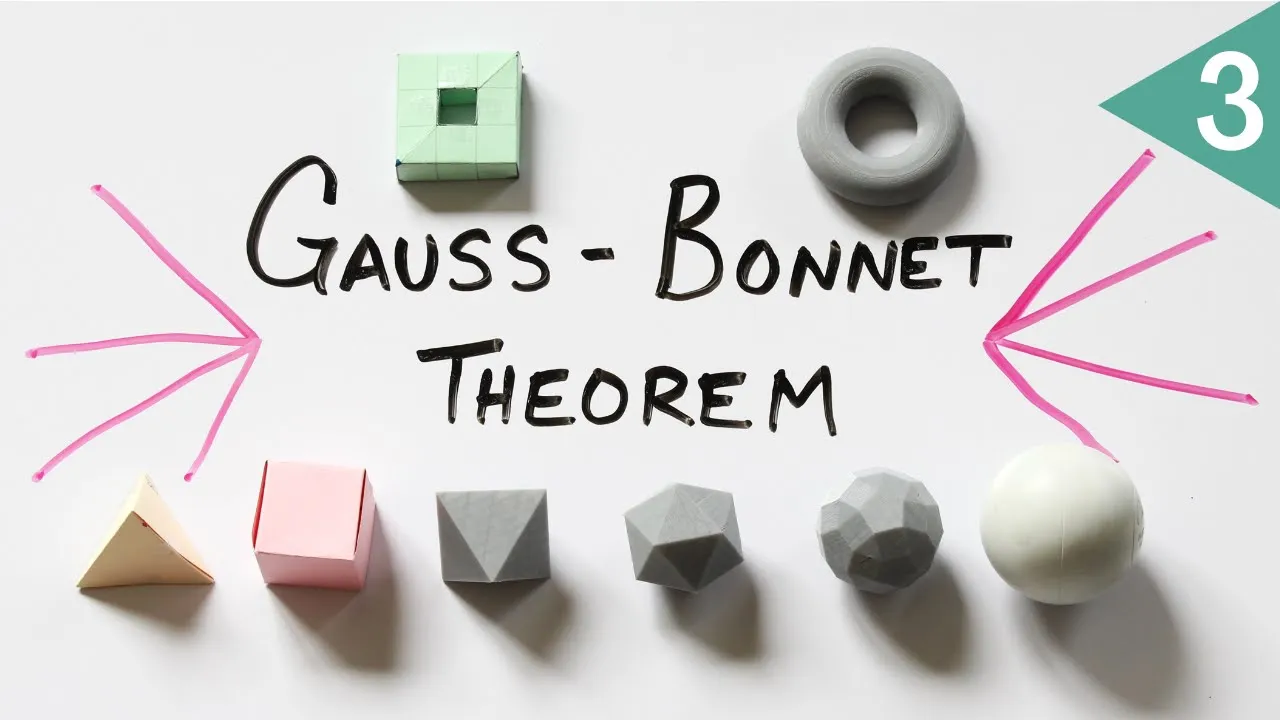
The Gauss-Bonnet Theorem, which establishes a fundamental link between the local curvature of a surface and its global topology.
The study of developable surfaces and their structural engineering applications, such as in architecture, sheet metal fabrication, and packaging design.
Advanced topics in Riemannian Geometry, which extends these curvature concepts to higher-dimensional manifolds.
The physics of thin-shell mechanics and elasticity, exploring how materials resist bending versus stretching.
1.5M views46.4Klikes7:42Original Release: 2016-06-16
CLIFF STONE: So, how come we eat pizza the way we do?
You know, as well as I do: If I just hold it like this, it flops over.
You know, as well as I do, that if I curl it like this: I can eat.
So, why do we eat pizza like this?
Gauss.
Gauss tells us why.
What does Gauss has to do with it?
Gauss came up with this absolutely nifty theorem called the Theorema Egregium.
Also, in English, called the Remarkable Theorem.
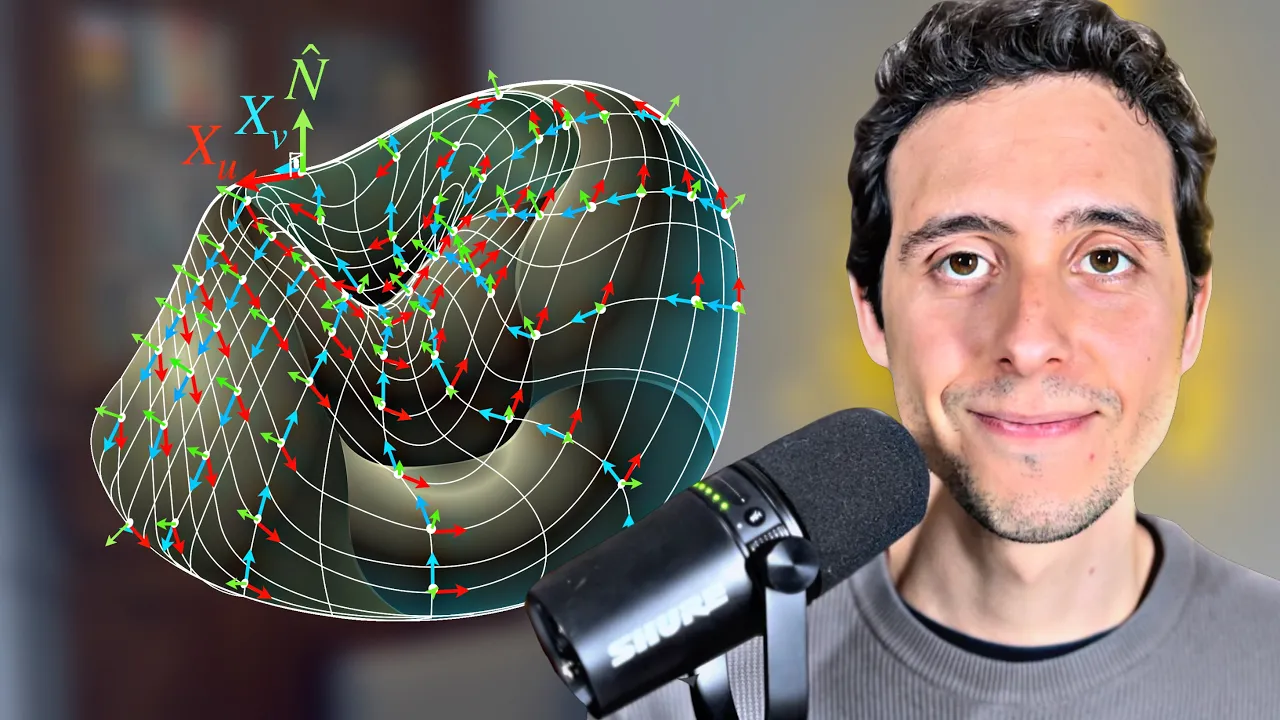
Curvature is an intrinsic property of surfaces.
Curvature? We all kind of know a curve is. What's curvature?
This piece of paper has no curvature at all. Right?
It's flat going this way, flat going this way. We'll come back to that.
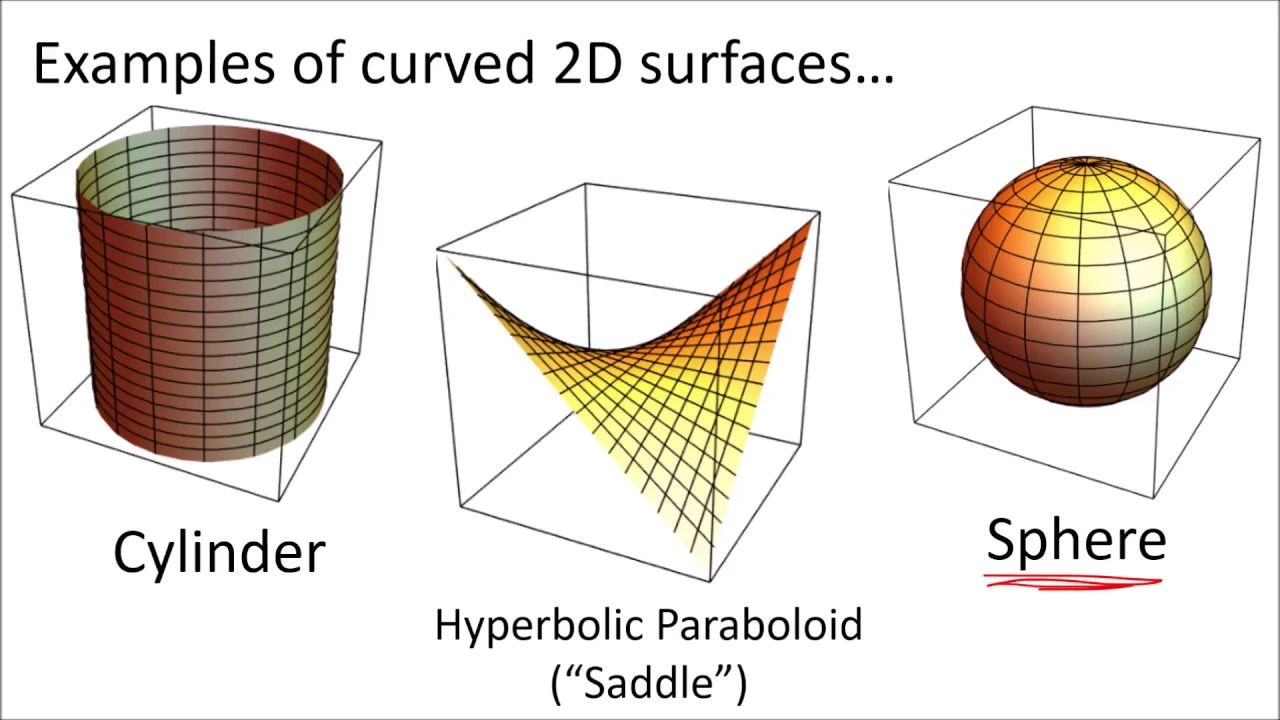
What about a sphere? A sphere clearly has curvature going outward this way, and an outward going curvature this way. If both curves are outward, Gauss says: multiply them together This is positive, this is positive. Positive multiplied by positive means Oh, this has a positive curvature!
So this is a positive curvature right here. Everywhere on a sphere it's positive curvature.
What about a banana? For a banana I see along here, along here, it's curving out. Along this way its curving out, so this is positive curvature. But watch this, watch this!
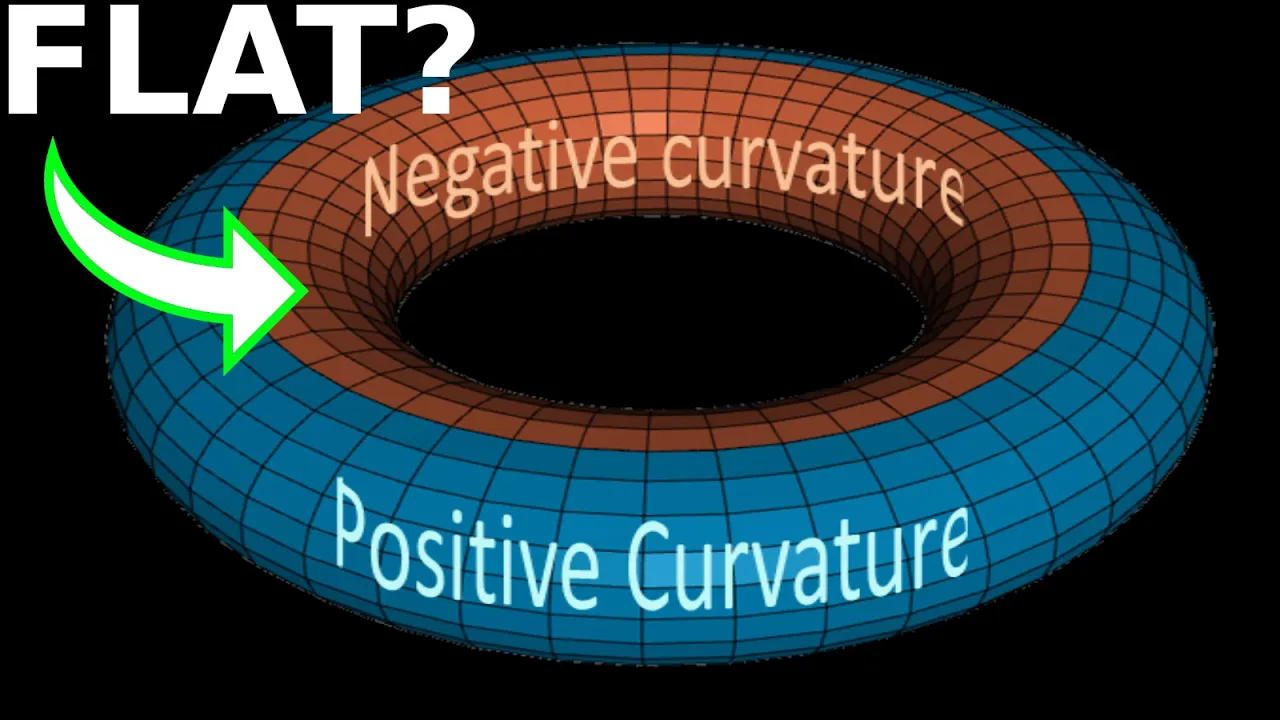
Over here, oh, it's curving outward along here, we remember that. But along here it's curving inward. So this one is a negative Gaussian curvature, this one is a positive. A positive times a negative means that at this point I have a negative curvature. So, someplace, along a line here, along a line here the curvature of a banana changes from being positive Gaussian curvature to negative Gaussian curvature. For a torus, along here, it's curving outward, that's cool. Along this way it's curving outward outward Outward times outward is positive. So, that's positive.
But over on the inside, over here, it's curving outward there, but inward here!
So this means this is negative curvature.
So it's negative curvature around here, Positive curvature, so some place around this line in a torus, and along some place around here It goes from negative gaussian curvature to positive. That makes sense to me.
What Gauss said in his remarkable theorem: This curvature is intrinsic to the surface.
So, if I have something that starts out with a certain integrated Gaussian total curvature then, no matter how I stretch it and turn it around and move it, it's going to stay the same.
I know that this piece of paper starts out flat.
If I bend it... I'll draw a line here.
I'll bend it sort of along that line.
Ok, along there, in this direction there's negative curvature.
But along here, So it's minus, going along there, but this has still zero curvature.
So, it's a straight line, it's a straight line going that way.
But going this way, it's negative curvature.
Flipping on the other side... Look over here! I still have no curvature in that line.
And a positive curvature over here.
Well what's the Gaussian curvature right at this point, right here?
It's some positive number times zero.
Ah! Gauss tells us that Gaussian curvature, the multiplication of this direction curvature and this direction curvature is intrinsic to the surface.
That means that if I bend it this way and I get positive curvature at this point, since the surface started out with no curvature, flat, no curvature at all, then if I add positive curvature here, I'd better multiply that by something that has zero curvature, which is a straight line.
So, if I have curvature in this direction I'd better have no curvature there.
What about a pizza?
Come here, Brady! Come, come here!
If I have a flat pizza and I lift it up like this it's going to bend down! If it bends this way, then... Oh! The Gaussian curvature is positive here but I have zero going this way.
But I can take advantage of that by saying: I will make this have no curvature along here and negative Gaussian curvature, negative curvature there, so at each of these points, the curvature stays the same.
If it tries to flop this way while I'm curving it this way, the pizza would be violating Gauss's remarkable theorem.
Pizzas don't like to do that.
BRADY HARAN: We'd like to thank the Great Courses Plus for supporting this episode.
Now this is a collection bursting with over seven thousand different video lessons and courses that you can stream onto your computer, your laptop, your phone, your tablet, all the usual devices.
These videos are good fun but they're also really in-depth and they cover all sorts of subjects from literature, history... I've been watching some about chess lately, and of course I've got plenty about mathematics.
There are loads of examples I could give. Just one that I think is really good is all about the mathematics of games and puzzles.
This is a whole bunch of videos and lessons covering all sorts of things from casino games, blackjack, sudokus, you name it.
And really going into depth about the mathematics underlying these games. I think numberphiles will really love it.
No tests, no homework, just really interesting lessons from these world-class professors.
Now the Great Courses Plus is offering you a free one month trial of their service: access to all these videos free of charge. And if it seems like your thing you can continue from as low as $14.99 a month.
If you'd like to give that free trial a go, go to thegreatcoursesplus.com/numberphile.
It's on the screen, there's also a link in the description you can click on.
thegreatcoursesplus.com/numberphile Free one month trial. Make sure you use the links so they know you came from this episode. And our thanks to them for supporting us!
CLIFF STONE: In other words, the reason why there is a correct way to eat pizza and this won't flop over is that if that flopped over like this, I would be forcing a point right here to change its Gaussian curvature.
Not just an intrinsic part of a piece of paper, but an intrinsic part of a piece of pizza.
Up Next
29:33
First Fundamental Form: Surface Geometry Basics
@curvesandsurfaces6865
11.4K views•2016-08-01
4:43
Elliptic Curve Cryptography Explained: ECC, ECDSA, ECDH
@PracticalNetworking
28.5K views•2024-10-21
11:51
The Mathematics Behind the Enigma Machine | Numberphile
@numberphile
6.6M views•2013-01-10
6:00
The Mathematical Impossibility of Accurate World Maps
@Vox
23.3M views•2016-12-02
Related Study Plans & Knowledge Roadmaps
Structured learning paths in Mathematics
mathematics
Tensor Calculus: Vectors to Riemann Curvature
01Mathematical Foundations: Linear Algebra & Calculus
02Covectors, Dual Spaces, and Tensor Basics
03The Metric Tensor and Index Gymnastics
+ 2 more learning modules
40h5 modules
Explore Roadmap
mathematics
Gödel's Incompleteness: Logic, Proofs & Limits
01Introduction to Formal Systems & Hilbert's Dream
02Set Theory, Cardinality, and Cantor's Diagonal Argument
03Arithmetization and Gödel Numbering
+ 2 more learning modules
14h5 modules
Explore Roadmap
mathematics
Galois Theory: Fields, Groups & Solvability
01Foundations of Abstract Algebra: Groups & Fields
02Polynomials & Field Extensions
03Splitting Fields & Symmetries
+ 2 more learning modules
24h5 modules
Explore Roadmap
mathematics
Non-Euclidean Geometry: Models & Geodesics
01Euclid's Fifth Postulate and the Birth of New Geometries
02Hyperbolic Space and the Poincaré Disk Model
03Geodesics: Defining Straight Lines in Curved Spaces
+ 2 more learning modules
15h5 modules
Explore Roadmap