











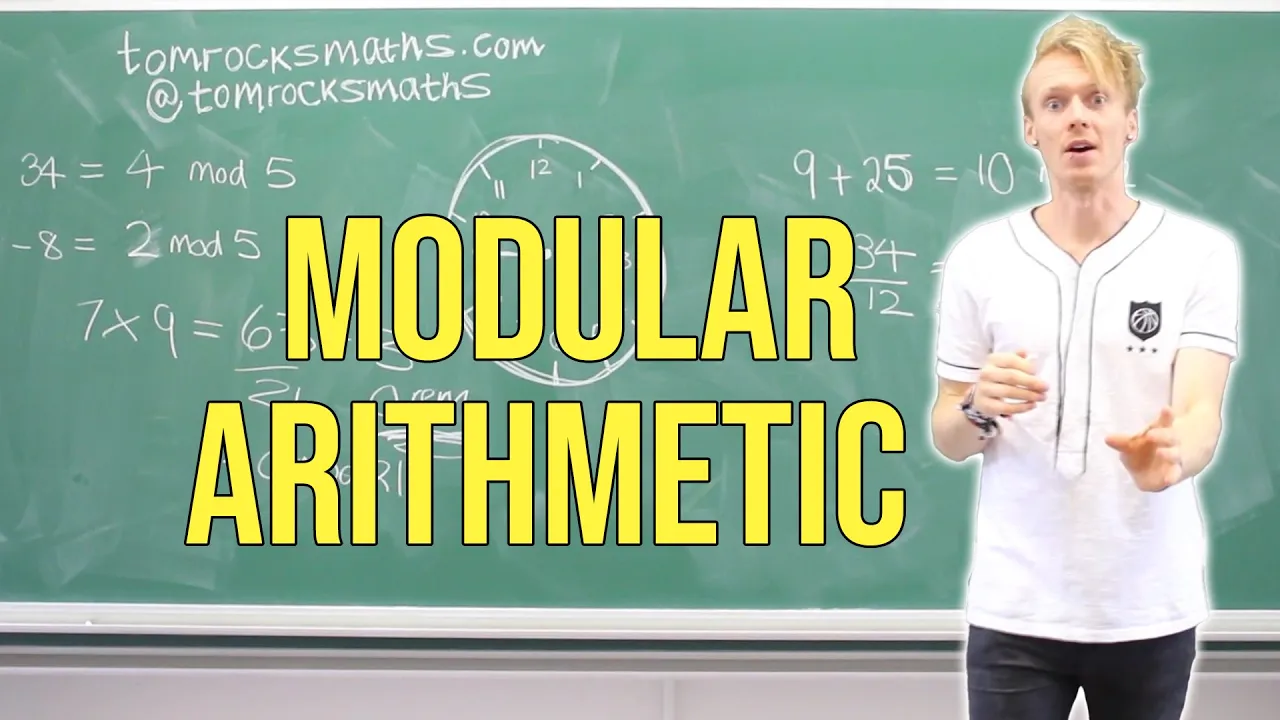
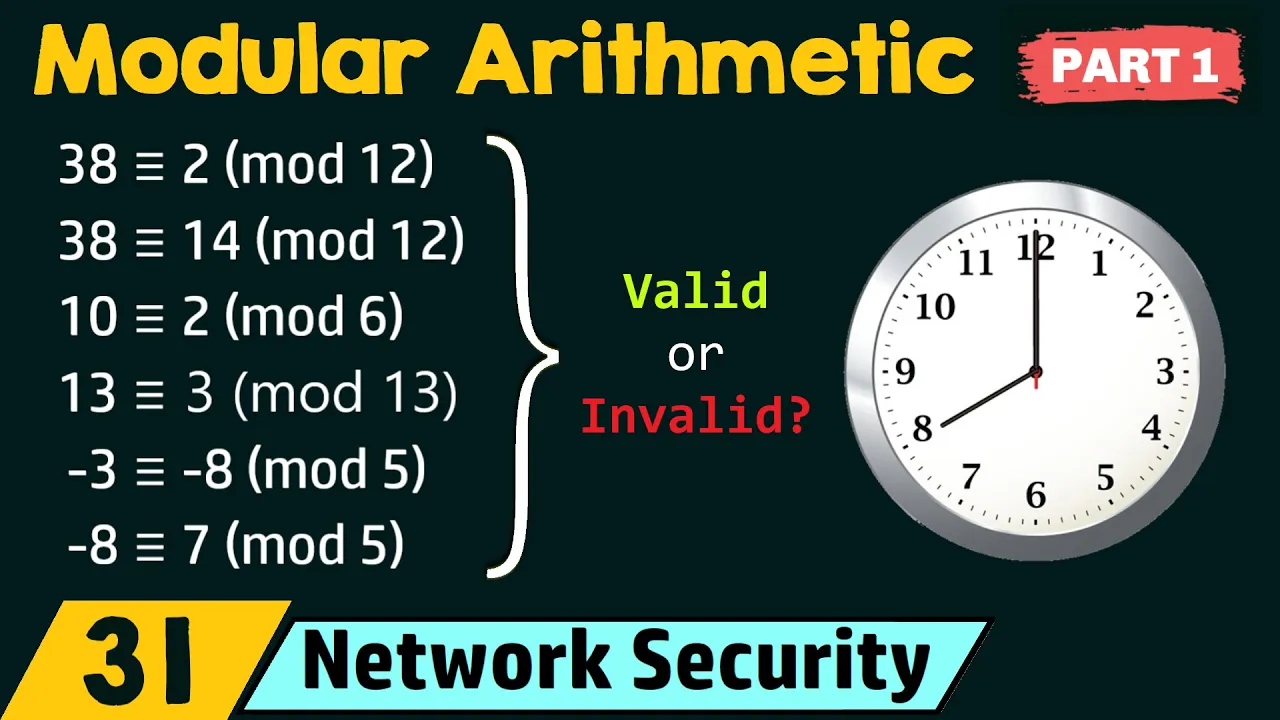
![[Discrete Mathematics] Modular Arithmetic](https://i.ytimg.com/vi_webp/d-n92Ml1iu0/maxresdefault.webp)



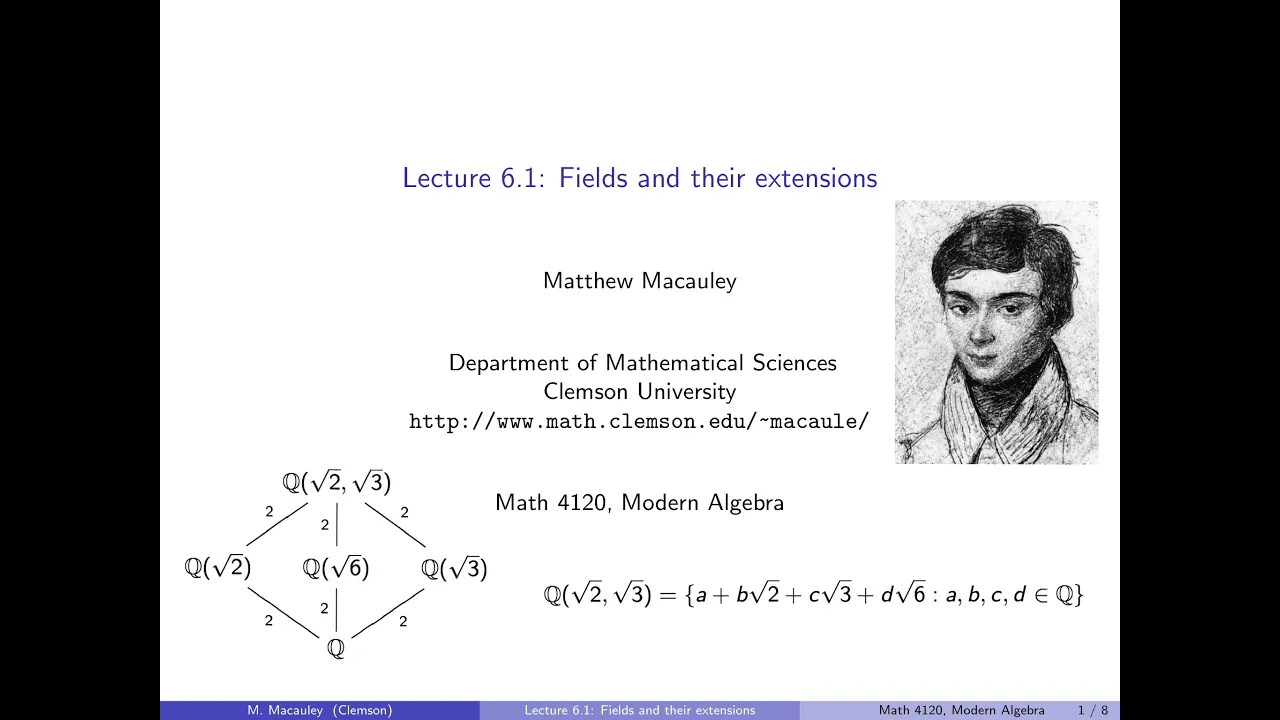







A field is a set equipped with two operations (addition and multiplication) where the elements form a commutative group under addition, the non-zero elements form a commutative group under multiplication, and the operations satisfy the distributive property; examples include the rational numbers (an infinite field) and the integers mod p for any prime p (finite prime fields), and every field contains exactly one prime field as a subfield, with its characteristic indicating which prime field it extends (characteristic 0 for extensions of Q, characteristic p for extensions of Z/pZ).
Field Definition Expanded: Key Object in Abstract Algebra Explained
Added:Basic Set Theory and Binary Operations: Understanding sets, relations, and how operations combine elements within a set.
Group Theory: Familiarity with the definition of a group, abelian groups, and fundamental group properties.
Ring Theory: Understanding rings, commutative rings, integral domains, and the concept of multiplicative identity and inverses.
Modular Arithmetic: Conceptual understanding of arithmetic modulo n, which provides essential examples of finite algebraic structures.
Vector Spaces: Exploring how vector spaces are formally defined over arbitrary fields, which is the foundation of advanced linear algebra.
Field Extensions: Studying how a field can be contained within a larger field, such as extending the rational numbers to the real numbers.
Galois Theory: Investigating the algebraic connections between field extensions and group theory, famously used to prove the insolvability of quintic equations.
Finite Fields and Cryptography: Learning about algebraic structures with a finite number of elements and their critical applications in coding theory and network security.
405.7K views14.2Klikes8:05Original Release: 2018-07-13
In abstract algebra, there is a wide variety of operations: geometric transformations, function composition, matrix multiplication… But many sets of elements have the familiar operations from arithmetic: addition, subtraction, multiplication and division. Loosely speaking, if you can add and subtract, you have a group. If you can add, subtract and multiply, you have a ring. But if you’re lucky and get all four operations, the result is an object that behaves similarly to the numbers you learned about in arithmetic and algebra. We call these fields.
One thing we’ve talked about before, but it bears repeating, is that in abstract algebra, subtraction is actually adding with negatives. For example, “3 minus 5” is the same as 3 plus “negative 5.” So instead of saying “you can add and subtract”, we say “there’s addition and additive inverses.” Notice that word “additive?” That’s because there is more than one kind of inverse.
For example, “3 DIVIDED by 5” is the same as 3 times 1/5.
So instead of saying “you can multiply and divide”, in abstract algebra we say “there’s multiplication and multiplicative inverses.” The additive inverse of 5 is negative 5.
The multiplicative inverse of 5 is 1/5.
So in arithmetic, you learn about addition, subtraction, multiplication and division.
But in abstract algebra, you speak of addition, additive inverses, multiplication, and multiplicative inverses. It’s a shift in thinking, but it’s key to understanding the more abstract objects.
We’re now ready to talk about fields. To motivate the definition, we’ll start with a collection of 6 groups, some of which come with additional features. By adding features we’re familiar with from the real and complex numbers, we’ll arrive at the full definition of a field.
Consider these 6 sets: The integers The 2-by-3 real matrices The 2-by-2 real matrices The rational numbers The integers mod 5, and The integers mod 6. Notice that all 6 sets are groups under addition: They’re closed under addition: you can add two elements together and the sum is in the set. The negative of each element is in the set.
There’s an additive identity, and the associative property holds.
Better still, all 6 groups are COMMUTATIVE under addition.
So as a first pass, all 6 objects are commutative groups under addition.
The next feature we’d like to include is multiplication.
You can multiply any two integers or rational numbers together.
You can also multiply any two numbers mod N for any N.
That leaves the two sets of matrices. You can multiply two square matrices, but you cannot multiply 2-by-3 matrices by each other.
Their dimensions are incompatible for multiplication. So only 5 of the 6 sets advance to the next round of commutative groups with multiplication.
Just as all the groups are commutative under addition, in a field, we’d like multiplication to be commutative as well. After all, the real and complex numbers are both commutative, and they are a pleasure to work with.
The integers and rational numbers are both commutative under multiplication, so they advance. Also, the integers mod N are commutative under multiplication for any N. But we’re about to lose another candidate.
The 2-by-2 matrices are NOT commutative under multiplication.
There are an infinite number of examples where matrix multiplication is not commutative.
Here’s one example... So only 4 of the 6 are commutative under multiplication.
Next, we’d like each number to have a multiplicative inverse.
The additive inverse 0 is the big exception here.
You cannot divide by 0, so this number cannot have a multiplicative inverse.
But we’d like every NON-ZERO number to have a multiplicative inverse.
Sadly, we’re about to lose two more sets. In the set of integers, only 1 and -1 have multiplicative inverses. None of the other integers have one.
For example, the inverse of 2 under multiplication is ½, which is not an integer.
And we lose the integers mod 6 as well. 2, 3 and 4 do not have inverses mod 6.
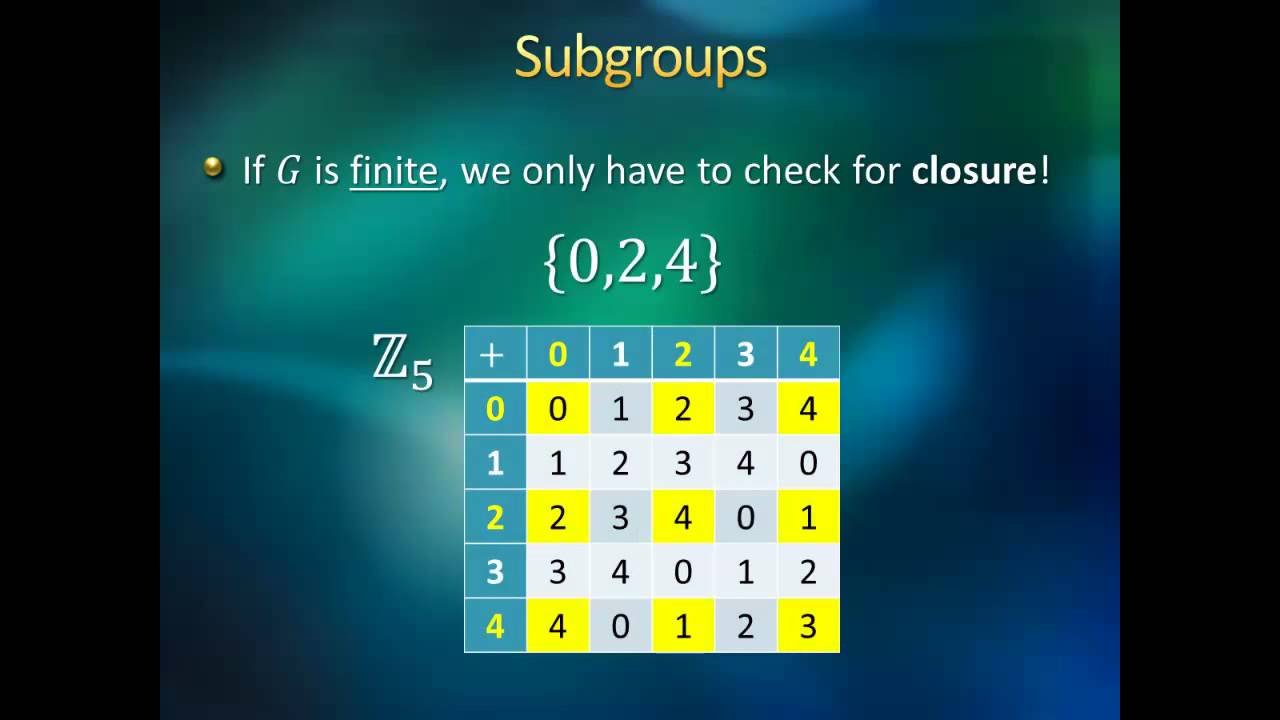
Mod 5, however, is different. Here, every non-zero number has a multiplicative inverse. You can check this by looking at the multiplication table for this set. So the only two sets to advance are the rational numbers and the integers mod 5. By the way, these two sets both have a multiplicative identity 1. This is not a surprise, since the product of a number and its multiplicative inverse is 1... The race is over, and we have two winners. The rational numbers and the integers mod 5. These both share a similar set of properties. They are both commutative groups under addition.
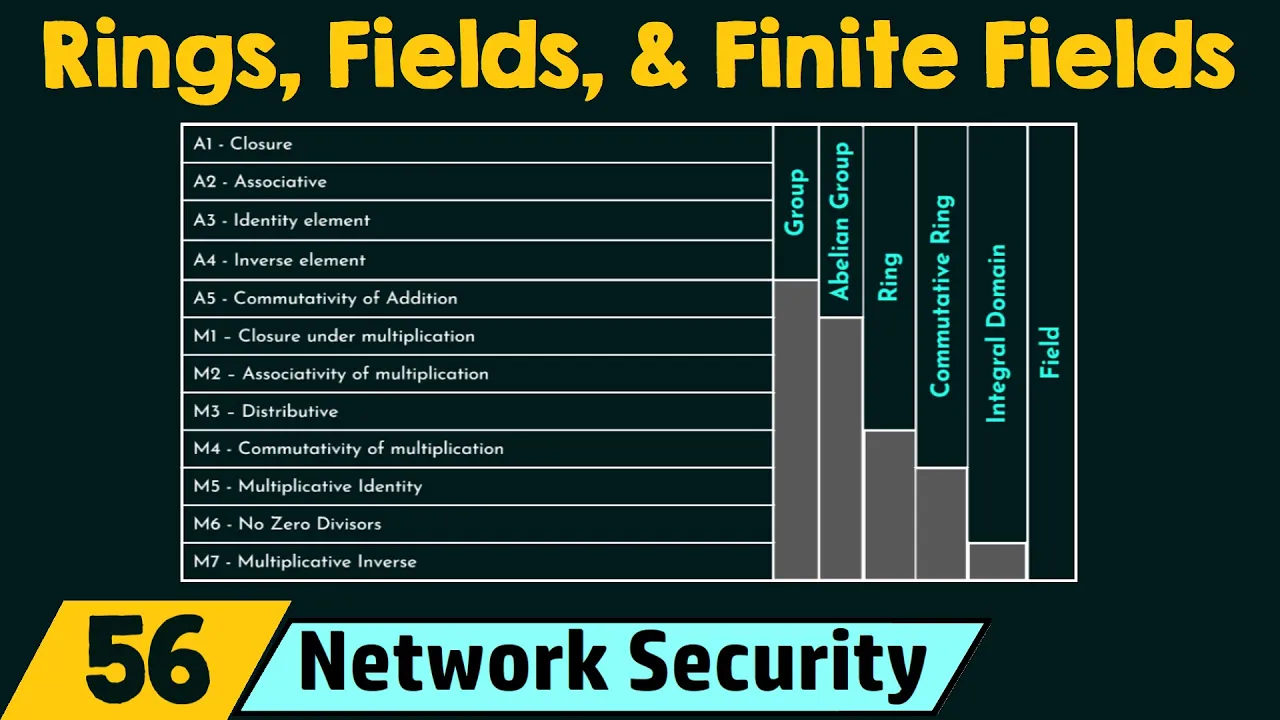
They both have a second operation - multiplication, which makes them rings. Furthermore, multiplication is commutative, so they are commutative rings. Better still, other than zero, every number has a multiplicative inverse. It’s this last property which puts them over the top and turns them into fields. We’re now ready for the textbook definition of a field.
A field is a set of elements “F” with two operations: addition and multiplication.
Under addition, the elements are a commutative group. Under multiplication, the non-zero elements are a commutative group. And addition and multiplication are linked by the distributive property. This is the compact definition of a field. If you wanted, you could define a field and make no mention of groups whatsoever. You could just give a complete list of all the properties a field must satisfy. This is fine, but you do lose sight of the fact that a field is actually two groups with two operations at the same time.
Let’s return to the two examples of a field we just saw: the rational numbers and the integers mod 5. The rational numbers are denoted by “Q” for “quotient”, since every number in this field is the quotient of two integers.
The rationals are an infinite field, while the integers mod 5 are a finite field.
But the integers mod 5 are not the only finite field.
In fact, the integers mod “P” for ANY prime number “P” is also a field.
Together, these form the starting points for ALL fields.
That is, if you pick ANY field “F”, then it will contain one and only one of these fields as a subfield. We call these fields “prime fields”, and say that “F” is an extension field. If “F” is an extension of the integers mod 2, we say it has “characteristic 2.” If it’s an extension of the integers mod 3, it has “characteristic 3.” And if it’s an extension of the integers mod P, we say “F” has “characteristic P.” But if F is an extension of the rational numbers, we say it has “characteristic 0.” So the characteristic of a field tells us which prime field it extends.
The are an infinite number of fields in mathematics. We begin by learning about the “big 3”: the rational numbers, the real numbers and the complex numbers. But there’s an infinite number of infinite fields, and even an infinite number of FINITE fields! From finite fields to Galois extension fields, you’ll find many uses for this structure.
Thank you for watching Socratica. We’re a small team, making beautiful, high-quality, CHALLENGING math and science videos. We put our heart and soul and ALL of our own money into making these videos for you. I’ll be honest with you - it’s not easy sometimes.
We’d love to make more videos, faster, but our resources are limited. If you find our videos helpful - if you value what we do, please consider becoming our Patron on Patreon.
Even the smallest donation goes a long way. Thank you.
Up Next

2:05
Minimal Polynomial of 2 - Cube Root of 5 over Q
@AdamGlesser
13K views•2019-02-20
4:43
Elliptic Curve Cryptography Explained: ECC, ECDSA, ECDH
@PracticalNetworking
28.5K views•2024-10-21
12:26
Congruences and Modular Arithmetic in Number Theory
@Socratica
36.7K views•2024-02-06

6:00
The Mathematical Impossibility of Accurate World Maps
@Vox
23.3M views•2016-12-02
Related Study Plans & Knowledge Roadmaps
Structured learning paths in Mathematics
mathematics
Tensor Calculus: Vectors to Riemann Curvature
01Mathematical Foundations: Linear Algebra & Calculus
02Covectors, Dual Spaces, and Tensor Basics
03The Metric Tensor and Index Gymnastics
+ 2 more learning modules
40h5 modules
Explore Roadmap
mathematics
Gödel's Incompleteness: Logic, Proofs & Limits
01Introduction to Formal Systems & Hilbert's Dream
02Set Theory, Cardinality, and Cantor's Diagonal Argument
03Arithmetization and Gödel Numbering
+ 2 more learning modules
14h5 modules
Explore Roadmap
mathematics
Galois Theory: Fields, Groups & Solvability
01Foundations of Abstract Algebra: Groups & Fields
02Polynomials & Field Extensions
03Splitting Fields & Symmetries
+ 2 more learning modules
24h5 modules
Explore Roadmap
mathematics
Non-Euclidean Geometry: Models & Geodesics
01Euclid's Fifth Postulate and the Birth of New Geometries
02Hyperbolic Space and the Poincaré Disk Model
03Geodesics: Defining Straight Lines in Curved Spaces
+ 2 more learning modules
15h5 modules
Explore Roadmap