















A finite group is solvable if it has a composition series with all cyclic composition factors (which must be of prime order), and this property characterizes whether a polynomial equation can be solved by radicals; specifically, a polynomial is solvable by radicals if and only if its Galois group is a solvable group, which explains why the general quintic equation cannot be solved by radicals since its Galois group S₅ contains the non-solvable alternating group A₅ as a composition factor.
Solvable Groups in Abstract Algebra | Composition Series & Jordan-Hölder
Added:Definition and properties of normal subgroups and quotient (factor) groups.
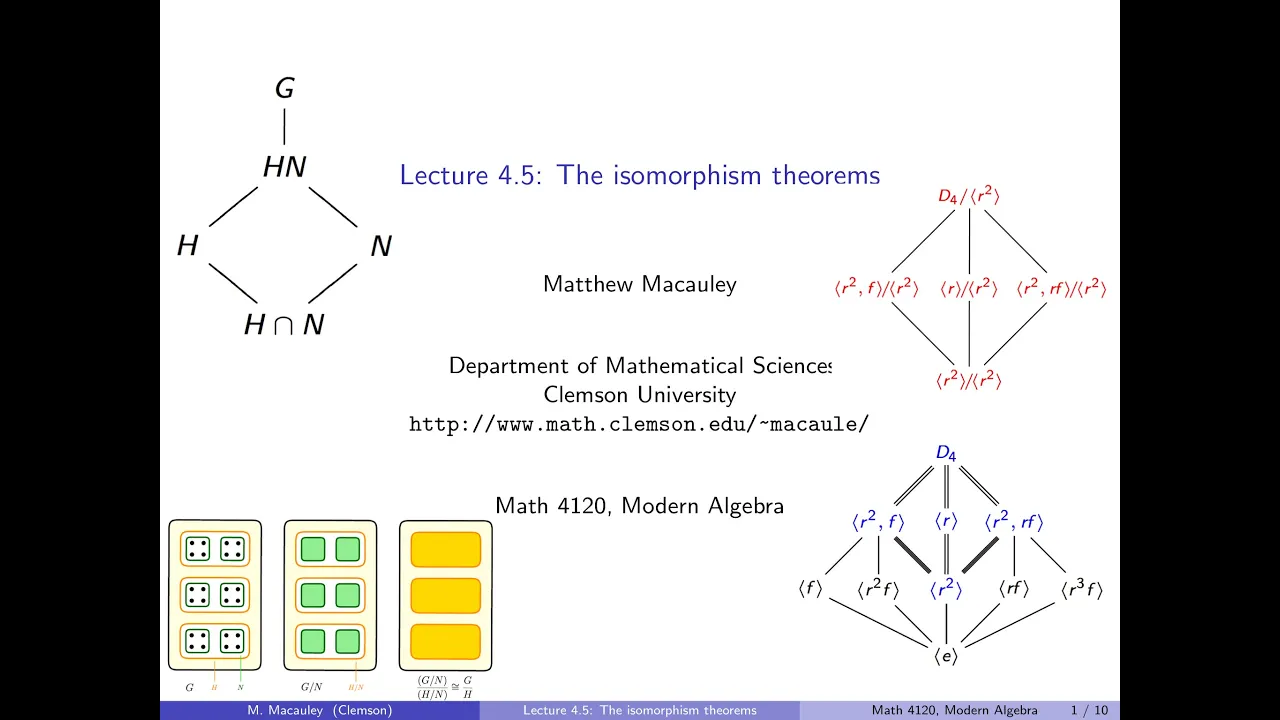
The Isomorphism Theorems for groups, particularly the First and Third Isomorphism Theorems.
The concept of simple groups, which serve as the simple composition factors in a composition series.
Familiarity with symmetric and alternating groups (S_n and A_n), as they provide key examples of solvable and non-solvable groups.
Galois Theory, exploring the connection between solvable Galois groups and the solvability of polynomial equations by radicals.
Nilpotent groups and the lower/upper central series, which represent a stronger structural constraint than solvability.
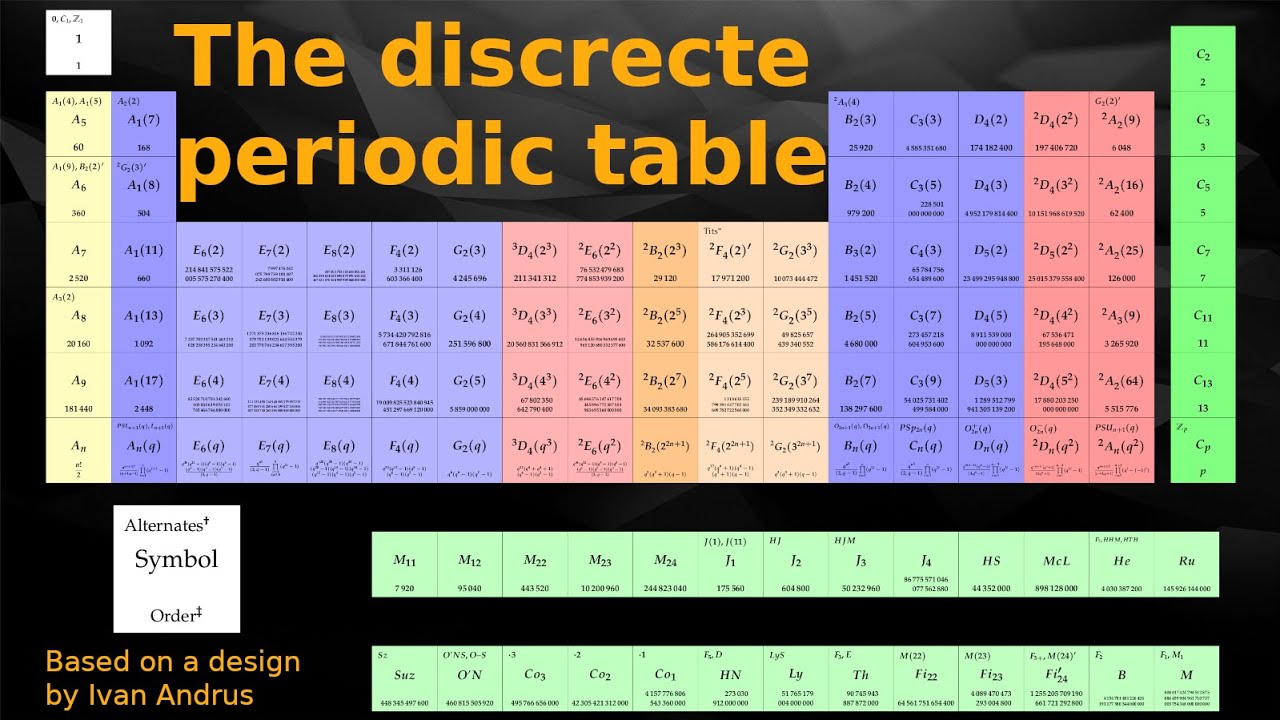
The Classification of Finite Simple Groups, representing the complete list of the 'building blocks' identified by the Jordan-Hölder theorem.
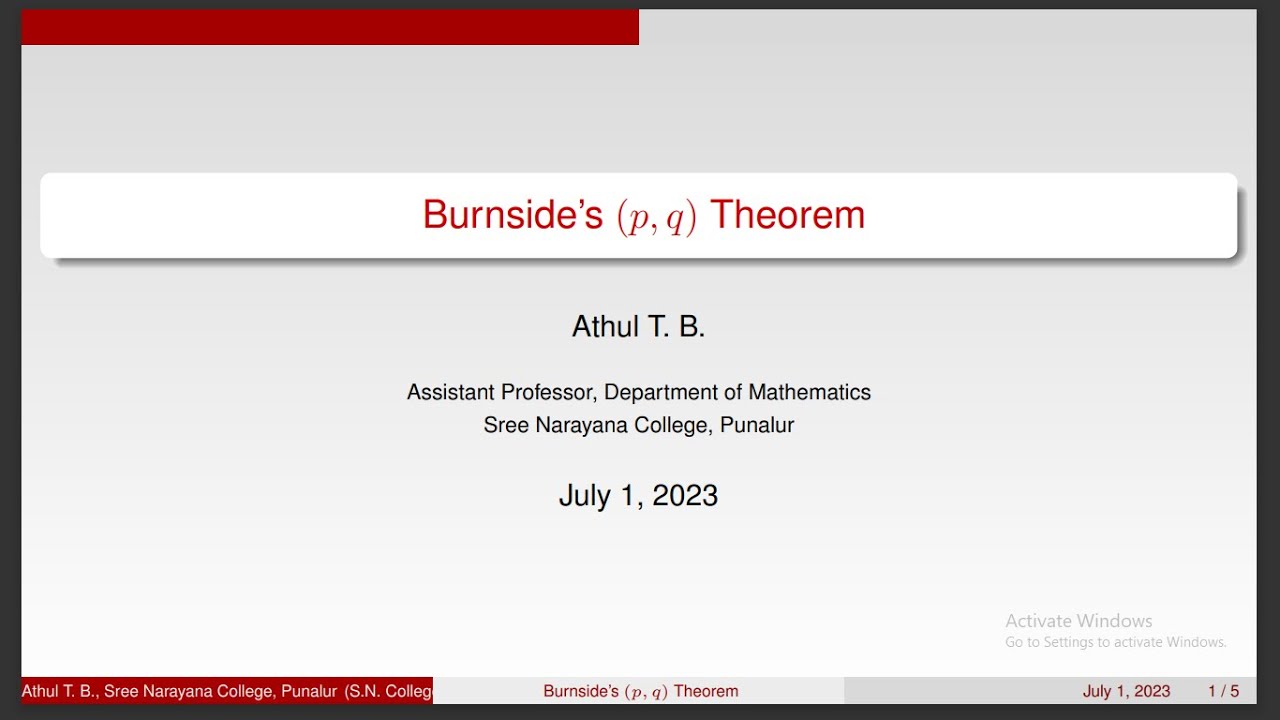
Advanced theorems in finite group theory, such as Burnside's p-q Theorem and the Feit-Thompson Odd Order Theorem.
936 views0likes26:16Original Release: 2022-04-13
welcome back to our lecture series math 4230 abstract algebra 2 for students at southern utah university as usual be your professor today dr andrew missilden um in lecture 36 we are going to talk about the solvability of polynomial equations using the technique of radicals and we're going to do that in the second half of this lecture the actual talk about solvability what does it mean to solve a polynomial by radicals um in particular why is the the general quintic equation impossible solved by radicals now in order to do that we have to first develop the notion of a solvable group um with our lecture series we actually could have done this a long long time ago right i mean if you follow along with the numbering of our lectures here we're actually currently in chapter 23 but the notion of a solvable group actually was presented back in chapter 13 um from tom judson's abstract algebra textbook for which our numbering is following there um we opted not to discuss it back in um abstract algebra one that is math 42 20.
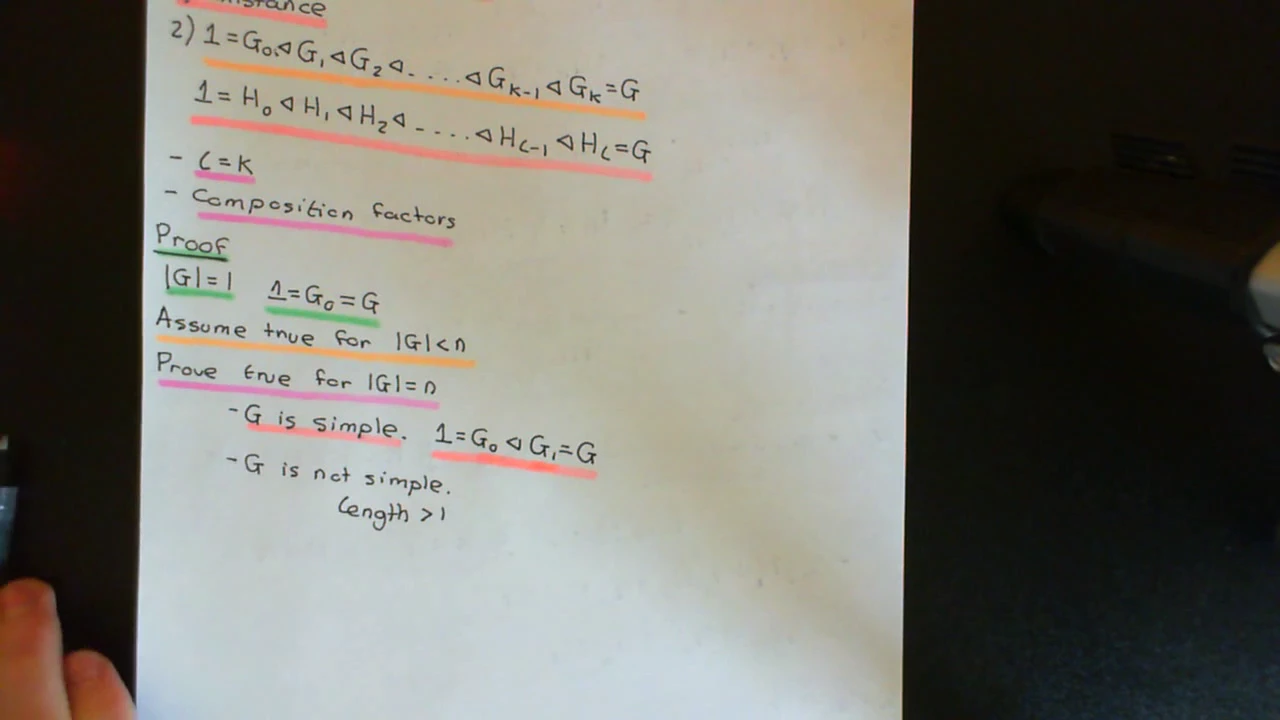
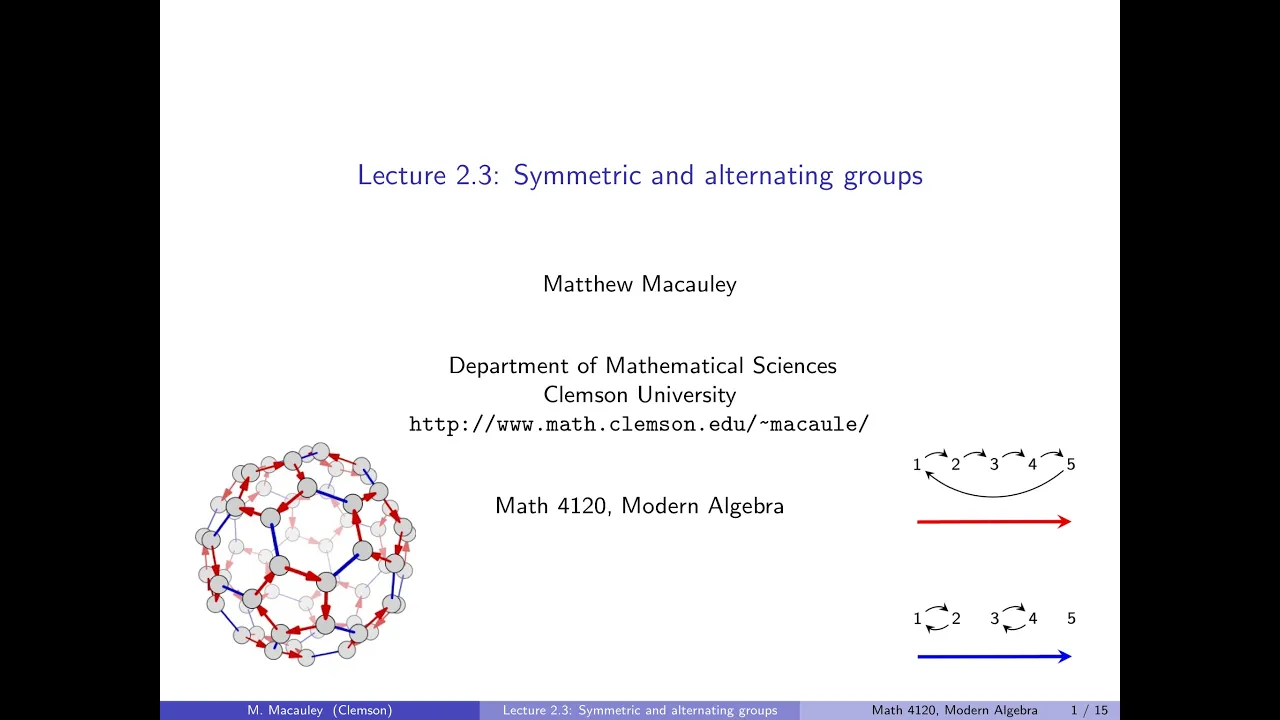
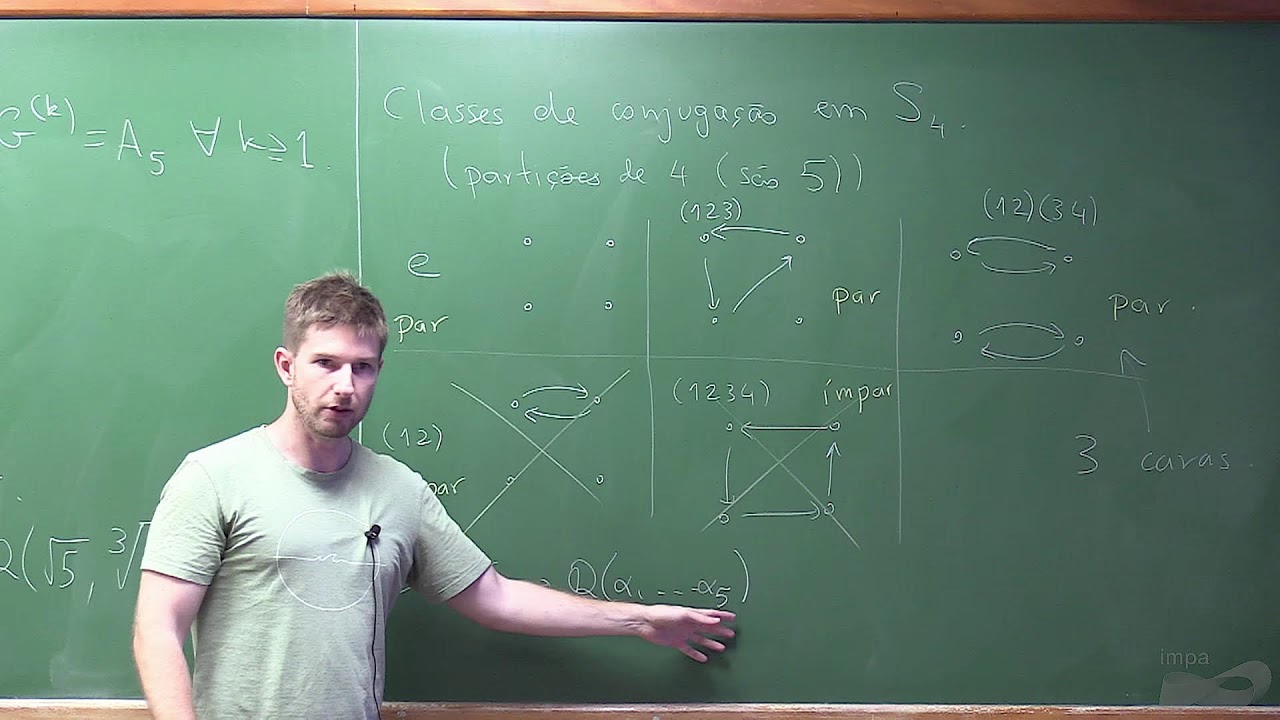
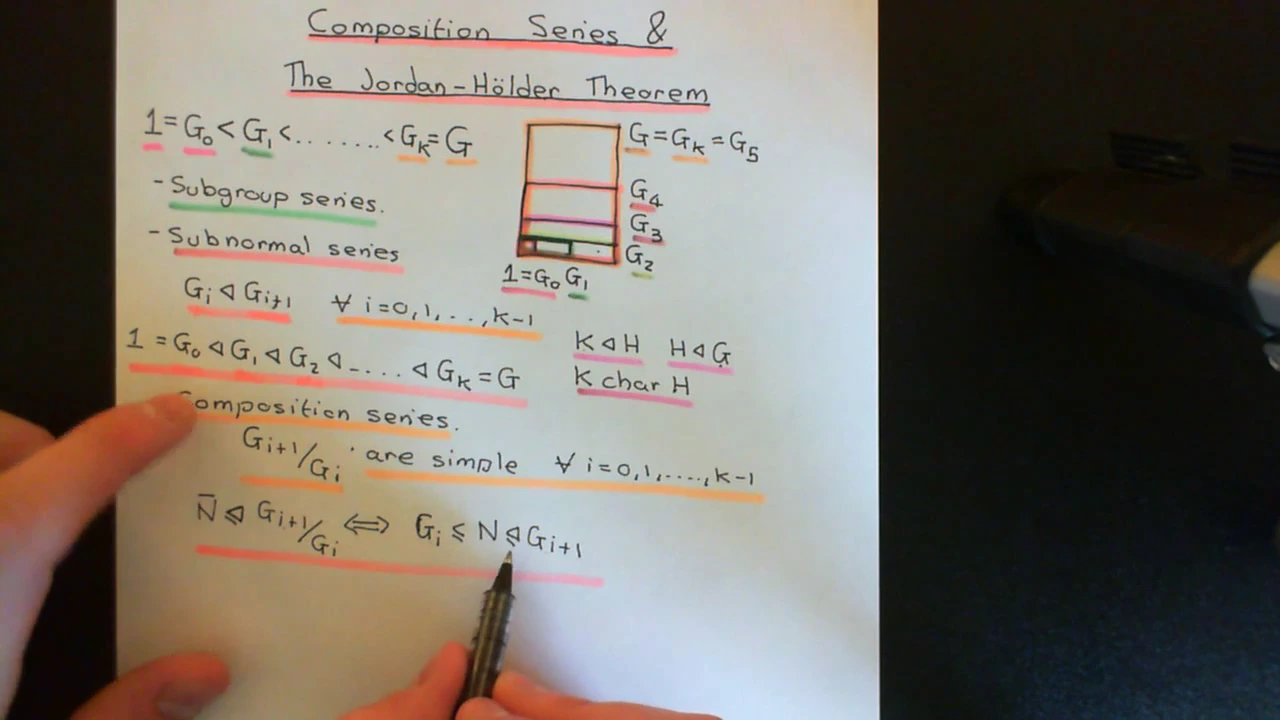
uh but it becomes a necessity now if we really want to understand um the insolvability of the quintic we have to understand what it means for a group to be insolvable which of course means we have to know what a solvable group is and the terminology for a solvable group is somewhat curious but it really its name comes from this idea of solvability of polynomial equations by radicals and so while the term might seem weird it's going to turn out that a polynomial is solved by radicals if and only if it's a galwa group is a solvable group and so that's where the terminology comes from here so what does it mean for a group to be solvable well there's a few things we got to say first um so given a group we can define a so-called sub-normal series of g we say it has length in if it there's a sequence of subgroups which we'll call h i such that the following conditions happens um at the very bottom of our chain we call that the trivial subgroup that's going to be h0 then you have some subgroup h1 which contains h0 admittedly everyone contains h0 but in particular this containment is proper h1 is not equal to h0 then there's some other subgroup h2 that properly contains h1 then there's some other subgroup h3 that properly contains h2 again all of these containments are proper and you go up your chain um until we get to h n minus one this is a subgroup can properly containing h n minus two um and then it is contained properly inside of h n which is the whole group itself so when you look at this we're gonna have n plus one groups in this in this chain right here the bottom is the trivial group the top is the whole group and you have all of these groups in the middle that are properly contained there's never equality in that chain whatsoever that's what's going to give us a series of groups of course why do we call it subnormal well we require that each group in this chain when you compare neighbors in the series um h i has to be a normal subgroup of h i plus one all right so h zero is normal inside of h1 h1 is normal inside of h2 h2 is normal inside of h 3 et cetera et cetera h n minus 1 is normal inside of h n now there's a very important uh distinction that needs to be made here when we talk about a sub normal series we are not assuming that these subgroups are normal inside of g no no no no we are saying they're normal inside of the next group right so h1 is not necessarily a normal subgroup of g it will necessarily be a subgroup of g but it's not necessarily a normal subgroup of g it could be but not necessarily but what we do require is that h1 is a normal subgroup of h2 and that relativity there can make a difference there right clearly if h1 was normal inside of g it'll be normal inside of h2 and every other subgroup as well but it's only it's only required that it be a normal subgroup of the next group in the series and that's why we refer to this as a sub normal series that every group in the series is normal in the next group in the series but not necessarily normal in the whole group now if you do require that each subgroup in the series is normal inside of g you refer to that as a normal series and one can talk about normal series of groups but for the notion of a solvable group it's better to focus on subnormal and so we only require that you're normal in the successor inside of that series now we should mention that the subnormality condition here guarantees that the quotient group h i mod out h i minus one is well defined um for every pairing you have here that is consecutive pairings and these quotient groups are referred to as the factors of a subnormal series okay so that gives us what a subnormal series is and again we also have a notion of a normal series but we're only going to focus on sub normal series in this situation now if you start with a finite group every finite group will have a maximal normal subgroup that is there's a largest normal subgroup proper inside of g and so you can take that then to be the next one but then that group because it's a finite group by induction it would have a maximal subnormal series and which you can glue those things together uh what i'm trying to say here is that every finite group has a maximal subnormal series what do we mean by maximal if we have a subnormal series for which we can't insert any new subgroups that these are proper groups right they're the proper subgroups of each other there could be a large gap in between them um the fact we say that a subnormal series is maximal means that we can't fit any other uh normal a subnormal subgroup in between there and this this is true for finite groups now for for infinite groups you can have an issue right here that these uh these subnormal series might not have a maximal extension you might not be able to enlarge it larger and bigger and bigger and bigger and bigger and bigger right um take take the integers for example right um if you take the integers um you can then make put inside of a 2z which you can put inside of that 4z for which you could then put inside of that eight z right um and these these by definition these sub normal series have to have finite length and so you have to kind of terminate this process after a while uh but you could always make it bigger by adding one more right you could always go one more one more one more and so in the case of like the integers you can't ever construct a maximal sub-number series okay but finite groups because of the induction uh because of induction we can always construct a maximal subnormal series a group uh if it has a maxwell subnormal series we call that maximal subnormal series a composition series okay composition series is a maximal one a maximal sub-normal series now if you have a if you have a normal series if you have a maximal normal series that's called a principle series but like i said we're not going to worry about normal series or subnormal series in this context but i just want to throw out the vocabulary the factors of a composition series which is a maximal sub-normal series are called composite composition factors and they actually measure something about that group now since the if you have a composition series so it's a maximal subnormal series look at the composition factors these quotient groups because the composition series is maximal that means you can't fit in any more normal subgroups that means if you take two consecutive groups inside of your composition series like like h1 are hi and hi minus one since it's maximal as a subnormal series that means there doesn't exist any normal subgroup sitting between h i and h i minus one and so then by the correspondence theorem if there's no normal subgroup sitting in between h i and h i minus one the quotient group has no proper non-trivial normal subgroups and therefore it's a simple group in that situation and so that's a very nice uh that's a very nice condition that we have a subnormal series as a composition series if and only if uh it's all of its composition factors are all the factors are simple groups and this is actually how one can try to fix some of these um this is how one could try to fix these the the infinite group problem like i said before because after all when you look at z mod two z that's a simple group it's just a z2 if you take 2z mod 4z that's a simple group in z2 so in some accents i can get this infinite uh subnormal series with for which all the comp all the factors are simple so one can one can get around the infinite uh group problem ex for at least for abelian groups uh and i i don't want to say too much about that but for the finite groups be aware that you have a composition series if and only if um all of these factors are simple because again h i mod out h i minus 1 will be simple if and only if h i minus 1 is a maximal normal subgroup and if those are all maximum normal subgroups that means you can't fit any other normal subgroups in the series so you can check whether a sub-normal series is composition or not by looking at these factors are they simple groups or not all right uh let's see we've commented on some of these things already so h i minus one is a maxwell normal subgroup if and only if there's no proper normal subgroups in between them which would mean that the series is maximum in that situation okay um and then the in this the simple factors of a composition series are called composition factors all right i've illustrated all those things now uh so let's look at a few examples of this let's take the dihedral group d4 so this is going to be the symmetries of the square and consider the following um what i claim is a subnormal series here so start off with d4 and then look at this klein four group that sits inside of it so i'll actually indicate this we have this klein four group um v4 here which is gonna be generated by the two two cycle one two three four and the two two cycle one three two four like so i claim that whoops i claim that this is in fact normal inside of here right because d4 is a group of order 8 v4 is a group of order 4 and therefore the index of this group d4 with v4 has got to be 8 divided by that's a horrible 8. 8 divided by 4 which is 2. every subgroup of index 2 is normal so we do get that this klein 4 group is normal inside of d4 okay but we can make that same argument again if we take this client 4 group pick your favorite 2 2 cycle in that in that client 4 group so take for example 1 2 3 4. all right this is a proper subgroup because this is now has order 2 this has order 4. and the same argument applies since we have a subgroup of order 2 inside of a subgroup of order 4 the index has to be 2 in that situation therefore we get that this is a normal subgroup of the klein4 group but by contrast right this is only a sub normal series this group um this this cyclic group z2 is not normal inside of d4 it's normal inside of the klein iv group but it's not a normal subgroup of d4 that's the important thing about these sub normal series and then of course the trivial subgroup is normal it's normal inside of d4 so it's normal inside of everything else but again this is a this is a subgroup of index two so it's gonna be normal uh so we do have an example of a subnormal series right here i'm just gonna abbreviate it like this we have d4 uh which then contains uh v4 which then contains a z2 which then contains whoops the trivial subgroup so we have something like that now let's look at all the various composition factors um because i actually claim this is a composition series how do i know that well because i can look at the factors right here uh when we take d4 mod out by v4 this is a group of order two so it has to be isomorphic to the cyclic group of order two and by similar reason v4 mod out z2 and z2 mod out one these are all all three of these composition factors are groups of order two and there's only one group of order two up tysomorphism so all three of these factors have to be isomorphic to z2 which z2 is a simple group it's a simple abelian group mind you but it's a simple group so this does give us in fact a composition series where our three factors are going to be uh z2 so we got z2 and z2 and then z2 those are three composition factors all right looking at the next example right here let's look at a different composition series for d4 so for example we have d4 and sitting inside of that is the subgroup generated by r um this would be our rotation by 90 degrees as a group this is the same thing as z4 this is the cyclic group of order four because r has order four again by considering indices right d4 is order eight v4 is order two so the index of this group the subgroup is going to be two that makes it a normal subgroup then we can look at the subgroup of z4 that's generated by r squared this is going to look like z2 because the 180 degree rotation has order 2. by the same reasoning as before um this will be normal in the larger group because it has order uh has index two now unlike the previous example this subgroup uh the subgroup generated by r2 is actually normal inside of d4 that's not required to be a normal a subnormal series but this is actually an example of a normal series because all of these subgroups are normal because after all the subgroup gender by r2 is in fact the center of the dihedral group which is a normal subgroup and of course the trivial subgroup is normal as well so this this is a composition series because for the same reasoning if you take d4 mod v4 that's a group of order two so it's z2 if you take v4 mod z2 or z2 mod 1 again these are all groups of order two so they have to all be z2 so in this situation we have our composition series which has d4 inside of it you have a v4 which is a normal subgroup and then you have of course a z2 down here and then you have the trivial group again um and then all of these composition factors are again z2 z2 and z2 all right so some things to mention here that the first composition series we have is subnormal but not a normal series so this is not a principle series but when you look at the second one it actually does turn out that each of these groups here are normal subgroups of d4 so this composition series actually is a principle series since it's a it's a maxwell normal series which is kind of a cool little observation there like i said we're not going to say too much about principle series i just want to bring it up but the thing i really want to emphasize here is that when you look at the composition series for this one and you look at the composition series for this one it's the exact same you got z2 z2 z2 in both situations um so the composition series didn't matter on the composition excuse me the composition factors didn't depend on the composition series you got the exact same ones we're going to see this pattern occurring over and over and over again and one thing i want to mention is that by the sea loft theorems that we developed previously every p group is going to have a composition series that basically looks like the following right where you can you take your p group then by the sea loft theory there does exist um subgroups of order so let's say that the p group has order p to the k then there's gonna be subgroups of order p to the k minus one um those will have to be normal inside of the p group but then there's going to be subgroups of order p to the k minus 2 which will have to be normal inside of the previous group not the whole group and then by induction you can go downward so for a p group you will always always get a composition series whose composition factors look like zp times zp times zp times zp times ep and you're going to get k copies of zp so we can predict the composition series well at least i can say i can predict the composition factors for any p group d4 is such an example all right let's look at a non-p group let's switch to the cyclic group of order 60 z60 of course and so let's see what happens here well since it's an abelian group every every subgroup is going to be normal outside of z6 so every composition series we construct in this situation will in fact be a principle series even though we don't need it to be a principle series that's what happens for finite appealing groups here and so we can look at the subgroups in this situation right so if you take the subgroup of z 60 that's generated by three this will give us a cyclic group of order 20 okay then inside of that you can take the subgroup generated by 15. um this will be a subgroup so the sub group generated by three is z20 the subgroup generated by 15 is z4 and then inside of that you have the subgroup generated by 30 which will look like z2 in that situation so you have all these cyclic groups and i'm going to write those again z60 uh it sits it contains inside of it is z20 sitting inside of that is z4 sitting inside of that is z2 and sitting inside of that is the trivial subgroup so in summary this is our this is our composition series normality is not at worry because we're in a dealing group why is it composition series we'll look at the factors if we take z 60 and we mod out by z 20 then that gives us a group of order three that has to be the cyclic group of order three so we get this first composition factor of three if you take z4 and excuse me if you take z20 and mod out by z4 that'll give you a cyclic group all quotients of cyclic groups or cyclic that'll give you a cyclic group whose order is 5 so that's got to be z5 that's our second composition factor notice that because the orders of these cyclic groups are primes that makes them simple groups if you have z4 mod out by z2 that gives you a z2 and then if you take z2 mod out by the trivial subgroup since this is an additive group i'm going to write the trivial subgroup as a zero this time z2 mod out by zero gives you z2 and this gives you the composition factors z3 z5 z2 and z2 i want you to notice that 3 times 5 times 2 times 2 is in fact equal to 20. so this it turns out and we'll see let's actually look at another example right what if we take a different composition series z 60 where this time we look at the subgroup generated by two which this i'll use a different color to indicate this one this one's going to look like z30 then you're going to take the subgroup generated by four which is the same thing as that that is that's a cyclic group of order 15. then you're going to take the subgroup generated by 20 which is as a cyclic group z3 and then you take the trivial subgroup in that situation so what our composition series looks like this time you take z60 which is which contains z30 which contains z15 which contains z3 which then contains the identity in that situation the composition factors well if you take a cyclic group of order 60 mod out by a cyclic group of order 30 that gives you a cyclic group of order two if you take 30 and you take and divide that by 15 you're gonna get two so another z2 if you take 15 and divide it by 3 you're going to get 5 and then finally if you take 3 and you don't take out you don't want to buy anything you get z3 and so notice our composition factors are again one in the same thing it doesn't matter what the composition series looks like the composition factors are in fact in fact the same things and those exact same things two three five and three we could predict what these things are going to be because um when you take a cyclic group it's that's composition factors are all going to be cyclics groups and you're going to take all the prime divisors of your number with multiplicity right because 2 shows up twice in fact one can argue that for a finite ability group this is the principle that you're going to get that the composition factors for a finite ability group are going to be exactly those cyclic um groups of prime order where you take all the primes of the abelian group up to multiplicity all right and so one more example here if you take for example the um the some the symmetric group of degree 5 s5 a composition series would be the following you take s5 which contains inside of it a5 which contains inside of it the trivial subgroup that's a pretty short composition series but it is is in fact a composition series for the following reason if you take s5 min out by a5 since the degree of a5 is two that's what makes it normal instead of s5 there since it's a degree 2 normal subgroup the quotient has to be z2 okay but on the other hand if you take a5 mod out by 1 that gives you back a5 but as we've proven previously a5 is a simple group and so as z2 is simple and it's a5 is simple that gives you a composition series and it turns out that up to equivalence this is the only composition series for s5 because as we'll see in just a second the composition factors are determined um by the group itself it doesn't matter what the composition series are the composition factors are always one and the same thing and for z5 you always get z2 and a5 now how do i know that well i'm actually going to state the jordan holder theorem here which says that 82 composition series of a group are isomorphic what does it mean for two composition series to be isomorphic it means that there's a one-to-one correspondence between the composition factors where that correspondence is an isomorphism preserving correspondence basically the the jordan holder theorem tells us that uh any two all all composition series of a finite group produce the same composition factors it's a unique characteristic of the group um we're not going to prove the jordan holder theorem in this video um it's not beyond the scope of our lecture series it's mostly just a timing thing i want us to be aware that the composition factors are uniquely determined by the they're uniquely determined by the group itself it doesn't matter which composition series you choose you're always going to get the same the same series the same the same composition factors excuse me the series can change and so this then leads us to the topic for this video here the titular topic that is that is of a solvable group we say that a finite group is solvable if it has a composition series with cyclic composition factors which those cyclic factors of course will have to have prime order because an abelian group is simple if and only if it is of the form zp where p is a prime so a finite abelian excuse me a finite group is solvable if and only if its composition series only involves cyclic compositions uh cyclic uh composition factors excuse me so looking at some of the examples we've already looked at if you take z 60 all of its composition factors well you had z2 z2 z3 and z5 this is a solvable group because its composition factors are all cyclic uh and this will actually apply to any abelian group because of the uh fundamental theorem of finite ability groups every abelian group can be written as a direct product of cyclic groups and one can argue that when you have a direct product of groups um their composition factors will then be just the union of the composition factors for each of the direct factors uh in the direct product so and then by basically mimicking the strategy we did with z60 every cyclic group it's it's will have cyclic composition factors and therefore every abelian group is solvable we also looked at d4 d4 was a solvable group because its composition factors were z2 z2 and z2 and we also made the argument that every p group will have a similar composition um series and thus similar composition factors if you have a group whose order is p to the k then your composition factors are going to be zp zp zp and you're going to do that k times so each for us for a p group the composition factors is always going to be zp up to some number and those are cyclic simple groups and therefore p groups are always solvable as well and so those are two very important families of solvable groups there's lots and lots of solvable groups but the important thing to mention here is that if you look at the symmetric group s n where n is greater than or equal to five that is not not a solvable group because if you look at a5 or a6 or a7 or a n for n larger greater than um then five in that situation that is a simple group which is not cyclic and so in that situation you're you have a composition series that looks like sn which contains a n which contains one your composition factors will be z2 which is sn mod out a n and you're gonna have a n in that situation uh when n is greater than equal to five so since the composition factors don't depend on the series this is what the composition factors have to look like um and therefore we get a non-solvable group because we have a composition factor that's not cyclic and it turns out this observation right here the the special number five is exactly why degree five polynomials aka quintix polynomials uh cannot be solvable can't not always be solved by radicals but we'll provide the details of that in the next video
Up Next

10:19
Why Quintic Equations Have No General Formula | Galois Theory
@Aleph0
205.6K views•2021-02-20

4:43
Elliptic Curve Cryptography Explained: ECC, ECDSA, ECDH
@PracticalNetworking
28.5K views•2024-10-21
10:44
Fourier Series Introduction: The Big Idea Explained
@DrTrefor
387K views•2021-05-03

6:00
The Mathematical Impossibility of Accurate World Maps
@Vox
23.3M views•2016-12-02
Related Study Plans & Knowledge Roadmaps
Structured learning paths in Mathematics
mathematics
Tensor Calculus: Vectors to Riemann Curvature
01Mathematical Foundations: Linear Algebra & Calculus
02Covectors, Dual Spaces, and Tensor Basics
03The Metric Tensor and Index Gymnastics
+ 2 more learning modules
40h5 modules
Explore Roadmap
mathematics
Gödel's Incompleteness: Logic, Proofs & Limits
01Introduction to Formal Systems & Hilbert's Dream
02Set Theory, Cardinality, and Cantor's Diagonal Argument
03Arithmetization and Gödel Numbering
+ 2 more learning modules
14h5 modules
Explore Roadmap
mathematics
Galois Theory: Fields, Groups & Solvability
01Foundations of Abstract Algebra: Groups & Fields
02Polynomials & Field Extensions
03Splitting Fields & Symmetries
+ 2 more learning modules
24h5 modules
Explore Roadmap
mathematics
Non-Euclidean Geometry: Models & Geodesics
01Euclid's Fifth Postulate and the Birth of New Geometries
02Hyperbolic Space and the Poincaré Disk Model
03Geodesics: Defining Straight Lines in Curved Spaces
+ 2 more learning modules
15h5 modules
Explore Roadmap