









![[GALOIS] Tổng hợp lí thuyết | Phần 2](https://i.ytimg.com/vi/yapsgeyibro/sddefault.jpg)


![[현대대수학] 분리확대체 | 분리확대 성질, 완전체, 유한체 또는 표수가 0인 체는 완전체, 원시원소정리, 중복도](https://i.ytimg.com/vi/GsDzn_gSx_E/maxresdefault.jpg)

![30강 현대대수학 프렐라이 제7판 갈로아이론의기본정리 (p.218~) [완강]](https://i.ytimg.com/vi/YAs-usTmNTc/maxresdefault.jpg)




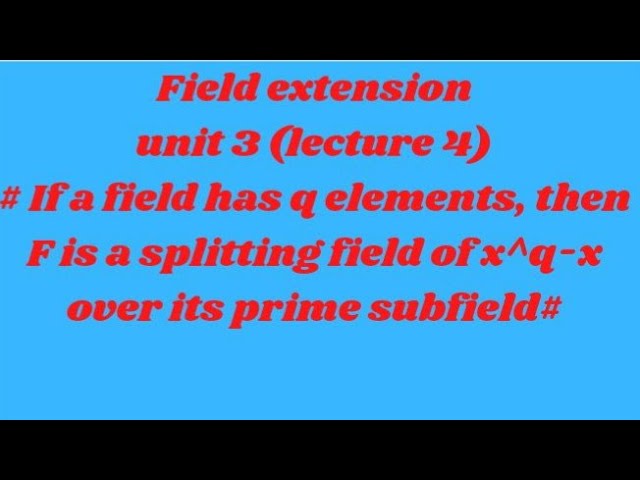





A splitting field of a polynomial f(x) over a field F is the smallest extension field E of F in which f(x) factors completely into linear terms; splitting fields exist for any non-constant polynomial and are unique up to isomorphism, meaning that if you have two splitting fields for the same polynomial, there exists an isomorphism between them that maps roots of the polynomial to each other.
Splitting Fields in Field Extensions | Abstract Algebra
Added:Basic field theory concepts, including field extensions, subfields, and the degree of an extension.
Polynomial rings over a field, irreducible polynomials, and polynomial factorization.
Kronecker's Theorem, which guarantees the existence of an extension field containing a root for any irreducible polynomial.
The concept of field isomorphisms and how homomorphisms extend from base fields to their polynomial rings.
Normal extensions, which generalize splitting fields to algebraic extensions that contain all roots of their irreducible polynomials.
Separable extensions, which are crucial for ensuring that polynomials do not have multiple roots in a splitting field.
Introduction to Galois Groups and the Fundamental Theorem of Galois Theory, linking field extensions to group theory.
The classification and structure of finite fields (Galois fields) as splitting fields of polynomials of the form x^(q) - x.
The concept of an Algebraic Closure, representing a field containing roots for all possible polynomials over a given base field.
5.9K views37likes10:09Original Release: 2015-05-07
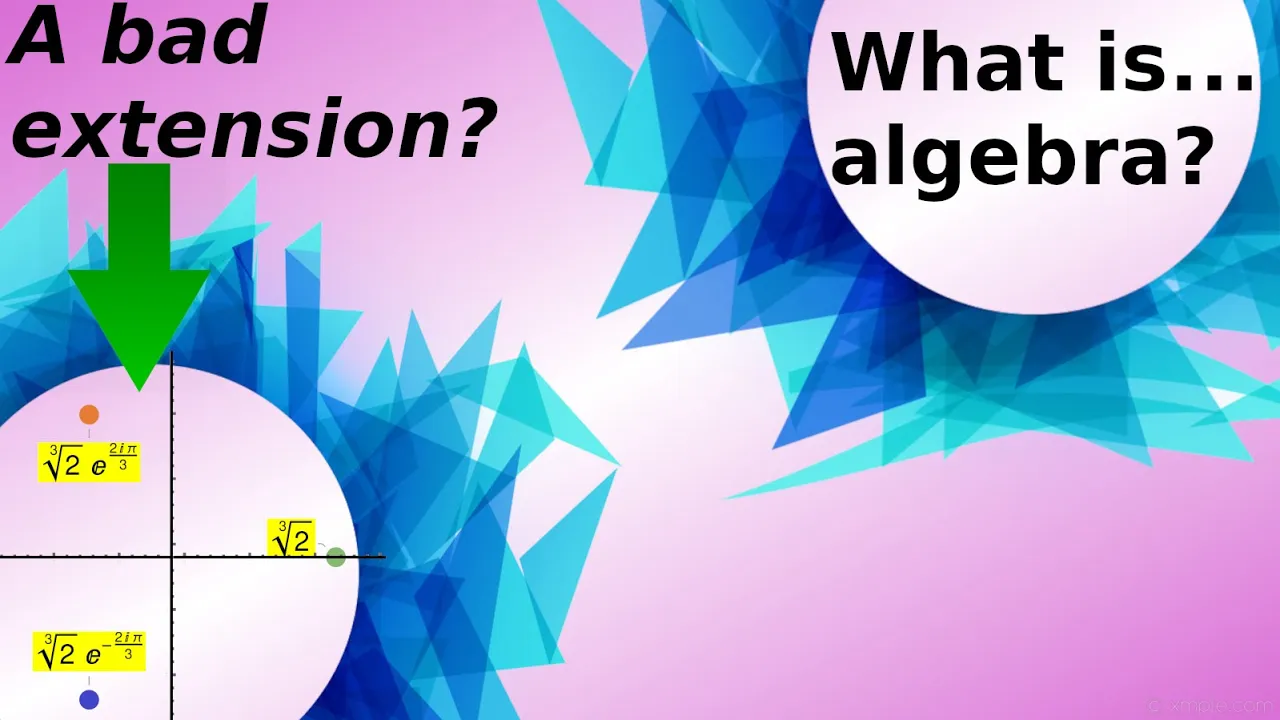
[Music] let us now talk about splitting Fields so say you're given a polinomial here and we say this polinomial F splits in an extension field e over this field F if it factors as a product of linear terms so you only have linear terms so e is called a splitting field if F splits over e but not in any smaller field so this e is the most economical field so let us see an example say x² - 2 over rationals so this splits over real numbers as x - < tk2 * x + < tk2 but these real numbers are not economical this is not a splitting field you actually have a smaller field this is root2 adjoined with rationals which is the splitting field for x² - 2 consider another polinomial X Cub - 2 so say this is also over rationals and this splits like this where Omega is the cube root of unity so 2 pi I by 3 so you can see x cubus 2 splits over this Q2 1/3 Omega so notice that it also splits over complex numbers but this is too big we want something smaller so it splits over this but it does not split over this smaller field Q2 1/3 because this field does not contain this complex number Omega the cube root of unity so notice that by uniqueness of uh simple algebraic extensions this is iso2 Q2 1/3 because this is the root of x cubus 2 and this is also ISO to Omega 2 1/3 because Omega 2 1/3 is also the root of x cubus 2 so these two Fields therefore are isomorphic to each other so you can construct an isomorphism between these two Fields notice that although you can construct an isomorphism these two fields are distinct see this lies in real numbers whereas this does not lie in real numbers because it has this Omega which is cube root of unity and you can see it's a complex number you have I right here so we already know that any polinomial will split over complex numbers so this is already known to us from analysis so thus for any irreducible polinomial over a field F to get a splitting field you just know what the roots of the polinomial r and you attach those roots to the field so if the roots of the polinomial are R1 R2 all the way to RN then you attach them to your field and this will give you the splitting field so our first result is which we want to prove it that splitting Fields exist just looking at here you can say the splitting Fields exist but we want to prove this so what it says is so say you have a non- constant polinomial f ofx which lies in this F ofx this F is a field right here then there is a splitting field for this polinomial F ofx E so e obviously Lies Over F so if degree of f ofx is one then we are already done there's nothing to prove this is already linear to go further we use induction case n equals to 1 is done now you have the induction statement statement is true for all p omals for degree less than F so we already know that the irreducible factor of f will split in some extension field in fact this is the procedure for constructing extension Fields you take the field and modulo out by your irreducible polinomial it will always give you an extension field which will contain the root of the polinomial just like here you modul this out you can get this or this so you will always get an extension field where this splits but say you have 2 1/3 you will only have the first Factor the second would be still a reducing I in this field so F will split in some extension field so you will get some linear Factor at least so f of x is x - R1 * G of X now you use the induction step now since degree of G is less than degree of f so we have already said that the statement is true for all polinomial for degree less than F so by induction G would split now and say the roots of G are R2 R3 all the way to RN you have r R1 here so you just get a splitting field now you adjoin this R1 and then you adjoin all these roots so you get a splitting field like this now an important statement here is that the splitting fields are in a sense unique so to see this notice this diagram here so say this is an ISO so if this is an ISO say the element here in field F1 gets M to element here beta in field F2 so Alpha is getting mapped to Beta so now this F1 automatically injects into f1x and FS2 injects into f2x so here say you have a polinomial which is say alpha 1 X+ Alpha 2 x² so say this map is bar Fe you apply again the same map bar Fe to it so X would remain as such and and these Alphas will become beta so beta 1 X Plus beta 2 x² so these beta 1 and beta 2 come from alpha 1 and Alpha 2 is precisely what this isomorphism would map alpha 1 Alpha 2 2 so here alpha 1 Alpha 2 will get mapped to say beta 1 beta 2 so say you have a polinomial here P of X so this polinomial will get mapped to 5 p e of X where X remains as such and this five just changes the coefficients just like the coefficients have been changed here so the polinomial changes just like this polinomial becomes this so This Fire essentially acting on here now you take the subjection map so f1x over irreducible polinomial here f2x over this 5 P of X so this will be also IR reducible here because it is IR reducible here so and this is an ISO because this ISO is doing nothing it's just carrying everything here and doing absolutely nothing on X so this ISO will now become an isomorphism here so say a is a root of P of X then from your algebraic extensions we know that f1x over this P of X will give you F1 of a just like here and this B is a root of 5 P of X so B is a root of 5 P of X polinomial here so F2 over 5 P of X will be F2 of P so this a is sent to this P via this isomorphism so to prove this is an isomorphism we have to do some more work you first have to construct this brown map which is composition of this map and say this projection map say Pi 1 so first apply War Fe and then apply Pi 1 this is this map and this is the map which will descend here so you will get an isomorphism so important remark here is before we end the lecture is that the splitting field is unique up to isomorphism so say you're given a monomorphism or an injective map fub1 to F2 so for us we will consider this as an isomorphic map so if f of x lies in the first f1x so say f of x lies right here and f f ofx lies in F2 of X so you have correspondingly five F ofx right here so this gets mapped right here and say this F this splits in E1 and 5 F ofx this THS an E2 so then this five this sends roots of f of x to roots of f f ofx so you have F ofx right here and you have 5 f of x right here so this will split in some field E1 this will split in some field E2 so the roots here are say R1 R2 all the way to say RN The Roots here are Row one row2 all the way to say row N so this five will send these roots to these roots right right here so in some sense splitting field is unique up to isomorphism notice that we are not saying which roote will get mapped to which roote we are just saying these roots are getting mapped to these roots now in general this can be extended to a monomorphism rather than just an isomorphism and this is easy to see so say you have this map F1 this injects into some map l so this is a monomorphism so we rewrite this so you rewrite it this as fub1 2 F2 which is a subset of this field L and you have an isomorphism right here so this becomes this case and then you just have um inclusion Maps here L and this will go to L of X and then you also modulo out again with 5 P ofx so this will get included into L ofx modulo out 5 P of X so everything will get transferred to a monomorphism
Up Next
20:20
Normal and Separable Field Extensions Explained | Abstract Algebra
@VisualMath
957 views•2021-07-13

4:43
Elliptic Curve Cryptography Explained: ECC, ECDSA, ECDH
@PracticalNetworking
28.5K views•2024-10-21
10:44
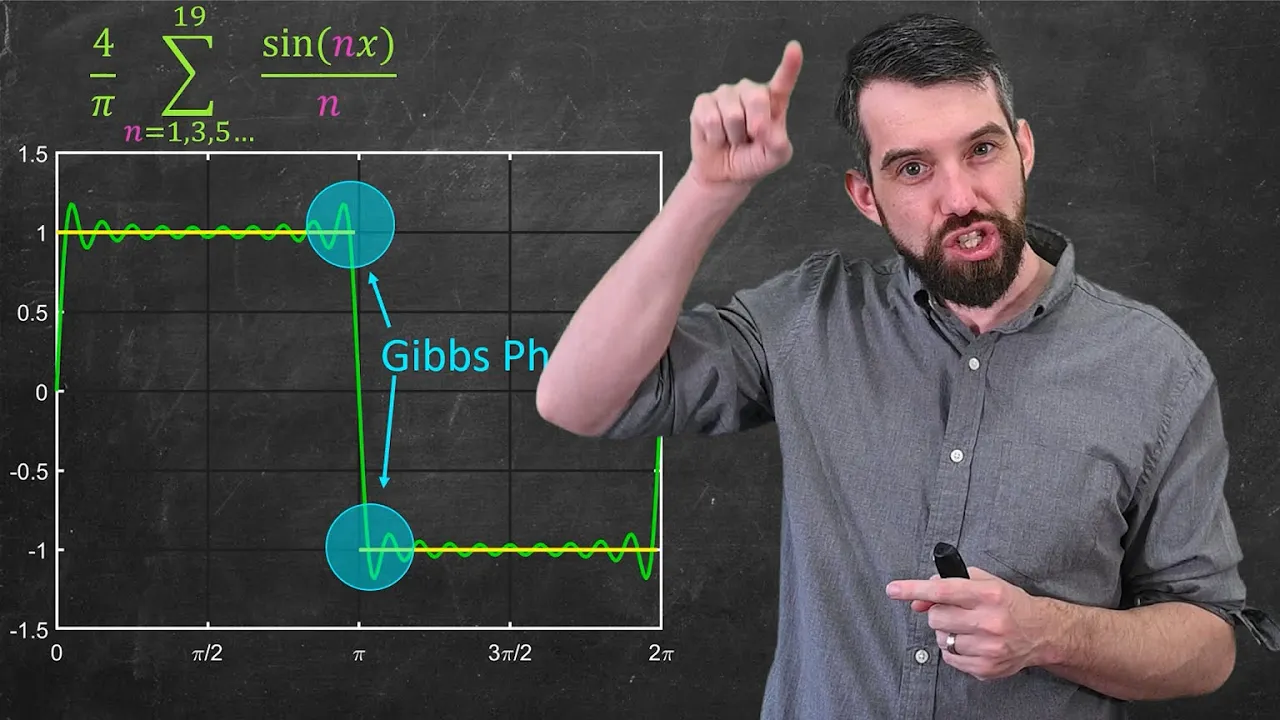
Fourier Series Introduction: The Big Idea Explained
@DrTrefor
387K views•2021-05-03

6:00
The Mathematical Impossibility of Accurate World Maps
@Vox
23.3M views•2016-12-02
Related Study Plans & Knowledge Roadmaps
Structured learning paths in Mathematics
mathematics
Tensor Calculus: Vectors to Riemann Curvature
01Mathematical Foundations: Linear Algebra & Calculus
02Covectors, Dual Spaces, and Tensor Basics
03The Metric Tensor and Index Gymnastics
+ 2 more learning modules
40h5 modules
Explore Roadmap
mathematics
Gödel's Incompleteness: Logic, Proofs & Limits
01Introduction to Formal Systems & Hilbert's Dream
02Set Theory, Cardinality, and Cantor's Diagonal Argument
03Arithmetization and Gödel Numbering
+ 2 more learning modules
14h5 modules
Explore Roadmap
mathematics
Galois Theory: Fields, Groups & Solvability
01Foundations of Abstract Algebra: Groups & Fields
02Polynomials & Field Extensions
03Splitting Fields & Symmetries
+ 2 more learning modules
24h5 modules
Explore Roadmap
mathematics
Non-Euclidean Geometry: Models & Geodesics
01Euclid's Fifth Postulate and the Birth of New Geometries
02Hyperbolic Space and the Poincaré Disk Model
03Geodesics: Defining Straight Lines in Curved Spaces
+ 2 more learning modules
15h5 modules
Explore Roadmap