


![35 - TEORÍA CUÁNTICA de CAMPOS [Spinor 1]](https://i.ytimg.com/vi/2PYC63CJnUs/maxresdefault.jpg)




![Mathvengers: Integral War [ 24 ways to integrate cos(x) from 0 to pi/2]](https://i.ytimg.com/vi/gO8AwBmQK5Q/maxresdefault.jpg)








![모든 힘은 대칭에서 시작된다 : 게이지 이론 입문편 – 전자기력과 질량의 기원까지[All Force Begins with Symmetry: Gauge Theory]](https://i.ytimg.com/vi_webp/hyXJgpKJAlU/maxresdefault.webp)

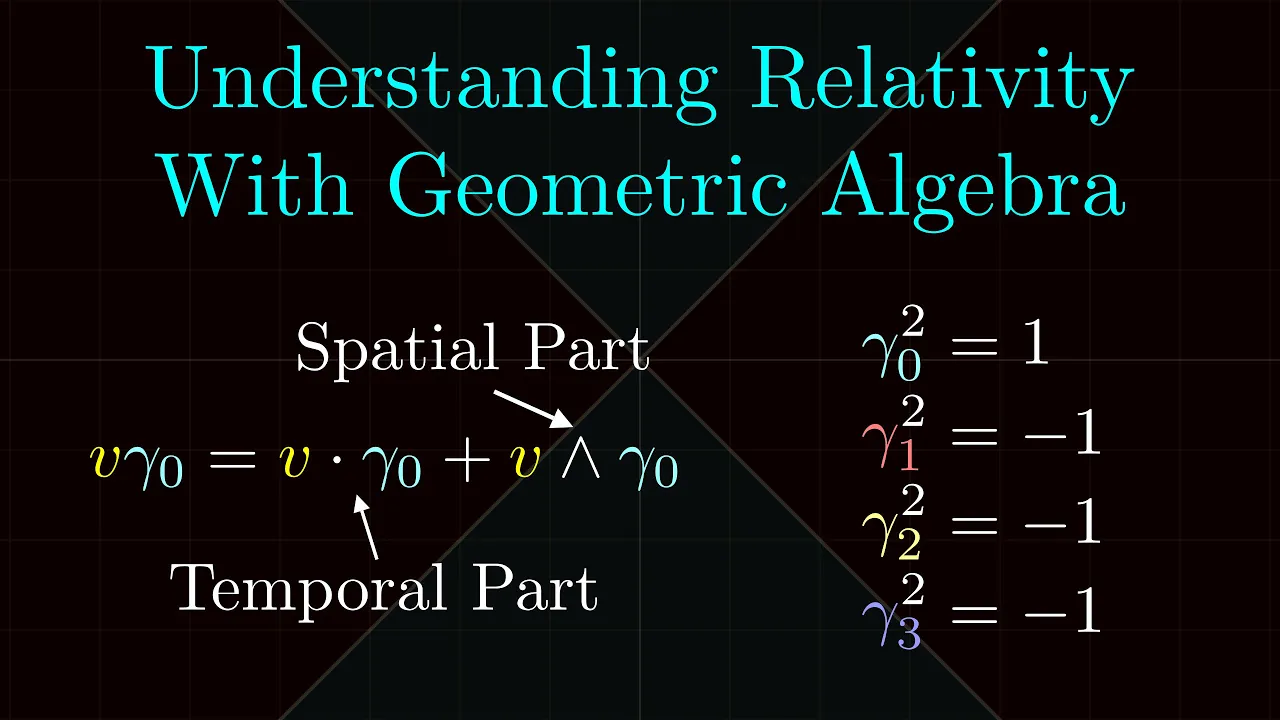
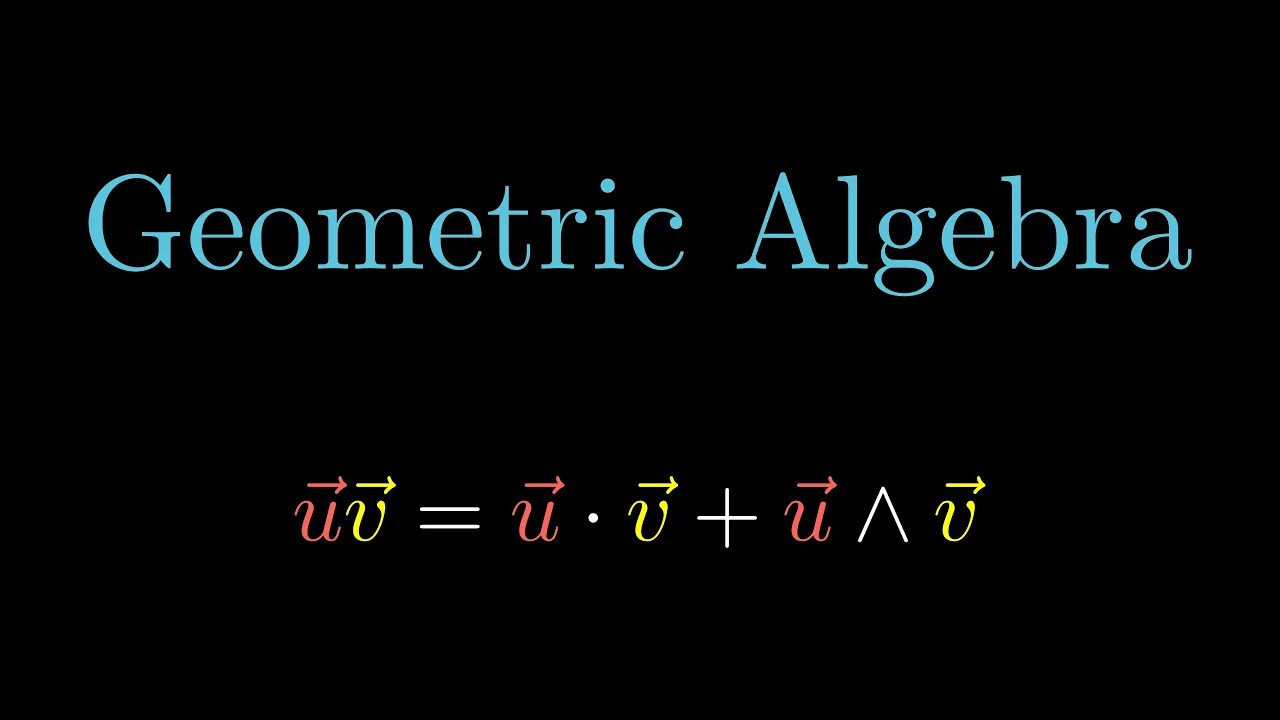
Maxwell's equations can be unified into a single multivector equation using geometric algebra by combining the electric and magnetic fields into a single entity called the Faraday bivector F = E + i√(μ/ε)H, where the space-time gradient operator ∇ acts on F to produce the source multivector J, and all original equations can be recovered through grade selection operations.
Maxwell's Equations in Geometric Algebra | Multivector Form
Added:Classical Electromagnetism: Familiarity with Maxwell's equations in their traditional differential vector calculus form, including Gauss's laws, Faraday's law, and Ampere's law.
Fundamentals of Geometric (Clifford) Algebra: Understanding of the geometric product, outer (wedge) product, inner product, and the concepts of multivectors, bivectors, and grade projection.
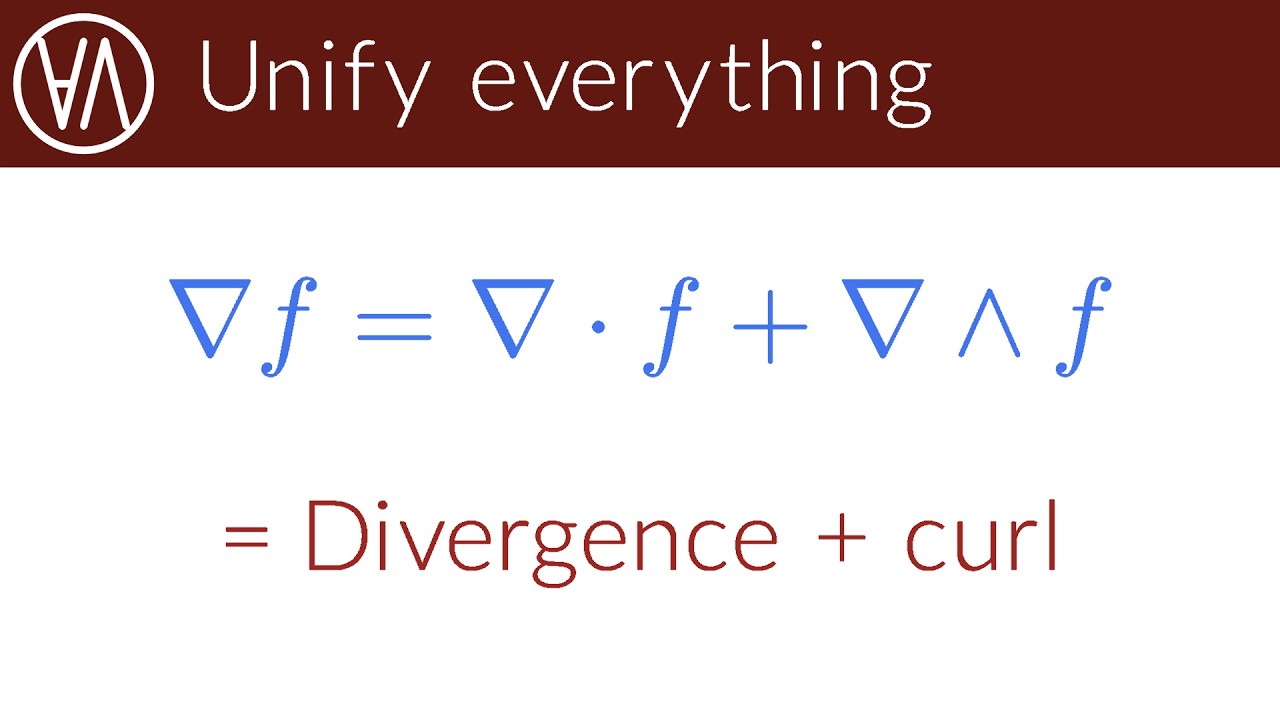
The Geometric Derivative: Conceptual knowledge of how the vector derivative (del operator) acts on multivectors to combine divergence and curl into a single operation.
Vector Calculus: Proficiency with gradient, divergence, curl, and coordinate-free representations of spatial dimensions.
Spacetime Algebra (STA) and Relativity: Extending the multivector Maxwell's equation into 4D Minkowski spacetime to reformulate relativistic electrodynamics covariantly.
Electromagnetic Lagrangian Formulation: Expressing classical field theories, action principles, and the electromagnetic Lagrangian density using geometric algebra.
Green's Functions in Geometric Algebra: Solving complex boundary-value problems and electromagnetic radiation/scattering using Clifford-valued Green's functions.
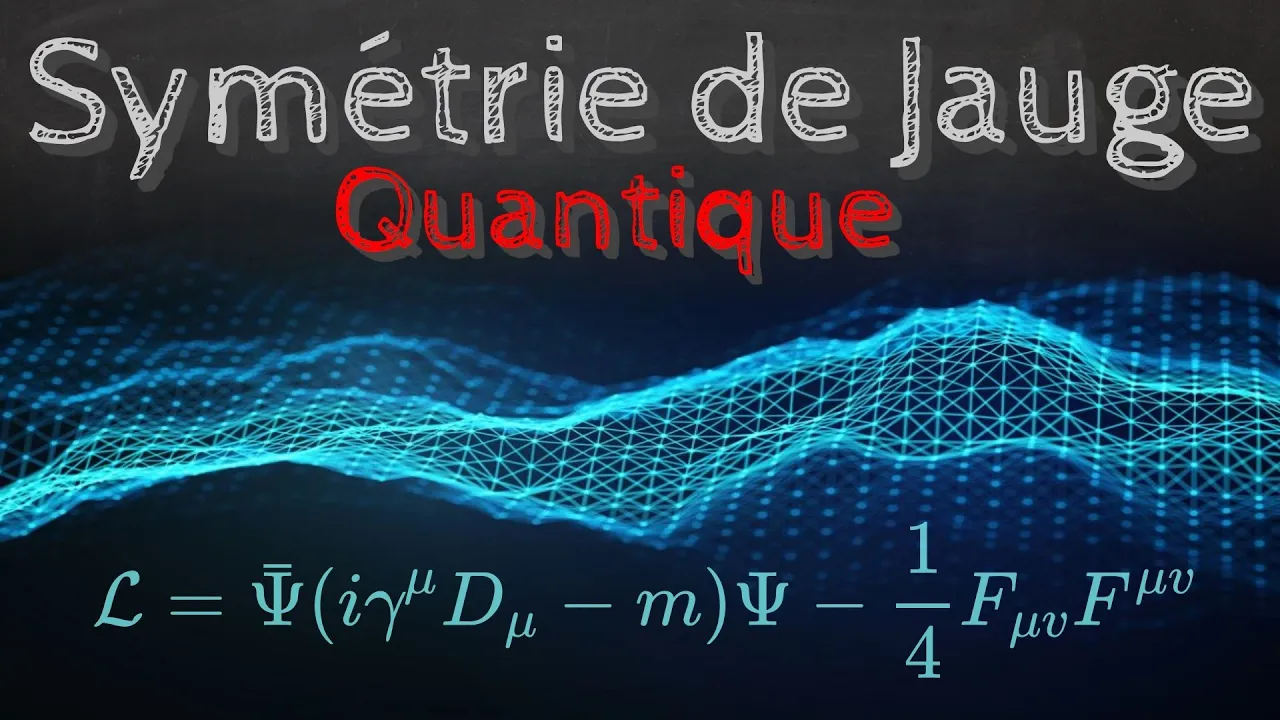
Gauge Theory and Quantum Mechanics: Exploring how gauge transformations are represented in GA, and transitioning to the geometric algebra formulation of the Dirac and Schrödinger equations.
13.5K views498likes9:28Original Release: 2023-10-30
in this video we'll figure out a geometric algebra form of Maxwell's equation translating from the Gibbs form of Maxwell's equations with curls and divergences to a multiv vector form that incorporates all of these into one single equation because they're useful in antenna and microwave engineering and don't add much additional complexity I've included fictional magnetic charge density row subm and current density M sources we'll use e and H as the primary Fields assuming that the electric Fields e and D are also related by a scalar not tens proportionality Factor Epsilon and that the magnetic fields B and H are related by a scaler not tensor proportionality Factor mu this implies that we're treating the matter containing the fields as isometric the same in all directions we're going to make a series of Transformations using linear combinations of Maxwells equations we'll first group our divs and curls to show that we can find a pair of multiv vector gradient equations one for each field using the geometric product of the gradient and that field well then scale are magnetic fields so so it like the electric field has SI units of volts per meter and write it out as a bi Vector i a h where a is the square root of mu over abilon we'll see another constant combination the reciprocal square root of mu Epsilon occur repeatedly we'll label this C in a future video we'll show that c is the speed of propagation of the fields in regions free of sources after this rescaling of the magnetic gradient equation we'll be able to add our two remaining equations and factor out all the differential operators to find Maxwell's equation we've taken Maxwell's equations a seemingly crazy mix of divs and curls and signs and found a simple underlying structure for it all wow we'll write out our combined electric and magnetic field multiv vectors F called the Faraday and we'll call the current and charge density multivator J it's tempting to give the SpaceTime differential operator a special symbol but it won't do that here I will however call it the SpaceTime gradient an entity that happens to have an intrinsically relative listic four-dimensional structure applications of this unified form of Maxwell's equations will be left for future videos we're going to use the fields e and H as our primary Fields writing Bal mu and D = Epsilon e after that substitution we're left with a curl and Divergence equation for E and A curl and Divergence equation for H we'll be able to group Maxwell's equations by taking advantage of the geometric product in reverse the geometric product of two vectors X and Y has a dotproduct and a wedge product component we can write the wedge product in its dual form as I * the cross product because the gradient is a vector we're free to write xal grad and substitute grad yal grad doy plus I grad cross y we can now group The Divergence equation for E that is Gus's law and the curl equation for E the maxal Faraday equation into a single gradient equation for E we use gr. e plus I grad cross e to form the gradient of e is row over Epsilon minus i m - I mu dhtt we can do the same thing for Gus's law for magnetism and the amperior maxall equation taking gr. h plus I grad cross H to form grad h = r sub m/ mu + I jus I Epsilon D DT our electric and magnetic fields have different units volts per meter and ampir per meter respectively which is a bit annoying when we want to form a complex super position of the two there are two combinations of mu and Epsilon that are particularly useful the first we'll call Ada which is the square root of mu over Epsilon this has units of ohms the dimensions of resistance the second is a combination that we'll call C that's 1 over theare root of mu Epsilon this has dimensions of velocity we'll use Ada H as a redim menion magnetic field so that both electric and magnetic field components of our total electromagnetic field have units of volt per meter in our electric field gradient equation we can rewrite mu as the < TK of mu Epsilon time the < TK of mu Epsilon this is Ada over C we'll see that we want to treat the magnetic field as a bi Vector instead of a vector so we group together i a h as our magnetic bi Vector field variable we can now proceed to rewrite our grad H equation as the gradient of i a h first we multiply both sides by Ada to find an equation for grad Ada H and simplify it then we multiply through by the pseudoscalar I noting that I commutes with vectors we're left with an equation for grad I a to H we can now write out our equations for grad e and grad i h with all the differential operators on the left our grad e equation has only scalar and bi Vector terms our grad I equation has only vector and tri Vector terms in both all units have dimensions of volts per meter squar so we're free to add these without any loss of information performing that sum we see that we naturally end up with a total electric and magnetic field multiv Vector e plus i a h we can Factor all the differential operators leaving us with a hybrid space and time differential operator that acts on the combined electromagnetic field resulting in a charge multiv Vector this is Maxwell's equation singular we could call it a day however it's aesthetically pleasing to write FAL e + i h are combined electromagnetic field sometimes called the Faraday and write J with all the source charge and current density contributions we've assembled the multiv vector form of Maxwell's equations by selectively adding and scaling our original equations in ways that might seem suspect we should now be able to verify that we haven't lost any information by doing this and extract the original curl and Divergence relations from our unified multiv Vector Maxwells equation to do so we need only apply grade selection operations for each of the 0123 grades to select the scalar Vector bi vector and tri Vector grades of the multiv vector Maxwell's equation then show how those relate to the original equations let's start by selecting the scalar grade all of the grade selections from the current and charge multiv Vector are trivial as we explicitly have one term for each grade on the right hand side the time partials contribute only vector and scalar grades and grad I H has only vector and tri Vector grades this lead us with ad row as the grade zero selection of grad e that is grad do E equals row over Epsilon next we select the grade one components Max Wells equations on the left we have minus edj on the right we have contributions from dedt and grad i h can commute I and grad and then expand grad H as grad Doh Plus grad wedge H the scalar term does not contribute to the vector grade selection and we can further expand grad wedge H as I times grad cross H dividing through by Ada leaves us with the Amper maxel equation to extract the bi Vector components on the left we have minus i m on the right we have contributions from DDT of I a to H and from grad e we write out the bi Vector term of grad e in dual form using the cross product then we multiply through by I to find the max wer equation selecting Tri Vector components on the left we have just i c row subm on the right only the gradient of I a to H contributes to the tri Vector term in particular if we commute I and grad and expand grad H as grad Doh Plus grad wedge H we see that only the grad Doh contributes to the overall grade three selection we're left with IC row m equal I a gradh dividing through by C we're left with row subm mu * grad Doh or grad dob this is ghost's law for magnetism with the fictitious magnetic charge density added we've shown that we can use grade selection applied to our multiv Vector Maxs equation to show that we can recover the giban form of Maxwells equations we started with Maxwells equations augmented with fictitious magnetic charge and current densities we introduced that is it's the same in all directions and recast Maxwell's equations with E and H as the primary fields we were able to form specific linear combinations of Maxwell's equations to show that they can be written as a multiv vector equation with a multiv vector current and charge density on one side and on the other a space-time and derivative operator acting on a combined electromagnetic field called the Faraday we finished off by showing we were able to recover the original conventional Maxwells equations by grade selection applications will come in a future video this video was made with manam and da Vinci resolve please like subscribe and share for more content of this nature for more geometric algebra content check out my blog Peter yo.com where you'll also find my book geometric algebra for electrical engineers and plenty of other math and physics related content including latex types set notes for a number of undergrad and graduate physics and engineering classes
Up Next
23:39
Vector Derivative in Geometric Calculus: Gradient and Maxwell's Equations
@AlanMacdonald1
12.8K views•2016-03-19
73:35
Deriving Maxwell's Equations in Geometric Algebra (QED Prereqs) 11
@XylyXylyX
2.6K views•2024-09-08

32:32
NMR Spin Physics I: Zeeman Effect, Resonance Condition & Larmor Frequency
@nptel-indianinstituteofsci8064
2.3K views•2024-01-17

33:44
The Blue LED: A Decade-Long Scientific Challenge Explained
@veritasium
46.5M views•2024-02-08
Related Study Plans & Knowledge Roadmaps
Structured learning paths in Physics
physics
Medical Physics: Imaging, MRI & Radiotherapy
01Foundations of Radiation and Matter Interaction
02X-Ray Imaging and Computed Tomography (CT)
03Magnetic Resonance Imaging (MRI) Physics
+ 3 more learning modules
15h6 modules
Explore Roadmap
physics
Nuclear Physics (Decay, Fission & Reactors)
01Atomic Structure and the Binding Force
02Radioactive Decay and Half-Life
03Nuclear Fission Mechanics and Chain Reactions
+ 2 more learning modules
12h5 modules
Explore Roadmap
physics
Soft Matter (Polymers, Colloids & Rheology)
01Foundations of Soft Matter & Thermal Forces
02Polymer Physics and Macromolecules
03Colloids, Surfactants, and Self-Assembly
+ 2 more learning modules
38h5 modules
Explore Roadmap
physics
Analytical Mechanics: Lagrangian & Hamiltonian
01Mathematical Foundations: Calculus of Variations
02From Newtonian Mechanics to Constraint Dynamics
03The Principle of Least Action & Lagrangian Mechanics
+ 3 more learning modules
28h6 modules
Explore Roadmap