

![[Metodos I] Introduccion a Vectores](https://i.ytimg.com/vi/vxuqHjp4mNk/maxresdefault.jpg)




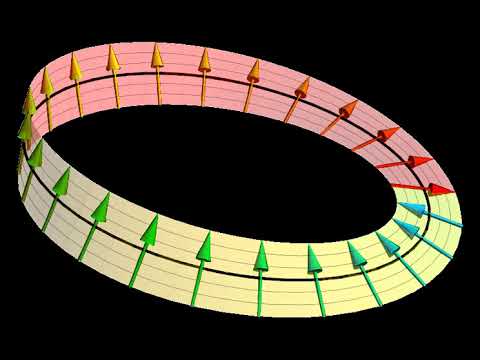
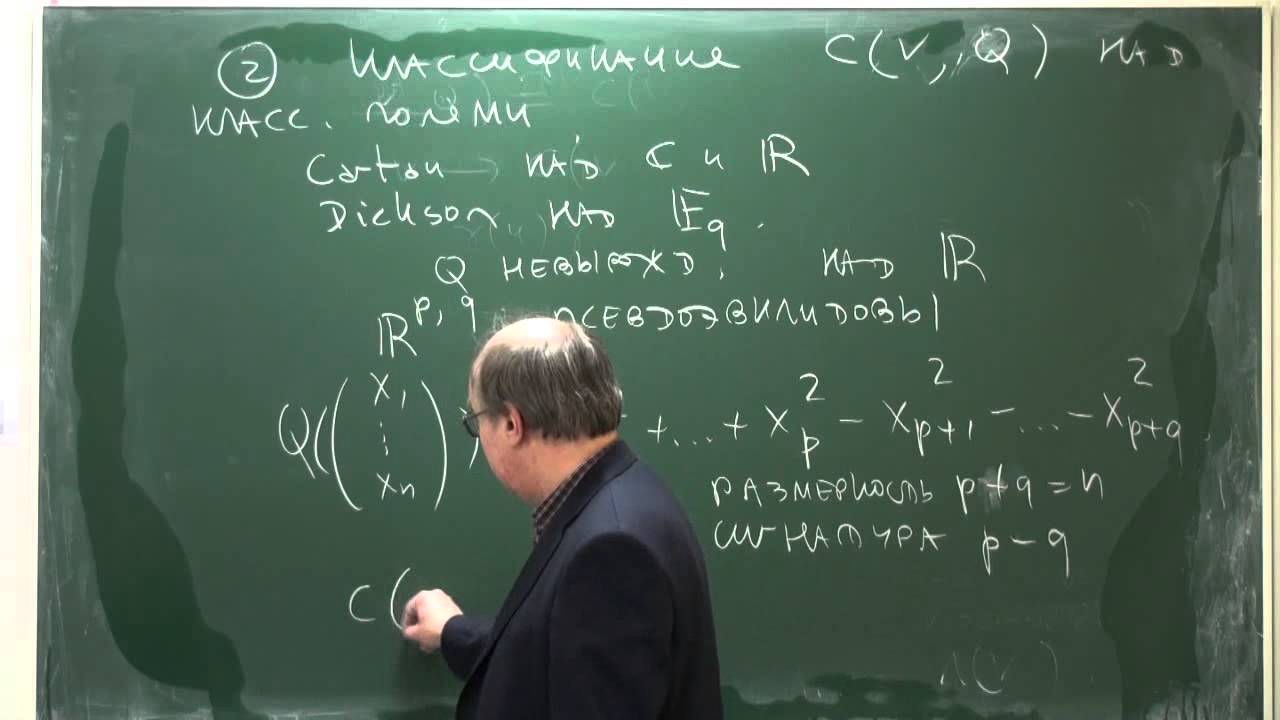
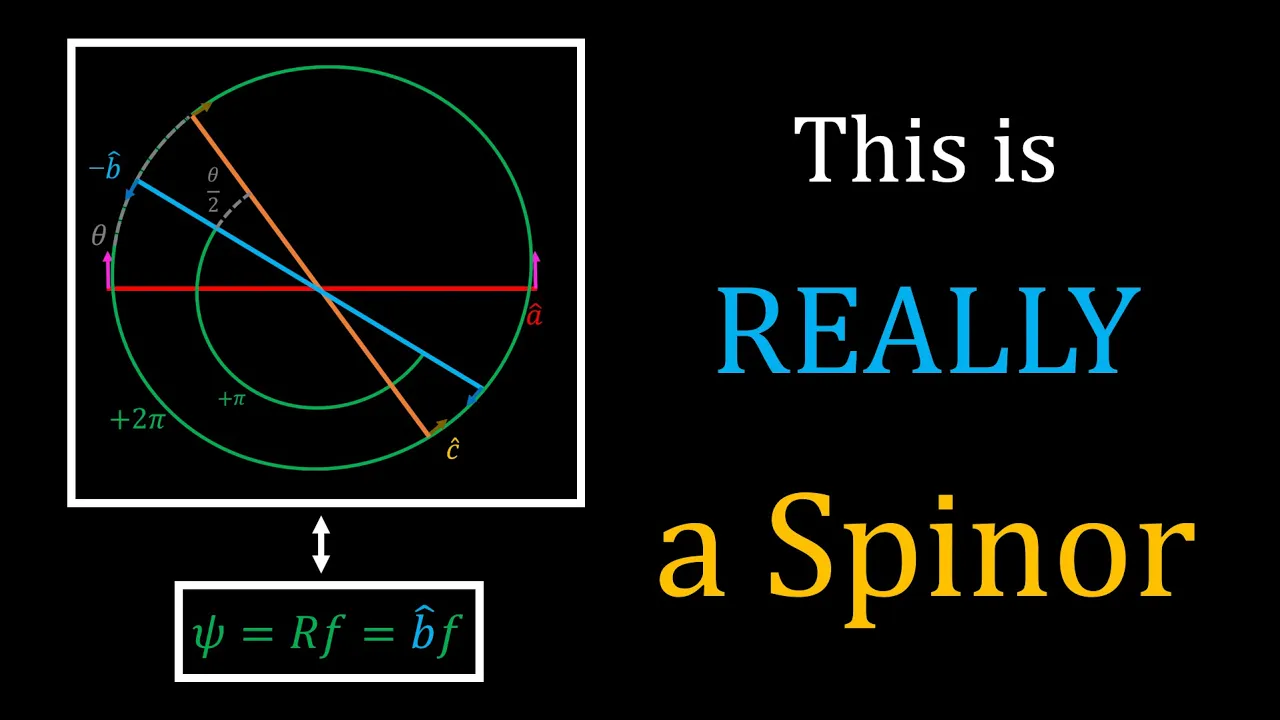

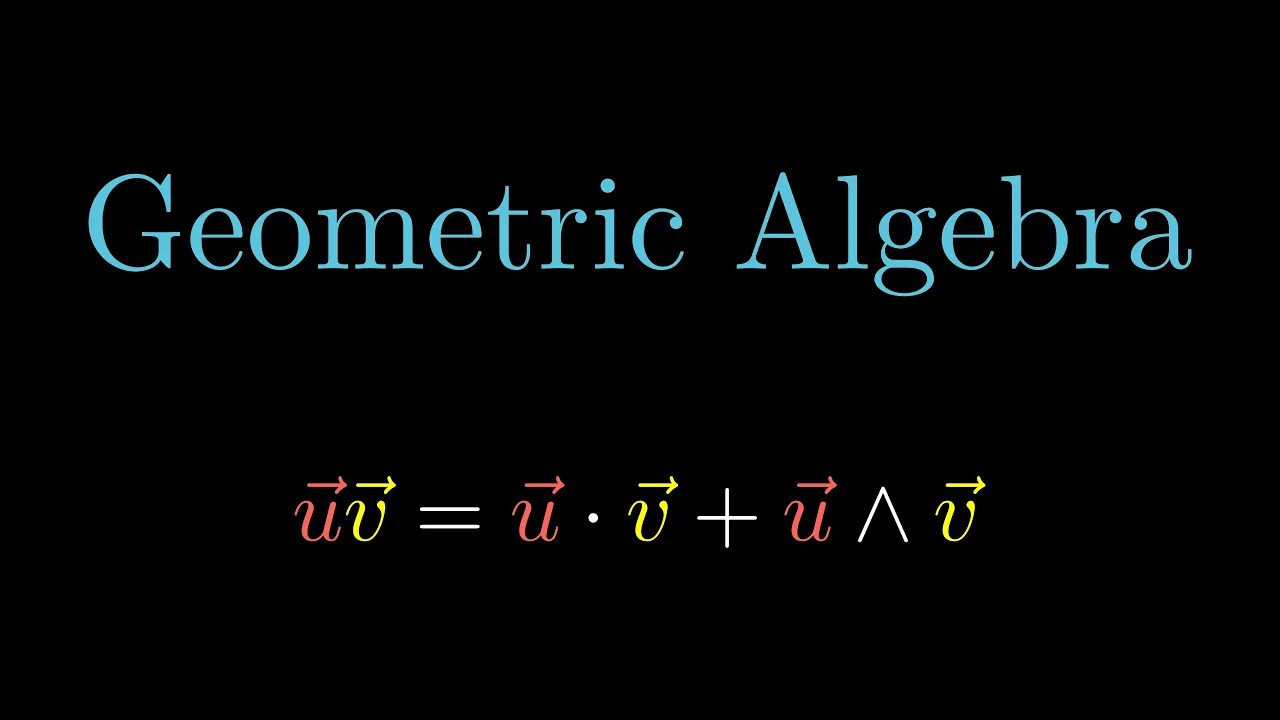
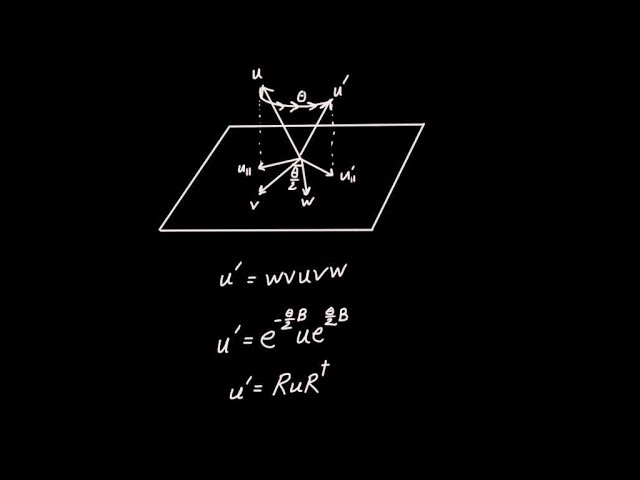







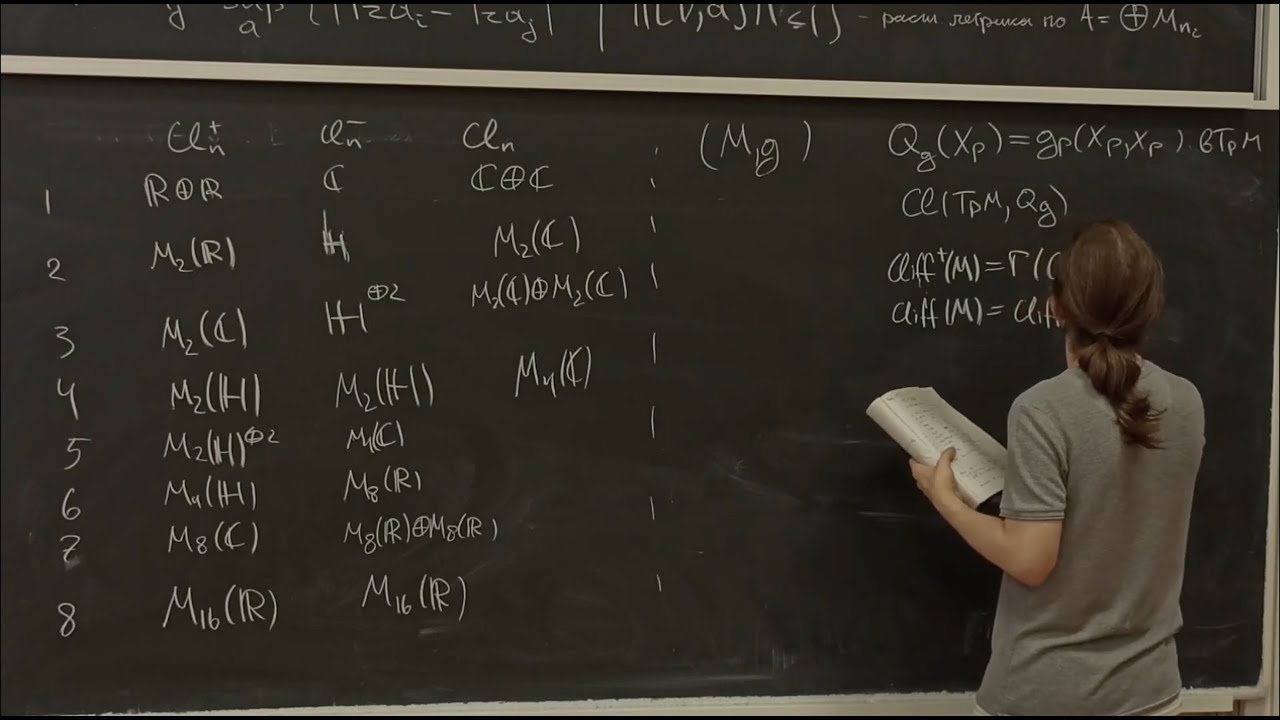


Clifford algebras are algebraic structures that generalize complex numbers, quaternions, and sigma matrices by allowing symbols to square to either +1 or -1 and introducing an anti-commutative property where swapping the order of multiplication gives a negative sign; they unify various mathematical objects like scalars, vectors, bi-vectors, and spinors into a single framework, enabling the formulation of physical laws such as Maxwell's equations in a unified equation, and are constructed by taking a vector space and defining a geometric product where the product of a vector with itself yields its squared magnitude and the product of orthogonal vectors is anti-commutative.
Spinors for Beginners 11: Clifford Algebra & Geometric Multiplication
Added:Fundamental linear algebra, including vector spaces, basis vectors, and the inner (dot) product.
The concept of the exterior algebra (Grassmann algebra) and the wedge (outer) product representing oriented areas.
Basic familiarity with rotations in 2D and 3D space, including the concept of quaternions or Pauli matrices.
The basic definition and motivation of spinors as geometric objects that transform differently than vectors under rotation.
How to represent rotations in any dimension using 'rotors' and the sandwich product formula.
Spacetime Algebra (STA) and how Clifford algebra unifies Maxwell's equations and special relativity into a single framework.
The connection between Clifford algebras, gamma matrices, and the Dirac equation in relativistic quantum mechanics.
The formal algebraic classification of Clifford algebras ($Cl_{p,q}$) and the concept of Bott periodicity.
71.4K views2.2Klikes33:22Original Release: 2023-07-23
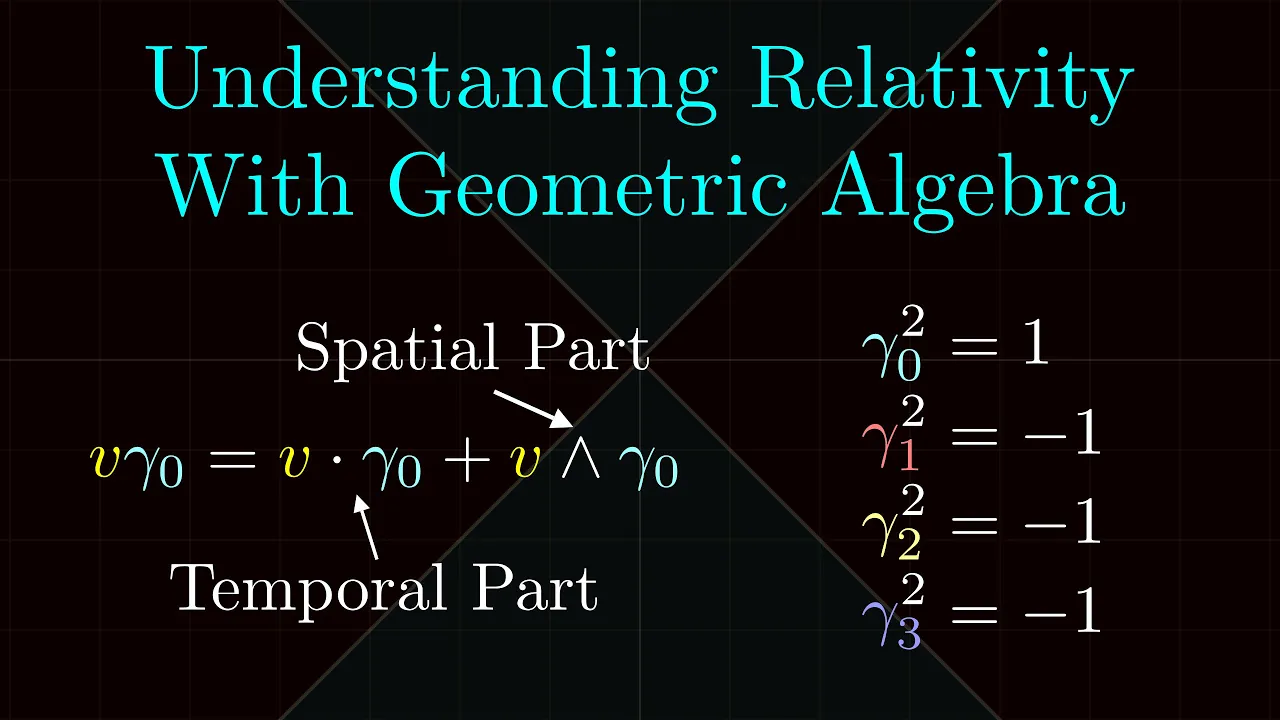
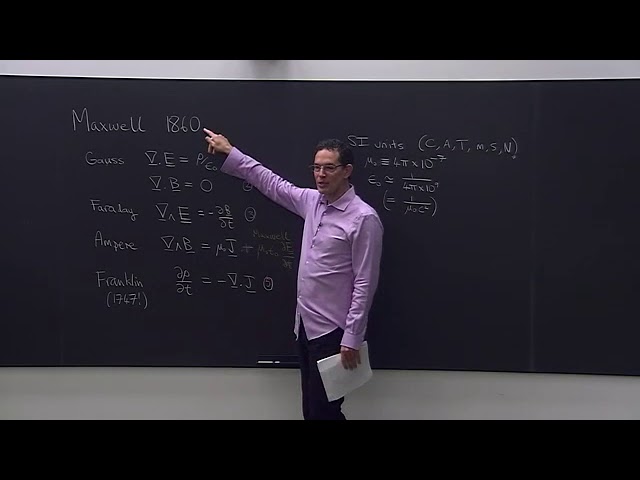
in this video we're going to introduce Clifford algebras also called geometric algebras for understanding spinners so far in this series we've looked at Spinners in three dimensions called poly Spinners and Spinners and four-dimensional space time called vial Spinners we came across these powley Spinners and vial Spinners almost by accident by rewriting 3D and 4D vectors as 2x2 matrices and finding that we could Factor them into a pair of spinners Clifford algebras are useful because they stop making Spinners look like accidents Clifford algebras give us a consistent recipe for building Spinners in any Dimension like 3 4 7 or 20 dimensions this recipe says that Spinners are members of minimal left ideals and Clifford algebras this recipe probably doesn't make much sense now but it should make sense over the course of the next few videos Clifford algebra's also unite many types of mathematical objects together in physics we deal with various objects like scalars vectors bi-vectors linear maps and spinners all of these objects live together side by side in Clifford algebras doing physics with Clifford algebras feels a bit like doing physics with the batteries included oftentimes everything we need to solve a problem in physics already lives inside a Clifford algebra and we don't need to invent any new mathematical objects to solve the problem for example Clifford algebras allow us to unite the four Maxwell equations of electricity and magnetism together into a single equation the YouTuber suji lacmo has some fantastic introduction videos for Clifford algebras and if you're looking for some more advanced videos on Clifford algebras you can look at the bi-vector YouTube channel for Clifford algebra content on spinners specifically I'll be referring to this thesis by Crystal and McKenzie in later videos I've linked all of these sources in the description so what exactly are Clifford algebras they can be thought of as a generalization of the complex numbers quaternions and the sigma matrices all of these algebraic systems involve symbols that square to either negative one or positive one and also involve symbols where swapping the order of multiplication gives us a negative sign this is also called the anti-commutative property Loosely speaking Clifford algebras are algebraic structures where we can square symbols to plus one or minus one and also swap their order to get a negative sign a good first step for learning Clifford algebras is to begin by understanding Grassman algebras also called exterior algebras I realize I'm throwing a lot of names out right now but Grassman algebras can be thought of as a stepping stone to learning Clifford algebras so we're going to start with learning Grassman algebras the key idea in Grassman algebra is the wedge product if we have a vector U and another vector v their wedge product U wedge V is a plane segment formed by u and v with an orientation that follows the arrows if we swap the order of these vectors and look at V wedge U we get the same plane segment but with the opposite orientation these oriented plane segments are called bi-vectors these bi-vectors are a useful way for representing rotations and angular momentum in introductory physics classes angular momentum is usually represented using a vector which you get by using the awkward right hand rule where you curl the fingers of your right hand in the direction of the rotation and stick your thumb out in the direction of the angular momentum vector not only is this awkward but it can lead to strange geometric results for example if we reflect a rotating object in a mirror the angular momentum Vector points in the opposite direction this is a very strange behavior for a vector and indicates we might be doing something wrong however when we represent rotations and angular momentum using bi-vectors instead the direction of rotation is immediately obvious and when we reflect the rotation in a mirror the bi-vector changes in a predictable way reversing the orientation in a way that makes sense when we have a vector U it's opposite minus U is a parallel Vector of the same length but pointing in the opposite direction when we add U and negative U together we get zero similarly when we have a bi Vector U wedge V it's opposite V wedge U is a bi-vector of the same size but oriented in the opposite direction when we add U wedge V and V wedge U together we get zero for this reason we can also write V wedge U as negative U wedge V because it's the same bi-vector as U wedge V but with the opposite orientation this gives us our first important property of the wedge product when we swap the order of the vectors in the wedge product we get a negative sign in front this means that the wedge product is anti-commutative when it comes to vectors A vector's magnitude is equal to the length of its Arrow if a vector has length 0 we call it the zero vector for bi-vectors a bi-vector's magnitude is equal to the area of its plane segment if a bi Vector has zero area we call it the Zero by vector notice that if we take the wedge product of two vectors that are parallel we end up with an area of zero so we get the Zero by vector in particular the wedge product of a vector with itself always gives zero when we have the wedge product used over a sum of vectors we can distribute the wedge product over the sum similar to The Way We distribute multiplication over brackets in high school algebra this has an easy visual interpretation if we add U1 and U2 and then take the wedge product with v this is the same thing as taking U1 wedge V and U2 wedge V and adding them together into a single oriented plane this gives us the distributive properties of the wedge product also when we multiply U wedge V by a scalar like three we can either multiply the U by 3 or multiply the V by three mathematically the results are the same now these results might look different to you visually however as long as the areas of the two plane segments are the same and the orientations are the same the bi-vectors are considered equal it doesn't matter if we draw the areas as squares rectangles parallelograms circles or some other shape and the angle or rotation of the shape also doesn't matter for example any bi-vector drawn as a parallelogram can be redrawn as a rectangle the portion of the wedge product involving parallel vectors goes to zero so we only need the orthogonal portion of the vectors also the property of the wedge product being anti-commutative and the property of a vector wedged with itself equaling zero are actually equivalent properties and can be derived from each other if we take the anti-commutative property and set V equals U we get something that equals the negative of itself which must be zero so that proves the equivalence in One Direction if we instead start with this wedge product of a sum U plus V with itself and assume anything wedged with itself is zero we can distribute to get four terms two of which go to zero and we're left with the anti-communitive property this shows the equivalence in the other direction now we've talked about the abstract properties of bi vectors but I'd also like to talk about bi-vector components let's say we're working in 2D space with basis vectors e x and e y and we're looking at the bi-vector U wedge V what are these bi vectors components we can write u and v as linear combinations of the basis vectors then distribute over the wedge product to get four terms first outer inner last the ex wedge ex and ey wedge ey terms go to zero and we can rewrite e y wedge ex as negative ex wedge ey using the anti-commutivity of the wedge product so we find that U wedge V has only one component with the basis by Vector e x wedge ey and the component is u x v y minus u y v x which is the formula for the area of a parallelogram using Vector components there is only one basis bi-vector here because in the X Y plane there is only one possible pair of axes in 3D space the formula for U wedge V has three components because there are three possible pairs of axes y z z x and x y as an exercise you can try proving that these are the components these end up being the same components that result from the cross product of u and v if we continue using the wedge product we can build higher dimensional multi-vectors like tri-vectors quad vectors and so on however we can't keep going up forever in three dimensions for example the tri-vector is the highest we can go if we include an extra wedge product the result will always go to zero because we'll always have a vector wedged with itself somewhere also take note that in three dimensions there is only one trivector possibly with a scaling constant in front since we can always swap the basis vectors into the XYZ order by introducing minus signs as needed in space with a given Dimension we can count the number of basis multi-vectors of each type just by counting the number of possible basis Vector combinations as a result the multi-vectors in a given Grassman algebra form a sort of diamond shape with low-grade multi-vectors at the bottom and high-grade multi-vectors at the top every multi-vector has exactly two possible orientations given by a plus or a minus sign we reverse the orientation of a vector just by flipping the Arrow's Direction we can build a bi-vector using a set of vectors all oriented so that the tip of one touches the tail of the next forming the boundary of a plane segment the orientation of this bi Vector just follows the orientation of the vectors along the boundary we can reverse the orientation of the bifector introducing a negative sign just by reversing the orientation of the vectors along the boundary this logic applies for higher Dimensions as well we can build a tri-vector using a set of bi-vectors that form the faces of a cube the rule is each bi-vector must be oriented opposite to its neighbors wherever they share an edge if we want to reverse the orientation of a trivector we just reverse the orientations of all its bi-vector faces the approach of using the boundary to define the orientation of a multi-vector applies for multi-vectors of all dimensions so that's Grassman algebras which are algebraic structures over Vector spaces that use the wedge product to build multi-vectors now what's a Clifford algebra Loosely speaking it's an algebra where symbols Square to either plus 1 or -1 and flipping the order of symbols introduces a negative sign similar to what we saw with Grassman algebras this multiplication rule is called the Clifford product or geometric product which is denoted by writing symbols next to each other like this we'll soon see that this leads us to the complex numbers the quaternions the sigma matrices and their generalizations instead of starting with a formal definition of Clifford algebras I'm going to go through a few examples and then I'll give a definition at the end so let's look at some examples of Clifford algebras which are algebras with symbols that square two plus one or -1 let's say we have a symbol I that squares 2 minus one one way to approach this is to interpret this as a matrix problem saying that the number one is actually the identity Matrix and the symbol I is actually a matrix like this that squares to the negative identity the expression a plus IB would then give you a matrix like this another way to approach this is to Simply treat I as its own symbol with i squared equals negative one as the definition this is the more traditional approach and it's how we normally Define complex numbers what we have here is the Clifford algebra cl01 because we have zero symbols that square two positive one and a single symbol that squares two negative one so the complex numbers also called cl01 are a first example of a Clifford algebra so we have two options for looking at Clifford algebras we can either look at them using matrices or we can look at them using abstract symbols now we normally take the second approach of abstract symbols as the more Pure or correct definition of the complex numbers and we prefer it over the Matrix approach the reason is there are an infinite number of matrices of all different sizes that square to the negative identity Matrix we say that these are all Matrix representations of the abstract symbol I but we don't actually need any of these Matrix representations to do math with complex numbers it's often simpler to just take the symbol I as its own object and forget about matrices as an exercise you can try multiplying the expression a plus IB times C plus ID in both Matrix form and symbolic form and show that they give equivalent results here's another example of a Clifford algebra let's say that we have a symbol J which squares two plus one again we can interpret this as a matrix problem saying one is the identity Matrix and J is a matrix like this that squares to the identity so the expression a plus J B would correspond to this Matrix here but once again there are an infinite number of matrices of all sizes that square to the identity a simpler approach is to just treat J as its own symbol with J squared equals plus one as the definition this is the Clifford algebra cl10 because it has a single symbol that squares two plus one and zero symbols that square two minus one this is also called the split complex numbers here's another example we have three symbols Sigma X Sigma Y and sigma Z that all square 2 positive one but since we now have more than one symbol we now also need to decide how these symbols will multiply with each other let's take some inspiration from Grassman algebras let's say that when we multiply two of these Clifford algebra symbols together we can flip their order if we include a minus sign if we approach this as a matrix problem we get the sigma matrices or Pali matrices that we spent a lot of time talking about in videos six to ten but the Clifford algebra style approach is to forget about the matrices and just treat these three sigmas as their own symbols that square two positive one and anti-commute with each other actually if you were to go back and watch video number six which covers Sigma matrices in detail you'll notice that almost everything in the video can be figured out without writing down any matrices and just using these squaring and anti-commutative properties of the sigmas again the sigma's only approach is seen as simpler because we can get all the same results without worrying about matrices this gives us the Clifford algebra cl30 because we have three symbols that square two plus one and zero symbols that square two minus one and the three symbols also anti-commute with each other this is also called the algebra of physical space pairs of different sigmas give us the bi vectors in cl30 and it turns out these are completely equivalent to the quaternion imaginary units i j k the reasons IJ and K anti-commute with each other is rooted in the fact that the sigma pair bi-vector is also anti-commute with each other we say that the quaternions are the even grade sub-algebra of cl30 because they only involve the grade zero scalar and the grade 2 bi-vectors here is one final example with four symbols gamma zero Gamma 1 gamma 2 and gamma 3. gamma zero squares 2 positive one and the other three Gammas Square two negative one and all the Gammas anti-commute with each other treating this as a matrix problem we can get these matrices which are called the Dirac matrices or gamma matrices these will pop up if you've ever studied the Dirac equation for particle physics or Quantum field Theory and again there are multiple Solutions this set of matrices is called the chiral basis or vial basis there's also this alternative solution called the mass basis or Dirac basis but as usual I'm going to say it's better to just treat the Gammas as their own symbols that obey these squaring and anti-commutative properties and take those as the definition this gives us the Clifford algebra cl13 because we have one symbol that squares two plus one and three symbols that square two minus one this is also called the space-time algebra suji lacmo has a great video showing how this can be used to formulate special relativity Linked In the description so generally speaking we say that the Clifford algebra clpq is in algebra with P symbols that square two plus one and Q symbols that square two minus one and the symbols all anti-commute with each other sometimes if Q equals zero and there are no symbols that square two minus one we can omit the Q in our notation and just write CLP for a Clifford algebra with P symbols that square two plus one and anti-commute I should mention that this anti-commutation relation is sometimes written like this with curly braces and the dot product or metric if the two symbols are different these two terms in the sum cancel and we get zero since the dot product of orthogonal vectors is zero if the two symbols are the same we get twice the vectors squared length as a quick aside sometimes in Clifford algebras we also include symbols that square to zero if we have a symbol Epsilon that squares to zero we can again interpret this as a matrix problem where zero is the zero Matrix and Epsilon is a matrix that squares two zero like this but it's more common to treat Epsilon as its own symbol with Epsilon squared equals zero as the definition these are called the Dual numbers in Clifford algebra notation we call this cl001 where the first two numbers tell us how many symbols Square two plus one and minus one and the third number tells us how many symbols Square two zero these won't come up very often in this video series but it's useful to know about so let's compare the wedge product from Grassman algebras to the Clifford product in Clifford algebras now with Grassman algebras I was often talking about vectors in Clifford algebras I was Loosely talking about symbols but we're going to interpret these symbols as basis vectors in Clifford algebras for example with the sigma matrices cl30 we can think of the three symbols as forming a 3D orthonormal basis this is how we've been treating the sigma matrices in previous videos with Grassman algebras the wedge product of a vector with itself always gives zero because the resulting plane segment has an area of zero with Clifford algebras taking the Clifford product of a vector with itself gives that vectors squared magnitude unit vectors in our orthonormal basis Square two plus one or -1 because they have a length of one likewise a vector of length 5 will Square two plus or minus 25.
if you're confused about why a vector would Square to negative one this ends up being useful in special relativity when we need to tell the difference between time-like vectors and space-like vectors with Grassman algebras anytime we have a wedge product of two vectors we can always flip their order if we include a negative sign which is the anti-commutative property for Clifford algebras the anti-communitive property applies only for orthogonal vectors for the sigmas sigma X Sigma Y and sigma Z are all orthogonal so they all anti-commute with each other but a given Sigma will not anti-commute with an arbitrary vector v which is not orthogonal to it let's look at the Clifford product of two vectors in cl20 where the ex and ey basis vectors both Square two plus one we can write vectors u and v in terms of this basis we can then write the Clifford product U times V using distributive properties first out inner last and get four terms the terms with e x squared and e y squared both go to plus one so we get a sum of scalars since e x and e y are orthogonal we can flip e y times e x to get Negative e x times e y using anti-commutivity we can then group these two terms together so the Clifford product of two vectors is the sum of a scalar and a bi-vector the scalar part looks like the dot product of u and v and the bi-vector part looks like the wedge product of u and v so loosely speaking the Clifford product can be thought of as a combination of the dot product and the wedge product when we take the Clifford product of two orthogonal vectors u and v the dot product goes to zero and we're left with just the wedge product so we get to use the anti-commutivity of the wedge product in this special case when we take the Clifford product of two parallel vectors u and v the wedge product part goes to zero and we get U dot V which also equals V Dot U due to the commutivity of the dot product and remember the dot product of a vector with itself gives that vectors squared length before I finish the video I'm going to go over some more abstract definitions of Grassman algebras and Clifford algebras that involve tensor algebras and quotients this is a little more advanced and you probably don't need to worry about it if you're a beginner with Clifford algebras I'm just including this section for completeness for those who want to know about it I've already talked about the tensor product in video number eight as a basic review the tensor product is like an abstract generalization of the outer product of a column vector and a row vector it obeys distributive properties over addition just like array multiplication and distributivity works in both directions and when multiplying by a scalar we can either give the scalar to the left hand side or the right hand side we can create tensor products of 2 3 4 or any number of vectors now I'll introduce the tensor algebra let's say that we have a two-dimensional Vector space V with basis vectors E1 and E2 the tensor algebra of V denoted Tia V includes scalars all the vectors in V all the tensor products of two vectors in V all the tensor products of three vectors in v and so on up to Infinity as we increase the number of tensor products the number of possible terms increases exponentially individual vectors live in the vector space V Vector pairs live in V tensor V also written V squared Vector triples live in V tensor V tensor V or V cubed and so on scalars live in the set of scalar's s which is sometimes written as V to the power of zero in tensor algebras we can add together arbitrary elements from this infinite collection so we can write expressions like two plus three e one minus 5 E2 tensor E1 tensor E2 now let's try modifying our tensor algebra with a special rule we're going to say that anytime we see a vector tensored with itself it will go to zero this leaves scalars unchanged and also leaves individual vectors unchanged but with tensor products of two vectors E1 tensor E1 and E2 tensor E2 now get sent to zero but as we proved earlier the property of a vector product with itself equaling zero automatically implies that we can swap the order of a product if we introduce a negative sign so using this new rule E1 tensor E2 equals negative E2 tensor E1 for the tensor product of three vectors it turns out every single term goes to zero since all terms contain at least one pair of identical basis vectors this applies for any larger tensor products as well so using this new rule we've eliminated a huge number of infinite tensor products and we're left with only four what we're left with is exactly the rules for The Grassman algebra so abstractly The Grassman algebra is what we get when we start with the tensor algebra and apply the Special Rule that any Vector tensored with itself goes to zero more formally we say that The Grassman algebra is what we get when we take the quotient of the tensor algebra by the ideal generated by V tensor V we can start over and do this again but with a slightly modified rule where we take any Vector tensored with itself and instead of setting it to zero we set it to that vector's squared length using this Rule scalars and individual vectors are unaffected E1 tensor E1 and E2 tensor E2 are now equal to the scalar one this property also results in the anti-commutative property if two vectors are orthogonal this is because orthogonal vectors obey a Pythagoras formula which allows us to cancel the terms from both sides of this equation and so because E1 and E2 are orthogonal we get that E2 tensor E1 equals negative E1 tensor E2 for the terms with three vectors in the product any identical vectors get sent to the scalar plus one so we're left with just individual vectors which we already have in our algebra in fact any more complicated combination of vectors will always give us either scalars vectors or bi-vectors so again we've removed all the higher infinite number of terms and we're left with only four terms this is exactly the Clifford algebra cl20 where vectors Square to their squared magnitudes and orthogonal vectors anti-commute so abstractly the Clifford algebra is what we get when we start with the tensor algebra and apply the Special Rule that any Vector tensored with itself goes to its squared length more formally we say that the Clifford algebra is what we get when we take the quotient of the tensor algebra by the ideal generated by the tensor V minus the squared magnitude of V you might also see this magnitude formula written with a G this is called the metric tensor and it's just a function that gives Vector lengths so to conclude a Clifford algebra also called a geometric algebra is what we get when we take a vector space and allow multiplication between vectors using the Clifford product also called the geometric product the Clifford product of a vector with itself gives that vectors squared magnitude and the Clifford product of two orthogonal vectors is anti-communitive so we can swap the order if we include a negative sign in the next video we're going to see how we can use Clifford algebras to build spin groups in any Dimension these are groups that double cover the rotation group in a given Dimension and do rotations and lorentz boosts using double-sided transformations
Up Next

40:35
Geometric Algebra: Key Operations Explained for Students
@sudgylacmoe
40K views•2023-04-20
51:00
Conformal Geometric Algebra Explained: Lines, Spheres & Inverse Kinematics
@bivector
1.5K views•2024-09-05

47:15
Spin Groups & Clifford Algebras: From Quaternions to Any Dimension
@eigenchris
37.8K views•2023-09-17

6:00
The Mathematical Impossibility of Accurate World Maps
@Vox
23.3M views•2016-12-02
Related Study Plans & Knowledge Roadmaps
Structured learning paths in Mathematics
mathematics
Tensor Calculus: Vectors to Riemann Curvature
01Mathematical Foundations: Linear Algebra & Calculus
02Covectors, Dual Spaces, and Tensor Basics
03The Metric Tensor and Index Gymnastics
+ 2 more learning modules
40h5 modules
Explore Roadmap
mathematics
Gödel's Incompleteness: Logic, Proofs & Limits
01Introduction to Formal Systems & Hilbert's Dream
02Set Theory, Cardinality, and Cantor's Diagonal Argument
03Arithmetization and Gödel Numbering
+ 2 more learning modules
14h5 modules
Explore Roadmap
mathematics
Galois Theory: Fields, Groups & Solvability
01Foundations of Abstract Algebra: Groups & Fields
02Polynomials & Field Extensions
03Splitting Fields & Symmetries
+ 2 more learning modules
24h5 modules
Explore Roadmap
mathematics
Non-Euclidean Geometry: Models & Geodesics
01Euclid's Fifth Postulate and the Birth of New Geometries
02Hyperbolic Space and the Poincaré Disk Model
03Geodesics: Defining Straight Lines in Curved Spaces
+ 2 more learning modules
15h5 modules
Explore Roadmap