














![[Lie Groups and Lie Algebras] Lecture 2. Matrix exponents and logarithms](https://i.ytimg.com/vi/tAVtcWxb7zw/sddefault.jpg)

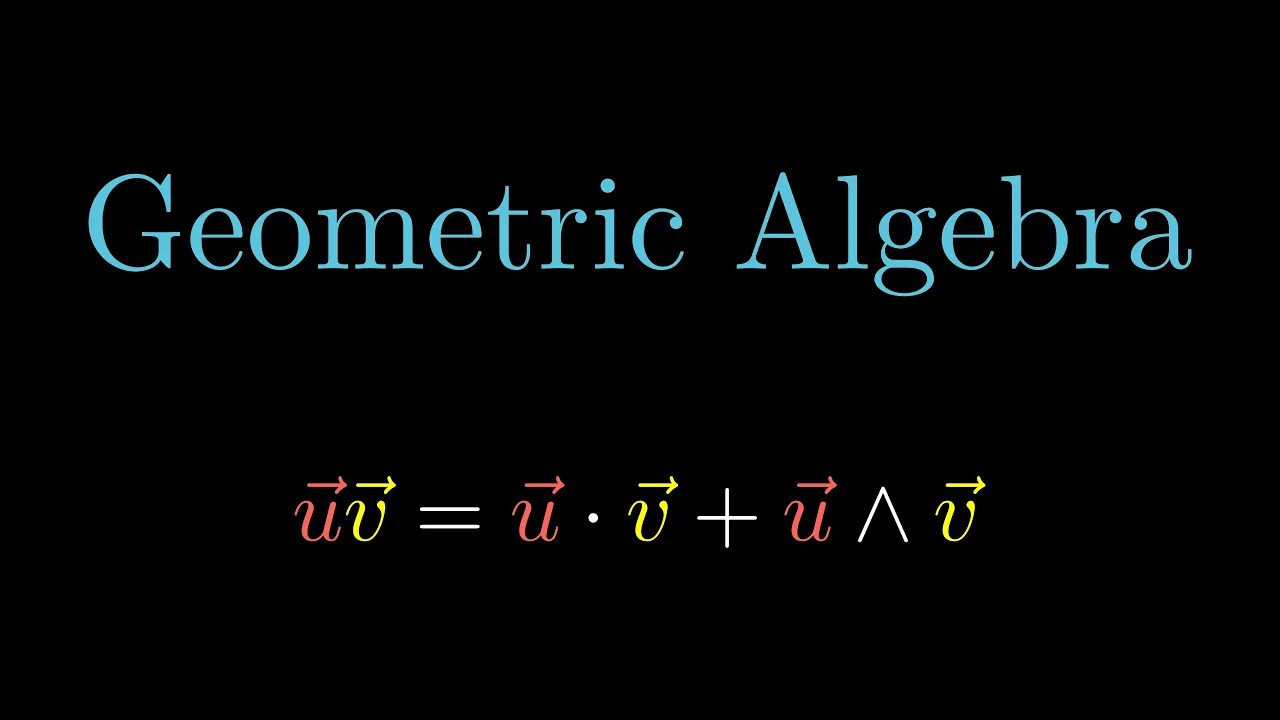


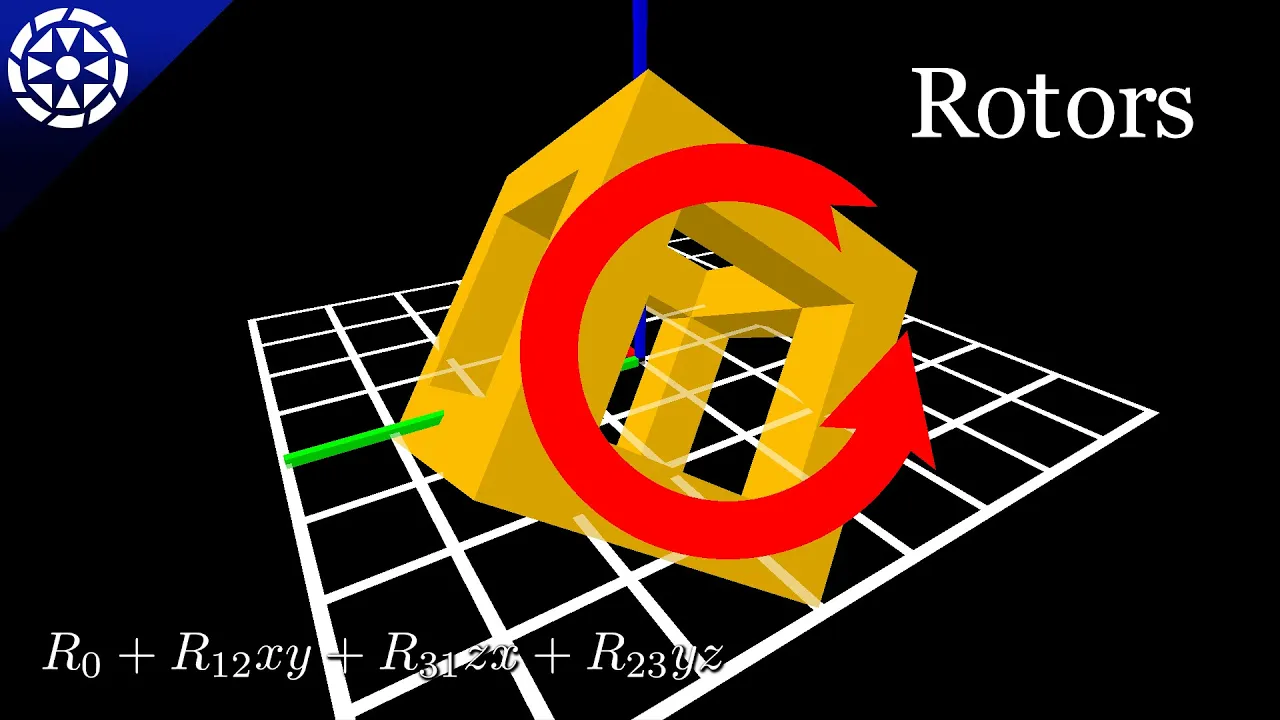


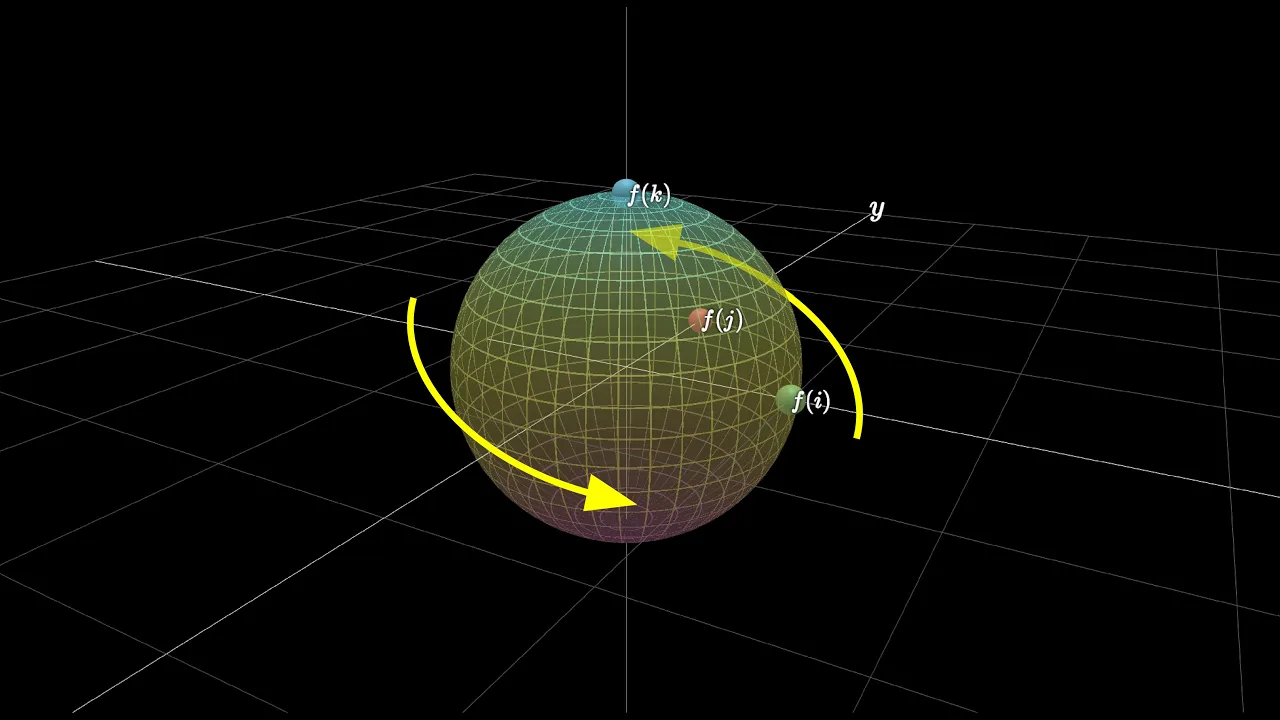
In geometric algebra, a 3D rotation can be achieved through double reflection across two unit vectors V and W separated by half the desired rotation angle θ/2, expressed as U' = WVUW. This double reflection is equivalent to a rotation by angle θ in the plane containing V and W, with the orthogonal component of the vector remaining unchanged. The rotor formulation generalizes this as U' = e^(-θ/2B)Ue^(θ/2B), where B is the unit bivector defining the rotation plane. Importantly, rotors exhibit spinorial behavior, flipping sign under a 2π rotation but returning to their original state under a 4π rotation, demonstrating that the rotor group double-covers the rotation group SO(3).
Geometric Algebra: 3D Rotations, Rotors, and Double Reflections
Added:Basic understanding of 3D linear algebra, including vectors, dot products, and traditional rotation matrices.
The fundamentals of Geometric Algebra (Clifford Algebra), specifically the geometric product and the concept of bivectors in 3D space.
The mathematical formulation of vector reflection across a plane using normal vectors.
Familiarity with complex numbers and Euler's formula, as they form the algebraic foundation for rotors.
The direct mathematical mapping between 3D rotors and quaternions, exploring why quaternions represent rotations.
Conformal Geometric Algebra (CGA), which extends rotors to handle translation, rotation, and scaling in a unified 5D framework.
The study of Lie Groups and Lie Algebras, specifically the double-cover relationship between SU(2) and SO(3).
Applications of spinor and rotor algebra in quantum mechanics, such as describing the spin of electron wavefunctions.
Practical implementation of rotors in computer graphics, game engines, and robotics for smooth spatial interpolation (SLERP) and kinematics.
24.6K views573likes48:59Original Release: 2017-04-09
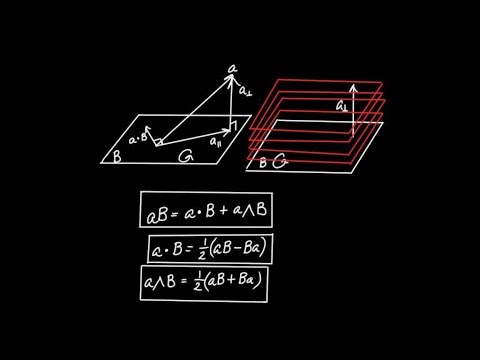
in this next video in the geometric algebra series what I'd like to do is push our concept of rotations past two Dimensions into three dimensions and also introduce the rotor concept the outline of the video is as follows we're going to first review the composition of Reflections that is we're going to review the fact that when we compose two Reflections we get a rotation then we're going to talk about threedimensional rotations and then I'm going to introduce the rotor let's first review how to reflect vectors through other vectors let's suppose I have some Vector U and another vector v and I want to reflect the vector U through V remember this consisted of taking the rejected part negating it and adding it to the projected part to form the newly reflected Vector called U Prime we derived the formula for how to c calculate this U Prime is equal to V inverse UV now in the special case where V happens to be of length one this implies that V inverse is the same as V in which case this formula actually simplifies to V UV so to take the vector U and reflect it through the unit vector v you hit it on both left and right with v through the geometric product now suppose we do this once again we're now going to take U Prime and another unit Vector let's say w reflect U Prime through W to generate uble Prime and algebraically that's got to be given by taking this vector v UV hitting on the left with a W and on the right with a w we discovered in the previous video that the composition of two Reflections is the same as a rotation and let's quickly review why that is let me first make this expression a little bit more intelligible by throwing some parentheses around it so I have WV * U * VW we can also observe that that WV is the inverse of VW because when you multiply WV * VW you get back to one so I write that in VW all inverse time U * VW now let's take note of that geometric product VW this is the product of the two vectors that we were using to reflect U these two vectors have an angle between them the angle from V to W I'm going to call the angle Theta / 2 and you'll see why it's the half angle in the second also remember that we had another way of writing this geometric product in general the geometric prop between two vectors can be written as the length of V times the length of w time e to the angle separating Theta / 2times the unit by Vector in the plane of V and W in this case let's suppose we're in two Dimensions so the unit by Vector will be E1 E2 now the length of v and the length of w were both one so this formula becomes simply e Theta 2 * I where I is equal to E1 E2 so we see that this VW is equal to e to the take over 2 * I that can be substituted to the right hand side and I'll do that in just a second what we we also have the inverse over here on the left hand side so VW inverse and what's the inverse of this exponential well it's just going to be the exponential with the negative up in the argument so minus th/ 2 * I which means that U Prime can be written as e to the Theta over 2 * I * U * e to the Theta / 2 * I and we have some experience with formulas that look like this what this formula means is that the transformation from U to U Prime is a rotation by Theta it's going to be the double of the angle found up here in the argument so double Theta over 2 or just Theta in the plane I in the E1 E2 plane we're assuming that which is working in two Dimensions so the angle of rotation from U to U Prime which I can draw in like this is actually Theta notice that it's double the angle between these two vectors used to do the reflecting so we have some experience composing Reflections to generate rotations in the plane in two Dimensions to generate these double-sided transformation laws and this is how I'd like you to think of rotations in general as occurring through a double-sided transformation law now in the special case where the vector being transformed is in the same plane as the B Vector up here in the arguments we can actually rewrite this as a single-sided transformation we found before that this is equal to U * e to the full angle Theta * I so in this special case where the vectors in the same plane as divide Vector you can do a little rearranging here but as I said I'd like you to think of this formula the double side transformation law is expressing what's going on in general with rotations so that idea of two refle being a rotation is actually quite powerful and I claim it's going to allow us to do three dimensional rotations too so to show you that let me draw in two vectors of unit length in three dimensions again I'm going to call that one V this one W let me also draw in the plane in which these vectors are sitting so V and W are sitting in this plane let's also suppose I have another Vector off the plane that I'm interested in rotating let me call that Vector U U and let's just do the same procedure as before let's first take U and reflect it through the vector v so I'm going to project this down onto V I get a projected part and a rejected part but then I'm going to negate that rejected part and bring that down there going to add this Vector to this Vector I get that Vector down there and just using the algebra this Vector is U then I hit it on both sides with a V and then I take this vector v UV and I reflect it through the second Vector W so again I consider both projected and rejected parts and I negate once again the rejected part add it to the projected part and I get this second factor which is going to be w v u VW just a before and I'll call this final Vector U Prime now I claim this Vector U Prime which let me write again I start with the vector U hit on both sides with a V and hit both sides with a W I claim that this Vector U Prime is the rotated version of U from U to U Prime in this plane through an angle which is double that angle just as before that is if I consider the angle between V and W to be as before Theta / 2 the angle going from U to U Prime along this Arc right here so this would be the motion of the rotation this angle coming from here to here is going to be the angle Theta so in the abstract doing these threedimensional rotations isn't very difficult let's suppose you had some plane that you're interested in rotating in and let's say you have some angle Theta that you want to rotate what you do is you take two vectors of length one in that plane and you make those angles have an angle of theta over two between them and then what you do is a double reflection through both of those vectors you start with U reflect through V hit on both sides with a V and then both sides with a W and that's all there is to it but let me further spell out why this double reflection is doing what I claim it's doing it's taking U and it's rotating over to U Prime and it's doing a rotation in this plane given by V and W here I have a similar diagram with the two unit vectors V and W having an angle of separation of theta over 2 and I have another Vector off the plane being defined by V and W called U and U is a vector that I'd like to rotate by an angle Theta and let me also point out this that this plane has the same orientation it represents the same same plane up to a scalar multiple as the B vector v wedge W which means this plane has an intrinsic orientation given by that symbol there so what I'm going to do to try to convince you that this double reflection operation is a rotation in this plane what I'm going to do is I'm going to break the vector U up into two parts first a part which is in the plane let's suppose that Vector right there is the part of U in the plane so it's going to be U parallel this is just the projection of U onto this plane and then I have the vector which is off the plane which is orthogonal to the plane which I'm going to call Ur So I'm going to write U as the sum of U parallel and U per so I have W * V time U parallel plus u per then times VW and then what I'm going to do is simply distribute to both terms here so my first term is going to be WV throw parentheses around there times U parallel then times on the right VW so that's the first term the second term is going to be WV time U perp times VW just Distributing now let's observe this term a little we see that uur is completely orthogonal to the plane now if it's orthogonal to the plane it must also be orthogonal to both V and W and remember that when you have two vectors which are orthogonal let's say I have two vectors A and B and A and B orthogonal I can swap the order of the geometric product just I just have to stick in a minus sign so AB would be equal to minus ba so I'm going to use that feature there orthogonality of uur to both V and W like this I'm going to swap the order with v I'm going to move it right there that's going to introduce one minus sign then I'm going to also move Ur to the front right there which will introduce another minus sign so overall once I swap the orders what I get is plus u perp times w v VW now what I have here is ur * W * V ^ 2 * W what's v s remember I assumed V was of unit length so v^2 is just one so I have uur * W * W or W ^2 and again I assume that W was of unit length so that term actually simplifies down to U per so what that means is that taking the orthogonal part of U to the plane and doing a double reflection upon that Vector with V and W at the end of the day that returns urp so the double reflection does nothing to urp so we see that the double reflection through V and W does nothing to urp but what does it do to the parallel part of U the part of youu in the plane well let's just examine this formula this form for is saying that what I have to do to generate the vector that comes out of this whole expression is do the double reflection first through V and then secondly through W but look at look at this U parallel V and W are all in the same plane and we use our knowledge from before of doing double Reflections in the plane to generate rotations so what this this first expression is tell me is that U parallel gets reflected through V first I draw that in there that would be the first version of U parallel let me call that U parallel star and then I do another reflection through the vector W that's that gets reflected over here and let me call that one U parallel Prime and again we use our know Knowledge from before the angle between U parallel and U parallel Prime this angle from here to here is going to be Theta it's going to be twice the angle of separation between these two vectors so this whole thing is going to be what I have in the diagram U parallel Prime that's equal to U Prime so U Prime is going to be the sum of this Vector with this Vector which was Untouched by the double reflection so I'm going to try to draw that in right there that U per which was unchanged so I have this vector plus this Vector so let me draw on the sum there that Vector is U Prime so we see that for U the part of the vector in the plane was rotated by the angle Theta and the part out of the plane the part orthogonal to the plane was left untouched and that suffices to show that this double reflection is doing exactly what I said it's taking the vector U and it's rotating it over to the vector U Prime in that Arc by the angle Theta the angle twice the angle of separation between V and W as you can see I didn't have to teach you very much more we're just extending our ideas of double Reflections into the three-dimensional case and let me also repeat what the general strategy is in the abstract for doing threedimensional rotations so you have some plane in mind that you want to rotate in so what you do is you select two vectors let's say V and W which are both both of unit length and which have an angle separation of half the angle that you want to rotate by and you do the double reflection of the vector of Interest let's say U first through V and a diagram I had that drawn down here and then secondly through W up to there and that's really the punchline of this whole video about threedimensional rotations that's it's equivalent to a double reflection just as before let me also point out one thing which is absent from this discussion of threedimensional rotations and that was any talk of doing a rotation around an axis now often times when you talk about threedimensional rotations you might say something like I have a vector of Interest let's say U and I'd like to rotate by an angle Theta around an axis now that's something we didn't talk about in this video and we don't have to and the reason being that this whole talk of rotations occurring in a plane is the superior way of thinking about that talk of rotating around an axis only works for two dimensions and three dimensions anything higher than three dimensions that won't work but this talk of gener of doing rotations in a plane in a two-dimensional Subspace will generalize to higher Dimensions so this idea is actually the superior way of doing it in the abstract so let me show you an example of that double reflection producing rotation in action so what I'd like to do is rotate the vector U E1 plus E3 in the E1 E2 plane by the angle Theta 2 so what I'd like to do here's my my three directions E1 E2 and E3 here's my Vector of Interest U which is E1 plus E3 and I'd like to do a rotation in the E1 E2 plane or the XY plane if you will and also notice when I specify the plane I've also specified the orientation to the rotation so E1 E2 so I'm interested in rotating in that direction in the plane by this angle Theta equal pi/ 2 so let's set up doing this three dimensional rotation through a double reflection so I have my plane in mind and what I now need to do is pick two unit vectors in this plane which are separated by half this angle so if Theta is Pi / 2 the half angle th/ 2 is going to be pi over 4 so I've got to pick two unit vectors in this point which are separated by 45° Pi 4 so that's not too difficult to do let me select the first Vector to be just E1 so let me have that be my vector v write that over here V is equal to E1 and I've got to select the second Vector W so that's got to be 45° so that's going to be in this direction in the E1 plus E2 Direction but remember I've got to make that a normal vector and that's easy to to normalize the normal the normalization of E1 plus E2 is going to be 1/ < tk2 E1 + 1/ < tk2 E2 so if I draw that Vector in here that's going to look something like that that's going to be my Vector W notice the angle of Separation here is pi over 4 and also notice that everything is oriented in the right way I have V first then W so I'm doing the rotation in that direction as opposed to the reverse Direction and what I'm going to do is doubly reflect U so I start with U multiply on the left and right by V and then left and right by W that's going to generate U Prime to do this computation what I'll first do is take the geometric product V * W so VW that's the do product plus the wedge product what's product between these two that's going to be 1 over < tk2 the wedge product just by examination that's going to be plus 1 / < tk2 E1 E2 so it's VW what's WV remember when you swap the order here you only swap the sign of the wedge product part you keep the grade Zero part the same so the do product is going to also be 1/ < tk2 and then you should swap the sign of this so this is minus 1 < tk2 * E1 E2 and as before you can check that these two are inverses of one another when you multiply the two you get back to one so let me substitute everything in there so we see that U Prime is going to be 1/ < tk2 minus 1/ < tk2 E1 E2 on the left my Vector U is E1 plus E3 and then on the right we have 1 < tk2 + 1/ < tk2 * E1 E2 and if you do this computation it's very simple to do just distribute all the stuff out what you'll find is that U Prime is equal to E2 plus E3 so the newly rotated Vector if use right there U Prime is E2 plus E3 so that's U Prime so U gets moved over there now if you just examine this figure using our knowledge of double Reflections this results that U Prime is equal to E2 plus E3 should make sense because U that's E1 plus E3 the part of U in the plane of E1 E2 that is U parallel is simply E1 and the part orthogonal to the plane is E3 so that's the part in the plane we rotate the part in the plane 90° swing it over to E2 then add it part add it back to the perpendicular part of the plane because that's untouched and that generates U Prime you can also see that the part of the vector in the plane E1 when it under goes the double reflection first through V which does nothing and then it gets reflected through W that moves it over there like that and yet in another way you can see that this result makes sense is that if you just start with the vector U First reflect it through the vector v that gets sent down there somewhere so something like that and then reflect it a second time through W that gets moved up to U Prime so a number of different ways you can see that this result makes sense one other thing to point out about this example is that we can write these Geet products VW and WV as exponentials just as we were doing for two dimensional rotations and this is going to lead into our talk about rotors so what I'm going to do is I'm going to rewrite this formula as I did before as VW all inverse * U time VW remember that VW V and W are both of unit length which means that this can be written as e to the angle separating the two the angle separating the two was Pi 4 times the unit by a vector in the plane of V and W in this case that was E1 E2 now the inverse of this is as before you stick a minus sign up there in the argument so this is going to be e to the minus pi over 4 E12 which means I can just rewrite this formula in my example to calculate U Prime what I do is I multiply U on the left by minus pi over 4 E1 E2 and then on the right by e to the plus pi over 4 E1 E2 so we're going to see this formula come up again and again again we see this double-sided transformation law and you see that in general if I think of just U as a variable Vector U does doesn't necessarily have to be in the plane of E1 E2 this Vector can be wherever it like it doesn't have to be in the plane of E1 and E2 which means I can't swap the order here and write it as a single size transformation law which means this is actually the general transformation law for doing precisely what I have here in Ro rotating in the E1 E2 plane by pi/ 2 the point I'm really driving at here is that again if we think of U as just a very variable Vector we want to transform U into U Prime by rotation the right pair of objects for the job would be this pair of exponentials here this pair of exponentials is going to do precisely this job it's going to rotate in the E1 E2 plane by Pi / 2 and it's always going to have this sort of form up here in the argument you're going to see the half angle times the unit by Vector associated with the RO I want to do and this pair is what we're going to talk about in just a second it's going to involve the rotors but let me first make a few uh prun comments about bi vectors the reason I've got to make a few comments about by vectors is because I use the term unit by Vector just there so I've got to tell you how we're going to measure the length of these B vectors so let's consider some general b Vector in G3 which is given by a * E1 E2 plus b * E2 E3 plus C * E3 E1 just some linear combination a B and C of the basis by vectors and what I'd like you to check is that when you square this Vector under the geometric product you actually get something very nice you get a pure scaler pure grade zero and the grade zero thing that you get is actually the negative sum of squares of the components of the B Vector so this is actually pretty nice because if we were to think of this thing as just some abstract Vector this is how you normally to find the square length of a vector you just take the sum of squares of the components that's the squar length of a vector and that's actually what I'm going to do I'm going to define the length or the magnitude squared of these B vectors to be the negative of the square of the B Vector under the geometric product which is simply to say that's a squ plus b^2 plus c^2 and the unit by vectors so we're going to say that a b Vector is of unit length when the length is one which implies that b if it's Unit B will Square to minus one under the geometric product so hopefully that's not too difficult you just treat these uh B vectors as pseudo vectors which is the term I used a few videos ago and you work with lengths as you would normally expect to work with them and by the way these lengths what they mean is the amount of area contained within these B vectors so it's it's actually a very natural definition for example if we had the B Vector which is not necessarily of unit length let's just make one up let's say E1 E2 plus E2 E3 minus E3 E1 so this represents some oriented patch of area in the plane and we see that just by summing up the squares of the components we have 1 s+ 1 s+ 1 s so the square length is three which immediately tells me that this B Vector squares to minus 3 and what I can do to normalize this B Vector is divide by the length just as I do with vectors so the length of this thing is a square root of three just the square root of this so that means that the the unit by Vector in this plane with the same orientation is actually 1 over < tk3 * E1 E2 plus E2 E3 minus E3 E1 so this is actually pretty natural you just work with these as you would with vectors so let's return to our talk of rotations through double Reflections so I have some Vector U I hit it on both sides with a V which is of length one and then on both sides with a W which is also of length one so if it's a double reflection so it generates a rotation and I'll throw on some parentheses there let me now introduce the concept of the rotor so the rotor as the name suggests is going to be the sort of mathematical object which rotates vectors when it acts upon them and the rotor is going to be defined in general as the geometric product of an even number of unit vectors in this case we see on both sides of U an even number namely two geometric product of two unit vectors so what I'm going to do is going to Define def the rotor r as a geometric product of w and V so certainly an even number of vectors and these again we both we assume that these are both of length one and then what I'm going to do is I'm going to Define another rotor which I'm going to symbolize by R dagger and this is going to be the reverse rotor that is it's going to be the geometric product of these two vectors written in the reverse order as the name suggests so instead of WV it's going to be VW and notice this is what we have on the left hand side here and VW is what we have on the right hand side so what these definitions allow us to do is write U Prime as start out with u act on the left hand side with the rotor R and then act on the right hand side with the reverse rotor R dagger there are a couple important things to immediately notice with these this pair of rotors is that these are inverses of one another that is to say R dagger is the inverse of R now why is that well let's multiply R dagger and R so R dagger is VW and then R is WV so that's equal to R dagger * R remember we have W * W so we have VW ^2 * v v w is of length one so this simplifies to v^2 V is also of length one so that simplifies down to one so we see that these are inverses of one another and if you do the same procedure for our our dagger you'll see that this is also going to be equal to one let me just write that out that's going to be W * V * V * W and again that's W * V ^2 W which is equal to w^2 which is equal to one so we see we also have this additional property of the rotors which is that R dagger R is equal to R * R dagger and these are all equal to one so that's an important property of these mathematical objects called rotors when you multiply them by the reverse on either left or right they're equal to one another important thing to notice too if you do the reverse of rotor of r twice you get back to itself that is say our double dagger our dagger dagger is equal to one is equal to R now what's nice about these rotors is that they immediately isolate out the sorts of mathematical objects in the geometric algebra which do rotations so let's now ask the question what does a general rotor look like so we see that it's going to be a product of an even number of unit vectors but what does that look like it's actually going to look like something we've seen before so let's say I have actually let's start with r dagger so we have R dagger it's going to be V * W writing that out as a geometric product we're going to use the exponential form in just a second but let me write out the long form so we have v.w plus v w w again this is equal to like the V like the W cosine of the angle in between them but I'm going to call the angle in between them Theta 2 that half angle that's the do product part in the product part is going to be length of V length of w time the S of the angle between them which I'm calling Theta 2 now this is going to be times the unit by Vector in the plane of V wedge W so this unit by vector v is going to be in the same plane but it's going to be of length one that is to say B is going to square to minus one that's an important property B B has got a square to minus one if we're going to write it in exponential form so as I said V and W are of length one so I'll just get rid of these so we're left with cosine Theta / 2 plus sin th/ 2 * b b s is to minus one so we're going to use oil's formula to write this up in exponential form so this is going to be e to the Theta / 2 * B so that's what R diag looks like and remember r and r our dagger or inverses of one another so we'll do just as we did before to generate the inverse that amounts to sticking a minus sign up there in the argument so if R dagger is e to the Theta 2 * B that means that R is equal to minus Theta / 2 * B and if you had written out R in this form before you get the sign flip from this watch product part one other thing to point out before I forget so we had this expression in terms of cosiness and SS for R diager I can also do the same for R just using Oilers formula and reverse this is going to be equal to cosine of minus the 2 but cosine is an even function so the argument is just going to be Theta over 2 that's going to be plus S ofus the/ 2 but sign is even so the minus sign comes out front so actually minus s Theta 2 and then times B so notice the between R and R dagger they just differ in this sign here and here and this is actually very similar to uh conjugates what you see in complex numbers and that this first this first term dealing with the cosine when you take the conjugate it's left alone whereas this I guess you can call it the imaginary part dealing with the sign is flipped another thing to notice too about these rotors is that the terms that they contain are only of even grade that is you see a term of grade Z here the scalar part and you see a term of grade two over here with the V Vector there's no grade four in G3 so these rotors only contain terms with grade zero and grade two elements so these two facts about rotors that R is equal to e to Theus Theta over 2 * B and the r dagger the reverse rotor is equal to e to the plus Theta over2 * B allows us to rewrite this expression in the following way you Prime is equal to eus th/ 2 * B * U then e plus th/ 2 * B so this expression here is actually the general rotation formula also combined with this formula here the rotor form these are the general formulas for doing rotations in three dimensions so these are the most important for formulas of the video and you can see right from this formula here it tells you everything you need to input into this formula to do a 3D rotation you need to tell me what angle you want and you see the half angle is actually appearing in the arguments here and you have to tell me in which plane you'd like to do the rotation and that B has got to be of unit length that is you want b^2 to be equal to minus one which isn't too difficult to do as we were saying before with normalizing these by vectors you just specify the plane if it's not of unit length just normalize it as you would with any other Vector just make sure that b^2 is equal to one to minus one these rotors are also very nice for an abstract analysis of rotations too so let's say I have some rotation in mind I have a unit by Vector in which I'd like to rotate and I also have an angle let's say I form the rotor pair R1 and R1 dagger so these two will do a rotation in the double-sided fashion that is U some input Vector gets mapped to R1 U R1 dagger so that mapping will rotate the vector U now let's suppose I do a second rotation and let's say that second rotation is being done by the rotor pair R2 R2 dagger so that's easy to do just take this Vector because this is just going to be a vector when the dust settles this gets mapped again in the two-sided fashion two we start with R1 Ur R1 multiply on the left by R2 and then on the right by R2 dagger so we actually see that the composite rotation is given by multiplying by this thing R2 * R1 on the left and then this thing R1 dagger time R2 dagger on the right of U writing this out in a different way the doubly rotated version of U which I'll call uble Prime is equal to this thing R2 R1 on the left time U times this thing on the right but I claim this thing on the right is also equal to R2 R1 all daggered and the way to show that is just to multiply this and this using the rotor laws and you'll see that this thing this R1 dagger time R2 dagger is indeed the dagger of R2 R1 one but hopefully the algebra looks natural here um this dagger thing works very similar to a transpose operator or an inverse operator in Matrix algebra so what this means is that the composition of two rotations is given by a new rotor which I'm going to call R3 which is equal to the product of rotors R2 * R1 and it's corresponding dagger the dagger rotor R3 dagger is going to be R1 dagger times R2 dagger now this fact that the geometric product of two rotors is itself another rotor that's something I'm staying without proof but I'm going to further develop that idea when I talk about querian because these rotors are very intimately linked with unit querian and if you know anything about querian you might know that the product of two unit unit querian is another unit querian so the set of all unit querian is closed under the quaternionic product that is to say it forms a group likewise these rotors form a group with the group operation being the geometric product so these rotors actually form a group which is a very nice abstract statement and coupled with their dagger rotor when they act upon vectors in the two-sided fashion given here they do rotation another nice thing about G3 is that all the rotors in G3 look like e to the minus Theta 2 * B so they're just the exponential of some by Vector so let's say R1 is given by e to the minus Theta 1 / 2 * B1 so Theta 1 is just the angle associated with the first rotation and B1 is the plane associated with the first rotation let's say I have the second rotor that's going to be e to the minus Theta 2 over two * B2 so this is going to be the second rotation so this is going to be the first one this is going to be the second one so this is saying that R3 the new rotor is equal to the product of this times this in that order and what's actually nice and you can show this yourself if you want to work through the mess is that this is the exponential of minus theta 3 theta 3 is some new angle over two * B3 or B3 is some new plane and what this is saying is that if you do the composition of two 3D rotations in the order r1's first and then R2 second that can be done all in one step by some separate 3D rot all in one step given by this rotor and its dagger pair so I'm studing a lot of things about rotors without proof in this video but I intend to develop these ideas a bit further in future videos my intention here is just to give you a little introduction to rotors there are a couple more things I'd like to point out before I conclude this video the next thing I'd like to point out if we go back to our transformation law you prime is equal to r u r dagger now I claim that for any rotation that you can conceivably want to do there are two pairs of rotors which will do that job just as well so the first pair is going to be this r r dagger pair when they act two-sided and the way to observe the second pair which will do the same rotation job is to Simply multiply this thing by one but of course going to be a little bit clever multiply by one by multiplying by by -1 * -1 this is equal to minus- Ru R dagger I'm going to move that minus sign over here to the r dagger I'm going to rewrite this as minus r * U * minus r dagger so we see that the rotation job can be done by multiplying by r r dagger two-sided or it can also be done by multiplying by minus r R dagger two-sided so this pair and this pair minus our dagger will perform the same rotation that is to say for any rotation you can want to do you can pick the r or the minus r rotor with its corresponding dagger pair to perform that rotation and the way you often hear this stated abstractly is that the group of rotors double covers the rotation group that is for any rotation you can want to do there are two rotors which will do the job when coupled with a dagger pair so let me give you an actual example of that let's say I have some Vector U and what I'd like to do is do a 2 pi rotation so I'm just I'm going to swing the vector around 2 pi radians so intuitively the vector shouldn't change what I get here on the right hand side should be just U so what rotor will do the job of a 2 pi rotation so we used a formula we saw before that R is equal eus Theta 2 * B since we're doing a 2 pi rotation it doesn't really matter what the B is so I'll leave that it's just B Theta is 2 pi so the half angle is actually minus Pi time B so that means that this rotor using Oiler Formula E - piun over * B is equal to -1 just like e to the - piun * I is equal to minus one so that's actually the first rotor that you could use you could use R let me call that R1 and it's dagger which remember I said this is very similar to The Complex conjugate the conjugate of this is just minus one so the way you could do this 2 pi rotation is just to multiply in the left by minus one then we have U then on the right by minus one of course that's equal to U or you can use the negative of rotor one which is of course one and that dagger pair or two dagger is also going to be one so you can also do 1 * U * 1 which is also equal to U so you can use the rotor minus one or one to do a two Pi rotation the last thing I'd like to point out in this video about rotors is that they behave a bit strange under two Pi rotation so let's say I have some Factor U and I just perform some rotation upon it I have some rotor R1 that multiplies it U on the left and then R1 dagger multiplies on the right just a usual two-sided transformation law so I have this newly rotated Vector what I'd like to do is take that newly rotated vector and perform a 2 pi rotation upon it so intuitively when I take this Vector swing it around 2 pi radians it should be returned back to itself but let's write out the rotor that's going to be needed to do the job of this 2 pi rotation so again this is going to be e to the minus half angle time B for the 2 pi rotation again the B doesn't really matter so plugging in theta equals 2 pi I get eus piun * B and again using Oiler formula I get minus one for R2 so R2 dagger will be the conjugate of this which will be minus one so what that means is that this thing gets multiplied by the rotor on the left which is going to be e to the minus Pi * B * R1 this will be the new composite rotor time U and then I have R1 dagger that e to the plus pi * B because that's a conjugate this thing in the left here we saw this is equal to minus one so this new rotor becomes minus R1 * U this e to the pi * B that's also by orderers fora minus one so on the right the new rotor on the right is going to be minus R1 dagger and we can notice that after You Yank out these minus signs this expression here is equal to this expression so as we expect the vector when undergoing a 2 pi rotation doesn't change but what happened to the rotor R1 when we do a 2 pi rotation so we see that the rotor started out as R1 when we do a 2 pi rotation the rotor becomes minus R1 so that's a little bit weird so we swing the vectors around 2 pi but then the rotor flip sign so what this actually implies is that if I do a 2 pi rotation yet again this will flip sign once more and it'll return to itself which in turn implies that if I had done a 4 Pi rotation the rotor would have been invariant so vectors are invariant under a 2 pi rotation rotors are invariant under a 4 Pi rotation but they flip sign Upon A 2 pi rotation and mathematical objects which do precisely this they're invariant under a 4 Pi rotation but they flip signed under a 2 pi rotation these sorts of mathematical objects are called Spinners so these sorts of mathematical objects that actually require two revolutions to be returned to their initial state but if you do one revolution they actually flip sign these are actually very useful in application and also at the abstract level so this is one sort of neat thing that we're noticing just by a simple analysis of 3D rotations so I think that'll wrap it up for this video If you enjoyed the content consider subscribing to the channel like and comment on the videos blah blah blah leave your angry comments too I always look forward to those and and I thank you for watching
Up Next
11:03
Geometric Calculus 4: Fundamental Theorem & Analytic Functions
@AlanMacdonald1
16K views•2016-03-19
51:00
Conformal Geometric Algebra Explained: Lines, Spheres & Inverse Kinematics
@bivector
1.5K views•2024-09-05
36:26
Geometric Algebra: Rotors and Quaternions Explained
@Math_oma
17.1K views•2018-06-19

6:00
The Mathematical Impossibility of Accurate World Maps
@Vox
23.3M views•2016-12-02
Related Study Plans & Knowledge Roadmaps
Structured learning paths in Mathematics
mathematics
Tensor Calculus: Vectors to Riemann Curvature
01Mathematical Foundations: Linear Algebra & Calculus
02Covectors, Dual Spaces, and Tensor Basics
03The Metric Tensor and Index Gymnastics
+ 2 more learning modules
40h5 modules
Explore Roadmap
mathematics
Gödel's Incompleteness: Logic, Proofs & Limits
01Introduction to Formal Systems & Hilbert's Dream
02Set Theory, Cardinality, and Cantor's Diagonal Argument
03Arithmetization and Gödel Numbering
+ 2 more learning modules
14h5 modules
Explore Roadmap
mathematics
Galois Theory: Fields, Groups & Solvability
01Foundations of Abstract Algebra: Groups & Fields
02Polynomials & Field Extensions
03Splitting Fields & Symmetries
+ 2 more learning modules
24h5 modules
Explore Roadmap
mathematics
Non-Euclidean Geometry: Models & Geodesics
01Euclid's Fifth Postulate and the Birth of New Geometries
02Hyperbolic Space and the Poincaré Disk Model
03Geodesics: Defining Straight Lines in Curved Spaces
+ 2 more learning modules
15h5 modules
Explore Roadmap