


















The fundamental theorem of geometric calculus states that for a multivector-valued function f on an M-dimensional manifold M, the directed integral of the vector derivative of f over M equals the directed integral of f over the boundary ∂M, which unifies and generalizes classical theorems like the divergence theorem, Stokes' theorem, and Cauchy's integral theorem, while also extending complex analysis to higher dimensions.
Geometric Calculus 4: Fundamental Theorem & Analytic Functions
Added:Basics of Geometric Algebra: Mastery of multivectors, the geometric product, and the distinction between outer and inner products.
Classical Multivariable Calculus: A strong grasp of vector calculus, specifically the gradient, divergence, curl, and line, surface, and volume integration.
Classical Integral Theorems: Familiarity with the theorems of Green, Stokes, and Gauss (Divergence Theorem), as the video generalizes these concepts.
The Geometric Derivative: Understanding the vector derivative operator (del) and its algebraic interaction with multivector fields.
Clifford Analysis and Monogenic Functions: Exploring the higher-dimensional generalizations of complex analysis and holomorphic functions using Clifford algebras.
Applications to Classical Electrodynamics: Using the fundamental theorem of geometric calculus to reformulate and solve Maxwell's equations in a single, unified equation.
Generalized Cauchy Integral Formulas: Studying how Cauchy's integral formula and Cauchy-Pompeiu formulas generalize to arbitrary dimensions.
Boundary Value Problems and Green's Functions: Applying geometric calculus integral theorems to solve boundary value problems in physics and engineering.
Differential Forms and Exterior Calculus: Comparing the coordinate-free integration theory of geometric calculus with the framework of differential forms.
16K views297likes11:03Original Release: 2016-03-19
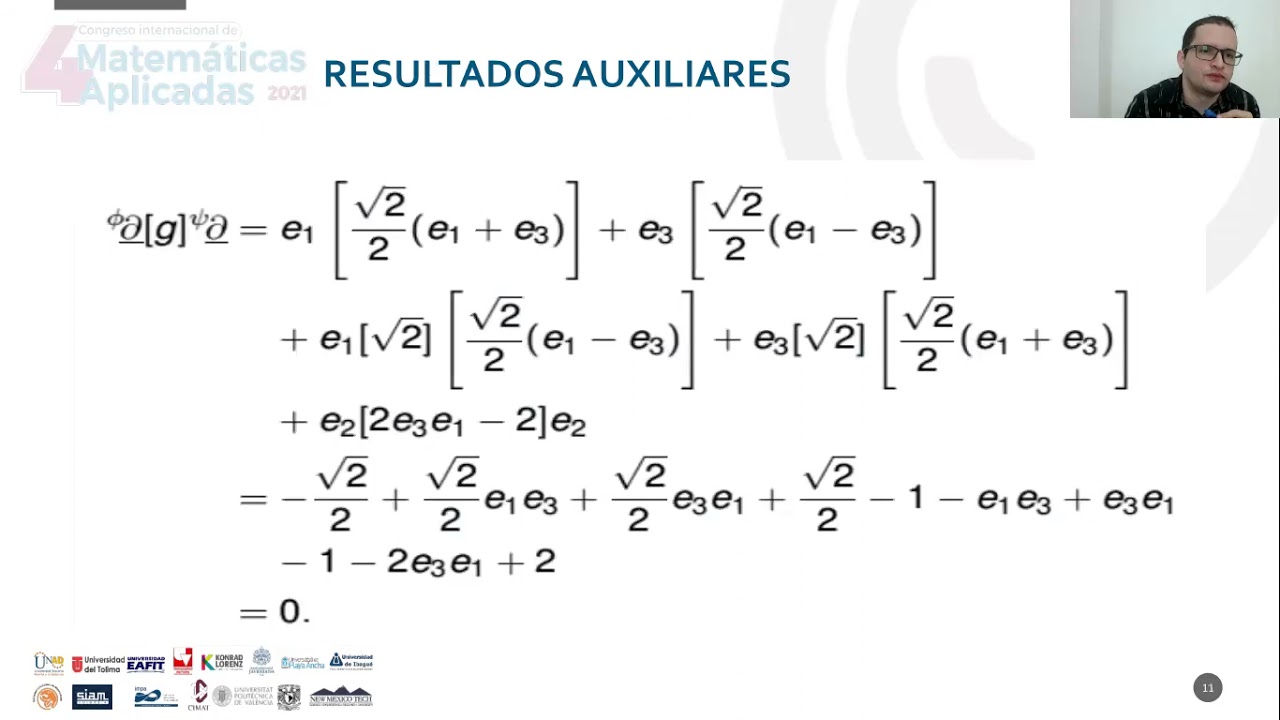
this part four of the playlist discusses the fundamental theorem first we need to discuss the boundary of a manifold I'll first state the theorem and then give some examples theorem the boundary of an M dimensional manifold m is an M minus 1dimensional manifold denoted with the partial sign again M and here are the examples first the m equal 3 case I have a solid ball a three-dimensional manifold M and its boundary is its surface a sphere which is a two-dimensional manifold here is the m equals 2 case this time the manifold is a hemisphere M and its boundary is a circle which is a onedimensional manifold and finally here's the m equals 1 case the manifold is a curve its boundary consists of its end points and we consider points individual points points to be Zero Dimensional manifolds before introducing the fundamental theorem of geometric calculus I'd like to have a look at the three important Vector calculus integral theorems and here they are now they look quite different but there are some similarities on the left side I have an integral over a manifold and inside of the integral I have some sort of a derivative of a function on the right side I have the function itself F and v a scalar valued function and I'm integrating over the boundary of the manifold on the left s the surface s is the boundary of the manifold v c is the boundary of the manifold s and one considers the integral over the boundary points of a curve to be the difference of the values of the function at the two end points [Music] there it is the fundamental theorem of geometric calculus let's see what the theorem says it equates two directed integrals one over a manifold and one over the boundary of the manifold the directed integral on the left is that of the vector derivative of a multiv vector valued function defined on the manifold on the right we have the directed integral of the function itself notice that the three previous parts of this playlist provide essential concepts for the formulation of this theorem in the next several slides we'll see that despite the despite the Simplicity of the statement of the theorem it has amazing power and has many powerful corollaries I'll let you have a look at it before I move to the next slide the first corollaries that we'll discuss are generalizations of the Divergence Theorem and sois Theorem or as I prefer to call it the curl theorem first the Divergence Theorem here is the standard statement in R3 here is the corollary it starts with an M dimensional manifold in RM here V is a three-dimensional manifold a solid in R3 n is the unit normal to the boundary of M recall that this D Sigma was a vector orthogonal to S and that orthogonality survives as this Vector n notice that these integrals are are not directed integrals but ordinary multiple integrals X is not bold here which indicates that this is a as I say a a standard multiple integral as is uh this curl theorem here is the standard formula for it in R3 and here is the general I ization an M minus1 Vector field on an M dimensional manifold f is a one vector that is to say a vector field on a two-dimensional manifold s the generalization then of this formula is this both generalizations follow from the fundamental Theory by some fairly simple manipulations let's see what the fundamental theorem has to say about G about complex analysis according to Honus and subject geometric calculus fully integrates complex analysis and real analysis into a single subject let's see some of why that's so here's the definition of an analytic function on a manifold f is some multi Vector valued function on the manifold and it's called analytic if its Vector derivative is zero now this truly is a generalization of the ordinary definition of an analytic function in a plane because in a plane this condition this analyticity condition is exactly the same as saying that the function satisfies the coy remon equations which are equivalent to F being an analytic function there's a bit of a peculiarity in that there's no function called the derivative of F this is a statement of koshy's integral theorem in standard complex variable Theory f is an analytic function in some region and if that's the case then the integral of the function around a closed curve is zero here is its generalization to manifolds if f is an analytic function on an M dimensional manifold M then the integral of f around the boundary the directed integral of f around the boundary is zero and for the proof we need only write the fundamental theorem if f is analytic then this is zero the left side is zero and so too is the right here's kosh's integral formula from standard complex variable Theory C is a closed curve in the plane f is a function which is analytic on the curve together with its interior the theorem says that the value of the function at a point interior to the curve Z KN here can be recovered from values of the function on the curve by performing this integration let's see what the generalization to RM is I'll start with a bounded open set in ourm not a general manifold that takes more mathematics I have a function f which is analytic on M and continuous on M together with its boundary then I can recover the value of the function at a point in the manifold by integrating F around the boundary of the manifold I subm is the unit Pudo scalar of GM Omega subm is the surface area of the boundary of the unit ball in RM when m is two that boundary is the circumference of the unit circle and uh we have 2 pi here once this theorem is established very many theorems from standard complex variable Theory generalize the key fact about an analytic function is that its values uh on the on a manifold can be obtained from its values on the boundary of the manifold
Up Next

47:15
Spin Groups & Clifford Algebras: From Quaternions to Any Dimension
@eigenchris
37.8K views•2023-09-17
51:00
Conformal Geometric Algebra Explained: Lines, Spheres & Inverse Kinematics
@bivector
1.5K views•2024-09-05
10:44
Fourier Series Introduction: The Big Idea Explained
@DrTrefor
387K views•2021-05-03

6:00
The Mathematical Impossibility of Accurate World Maps
@Vox
23.3M views•2016-12-02
Related Study Plans & Knowledge Roadmaps
Structured learning paths in Mathematics
mathematics
Tensor Calculus: Vectors to Riemann Curvature
01Mathematical Foundations: Linear Algebra & Calculus
02Covectors, Dual Spaces, and Tensor Basics
03The Metric Tensor and Index Gymnastics
+ 2 more learning modules
40h5 modules
Explore Roadmap
mathematics
Gödel's Incompleteness: Logic, Proofs & Limits
01Introduction to Formal Systems & Hilbert's Dream
02Set Theory, Cardinality, and Cantor's Diagonal Argument
03Arithmetization and Gödel Numbering
+ 2 more learning modules
14h5 modules
Explore Roadmap
mathematics
Galois Theory: Fields, Groups & Solvability
01Foundations of Abstract Algebra: Groups & Fields
02Polynomials & Field Extensions
03Splitting Fields & Symmetries
+ 2 more learning modules
24h5 modules
Explore Roadmap
mathematics
Non-Euclidean Geometry: Models & Geodesics
01Euclid's Fifth Postulate and the Birth of New Geometries
02Hyperbolic Space and the Poincaré Disk Model
03Geodesics: Defining Straight Lines in Curved Spaces
+ 2 more learning modules
15h5 modules
Explore Roadmap