
![Spinors for Beginners 10: SU(2) double covers SO(3) [ SL(2,C) double covers SO+(1,3) ]](https://i.ytimg.com/vi/Ay482u6b3Xo/hqdefault.jpg)














![Michael Atiyah, Seminars Geometry and Topology 2/2 [2009]](https://i.ytimg.com/vi/Xt6gBHSU36c/hqdefault.jpg)

![Consider The Source: 2013-06-14 - Disc Jam Music Festival; Brimfield, MA [Complete Set]](https://i.ytimg.com/vi/-i1Jdl9S0WU/maxresdefault.jpg)
![Index Theory, survey - Stephan Stolz [2018]](https://i.ytimg.com/vi_webp/1OML4_kaaTU/maxresdefault.webp)
![Michael Atiyah, Seminars Geometry and Topology 1/2 [2009]](https://i.ytimg.com/vi/lkGvymZqTDs/hqdefault.jpg)



Spin groups generalize quaternions and complex numbers to any dimension by using bi-vectors in Clifford algebras, where the spin(n) group consists of even-grade elements formed by products of unit vectors, serving as the double cover of the rotation group SO(n); this framework extends to spacetime via spin(1,3) for rotations and Lorentz boosts, with transformations performed through twisted conjugation using versors (products of vectors) that can be expressed exponentially as e^(Bθ/2) where B is a unit bi-vector.
Spin Groups & Clifford Algebras: From Quaternions to Any Dimension
Added:Fundamental concepts of linear algebra, including inner product spaces, quadratic forms, and orthogonal transformations.
Basic group theory, particularly matrix groups like the Special Orthogonal group SO(n).
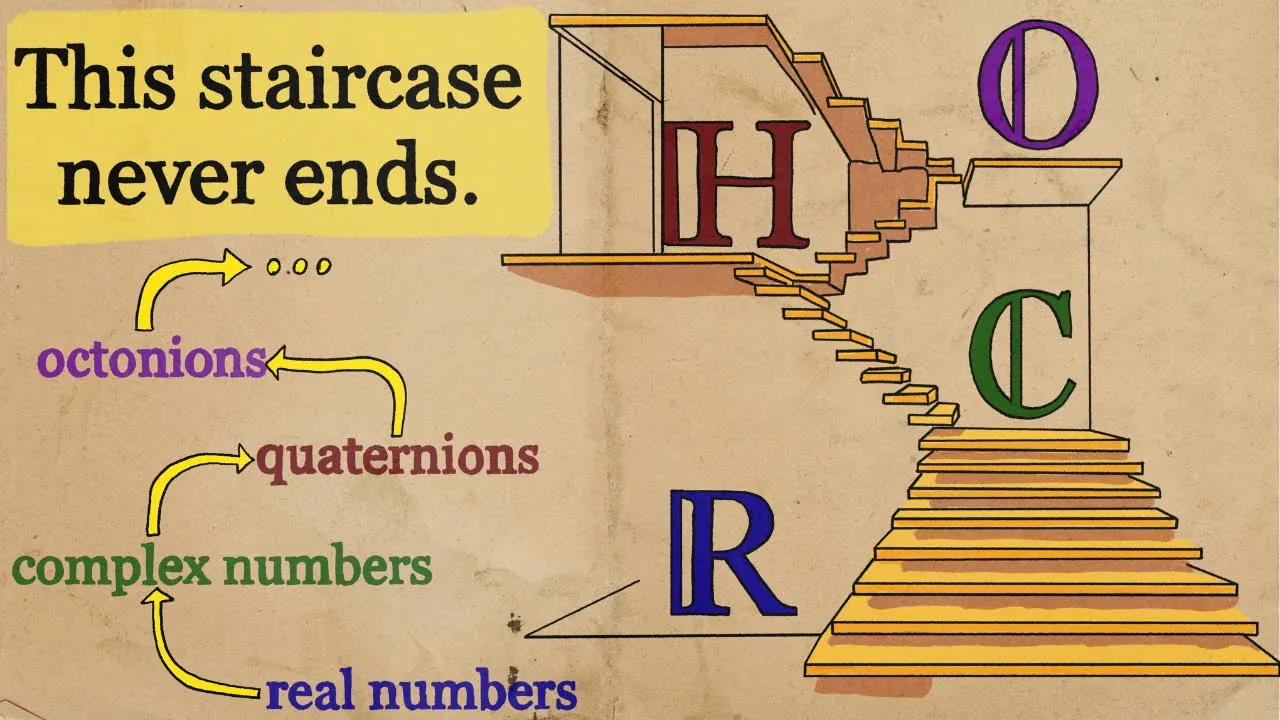
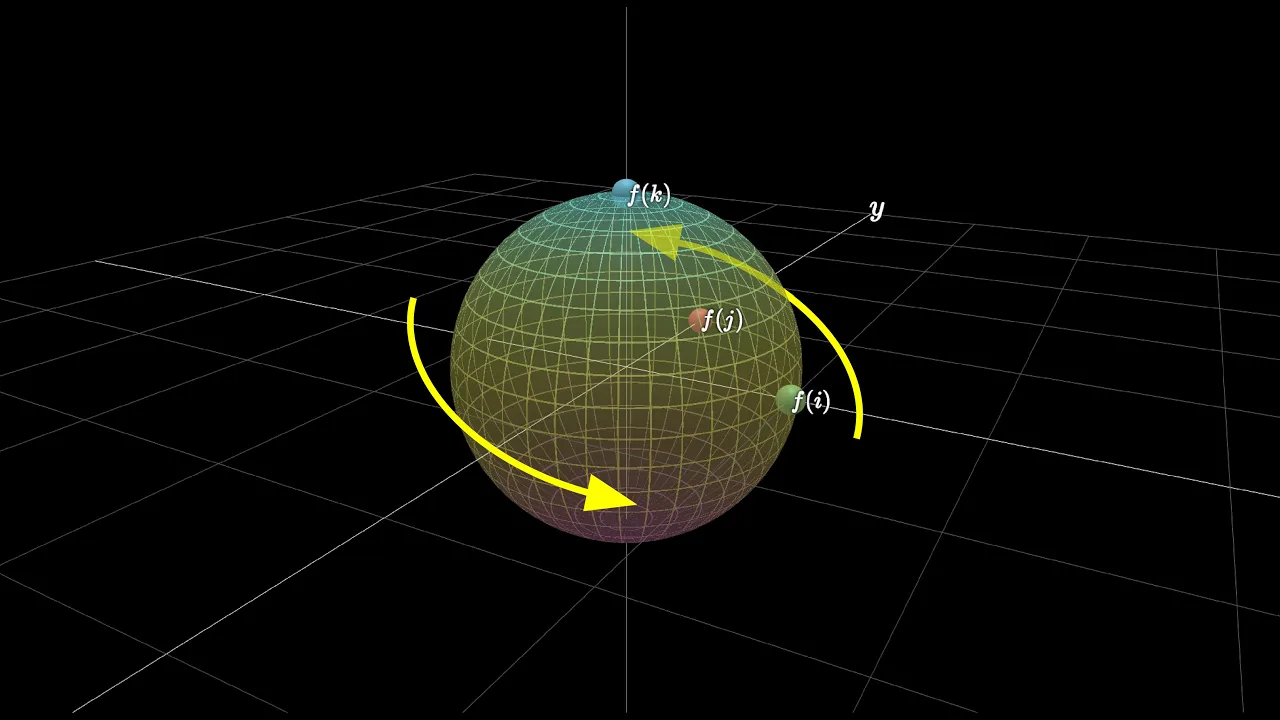
Understanding of Quaternions (H) and how they represent 3D rotations via conjugation.
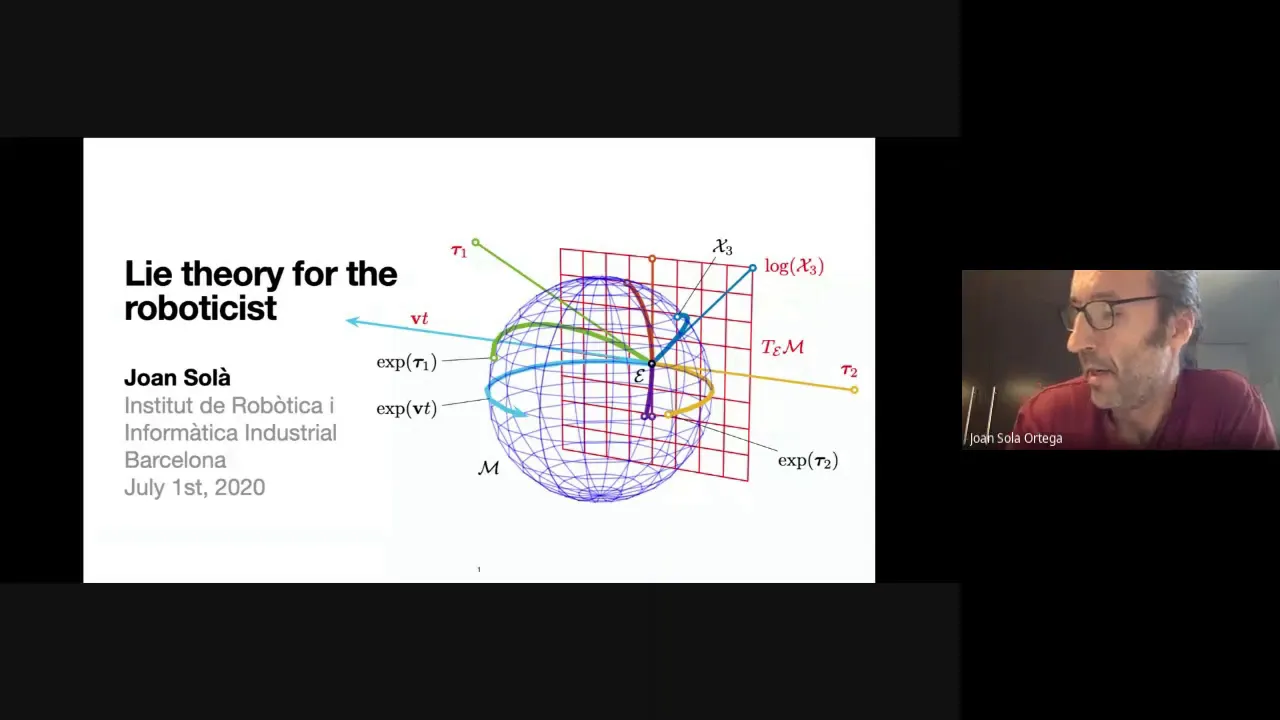
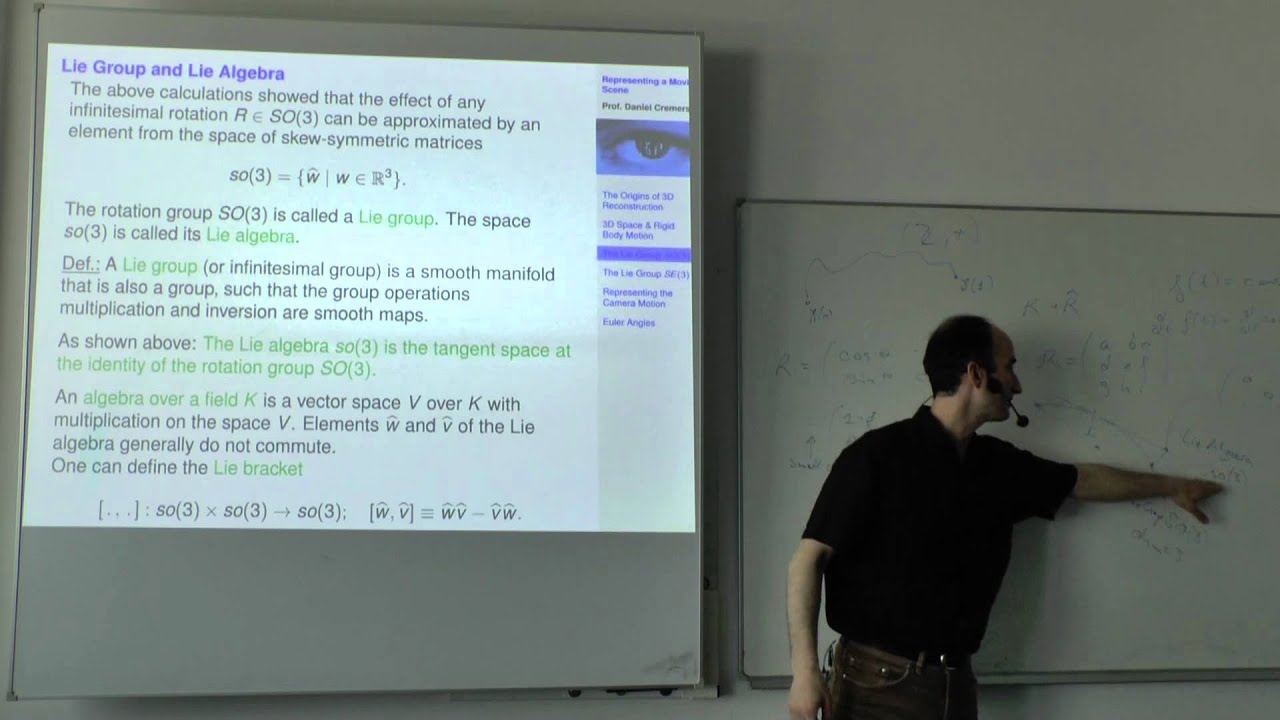
An introduction to Lie groups and Lie algebras, specifically the role of the exponential map.
The definition and algebraic construction of Spinors and their representation theory.
Applications in relativistic quantum mechanics, specifically the Dirac equation and electron spin.
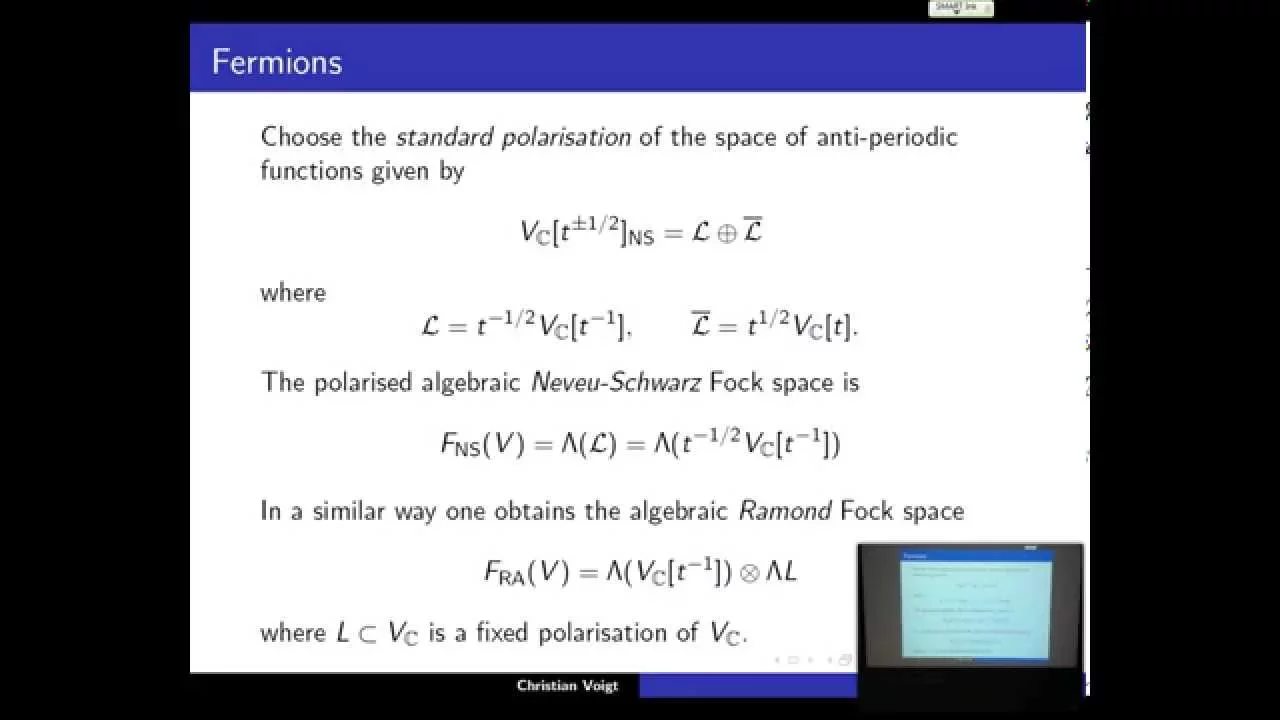
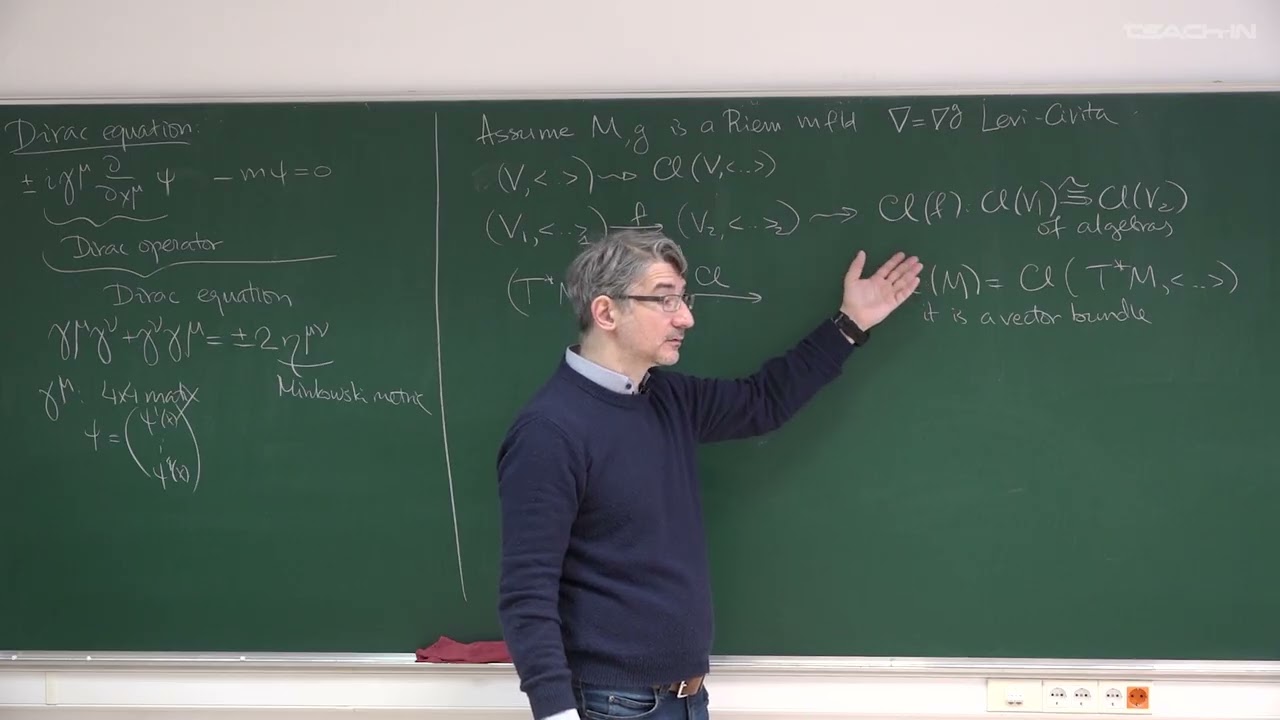
The study of Spin structures on manifolds and their role in differential topology and index theory.
Geometric Algebra (a branch of Clifford Algebra) and its practical applications in computer graphics, robotics, and physics.
37.8K views913likes47:15Original Release: 2023-09-17
in this video we're going to continue using Clifford algebras to generalize the complex numbers and quaternions to spin groups which help us do rotations in any dimension the unit length complex numbers are actually the group Spin 2 because they give us rotations in 2D space the unit length quaternions are actually the group spin three because they give us rotations in 3D space the spin and group is the generalization of these that gives us rotations in n-dimensional space we'll Define spin groups using Clifford algebras which are algebras where the basis vectors Square two plus one or -1 and where orthogonal vectors anti-commute with each other it turns out that it's better to view the complex I as the Clifford bi-vector Sigma X Sigma Y which represents a rotation in the X Y plane the unit quaternions are also better represented as bi-vectors instead of rotating around axis I we should think of rotating in the YZ plane and instead of axis J we think of the ZX plane and instead of axis K we think of the X Y plane the bi-vectors also multiply together to give us the standard quaternion multiplication rules because of the anti-commutative property since bi-vectors and Clifford algebras always give us rotations we can extend this pattern to work in any Dimension n where the bi-vector sigma a sigma B gives us a rotation in the a b plane this is how we Define the spin and group we can also generalize this to space time the group spin 1 3 gives us both rotations and lorentz boosts in one time Dimension and three space dimensions its generalization is spin PQ for rotations and boosts in P time dimensions and Q space dimensions in this video I'm going to show how Clifford algebras can be used to do Reflections and rotations on vectors in any Dimension this explains why Clifford algebras are also called geometric algebras because they allow us to easily perform geometric operations on vectors some of this video's content was already covered in video number six when I introduced the Pauli matrices and Paulie vectors but that video relied on matrices to do rotations this video will involve no matrices and only use abstract symbols from the Clifford algebras to do geometric operations before we start I'd like to go over some names we give to various members of Clifford algebras just so we're on the same page when I use them later the standard building block in Clifford algebras is the vector which belongs to some Vector space V ectors combined together with the wedge product give us bi-vectors Tri vectors or general K vectors also called k-blades the grade of a k Vector refers to how many vectors appear in the wedge product an arbitrary sum of K vectors is called a multi-vector when we have a Clifford product of vectors we call this averser note that the Clifford product of two vectors is not the same thing as a bi-vector since the Clifford product gives us the sum of a scalar and a bi-vector the Clifford product and wedge product are only the same if the two vectors are orthogonal and the dot product part goes to zero with this out of the way let's get started with learning about rotations and Reflections in Clifford algebras to start let's look at cl30 the Clifford algebra in 3D space with three orthonormal basis vectors that square two plus one which are Sigma X Sigma Y and sigma Z and when we multiply two different orthogonal basis vectors together we can switch their order if we include a negative sign since multiplication of orthogonal vectors is anti-commutative let's start with performing Vector reflections we reflect vectors by performing negative conjugation on them using the vector we want to reflect along let's see how this works if we want to reflect a vector along the z-axis this means we leave the X and Y components the same but change the sign of the Z component so this is like if the plane perpendicular to Z the X Y plane is a mirror that we're reflecting in reflection of a vector v along the Z direction is done using negative conjugation by Zed which means we multiply by Sigma Z on the left and sigma Z inverse on the right and include a negative sign in front for example reflecting Sigma X along Sigma Z looks like this the colors don't mean anything here they're just to make the formula more readable since Sigma Z multiplied by itself gives plus one this means Sigma Z is its own inverse so we can just drop the inverse operation after swapping we get an additional negative sign in front which cancels with the first negative sign also Sigma Z squared gives us plus one so we get Sigma X as a result it makes sense that Sigma X is unchanged when we reflect it in this mirror associated with Sigma Z the same is true for reflecting Sigma y along the z-axis but if we want to reflect Sigma Z along the z-axis sigma Z immediately cancels with Sigma Z inverse and so we get Negative Sigma Z so the sigma Z basis Vector has been reflected as expected if we take a general vector v which is a linear combination of Sigma X Sigma Y and sigma Z and reflect it along Z with a negative conjugation the X and Y parts are left unchanged but the Z part is reflected and gets a negative sign as expected now when we're doing reflection along a unit Vector that squares 2 1 such as Sigma Z its inverse is not required in the conjugation formula however if we reflect along a vector U which doesn't have unit length we need to properly calculate the inverse we know U times U equals the squared length of U we can multiply on both sides by U inverse cancel U and U inverse and then divide by the squared length so U inverse equals U divided by the squared length of U for example if we reflect along 5 Sigma Z its squared length is 5 squared so the inverse is 5 Sigma Z over five squared in the negative conjugation each factor of one over five serves to normalize the vectors in the reflection formula if they are not already normalized so we get the same reflection formula as if we had just reflected along a unit length Sigma Z vector we can prove this reflection formula works for any invertible Vector U we break V into portions parallel to U and perpendicular to you then distribute the parallel portion of V can be written as a scaled version of U using a scale factor k and the perpendicular part of V will anti-commute with u so we can swap their order and change the sign U and U inverse combine to one here and here and we can rewrite K times U as the parallel portion of V the result is V where the portion parallel to U is reflected with a minus sign and the perpendicular part is unchanged as expected so this negative conjugation formula breaks a vector v up into Parts parallel to U and perpendicular to you and it only reflects the part parallel to you we can also confirm that this reflection formula keeps the length of V unchanged if we take V times V and then reflect both V's the negative signs cancel and the inner uu inverse cancel V times V gives the squared length of V which is a scalar that can be moved here so that U and U inverse cancel so the squared length of V is unchanged by reflection now let's look at space time which has the Clifford algebra cl13 this has one dimension of time and three dimensions of space given by the orthonormal basis vectors gamma T gamma X gamma Y and Gamma Z according to the plus minus minus minus metric the time basis Vector squares two plus one and each of the space basis vectors Square two minus one and the basis vectors anti-commute with each other we could also choose to work in cl31 if we wanted which uses the mostly plus metric convention but for this video I'm going to work in cl13 which has the mostly minus convention let's review some of the basics of special relativity the lengths of space-time vectors are measured using the space-time interval formula given here as an exercise you can check that we get this formula when we square a space-time vector and that the Clifford algebra symbols give us all the correct signs looking at a space-time diagram the time-like vectors that point to the future or the past have positive squared lengths space-like vectors that point in spatial directions have negative squared lengths and lights like vectors that point along light beams have zero squared lengths it's very important to remember what orthogonality looks like in space time in ordinary space two vectors are orthogonal if they meet at right angles in space time a time-like vector and a space-like vector are orthogonal if they make equal angles with a beam of light this affects how Reflections work in space-time in ordinary space a reflection Vector defines a mirror that is orthogonal to it when we reflect a vector in the mirror the initial and reflected vectors form equal circular angles with the mirror in space-time a reflection Vector also defines a mirror that is orthogonal to it but recall orthogonality means forming equal angles with a light beam so the mirror looks like this when we reflect a vector in the mirror the initial and final vectors form equal hyperbolic angles with the mirror so this is a little more complicated than physical space but the basic idea is the same the Reflections in space time are done exactly as before with negative conjugation however note that the inverse operation on the right is always required if we reflect with a space like vector its squared length is negative and this negative sign is important to keep track of in the reflection formula gamma X for example is a space like vector this means that the inverse of gamma X is actually negative gamma X since gamma X squares to negative one this extra minus sign in the inverse is important to keep track of if we try to do a reflection this extra minus sign will cancel out with the minus sign we get from squaring gamma X ensuring that our result has the correct sign also some vectors in space time such as gamma t plus gamma Z Square to zero these are the light like vectors which point along the paths of light beams in space time because their squared length is zero lights like vectors have no inverse and so we cannot use them to reflect along four reflections you can think of a light-like vector as existing at an infinite hyperbolic angle so we can't use it to measure hyperbolic reflection angles with our initial and final vectors so reflections of vectors in physical space and space time both use the same negative conjugation formula this negative conjugation Works in all Clifford algebras of any Dimension as well not just 3D space or 4D space-time now let's look into doing rotations in physical space with cl30 a rotation can be thought of as a pair of Reflections for example if we take this flag and reflect it in this mirror then take the result and reflect it in this mirror we end up with a rotation of the original flag so if we want to rotate something all we need to do is do a pair of reflections also notice that the angle of the flag's rotation is twice the angle between the two mirrors that we used so if we want to do a rotation by some angle Theta all we need to do is pick two reflection vectors that are at an angle of theta over two apart let's say we want to do a rotation by angle Theta in the X Y plane first we reflect along the x-axis with Sigma X then we reflect along a unit Vector Tau which forms an angle of theta over two with Sigma X in other words Tau equals cosine Theta over 2 Sigma X Plus sine Theta over 2 Sigma y so let's see what our rotation formula looks like on a vector v first we reflect along Sigma X then we reflect along Tau the two negative signs in the double reflection cancel out also it's a rule in algebra that the inverse of a product is the product of the inverses written in the opposite order this causes the terms in their inverses to cancel out one by one so we can rewrite Sigma X inverse times Tau inverse as the inverse of Tau times Sigma X note that our rotation formula is also a conjugation formula with a product of vectors on the left and the inverse of that product of vectors on the right we'll call this product of vectors averser which is a word we'll talk more about later the angle between the two vectors in the verser is half of the rotation angle so it's as if each verser does a rotation of theta over two and they combine to do a rotation of theta now let's plug in our definition of Tau into the rotation formula we can distribute the sigma X recall that Sigma x squared equals plus one so we get this as a final step I'm going to reverse the order of the sigmas and introduce a negative sign so that it reads negative Sigma x times Sigma y this reminds us that the rotation is in the orientation that brings the positive x-axis towards the positive y-axis now let's look at what we have so far we know rotations are done using conjugation with a product of a pair of vectors and this pair of vectors is sometimes called averser the verser can be written using a pair of vectors like this or in expanded form using cosines and Sines note that this verser is not a bi-vector in general a bi-vector is given by the wedge product of two vectors but the verser is given by the Clifford product of two vectors which has a DOT product part that results in a scalar and a wedge product part which results in a bi-vector now what is the inverse of this verser recall that we can write the inverse of a product as the product of inverses in the opposite order recall Sigma X and Tau are not always orthogonal so we cannot swap them in exchange for a negative sign however since Sigma X and Tau are both unit vectors that square two plus one they are their own inverses so in this special case of unit vectors the inverse of the verser involves just swapping the order of the vectors we can also apply this logic to our formula with Sines and cosines we get the inverse just by swapping the order of the sigmas since Sigma X and sigma y are orthogonal we can swap them in exchange for a negative sign if we want Sigma x times Sigma y also squares 2 negative one so it's similar to The Complex I and the reversal operation is a bit like taking the complex conjugate in the special case where the verser is made up of unit vectors we can replace the inverse operation with a reversal operation which is often written as a tilde or a dagger the dagger taking inspiration from the hermitian conjugate which is known to reverse the order of Pauli matrices however what if we used averser that is not made of unit vectors such as 5 Sigma x times Tau the inverse in this case is not just the reverse we need to include additional numerical factors because the vectors don't have length one the inverse ends up being the reverse Tau times 5 Sigma X all over 5 squared which is the squared magnitude of 5 Sigma X just like we saw with Reflections each factor of one over five will normalize the vectors on either side making the formula the same as if we rotated using averser made up of only unit vectors now let's explicitly check that this formula actually works we can distribute V over the left brackets since cosine is just a scalar we can bring V to the other side for free for the sine term things are more complicated depending on whether or not V is in the plane of rotation if V is not in the plane of rotation for example V equals Sigma Z then we do two flips here picking up two negative signs that cancel out and the result is unchanged in other words if V is not in the plane of rotation we can move V to the other side of this expression without any changes these two expressions are inverses of each other and so they cancel out leaving V unchanged so if the vector v is outside the plane of rotation this rotation formula does not affect it however if V is in the plane of rotation for example Sigma X then we only pick up one negative sign while doing the swapping since swapping a basis Vector with itself does nothing in this case we do end up with a sign change we can Factor Sigma X out in front and as we showed before taking the inverse of this expression is the same thing as changing the sign in front of the sigmas so now instead of the vector being unchanged we have the vector times this product Distributing we get cosine squared plus two cosine sine times the X Y by Vector plus sine squared with the X Y by Vector squared as discussed before the X Y by Vector squares 2 negative one leaving us with negative sine squared the result involves the double angle formula for cosine and the double angle formula for sine so the angles of theta over two get doubled to Theta after we distribute the sigma X the cosine term gets Sigma X and the sine term gets Sigma x squared which goes to 1. leaving it with only Sigma y this results in the original Vector rotated by an angle Theta as expected if a vector has Parts both inside and outside the plane of rotation only the part inside the plane of rotation will be affected by this formula so in conclusion this double-sided operation will rotate vectors within the plane of rotation and ignore vectors outside the plane of rotation as expected we can get similar formulas for the YZ and ZX planes but remember you can always rotate in any arbitrary plane of your choice just pick two vectors in that plane A and B and ensure they are separated by an angle of theta over two you can then double reflect along each of these vectors and this is equivalent to doing a rotation by an angle Theta in the a b plane now let's look back at our formula for rotating in the X Y plane this expression here has a lot in common with Euler's formula which says that e to the I times an angle equals cosine plus I times sine the reason that this is true is due to the fact that I squares 2 negative one it turns out that Sigma x times Sigma y also squares 2 negative one so these formulas are very similar and it turns out that we can write this expression as e to the sigma X Sigma y Theta over two let's recall the Taylor series of e to the X we get an infinite polynomial in X with factorials in the denominator if we do e to the I Theta then the first term with the zero power goes to one the first Power gets an i out in front the second power gives us I squared which is negative one the third power gives us I cubed which is I squared times I which is just negative I and the fourth power gives us I squared twice which is negative one times negative one equals positive one this pattern of one I negative one negative I repeats forever if we separate the terms without I from the terms with I the series Without I is the Taylor series for cosine and the series with I is the Taylor series first sign this is the proof of Euler's formula if we do this exercise again but with replacing I with Sigma x times Sigma y it works out the exact same way since the bi Vector Sigma X Sigma y also squares 2 negative one so Euler's formula doesn't just work for I it works for any symbol that squares to negative one also note that if we use a negative angle in this formula the cosine term is unchanged since cosine is symmetric the cosine of an angle and its negative give the same result the sine term however can have the negative sign moved out in front since sine is an anti-symmetric function so we can replace these formulas with a negative exponential and a positive exponential involving the bi-vector sigma X Sigma y this exponential version of the formula works for rotating in any plane given by two sigmas more generally the rotation formula can be performed with any general unit by Vector B that squares 2 negative one recall a bifector represents an oriented plane given by the wedge product of two vectors the bifectors orientation in space gives the plane and direction of rotation the Theta over 2 scales the size of the bi-vector to the size required for rotating by an angle Theta one way to get to the required bi-vector in 3D is to write out a unit Vector for the axis of rotation and then replace the basis vectors with the corresponding orthogonal bi-vector planes after being exponentiated the bifector becomes averser and this is what performs the rotation now you might be confused about this double-sided transformation if we want to rotate a complex number A Plus IB we just do a single sided multiplication by e to the I Theta since complex numbers commute we can also write this as a double-sided transformation with e to the positive I Theta over 2 on both sides so why do the signs look different in Clifford algebras the key is to realize that in the X Y plane the complex I is just the bi-vector sigma x times Sigma Y in disguise in the complex number approach both the Rotator and the object being rotated are a scalar plus a bi vector in Clifford algebras the object being rotated is a vector instead we can make the two equivalent if we pre-multiply this vector by Sigma X this explains where the sign change comes from swapping order with a sigma X introduces an extra minus sign now let's look at the rotations in four-dimensional space time with cl13 in space time we should be able to do three rotations as well as three lorentz boosts the rotations here work the same way as in 3D space if we want to rotate in the X Y plane we just use the cosine and sine formulas using the bi-vector gamma X gamma Y which squares to negative one since this bi Vector squares 2 negative one we can also use the exponential formulas that we discussed previously but what if we use a bi-vector that involves the time basis Vector gamma T what happens if we try to do a rotation where the bi-vector involves the time basis vector and one of the space basis vectors if you guessed lorentz boosts you are correct these three bifectors involving the time basis Vector give us lorentz boosts in the three orthogonal directions but let's look at this exponential formula more closely gamma T times gamma X actually squares two plus one not negative one flipping the inner terms gives us a negative sign but this cancels what the negative sign we get when gamma X squares 2 negative one and since gamma T squares two plus one the answer is plus one so what happens when we take the exponential of a symbol that squares two plus one we can check this using the split complex number J from the last video where J squares two plus one when we write out the infinite Taylor series of e to the J Phi the zeroth power goes to one the first Power gets J in front the second power gets J squared which is plus one the third power gets J cubed which is just plus one times J and the fourth power gets J squared twice which is just plus one this pattern of one J One J continues forever notice that all the signs are positive this time if we separate the terms without Js from the terms with JS the terms without J's give us the Taylor series for hyperbolic cosine and the terms with J's give us the Taylor series for hyperbolic sign as discussed in video 9 lorentz boosts are just another word for hyperbolic rotations so this result is indeed a lorentz boost if we replace the symbol J with the bi-vector gamma T times gamma Z which also squares two plus one we get a similar formula involving hyperbolic trig functions which represents a lorentz boost in the Z Direction we can get similar formulas for boosting in the X and Y directions it also turns out that putting a negative sign in the hyperbolic angle gives us the same formula but with a negative sign in front of the sine H term so we can also rewrite the lorentz Boost formula using exponentials a boost in the eye direction is given by exponentiating a bi-vector formed with gamma T and Gamma I more generally a boost is performed by exponentiating a unit by Vector that squares two plus one to get this unit by Vector one axis must be time like and the other must be space-like and the Boost is done in the spatial Direction contained in the bi-vector the angle Phi over 2 scales the size of the bi Vector that's required for doing a boost by a hyperbolic angle of Phi now bi-vectors can be used for both boosts and rotations so how can we tell which bi-vectors do what if a bi Vector squares to a positive number it performs a boost since the exponential gives us a hyperbolic rotation similar to the split complex number J if a bi Vector squares to a negative number its exponential performs a circular rotation similar to the complex number I before moving on I'd like to say a few things about how boosts are visualized as a pair of reflections you might think that a boost in the X direction is given by reflection along X and then a reflection along t but this changes a future pointing Vector into a past pointing Vector which doesn't make sense for a boost it's actually impossible to end up with such a transformation using our boost formula because hyperbolic cosine never gives zero if we rearrange this formula we see that a boost is given by two reflections with two time-like vectors since hyperbolic cosine is always larger in size than hyperbolic sine we know for sure this Vector I'm labeling as Delta is a time like vector so a boost is given by two time-like Reflections one reflects us into the past light cone and another reflects us back into the future light cone with the Boost's hyperbolic angle being twice the angle between the two time-like vectors as a very quick aside when we have a symbol Epsilon that squares to zero we get the dual numbers and these can be used to do Galilean boosts from Galilean relativity you can pause if you want to look at the details but the Matrix representation of Epsilon helps us build a Galilean Matrix that changes coordinate frames according to Galilean relativity we can do double-sided Transformations that perform a Galilean boosts which can also be written with exponentials so using Clifford algebras we've discovered how to do rotations in 3D space and also how to do rotations and boosts in four-dimensional space time and it's not difficult to see how we can generalize these formulas to any arbitrary dimension in any Dimension if we want to rotate in a plane we just take a bivector of size 1 in that plane and exponentiate it and apply this double-sided transformation with half angles the members of Clifford algebras that do these rotations using double-sided Transformations are part of that Clifford algebra's spin group for example the exponentials that do rotations in cl30 are part of the group spin three zero and the exponentials that do rotations and boosts in cl13 are part of the group spin 1 3.
generally speaking the members that do double-sided rotations in clpq are part of the group spin PQ but what is the formal definition of these spin groups we'll start by defining the spin and group which lives inside the Clifford algebra cln which has n basis vectors that square two plus one and anti-commute with each other we already know the formula for reflecting a vector v in the Clifford algebra cln we just negative conjugate it with a reflection Vector U If U happens to be a unit Vector that squares two plus one then U is its own inverse and we can forget about the inverse operation however if U is not unit length then it squares to its squared length and so U inverse equals U over its squared length this forces both copies of U to be normalized by its length giving a formula that does involve unit vectors in this scenario we call you averser of length one next we learned that a rotation is just a pair of Reflections so we can rotate by doing two reflections with U2 and U1 the negative signs cancel and we know the product of inverses is just the inverse of the product in the reverse order here I'll call U1 U2 averser of length 2.
if U1 and U2 are unit vectors that square two plus one then they each equal their own inverses so the inverse of U1 U2 is just the reverse U2 U1 this is sometimes denoted with a tilde or a dagger so we can write to the rotation formula like this however if U1 and U2 are not unit length then multiplying by the reverse doesn't give one instead it gives the product of the squared lengths of the vectors the inverse is then the reverse divided by the squared lengths as before these squared lengths normalize the vectors so that they have length one if we do three reflections with u3 U2 U1 this equals a rotation plus a reflection only two of the negative signs cancel and so we end up with a negative out in front here we have a verser of length 3.
again if all of these are unit vectors we can write the inverse as just the reverse but for non-unit vectors the inverse requires division by the squared magnitudes so that the vectors become normalized if we do four Reflections this equals a pair of rotations which combine together to just give another rotation we get no negative sign in front and averser of length four the rules for inverse are the same as before and we can keep going with larger and larger reversers so the rule is if we have a versa with an odd length then we get a reflected rotation and our formula requires a minus sign in front if we have a verser with an even length we get a pure rotation and our formula has no minus sign one issue with these formulas is that there's an infinite number of versers that do the same transformation for example reflecting along U 2u 5u and 100u all do the same thing we can reduce this infinite number of choices if we force the vector U to have unit length in this case there are only two vectors that can do the same reflection plus u and minus U since the transformation is double-sided the two minus signs in minus U will cancel out so it gives the same transformation as plus u the same is true for rotations if we force the verser U1 U2 to be made up of unit vectors then there are only two choices of Versa that perform a given rotation the plus and minus versions of U1 U2 this extends for verses of any length if the verser is built using only unit vectors there are only two verses that will do the same geometric transformation the plus and minus signs of the same versa also to get the inverse of versers made up of only unit length vectors we just take the reverse we say that the set of verses of even length that are made up of unit vectors is called the spin and group this contains all possible rotations that can be done in n-dimensional space spin n is the double cover of the rotation Matrix Group son which is the special orthogonal n by n matrices we say spin n is the double cover because there are two members of spin n that perform the same rotation as a given son Matrix because positive and negative versions of averser do the same rotation they are both associated with a single rotation Matrix if we expand the set to include all verses of both even and odd lengths made up of unit vectors we call this the pin and group this contains all possible rotations and reflected rotations that can be done in n-dimensional space pin n is the double cover of the orthogonal group O N which includes rotations and reflected rotations again it's the double cover because there are two verses in the pin and group for every on Matrix that performs the same geometric operation the plus and minus versions of the same Versa perform the same geometric operation the reason we call it the pin and group is a bit silly the son group does pure rotations to include reflected rotations we just cross off the S to get o n similarly the spin and group does pure rotations to include reflected rotations we just cross off the S to get the pin and group one thing that's a bit awkward is that we have two different formulas for reflected rotations and pure rotations one has a negative sign and the other doesn't we can merge the two formulas into a single formula if we introduce a new operation called grade involution for Clifford algebras which is usually denoted by alpha or a hat symbol the great Evolution just takes a vector and gives it a negative sign if you apply it to a product of vectors then they each get the negative sign if you apply it to a product of two vectors then they each get a negative sign which cancel with each other so there is no overall sign change in the case of three vectors two of them cancel and there is an overall sign change with four vectors all the minus signs cancel and there is no sign change the grade involution formula basically swaps the signs of odd grade members and leaves the sign unchanged for even grade members so by applying grade involution to the first verser in a conjugation we automatically get the correct sign depending on if U is even grade or odd grade so this conjugation with a great involution allows us to perform both reflected rotations and pure rotations in a Clifford algebra of any dimension a conjugation that includes this grade involution is sometimes called a twisted conjugation now we just need to put in a little more work to generalize this to space-time in a Clifford algebra clpq with p time dimensions and Q space dimensions as discussed previously the reflection and rotation formulas work the exact same as in physical space negative conjugation with a vector for a reflection and positive conjugation with a grade 2 Versa for a rotation we can Define the spin p q group almost exactly as before even grade Versa is made of unit vectors however unit vectors include both time like unit vectors that square two plus one and space-like unit vectors that square two minus one this means that for members of the spin PQ group an element multiplied by its reverse won't always give plus one it will sometimes give -1 for example if the transformation contains a boost sometimes we Define the spin plus p q group to only include members who multiply with their reverse to give plus one and the minus one case is excluded the pin p q group is simply defined as all versars of any length made of unit vectors as expected spin PQ is the double cover of so plus PQ where the plus indicates that time Reflections are excluded and pin PQ is the double cover of opq which includes both space and time reflections it's important to keep in mind that for space time if a vector is space-like and squares to a negative number then its inverse will have an extra negative sign so we always require these inverse operations to get the signs right in our equations taking the inverse of a space like vector requires dividing by the squared length of the vector and this will give us the extra required negative sign so we've learned that we can transform a vector v using Twisted conjugation with averser r it turns out that we can also transform any general multi-vector M using a similar transformation let's start by assuming the verser r has an even length and so the gradient version doesn't change the sign if m is made up of vectors v w x y we can transform each individual Vector using conjugation the inner conjugation terms of R inverse and R cancel with each other and we're left with only the outer r's so conjugating each individual Vector in m is the same thing as conjugating M itself this allows us to transform bifector planes tri-vector cubes and so on with the same conjugation formula the quaternions i j k can be written in terms of bi vectors and rotated with the standard conjugation formula just like a vector but now what if the verser r has any lengths so its grade inversion can lead to a plus sign or a minus sign depending on its length if we take the individual vectors that make up M and twisted conjugate each one we get a bunch of R's with grade involution acting on them one way to write great involution is to take R times negative one to the power of the length of R this way even length R's get a plus sign and odd length R's get a minus sign if we have four grade involutions multiplied together we get the same result just taken to the fourth power using exponent rules the exponent of an exponent just gives multiplication of the exponents here the four is really the length of V W X Y which is the length of M so Twisted conjugation of a general multi-vector M comes with an overall sine s where the sign depends on both the length of the multi-vector m and the length of the verser r I'm going to finish off this video with a warning if you've been reading papers or watching videos on geometric algebra based on the work of a mathematician named David hestonis you might have heard people say that a spinner is defined as any sum of even grade elements in a Clifford algebra this is not the definition of spinner that I'm using in this video series I'm defining Spinners as members of minimal left ideals and Clifford algebras these two definitions are different but they are related I'll explain the relationship between these two definitions in future videos
Up Next

54:37
Projective Geometric Algebra Explained: A Swift Introduction
@sudgylacmoe
112.9K views•2023-08-13
51:00
Conformal Geometric Algebra Explained: Lines, Spheres & Inverse Kinematics
@bivector
1.5K views•2024-09-05

33:22
Spinors for Beginners 11: Clifford Algebra & Geometric Multiplication
@eigenchris
71.4K views•2023-07-23

6:00
The Mathematical Impossibility of Accurate World Maps
@Vox
23.3M views•2016-12-02
Related Study Plans & Knowledge Roadmaps
Structured learning paths in Mathematics
mathematics
Tensor Calculus: Vectors to Riemann Curvature
01Mathematical Foundations: Linear Algebra & Calculus
02Covectors, Dual Spaces, and Tensor Basics
03The Metric Tensor and Index Gymnastics
+ 2 more learning modules
40h5 modules
Explore Roadmap
mathematics
Gödel's Incompleteness: Logic, Proofs & Limits
01Introduction to Formal Systems & Hilbert's Dream
02Set Theory, Cardinality, and Cantor's Diagonal Argument
03Arithmetization and Gödel Numbering
+ 2 more learning modules
14h5 modules
Explore Roadmap
mathematics
Galois Theory: Fields, Groups & Solvability
01Foundations of Abstract Algebra: Groups & Fields
02Polynomials & Field Extensions
03Splitting Fields & Symmetries
+ 2 more learning modules
24h5 modules
Explore Roadmap
mathematics
Non-Euclidean Geometry: Models & Geodesics
01Euclid's Fifth Postulate and the Birth of New Geometries
02Hyperbolic Space and the Poincaré Disk Model
03Geodesics: Defining Straight Lines in Curved Spaces
+ 2 more learning modules
15h5 modules
Explore Roadmap