A chain reaction is a self-propagating process where neutrons cause fission in atomic nuclei, multiplying rapidly in a geometrical progression; in uncontrolled chain reactions, this leads to rapid, explosive energy release as seen in atom bombs, while controlled chain reactions maintain a steady neutron count (equal to one) for sustained, manageable energy production in nuclear reactors.
Chain Reaction in Nuclear Physics: Controlled vs Uncontrolled | Fission & Neutrons
Added:Deep Dive
Basic atomic structure, specifically the roles of protons, neutrons, and electrons within an atom.

Basic Structure of an atom | Electrons , protons and Neutrons | Atomic Structure | Chemistry
612
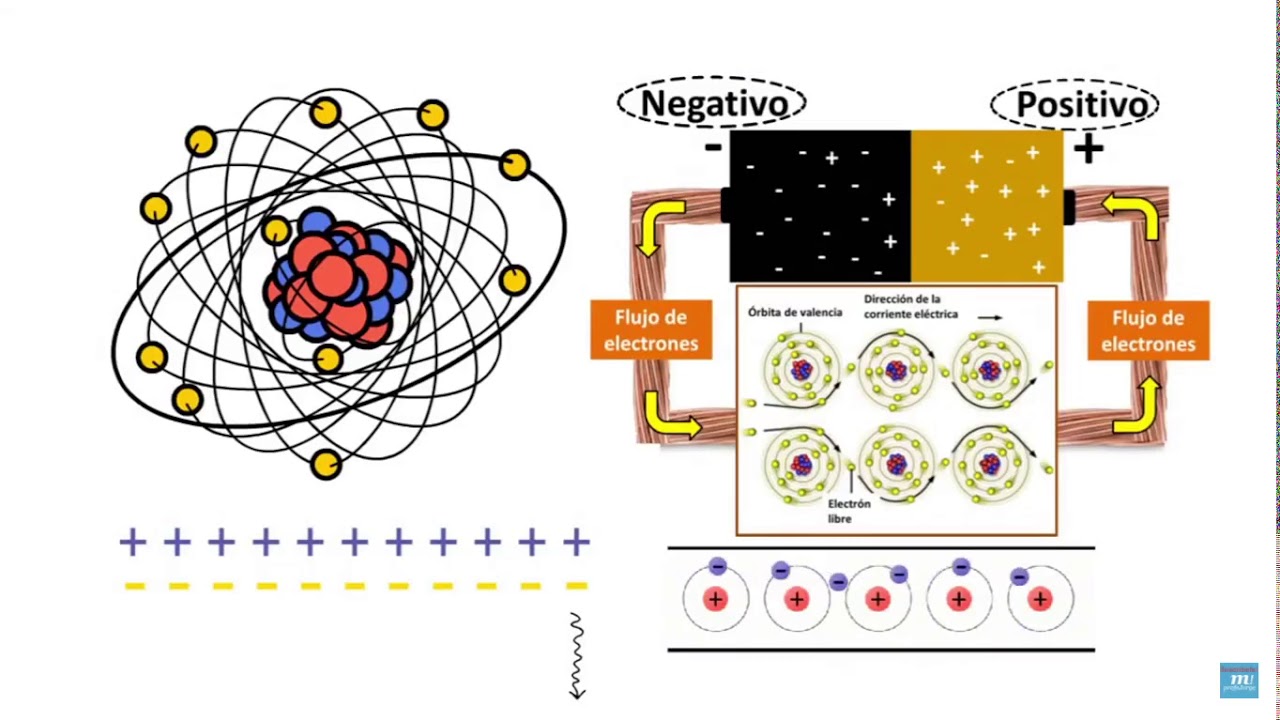
An atom consists of a dense nucleus containing positively charged protons and neutral neutrons, with negatively charged electrons revolving around the nucleus in fixed shells or energy levels; the atom is electrically neutral because the number of protons equals the number of electrons, and neutrons help manage repulsion between protons while electrons manage repulsion through multiple shells.
Click to watch →

Class 9-Chemistry-Chapter 4 (part 1)
123
After the discovery of electrons, protons, and neutrons, it was found that all atoms have the following similar basic structure: (1) Electrons are negatively charged particles that are found outside the nucleus; (2) Protons are positively charged particles that are found in the nucleus of an atom; (3) Neutrons are electrically neutral particles that are also found in the nucleus; (4) Neutrons are slightly heavier than protons.
Click to watch →

protonen neutronen elektronen
3.6K
Atoms consist of three types of elementary particles: protons (positively charged particles in the nucleus with mass 1 that determine the element's identity), neutrons (neutral particles in the nucleus that act as 'glue' to stabilize the nucleus by counteracting proton repulsion), and electrons (negatively charged particles orbiting the nucleus with nearly zero mass that determine the atom's electrical charge). The number of protons defines the element, while neutrons create isotopes and electrons create ions.
Click to watch →

Atom- finding protons, electrons, and neutrons (history up to 12:07)
756
An atom consists of three main parts: protons and neutrons located in the nucleus at the center, and electrons orbiting around the nucleus. Protons carry a positive charge, electrons carry a negative charge, and neutrons are neutral (no charge). The nucleus contains the majority of the atom's mass, while electrons are much smaller and lighter.
Click to watch →
FS200 - Secciones 21.1 y 21.2 - 2/12/30
205
An atom consists of protons (positive charge), neutrons (no charge), and electrons (negative charge). Protons and neutrons are located in the nucleus at the center of the atom, while electrons orbit around the nucleus. The number of protons determines the element's identity, and in a neutral atom, the number of protons equals the number of electrons.
Click to watch →
Deep Dive
The fundamental definition of nuclear fission, including how a heavy nucleus splits into smaller daughter nuclei.

B.Sc- 3rd yr | Nuclear physics || Nuclear Fission | Lec-01|| BY -A.D SINGH #mgsu
1K
Nuclear fission is a reaction in which a heavy nucleus (heavy nuclear) splits into two equal parts (two equal parts). During this process, a large quantity of energy is released. This is the fundamental definition of nuclear fission as a nuclear reaction where a heavy nucleus divides into two smaller nuclei with the release of significant energy.
Click to watch →

GCSE Physics 9-1: Nuclear Fission
373
Nuclear fission is the process in which a large, heavy nucleus splits into two smaller, lighter nuclei. This process releases energy as a result of the splitting. The original nucleus is called the parent nucleus, while the resulting smaller nuclei are called daughter nuclei.
Click to watch →

L-8, नाभिकीय विघटन | Nuclear Disintegration | अध्याय-13, नाभिक | Nuclei | 12th Physics
26.5K
Nuclear fission is defined as the process where a heavy nucleus (parent nucleus) splits into two or more lighter nuclei (daughter nuclei). The parent nucleus is unstable and breaks apart into smaller, more stable nuclei. This process releases a significant amount of energy and is fundamental to understanding nuclear reactions.
Click to watch →

नाभिकीय विखंडन और नाभिकीय संलयन में अंतर // nabhikiy sanlayan aur nabhikiy vikhandan mein antar
725
Nuclear fission is a process where a heavy nucleus splits into two approximately equal-mass nuclei. This is the fundamental definition of nuclear fission.
Click to watch →

Nuclear Fission and Fission Chain Reaction |Lec#07 |Class10/12 |Radioactivity
4.1K
Nuclear fission is defined as the process of splitting a heavy nucleus into two intermediate nuclei with the release of energy. The term 'fission' literally means to divide or split into pieces. In this process, a heavy nucleus (such as uranium) breaks apart into smaller nuclei, releasing a significant amount of energy.
Click to watch →
Deep Dive
The concept of isotopes, particularly the difference between stable isotopes and fissile isotopes like Uranium-235.

ಅಮೆರಿಕ, ಜಪಾನ್ ಸೋತಲ್ಲಿ ಗೆದ್ದ ಭಾರತ! | Kalpakkam PFBR | Nuclear Power | Masth Magaa | Amar
67.9K
Natural uranium consists of three isotopes: Uranium-234, Uranium-235, and Uranium-238. Among these, Uranium-235 is the fissile isotope that can sustain a nuclear chain reaction. It is unstable and naturally decays over time. When a neutron strikes a Uranium-235 nucleus, it splits into two smaller nuclei, releasing energy and additional neutrons.
Click to watch →
10 ICSE | PHYSICS BOARD QUESTION PAPER | ANSWER KEY | 2023-2024
95.6K
Uranium is available in two main isotopic forms: U-238 and U-235. U-235 is the fissile isotope used in nuclear reactors and weapons because it can sustain a nuclear chain reaction. U-238 is not fissile and cannot sustain a chain reaction under normal conditions.
Click to watch →
Why Chernobyl Exploded - The Real Physics Behind The Reactor
4.9M
Naturally occurring uranium consists primarily of two isotopes: uranium-238 (most common) and uranium-235 (much rarer). Only about 0.7% of natural uranium is fissile uranium-235, which splits when hit by neutrons and releases energy. Uranium-238 tends to absorb neutrons without splitting. For nuclear weapons, uranium is enriched to approximately 80% uranium-235 concentration. The difference in behavior between these isotopes is fundamental to both reactor operation and weapons development.
Click to watch →
Tabla Periódica | El URANIO, un metal con el que se GENERA ENERGÍA
1.3M
Natural uranium consists of two main isotopes: U-235 (92 protons + 143 neutrons) and U-238 (92 protons + 146 neutrons). Despite having only three additional neutrons, U-238 is significantly more stable than U-235. As a result, U-238 decays much more slowly, while U-235 decays rapidly. Today, approximately half of Earth's original U-238 remains, but only about 1% of natural uranium is U-235.
Click to watch →

التحولات النووية II التمرين 17 من معسكر الانقاذ
144.6K
Fissile isotopes are nuclei that can undergo fission after absorbing a neutron. Uranium-235 is fissile because it can absorb a neutron and split, releasing energy and additional neutrons. Uranium-238 is not fissile but can be converted to plutonium-239 through neutron bombardment. The key property is the ability to sustain a chain reaction.
Click to watch →
Deep Dive
Einstein's mass-energy equivalence principle (E=mc^2) to understand the origin of the massive energy released during fission.

فيزياء السادس العلمي | الفصل التاسع | المحاضرة 4 | التفاعلات النووية - منهج 2025
89.7K
The enormous energy released in nuclear fission comes from the mass defect - the difference between the total mass of the original nucleus and the sum of the masses of the fission products. According to Einstein's mass-energy equivalence equation (E=mc²), this small amount of missing mass is converted into a tremendous amount of energy. This explains why nuclear fission releases much more energy than chemical reactions.
Click to watch →

فيزياء السادس علمي || 7- الفصل التاسع || الانشطار والاندماج النووي
174.3K
In nuclear fission, the total mass of the products is less than the total mass of the reactants. This mass difference (mass defect) is converted into energy according to Einstein's equation E=mc². The released energy is enormous because even a small amount of mass corresponds to a huge amount of energy. This explains why nuclear reactions release far more energy than chemical reactions.
Click to watch →

05. Nuclear Power Plant. (Power System Class-05)
2.2K
The energy released during nuclear fission follows Einstein's famous equation E=mc², where E represents energy, m represents mass, and c represents the speed of light. In nuclear fission, the total mass of the fission fragments is slightly less than the original uranium nucleus. This mass difference (Δm) is converted directly into energy. The equation shows that even a small amount of mass can produce an enormous amount of energy because the speed of light (c) is a very large number. This is why nuclear reactions release vastly more energy than chemical reactions like burning coal or gasoline. The mass defect in uranium-235 fission is approximately 0.1% of the original mass, yet this small percentage produces tremendous energy output.
Click to watch →
Bombe au Cobalt : l’arme si mortelle que ses propres concepteurs ont refusé de la tester ?
210
Einstein's equation E=mc² reveals that mass and energy are interchangeable, with c² (9×10¹⁶ J/kg) as the conversion factor. A 1 gram of mass contains energy equivalent to 20 megatons of TNT. Nuclear fission, discovered in 1938 by Otto and Fritz Strassmann and interpreted by Lise Meitner and Otto Frisch, involves splitting heavy nuclei like uranium into lighter fragments, releasing enormous energy. When uranium-235 absorbs a neutron, it splits and releases additional neutrons that can trigger further fissions, creating a chain reaction that can be controlled (reactors) or explosive (weapons).
Click to watch →

الصف_الثالث_الثانوي_المحاضرة (6) ظاهرة_كومتون
2K
Einstein proposed that mass and energy are equivalent and can be converted into each other according to E = mc². This means mass can be converted to energy and vice versa, with the amount of energy proportional to the mass converted. The speed of light squared (c²) is approximately 9 × 10¹⁶ m²/s², a very large constant. Converting just 1 milligram of mass produces approximately 90 gigajoules of energy. Nuclear fission (splitting of heavy nuclei like uranium-235) releases enormous energy because a small mass defect is converted to energy according to this equation.
Click to watch →
Prerequisite Knowledge
- Concept 01Basic atomic structure, specifically the roles of protons, neutrons, and electrons within an atom.
- Concept 02The fundamental definition of nuclear fission, including how a heavy nucleus splits into smaller daughter nuclei.
- Concept 03The concept of isotopes, particularly the difference between stable isotopes and fissile isotopes like Uranium-235.
- Concept 04Einstein's mass-energy equivalence principle (E=mc^2) to understand the origin of the massive energy released during fission.
Subsequent Learning
- Step 01The specific physics of reactor control, including the functions of neutron moderators, control rods, and coolants.
- Step 02The concepts of critical mass, subcriticality, and supercriticality in maintaining stable chain reactions.
- Step 03Nuclear fuel enrichment technologies and the difference between low-enriched reactor fuel and highly-enriched weapons-grade material.
- Step 04The fundamental principles of nuclear fusion, comparing its mechanisms and energy yield to nuclear fission.
- Step 05Nuclear waste management challenges, radioactive decay half-lives, and the safety systems designed to prevent meltdown scenarios.
Chain Reactions
Reactor Outcome
Chain Reactions
0:00Playing Section
- 1
Explains chain reaction as self-propagating neutron multiplication process.
- 2
Differentiates uncontrolled fission in atom bombs from controlled reactor operation.
Accelerator-Driven Systems (ADS) and Subcritical Fission
Traditional nuclear physics instruction categorizes fission reactions into a strict binary: controlled, self-sustaining chain reactions (nuclear reactors) and uncontrolled ones (nuclear weapons). However, Accelerator-Driven Systems (ADS) introduce an alternative paradigm known as subcritical fission. In an ADS, the reactor core is designed to be inherently incapable of sustaining a chain reaction on its own because its neutron multiplication factor remains strictly below critical threshold. Instead, the system is driven by an external particle accelerator that continuously supplies neutrons through spallation. If the accelerator is turned off, the reaction ceases instantly. This technology challenges the traditional binary of controlled versus uncontrolled self-sustaining reactions, presenting a fundamentally different approach to safety, power generation, and nuclear waste transmutation by removing the risk of a runaway criticality accident.
Deep Dive
The specific physics of reactor control, including the functions of neutron moderators, control rods, and coolants.

التحولات النووية 02 ( الإنشطار والإندماج ) / BAC 2026
27.4K
Nuclear reactors use control rods and moderators to control the chain reaction. Control rods (made of boron or cadmium) absorb neutrons to slow down or stop the reaction. Moderators (made of water or graphite) slow down neutrons by colliding with them, reducing their kinetic energy. This is necessary because fast neutrons tend to pass through nuclei without being absorbed, while slow (thermal) neutrons are more likely to be absorbed and cause fission. Together, these components allow precise control of the reaction rate.
Click to watch →

Nuclear Physics-Nuclear Fission ll Nuclear Fusion l 12th Physics l BSc Physics l GATE Physics l NEET
8.3K
Nuclear reactors contain fuel (Uranium-235), control rods (boron) that absorb neutrons to control reaction rate, moderators (graphite or heavy water) that slow down fast neutrons to increase fission probability, and coolants (liquid sodium or carbon dioxide) that remove heat. The moderator is essential because fast neutrons are less likely to cause fission in Uranium-235. By slowing neutrons, the probability of fission increases significantly, enabling sustained chain reactions at controlled rates.
Click to watch →

GCSE Physics Tutorial - Topic 6 Radioactivity Separate
2.2K
Nuclear reactors contain fuel rods (uranium-235, plutonium, or thorium), moderators (water or graphite) that slow neutrons, control rods (boron or cadmium) that absorb neutrons to control reaction rate, coolant (usually water) that removes heat, and radiation shields. In boiling water reactors, water moderator is allowed to boil off as steam to drive turbines. The moderator slows fast neutrons so they can be captured by uranium-235 nuclei, sustaining the chain reaction. Control rods can be inserted to stop the reaction in emergencies.
Click to watch →

Come si manovra un reattore? LIVE con un operatore nucleare!
12.3K
Nuclear fission releases neutrons with high energy (average 2 MeV), but these fast neutrons are less likely to cause additional fission in uranium-235. Moderation slows these neutrons down to thermal energies (around 0.025 eV) where they are more likely to cause fission. Water is an effective moderator because hydrogen atoms efficiently slow neutrons through elastic collisions. Control rods regulate reactor power by absorbing neutrons. The Trino plant used control rods with a cruciform (cross-shaped) design, inserted into special niches in the fuel assemblies. Modern plants use control rods with boron carbide that are inserted directly into fuel assemblies. Nuclear reactors require neutron sources to initiate the chain reaction. Primary neutron sources use alpha particles from polonium-beryllium reactions to produce neutrons. Secondary sources use gamma rays from activated antimony to produce neutrons through photoneutron reactions. Boron chemical control uses dissolved boric acid in the primary coolant to regulate reactor reactivity. Boron is an effective neutron absorber, allowing operators to control the neutron economy by varying boron concentration.
Click to watch →

12th Physics Complete Short Questions 🔥| Bihar Board Class 12th Physics Important Question |
24.4K
In a nuclear reactor: (1) Moderator is used to slow down neutrons produced by nuclear fission. (2) Coolant is used to absorb heat generated in the chain reaction. (3) Control rods (made of cadmium and boron) are used to control the chain reaction by absorbing neutrons.
Click to watch →
Deep Dive
The concepts of critical mass, subcriticality, and supercriticality in maintaining stable chain reactions.

Nuclear Fission | Fission Chain Reaction | Nuclear Physics | Fsc Physics | Mubashar Ahmad
4.6K
Chain reactions exist in three criticality states: (1) Subcritical - when not all neutrons participate in causing additional fission, the reaction dies out, (2) Critical - when exactly one neutron from each fission causes another fission, the reaction sustains at a constant rate, (3) Supercritical - when all neutrons cause additional fission, the reaction rate increases exponentially. In subcritical state, if 3 neutrons are produced but only 1 causes another fission, the reaction cannot sustain itself. In critical state, the reaction maintains steady rate. In supercritical state, the reaction grows uncontrollably, producing explosive energy release used in atomic bombs.
Click to watch →
critical mass,sub critical mass,super critical mass
327
Nuclear chain reactions depend on the balance between neutron production and neutron loss. Critical mass is the minimum amount of fissile material needed to sustain a self-perpetuating reaction. Subcritical conditions occur when neutron loss exceeds production, causing the reaction to diminish. Supercritical conditions arise when production exceeds loss, leading to exponential growth. The fundamental equation states that the rate of neutron loss equals the rate of neutron creation at criticality. Understanding these principles is essential for nuclear reactor design, weapons development, and radiation safety applications.
Click to watch →

The Making of the Atom Bomb | Evan Picoult
1.8K
Criticality describes the condition of a nuclear chain reaction: subcriticality means the number of neutrons produced diminishes and the reaction dies out; criticality means the number of neutrons remains constant (steady state); supercriticality means the number of neutrons grows at any rate from 1% to 10% or more. Controlling these states is essential for nuclear reactors and weapons. By inserting materials that absorb neutrons, the rate of fission can be controlled to achieve any desired rate.
Click to watch →
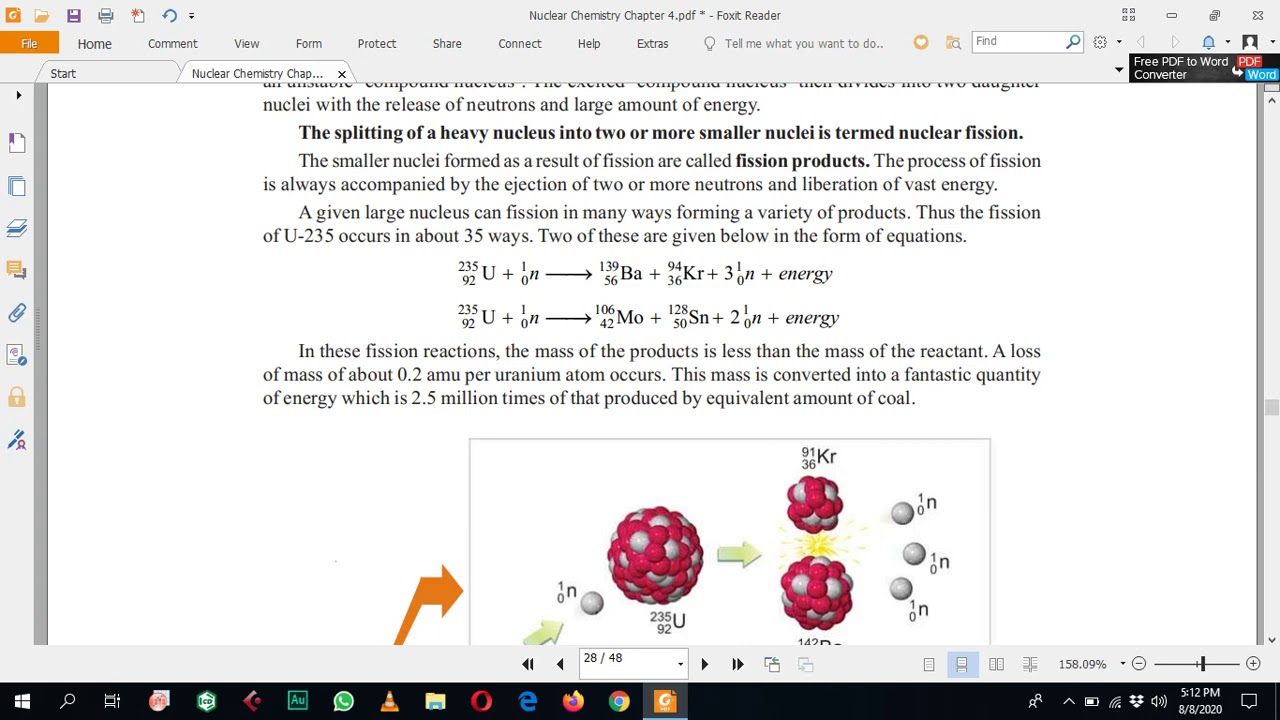
CHM 402 21
278
A chain reaction occurs when neutrons released from one fission event cause additional fission events in nearby nuclei. The multiplication factor determines whether the reaction grows, shrinks, or remains steady. Critical mass is the minimum amount of fissile material needed to sustain a chain reaction—for uranium-235, this is approximately 10 kg. Subcritical mass cannot sustain a chain reaction, while supercritical mass causes exponential growth. This principle underlies both nuclear reactors (controlled chain reactions) and atomic bombs (uncontrolled chain reactions).
Click to watch →
فزیک صنف دوازدهم- جلسه هفتاد و پنجم - موضوع: تعامل زنجیرهای 21.4.1403
159
Chain reactions do not occur naturally in uranium mines because natural U-235 concentration is too low (0.7%) and neutrons are too fast. Critical mass is the minimum fissile material needed to sustain a chain reaction. Three states exist: subcritical (absorbed > released, no reaction), critical (absorbed = released, steady reaction), and supercritical (released > absorbed, exponential growth leading to explosion). Nuclear reactors operate at critical mass for controlled energy production, while nuclear weapons use supercritical mass for uncontrolled detonation. The balance between these states determines whether nuclear energy is harnessed safely or released destructively.
Click to watch →
Deep Dive
Nuclear fuel enrichment technologies and the difference between low-enriched reactor fuel and highly-enriched weapons-grade material.
Nuclear Energy in One Shot: Prelims & Mains Masterclass | UPSC CSE 2026
234
Nuclear enrichment increases U-235 percentage in uranium. Low-enriched uranium (3-5% U-235) is used for reactors and is safe for peaceful purposes. Highly enriched uranium (90% U-235) is weapons-grade for nuclear bombs. The key difference is controlled vs uncontrolled fission. India's program avoids enrichment by using PHWR with natural uranium, converting U-238 to plutonium-239 for Stage 2, and converting thorium-232 to uranium-233 for Stage 3, utilizing India's thorium reserves.
Click to watch →

Iran–Israel War Explained (2026): How the U.S. Got Pulled In
120
The distinction between civilian nuclear fuel and weapons-grade material is critical. Natural uranium contains very little of the isotope needed for sustained fission. Civilian power reactor fuel is generally enriched to low levels (typically 3-5%). Weapons-grade material is normally enriched to around 90%. Before the 2025 attacks, Iran had accumulated uranium enriched to 60%, far beyond ordinary power reactor requirements and technically closer to weapons-grade. However, enriched uranium is not the same as a finished nuclear weapon, which would require further enrichment, engineering, weaponization, and a reliable delivery system. The danger lies in capability, uncertainty, and time rather than an immediate weapon.
Click to watch →
Como é feito o ENRIQUECIMENTO DE URÂNIO I O Segredo do Combustível Nuclear!
311
Enriched UF6 is converted to uranium dioxide (UO2) powder, compacted into fuel pellets, and assembled into fuel rods and bundles for reactor cores. Reactor fuel requires 3-5% U-235 enrichment (Low Enriched Uranium), while weapons require over 90% U-235 (High Enriched Uranium). The same enrichment technology serves both purposes, with weapons production requiring dramatically more stages. This dual-use capability makes enrichment technology a sensitive international issue. The International Atomic Energy Agency (IAEA) monitors enrichment facilities worldwide to prevent diversion of materials for weapons production, ensuring nuclear materials serve peaceful energy purposes.
Click to watch →

ಅಣು ಸ್ಥಾವರಗಳೇ ಟಾರ್ಗೆಟ್.! | Middle East on Edge | | Iran–Israel War Escalates | Iran–Israel Conflict
120.9K
Civilian nuclear reactors use low-enriched uranium (3-5% enrichment), which is sufficient for generating electricity but cannot sustain a nuclear chain reaction for weapons. Weapons-grade uranium requires 90%+ enrichment. The difference between these two levels is critical: while low-enriched uranium can cause radiation accidents, weapons-grade uranium presents much greater proliferation risks. This distinction explains why international monitoring focuses heavily on enrichment levels at nuclear facilities.
Click to watch →
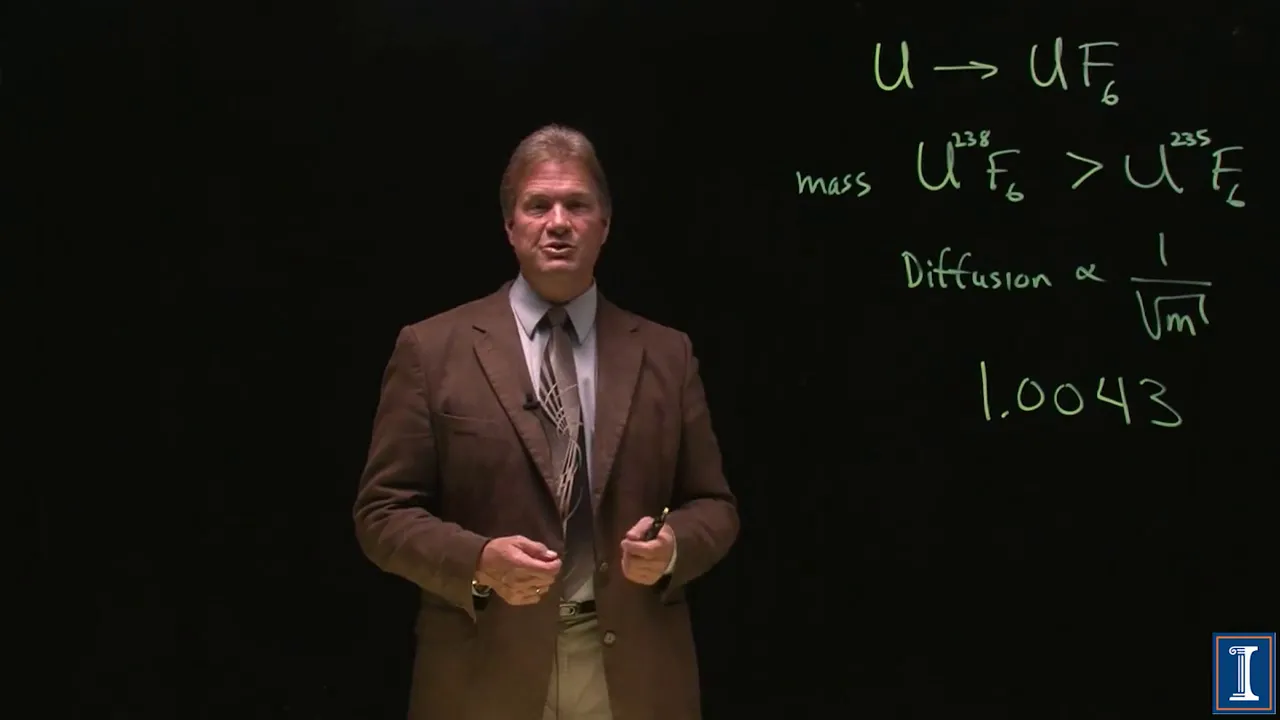
Getting to the Good Stuff (Uranium Enrichment)
180.1K
The same enrichment technology used to produce reactor fuel (3% U-235) can also produce weapons-grade material (90% U-235) if operated long enough. This creates significant international concern regarding countries developing enrichment capabilities. Building centrifuges capable of achieving the necessary separation factors requires extremely high precision engineering and tight tolerances.
Click to watch →
Deep Dive
The fundamental principles of nuclear fusion, comparing its mechanisms and energy yield to nuclear fission.
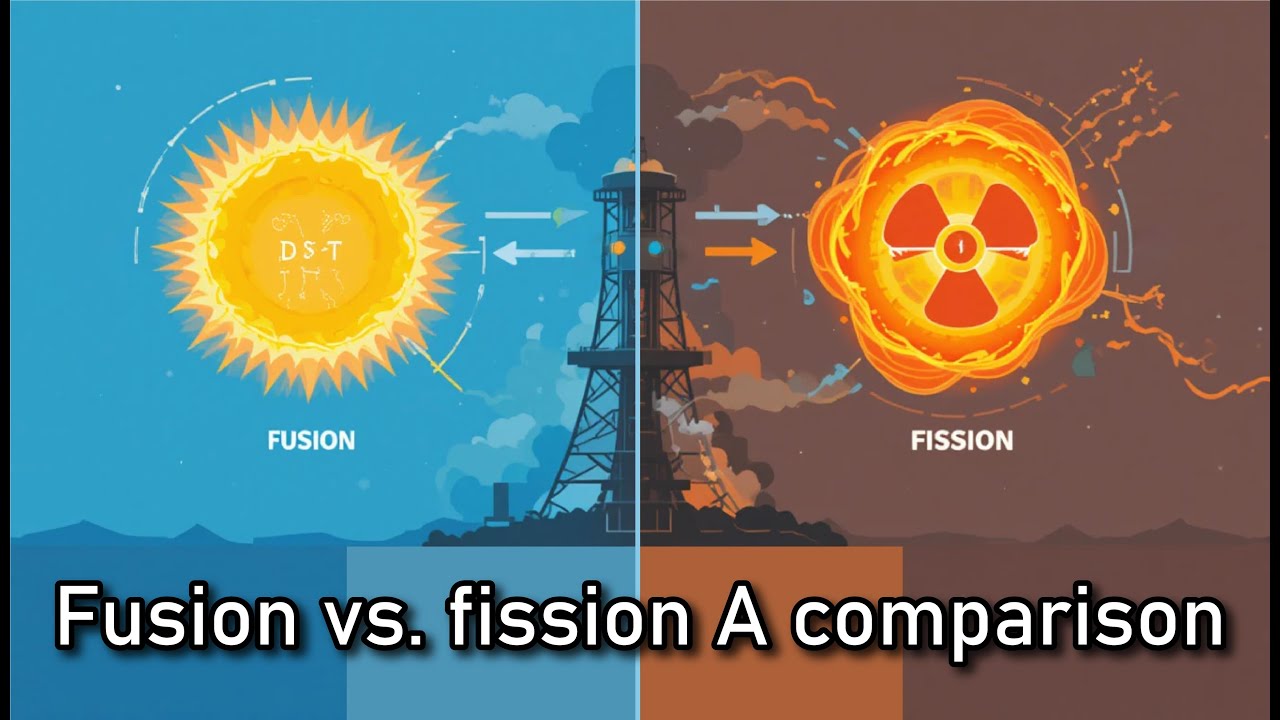
Fusion vs. fission A comparison
126
Nuclear fission and fusion are fundamental energy-harnessing processes operating through diametrically opposed mechanisms. Fission involves splitting heavy nuclei like uranium-235 into lighter fragments through neutron bombardment, releasing energy via binding energy conversion. Fusion merges light nuclei to form heavier elements, converting approximately 0.7% of mass to energy versus 0.1% for fission. Fission operates at near-ambient temperatures using slow neutrons with chain reactions, while fusion requires overcoming electrostatic repulsion through extreme conditions exceeding 100 million Kelvin, necessitating magnetic or inertial confinement. The ITER project aims to demonstrate net energy gain by 2035. Natural fission occurred at Oklo, Gabon 2 billion years ago, while stars sustain fusion through gravitational confinement via proton-proton chains or CNO cycles.
Click to watch →
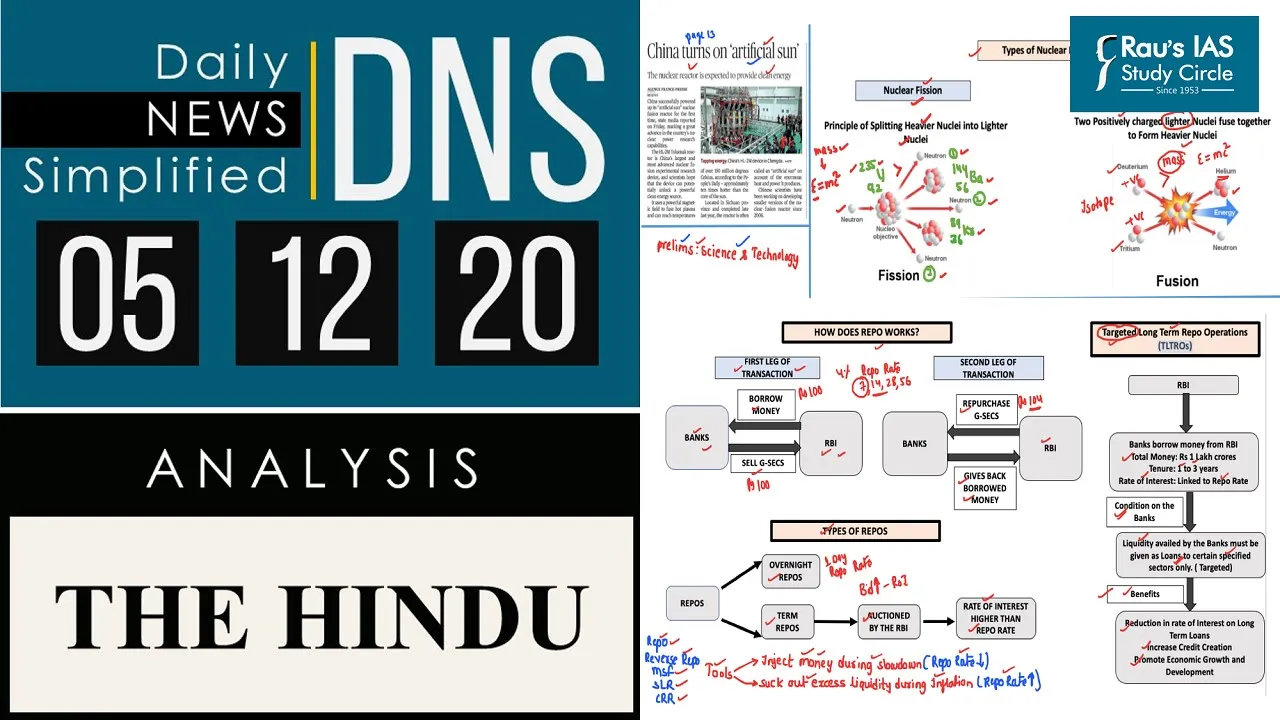
THE HINDU Analysis, 05 December 2020 Daily News Analysis for UPSC – DNS
26.5K
Nuclear fission splits heavy unstable nuclei (uranium-235, plutonium, thorium) into lighter nuclei, releasing energy when mass is converted via E=mc². Nuclear fusion combines lighter positively charged nuclei (deuterium and tritium, hydrogen isotopes) to form heavier helium nuclei, releasing even more energy per unit mass. Both processes convert mass differences to energy, but fusion releases significantly more energy. Fusion requires overcoming electrostatic repulsion between nuclei, demanding temperatures six times the sun's core temperature.
Click to watch →

(508-P3014F) Nuclear Fission and Fusion (From Previous Semester)
177
Nuclear fission is when a heavy nucleus splits into lighter nuclei, releasing energy. The key feature is one heavy nucleus (like Uranium-235) splitting into two lighter nuclei (like Krypton and Barium). Nuclear fusion is when two light nuclei combine to form a heavier nucleus, requiring extreme temperatures to overcome electrostatic repulsion. Both processes release energy through mass defect—the difference in mass between reactants and products. Mass defect is converted to energy via Einstein's equation E = mc². The energy released per reaction is relatively small (about 200 MeV), but many reactions can generate enormous energy.
Click to watch →
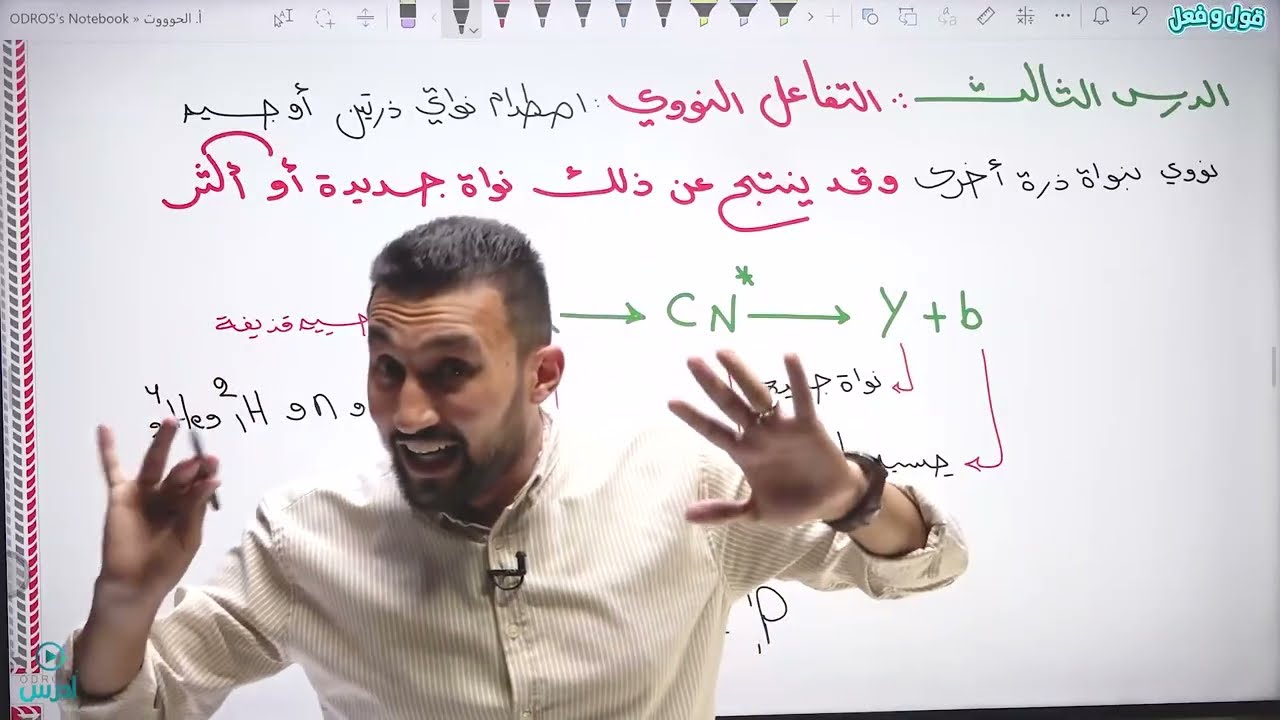
مكثف الفيزياء النووية - تحضيرات الامتحان الوزاري ( علمي وصناعي )
9.2K
Nuclear fusion is the combining of light nuclei to form heavier nuclei, releasing energy. This process requires extremely high temperatures and pressures, conditions found in stars. Fusion releases more energy per unit mass than fission. The most common fusion reaction involves hydrogen isotopes: deuterium (H-2) and tritium (H-3) fuse to form helium-4 and a neutron. To distinguish fusion from fission: fusion involves light nuclei combining, while fission involves heavy nuclei splitting. The products in fusion are heavier than reactants, while in fission they are lighter. Energy released is calculated using the same formula as fission: Q = (mass of reactants - mass of products) × 931.5 MeV.
Click to watch →
التحولات النووية 02 ( الإنشطار والإندماج ) / BAC 2026
27.4K
Nuclear fusion combines two light nuclei (A < 20) to form a heavier, more stable nucleus, releasing energy. Conditions required: extremely high temperatures (20 million°C) and high pressure to overcome electrostatic repulsion. Fusion occurs naturally in stars like our Sun. Comparison with fission: fusion releases more energy per nucleon but is much harder to achieve. Fusion produces no long-lived radioactive waste (product is stable helium), making it a cleaner energy source. The energy released comes from the mass defect, where some mass is converted to energy. For deuterium-tritium fusion: D + T → He-4 + n + 17.6 MeV.
Click to watch →
Deep Dive
Nuclear waste management challenges, radioactive decay half-lives, and the safety systems designed to prevent meltdown scenarios.
We Should Be Talking About Nuclear Waste
4K
Radioactive half-life is the time it takes for half of a radioactive isotope to decay. Using a chocolate bar analogy, after one half-life half disappears, after another half-life another half disappears, and after seven half-lives less than 2% remains. For waste with a 1,000-year half-life, less than 2% remains after 7,000 years. Many nuclear waste byproducts have half-lives of thousands to hundreds of thousands of years. To be safe, geological disposal facilities must remain secure for at least 100,000 years—longer than human civilization has existed—to ensure radioactivity decreases to background levels.
Click to watch →

Nuclear Hotseat #436 - Nuclear Waste Lies: San Onofre w/Donna Gilmore 11-2-2019
115
This comprehensive segment addresses the fundamental unsolved problem of nuclear waste disposal. Since radioactivity cannot be shut off or rendered harmless, waste disposal is actually a euphemism for waste abandonment. Sir Brian Flowers' 1976 report warned that if nuclear energy had been deployed before WWII, large parts of Europe would be uninhabitable today due to Chernobyl-like meltdowns. The Chernobyl accident released 80,000 tera barrels of cesium-137, making land in a 30km radius uninhabitable for at least 300 years. A single irradiated fuel bundle can deliver a lethal dose at one meter in 20 seconds. Spent fuel pools contain 50 times more cesium-137 than Chernobyl released. Tritium, chemically identical to hydrogen, becomes incorporated into all living things including DNA, and is at least three times more biologically harmful than gamma radiation per unit of energy absorbed. Half-lives can be deceptive as some materials become more radioactive over time, and plutonium's 24,000-year half-life transforms into a material with a 700 million-year half-life. Some radioactive materials are difficult to detect even in well-equipped plants because they give off non-penetrating radiation yet can be extraordinarily dangerous inside the body.
Click to watch →

2.3 - Nuclear
295
Radioactive waste management depends on half-life. Low-level waste with short half-lives can be stored until it decays safely. Long-lived waste (millions of years) requires containment in glass and cement, buried deep underground in stable geological formations to prevent environmental contamination.
Click to watch →
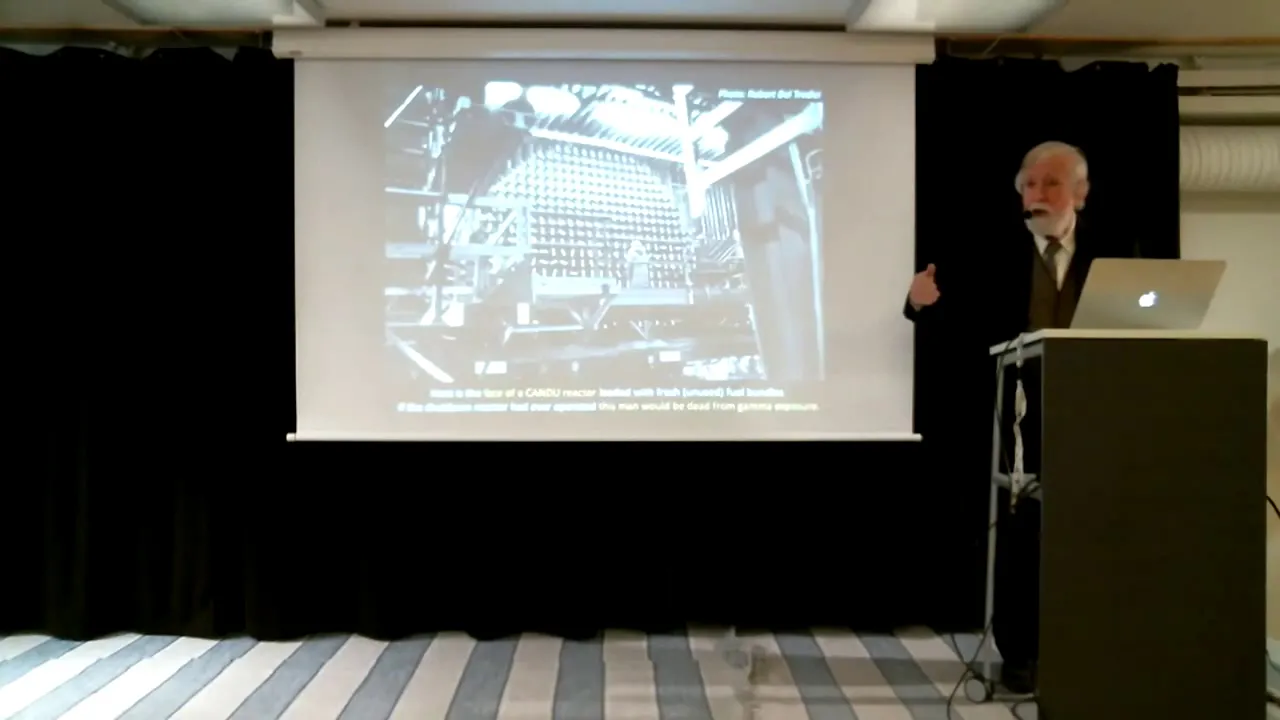
On Nuclear Waste, by Dr. Gordon Edwards, Canadian Coalition for Nuclear Responsibility (CCNR)
374
Nuclear waste creates ongoing hazards because radioactivity cannot be controlled or stopped—it simply continues until atoms become stable. This explains why reactors can melt down even when shut down, generating temperatures twice the melting point of steel. More dangerously, burying nuclear waste creates plutonium-239 through neutron absorption by uranium-238. With a half-life of 24,000 years, this material accumulates in waste and could be extracted by future civilizations to build atomic bombs. Historical disposal attempts have failed catastrophically: eight U.S. geological disposal sites failed, German repositories required billions to fix, and one drum explosion sent radioactive dust 750 meters upward, contaminating 22 workers and costing nearly two billion dollars to clean up. Radiation breaks chemical bonds in unexpected ways, creating abnormal reactions that can produce dangerous substances like flammable gases that accumulate and cause violent explosions.
Click to watch →

RESIDUOS NUCLEARES
31.1K
Nuclear waste management involves classifying waste by half-life (short-lived ~90 days, medium-lived ~30 years, long-lived >30 years) and activity level (low, medium, high). High-activity waste requires cooling due to heat generation. A multi-barrier system prevents environmental contamination: chemical barrier (solidification), physical barrier (containers), engineering barrier (shielded structures), and geological barrier (stable crust with no water). Low/medium activity waste uses surface storage with concrete cells, clay, and vegetation, with hazards disappearing in ~300 years. Spain's Cabril facility (operational since 1992) stores 2,000 m³ annually, with capacity for 50,000 m³.
Click to watch →
Chain Reactions
Reactor Outcome
Chain Reactions
0:00- 1
Explains chain reaction as self-propagating neutron multiplication process.
- 2
Differentiates uncontrolled fission in atom bombs from controlled reactor operation.
Accelerator-Driven Systems (ADS) and Subcritical Fission
Traditional nuclear physics instruction categorizes fission reactions into a strict binary: controlled, self-sustaining chain reactions (nuclear reactors) and uncontrolled ones (nuclear weapons). However, Accelerator-Driven Systems (ADS) introduce an alternative paradigm known as subcritical fission. In an ADS, the reactor core is designed to be inherently incapable of sustaining a chain reaction on its own because its neutron multiplication factor remains strictly below critical threshold. Instead, the system is driven by an external particle accelerator that continuously supplies neutrons through spallation. If the accelerator is turned off, the reaction ceases instantly. This technology challenges the traditional binary of controlled versus uncontrolled self-sustaining reactions, presenting a fundamentally different approach to safety, power generation, and nuclear waste transmutation by removing the risk of a runaway criticality accident.
Basic atomic structure, specifically the roles of protons, neutrons, and electrons within an atom.
The fundamental definition of nuclear fission, including how a heavy nucleus splits into smaller daughter nuclei.
The concept of isotopes, particularly the difference between stable isotopes and fissile isotopes like Uranium-235.
Einstein's mass-energy equivalence principle (E=mc^2) to understand the origin of the massive energy released during fission.
The specific physics of reactor control, including the functions of neutron moderators, control rods, and coolants.
The concepts of critical mass, subcriticality, and supercriticality in maintaining stable chain reactions.
Nuclear fuel enrichment technologies and the difference between low-enriched reactor fuel and highly-enriched weapons-grade material.
The fundamental principles of nuclear fusion, comparing its mechanisms and energy yield to nuclear fission.
Nuclear waste management challenges, radioactive decay half-lives, and the safety systems designed to prevent meltdown scenarios.
11.3K views119likes2:56@physics4students419Original Release: 2017-02-17
hi students this animation and description would help you do not physics even more easier and better so please to watch it up join any physics what is chain reaction chain-reaction is an important phenomenon of continuous energy flow now let us see how the energy gets decapitated consider a neutron causing fission in a uranium nucleus producing three neutrons the three neutrons in turn may cause fission in three uranium nuclei producing nine neutron these line neutrons in turn may produce 27 neutrons and so on a chain reaction is a self-propagating process in which the number of neutrons goes on multiplying rapidly almost in a geometrical progression two types of chain reactions are possible in the uncontrolled chain reaction the number of neutrons multiplied indefinitely and the entire amount of energy is released within a fraction of a second this type of chain reaction takes place in atom bombs in the control chain-reaction the number of fission producing neutron is kept constant and is always equal to 1 the reaction is sustained in a controlled manner control chain reaction is taking place in a nuclear reactor so what is the outcome of the reactor when a thermal Neutron bombards uranium-235 nucleus it breaks into two fission fragments and three fast Neutron one Neutron may escape and one Neutron may be captured by uranium 238 which decays to neptunium 239 and then to plutonium 239 one Neutron is available for carrying out chain reaction the chain reaction is possible only when the loss of neutrons is less than the neutrons produced thank you for watching please subscribe this channel for [Music]
Up Next

73:39
Physics for Future Presidents: Lecture 7 - Nuclear Weapons
@CosmoLearning
4.3K views•2017-07-28

12:53
21cm Hyperfine Transition in Neutral Hydrogen: Radio Astronomy Basics
@AaronRobertParsons
12.4K views•2011-10-13

32:32
NMR Spin Physics I: Zeeman Effect, Resonance Condition & Larmor Frequency
@nptel-indianinstituteofsci8064
2.3K views•2024-01-17

27:14
Entropy and the Second Law of Thermodynamics Explained
@veritasium
27.5M views•2023-07-01
Related Study Plans & Knowledge Roadmaps
Structured learning paths in Physics
physics
Nuclear Physics (Decay, Fission & Reactors)
01Atomic Structure and the Binding Force
02Radioactive Decay and Half-Life
03Nuclear Fission Mechanics and Chain Reactions
+ 2 more learning modules
12h5 modules
Explore Roadmap
physics
Soft Matter (Polymers, Colloids & Rheology)
01Foundations of Soft Matter & Thermal Forces
02Polymer Physics and Macromolecules
03Colloids, Surfactants, and Self-Assembly
+ 2 more learning modules
38h5 modules
Explore Roadmap
physics
Analytical Mechanics: Lagrangian & Hamiltonian
01Mathematical Foundations: Calculus of Variations
02From Newtonian Mechanics to Constraint Dynamics
03The Principle of Least Action & Lagrangian Mechanics
+ 3 more learning modules
28h6 modules
Explore Roadmap
physics
General Relativity (Spacetime & Cosmology)
01Foundations of Relativity: Special Relativity
02The Geometry of Spacetime: Equivalence Principle & Curvature
03Einstein's Field Equations: The Mathematics of Gravity
+ 2 more learning modules
55h5 modules
Explore Roadmap