General Relativity (Spacetime & Cosmology)
Learning Goal: Master the conceptual and mathematical foundations of General Relativity and modern physical cosmology. By completing this curriculum, you will understand how special relativity transitions into curved spacetime, how tensor calculus defines the Einstein Field Equations, the mechanics of Schwarzschild black holes and gravitational waves, and the mathematics governing the expansion and evolution of our universe.
- Prerequisites: Multivariable calculus, linear algebra, classical mechanics (Newtonian gravity and Lagrangian mechanics), and basic electrodynamics.
- Estimated Total Study Time: 55 Hours
Module 1: Foundations of Relativity: Special Relativity
Module Overview
To understand gravity as curved spacetime, we must first master the flat four-dimensional world of Special Relativity. This module covers the core postulates of Einstein's 1905 theory: the constancy of the speed of light and the relativity of inertial frames. You will study the mathematics of Minkowski space, derive the Lorentz transformations, explore kinematic consequences like time dilation and length contraction, and resolve classical relativistic paradoxes to build a solid foundation for General Relativity.
Recommended Videos
Why this video is valuable: Delivered by Professor Leonard Susskind, this Stanford University lecture provides a rigorous academic introduction to the mathematical formulation of Special Relativity. It moves beyond superficial pop-science explanations to establish the principle of relativity, the invariance of the spacetime interval, and how physical laws must be restructured to be invariant under Lorentz transformations.
Knowledge Checkpoint:
- Understand the definition of the invariant spacetime interval () and why it remains constant across all inertial frames.
- Explain how the speed of light acts as a structural constant of spacetime rather than just a physical speed limit.
- Distinguish between coordinate time and proper time.

Why this video is valuable: This highly visual animation offers an intuitive conceptual foundation for the core ideas of special relativity. It acts as an excellent warm-up or review companion to Susskind's formal lecture, helping you visualize how time dilation and length contraction physically manifest from different observers' perspectives.
Knowledge Checkpoint:
- Explain how two events that are simultaneous in one frame of reference are not simultaneous in another (relativity of simultaneity).
- Describe the physical mechanism behind time dilation and length contraction using light clock diagrams.

Why this video is valuable: This video focuses on the Muon Paradox—a classic, real-world proof of special relativity. By walking through the calculation of muon decay from both the Earth's frame and the muon's frame, the video demonstrates how length contraction and time dilation must work in tandem to maintain physical consistency.
Knowledge Checkpoint:
- Calculate how high-altitude atmospheric muons reach the Earth's surface despite their brief lifetime.
- Reconcile how the muon's frame observes length contraction of the Earth's atmosphere while the ground-based observer measures time dilation of the muon's internal clock.
Module 2: The Geometry of Spacetime: Equivalence Principle & Curvature
Module Overview
In this module, you will transition from flat Minkowski spacetime to curved Riemannian spacetime. You will analyze Einstein's "happiest thought"—the Equivalence Principle—which states that the local effects of gravity are indistinguishable from uniform acceleration. By exploring how accelerating frames warp coordinate grids and bend light, you will discover why gravity is not an active Newtonian force, but rather a geometric consequence of objects moving along straight-line paths (geodesics) through warped spacetime.
Recommended Videos
Why this video is valuable: This is one of the most conceptually clear, high-production explanations of the Equivalence Principle and geodesic motion. It deconstructs the traditional Newtonian model of gravity and explains how free-fall is actually the true inertial, unaccelerated state of motion, whereas standing on the Earth's surface is a continuously accelerated state.
Knowledge Checkpoint:
- Explain why an accelerometer reads zero during free-fall but reads () when resting on the ground.
- Define a "geodesic" and explain how objects "fall" by following straight lines through curved four-dimensional spacetime.
- Detail how the Equivalence Principle implies that gravity must bend light paths.

Why this video is valuable: The introductory lecture to Stanford's General Relativity series. Leonard Susskind mathematically transitions from the flat Minkowski metric () to generalized curvilinear coordinates. He details how the concept of "flatness" is analyzed mathematically and sets up the geometric language required to handle gravity.
Knowledge Checkpoint:
- Contrast how flat space and curved space behave when parallel lines are projected (holonomy and parallel transport).
- Understand how curvilinear coordinates differ from actual physical curvature.

Why this video is valuable: This video provides a deep dive into how time warping (as opposed to just space warping) is the primary driver of gravity for slow-moving macroscopic objects on Earth. It helps resolve the common point of confusion regarding why objects at rest begin to fall when dropped.
Knowledge Checkpoint:
- Explain how gravitational time dilation (clocks ticking slower closer to a mass) causes the trajectory of a stationary object to curve downward through space.
- Identify which component of the metric tensor () dominates the motion of slow-moving matter in weak gravitational fields.
Module 3: Mathematics of Spacetime: Tensors & Einstein's Field Equations
Module Overview
This module tackles the core mathematical machinery of General Relativity. To describe physical laws independently of arbitrary coordinate systems, we use tensor calculus. You will study coordinate transformations, the metric tensor (which measures intervals in curved space), Christoffel symbols (representing the gravitational "connection"), covariant derivatives, and curvature tensors (Riemann and Ricci). This culminates in a deep dive into the Einstein Field Equations (EFE), which describe how mass-energy density curves the fabric of spacetime.
Recommended Videos

Why this video is valuable: This rigorous academic lecture introduces tensor analysis explicitly framed for GR beginners. It outlines how scalars, vectors, and higher-rank tensors transform under coordinate changes, defining covariant and contravariant components, index notation, and the role of the metric tensor.
Knowledge Checkpoint:
- Understand the difference between contravariant vectors () and covariant vectors/one-forms (), and how the metric tensor () is used to raise and lower indices.
- Define a tensor by its transformation properties under coordinate transitions.
- Explain the coordinate-invariant definition of a vector space tangent to a manifold.

Why this video is valuable: An intermediate-level pedagogical video that bridges the gap between abstract coordinate maps and physical, real-world distance measurements. It builds an intuitive, visual understanding of the metric tensor () as a localized, variable coordinate conversion factor.
Knowledge Checkpoint:
- Describe how the metric tensor functions as a local generalized dot-product machine.
- Visualize how a coordinate system grid can change shape and density while the underlying geometry remains unchanged.

Why this video is valuable: This video provides a direct, hand-written mathematical derivation of the geodesic equation from the principle of least action (extrema of proper time interval). This derivation is critical for seeing how Christoffel symbols emerge directly from variation of the metric.
Knowledge Checkpoint:
- Write down the geodesic equation: .
- Define Christoffel symbols () in terms of derivatives of the metric tensor .
- Contrast a standard partial derivative with a covariant derivative () and explain why the latter is required in curved spacetime.

Why this video is valuable: An exceptional, long-form whiteboard walk-through of the components of the Einstein Field Equations. It systematically defines the physical and geometric meaning of each tensor in the equation: , connecting the Ricci curvature tensor, Ricci scalar, metric tensor, and Stress-Energy tensor.
Knowledge Checkpoint:
- Explain the physical meaning of each component of the Stress-Energy tensor (e.g., energy density, momentum density, shear stress, and pressure).
- Define the Einstein Tensor () and explain why its covariant divergence must vanish () to satisfy local conservation of energy-momentum.
- Understand the role of the cosmological constant () in the field equations.
Module 4: Extreme Gravity: Black Holes & Gravitational Waves
Module Overview
With the Field Equations established, you will now explore their most extreme solutions. The first exact non-trivial solution, derived by Karl Schwarzschild in 1916, describes spacetime around a static, spherically symmetric mass. This module examines the Schwarzschild metric, event horizons, gravitational redshift, and coordinate singularities. Additionally, you will study how dynamic movements of asymmetric mass distributions generate ripples in the fabric of spacetime, known as gravitational waves, and review how they are detected by laser interferometers.
Recommended Videos
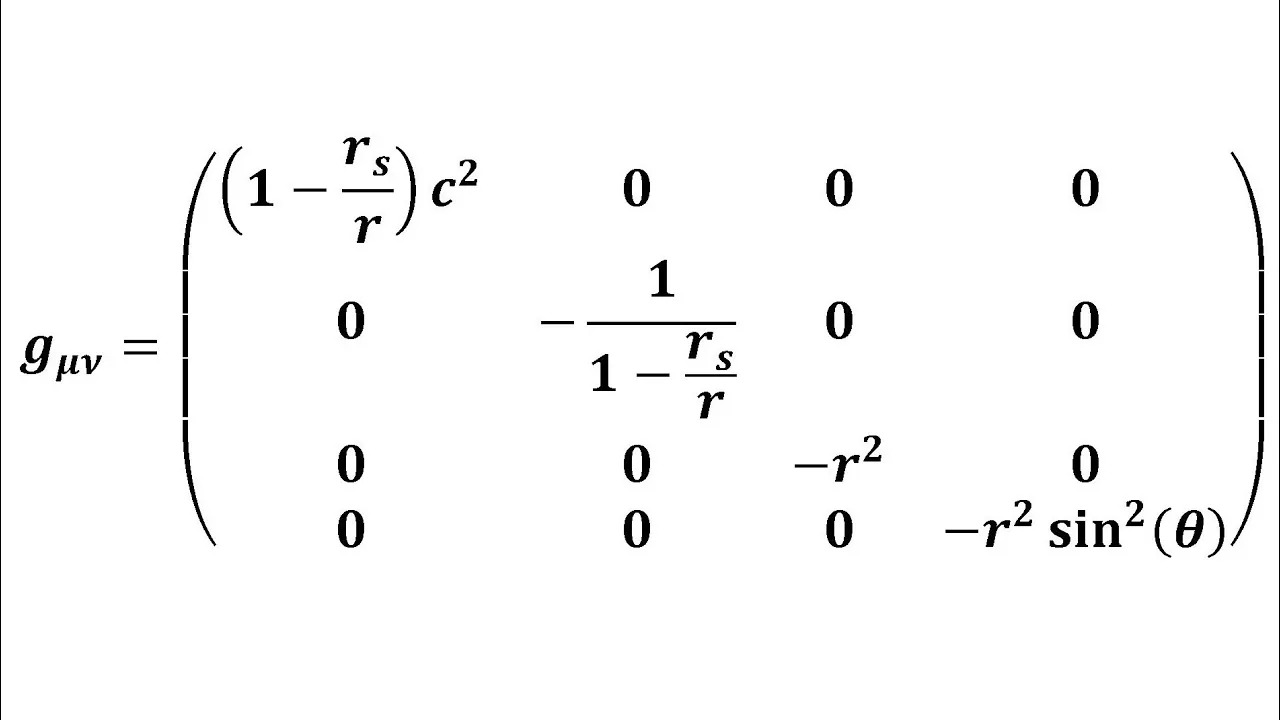
Why this video is valuable: This is a comprehensive, step-by-step mathematical derivation of the Schwarzschild metric from the vacuum field equations (). By working out the exact constraints of spherical symmetry and static conditions, it provides a rigorous, classroom-level derivation that addresses a common gap in general relativity self-study.
Knowledge Checkpoint:
- Write down the Schwarzschild metric and explain what each term represents:
- Show how Karl Schwarzschild leveraged the and Ricci tensor components to solve for the metric coefficients.
- Mathematically define the Schwarzschild radius ().
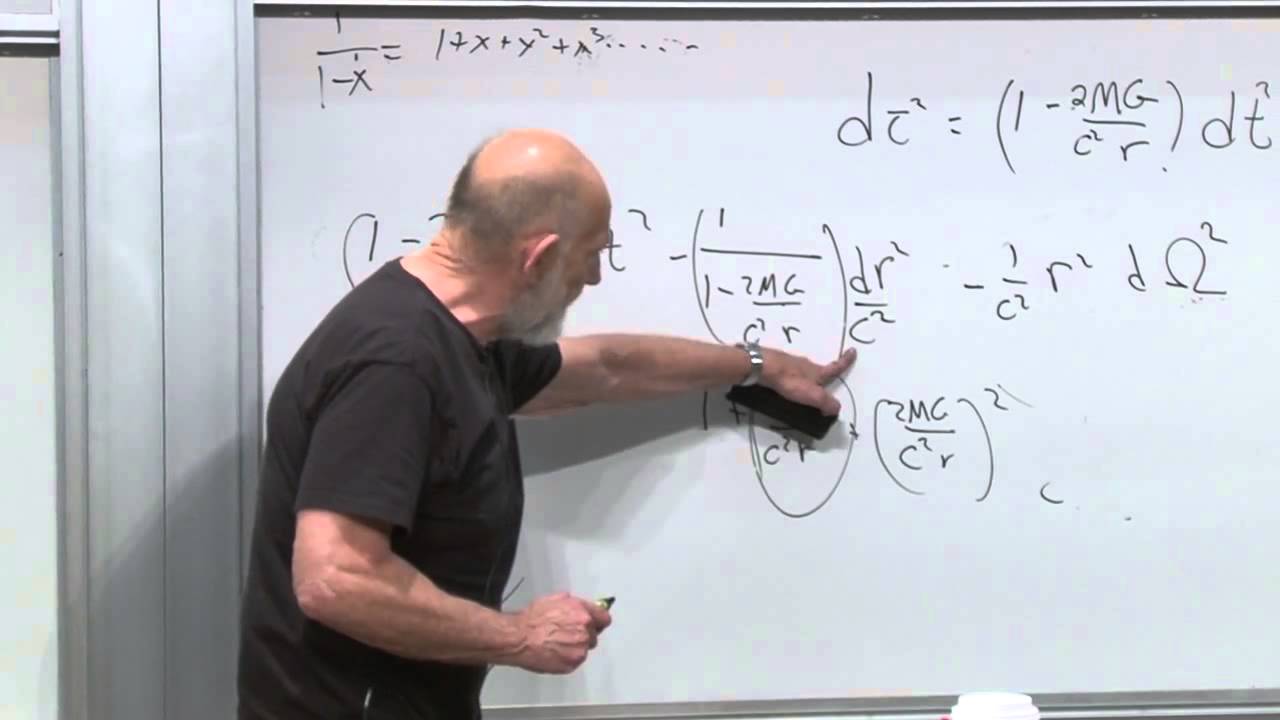
Why this video is valuable: Susskind's specialized lecture on the Schwarzschild geometry. This video analyzes the paths of light and matter (geodesics) around a black hole, explains coordinate singularities vs. physical singularities, and covers the phenomenon of infinite gravitational redshift at the event horizon.
Knowledge Checkpoint:
- Differentiate between the coordinate singularity at (which can be removed by changing coordinates, e.g., to Kruskal-Szekeres coordinates) and the true gravitational singularity at .
- Describe what happens to the roles of the coordinates and when crossing the event horizon ().
- Calculate the path of a light ray moving radially inward toward the horizon.

Why this video is valuable: This highly visual tutorial illustrates how geodesic equations dictate orbits and free-fall trajectories in the curved spacetime around a Schwarzschild mass. It provides the visual intuition to understand why orbits are precessing (such as the Perihelion Precession of Mercury) and how general relativity differs from Newtonian orbits.
Knowledge Checkpoint:
- Explain how Mercury's perihelion precession acts as an experimental proof of GR over Newtonian mechanics.
- Contrast how a geodesic path differs for a massless photon (light bending) vs. a massive particle.
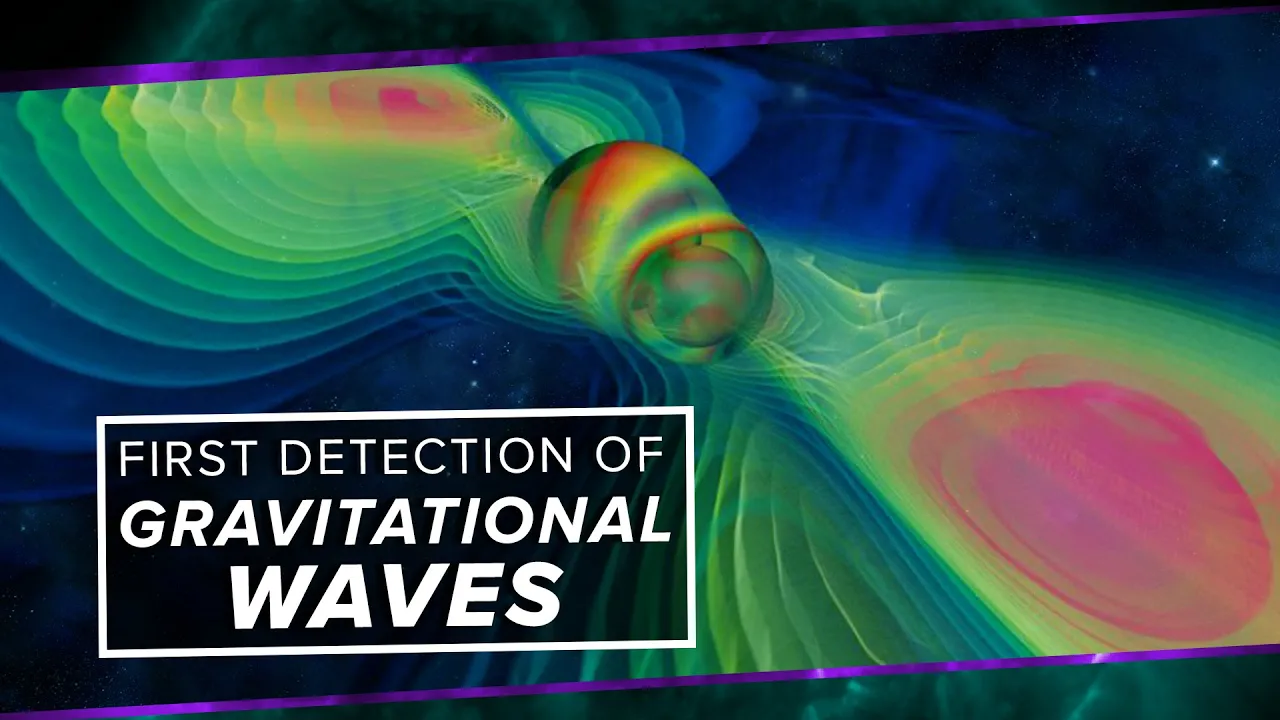
Why this video is valuable: This video focuses on the physics of gravitational waves and their historic detection by LIGO. It explains how linearized, weak-field gravity equations yield wave solutions that travel at the speed of light, and how these transverse quadrupole waves stretch and squeeze space itself.
Knowledge Checkpoint:
- Define the polarization states of gravitational waves ( and ).
- Explain how a Michelson interferometer uses laser phase shifts to measure variations in arm length down to meters during a gravitational wave's passage.
- Describe why spherically symmetric systems cannot emit gravitational waves (requiring instead an asymmetric quadrupole moment, like binary black hole mergers).
Module 5: Cosmology: The Physics of the Expanding Universe
Module Overview
In this final module, you will apply the Einstein Field Equations to the entire universe. By assuming the cosmological principle—that on large scales, the universe is homogeneous (looks the same everywhere) and isotropic (looks the same in all directions)—we use the Friedmann-Lemaître-Robertson-Walker (FLRW) metric. You will derive and solve the Friedmann equations to discover how the cosmic scale factor changes over time, study the thermodynamic evolution of the early universe, analyze Cosmic Inflation, and explore the modern consensus model of cosmology: (Dark Matter and Dark Energy).
Recommended Videos
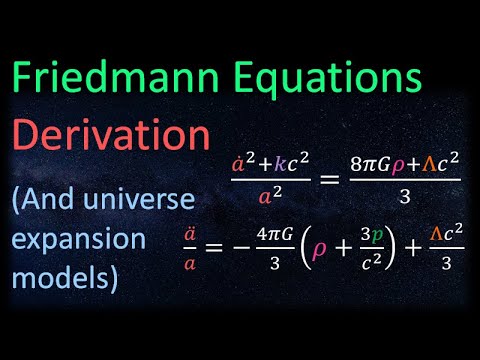
Why this video is valuable: An outstanding mathematical finale that derives the Friedmann equations directly from the FLRW metric using the perfect fluid model for the Stress-Energy tensor. The video walks through the derivation of the scale factor and categorizes cosmic evolution models based on curvature ().
Knowledge Checkpoint:
- Write out the Friedmann Equations:
- Explain the cosmological principle and identify the meaning of the scale factor .
- Map out how a flat (), open (), and closed () universe evolves differently over time.

Why this video is valuable: The academic foundation of Stanford's cosmology curriculum. Leonard Susskind introduces comoving coordinates, physical coordinates, and the Hubble expansion parameter (). He connects Einstein's equations to fluid dynamics to show why a static universe is inherently unstable.
Knowledge Checkpoint:
- Define comoving coordinates and translate them to physical coordinates using the scale factor.
- Explain Hubble's Law () and calculate the current Hubble parameter.
- Mathematically demonstrate why a static universe requires fine-tuning or a cosmological constant to avoid gravitational collapse.

Why this video is valuable: This lecture specifically fills the gap regarding Dark Energy and the equation of state parameter (). It explains how different energy components (matter, radiation, dark energy) scale differently as the universe expands, and how dark energy () leads to exponential expansion.
Knowledge Checkpoint:
- Explain how density () scales with the scale factor for non-relativistic matter (), radiation (), and Dark Energy/Cosmological Constant ().
- Define the equation of state parameter , and state the values of for dust, radiation, and dark energy.
- Explain why dark energy leads to an accelerating expansion of the universe (negative pressure).
Why this video is valuable: Susskind focuses on the physics of Cosmic Inflation. This short, high-density lecture explains the mathematics of scalar fields () in the early universe, detailing how a flat potential energy curve drives a period of rapid, exponential expansion that solves key cosmological puzzles.
Knowledge Checkpoint:
- Explain how Cosmic Inflation resolves the "flatness problem" and the "horizon problem".
- Describe the behavior of a scalar field rolling slowly down a potential energy slope, acting as a temporary cosmological constant.
Course Map
Below is the recommended learning progression. While Module 4 and Module 5 both require the mathematical tools developed in Module 3, they cover different physical regimes (strong, highly localized gravity vs. isotropic, large-scale gravity) and can be studied in parallel or sequentially.
Key People Index
- Albert Einstein (1879–1955): Formulated Special Relativity (1905), discovered the Equivalence Principle (1907), and completed the General Theory of Relativity (1915), fundamentally rewriting our understanding of space, time, and gravity.
- Hendrik Lorentz (1853–1928): Developed the mathematical transformations that preserve Maxwell's equations of electromagnetism across moving reference frames, which Einstein used to build Special Relativity.
- Karl Schwarzschild (1873–1916): Derived the first exact solution to the Einstein Field Equations in 1916 while serving on the Russian front in World War I, establishing the mathematical foundation for modern black hole physics.
- Alexander Friedmann (1888–1925): Solved the Einstein Field Equations for a homogeneous, isotropic universe, proving that General Relativity natively predicts a dynamic, expanding or contracting universe.
- Leonard Susskind (1940–Present): Felix Bloch Professor of Theoretical Physics at Stanford University. Known as one of the fathers of string theory, his clear lectures serve as the academic backbone of this curriculum.
Final Self-Assessment
To verify your mastery of General Relativity and Cosmology, you should be able to confidently check off every item in this final assessment.
- Coordinate Independence: Explain why physical laws must be expressed as tensor equations to ensure they are coordinate-independent (diffeomorphism covariance).
- Minkowski to Curved Spacetime: Formulate how a free particle's flat-space equation of motion () generalizes to curved spacetime by substituting the standard derivative with a covariant derivative.
- Equivalence Principle: Explain how a local frame inside a windowless elevator in free-fall is identical to an inertial frame floating in deep space, and identify the mathematical limits of this "locality" due to tidal forces (Riemann curvature tensor).
- Metric Tensor vs. Christoffel Symbols: Calculate Christoffel symbols given a diagonal 2D metric tensor (such as polar coordinates or a sphere's surface).
- Einstein Field Equations: State the Einstein Field Equations from memory, describe the role of the Einstein tensor , and explain how the stress-energy tensor acts as the source term.
- Schwarzschild Coordinates: Detail why the apparent singularity at in Schwarzschild coordinates is only a coordinate singularity, and describe how Kruskal-Szekeres coordinates resolve this boundary.
- Black Hole Geodesics: Explain why light cannot escape a black hole from inside the event horizon using the coordinate-swapping property of the Schwarzschild metric (the spatial coordinate becomes a time-like coordinate, pointing inevitably toward ).
- Gravitational Waves: Explain how gravitational waves transport energy through space, and why their physical influence is mathematically characterized as a tidal strain ().
- Friedmann Derivation: Derive the first Friedmann equation from the FLRW metric, using the pressure and density of a cosmic fluid.
- Cosmic Acceleration: Describe the mathematical role of a positive Cosmological Constant or dark energy equation of state () in driving the accelerating expansion of the universe.
- Early Universe Inflation: Identify the two core cosmological problems (horizon and flatness) solved by assuming a brief epoch of exponential cosmic expansion driven by a scalar inflation field.