













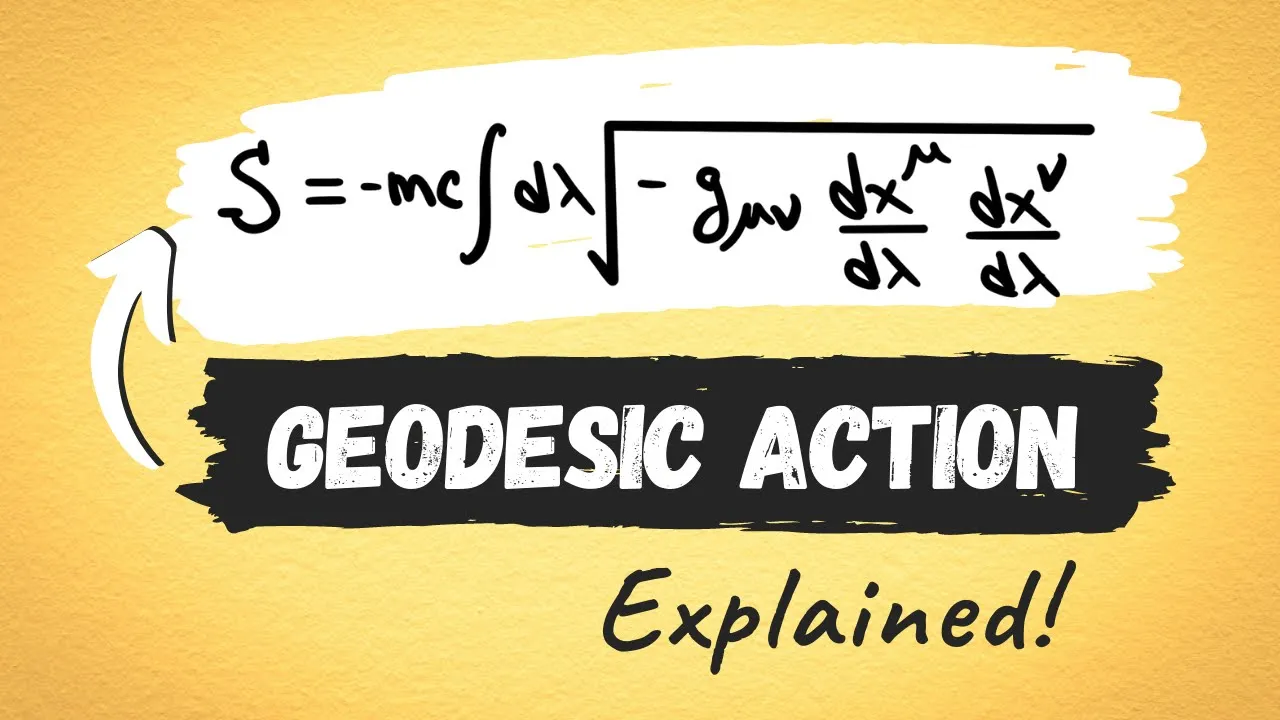




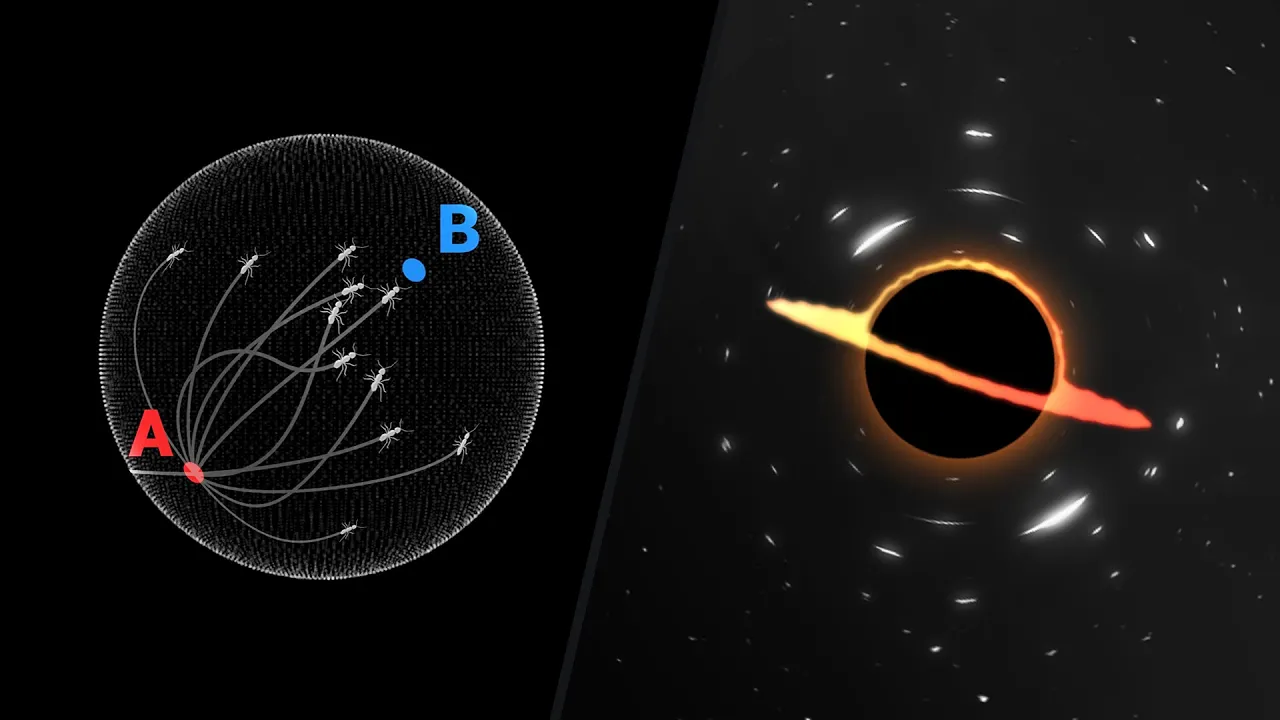
The geodesic equation describes the path of a free-falling particle in curved spacetime, where the covariant derivative of the four-velocity with respect to itself equals zero. This equation can be derived by recognizing that the directional derivative of a scalar field in the direction of a velocity vector represents the rate of change of that field along the particle's path, and when this is zero, the particle follows a geodesic. The resulting equation is d²x^μ/dτ² + Γ^μ_αβ(dx^α/dτ)(dx^β/dτ) = 0, where τ is proper time and Γ^μ_αβ are the Christoffel symbols representing spacetime curvature.
Deriving the Geodesic Equation: A Simple Approach
Added:Understanding of basic General Relativity concepts, particularly the metric tensor and how gravity is described as spacetime curvature.
Familiarity with tensor calculus, specifically index notation and the Einstein summation convention.
An introductory understanding of the covariant derivative and why standard partial derivatives fail in curved coordinates.
The conceptual definition of a geodesic as the shortest or straightest possible path (extremal path) in a curved space.
Solving the geodesic equation for specific physical metrics, such as calculating planetary orbits and light bending in the Schwarzschild metric.
Exploring parallel transport and its connection to the Riemann curvature tensor and geodesic deviation.
Studying the Einstein Field Equations to understand how mass and energy source the spacetime curvature that dictates geodesic motion.
Analyzing cosmological models (like the FLRW metric) and the geodesics of expanding space.
220 views5likes10:52Original Release: 2025-08-23
Hello relativity friends. Um, I got something fun here. I'm calling it a simple derivation of the geodessic equation. Okay. Now, when you use the word the simple in a sentence with general relativity, it's a relative word, pun intended, uh, because general relativity is rather complicated. And the normal way you derive the geodessic equation is something called the principle of least action. And then you use the oiler lrange equation and you do math math math math. Uh it's complicated. I think this is much easier to understand and you basically get to the the same answer. So I'm going to I'm going to I'm going to go with this because this is the one I understand.
Okay. And this is from the book general relativity and intuitive and intuitive introduction. The chapter in that book general relativity for dummies. Since general relativity makes me feel like a dummy, I think this is appropriate. And I'll put a link in the description for this book. I like this book. I use it as reference all the time. Okay, we're going to start with the gradient of a scalar function and it looks like this. So we got the Dell operator acting on this scalar field, the scalar function. Let's just call it scalar. So we get the derivative of that with respect to the coordinates, right? Times its basis vectors. It's obviously in cartisian coordinates. All right. And we also have a vector and we let's say it's a velocity the vector. It has its components and it has its basis the vectors. All right. Now we're going to multiply these together which is going to give us a scaler. Right? So we're going to have little v.ell f. Now remember these are orthonormal basis vectors. So ex is 1. ex dot anything else is zero. And that applies for the rest of these. So we're just going to be left with three nonzero terms. And here's what we get.
All right. Now, let's do Oh, first I want to say this is telling us the rate of change of f the scalar in the direction of v. The rate of change of f in the direction of v. So it is a directional derivative in the direction of v. Right? That's what it's telling us. Let's take an example. All right.
Here's a a vector and here is a scalar a scalar function. All right. Now, let's dot these two things. Not yet. Let's take the gradient of this. So, the derivative of this with respect to x is just six. With respect to y is six.
Respect to z is six. So, this is the gradient of f. So, it is the steepest rate of change of this function. That's what that means.
Now let's dot it with f. All right. The same thing applies for the basis of vectors. We just get three terms. So now -3 * 6 is -8. 0 * anything 0. 3 * 6 is 18. So this is zero.
What's that mean? What's that telling us? It means that the scalar the field f this f is constant in the direction of this velocity vector. This is constant in the direction of this velocity of the vector. So the takeaway from this is that v. delf is equal to zero.
This means that okay now let's switch to relativistic velocity which is called u and it's called the four velocity because it's a function of four coordinates uh time and three spatial components.
That's spacetime and we can write that using the summation notation as its components and basis vectors. Okay.
Now we want to make that equation we found up there a tensor equation. So one way to do that is just change this dell operator to a coariant derivative.
Now warning this works most of the time to change a variant equation to an invariant equation. just changing the delta coariant but derivative but it doesn't always work that's I found that out the hard way okay so we want to know the change in the for velocity with respect to itself okay so we want to know the the change in the for velocity that's going to be the for velocity with respect to itself now remember one of the poses of general relativity states that an obser observer does not experience any acceleration in freef fall. All right? And you can look at you've seen these pictures many times. So a person on earth in a uniform gravitational field of 1g would would the the the physics would behave exactly like it would if there's a person in a rocket ship that was accelerating at 1 oneg. These these people experience the same feeling.
Okay.
So this means that the geodessic in general relativity is defined as a path in spacetime that follows the curvature of spacetime itself. No external the forces are present. So uh someone didn't push you or shoot you out of a rocket ship or anything. This means that the velocity of the change in the for velocity is zero along the geodessic. So if we're traveling along a geodessic in spacetime our for velocity vector is zero. All right. So that makes the definition of the geodessic then the directional covariant derivative that's what we've been talking about of the for velocity in the direction of the for velocity is zero. So we take that gradient equation we saw above and we change it to this. So these are the components of the four velocity times the covariant derivative of the components of the four velocity. Right?
So this is the coariant derivative of u mu with respect to the coordinate alpha times the component u alpha. That's what that means. All right. Now we know how to take the coariant derivative at this point. We've done it many times. Okay, so when you take the coariant derivative of something and we got a one index tensor here in the contravariant position, first thing we write down is the partial derivative of that with respect to the coordinate which is x alpha. And since this is in the contravariant position, we had a plus sign, remember? Then we put our christophal the symbol here, gamma. Now look over here, there's only one free index in this whole equation. It's that one. This is a summation index. So we have to put that there. All right. So then we put our alpha here and we put uh the component here. But we need in order to make this a tensor equation, this needs to be a summation index. So we make up a new one. We make up beta.
Now we distribute this inside and we get this equation. Okay. So far so good. Now we can write this here as the change in the coordinate x alpha with respect to towel which is called proper time.
Now what is proper time? You may ask yourself let's think back to uh to special relativity okay where we saw an equation that looked like this. We had times this lorence the factor it's called it's called the gamma the factor is equal to tow.
So this time is the time of someone at rest and this is the time of someone moving. So proper time means that if you're in motion you have a clock with you. This is your time in motion and this is the time of an observer who's at rest. Right? So if I'm at rest and you're traveling at 90% the speed of light, I measure tw 24 hours go by and you measure according to this equation this.
So I put in uh 90% the C I square it the C's cancel 1 minus.81 * 24 about 10 10 and a half hours. So you say no it's only 10 and a half hours to go by and I say no it's not it's 24 hours go have gone by. So a moving clock runs slower than a clock at rest, right? So that's proper time. All right.
So now where were we? Oh, we had this and we said we're going to define this mu alpha as the derivative uh because that's velocity, right? So the change in distance with respect to time. It's the same equation. It's just relativistic with with respect to the proper time.
We're going to put that right there.
Okay, so that makes this equation look like this. Now look here, these two things are the same. So we can get rid of these. And I I hope no mathematicians are watching. So we get this equation.
The change in the forward velocity u mu component uh with respect to the proper time towel. Okay. Now since we're going to set this equal to zero then this is equal to zero. Right?
Now since mu m new is equal to the change in the x mu coordinate with respect to we can just put that in for right here.
Right? So we're going to put this in right there and we get the partial of this partial with respect to gives us the second derivative of x mu with respect to tao uh squared. We put that back in like this. And this is actually the equation of a geodessic. Now this might not be the form you're used to to to seeing it in. Here might be the way you're used to seeing it because what is mu alpha? That is the change in x alpha with respect to tao. What is mu beta?
The change in x beta with respect to tao. This is probably the form you're used to seeing it in. Anyway, I thought that was so much easier than the normal way to do it. All right, see you later.
Up Next

126:22
Einstein Field Equations for Beginners: General Relativity Explained
@DrPhysicsA
4.6M views•2013-06-22

12:53
21cm Hyperfine Transition in Neutral Hydrogen: Radio Astronomy Basics
@AaronRobertParsons
12.4K views•2011-10-13

32:32
NMR Spin Physics I: Zeeman Effect, Resonance Condition & Larmor Frequency
@nptel-indianinstituteofsci8064
2.3K views•2024-01-17

27:14
Entropy and the Second Law of Thermodynamics Explained
@veritasium
27.5M views•2023-07-01
Related Study Plans & Knowledge Roadmaps
Structured learning paths in Physics
physics
Nuclear Physics (Decay, Fission & Reactors)
01Atomic Structure and the Binding Force
02Radioactive Decay and Half-Life
03Nuclear Fission Mechanics and Chain Reactions
+ 2 more learning modules
12h5 modules
Explore Roadmap
physics
Soft Matter (Polymers, Colloids & Rheology)
01Foundations of Soft Matter & Thermal Forces
02Polymer Physics and Macromolecules
03Colloids, Surfactants, and Self-Assembly
+ 2 more learning modules
38h5 modules
Explore Roadmap
physics
Analytical Mechanics: Lagrangian & Hamiltonian
01Mathematical Foundations: Calculus of Variations
02From Newtonian Mechanics to Constraint Dynamics
03The Principle of Least Action & Lagrangian Mechanics
+ 3 more learning modules
28h6 modules
Explore Roadmap
physics
General Relativity (Spacetime & Cosmology)
01Foundations of Relativity: Special Relativity
02The Geometry of Spacetime: Equivalence Principle & Curvature
03Einstein's Field Equations: The Mathematics of Gravity
+ 2 more learning modules
55h5 modules
Explore Roadmap