




![Lecture-4 Ultrafast Laser Course (from basics of laser to ultrafast laser pulses) [08-09-25]](https://i.ytimg.com/vi_webp/S7pqQQEomBk/sddefault.webp)









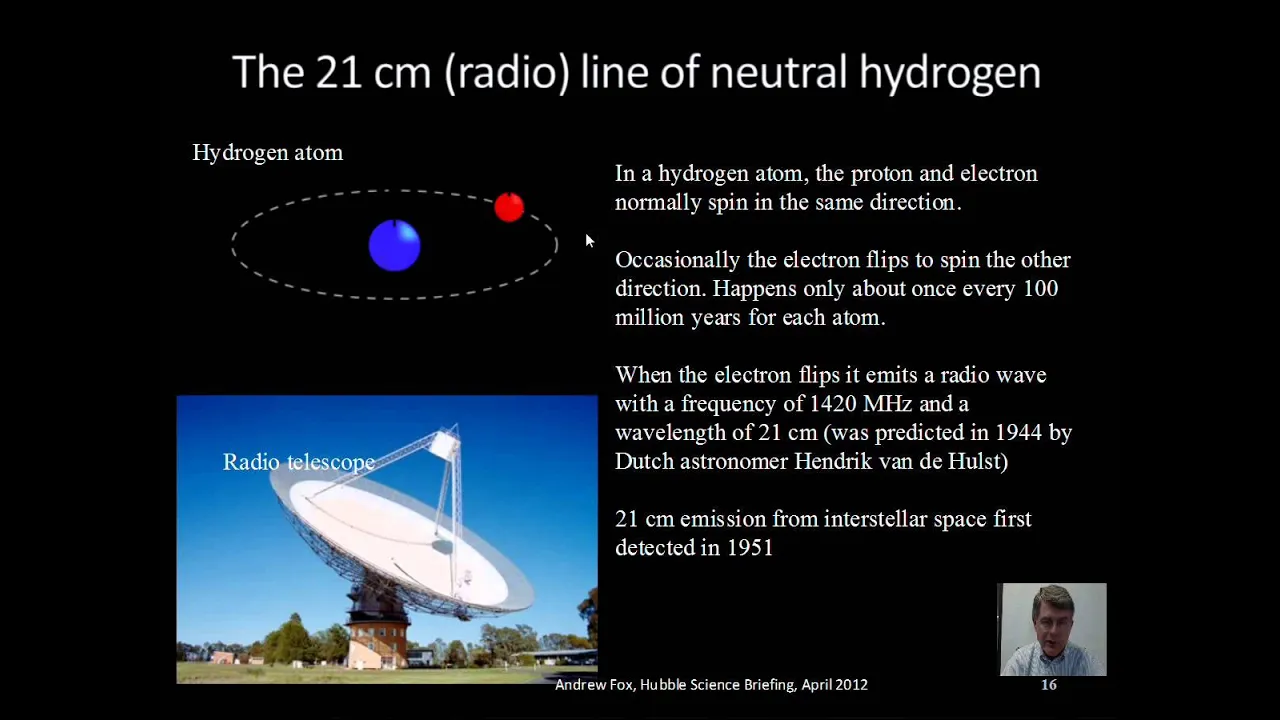



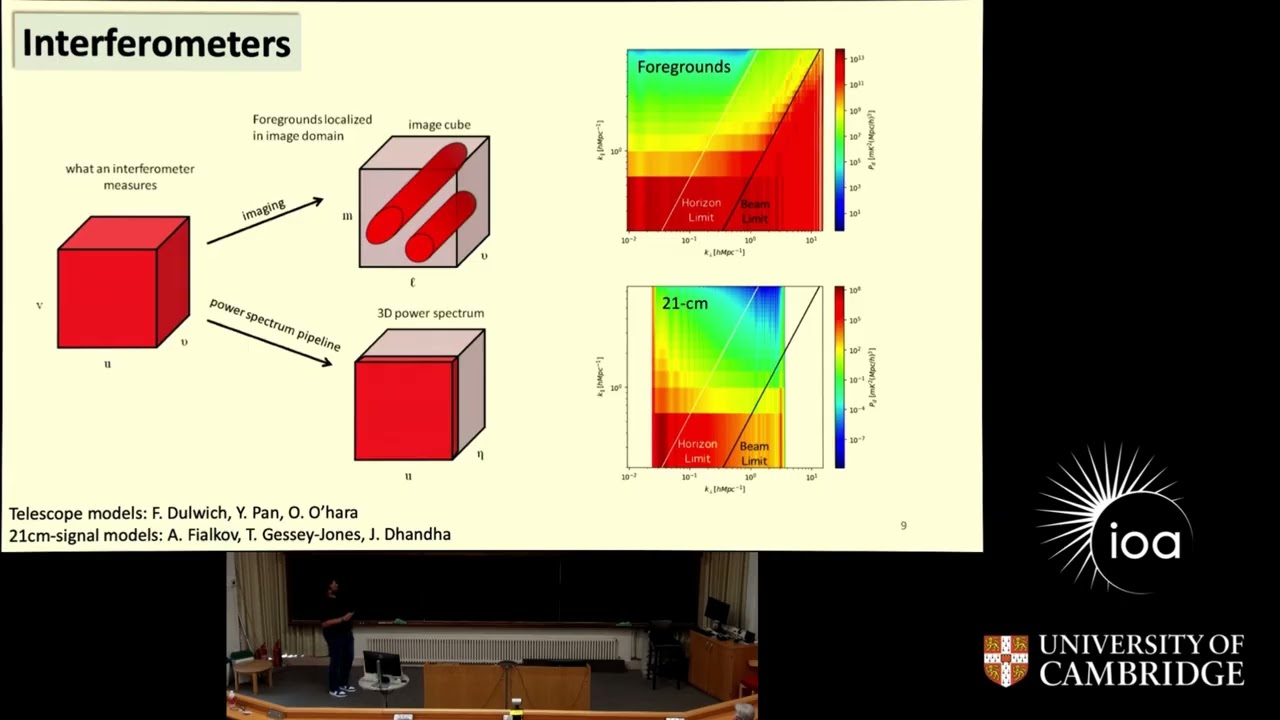


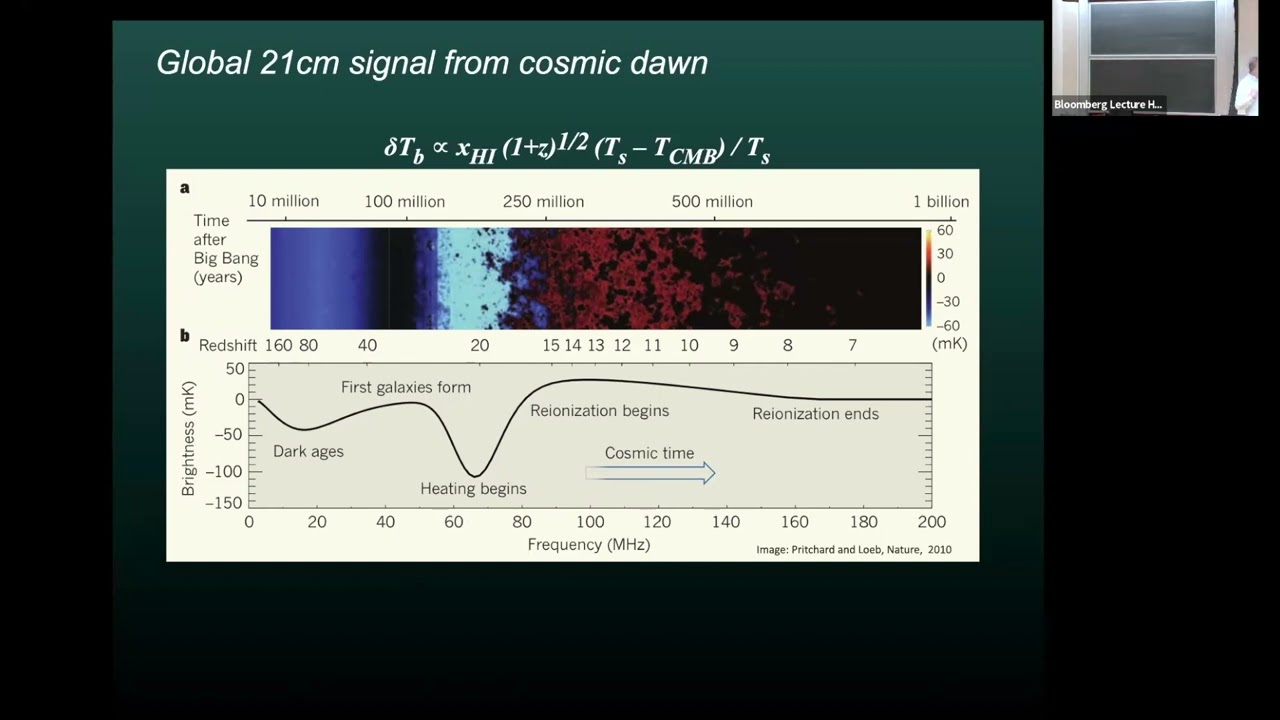

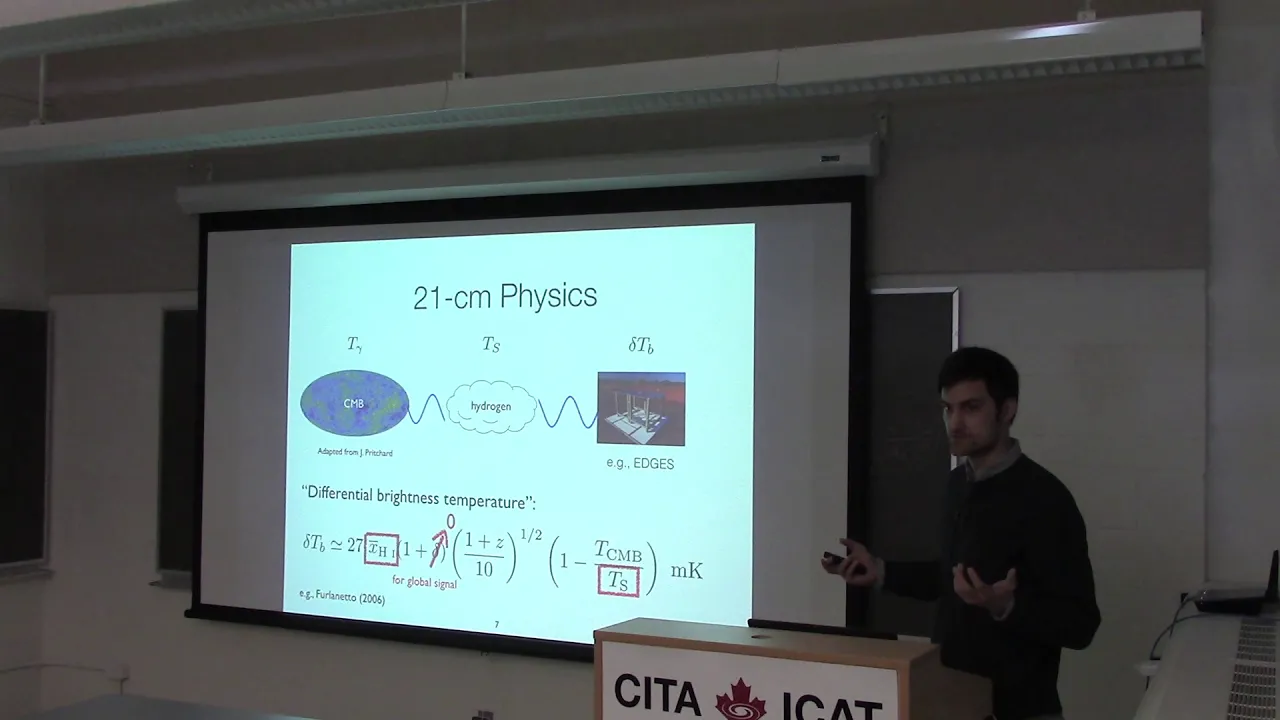

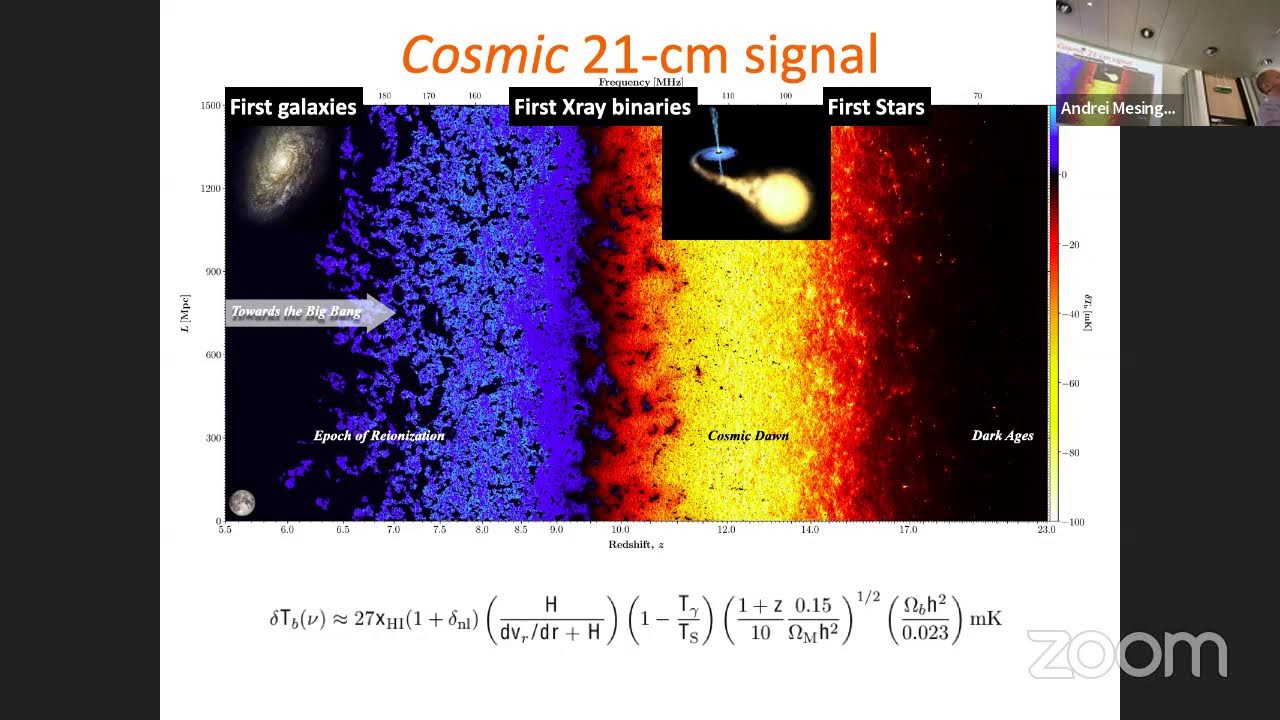




The 21cm hyperfine transition occurs when the electron spin in neutral hydrogen flips from parallel to anti-parallel alignment with respect to the proton's magnetic moment, releasing a photon with a wavelength of 21 centimeters and frequency of approximately 1.4 GHz; this transition has an extremely low probability (Einstein coefficient ~10⁻¹⁵ per second) resulting in a characteristic timescale of about 10⁷ years, making it a fundamental tool in radio astronomy for mapping neutral hydrogen in the universe.
21cm Hyperfine Transition in Neutral Hydrogen: Radio Astronomy Basics
Added:Basic quantum mechanics of the hydrogen atom, including the concepts of electron and proton spin angular momentum.
Foundational statistical mechanics, specifically the Boltzmann distribution and how it dictates energy level populations at thermal equilibrium.
Introductory radiative transfer concepts, such as optical depth, specific intensity, and local thermodynamic equilibrium (LTE).
The Doppler effect and spectral line shifting, which are crucial for interpreting velocity structures in astronomical spectra.
Mapping the spiral structure and rotation curves of the Milky Way and external galaxies using the 21cm line (HI surveys).
Cosmological studies of the early Universe, specifically tracing the Epoch of Reionization and the Cosmic Dawn using highly redshifted 21cm signals.
The Wouthuysen-Field effect and other non-thermal excitation mechanisms that decouple the spin temperature from the gas kinetic temperature.
The engineering and observation techniques of radio interferometry, including how modern arrays (e.g., SKA, HERA) detect weak 21cm background signals.
12.4K views172likes12:53Original Release: 2011-10-13
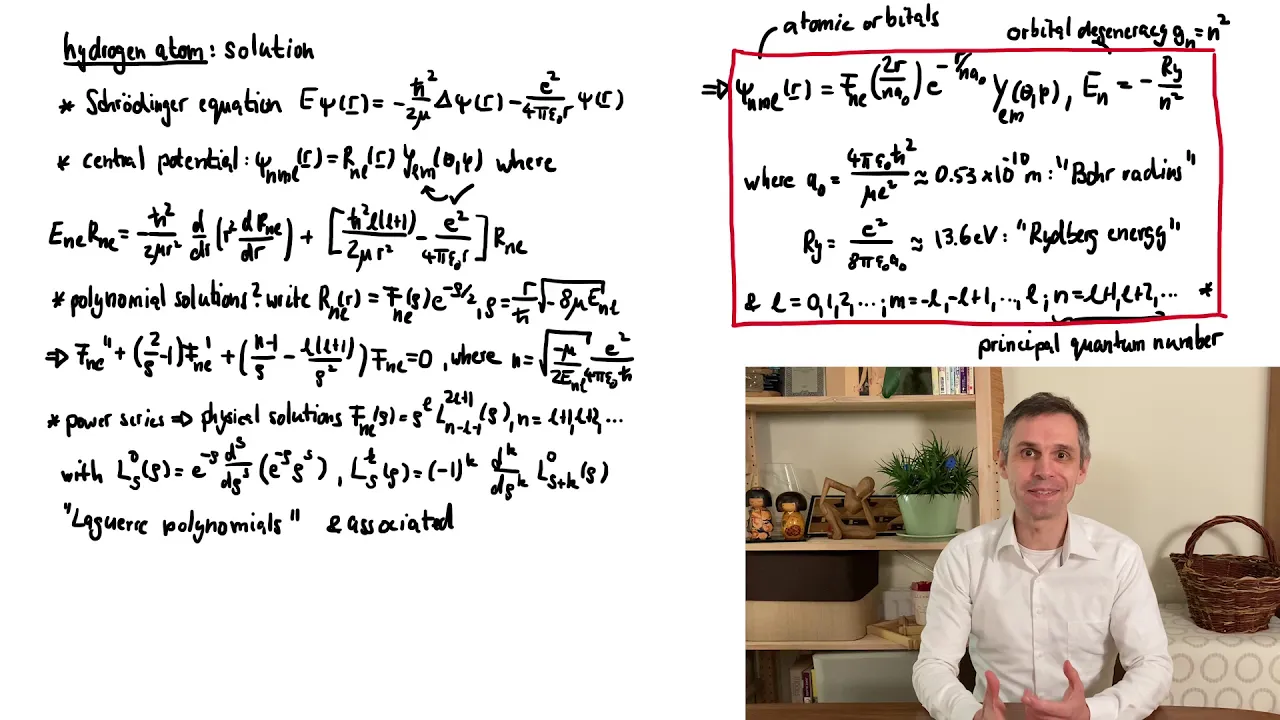
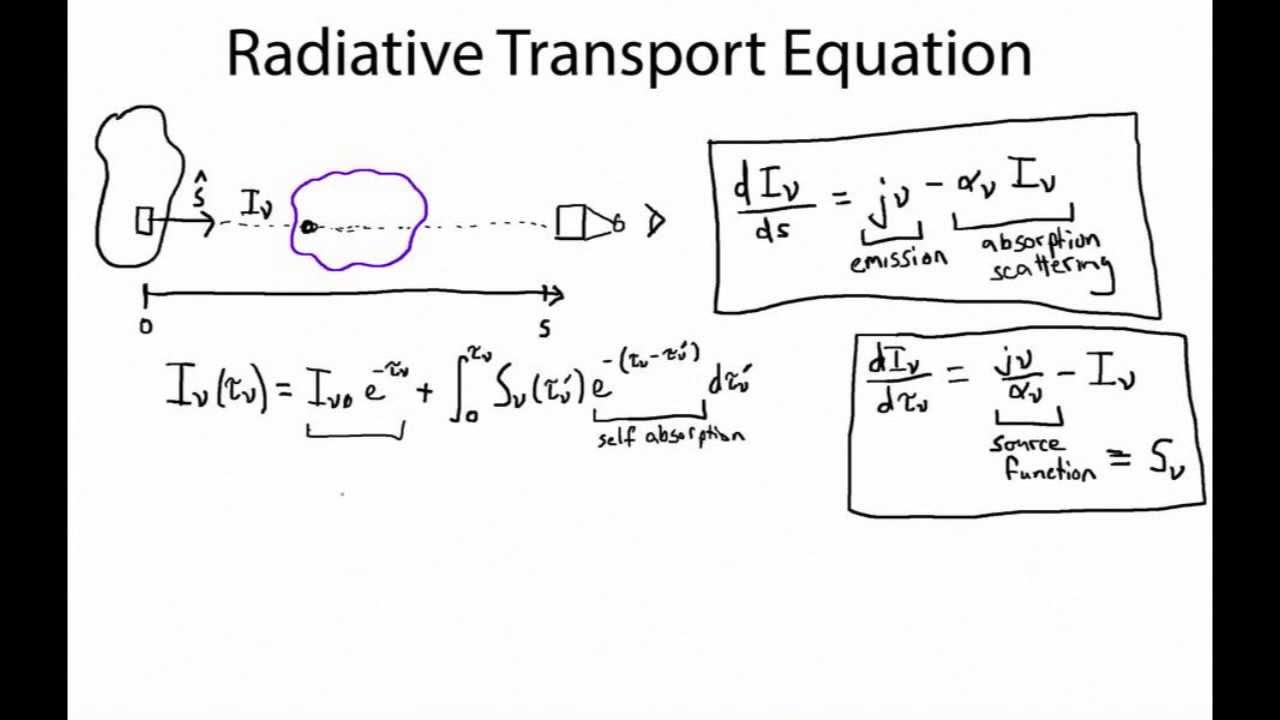
okay now we want to talk about 21-centimeter vision is called the hyperfine transition so imagine we have an hydrogen item with a proton the electron orbiting this proton but what on an electron has a spin so say if I have this proton spin like this so the state of the electron could be spinning up like this or spinning down when the electron and proton in a parallel spin and this is in anti parallel spin they have energy e say e 2 and this half energy say e 1 e 2 is larger than a 1 and the difference between them is about 6 times 10 minus 6 electron volt if an electron have a transition from parallel to and the parallel spin of this transition they will emit a photon with frequency F the frequency of this photon is related to the energy the difference of energy between those state so we have Delta e is H edges Planck constant times the frequency of the photon and using this energy we have a frequency of about 1.4 gigahertz or wavelength that is C over F which C is the speed of the light is about 21 centimeters so if there is a transition hyperfine transition in neutral hydrogen or h1 from a parallel spin to anti parallel spin then they emit a photon with wavelength of 21 centimeters we have talked about the parallel state that is half energy e2 which is a level energy of the parallel state and this is the e1 is the energy levels of anti parallel state which is lower than e2 half difference Delta e so say I have electron in the parallel state what is the probability of this electron to make a transition to anti parallel state the probability is defined by the Einstein coefficient with a symbol a and have subscripts to one so makes define a transition between level 2 to level 1 for hyperfine transition of neutral hydrogen the value of Einstein Co efficient I ate one is about 10 to minus 15 per second so these have a characteristic time we can estimate s 1 / n stein coefficient and it's about 10 to 7 years so spontaneous transition of hyperfine level in atomic hydrogen is has a very very long characteristic time ok now I want to talk about the spin temperatures so spending brothers describe the ratio of atoms in excited state or in parallel state with energy level e 2 to the excited states or antiparallel states with energy level e 1 so if I'm using a Boltzmann equation the number of electron the number density of electrons in energy level e 2 is n 2 and the number of electrons in energy levels 1 and 1 so the ratio between n 2 and + 1 is given by G 2 / G 1 G is the statistical weight of the atom in that state so for hyperfine transition G 2 / G 1 is 3 and this is exponent of minus H mu over KT new here is a frequency and tears as a spin temperatures again H is a Planck constant and T is a Boltzmann constant so basically in this equation spin temperatures governs the ratio of the atoms on the excited state to the lower states there are three process that determines the population of the hyperfine levels first is a collision between atoms so the collision between atoms described by the kinetic temperatures of the atoms the second is the radiation of 21 centimeters which characterized by the radiation temperatures and the last thing is radiation in lyman-alpha that is radiation between the transition of the electronic levels of atomic hydrogen so this is characterized by Lyman temperatures the spin temperatures is 221 centimeter relation temperatures plus a coefficient times kinetic temperatures and efficient against x alignment of the temperatures divided by 1 plus h co efficient these two coefficients determine the relative efficiency of the process so say if the collision between atoms is dominant then the Y C it will becomes large so if this not dominant so this is become less after many interaction the spin temperatures becomes thermal temperatures the last thing I want to talk is about each one column density the symbol is in H the definition of x1 column density is the number of neutral hydrogen per unit area say unit area it's a meter square of the line of sight so say I'm observing a huge cloud of h1 which is me here and this is the line of sight which is strike line of course between the observer and hydrogen cloud and if I have this column which is parallel to the line of sight but has the area of 1 centimeter square the NH or h1 calm density is the number of atomic hydrogen in this region so what I measure in my instrument is this like this this is the velocity in kilometer per second and this is the intensity of the the signals I have signals like this approximately there is a absorption line caused by this cloud and to calculate the h1 column density I can use this simple equation the s here is a spin temperatures measure in Kelvin and now here is optical depth which is simply the ratio it winds say optical depth in this frequency it's just a ratio of the intensity is this in this point with the intensity in this point so this is I accent and this is I so at velocity V at velocity V so optical depth at velocity V is just a ratio and I integrate the optical their overall velocity because the frequency has been changed of velocity in kilometer per second so basically what I'm doing in that integral is measure the area of this absorption line then I get H 1 column density if I can approximate this line as a Gaussian line it's a Gaussian profile like this is a Gaussian with a maximum optical depth so this is the maximum optical depth view is tau naught and the full half maximum width so if this intensity here is I and I have intensity here is I have intensity here so this is the full width of health maximum this is the full width of health maximum the altar fee so I can approximate this if Gaussian I can approximate this equation with the same about the same but it's all not and this is the full width half maximum
Up Next
88:01
Introduction to Cosmology: Lecture 1 by Laura Covi | GR Basis & FRW Metric
@mainzinstitutefortheoretic1604
11.2K views•2019-08-22

86:56
Interfacial Rheology Explained: Theory, Measurements, and Applications
@TAInstruments
12.4K views•2013-07-10

32:32
NMR Spin Physics I: Zeeman Effect, Resonance Condition & Larmor Frequency
@nptel-indianinstituteofsci8064
2.3K views•2024-01-17

27:14
Entropy and the Second Law of Thermodynamics Explained
@veritasium
27.5M views•2023-07-01
Related Study Plans & Knowledge Roadmaps
Structured learning paths in Physics
physics
Nuclear Physics (Decay, Fission & Reactors)
01Atomic Structure and the Binding Force
02Radioactive Decay and Half-Life
03Nuclear Fission Mechanics and Chain Reactions
+ 2 more learning modules
12h5 modules
Explore Roadmap
physics
Soft Matter (Polymers, Colloids & Rheology)
01Foundations of Soft Matter & Thermal Forces
02Polymer Physics and Macromolecules
03Colloids, Surfactants, and Self-Assembly
+ 2 more learning modules
38h5 modules
Explore Roadmap
physics
Analytical Mechanics: Lagrangian & Hamiltonian
01Mathematical Foundations: Calculus of Variations
02From Newtonian Mechanics to Constraint Dynamics
03The Principle of Least Action & Lagrangian Mechanics
+ 3 more learning modules
28h6 modules
Explore Roadmap
physics
General Relativity (Spacetime & Cosmology)
01Foundations of Relativity: Special Relativity
02The Geometry of Spacetime: Equivalence Principle & Curvature
03Einstein's Field Equations: The Mathematics of Gravity
+ 2 more learning modules
55h5 modules
Explore Roadmap