








![8 - Curso de Relatividad General [Cálculo geodésicas en general]](https://i.ytimg.com/vi_webp/i_zhXcWee_k/maxresdefault.webp)
![13 - Curso de Relatividad General [ Transporte Paralelo (3/3) ]](https://i.ytimg.com/vi_webp/u4xDlmZuP3k/maxresdefault.webp)








![Le jour où l'espace a tremblé ! Détection historique d'une onde gravitationnelle… [ETd'O #14]](https://i.ytimg.com/vi/8NSS4zp5lFk/hqdefault.jpg?sqp=-oaymwEmCOADEOgC8quKqQMa8AEB-AHUBoAC4AOKAgwIABABGGUgUyhCMA8=&rs=AOn4CLC-3Kn-we-W8KPbpR8AKVM1aUk8Bw)

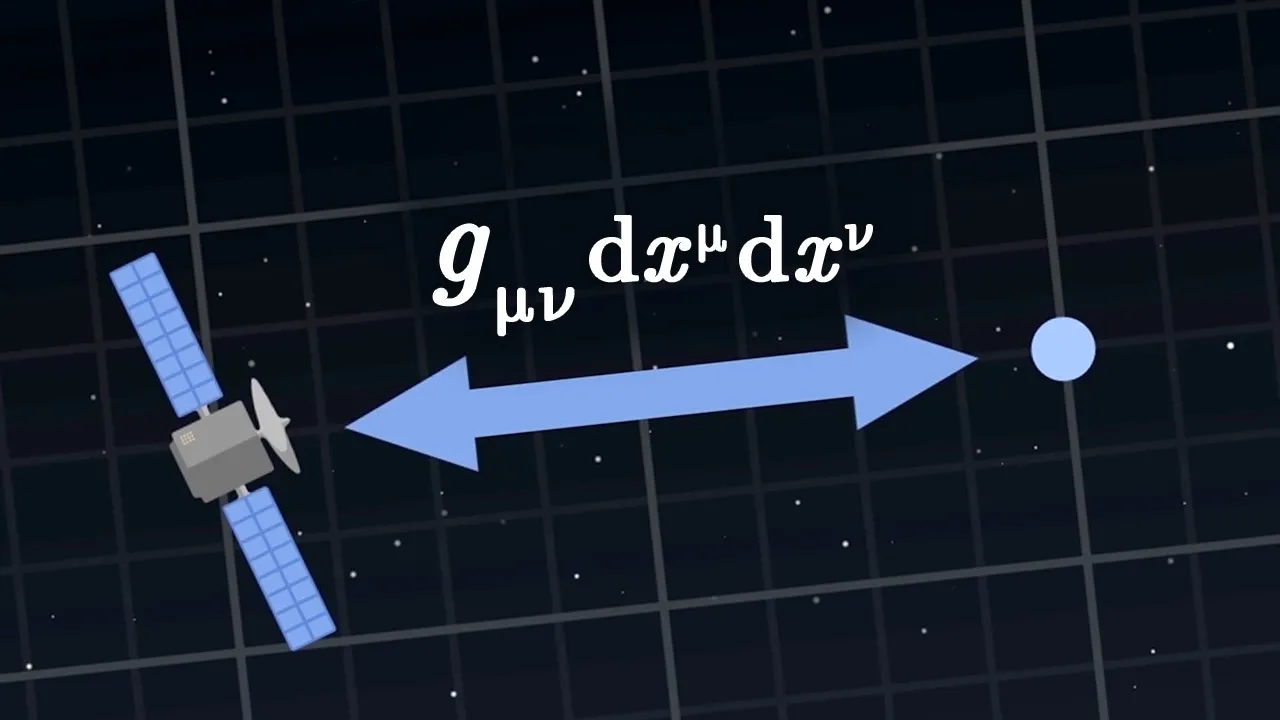
The metric tensor is essentially a sophisticated bar scale that assigns a conversion factor to each infinitesimal region of space-time, enabling the calculation of real-world distances from coordinate distances; it requires three components in two dimensions (two for stretching/shrinking along axes and one for angular skewing between axes), six components in three dimensions, and ten components in four-dimensional spacetime to fully characterize how distances and angles change across different locations.
Metric Tensor in General Relativity Explained Simply
Added:Basic principles of Special Relativity, including the concept of spacetime as a four-dimensional continuum and the invariant interval.
Fundamental concepts of Linear Algebra, specifically vectors, matrices, dot products, and coordinate transformations.
Introductory Multivariable Calculus, including partial derivatives and differential elements.
The Equivalence Principle of General Relativity, which posits that gravity can be described as the geometry of curved spacetime.
Deriving the Christoffel symbols to understand how the metric tensor defines parallel transport and straight paths (geodesics) in curved spacetime.
The Riemann Curvature Tensor and Ricci Tensor, which mathematically describe the degree of curvature of a manifold.
Einstein's Field Equations, specifically how the stress-energy tensor acts as the source that determines the metric tensor.
Analytic solutions to Einstein's equations, starting with the Schwarzschild metric for static, spherically symmetric massive bodies.
The study of Gravitational Waves, interpreted as propagating ripples or perturbations in the metric tensor itself.
393.1K views15.9Klikes14:29Original Release: 2021-10-22
you're on a hike trying to figure out how far away you are from your destination you pull out a map whose bar scale tells you that one inch equals half a mile and measuring two inches between your current location and your destination you conclude that you're one mile out basic math sure but whether you realize it or not you've just utilized a form of the metric tensor one of the most revolutionary revisions to our modern geometry but what is this idea exactly and how has it come to play such a crucial role in the theory of general relativity this is dialect and today we're demystifying the metric tensor [Music] the equations of general relativity tell us that matter and energy alter the metric of space-time resulting in a four-dimensional curvature that's synonymous with gravity the key to understanding general relativity then is locked away somewhere in this notion of a metric which at every point across space and time is characterized by ten numbers in the form of a mathematical object called a tensor but how can we get a deeper intuition about this abstract idea well let's start by taking an approach to cartography this is a military-grade topographical map of fort rucker in alabama the lines and grids covering it are a coordinate system that allows for the precise distinguishing and pinpointing of different locations across the map now the maps bar scale will tell us how to convert from the distances on the map to actual distances on the earth for instance two centimeters on the map corresponds to one kilometer on the ground the bar scale is thus the map's metric or the mathematical object which functions to convert the map's coordinate intervals to real distances on the ground the value or component of this metric is simply the ratio given by the bar scale in this case that ratio is one to fifty thousand since one centimeter on the map corresponds to fifty thousand actual centimeters now viewed as a whole that's all a metric really is a bar scale it's when we want to be more precise that the need for a tensor arises on our map for instance it's not actually true that everywhere 2 centimeters will equal one kilometer this will only be the case wherever the topography of the terrain is relatively flat otherwise if it's hilly or mountainous then all sorts of extra distances are going to be thrown in depending on how high the elevation and how steep the grade of the local topography is if we're near a cliff or a steep mountain for instance traversing one kilometer of horizontal distance requires climbing a good deal of vertical distance as well thus in certain locations on our map two centimeters will actually correspond to a distance greater than one kilometer what this means is that the value of the metric is actually going to change in certain locations being nearly 1 in 50 000 in locations that are relatively flat but being one in more than 50 000 wherever terrain exhibits significant curvature [Music] most topographical maps encode such varying metrics via the use of contour lines on our fort rucker map for instance crossing from one contour line to the next indicates an elevation change of 10 meters thus for a given path on the map to find the total distance covered on the ground you have to not only convert the coordinate distance of the path into real world horizontal distance but you also have to count the number of contour lines crossed by the path to determine that path's change in vertical distance you can then estimate the path's total distance via a simple pythagorean relation the ratio of the original coordinate distance to this final distance is what yields the true value of the metric over the path traveled of course to make this metric as accurate as possible you have to keep making the path size smaller and smaller so that variances in local topography are accounted for essentially you can cut the map into very small pieces and then assign a metric value to each piece this is like giving each little tiny patch on the map its own different bar scale [Music] then as we travel across different patches on the map we can sum over those bar scales to determine how the actual distance on the ground changes with respect to any specified change in coordinates the usefulness of this is of course that one can determine one's real-world distance traveled simply by knowing the coordinate path traveled on the map so now we have a better understanding of what the metric does assigns a bar scale to each piece of the map but where do all these extra numbers of the tensor come from well maybe you noticed that our fort rucker map required two components at each point to define its metric one for the horizontal distance conversion and one for the vertical distance conversion so for a two-dimensional surface or manifold it might seem like you need two numbers to characterize your metric but a map like fort rucker actually takes advantage of certain symmetries in order to reduce the number of components needed to describe its metric consider making a map of the earth if like our fort rocker map you approach it from a sort of top down projection you'll end up with a map that looks like this notice that the lines of latitude here play the same role as the contour lines did in our fort rucker map the closer they are together the steeper the topography is relative to our projection thus the value of our metric grows smaller and smaller the closer we get towards the equator because more and more real-world distance is traversed by the same amount of coordinate distance consequently the shape of landmasses near the equator gets squashed and distorted now because this map has a unique radial symmetry you'd actually only need to specify one number or parameter to characterize the metric at any point but if we want a map of the entire earth this obviously won't suffice instead we would need a projection more like this this robinson projection is different from the other maps we've been looking at so far why because not only does it distort distances making land masses like greenland or antarctica which are further away from the equator appear larger than they actually are but it also distorts angles notice for instance that along this line of latitude near the north pole the lines of longitude all intersect it at different angles yet if you looked at the same lines on a globe you would see that they all intersect at right angles or 90 degrees thus at each of these points on the map if you wanted to give the value of the real angle between the coordinate lines you would need a sort of angle metric to convey the amount of coordinate skew this gives us an idea of what our third and final component of the metric must do somehow it must indicate to us how our angles change across different points of the map but to be precise and really figure out how each of these metric components relates to the other we need to look at the process that actually goes into making these types of maps that is let's ask how do we take a curved surface like that of a globe and make it into a flat surface like that of a map well the method is pretty simple and it works like this we take the sphere or curve surface that we are trying to depict and start by dividing it into many small pieces that are most nearly flat then we surgically cut all those pieces apart and put them back together on a flat surface like pieces of a puzzle at this point however the puzzle pieces won't fit together all that well and there will be many gaps and holes to get rid of those gaps we perform a simple operation upon each of the pieces we stretch and or skew the piece until it fits into place then we can assemble our map into a contiguous hole now the operations of stretching and skewing are pretty easy to describe mathematically stretching merely assigns a new scale to your coordinate intervals skewing meanwhile turns coordinate squares into coordinate parallelograms and consequently right triangles into obtuse or acute triangles so your distance element goes from being the hypotenuse of a right triangle to being one of the sides in an obtuse or an acute triangle and if you remember the extension of the pythagorean theorem from basic geometry you'll know that you need exactly three numbers to calculate the length of the side of a non-right triangle you need the length of the first side the length of the second side and the cosine of the angle between them and voila this is where your three values of the metric come from so for each tiny region of our map we need one number or bar scale to tell us how much our x-axis has been stretched or shrunk one number or bar scale to tell us how much our y-axis has been stretched or shrunk and one number to tell us how much the angle between the axes has been skewed [Music] the tinier we make these regions the more accurate our metric will become and the better we can describe our curved surface the list of these three numbers put together is called the metric tensor and it is easily generalized to higher dimensions by adding one more bar scale for each new dimension plus one new cosine angle value for every pairing of dimensions that can be skewed geometrically we can interpret the number of metric components as being the number of sides and angles you'd need to specify in order to determine the length of the diagonal of an nth dimensional parallelogram so in two dimensions you'll need three numbers at each point on your map to characterize the metric while in three dimensions you'll need six numbers and for four dimensions like that of general relativity space time you'll need four lengths and six angles or ten numbers total to fully characterize the metric at any point together these numbers give us that final desired value the value of the bar scale we need for each patch of our map [Music] and as we stated at the beginning of our video that's all the metric tensor really is just a fancy bar scale an important note to make here is that the framework of the metric tensor treats coordinate systems and the surfaces or manifolds that they describe as fundamentally distinct entities [Music] and although so far we've been dealing with metrics that go between different coordinate systems on different manifolds you can also have metrics which describe different coordinate systems on the same manifold an example of this would be going between cartesian and polar coordinates on a flat manifold because your initially cartesian surface once cut into many small pieces and then stretched skewed and rearranged according to a polar coordinate ordering still retains its original flatness the separation between coordinate systems and manifolds can be an intuitively difficult pill to swallow but it's a crucial idea which ultimately leads to the more sophisticated concept of curvature for the moment however the main takeaway here is that the metric tensor becomes involved whenever you're using some type of map meaning the representation of one surface by that of another the trick to understanding general relativity then is to realize that not all maps are two-dimensional pieces of paper you can hold in your hand [Music] so if you're planning on taking a hike through say a black hole you're going to need something of a four-dimensional map but more on that in future videos this has been dialect thanks for watching [Music]
Up Next

10:52
Deriving the Geodesic Equation: A Simple Approach
@lkapitan8232
220 views•2025-08-23

12:53
21cm Hyperfine Transition in Neutral Hydrogen: Radio Astronomy Basics
@AaronRobertParsons
12.4K views•2011-10-13

32:32
NMR Spin Physics I: Zeeman Effect, Resonance Condition & Larmor Frequency
@nptel-indianinstituteofsci8064
2.3K views•2024-01-17

27:14
Entropy and the Second Law of Thermodynamics Explained
@veritasium
27.5M views•2023-07-01
Related Study Plans & Knowledge Roadmaps
Structured learning paths in Physics
physics
Nuclear Physics (Decay, Fission & Reactors)
01Atomic Structure and the Binding Force
02Radioactive Decay and Half-Life
03Nuclear Fission Mechanics and Chain Reactions
+ 2 more learning modules
12h5 modules
Explore Roadmap
physics
Soft Matter (Polymers, Colloids & Rheology)
01Foundations of Soft Matter & Thermal Forces
02Polymer Physics and Macromolecules
03Colloids, Surfactants, and Self-Assembly
+ 2 more learning modules
38h5 modules
Explore Roadmap
physics
Analytical Mechanics: Lagrangian & Hamiltonian
01Mathematical Foundations: Calculus of Variations
02From Newtonian Mechanics to Constraint Dynamics
03The Principle of Least Action & Lagrangian Mechanics
+ 3 more learning modules
28h6 modules
Explore Roadmap
physics
General Relativity (Spacetime & Cosmology)
01Foundations of Relativity: Special Relativity
02The Geometry of Spacetime: Equivalence Principle & Curvature
03Einstein's Field Equations: The Mathematics of Gravity
+ 2 more learning modules
55h5 modules
Explore Roadmap