



![블랙홀에서는 왜 시간이 멈출까? [블랙홀2]](https://i.ytimg.com/vi_webp/tZi8IHq2A2k/maxresdefault.webp)







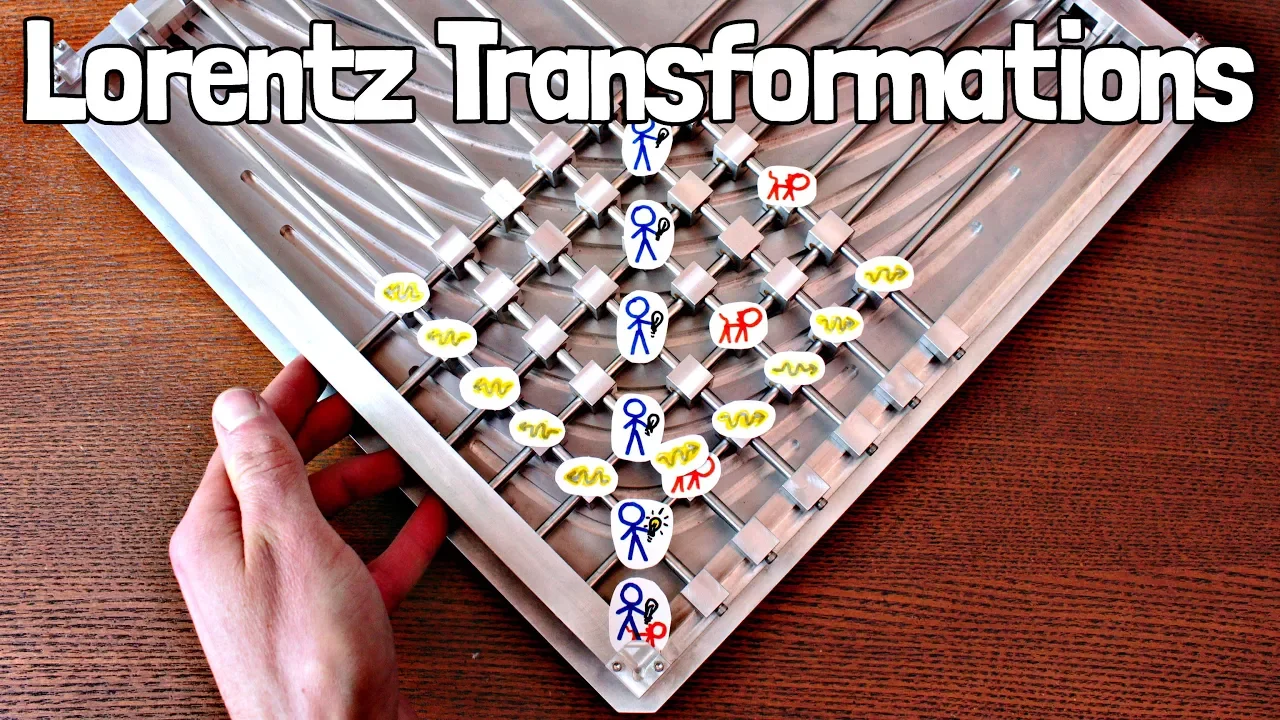

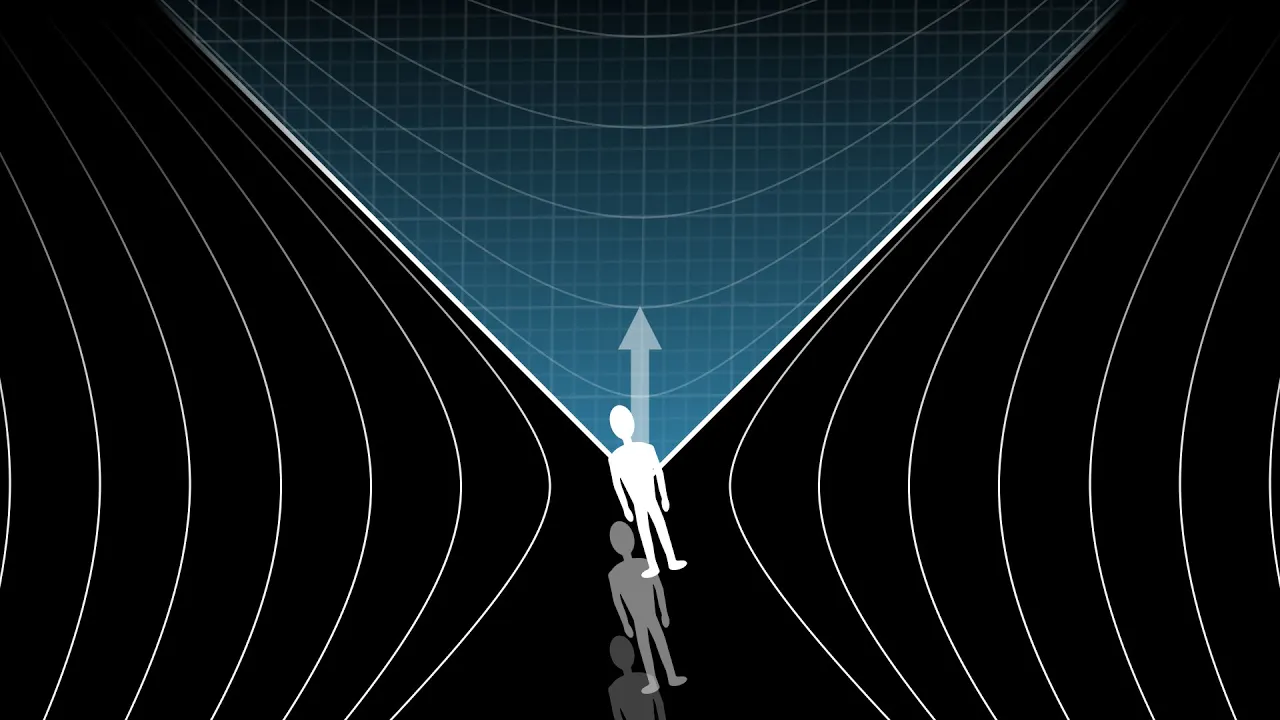





![ДИВНА МАТЕМАТИКА ЕЙНШТЕЙНА 🤯 [VERITASIUM]](https://i.ytimg.com/vi_webp/QZQptiZOQfs/maxresdefault.webp)


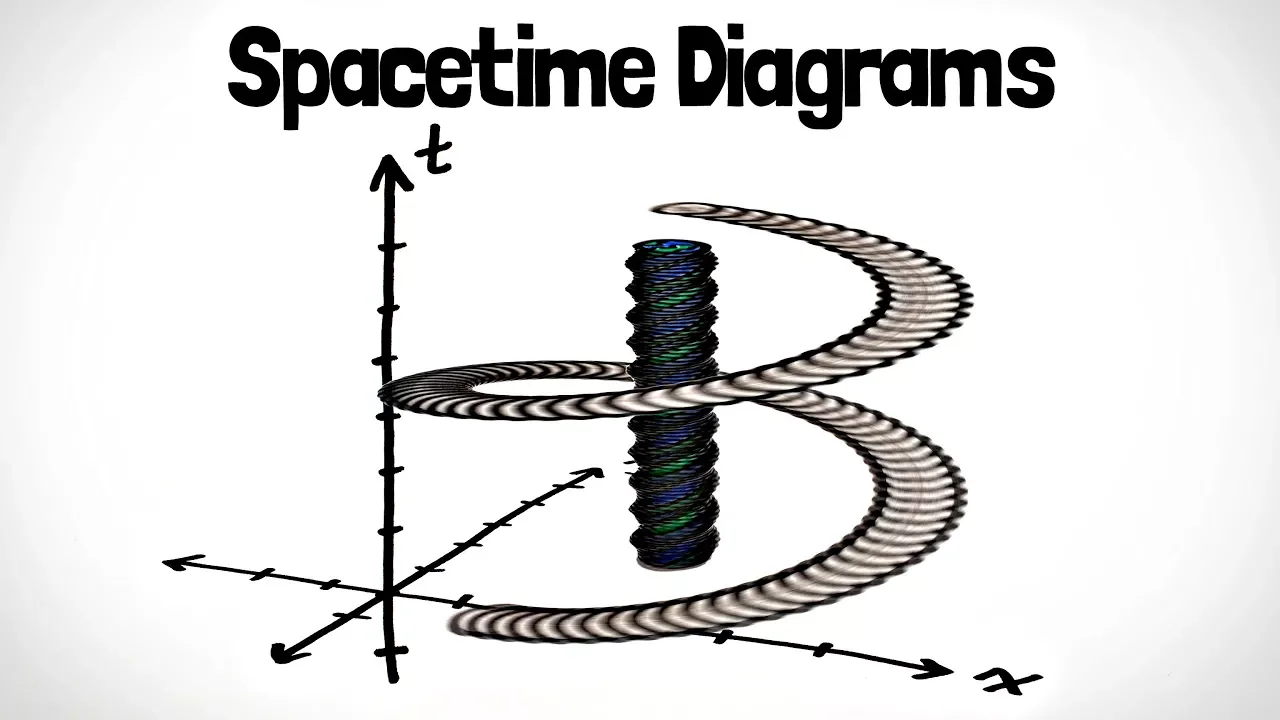







Albert Einstein's theory of special relativity, proposed in 1905, establishes that the speed of light in a vacuum is constant for all observers regardless of their motion, leading to counterintuitive phenomena such as time dilation (moving clocks run slower) and length contraction (moving objects appear shorter), which demonstrate that space and time are interconnected aspects of a four-dimensional spacetime continuum.
Special Relativity Explained: Time Dilation and Length Contraction
Added:Galilean Relativity and Classical Mechanics: Understanding reference frames, relative motion, and how velocities add classically.
The Constant Speed of Light: Familiarity with Maxwell's equations and the concept that the speed of light in a vacuum is invariant.
The Michelson-Morley Experiment: The historical context of searching for the 'luminiferous aether' and the implications of its null result.
Basic Algebraic Manipulation: Comfort with algebra to follow the derivations of relativistic factors like gamma.
Lorentz Transformations: Moving from conceptual understanding to the formal mathematical coordinate transformations between inertial frames.
Relativistic Momentum and Energy: Exploring mass-energy equivalence (E=mc^2) and how momentum behaves near the speed of light.
Minkowski Spacetime and Spacetime Diagrams: Visualizing relativistic effects on coordinate grids and understanding the concept of interval invariance.
Introduction to General Relativity: Transitioning from flat spacetime to curved spacetime to understand gravity and accelerating frames of reference.
GPS and Relativistic Corrections: Exploring how satellite navigation systems must account for both special and general relativistic time dilation to remain accurate.
1.4M views27Klikes8:59Original Release: 2017-02-23
This episode is supported by Prudential.
Let’s say you’re waiting for a friend of yours to arrive on a train.
And, I should point out, it’s a very-much-hypothetical train.
For one thing, it’s moving toward you in a vacuum.
And somehow, it can travel at half the speed of light.
But your friend, Bob, is on this amazing hypothetical train!
Oh, and the front of the train has a headlight.
From Bob’s perspective standing on the train, the light from the headlight is moving away from him at the speed of light.
So the train is moving at half the speed of light, but at the same time, it’s shooting out light from its headlight that’s moving at the speed of light.
You’d think that from your perspective on the platform, it would look like the light coming from the headlight was moving at one and a half times the speed of light.
Because it would have its own speed, plus the speed of the train.
But that’s not true.
Because light always has to move at the same speed through a vacuum, from any perspective.
So, from your point of view on the platform, that light wouldn’t look like it’s going faster than the speed of light.
It would just look like it’s moving at exactly the speed of light.
As counterintuitive and strange as that sounds.
Special relativity explains why.
[Theme Music] The theory of special relativity was proposed by Albert Einstein in 1905.
It explains the behavior of things that move very, very fast – as in, a significant fraction of the speed of light – where regular Newtonian physics doesn’t always apply.
It’s called special relativity because it only applies to specific situations: where the different frames of reference aren’t accelerating.
They’re called inertial reference frames.
In our train example, the two reference frames are the perspective of someone standing on the train, and someone standing on the platform.
Neither reference frame is accelerating, so they’re inertial, and so special relativity applies.
Now, special relativity is built around two main assumptions, or postulates.
The first says that the laws of physics are the same in all inertial reference frames.
It doesn’t matter whether you’re on the train or on the platform – the same equations will apply.
This has to be true, because there’s no real way to distinguish between reference frames.
For all Bob knows – from his perspective on the train as it passes the platform – he’s sitting perfectly still, while the platform zooms past him.
Or the platform could be staying put while he moves past it.
The first postulate tells us that it doesn’t matter.
The physics will play out in the same way, no matter what.
The second postulate says that the speed of light in a vacuum is the same for all observers – about 300,000,000 meters per second.
Always.
Whether or not the light source is moving.
Physicists have tested this fact with lots of experiments.
It's definitely true, all the time.
So even if light is coming from a train that’s moving at half the speed of light the light itself is still moving at about three hundred million meters per second.
And this is where things start to get weird.
You already know that speed multiplied by time equals distance.
But special relativity tells us that when it comes to light, speed is always constant.
Which would mean that the other two variables would have to change – time and distance.
And they do.
When time changes, that’s called time dilation, and when distance changes, that’s called length contraction.
Time dilation occurs when another reference frame is moving relative to you, so time in that reference frame slows down relative to the time you measure.
You can see why if we go back to Bob’s train.
Say Bob stands on the side of his train car that’s closer to the platform, and he’s facing a mirror on the opposite side of the car, 5 meters away.
He shines a flashlight toward this mirror, which reflects the light right back towards him.
From Bob’s point of view on the train, the situation is very simple.
The light traveled straight to the mirror and back, a distance of 10 meters, at the speed of light.
Sure, looking through the window, you saw the light travel to the mirror and back, but meanwhile, the train was still moving.
While the light traveled toward the mirror, the mirror moved sideways relative to your spot on the platform.
And while the light traveled back toward Bob, Bob moved even farther sideways.
The result is that you saw the light travel diagonally, as though its path formed two sides of a triangle.
From your point of view, the light traveled a greater distance than it did from Bob’s point of view.
But! Special relativity tells us that the light’s speed was still exactly c.
Even though it traveled a greater distance.
And if the light traveled a greater distance at the same speed then it must have been traveling for longer.
You and Bob are both timing the exact same series of events.
But you’re measuring a longer time than Bob is.
So, from your perspective on the platform, time has slowed down for Bob.
That’s time dilation.
If you measured the distance the light was traveling from your perspective on the platform, you’d calculate that time slowed down for Bob by a factor of 1 divided by the square root of 1 minus the train’s velocity squared divided by the speed of light squared.
We call this factor gamma, and it applies to any situation where another inertial reference frame is moving relative to yours.
Time in that moving reference frame will seem to equal time in your reference frame, multiplied by gamma.
Gamma always has to be greater than 1, because the velocity of the moving reference frame always has to be less than c, the speed of light.
So time is slower in that moving reference frame.
Because time can pass differently for people depending on their frame of reference, there’s also no universal concept of simultaneity.
In other words, something that seems simultaneous to you might not be simultaneous to Bob.
Say you see a flash of lightning at each end of Bob’s train, at the exact same time as he passes you on the platform.
I mean, we’re already talking about a train going half the speed of light.
So let’s say it gets struck by lightning too!
For some reason!
You see both flashes at the same time, and they’re both the same distance from you, traveling at the same speed.
So you can conclude that lightning struck both ends of his train at the same time.
But from Bob’s perspective on the train, that’s not what happened.
Because while the light is traveling from each end of the train to his eyes, he’s moving.
At the moment that you see both flashes, Bob has already moved past you.
So he’s seen the flash from the front of the train – but only that one.
Then he sees the flash from the lightning that struck the back of the train.
Light always moves at the speed of light, though, no matter what your reference frame is.
That’s the rule.
So, to Bob, the lightning must have struck the front of the train before it struck the back of the train.
Even though they seemed simultaneous to you.
Does your brain hurt yet?
As if time slowing down wasn’t weird enough, there’s also length contraction.
Length contraction means that if something is moving relative to you, its length in the direction that it’s moving will seem shorter than it would if it wasn’t moving.
So you might have measured the train to be 100 meters long before it left the station.
If Bob measures the train from where he’s standing, it will be 100 meters long.
But from your perspective on the platform as it moves past you, the train will be shorter.
Let’s say you want to measure the train as it moves past the spot where you’re standing on the platform.
The train is moving at half the speed of light. That’s set.
From Bob’s perspective, it takes about 6.66 x 10^-7 for the train to pass you.
Velocity multiplied by time equals distance, so Bob calculates that the train must be 100 meters long.
Now you try taking the same measurement.
Problem is, we already know that time moves faster for you than for Bob.
While 666 nanoseconds pass for Bob, only 577 nanoseconds pass for you.
And if the train takes 577 nanoseconds to pass you while it’s moving at half the speed of light, it must be 86.6 meters long!
In general, when something’s moving past you, its length in the direction of its motion will be equal to the length you’d measure if it was standing still, divided by gamma.
Length contraction happens for objects moving at regular speeds, too!
But it’s so tiny that there’s no way you’d ever notice it.
If the train was moving at 150 kilometers per hour, it would contract by less than a picometer – that’s 100th of the length of a hydrogen atom.
Since length contraction isn’t something we see in everyday life, it isn’t part of our intuitive sense of physics.
So special relativity tells us that because light always travels at the same speed, time dilates and length contracts to compensate.
Space and time – they’re directly connected to each other.
That’s what people mean when they talk about four-dimensional spacetime.
If you’re describing something physically, it’s not enough just to talk about its position in three-dimensional space.
You also need to take time into account.
A lot of this might seem counterintuitive, but that’s because we’re used to seeing the world at much, much slower speeds than light.
All of which is to say that when you start to analyze things that are moving fast, the universe becomes a very strange place.
Today, you learned about special relativity.
We went over its two postulates, and their consequences: time dilation, a lack of universal simultaneity, and length contraction.
We also talked about four-dimensional spacetime.
Thanks to Prudential for sponsoring this episode.
It’s human nature to prioritize present needs and what matters most to us, today.
But, when planning for your retirement, it’s best to prioritize tomorrow.
According to a Prudential study 1 in 3 Americans are not saving enough for retirement and, over 52% are not on track to be able to maintain their current standard of living.
Go to Raceforretirement.com and see how, if you start saving more today, you can continue to enjoy the things you love tomorrow.
Crash Course Physics is produced in association with PBS Digital Studios.
You can head over to their channel to check out a playlist of their latest amazing shows, like BBQ With Franklin, PBS Off Book, and Indy Alaska.
This episode of Crash Course was filmed in the Doctor Cheryll C. Kinney Crash Course Studio with the help of these amazing people and our equally amazing graphics team, is Thought Cafe.
Up Next
4:33
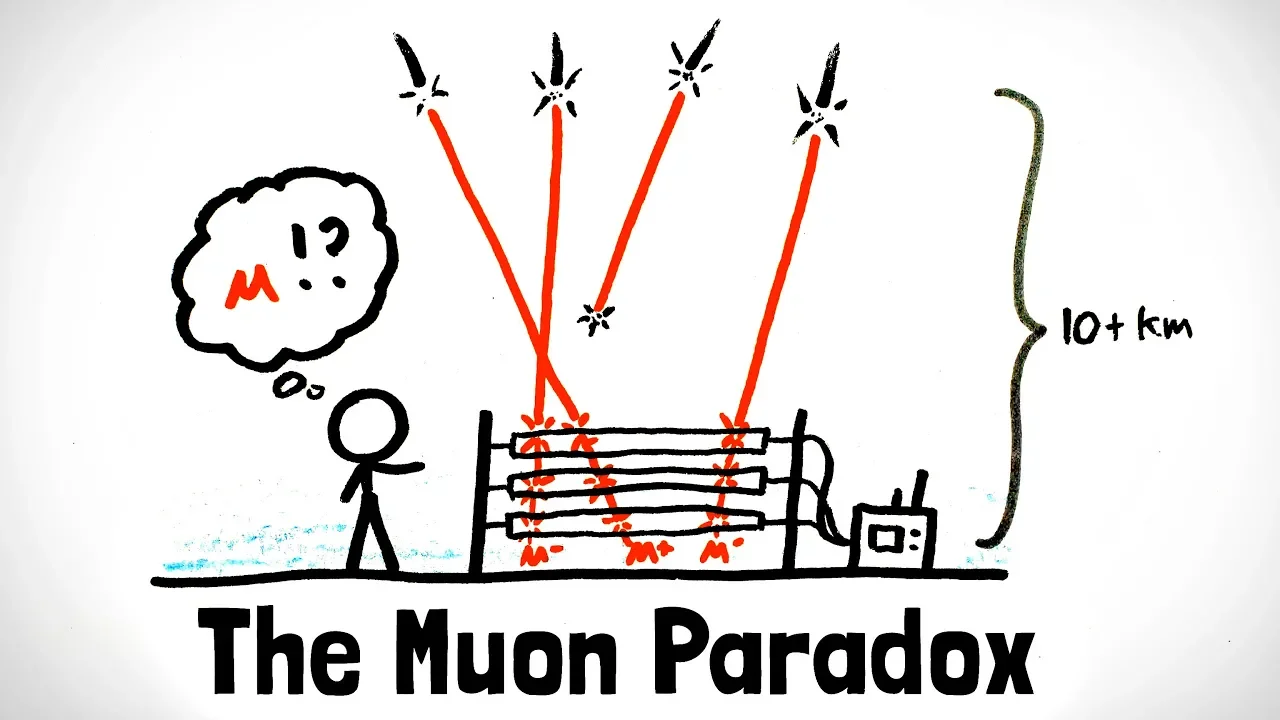
Muons and Special Relativity: Proof of Time Dilation
@MinutePhysics
1.2M views•2018-11-13

12:53
21cm Hyperfine Transition in Neutral Hydrogen: Radio Astronomy Basics
@AaronRobertParsons
12.4K views•2011-10-13

10:35
Understanding Standing Waves and Harmonics in Music
@crashcourse
833.9K views•2016-08-11

27:14
Entropy and the Second Law of Thermodynamics Explained
@veritasium
27.5M views•2023-07-01
Related Study Plans & Knowledge Roadmaps
Structured learning paths in Physics
physics
Nuclear Physics (Decay, Fission & Reactors)
01Atomic Structure and the Binding Force
02Radioactive Decay and Half-Life
03Nuclear Fission Mechanics and Chain Reactions
+ 2 more learning modules
12h5 modules
Explore Roadmap
physics
Soft Matter (Polymers, Colloids & Rheology)
01Foundations of Soft Matter & Thermal Forces
02Polymer Physics and Macromolecules
03Colloids, Surfactants, and Self-Assembly
+ 2 more learning modules
38h5 modules
Explore Roadmap
physics
Analytical Mechanics: Lagrangian & Hamiltonian
01Mathematical Foundations: Calculus of Variations
02From Newtonian Mechanics to Constraint Dynamics
03The Principle of Least Action & Lagrangian Mechanics
+ 3 more learning modules
28h6 modules
Explore Roadmap
physics
General Relativity (Spacetime & Cosmology)
01Foundations of Relativity: Special Relativity
02The Geometry of Spacetime: Equivalence Principle & Curvature
03Einstein's Field Equations: The Mathematics of Gravity
+ 2 more learning modules
55h5 modules
Explore Roadmap