




















Lorentz transformations are the correct mathematical framework for describing how motion appears from different inertial reference frames in special relativity; unlike Galilean transformations (shear transformations) which change all velocities equally and fail to preserve the speed of light, Lorentz transformations use squeeze rotations that keep the speed of light constant (appearing as 45° lines on properly scaled spacetime diagrams) while changing all other velocities, thereby correctly accounting for experimental evidence that light speed remains unchanged regardless of the observer's motion.
Lorentz Transformations Explained: Special Relativity Chapter 3
Added:The core postulates of Special Relativity, specifically the constancy of the speed of light (c) in all inertial reference frames.
Galilean relativity and classical mechanics, including how relative velocities and coordinate systems are treated in Newtonian physics.
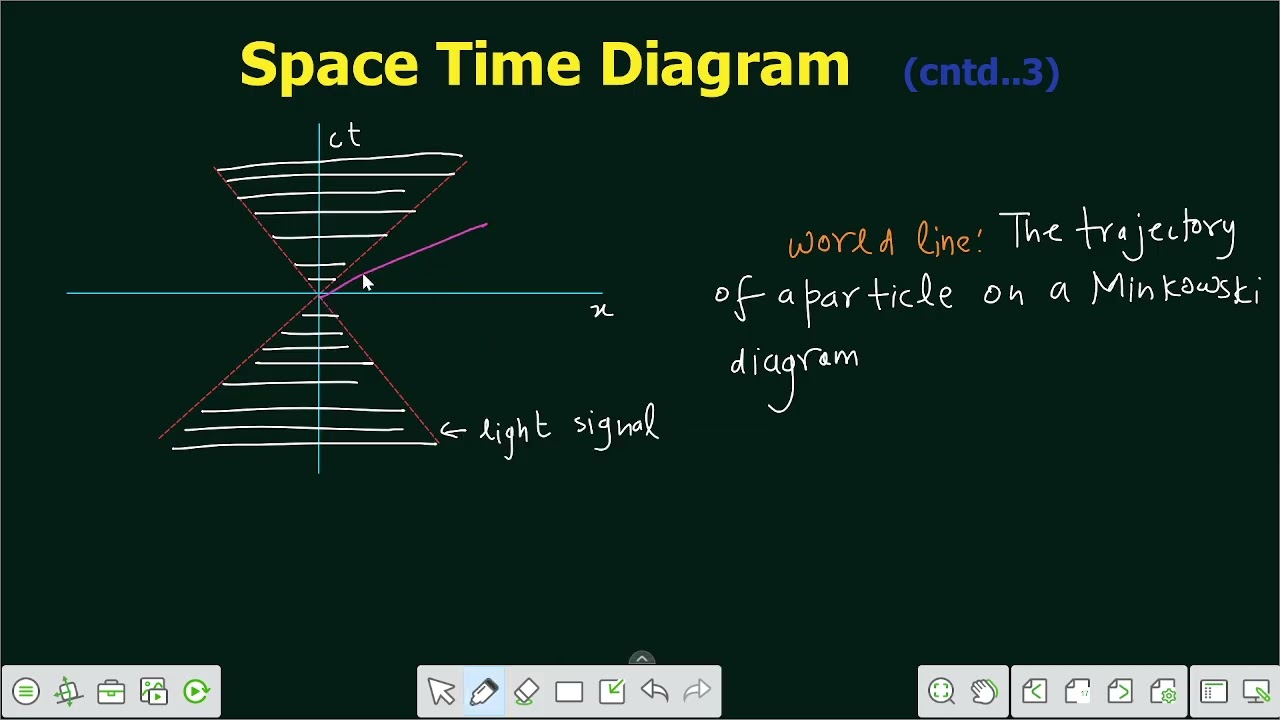
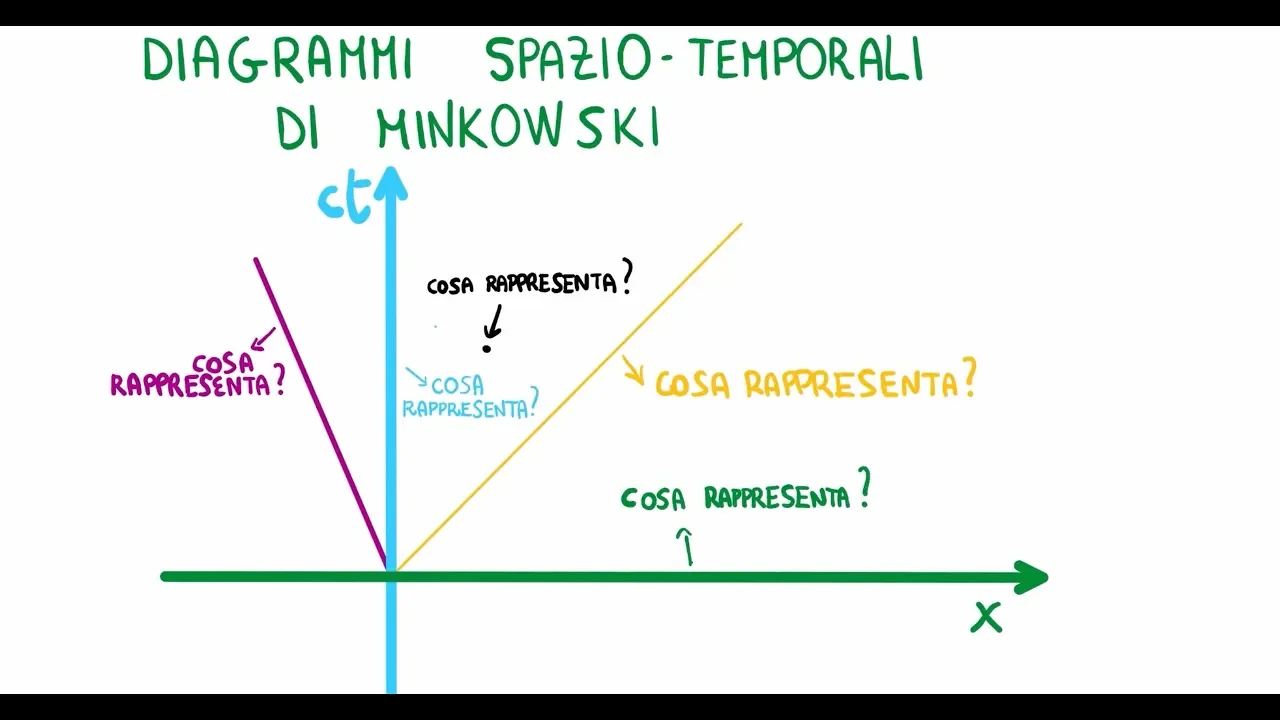
The basic structure of spacetime diagrams (Minkowski diagrams), including position and time axes, worldlines, and light cones.
Fundamental linear algebra and coordinate geometry, particularly the concept of transforming coordinates between observers in relative motion.
Mathematical derivation of Time Dilation and Length Contraction directly from the Lorentz transformation equations.
The Relativistic Velocity Addition formula, demonstrating why the speed of light remains an absolute speed limit.
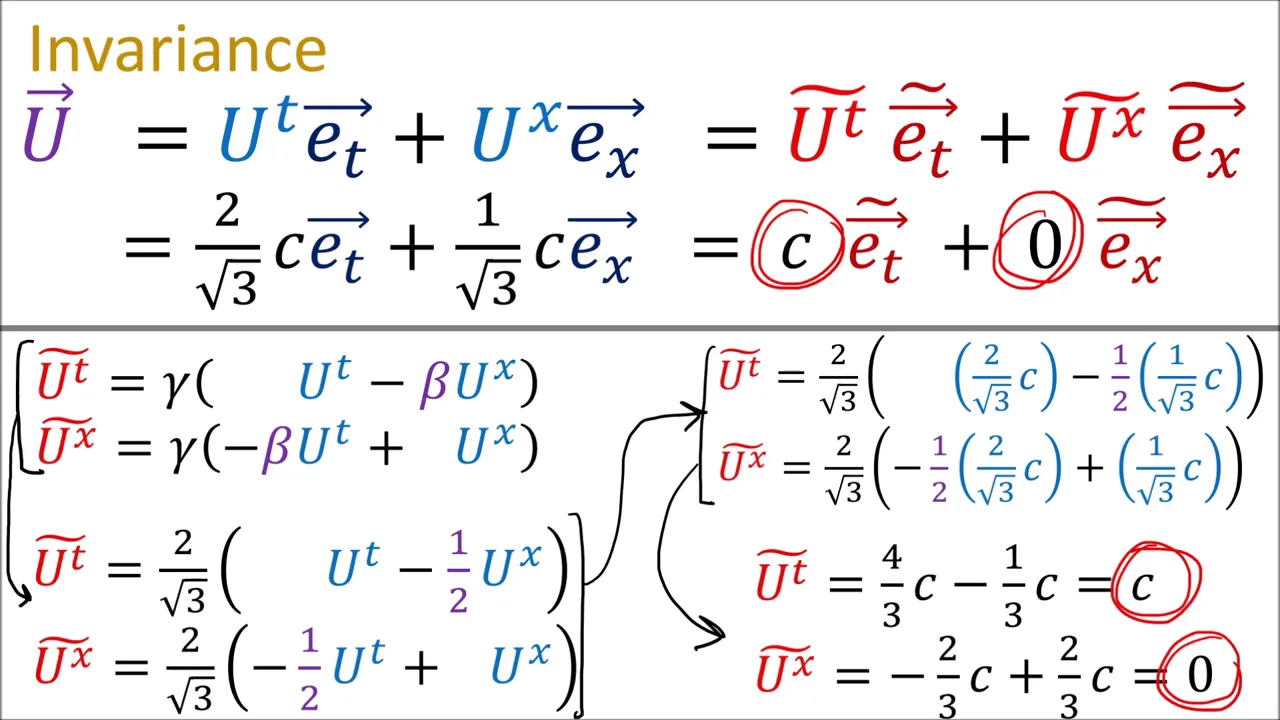
The invariance of the Spacetime Interval, showing how the 'distance' in spacetime remains constant for all inertial observers.
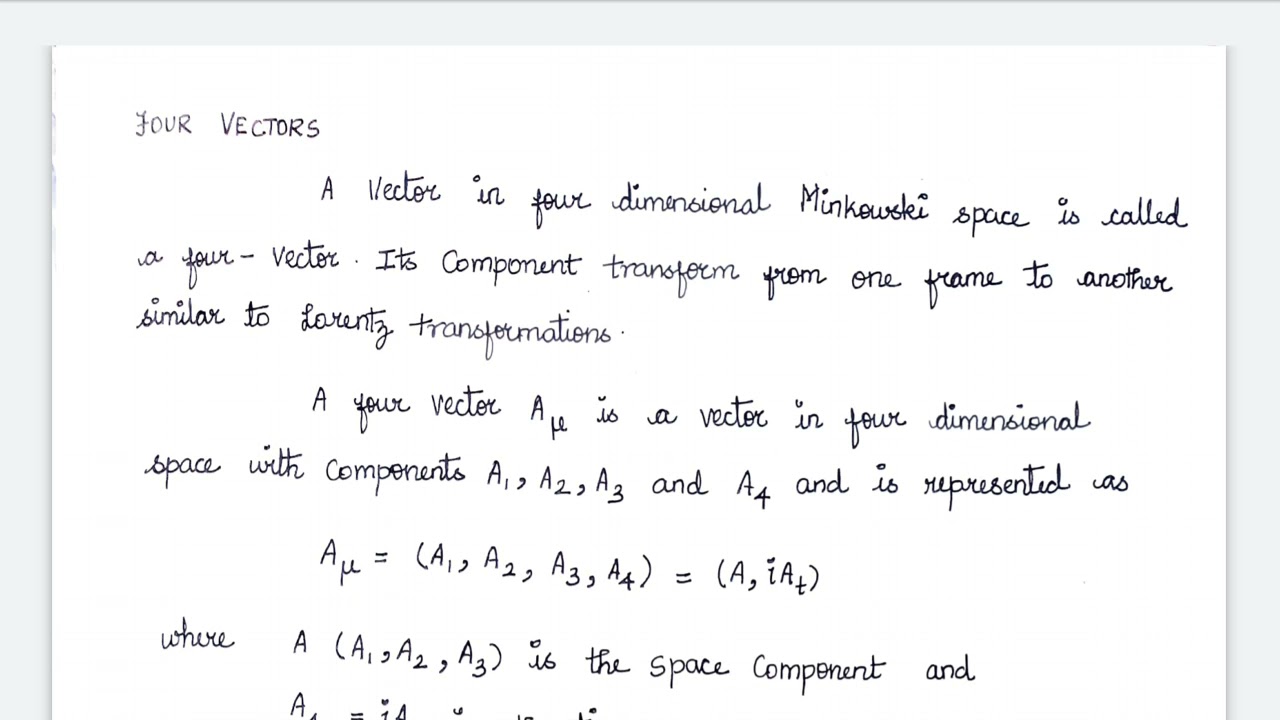
Introduction to Four-Vectors (such as four-position and four-momentum) and how they unify physical laws in relativistic dynamics.
2M views55.4Klikes12:17Original Release: 2018-04-03
The goal of relativity is to explain and understand how motion looks from different perspectives, and in particular, from different moving perspectives.
It's easy enough to describe motion itself – if something is moving relative to me, that means it has different positions at different times, which I can plot on a spacetime diagram.
This straight line corresponds to motion at a constant velocity of say, v units to the right every second.
And the question we're interested in is what do things look like from the moving perspective?
Of course, the answer to this question is a physical one, and is determined by experimental evidence gathered by actually moving.
And that evidence will come into play, but first we need to understand what it means, in terms of spacetime diagrams, to view something from a moving perspective.
We'll start with a key property of spacetime diagrams: when someone draws a spacetime diagram from their own perspective, on that diagram they're always, for all time, located at position x=0, since they're always a distance of 0 away from where they are.
Or in other words: a spacetime diagram like this represents your perspective only if your worldline is a straight vertical line that passes through x=0.
If, on a spacetime diagram, the worldline describing your motion leaves x=0 and goes anywhere else, that means you're moving relative to the perspective of that particular diagram, and thus it's not your perspective.
With this in mind, to describe how things look from the perspective of a moving object, like this cat, we simply need some way to transform spacetime diagrams that makes the worldline of the cat into a straight vertical line through x=0; or in other words, we want to make the spacetime diagram where the cat is moving into one where the cat's worldline coincides with the time axis.
That's not something we can do just by sliding the whole plot left or right or up or down, like we've done for perspectives from different locations.
No, changes of velocity require some sort of rotationy thing to change the angle of the worldline, and importantly, whatever this rotationy thing does should be generalizable to a world line at pretty much any angle, since there was nothing special about the particular speed the cat happened to be going.
There are also two important pieces of experimental evidence that we'll need to take into account: first, if I measure the cat as moving at a speed v away from me, then the cat will measure me as moving at that same speed v away from it, and likewise if we're moving towards each other.
Which means we not only want to transform the spacetime diagram in a way that the cat's angled line becomes vertical, but we also want the angle between our two lines to stay the same after the transformation – that is, from the cat's perspective, I should be moving.
The second piece of evidence we'll come to later.
Let's focus just on the section of the cat's worldline from time t=0, where it's at x=0, to t=4, where it's at x=2.
This section is a straight line between those two points, and we want it to end up as a straight vertical line, so we can simply leave the t=0,x=0 point unchanged while moving the t=4,x=2 point onto the time axis (where x=0).
And there are really only three general possibilities for how to do this: either this point gets moved onto the time axis while keeping it at the same point in time, t=4, or it gets moved onto the time axis at an earlier time (say, t=3), or a later time (like t=5).
There's a very nice geometric way to picture these possibilities.
If we think again of motion on a spacetime diagram as a series of snapshots, like, at time t=0 the cat is at position 0, at time t=1 the cat is at position 0.5, at time t=2 the cat is at position 1, etc, then the transformation where points move to the time axis and keep the same time just looks like sliding each snapshot over a corresponding amount; the possibility where points move to the time axis at a later time looks kind of like some sort of rotation around the origin; and the possibility where points move to the time axis at an earlier time looks kind of like some sort of squeezy rotation.
The reason these last two involve rotating the snapshots rather than just sliding is to make sure that the angle between the cat's worldline and my worldline stays the same before and after the transformation – it's a fun little geometry puzzle to understand why.
Now, among these three, the option that makes the most intuitive sense based on our everyday experiences of the passage of time, is that a given point in time should stay at the same point in time, and just slide over to the time axis.
I mean, we don't noticeably experience time travel every time we hop on a train or bike or plane.
And this sliding does mathematically work – if we move things at time t=1 a half meter to the left, and things at time t=2 one meter to the left, and so on, then we'll have a description from the cat's perspective – the cat's not moving, and I'm moving to the left half a meter every second.
It works for other speeds, too.
If we want the perspective of somebody who's going a meter per second to the right relative to the cat, we can slide the snapshots over even farther, and now the cat's going a meter per second to the left, and I'm going a meter and a half per second to the left.
And of course we can slide back to my perspective from which the newcomer is going a meter and a half per second to the right.
This kind of sliding change of perspective is normally called a “shear transformation,” but that's when both dimensions are space dimensions: since one of our dimensions is time, a shear transformation represents a change in the velocities of things, so in physics it's called a “boost.” As in, rocket boosters boosting you to a higher speed.
However, it turns out that boosts in the physical universe are not actually described by shear transformations.
This is where the second and most famous piece of experimental evidence comes in: the speed of light.
As you've probably heard, starting in the late 1800s, physicists built up mountains of experimental and theoretical evidence that the speed of light in a vacuum is always the same, even if you measure it from a moving perspective.
This is, of course, entirely unintuitive from our everyday experiences with velocities, where if you throw a ball from a standstill and then from a moving vehicle, the ball thrown from the vehicle will be moving faster relative to the ground.
And yet, experimental results show that light does not behave like everyday objects: shine light from a standstill, or from a moving vehicle, and its measured speed relative to the ground will be the same.
Shear transformations simply can't accomodate this feature of light's behavior: they change all velocities equally by sliding each snapshot an amount proportional to its time.
No velocity remains unchanged – if you draw the worldline of a light ray and then change to a moving perspective using a shear transformation, the speed of that light ray will change, which is wrong.
Luckily, one of the other two options for boosting to a moving perspective can accomodate a constant speed of light: remember the transformation where the snapshots do a kind of squeeze rotation, and points move to the time axis at earlier times?
This kind of transformation can amazingly leave one speed unchanged, even while it changes all other speeds.
More amazingly, the unchanged speed is left unchanged in all directions.
Let's do an example.
Here's a set of snapshots from my perspective with a slow-moving sheep and two fast-moving cats, and let's suppose that we have experimental evidence that cats always move at the same speed regardless of perspective.
If we want to describe this situation from the perspective of the sheep, we can't simply slide the snapshots over so the sheep isn't moving and its worldline coincides with the time axis, since that would change the speed of the cats.
But, if we slide and rotate and stretch the snapshots like this, then look – we've transformed the diagram to both describe things from the sheep's perspective and keep the cats moving at the same speed they were before.
You might note that the various cats appear to be spaced out differently along their worldlines, but that just means that the constant-time snapshots from my perspective aren't constant-time snapshots from the sheep's perspective.
The important thing is that the angle of the cats' worldlines – which represents their speed – has remained unchanged.
It's kind of amazing to me that this works at all; that it's mathematically and physically possible for all speeds except one to change!
But it is possible with these squeeze rotationy things, and they're the answer to our question of how to describe motion from a moving perspective.
Well, not by keeping the speed of cats constant, but by keeping the speed of light constant: by doing squeeze rotations so that a moving perspective's angled worldline becomes vertical without changing the speed of light – that is, without changing the slope of the worldlines for light rays.
These squeeze rotationy things are called Lorentz Transformations, named after one of the first people to derive the correct mathematical expression for them – it looks kind of like the equation for rotations that we saw in the last video, and I'll post a followup video showing how to derive this using just a few simple assumptions and experimental facts.
Lorentz Transformations are at the heart of special relativity – they're the thing that Lorentz and Einstein and Minkowski and others figured out was the correct description of how motion looks from moving perspectives in our universe, and they'll be the foundation of the rest of this series, too.
Now, as we've seen, Lorentz transformations look different depending on what speed you're trying to keep constant, or how you've scaled your axes.
Normally, physicists draw their spacetime diagram tickmarks such that if every vertical tickmark represents one second, a horizontal tickmark represents 299,792,458 meters, which means that the speed of light, which is 299,792,458 meters per second, is drawn as a 45° line – to the right for right-moving light, and to the left for left-moving light.
With this scaling, a Lorentz Transformation that leaves the speed of light constant simply consists of squeezing everything along one 45° line and stretching along the other in a particular, proportional way.
You can see immediately how this changes the angles of all of the other worldlines, that is, changes how we perceive their speeds, and yet doesn't change any of the light rays.
And it turns out that it's possible to actually build a mechanical device that does Lorentz Transformations for you: here it is!
Just like how a globe has the structure of rotations built into it in a fundamental way, and you can simply turn the globe to see how rotations work, rather than doing a lot of complicated math, this spacetime globe has Lorentz Transformations built in: it does the math of special relativity for you, allowing you to focus on understanding the physics of motion from different perspectives!
Here's a quick example: from my perspective, I'm always at the same position as time passes, while the cat is moving away from me to the right at a third the speed of light, and the light rays from my lightbulb are moving out to the right and left.
Using the time globe, I can do a Lorentz transformation to boost into the cat's perspective.
And from the cat's perspective, the cat – naturally – stays at the same position as time passes, while the cat views me as moving away from it at a third the speed of light to the left, and the speeds of the light rays from my lightbulb are still the same, still at 45° angles.
I just love how tangible and hands-on this is – normally when people are first introduced to special relativity and how motion looks from different perspectives, it's done with a bunch of messy, incomplete, algebraic equations – but you don't need the equations to understand the ideas of special relativity and how motion looks from different perspectives.
You just need an understanding of spacetime diagrams, and a time globe.
And so in the rest of this series, I'm going to be using the time globe extensively to dive into all of the normally confusing things you've heard about in Special relativity: time dilation, length contraction, the twins paradox, relativity of simultaneity, why you can't break the speed of light, and so on.
I have to say a huge thank you to my friend Mark Rober for helping actually make the time globe a reality (you may be familiar with his youtube channel where he does incredible feats of engineering, like this dartboard that moves so you always hit the bullseye).
He devoted a huge amount of time, effort, and engineering expertise to turn my crazy idea into this beautiful, precision, hands-on representation of special relativity and I'm supremely indebted to him – this series wouldn't be possible otherwise.
And if you're eager for more details, I'm planning another whole video about the time globe itself.
In the meanwhile, to get more hands-on with the math of special relativity, or economics, or machine learning, I highly recommend Brilliant.org, this video's sponsor.
In conjunction with my video series, Brilliant has rolled out their own course on special relativity with their own unique illustrative scenarios – like relativistic laser tag to understand lorentz transformations.
If you want to understand a mathematical topic deeply, there's really nothing better than thinking through the ideas and solving problems yourself.
And Brilliant helps you do just that.
Once you're ready to go in-depth into special relativity (or perhaps linear algebra or group theory, which are both also relevant for relativity), you can get 20% off by going to Brilliant.org/minutephysics.
Again, that’s Brilliant.org/minutephysics which gets you 20% off premium access to all of Brilliant's courses and puzzles, and lets Brilliant know you came from here.
Up Next
6:58
Minkowski Diagrams Explained: Special Relativity Basics
@FacultyofKhan
6K views•2023-11-06

12:53
21cm Hyperfine Transition in Neutral Hydrogen: Radio Astronomy Basics
@AaronRobertParsons
12.4K views•2011-10-13
21:43
Feynman's Lost Lecture: Why Planets Orbit in Ellipses | Physics Explained
@MinutePhysics
3.7M views•2018-07-20

27:14
Entropy and the Second Law of Thermodynamics Explained
@veritasium
27.5M views•2023-07-01
Related Study Plans & Knowledge Roadmaps
Structured learning paths in Physics
physics
Nuclear Physics (Decay, Fission & Reactors)
01Atomic Structure and the Binding Force
02Radioactive Decay and Half-Life
03Nuclear Fission Mechanics and Chain Reactions
+ 2 more learning modules
12h5 modules
Explore Roadmap
physics
Soft Matter (Polymers, Colloids & Rheology)
01Foundations of Soft Matter & Thermal Forces
02Polymer Physics and Macromolecules
03Colloids, Surfactants, and Self-Assembly
+ 2 more learning modules
38h5 modules
Explore Roadmap
physics
Analytical Mechanics: Lagrangian & Hamiltonian
01Mathematical Foundations: Calculus of Variations
02From Newtonian Mechanics to Constraint Dynamics
03The Principle of Least Action & Lagrangian Mechanics
+ 3 more learning modules
28h6 modules
Explore Roadmap
physics
General Relativity (Spacetime & Cosmology)
01Foundations of Relativity: Special Relativity
02The Geometry of Spacetime: Equivalence Principle & Curvature
03Einstein's Field Equations: The Mathematics of Gravity
+ 2 more learning modules
55h5 modules
Explore Roadmap