








![Pavel Krtouš: Aristoteles, Newton, Mach [FJDP 20.2.2025]](https://i.ytimg.com/vi/AvSr-8EmKU0/maxresdefault.jpg)





![[Lesson 15] QED Prerequisites-Lorentz Transformations-2](https://i.ytimg.com/vi/YpRQ8wjZI7U/sddefault.jpg?sqp=-oaymwEmCIAFEOAD8quKqQMa8AEB-AH-CYAC0AWKAgwIABABGGUgZShlMA8=&rs=AOn4CLBcLkHcf98KooDTZBFJA8B4Pj8TCQ)



![14: 4 Vectors for velocity and momentum|Relativistic Dynamics| H C VERMA | POCKET COACHING [ENGLISH]](https://i.ytimg.com/vi/GudLmcN4JHY/maxresdefault.jpg)


Minkowski spacetime diagrams are essential tools in special relativity that visualize events across different reference frames; they represent objects' worldlines—vertical lines for stationary objects, diagonal lines for constant-velocity objects, and curved lines for accelerating objects—with light always traveling along 45-degree light cone boundaries, establishing that physically possible worldlines must remain inside the light cone since nothing can exceed light speed.
Minkowski Diagrams Explained: Special Relativity Basics
Added:Einstein's postulates of Special Relativity, specifically the constancy of the speed of light in all inertial frames.
Basic algebra and coordinate graphing, including how to interpret slope and axes on a standard 2D plot.
The conceptual definitions of time dilation and length contraction as described by Lorentz factor math.
The concept of inertial reference frames and relative motion from classical mechanics.
Mathematical derivation and visualization of Lorentz transformations using boost angles on Minkowski diagrams.
Resolving classic relativity paradoxes, such as the Twin Paradox and the Pole-in-the-Barn Paradox, geometrically.
The concept of the spacetime interval (invariant interval) and classifying intervals as timelike, spacelike, or lightlike.
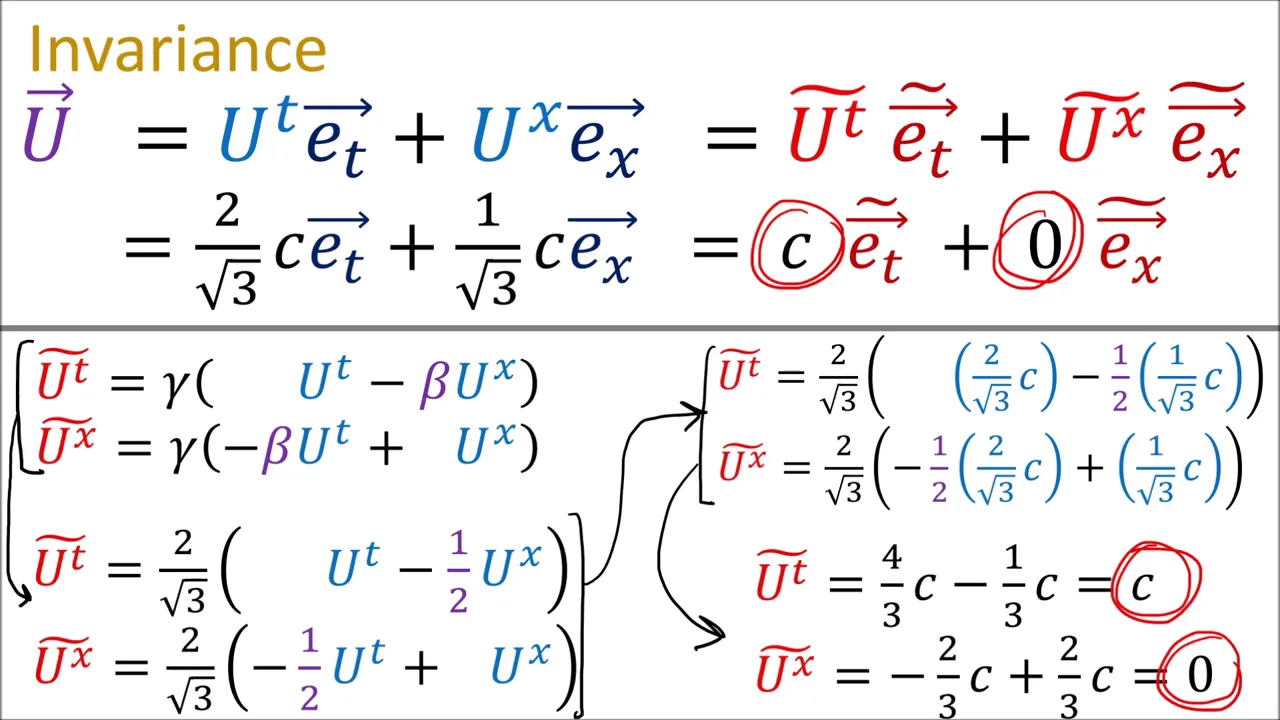
Four-vectors (such as four-velocity and four-momentum) and their application in relativistic dynamics.
Transitioning from flat Minkowski spacetime to curved spacetime in Einstein's General Theory of Relativity.
6K views153likes6:58Original Release: 2023-11-06
welcome back to another video on special relativity in this lesson we're going to talk about SpaceTime diagrams also known as manowski diagrams space-time diagrams are critical in special relativity because they're used to explain events that happen in different frames of reference and also to explain phenomena that underly special relativity stuff that we've talked about like length contraction time dilation Etc a basic SpaceTime diagram with one spatial Dimension is drawn something like this with time on the vertical axis and space or X on the horizontal axis every point on this diagram with a fixed value of position and time every Point represents an event let's take a simple example suppose I have an object a located somewhere in space at a position X notot at Time Zero if my a does not move then its position stays the same at time one which I'll draw as a point up over here if a then continues to remain stationary it will also be at X knot at time too and so on eventually if I join all these points to draw the path of a in the SpaceTime diagram I get a vertical line now the path of a in SpaceTime which happens to be represented by this vertical line for this particular situation the path of an object in SpaceTime is called its World line for a stationary object the world line is as you just saw a vertical line but let's draw another SpaceTime diagram to show another concept suppose I have an object B which initially starts out at X knot but this time it moves at a velocity V towards the positive xais so towards the right this means that at some time T object B will have moved V * T units to the right so in this case for an object moving at a constant velocity the world line for that object will simply be a diagonal line in this case the velocity V will be the tangent of the angle Theta over here with the horizontal distance opposite the angle and the vertical distance or the time adjacent to that angle and finally let's suppose I have an object C that again starts out at X knot but is accelerating so after a Time T it's over here but after a Time 2T it's traveled a farther distance because its velocity is increasing object C is accelerating in this case the world line for c will be curving over this way to the right so that should cover some really basic stuff about SpaceTime diagrams in one spatial Dimension now I'm going to talk about some important Concepts in special relativity as it pertains to these space diagrams we'll start with how light or particles traveling at light speed like photons are depicted on the SpaceTime diagram suppose I have a photon P1 that starts at the origin of the SpaceTime diagram and travels in the positive X direction of course because this is a photon it'll travel at the speed of light C so that means at time T the photon will have moved C * T units to the right and if I join these points I have a diagonal line from the origin extending like so the tangent of the angle over here is the speed of light C this line by the way is also known as the light line it's the world line of an object traveling at the speed of light a light line now what if I had another Photon P2 which again starts at the origin but now travels in the negative X Direction I'm going to draw P2 overlapping with P1 but hopefully it shouldn't get too too messy in any case I have a light line now going in the negative X Direction like so let's extend this logic even further what if now I added a second spatial Dimension with my y AIS going through as shown over here and what if this time I had a third Photon P3 that went in the positive y direction at the speed of light well then I'd have a third light line that looks like this and finally if I had a photon P4 starting at the origin and traveling this time in the negative y direction at the speed of light I would get a fourth light line as follows and in general if I drew a whole bunch of light lines going in all sorts of different directions in this two-dimensional space I would get something that looks like this can you tell me while simultaneously trying to overlook this rather messy diagram can you tell me what shape is formed by all of these light lines combined that's right the shape is a cone and this is called a light cone it's formed by a combination of a whole bunch of light lines going in all of these different directions and so let me draw another set of x and y axis and a ver iCal time axis with a light cone going through this graph the Apex or the pointy end of the light cone is at the origin suppose that I now have an object D that starts at the origin at time zero and moves all the way out here outside the light cone on the positive xaxis what does this mean well if I look at some arbitrary time T then the distance along my light cone for that time will be C * T where C is the speed of light however the distance since my object D has traveled is clearly greater than C * T therefore the object D has in effect traveled faster than light in that time T it's gone further than the beam of light has this is clearly not possible an object cannot travel faster than light and special relativity what one can conclude from this exercise though is that physically possible World lines must be contained inside the light cone as soon as they go outside you have an object traveling faster than light which is clearly not allowed now for the rest of my series on special relativity I'm going to adopt a convention whereby the units of time will be in light meters so T equals 1 light meter would mean 1 over roughly 300 millionth of a second aka the time it takes for light to travel 1 meter meanwhile the units of distance on our SpaceTime diagrams will be in plain old meters so using this convention if I were to draw A Spacetime diagram again with a light line on that SpaceTime diagram then for tal 1 light meter the photon would have traveled 1 M the speed corresponding to This Light line would then be 1 over one which is just one so therefore with this convention my speed of light becomes one and the angle my light line makes with the time axis is a plain and simple 45° or Pi by4 radians because the tangent of Pi by 4 is just 1 and with this convention any other object that is not light will travel slower than the speed of light and so it speed V will be less than one now hopefully that should give you a good enough idea of SpaceTime diagrams at least as an introduction in the somewhat short video in the next lesson I'm going to talk about transformation of SpaceTime diagrams when we go from one inertial reference frame to another with particular attention to how relativity of simultaneity Works in these FaceTime diagrams I'd like to thank the following patrons for their support and if you enjoyed the video feel free to like And subscribe this is the faculty of Han signing out
Up Next

18:35
Relativity of Simultaneity: Deriving the Time Discrepancy
@WorldScienceFestival
70.5K views•2020-03-31

12:53
21cm Hyperfine Transition in Neutral Hydrogen: Radio Astronomy Basics
@AaronRobertParsons
12.4K views•2011-10-13

14:20
Geodesic Equation Derivation | Tensor Calculus & General Relativity
@FacultyofKhan
12K views•2024-10-26

27:14
Entropy and the Second Law of Thermodynamics Explained
@veritasium
27.5M views•2023-07-01
Related Study Plans & Knowledge Roadmaps
Structured learning paths in Physics
physics
Nuclear Physics (Decay, Fission & Reactors)
01Atomic Structure and the Binding Force
02Radioactive Decay and Half-Life
03Nuclear Fission Mechanics and Chain Reactions
+ 2 more learning modules
12h5 modules
Explore Roadmap
physics
Soft Matter (Polymers, Colloids & Rheology)
01Foundations of Soft Matter & Thermal Forces
02Polymer Physics and Macromolecules
03Colloids, Surfactants, and Self-Assembly
+ 2 more learning modules
38h5 modules
Explore Roadmap
physics
Analytical Mechanics: Lagrangian & Hamiltonian
01Mathematical Foundations: Calculus of Variations
02From Newtonian Mechanics to Constraint Dynamics
03The Principle of Least Action & Lagrangian Mechanics
+ 3 more learning modules
28h6 modules
Explore Roadmap
physics
General Relativity (Spacetime & Cosmology)
01Foundations of Relativity: Special Relativity
02The Geometry of Spacetime: Equivalence Principle & Curvature
03Einstein's Field Equations: The Mathematics of Gravity
+ 2 more learning modules
55h5 modules
Explore Roadmap