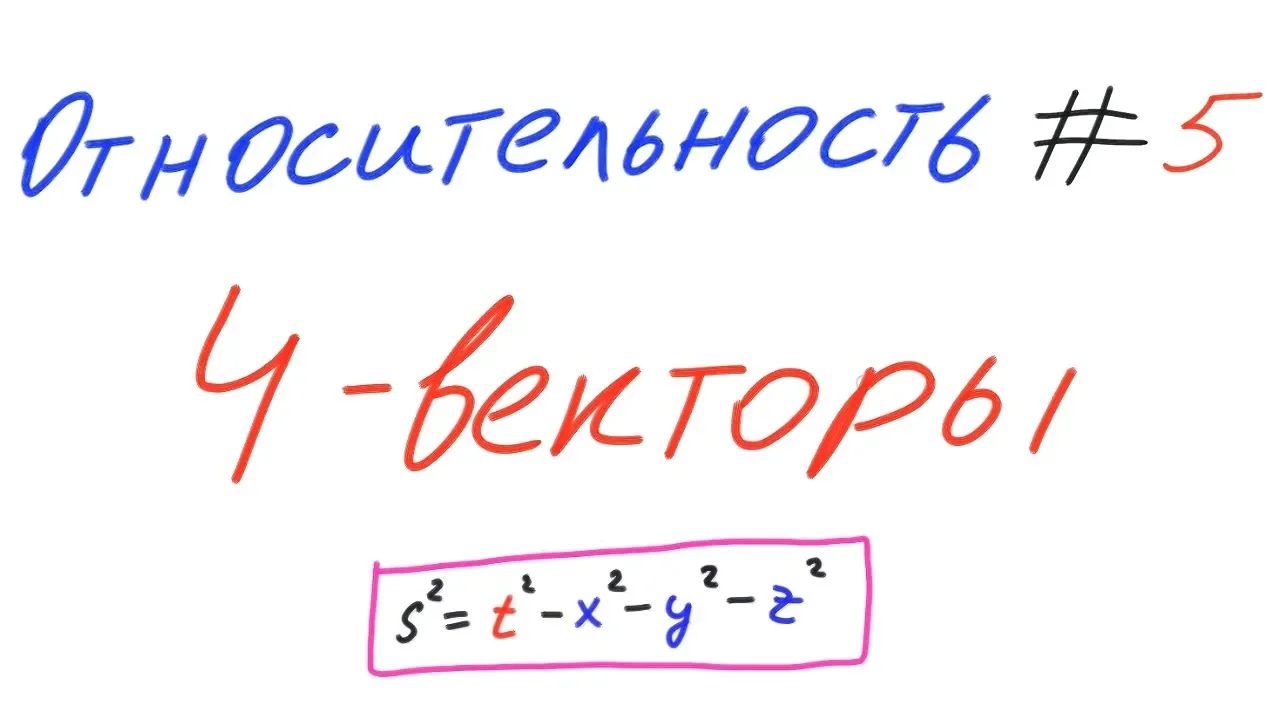













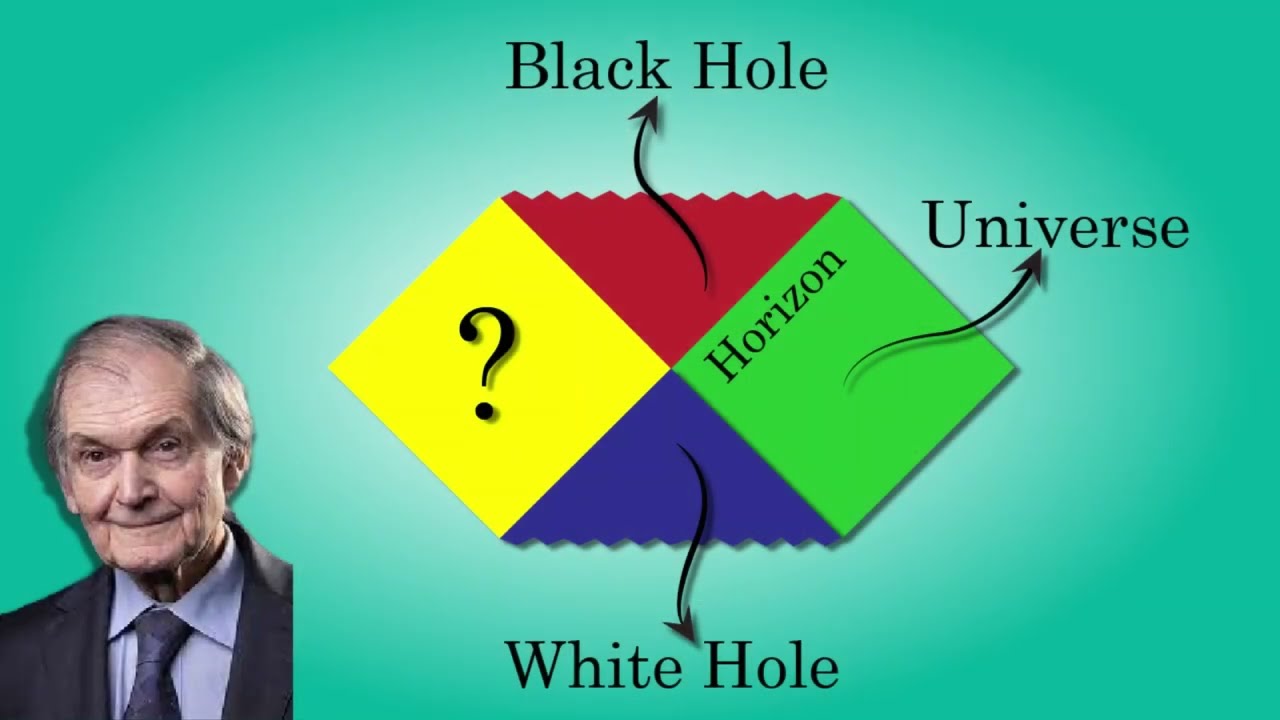


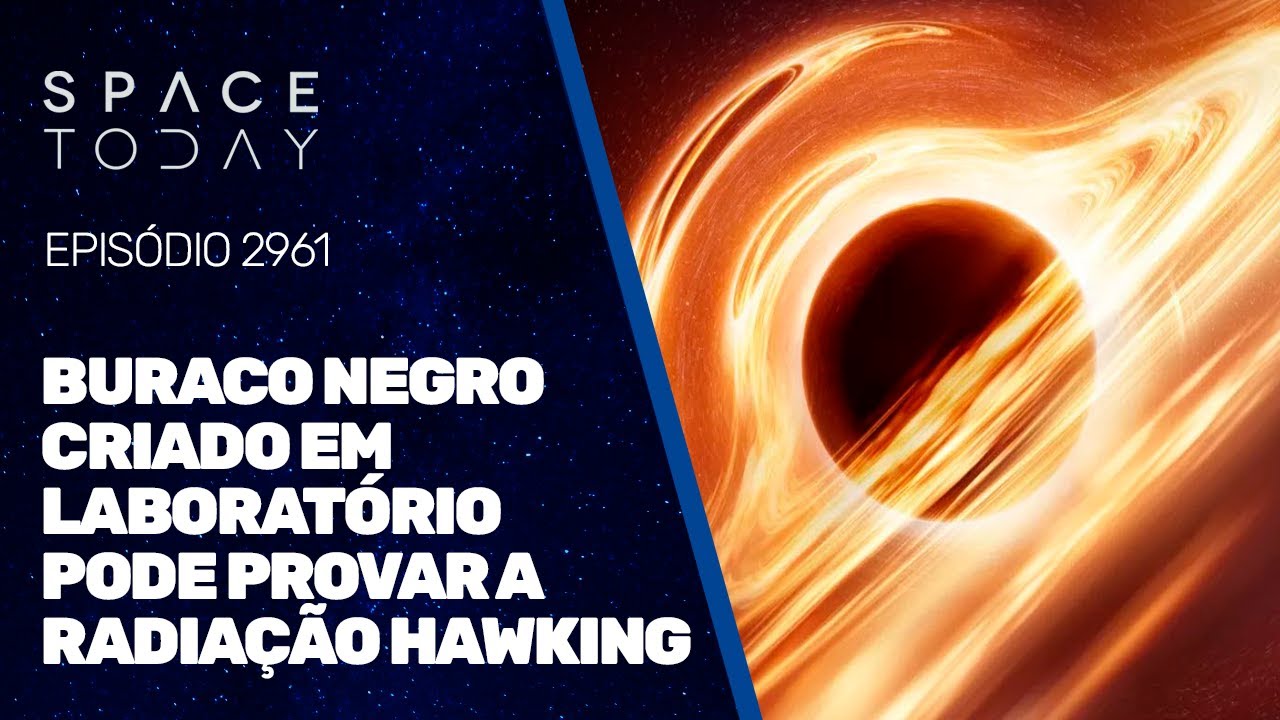








The Schwarzschild metric describes spacetime around a spherically symmetric mass as ds² = (1 - 2MG/r)dt² - (1/(1 - 2MG/r))dr² - r²(dθ² + sin²θdφ²), where the event horizon at r = 2MG occurs when the metric's time and radial components simultaneously flip sign, maintaining the required signature of one negative and three positive eigenvalues; this coordinate artifact explains why external observers perceive infalling matter as asymptotically approaching the horizon with decreasing velocity, while freely-falling observers experience normal passage through it.
General Relativity: Metrics, Black Holes & Event Horizons Explained
Added:Special Relativity, including the concepts of spacetime intervals, four-vectors, and the flat Minkowski metric.
Basic tensor calculus and differential geometry, specifically understanding manifolds, coordinate transformations, and index notation.
Newtonian gravitation and classical mechanics, to contrast Newtonian gravity with geometric gravity.
Multivariable calculus and linear algebra, particularly partial derivatives, matrices, and eigenvalues used in defining metric tensors.
The Kerr Metric and rotating black holes, exploring phenomena like frame-dragging and the ergosphere.
Kruskal-Szekeres coordinates and Penrose diagrams to visualize the global structure of spacetime and black hole interiors.
Hawking radiation and black hole thermodynamics, bridging general relativity with quantum mechanics.
Gravitational wave physics, understanding how perturbations in the metric propagate through spacetime.
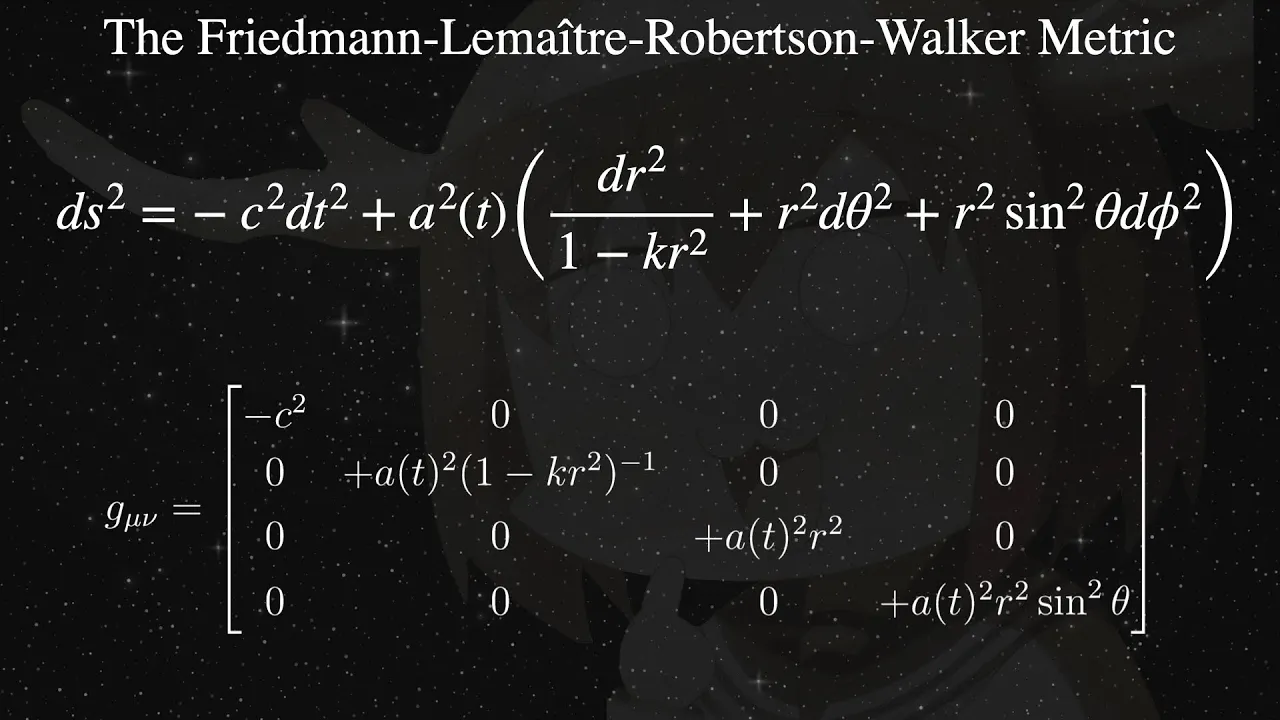
Relativistic cosmology, applying metrics to the entire universe via the Friedmann-Lemaître-Robertson-Walker (FLRW) metric.
184.9K views1.3Klikes1:39:07Original Release: 2012-10-30
[Music] Stanford University.
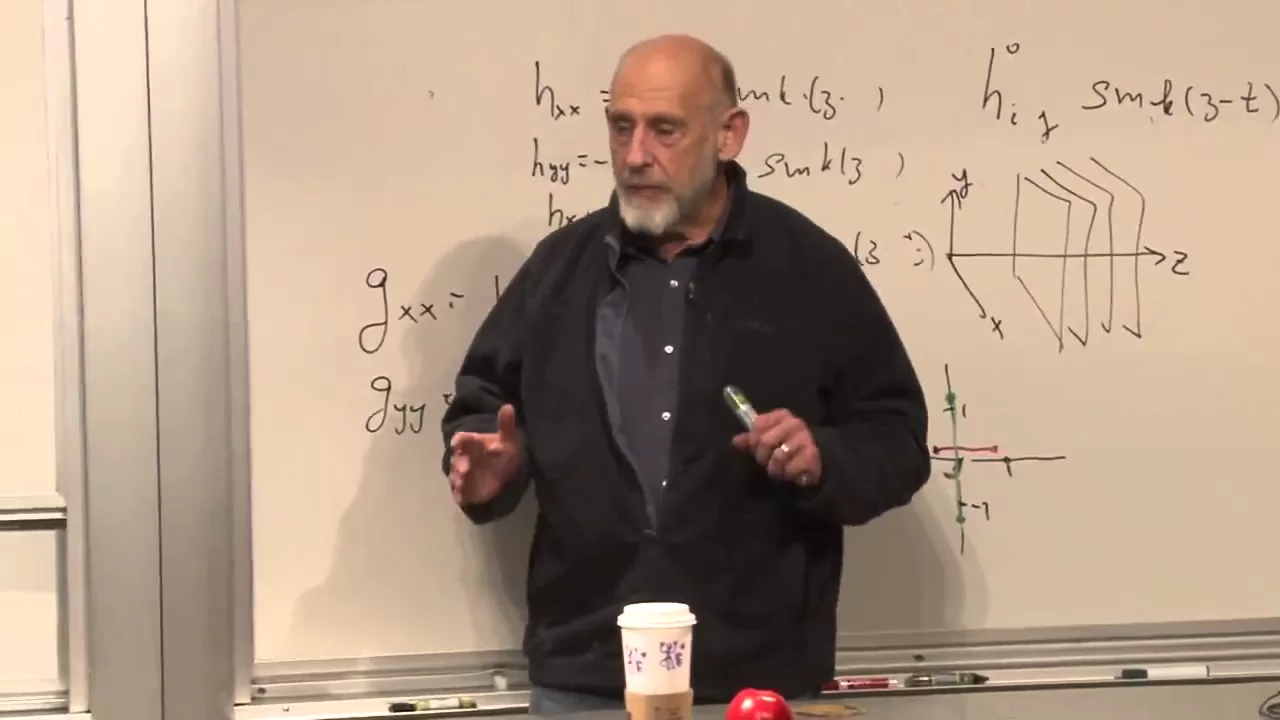
Okay. All right. Let's talk about timelike, space-like, and lightlike. For that, we just go back to special relativity. Let's uh spell out what that means. And uh special relativity is a metric. We've we've discussed this metric many times. We call it proper time. D to squ the to square 2 is the square of the proper time of some little interval. And as you remember it's the t ^2 minus dx^ 2 minus d y^2us dz^ 2.
And if we want to put the speed of light in, sometimes I'll put the speed of light in. The reason I put the speed of light in sometimes is to keep track of what's small and what's big under certain circumstances. For example, if you want to study, if you want to go to the non-relativistic limit, a limit where everything is moving slowly, then it's good to put back the speed of light because it keeps track in that case of the fact that the speed of light is much bigger than any other velocities in the problem. So, let me put it in for the moment. I'll put it in, take it out at uh under various circumstances. It goes in like that. 1 over C ^2 And if da squ is greater than zero. If d to squar is greater than zero. Now of course the square of a real number is always greater than zero. But d to squar is not defined by being the square of a real number. It's defined by this combination over here. And it can be positive or negative depending on whether the x^2 + d y^2 + dz^2 is bigger than dt dt ^2 or smaller than dt^2. Uh I said dx2 + d y^2 + dz 22 but I meant the x^2 over c^2 plus d y^2 over c^2 and so forth. But in any case if the to squ is greater than zero then the little element here is said to be timelike. It's got more time than it has space so to speak. This part is bigger than this part. And that can be described in terms of a light cone.
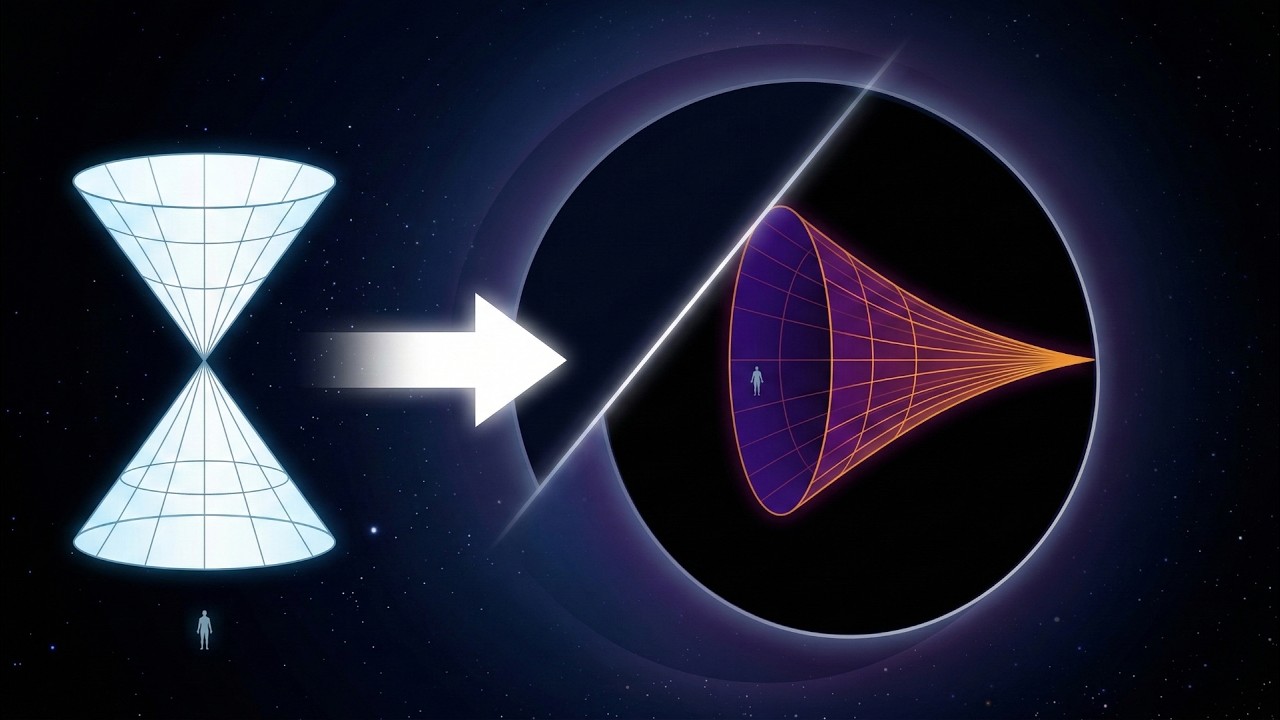
Remember the light cone? The light cone looks like that. And the boundaries of the light cone, the cone itself are the places where dt ^2 let's uh for the moment I don't want the c squares there.
uh dt ^2 equ= dx^2 + d y^2 + dz ^2 that's called light like if dt ^2 is bigger than dx^2 + d y^2 + dz2 it means the little vector lies in the interior of the cone like that it could also be lying in the backward direction in either case a little interval or a vector let's speak about a vector in general. A vector in general is timelike if its time component is bigger than the sums of the squares of the space components. Okay, that's timelike.
Spacelike is exactly the opposite. It's dt ^ 2 d to squ less than zero. And in that case we usually define another quantity ds^2 which is just a negative d to squ and it by definition is dx^2 + d y^ 2 plus dz ^ 2 minus dt ^ 2. It's the same object except with a relative with a different with a minus sign. Spacelike vectors are ones for which d s^ squ is bigger than zero. D to squ is less than zero. And space-like vectors lie outside the light cone.
Finally, there are lightlike vectors.
This is space-like. And finally, there are lightlike vectors. And lightlike vectors are the ones for which dt ^2 equals dx² + d y^2 + dz^2. Those are the trajectories of light rays and they lie in the cone. They lie in the surface of the cone itself. Those are the three kinds of vectors that you can have.
Um just for a moment consider what it would mean if there were two negative h sorry two positive signs and two negative signs instead of one positive sign and three negative signs. Somehow this would correspond to two time directions. The that doesn't mean anything in physics. In physics, there are never two time directions. There are always one time and three space. Now, can you imagine a world with two time? I can't. Frankly, I can't. I can't imagine what it mean to have two different time directions. And we will simply take the view that uh that that's not an option. There is always one timelike direction in the metric here and three space-like. But that doesn't mean that there's a unique direction which is timelike. There are many timelike directions pointing within this like cone here. The invariant statement is a statement about the metric tensor. The metric tensor we can write this in the form d to squar is equal to g mu new with a minus sign dx mu dx new. The minus sign is a convention. It's always defined. So that g mu new dx mu dx new goes with the space-like vectors having a positive sign here. Incidentally one other thing I'll just remind you um the proper time along a trajectory like this is a measure of what a clock along a trajectory ticks off. Proper time is a kind of time. It's the time read off by a moving clock. Proper distance ds squared.
Proper distance along a space-like surface is distance measured by a meter stick.
Right? So proper distance the s squ or the square root of the s squ really is a distance and proper time really is a time. Uh and keep that in mind. Okay. So uh this is our definition of a metric and for the case here that we've written the metric can be written in terms of a matrix and let's see the matrix is minus one 0 0 0 1 0 0 0 1 0 0 1. It's called adamu.
It's like the chronic delta except it has a minus sign. Okay, this thing has obviously three positive igen values.
It's a matrix. It has three positive igen values and one negative igen value.
And that's the invariant story. That's the story not that there's only one time direction, but that there is one negative igen value here. And a metric which would have two negative igen values or three negative igen values would have more than one time and we just don't even think about that that something that's uh physics does not seem to have made use of two negative times. Okay. So that's uh that's space-like timelike light and so forth.
More generally, it could be in flat space, but certainly in curved space, curved space time, the metric tensor G, the metric tensor cannot be chosen to be equal to this ADA symbol here. It's a general function gu of X. But G mu g mu of X cannot just be any old thing. At every point, at every X, there's a a matrix. At every x there's a matrix, every point and at every x the there must be one negative igen value and three positive igen values.
Wherever you are standing there, you should experience a world with one time direction and three space directions or more exactly one negative value and three positive. Okay. So what that means what that means is that every point in space has a light cone associated with it. Now I'm drawing it sort of tipped and tilted that reflects the fact that the coordinates themselves might be wavy and curved and so forth.
So as you move around because the coordinates and also the metric tensor might be varying from place to place.
The light cone might have an apparent tendency to uh to look different in different places. But that is just because um because as you move around in space the metric tensor may change from place to place and uh the coordinates change from place to place. All right. So at every point there's a light cone. There's a notion of light a space a timelike excuse me timelike vectors inside the light cone space-like vectors outside the light cone and lightlike the motion of light rays along the um the edge or the uh the cone itself. The cone is a surface. When you have a ice cream cone uh the ice cream on the inside is not part of the cone. The cone is the surface itself, the shell.
Okay. So, we have to make sure that we when we write a metric that it does have this property of the right number of positive and negative igen values.
Incidentally, that's called the property of having um a certain number of igen values positive and a certain number negative is called the signature of the metric. One says uh the signature of the metric what is the signature of the metric of ordinary flat space the blackboard not spacetime. Uh the blackboard has two dimensions and the signature of the blackboard would be plus plus the x^2 + the y^2. The signature of Manowski space special relativity is minus plus minus plus plus minus plus+ excuse me minus plus+ plus. Okay. So we have to make sure that if somebody if somebody gives us a metric wherever we got it from we might get it as a present in the mail. We might uh we might uh calculate it from some equations of motion some field equations. Always we should make sure that that metric has signature minus plus++ and if it doesn't means we did something wrong. Not only should it have that signature every point not at some point it should have it at every point.
Excuse me. Yeah.
Um there's so there's a single vector associated with negative value. There is a single vector associated with negative value direction of the no um related to the sheet. No, no, no. There's um there no there is not no there's not a single vector. There's not a single vector.
Anything anything in this uh interior of this like cone is equivalent to everything else by Lorent transformation. You can lorence transform this vector to any other vector. No this no you see that that that's incorrect. Supposing I gave you the metric plus+ plus. Does that look like it has only one positive igen vector? Sorry. Does that look like it has three positive igen vectors and everything else is not an igen vector? No. Any vector if this is the unit matrix any vector is an igen vector with plus one. Here it's true that you work this out. Any timelike vector is an igen vector of this matrix with igen value minus one. Any space-like vector is an igen vector of this metric with plus one. And any light like vector is an igen vector with zero.
Okay, you can check that. That's something to check.
This is my question which is I'm trying to understand the shape of each of those cones in this is the general relativity case. Yeah. how that relates to um the why why they get different shapes on well all right let's let's take this let's take the good let's take this um light cone over here this light cone with xyz coordinates defined in this way the light cone is a 45 degree cone with the uh with the generators of the cone the lines in the cone here at 45 If I were to multiply let's say dt ^2 by some number let's uh now let's let's uh let's divide this here now it's the same space it's exactly the same space it just corresponds to changing the x coordinate from x to x / c.
Okay. All right. But if I now drew the light cone in the coordinates X and T, it would look like this. If C was large, it would be squashed. That's just reflecting the fact that light moves with the speed of light. And so if C is large, light moves a long way in those coordinates. Same space. Have not changed the space, just change the coordinates. But by changing the coordinates, I can squash the light cone. I can even tilt the light cone. I can do all sorts of things to those co to those light cones. It does not reflect a real change in the geometry.
All right. Now, since we have just arbitrary coordinates that we're dealing with here, we could, for example, have this speed of light here depend on position. If it depended on position, it wouldn't change. We could have it depend on position. then the metric would have some funny position dependence and the metric as you moved from one place to another would go from looking this way to looking that way. So it's a pure coordinate issue whether it looks one way or the other. But the invariant statement is that there are space-like vectors, timelike vectors, lightlike vectors and the boundary between the space-like vectors and lightlike vectors is is a cone.
One comment I think the previous question actually was valid. I think there is only one direction of uh icon vector for time and the space like igon vector is a is a 3D space but time would be just one. I think the key point here is that that igon vector is not a tensor.
It transforms under lorren transformation. It transforms under lens transformation.
Um let's see.
Yeah.
Yeah.
Yeah. I didn't want to get into it. What you right? You're right. But let's let's uh let's come back to it. Let's come back to it. I want to get I want to get through to the metric of a black hole today. And I didn't want to spend it all on this. Uh let's come back to it.
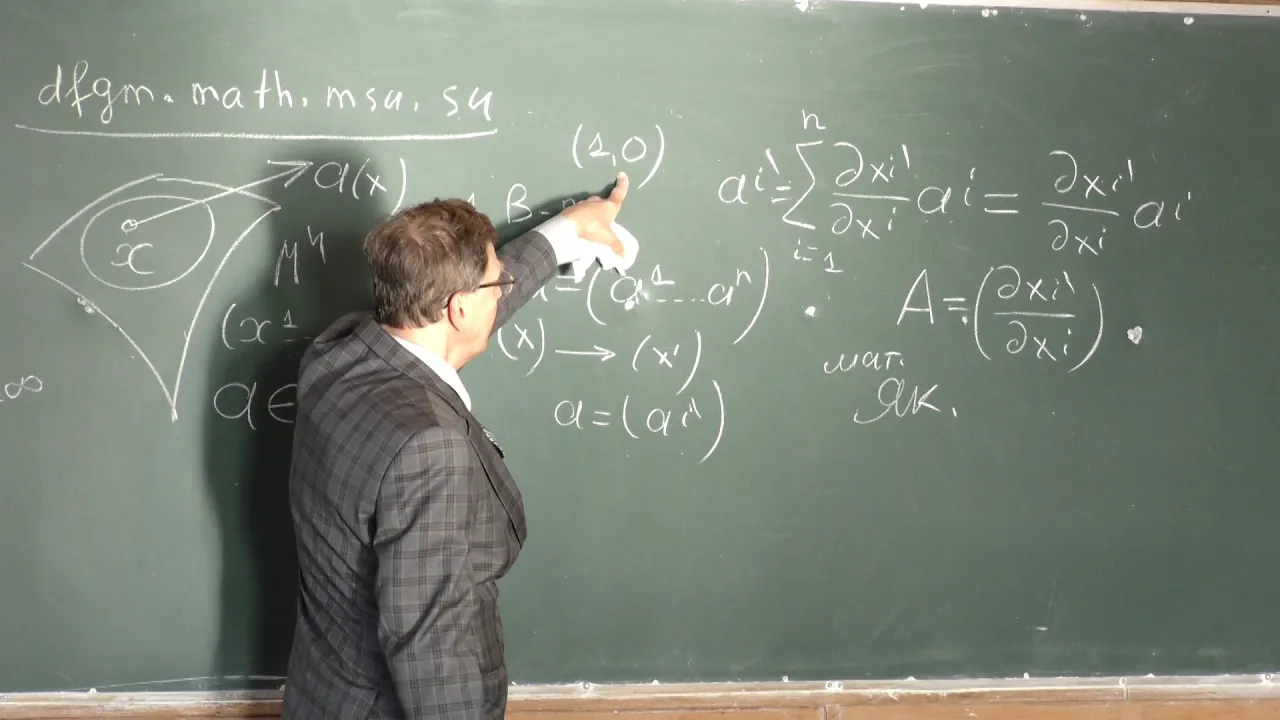
One igen vector three one I positive igen value sorry one negative igen value three positive igen values this metric transforms under lorren transformations into itself it transforms under lorren transformations into itself so if I do a lorren transformation we come back to exactly the same metric uh and uh that's the important issue Yeah. All right. I I told you what the rule for geodessic was last time or time before. It's that the covariant derivative of the tangent vector is zero. As you move along, it moves parallel to itself. I'm going to give you a different definition tonight, which in many ways is more useful. But let me first write down the original definition. d2 x mu by dao squared.
That's the der the tangent vector is dx mu d to this is the derivative of the tangent vector along some curve and should be plus or minus I think plus mu sigma row dx sigma dao dx row by dao That's the definition of a um of a geodessic. But there's another definition which is many times more useful. It's the analog of the definition of a geodessic in ordinary space. Ordinary space it's the shortest distance between two points or better yet stationary stationary distance between two points. Stationary distance between two points defines uh a geodessic. And so another way of writing this is to say we extremalize or we make minimum let's take the case of ordinary space ordinary blackboard or a curved version of the blackboard. We calculate the distance between two points. We're interested in the geodessic connecting those two points. Uh the geodessic connecting those two points. Calculate a curve.
Take a curve and calculate its distance.
What is its distance? Its distance in ordinary space would be for each little element of it. We have d s^2 equals g let's say mn dxm dxn. Now I'm talking about space and not space time. We'll come back to space time in a moment. That's ds^2 or ds is just a square root of that. In other words, Pythagoras theorem. Okay, that's the uh that's the distance along a little piece of geodessic here. And then we just add not geodessic curve. Then we add them all up. And to add them all up, we just do an integral. That integral sign just means add them all up. All add them all up. Let the distances go to zero. Add them all up. And that's equal to the total distance between those two points. The rule is to make that as small as possible to make it extreal. We learned when we studied classical mechanics how to do that. We learned when we studied classical mechanics that this is a problem in the calculus of variations. It's a problem analogous to minimizing the action for a particle.
In other words, we could think of this as the action for some kind of particle moving between here and here and then extremalize this or make it uh make it stationary is the rule for calculating the geodessic. What kind of equations do we use? This gimmu is a function of x here of course. What is the equation called that a that is the equation that tells you how to minimize a thing like this.
It's called the Oiler Lrange equations.
It's Lrange's equations for a lrangeian which is derived from this action. Think of this as an action for a particle going from here to here. Minimizing it is like minimizing a principle of least action.
When you go from the principle of least action to the Oiler Lrange equations, the principle of least action turns into differential equations. Typically it turns into F= ma type of equations. Right? Going from here to here is exactly that operation. Here's an action or a thing to minimize. Here's the solution to it in the form of a differential equation. In fact, it sort of looks like acceleration is equal to something. The something is kind of like a force. Okay. So let's uh come to the real problem where we're not interested in distance but in proper time. In proper time, if I want to calculate the proper time between the two points, space-time points, I do exactly the same thing, exactly the same thing, except there's a minus sign here. And that's equal to the proper time between 0.1 and 2 in spacetime.
0.1 2 in spacetime and there it is. That quantity is the thing. Do you maximize it or do you minimize it?
Anybody know? You minimize it. You minimize it.
Yeah, you minimize it.
Uh, sorry.
You Let's see.
Um, do I have the sign right? Let me get the sign right.
Yes. Okay. Now, let's suppose this really corresponds to the motion of a particle that starts at the space-time point and ends at the space-time point. The action depends on one more quantity.
It depends on the mass and the actual action. Let's uh the actual action is equal to minus the mass times the proper time between the points. This is definition. This is definition. The mass putting the mass in there we'll find out is important uh for thinking about energy and so forth. But the minus sign is strictly uh is strictly definition.
You'll see where it comes in as we go along. Minus the mass times this thing here. And in fact, the action I think is typically yeah, it's minimized. It's minimized. Typically minimized uh for a particle moving on a trajectory. Okay. What do we do with this thing? This thing is a completely unrecognizable object.
Uh you're probably saying to yourself, first of all, not only do I not know how to calculate to deal with it, to do anything with it. I don't even really understand what it means. What does it mean to have a square root of something time dx dx an integral kind of things we usually understand as integrals have a d something one d something and a function right some function and a d it could be a dt could be a d time but uh normally we don't see funny things like this with square roots of dx dx all right so this is easy to uh to explain Let's let's break up the interval into little time segments. Little time segments deltat t. Okay. And let's divide here each one of the or dt. Let's divide each one of these dxs by dt by dt. Some of these dxms might in fact be dts. dt is or t is one of the four coordinates. What happens if we have a dt dt? We just call it one. What happens if we have a dxdt? We call it the velocity, right? We call it just the ordinary velocity. Now, I did something here. I can't get away with just dividing things by dt, but I've divided by dt squared. So, I take and on the outside I put dt.
Should your indices be Greek? The indices. Yeah, the indices can be Greek and spacetime. Now that we're in spacetime, we can put Greek indices in there now that we're in spacetime. And you see what we have. Each one of these components is equal to one if it's dtdt or it's equal to a velocity along the trajectory. In other words, a thing like dxdt along the trajectory. These are components of the velocity of the particle or just one. And so each one of these things has a definite value along the trajectory. A certain function of the velocity. It's a function of the velocity and the position. So we have a square root of thing function of velocity and position times dt. This now has the meaning of a conventional integral along this trajectory here. And the integrant the integrant here is the lrangeian. It is the thing which plays the role of lrangeian. action by definition is equal to the integral of the lrangeian which is a function of velocities and positions. All right. So we we return to a problem that we saw all quarter what was it last quarter? Two quarters ago.
Two quarters ago. the problem of classical mechanics how to calculate an equation of motion from uh from an action. Now I'm not going to do it here. What I'm going to do is tell you that if you work out the oiler lrange equations, let me remind you what they are. Well, a grandian is by definition now minus m square<unk> of minus g mu of x dx mu by d to dt dx new by dt. Oh, incidentally is this is um the thing inside the square root is the thing inside the square root positive so that you can take its square root. It's got a minus sign here. It's positive.
It's positive. This is the proper time and it's always positive for a timelike trajectory. Particles always move on timelike trajectories. Real particles do not move faster than the speed of light.
Incidentally, in case it missed you missed it, a space-like trajectory is one which is going faster than the speed of light. Okay? So, this is always positive inside here for a timelike trajectory. This is lrangeian. And what do you do with it? Yeah.
Why is that uh item underneath the square root sign equal to the lagian just because it's in the action equation? Yeah.
Okay. By definition, by definition, by definition, but it's more than definition.
uh if you now ask to minimize the action it is equivalent to applying the oiler lrange equations to this lrangeian. So let's write them down. Let me remind you what they are. They're the derivative of the lrangeian with respect to uh let's call it x mu dot. That's the time derivative of x mu. Oh, incidentally, um, again, dt by dt is just one, right?
So, dt by dt just ignore that. This is a function of the space components of the velocity and x itself. All right. So, what do we do? We take the lranian, we differentiate it with respect to a velocity. Then we take its time derivative and set that equal to dl by dxm. This is the oiler lrange equations of motion that we learned all about in classical mechanics. All right. So the point is if you know the metric you can work out an equation of motion for a particle whose motion will be a geodessic definition of a geodessic. It minimizes the it minimizes the uh the proper time between two points. Now how does that relate to this definition over here? Well, if you work out exactly this equation with a given metric here, you will discover that it's exactly this. It's exactly these equations here. So, there's a little exercise. Work out the oiler lrange equations and show that they are the same as uh as requiring the trajectory to satisfy this equation here. It is generally true that this is a much easier thing to work with and we're going to do it tonight. We're going to work out some equations of motion for particles in a particular metric. We'll work it out and see how it works. And uh the metric will be everybody's favorite metric, the Schwarz shield metric.
Okay, let's uh let's now come to the problem of studying the motion of a particle or studying the metric and the motion of a particle in a real gravitational field.
The gravitational field of the sun or the earth or black hole or whatever you have. In other words, a massive object, a massive spherically symmetric object. And we're outside the mass of the object. We're far away from the mass of the object. and we're interested in the metric uh in the metric of space in there. Okay. So the first I'm going to write a formula and then we're going to check and see that this formula really for metric really does make sense in the sense that it would give rise using these equations of motion. It would give rise to something that looks very very familiar namely Newton's equations for a particle moving in a gravitational field. Okay, at least when you're far away from the gravitating object where the uh where the gravitation is fairly weak. All right, so here's going to be the metric we're going to write down. It's let's let's first start with flat space time.
That's just going to have dt ^2 minus 1 over c^2 dx^2 and now dx 2 stands for dx2 plus d y^2 + dz 2. So I I won't write them all down. Now that would be flat space and we expect that as we go very very far from the gravitating object that the spacetime looks flat if we go far away. But now we know that the the gravitating object does something to spacetime and so this shouldn't be exactly right. Let's put in here one. That will be there when you're very far away. And now let's put in something else. And we'll call it plus.
I think plus or minus um minus minus minus 1 plus yeah 1 + twice u of position. U is a function of position.
divided by c ^2 times dt ^2 and leave everything else alone for the moment. Don't change anything else. 1 + 2 u and I'll tell you what u is right now. It's the gravitational potential due to this object.
Let's check that as long as our particles are moving slowly that the geodessic equation here the lrangeian equation of motion just becomes Newton's equation for a particle moving in a gravitational potential u of x. All right, let's uh let's see what we get. We have a lrangeian and now we can write out what it is. It's minus m times the square root. Okay, let's go back to this form over here.
minus 1 + 2 u / c^2 dt ^2 and then I think plus 1 / c^2 dx^2 plus d y^2 + dz ^2 and so forth.
Just let's just put let's just call it x squ the x squ. Okay, that's No, sorry. The um the action the action is is the action is this thing, right? Square root of g mu dx mu by dt by dt. There we are.
DT, right? I simply wrote down what's here. g mu new dx mu dx new that's 1 + 2 u over c ^2 dt ^2 / dt ^2 + 1 / c ^2 dx^2 by dt ^2. If you don't understand what I wrote, tell me now. Okay. dt ^2 by dt² that's just one. So that's trivial. and dx^2 by dt ^2 we can just call that x dot squar there are three of them and they and we have to add them x dot square + y dot square plus z dot squ in there that's our action now next step let's work out now before we work it out let's approximate it let's approximate it we could work this out as it is but what I meant interested in is very slow motion. I'm interested in very slow motion. And because I'm interested in slow motion, I'm interested in slow motion because I want to show that this really does give rise to Newton's equations in the non-relativistic limit. The non-relativistic limit is one in which C is taken to be very large. Now, I could just erase anything with a 1 over C^2 in it, but boy, I would kill the uh I would kill everything then, right? I would kill everything.
I left something out here. It's minus M C^ squ. If I'm really putting C's in, the action has an MC squared in it.
Okay, an MC squ. It's just dimensions. Just multiply it by C^ square. All right, there's there's our action. And now let's expand it for small quantities. What is it? It's um I'm sorry. I'm having I'm I'm getting confused tonight. This is bad. Is this really minus here?
[Music] Um no, it's plus. And this is minus. Now it's correct. Now it's correct. Okay. How do you what do you do with a thing like this if you want to approximate it when C is large? Well, you write the thing inside the square root as 1 plus something small. Something small has a 1 / c ^2 in it. And then what is it? It's 2 u minus x dot^ 2* - mc^ 2. Then you use the binomial expansion.
Use the binomial expansion. Square root of 1 plus a small quantity is just 1 plus a half a small quantity. Okay. So this becomes - mc ^ 2 * 1 + 1 / 2 c^ 2* 2 u - x dot^ 2 equals finally we look at this it has a constant minus mc^2 a constant in the lrangeian makes no The only thing you do with a lrangeian is you differentiate it. So when you differentiate this term makes no difference. The rest of it here has term minus c ^2 cancels we get and the two cancels and we get minus m * u. Then the other half of it has m^ 2 / 2 c 2c ^ 2 that's plus m / 2 x dot^ 2 that's the lrangeian if you expand it out to small quantities in the non-relativistic limit notice what it has it has this constant which is irrelevant it has a conventional kinetic energy 12 mv squared and then it has a potential energy. It has a potential energy. This is just a function of x. It has a potential energy which we get to choose. We choose whatever we like for the potential energy there.
Incidentally, for a gravitational problem, the potential energy of a particle is always proportional to its mass. So here you see it. The potential energy is proportional to its mass.
If you work out from this, if you work out from this the equations of motion, of course, what you're going to get is just Newton's equations for a particle in a force in a gravitational field of gravitational field U. Okay. What will the equations be?
they will be x dot m x dot is equal to um min - m du by dx that's the force here's the acceleration and the mass cancels okay so the the main point here was that this action which is equivalent to the geodessic here is easily worked out just by thinking of the oiler lrange equations and it's even easier to work out if you're in the non-relativistic limit where you just uh say c is very very large 1 / c^² is very small and just expand the square root all right so that's a nice easy uh easy thing to see but the important point here is that what we learned out of this is that for some first approximation small quantities g minus G Kn is approximately perhaps exactly equal to 1 + twice the gravitational potential divided by C ^2. All right. So we've here's what we've learned. We've learned that the metric the metric Now of course there may be additional things in here which are even smaller than 1 over C^2. If for example there were one over c4th or one over c6 or anything like that in any of these terms here they would not be important in this non-relativistic limit. So we can't say with complete confidence that gn is 1 + twice the potential energy of a particle divided by c ^ 2. But uh we can say that must be true to the first order in small quantities.
Small quantities means 1 over c^2. All right. So let's write that down. Now let's write down what we know. Let me write let me rewrite it again. But uh what I want to do is for you we will put the mass of the sun. The sun is at the center. The mass of the sun divided by the distance to the sun times Newton's constant with a minus sign. This is the standard gravitational potential energy. The mass of the gravitating object G divided by the distance away U of X. And now we can write down our first guess at the metric of spacetime surrounding a gravitational mass. Here it is.
D to squ the leading order is equal to 1 minus 2 mg over R C^2 the C ^2 is from here there's a two mg over RC c^ 2 D to DT^ 2 minus DX² square - y^ 2 - dz^ 2 that's d^ 2 and of course plus oh over c^ squ plus smaller things. Is that beginning to look familiar to anybody? You recognize this piece some of you?
Schwarz metric the Schwarz metric or the metric of a black hole but not quite let's put c^2 r here right now next let's take the x^2 + d y^2 + dz ^2 that's this piece over here that's just the ordinary metric of threedimensional space in this formula over Here only the time component of the metric has been fiddled with the space components of the metric and everything else have not yet been fiddled with.
They will a little bit but not too much.
All right. The x squ + d y^2 + dz ^2 is just the usual metric of uh of ordinary flat space. Let's take flat space and polar coordinates. Polar coordinates three-dimensional polar coordinates.
Three-dimensional polar coordinates are characterized by a distance, namely a distance from the center of the sun. In this case, a distance and a pair of angles. The pair of angles can be a polar angle and an asamal angle. So let's see. So let's uh draw a sphere here. This is a point on the surface of the sphere. The sphere is at distance r.
Uh there is an angle an angle from the from the plane from the uh from the horizontal plane here. We could take it to be the angle from the north pole but I think I'll take it to be the angle from the equator. The horizontal plane here is the the equator. The angle from the equator is called theta. And then there's the azimuthal angle uh that can be measured from here.
That's phi fi. Okay. Now what is the length element on the surface of a sphere like this or in a surface of a sphere of radius r? Right? the leng the the the um the or better yet what how is this metric expressed in polar coordinates.
So I'm going to write it for you. It first of all has a dr 2. Incidentally if this were two dimensions you would know what to write.
You'd write dr r 2 plus r 2 d theta 2.
Right? What you would write in two dimensions would be dr r 2 + r 2 d theta 2. And that's there. That's correct.
Still the same. But there's another term and the other term is cossine of theta^ 2 d5^ 2. This is the metric of ordinary threedimensional space in polar coordinates. Two angles and a radio and a radius. The r^ 2 + r 2 * this. Why are we doing polar coordinates? Because polar coordinates are the good coordinates for studying the central force problem. Polar coordinates are convenient. You don't want to use x, y, and z to study the motion of a particle in a gravitational field. You want to use the the polar coordinates. And so we're going to write this metric in terms of polar coordinates. And we have it.
Now all we're going to do is make one change. We're going to give this a name.
d theta^ 2 plus cosine theta 2 d^ 2.
We're just going to give it a name so we don't have to write it over and over.
We're going to call it d omega squared for no other reason than to not have to write it over and over. Okay, so we now have the metric of ordinary space r 2 d omega^ 2 and that's what goes here. That's exactly what goes here. So let's now rewrite question. Is there a question? No. Okay, let's rewrite this 1 / c ^2 dr r 2 as this - 1 / c^ 2 r 2 d omega^ 2 and just keep in mind r is just radial distance nothing special. This complex thing here is just um metric on the surface of the sphere.
If you keep r fixed and you move around an angle, this gives you the contribution to the metric from moving an angle.
Now, there's something terribly wrong with this metric. Something very, very wrong with it.
It's fine when you're far away, but there's something deeply wrong when you get in close to the center. What happens when r becomes too small? When r becomes too small, not zero, but when r is positive but too but uh but small. When r becomes small, this becomes large. One minus a large number becomes negative. This coefficient becomes negative.
These coefficients are also negative.
What happens to the metric when you move in too close to the center? It has four positive igen or rather four yeah four positive igen values instead of one negative igen value and four and three positive igen values. When you move in too close, this quantity changes sign. Where does it change sign? It changes sign when r is equal to 2 mg over c ^2. In fact, there's a nicer way to write this. Let's write it a different way. Let's write it as [Music] um r - 2 mg over c^2 divided by r thing in the bracket here.
R / R is 1. 2 MG over C^2 / R is this thing here. Notice what happens when R gets smaller than 2 MG over C². 2 Mg over C² is just some number, positive number.
Okay, it's some particular characteristic radius of the black hole.
It's the Schwarz shield radius. At some point when r moves in toward the center this changes sign becomes negative. What happens is the sign here becomes exactly the same as the signs here all negative. The meaning of that is we somehow passed into a region where there are four space directions and no time direction. That's bad. That's bad.
That's something we don't want. Right?
That's not a good thing. What really happens if you study the field equations of general relativity, which we're going to do, we'll do this. But for the time being, let me just tell you what the right answer is. The right answer is at the point where this changes sign. This one also, there's nothing here yet. I haven't given you anything to put here, just one over C^2. But we're going to put something else here that has the property that when this one changes sign, this one also changes sign. So what happens? This one turns into a space direction, but this one turns into a time direction. The signature of the metric is maintained one timelike direction and three space-like directions. So what can we put here to make this flip sign in the same way that this flip sign? Well, you could put in 1 - 2 mg over c^2 r in front of the dr r 2. So when this one changed sign, this one changed sign.
That turns out not quite to be the right thing that uh that Einstein's field equations tell you to do. Einstein's field equations give us slightly different well it's it's a substantially different answer, but let's see what it says. It's 1 - 2 mg over c^2 r dt ^ 2 Okay.
Minus now in 1 / 1 - 2 mg over c^ 2 r 2 - 1 c ^2 r 2 d omega^ 2. All right. So when we got to the point as you move in closer than the Schwarz shield radius, this changes sign, but so does this. Because they both change sign, the signature of the metric stays the same. But something very odd has happened. The thing that we're calling t here becomes a space-like direction, and the thing that we're calling r becomes a timelike direction. They flip. Once you go inside that radius, the coordinate r becomes a time and the coordinate t becomes a space direction. This is not easy to visualize, but I will give you the tools to visualize it as we go along.
Something has happened as we passed in through a certain surface. The surface being r = 2 mg over c^2.
When you pass inside there, there's a flip between time and radius. Radius becomes time or becomes a time variable and time becomes a space variable. This is completely mysterious for the moment, but I assure you we will we will explain in some geometric detail what it is that's happening here.
Yes. How much time does it take to cross that line? Say it again. How much time?
I mean like how much time?
to cross that line. There's two things.
One is Yeah. Yeah. Yeah. Yeah. That's what we're going to do. We're going to do that. We're going to do that problem.
We're going to see that to cross that line, it takes a infinite amount of coordinate time, but a finite amount of proper time. So, somebody falling with a particle with a clock in their hand will say it takes an a finite amount of time to cross that line there.
Okay, somebody watching from the outside watching that person fall through will say it takes an infinite amount of time.
That's a characteristic of this metric and that's one of the things we want to work out tonight. Question. Yeah. What was the motivation for changing the coefficient on the R squ? Just the motivation for changing the coefficient is to make sure that the metric stays with a signature plus minus my R minus plus+. Okay. If this one changes sign, something has to give with one of the other ones. And the natural candidate is the r here that uh that flips its sign.
Okay. Now, first of all, think about where this is happening. This is happening at a distance or a coordinate r = 2 mg over c^2. C is a huge number. C is a huge number and it's in the denominator. This is a small distance. This is a small distance, but it's a small distance that that depends on the mass. It's a small distance that depends on the mass. For the earth, this distance would be about a centimeter.
Okay. So, we don't have to worry about it in thinking about the gravitation of the earth. Question. What happens to the clock? It it was ticking in a time direction. Is it ticking in a space direction now? Is it not ticking or No, it's ticking. It's ticking in a time direction.
Clocks clocks don't care about what coordinates you use. We're going to discover that this is an artifact of of particular coordinates. There's nothing going on special at this point. We're going to discover that this is just awkward coordinates that make it look like something is funny is happening here. A switch of space and time.
There's nothing funny happening there.
And we're going to work out and see exactly why. But for the moment it does look like there's something going on. C^ squ R It does look like there's something going on when this thing vanishes. When this thing vanishes here, this thing becomes infinite. It looks like some terrible things happening to the geometry. In fact, the geometry is completely smooth over here. Nothing special happening.
Um the light cone is perfectly healthy on all in all regions in here. Nothing funny going on. But we have to work harder to see it. This was the form that Schwarzfield derived the Schwarz uh the Schwarz of the history. Einstein wrote down some field equations. Schwarz shield. And what Einstein knew about them is he basically knew this piece here. And he knew some Oh. Oh, there's one thing that's important here. One thing that's important. Yeah. Which I neglected to say. How big is this correction here? Well, if I'm if I want to estimate how big this correction is in a non-relativistic limit, I want C to be very very large. If C is very large then I should expand this this one over a small quantity. This is a very small quantity 2 mg over C ^2 R. All right.
And so this is approximately equal to 1 + 2 mg over C ^2 R plus corrections. If you take 1 over 1 - X 1 over 1 - X is equal to 1 + X + X^2 + X cubed dot dot dot dot dot. That's a binomial expansion. And so the first correction if I write 1 / 1 - 2 mg / r is 1 + the small quantity. The next contribution is 2 mg over c ^2 r squared. This is typically small if you're not if you're not too close to the center of the thing. If you're at a reasonable distance away so that 2 mg over rc^ 2 is very small. The next terms are even smaller and smaller and smaller. Notice they're order 1 over c to the 4th one over c to the 6th one over c to the eth. So what we're doing here is we're modifying this term here also with corrections which are very small. The next correction here does contribute to the motion of particles and so forth but not in the non-relativistic limit. The next correction here would be something of order 1 over c to 4th. The x² blah blah blah blah blah and 1 / c to 4th is very very small. So as long as you don't get too close where r is too small, this correction is pretty negligible. That's order one over c to the 4th. There should be a c^ squ here.
I'm sorry. There should there should be a c squ downstairs.
Uh yeah even this term even this term is small even this term is small because there are two C squares this gets multiplied by another C^ squ so even this is small too small to be important I don't think I've convinced you that I can throw this term away have Okay, let's do it again. This is 1 + 2 mg over c ^2 r. Next term is 2 m 4 m^2 g^2 over r 2 1 / c to 4th dot dot dot.
And it all gets multiplied by 1 over c^2. All gets multiplied by 1 over c^2.
And notice that even the first correction here is 1 / c to the 4th much smaller than the original term dt ^2.
Even these things are small but especially the correction to a small thing is even smaller. So this is negligible compared to this and we we simply don't have to worry about it for slow particles for particles moving much slower than the speed of light.
Okay, that that's uh let's uh let's come back to this metric here before we analyze it and see what's going on at this point where you cross from space to time where you cross the horizon of the black hole. Let's use it.
Let's use it and see if we can figure out how particles move. Not in a non-relativistic limit, but let's do better. Let's see if we can answer how particles move uh without taking any approximations. If we're not going to do any approximations, incidentally, we might as well set C equal to one. Let's set C equal to one. Keep in mind that we set C equal to one. We can set C equal to one. It's just a choice of units. And now see if we can see how particles move in the presence of this metric. And it's not so hard. We can consider we can consider two kinds of orbits. Two kinds of orbits that I want to work out for you or at least I want to show you how they work. Circular orbits.
We'll find a little bit of a surprise about circular orbits and then radial orbits. Radial orbits. Maybe I'll do radial orbits. I think we'll do radial orbits first. I think we'll probably run out of time for for circular orbits. Which would you rather see? Circular orbits. What? What?
What? We're going to do both. We'll do both. One falling radially in. It's not an orbit. It's not an orbit. It's right.
It's not an orbit. Just a crash. A crash. A crash. Here's our Here's our um object. A um a rocket crashes into it.
And the question is the question was already asked, how long does it take for that rocket to reach the horizon? How long does it take uh for it to reach the horizon?
Okay.
No, we're going to want we're going to talk now about the external observer.
The external observer who uses t for time whereas somebody falling in in the rocket uses the tow uses towel for time. Okay. Proper time in the rocket or coordinate time from the outside.
Somebody watching with their clock.
Somebody on the outside watching this thing with their clock uses time t conventional time. Somebody falling in uses proper time. Okay. So we can we can ask both questions and they they have different answers very different answers. Okay. Now uh the main point of this is to show you how the things work.
So let's go back to the lrangeian for the infalling part for the particle.
Where is it? Uh let's go back. Incidentally where you start with any such calculation like this you start with the lrangeian for the particle.
Then you work out the oiler lrange equations or whatever you need to do with it and uh and you then solve the equations. There are tricks. There are tricks you can do and I'm going to show you tricks uh that uh that allow you to do the problem. Okay, the lrangeian yeah the action is minus m I'm going to leave the c^ squ out we set c equal to 1 times the square root of d to squar and the square root of d to squ let's write d to squ over here is equal to here it is oh here it is right here d t d to squ I'm also going to assume that the particle does not change its angle when it comes in. It comes in along a particular angle. And we will not have to worry about the piece of this over here. We're not moving around an angle.
And so if we're not moving around an angle as the particle falls in, we can say that d tow is equal to the square t of 1 - 2 mg / r dt ^2 - 1 / 1 - 2 mg / r the r 2 Let's put this into here. This is the action in this integral here. But now to make sense out of it, I'm going to divide by dt ^2 and multiply bdt 1 minus this. And now what is this quantity d r by dt ^ 2? That's just the velocity, the radial velocity squared. In other words, r dot squared. So this is r dot squared here.
And I have a lrangian. Here's my lrangeian. L is equal to minus m square<unk> of 1 - 2 mg / r - 1 / 1 - 2 mg / r* r dot 2.
The coordinate in this case is R. And here we have a lranian.
Okay, fortunately this problem is easy or at least it's easy to see what's happening. Let's not worry about uh the exact solutions. Exactly. Solving it is a little bit hard but seeing what happens is uh is easy. There's always a conserved quantity. What's the what's what's the what's the conserved quantity that's always there? Energy, right? Energy is always there. What is energy in terms of the lrangeian? Energy in terms of the lrangeian is the Hamiltonian. So I'm going to remind you what the Hamiltonian is. The Hamiltonian, the first thing we do is we calculate the momentum conjugate to R. What's the momentum conjugate to R?
That's partial of L with respect to R dot. Do you remember that? Partial of L with respect to the velocity is the momentum conjugate to R. And if we work that out, let's see what we get. That's not too hard. The square roots are an an annoyance. They're a real annoyance, but they're not uh they're not so so terrible. You know, I don't think I will work them out. I'll let you work them out. Partial of L with respect to R dot is a straightforward thing to do. You just differentiate with respect to R dot and you get P sub R. What do you do with it? You multiply it by R dot and then you subtract the lrangeian. Partial of L with respect to R dot. You multiply it by R dot. You subtract the lrangeian and that's called the Hamiltonian or the energy. That's the energy of the system. And you can work it out. You work it out. I'm not going to work it out. Here it is.
H is equal to 1 - 2 mg / r times the mass divided by square root of 1 - 2 mg / r in brackets times r dot squared I believe uh Third minus 1 / 1 - 2 mg over r r dot squared complicated thing. It's an ugly thing. It's a complicated thing but it's a definite thing. And what does it depend on? It depends on the velocity.
It depends on the velocity and that's the energy. What do we know about the energy? We know that it's conserved. We know that it's conserved. And so we can write that this is equal to E and that it doesn't change with time. It does not change with time. Okay, let's see what that says. That tells us that we can solve for R dot. We can find out what R dot is as a function of the energy. I'm going to write down what R dot is as a function of the energy.
You just solve for R dot. You solve this equation. It's not This is much easier than it looks. You just square it. You square it. You get rid of the square root. You get an e squ on the left hand side. You get the square of this here. and you turn it over and calculate uh R dot. Okay, let's see if I can find it. Here it is. Here's what you get. It's It's not at all complicated. R dot is approximately equal to I'll tell you when it's R - 2 MG over Oh, it's easy. No, no, it's not even approximate. It's exact. R dot is equal to Oh, very easy. Yep.
R squared is equal to the energy squared * 1 - 2 mg / r is that squared - 1 - 2 mg / r cubed divided by the square of the energy. It doesn't really matter what it is. It's a definite thing. But what does matter is what it does when R is near to MG. When R is near to MG, something bad happens to it. R dot is approximately equal to the square root of R - 2 MG / 2 Mg. Remember what 2 mg is? Mg is the radius of the horizon. R= 2 mg. And what this is telling us is as the particle falls toward the horizon, its velocity goes to zero as it gets as it falls towards the short shield radius, its velocity gets smaller and smaller.
Instead of accelerating, it gets smaller and smaller and smaller. Can we see that from here? I wonder. Uh yeah, the velocity gets smaller and smaller.
No, no, no. G R goes to zero.
Okay. So, let's see what's going on here.
[Music] Um, this goes to zero. This goes to zero as r goes to 2 mg.
Uh, this goes to zero.
So this is zero. No, this will go to zero. The first term here also goes to zero. And then we'll have in the denominator r dot squared or times um one over this thing here square root. So this goes to infinity.
to keep it keep it has to approach zero because 0 by 0 is something but the numerator and denominator has to grow go to zero ratio this goes to infinity right so if if r dot did not go to zero This would be 0 over infinity which would be zero but it can't be zero. It's supposed to be the energy which is conserved. All right. The energy is conserved and so r dot cannot sorry the only way to avoid to make this be zero over zero and make any sense which would be to have r dot go to zero. But here this is you can solve the equation solve it. solve for R dot as a function of E and M and everything else. And this is what you get. So as R so as R goes to 2MG, R dot goes to zero. It's a surprise. It's a surprise.
You might think the thing accelerates, but instead it slows down and slows down and slows down. Now can we see why this is? It slows down, gets asmmptoically slower and slower and slower and never passes this point. Never passes that point. Just asmtoically approaching it. Takes forever to get to here. Can we see why this is I wonder I think we can.
[Music] Um let's go back to the we have let's go back to the short shield metric.
Okay, the Schwartzfield metric is d to squar is equal to 1 - 2 mg / r dt ^ 2 minus 1 over 1 - 2 mg / r the r 2 and let's forget the other piece of it. The other piece of it is not playing any role.
Now, how does a radial light ray move? A radial light ray which is moving in let's say toward the uh or or better yet moving away. Moving away. Let's think about a light ray moving away from the object at distance r. Either moving away or falling in. It doesn't matter. Falling in or moving away. Okay. What is a light ray? A light ray is a solution to the equation that the uh the interval here this little distance here is light. Light means da squ equal to zero. And our original where is it? Our original light like means uh da squ is equal to zero.
So, a light ray satisfies. Let's solve this. We're going to set this equal to zero. And that will tell us that d that will tell us that dr is equal to dt * 1 - 2 mg / r. Now, let's do it. We're going to set this equal to zero.
Now let's multiply both sides by 1 - 2 m mg / r. That'll give us 1 - 2 mg / r^ 2 dt ^2 = dr r 2. Take the square root. And now divide by dt. That's a light ray. That's the fastest thing that can ever be. A light ray. Nothing can be faster than a light ray falling in. This could be falling in drt either positive or negative. This would be an infalling light ray. And what do we find that as r goes to the schwarz shield radius? What happens to this at the Schwarz shell radius? This goes to zero. This is equal to r - 2 mg / r and that's equal to the radial velocity. R dot the magnitude of the radial velocity. Even a light ray gets stuck as it's moving toward the uh is it moving with the speed of light? Of course, it's moving with the speed of light. What else can a light ray do?
But the speed of light has this property that in these coordinates in this particular set of coordinates the speed of light goes to zero as you get closer and closer. So nothing even including a light ray can get past this uh this surface here. Or so it seems. Or so it seems. In fact, that would have been a much e this is a much easier way to think about it, isn't it?
Yeah. What about when it's far away? How about when it's far away? When it's far away, this one is the most important thing. It's one. So when it's far away, the RDT is one. One here means the speed of light.
As it starts moving in closer and closer, it eventually gets to the point where this goes to zero. and then the RDT simply goes to zero. Something odd happens beyond that point. Okay, something odd happens beyond that point and uh we're going to work that out. Okay, this was I I the the problem with general relativity is the principles are pretty simple and the computations are always ugly. They're almost always ugly. this the there's nothing nice about the actual computations. The principles are simple and they give rise to complicated uh equations. It's just the way it is.
But if you ask let's have some questions now and if I I want to hear so I read a thing that when matter falls into a black hole some radiation is given off I guess at that boundary.
Well, obviously if it was right at that boundary, it wouldn't get anywhere.
Well, that's really fantastic. So, I'm thinking, well, how could radiation be given off because uh you know, it never reaches the boundary for something like that. Sorry. I mean, it would never escape from the boundary. Yeah. Yeah.
This fact that uh this is the magnitude of the velocity. The magnitude of the velocity goes to zero either for ingoing or outgoing radiation. Uh let's see, what do we do here?
We had we had an equation that this is equal to this squared before I took the square root. Now there are two solutions when I take the square root. The two solutions when I take the square root are plus and minus. The plus solution the RDT is outgoing radiation. All right. Outgoing radiation or outgoing outgoing light moving out the radial velocity is positive. The negative solution here is light falling in. But in either case, the magnitude of the velocity goes to zero. So you're right. If you start a light ray right at the uh the short shield radius, it won't get anywhere. In fact, a light ray will just sit at the at the short shield radius. A light ray interior to the short shield radius will fall in. a light ray exterior will go out, but the closer it starts to the um to the Schwarzel radius, the longer it will take to escape. That's what this is saying.
Well, it materializes outside the black hole. It doesn't materialize.
Mhm. Has to be a little bit outside. But uh you know if it starts out very very close, it will sit there for a very very long time and then after a very long time it will be observed to be a little bit away and then a little more away and a little more away and then go off with the speed of light.
So the one which is falling it looks like photon with greater than zero stationary mass.
Why? The one which is the photon if it's falling send it apparent velocity is almost zero. It looks like photon with non zero stationary mass. It's not the case. No.
No. Why does why do you think it has non- zero mass? No. Oh, sorry. Non zero stationary mass. It has some mass but it apparently stationary. It's apparently stationary. We're going to find out that not that that from the point of view of somebody falling with a photon, the photon moves with the speed of light and everybody including the photon just goes sailing right through. This is an artifact of peculiar coordinates at the horizon. There's nothing really going on that's that's uh that's strange at the horizon. The schwarzo radius is the horizon. One other thing that I should emphasize is that if we were really talking about the sun or the earth, the earth, well, the earth is how big? Uh the earth is 12,000 kilometers and 6,000 kilometers in uh in radius. Yeah. Earth is 6,000 km in radius in the earth. This schwarzill radius for the earth is about a centimeter. So it's a little thing like that. And this means that you can't you don't trust this solution in the interior where there's real stuff. This solution is only correct outside the region where the stuff is where the matter which creates the uh the gravitational field is. So this is the solution of the equations of motion for a lump of material outside the lump.
Now it's only if the lump shrinks and becomes smaller than this radius here that this radius means anything particular. It's only if the whole thing were to collapse down to a radius smaller than the Schwarzill radius that the Schwarzill rad that the um that the solution is meaningful and correct down to such small distances. So nothing there's nothing funny going on near the s the center of the earth in particular even this thing which I'm telling you is really not so funny even this this does not happen near the center of the earth the center of the earth does not have a uh a horizon rather the solution is different in the interior than it is on the outside they have to be pieced together but if the earth were to collapse and shrink to smaller than the schwarzill radius then this would this would be the solution. Okay.
So my question from our from our point of view anything that falls quote into the black hole doesn't really go into the black hole. It just all the matter that falls in stays on the surface from us watching it. In a sense that's true, right? We will we will not perceive it passing. We will watch it and it will asmtoically get slower and slower and slower and slow down never passing it. Whereas somebody riding with the infalling material will just sail right through the horizon. Question if an outside observer is nothing can ever get to the event horizon of a black hole. A black hole from or for an outside observer could never grow and by extrapolating backwards it would never form. So wouldn't if you just accept what correct? No I didn't understand it.
Okay. From the perspective of an outside observer, if you accept nothing but these equations, a black hole could never get larger because everything from a perspective of an outside observer would asmtoically approach the event horizon but never cross it. Yeah. If if that's true, a black hole could not grow and by extrapolating backwards it couldn't even form. Yeah. Well, this right this is what you're saying sounds right but it is wrong.
But to understand to understand how it's wrong, you you might say that a black hole can never get started. You say, let's suppose let's start with a little little tiny black hole.
Yeah. Let's start with a tiny tiny black hole and now let's throw stuff into it and try to make it bigger. That's what people tell us can happen. A tiny black hole can grow. You throw more planets into a black hole, eventually it'll grow from being a solar mass size to being a million solar mass size, so it grows.
But I've just told you also that nothing ever gets to the horizon. So there's something not quite right. Right. Okay. We're going to we're going to work out some examples. We're going to see exactly how a black hole grows.
Uh and the answer is it does grow. question.
Suppose you're standing at you're you're outside a black hole. Yeah. You you you drop a a sports car into the black hole.
Yeah. And you track it with a radar gun.
Yeah. You look at how fast it's going.
Yeah. What do you see? At least at first it starts going faster and faster, right?
Yeah. Sure. What? No. Oh, I'm sorry.
Yes, that's right. Yes, certainly it starts going faster and faster, but until it starts to go slower and slower, a point a point of No, there's a point there's a specific point where it sort of turns over and starts to look slower and slower, you know.
Well, let's see. The radar gun is out here, right? Yeah. So, as this thing falls, it falls. It flattens out. It must flatten out because the two edges of it, the front of it and the back of it never get past the horizon. And at the front and the back never get past the horizon and both asmtoically move toward it. It gets um it gets smaller and more squashed.
But now the radar gun sends in its radar and its radar does the same thing. Its radar never catches it. The radar will never catch the infalling thing.
it will also slow down. So after a long period of time, your car will be squashed against the horizon here. And the radar beam will also be squashed against here. They'll both be inching slower and slower and slower toward the horizon with a radar beam never quite catching the uh the horizon.
Yeah. Yeah. Yeah. Yeah. It just take it'll take longer and longer. That's right. It'll take longer and longer. And when the radar beam bounces off, it will be enormously redshifted. So I don't have to ask the followup question.
Yeah. Right. Exactly. This is Yeah. No, it what I said about the radar beam not catching up would be true if this were falling in if this were a light ray. But it just takes an enormously long time for the radar beam to catch up. And when the radar beam reflects, it's enormously redshifted.
But yeah, you beat that ticket because the the radar gun is not good enough.
Radar gun is not good enough for what reason?
To catch you speeding close to the horizon, [Music] right? Question. Yeah. Um so the statement that the native statement I guess I would say that speed of light is constant no matter what reference frame you're in that only true in special relativity or what what is it we're saying here I guess about that no what what is true all right let's again we have a we have somebody falling in who's in a car and that car gets squashed down and down and down. So we could ask the light ray which is crossing that car as the car falls in it gets more and more squashed and at the same time time slows down. We haven't talked about the slowing down of time. It's in here. Time slows down.
Meaning to say when this quant here here's the way to think about it. this quantity is going to zero. When this quantity goes to zero, a given amount of dt corresponds to a smaller and smaller and smaller proper time in the car. So, we we'll get to it. We'll work all this out. But what does happen is the light rate when you take into account how the clocks behave and how the meter sticks behave and everything the person in the car will see light go from the back of the car to the front of the car with the speed of light. The time the clocks and the meter sticks and everything will expand contract whatever they have to do. And in that car, following with the car, the light will go from the back to the front in exactly the amount of time that it's supposed to go. So that's uh that's not going to change. We'll work that out. We'll work it out. We'll work it out. Yeah.
Yes.
If gravity is about the shape of spaceime, what does it mean to unify gravity with the other forces nothing right now. What what does the attempt even mean? I what?
Well, um is there some charact character of the other forces that are that are affect the space of most ideas about unifying gravity together with the other forces involves adding other dimensions to space. When you add other dimensions to space, the gravitational field becomes more complicated. It has more components and the additional components of the gravitational field when viewed from three dimensions or three three space one time dimension the other components become the fields associated with electromagnetism associated with the standard model and so forth. So from the point of view of 3 + 1 ordinary 3+ 1 dimensions, 3+ 1 dimensions means three dimensions of space, one dimension of time. You have a bunch of fields in addition to the gravitational field.
When they're put together into a higher dimensional space, all you have is the gravitational field. So that uh uh that's most attempts at unification work along lines like that that uh the additional directions of space motion in the d different directions in the additional directions of space uh give rise to properties for particles for example which are their charges which are their various properties and uh that's where most ideas about unification go but uh so in the end it's all gravity like gravity in higher dimensions. Yeah.
In those theories that um end up resulting in multiverse type ideas, is the signature of the metric always 1 + 3 and all in well [Music] um you can ask in whether the current versions of the theory or you can ask whether in reality in reality nobody has the vaguest idea.
Could there be regions of space with odd properties of different signatures? I have no idea. Uh so that sounds like the signature then is mostly an empirical observation.
There aren't really No, it's more than that. It's a classical it's a classical property of general relativity. The general relativity equations of motion will resist a change in signature.
uh as the signature tries to get to the point where it's going to change the energies uh become explosive and uh and the it's kind of like trying to exceed the speed of light. Uh energy blows up at the point where the speed of light uh is approached. Energy blows up as the signature of spaceime starts to get close to the point where it could shift.
So it's it's more than um it's more than a statement of empirical fact. It's a property of Einstein's general theory.
On the other hand, you can ask, well, what happens if you add to Einstein's general relativity, quantum corrections, all sorts of things, and then nobody knows. Thus far, nothing anybody has ever seen in any version of uh quantum gravity, string theory, anything else has ever led to uh to um a change in the signature. Does that mean it doesn't happen somewhere? I don't know. And I think that's way beyond us. Really beyond us. Certainly beyond me right now. I'm about Yeah. From a humanist interest standpoint, I read that Schwarzfield was on the front lines of World War I when he worked out those equations. Do you have any insight into I mean, given that they're so complic how could someone do that? What kind of background he have?
Well, your guess is as good as mine. He was he was said to be an astronomer, but he was obviously a pretty sophisticated mathematician.
uh and uh yeah he w if he was in uh in World War I don't know it it boggles the mind you know sometimes when I want to go into deep withdrawal I sit down and solve equations it is it is one way of going into withdrawal I can tell you for more please visit us at stanford.edu edu.
Up Next

7:26
General Relativity Explained: Geodesics & Christoffel Symbols
@ScienceClicEN
256.1K views•2020-12-08

12:53
21cm Hyperfine Transition in Neutral Hydrogen: Radio Astronomy Basics
@AaronRobertParsons
12.4K views•2011-10-13
98:07
Classical Mechanics: Angular Momentum and Poisson Brackets
@stanford
139K views•2011-12-16

27:14
Entropy and the Second Law of Thermodynamics Explained
@veritasium
27.5M views•2023-07-01
Related Study Plans & Knowledge Roadmaps
Structured learning paths in Physics
physics
Nuclear Physics (Decay, Fission & Reactors)
01Atomic Structure and the Binding Force
02Radioactive Decay and Half-Life
03Nuclear Fission Mechanics and Chain Reactions
+ 2 more learning modules
12h5 modules
Explore Roadmap
physics
Soft Matter (Polymers, Colloids & Rheology)
01Foundations of Soft Matter & Thermal Forces
02Polymer Physics and Macromolecules
03Colloids, Surfactants, and Self-Assembly
+ 2 more learning modules
38h5 modules
Explore Roadmap
physics
Analytical Mechanics: Lagrangian & Hamiltonian
01Mathematical Foundations: Calculus of Variations
02From Newtonian Mechanics to Constraint Dynamics
03The Principle of Least Action & Lagrangian Mechanics
+ 3 more learning modules
28h6 modules
Explore Roadmap
physics
General Relativity (Spacetime & Cosmology)
01Foundations of Relativity: Special Relativity
02The Geometry of Spacetime: Equivalence Principle & Curvature
03Einstein's Field Equations: The Mathematics of Gravity
+ 2 more learning modules
55h5 modules
Explore Roadmap