













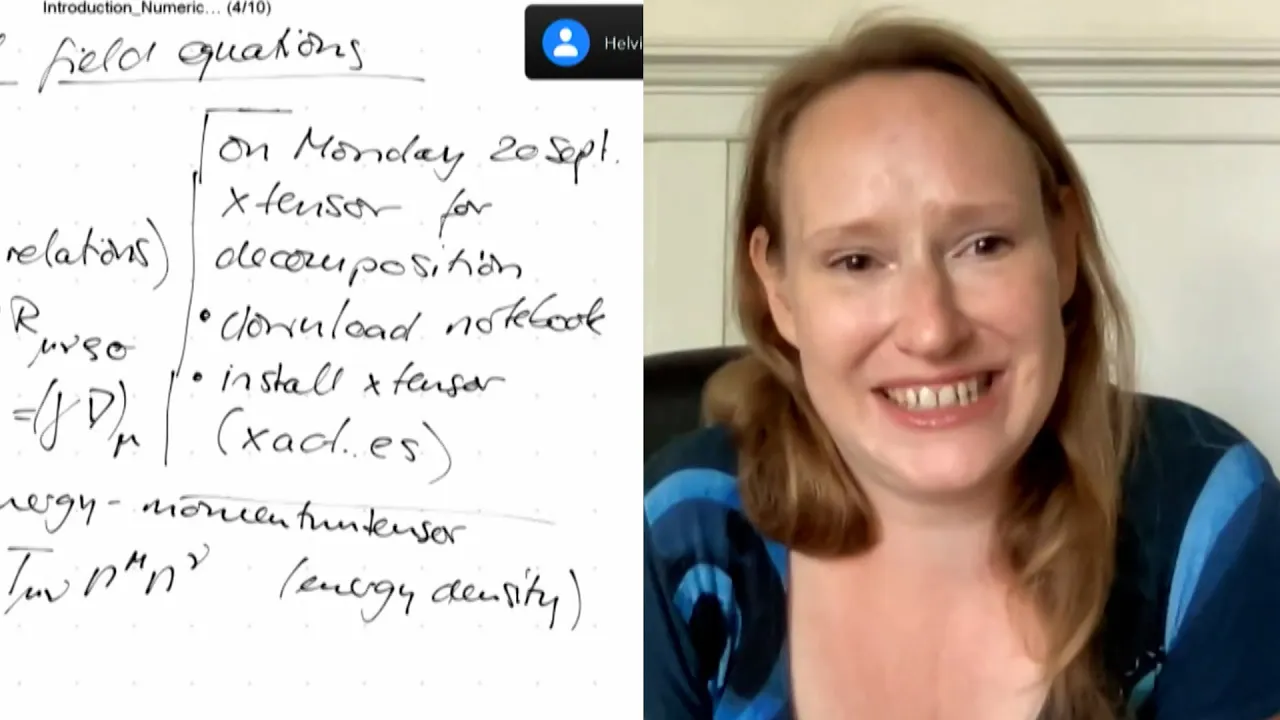
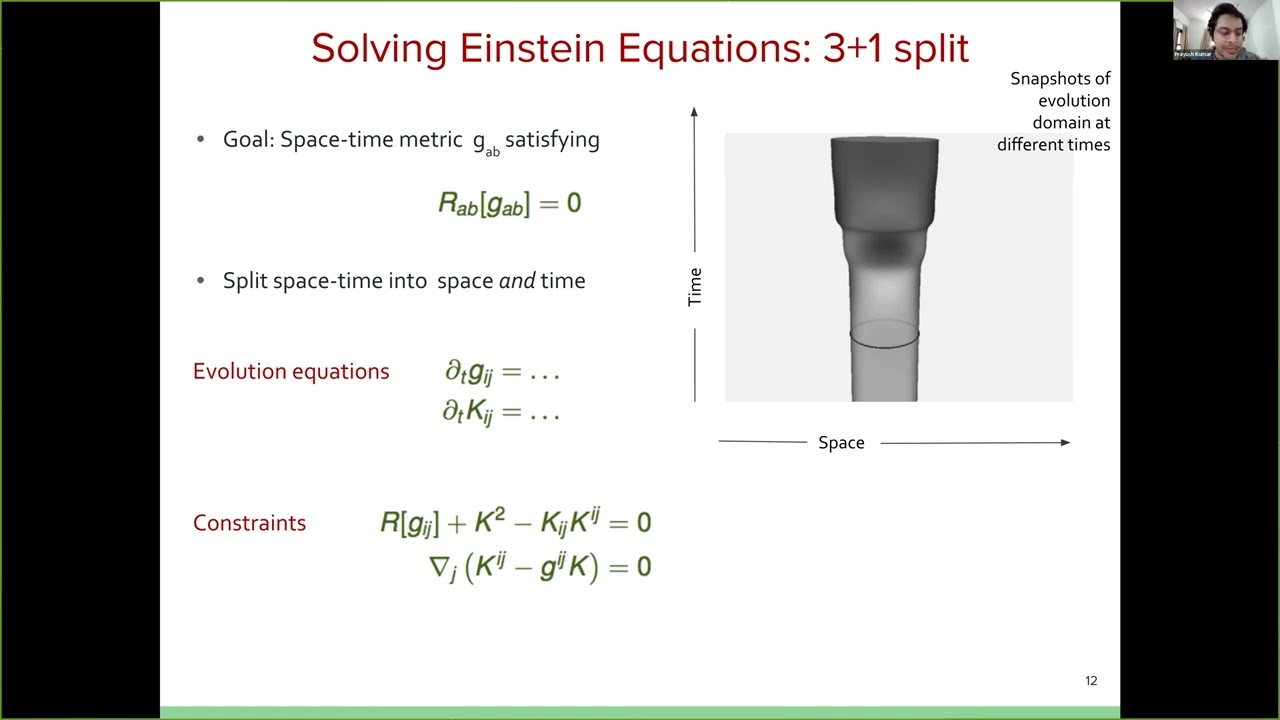

In the approximation of weak gravitational fields, Einstein's field equations become linear wave equations for the metric perturbation H_muu, which must satisfy transversality conditions (H_0i = 0, H_ii = 0) and the trace-free condition (H_xx + H_yy = 0), resulting in gravitational waves that propagate at the speed of light and cause tidal stretching and compression of objects perpendicular to the wave's direction of motion.
General Relativity 10: Gravitational Waves and Weak Fields
Added:The formulation and physical meaning of the non-linear Einstein Field Equations.
Spacetime geometry basics, specifically the Minkowski metric tensor and tensor calculus (covariant derivatives and Christoffel symbols).
The concept of coordinate transformations and basic gauge freedom in classical field theories like electromagnetism.
The derivation of the Quadrupole Formula to model how accelerating masses generate gravitational radiation.
The physics of gravitational wave detection, including the principles of laser interferometry used by LIGO and Virgo.
The polarization states of gravitational waves (plus and cross polarizations) and their physical effect on test masses.
An introduction to Numerical Relativity and strong-field regimes where linear approximations fail, such as black hole mergers.
216.5K views1.5Klikes1:36:20Original Release: 2012-12-11
[Music] Stanford University so the questions that were asked to me tonight are more or less by accident they exactly the ones that I want to address tonight weak gravitational fields linearity versus nonlinearity um and gravitational waves let's again working out the equations of general relativity is always unpleasant and we're not going to do it on the Blackboard they they would uh fill the Blackboard even for simple things and they probably would not be terribly Illuminating to learn this subject really how to compute and how to solve it equations and so forth I think you just have to sit down and do it on the other hand the principles are straightforward enough and it's easy enough to say what you get when you do solve the equations so that's the way we'll talk about gravity waves uh by writing down the equations and then writing down the solutions now we're interested in what could be called weak gravitational waves weak gravitational waves means that the ampl udes of the gravitational waves are small enough that you can make approximations such as the amplitude squared of the gravitational field is zero when a quantity is small and you're expanding an equation about the smallness of that quantity the usual rule is to ignore things which are higher order in that small quantity all right so we start start with an equilibrium we're we're talking now about fluctuations or perturbations about an equilibrium situation and the simplest equilibrium solution of let let's write Einstein's equations first Einstein's equations let's take the case without any matter no uh no energy momentum tensor then the equations of motion are just R mu newus 12 G mu new R is equal to zero that's called the Einstein tensor g muu equals z and it can be simplified if you take the trace of both sides the r here is the uh trace of the uh REI tensor if you take the trace of both sides you will discover that R the scalar curvature R is equal to zero and once you know that you can ignore the second term in the equation the equation is simple that doesn't really matter because we're not going to write down the details anyway but this is the equation of Einstein in a context in which uh there is no energy momentum tensor on the right hand side all right what's an equilibrium situation an equilibrium situation first of all means a solution which has no time dependence there really and which also doesn't have any matter on the right hand side matter is another word for the energy momentum tensor on the right hand side no right hand side there's really only one equilibrium situation the equilibrium situation is just empty space empty space is time independent the uh empty empty by empty space I mean empty flat space no curvature no interesting gravitational field and in that case the metric G muu now I'm not going to say the metric is equal to such and such the metric depends on the coordinates you use if I wrote that the metric of a flat plane is just the chronica Delta symbol you would correct me and say no the metric of a flat plane is not the chronica Delta a possible metric expressing the flatness of space would be the chronica Delta but if I used other coordinates the metric would not be the chronica Delta use curved coordinates use polar coordinates use any other kind of coordinates what's special about flat space is that you can find coordinates in which the metric has a nice simple form the same is true in general relativity flat SpaceTime with no gravitational field there is a choice of coordinates in which the metric has the simple form of ADA muu and let me just remind you what Ada muu is Ada mu new is a matrix let's just write the Matrix uh I think with the notations we've been using in this class I think it's um 1 - one - one - one 0 0 no sorry that's incorrect it's 1 0 0 0 0 1 minus one 1 0 0 0 0 1 0 0 0 0 1 which row and column corresponds to time the first one t x y z Z TX y z this is and so forth okay so that's the metric of flat SpaceTime 1 - one and three pluses and it's an equilibrium solution it is a solution of the Einstein field equations the Einstein field equations say certain components of curvature are equal to zero this is a geometry or this is a metric that has no curvature at all and so it is a solution if you plugged it in you would find it's a solution in fact it would be trivial one step now let's think about something which is close to empty space far away some complicated thing is happening far away too far away to be interesting to us or at least to be um close enough to us to uh to directly observe there's something going on a binary Pulsar is rotating around and doing some complicated emission of gravitational waves close by the gravitational field may be very strong even the gravitational Fe waves might be rather strong but if you go far enough away the gravitational radiation the gravitational waves that are produced by this thing are going to be very weak right what does weak mean weak means that the true metric can be chosen again I emphasize can be chosen the equal ad muu plus something small small means that its components are much smaller than the ones which appear here and that small thing is usually called H muu as far as I know it's called H because H is the letter after G I don't know any other reason for for h H H muu unlike ad muu is in general a function of position it's also when I say position I mean position and time it's a function of the coordinates it varies from place to place and it might describe a wave we'll come back to waves in a moment but uh let's uh what are we going to do with this we're going to take this metric calculate from it R mu new and set it equal to zero and that's going to give us an equation for H now the equation that you actually get from H for H it's not big enough to fill the whole Blackboard but it's big enough to to be quite unpleasant and so I'm just going to I'm going to be schematic I'm going to show you what goes into it first of all what is r r is Rel is a combination of components of the curvature tensor not going to write the curvature tensor I'm just going to remind you what it contains a curvature tensor itself the thing with four indices contains one term which is a derivative with respect to position with respect to X and I'm not even going to write which X it contains lots of different der Ives depending on the index structure derivative of the christopal symbol so it contains a first derivative of the christopal symbol and secondly it contains the christopal symbol quadratically squared or christopal symbol times another christopal symbol this is really all this is as much detail as we're going to do I could put the the indices in here and remind you where the indices go and there are various terms which look like this there are various terms which look like that but this is good enough for us what about Gamma what about the christopal symbol if you remember that well first of all it contains a factor of2 it contains the metric tensor with components upstairs the metric tensor with components upstairs is simply the inverse Matrix of the metric tensor itself it can also be expanded in powers of H the first contribution to it is just the Ada symbol itself so the inverse Ada is its own inverse Matrix and so it begins with a g to the minus one I'll be more specific in a minute and then it has derivatives of G it has various kinds of derivatives of G now come back to here G inverse that contains again things like Ada probably minus H but whatever it is it contains the Ada symbol plus a small correction the metric tensor with upper indices if you only had Ada would basically be the same Ada and then H would appear as a correction all right so G inverse here this would contain things like this is a wiggly equal sign which means not equal at all it would contain things like Ada minus a small correction or plus a small correction that's not important for us but then the derivative of G that only contains H why because the derivative of this metric tensor is just zero all it contains is zeros and ones derivative of zeros and ones is zero and so in the approximation that we're working in the derivative of G just contains derivatives of H let's just call it derivative of H okay let's look at what we have here this is the christopal symbol it contains one term which has one power of H incidentally H is small and we'll also assume that its derivative is also small if you have a small number a small function and you differentiate it it's equally small in general unless it has very sharp points or something which we'll assume it doesn't so the derivative of H is also considered to be a small thing Ada * H is once small H * the derivative of H is twice small it's quadratic in the fluctuation or in the in the small gravitational field so we ignore it too small to be important if H is 01 and derivative of H is.1 then H * H is. um o1 whatever very small all right so we can ignore this and Ada * H we'll just call derivative of H just call it derivative of H so the christop symbol itself is just in the approximation of small grav of weak gravitational radiation the christopal symbol itself is just proportional to some derivative or some collection of derivatives of H what about the Rey tensor then the Richi tensor will contain derivative of gamma and that's going to be second derivative of H it's going to contain various kinds of second derivative of the gravitational field incidentally H is called the gravitational field or the field of the the gravitational wave and then over here it's going to contain plus derivative of H time derivative of H gamma * gamma is quadratic in derivatives of H so immediately we say this is much smaller than this and we ignore it so whatever the devil this reachy tensor is it's composed out of simple second derivatives of the metric tensor from that we can conclude that Einstein's equations have a relatively simple form there's still plenty of indices around and the number of different terms involving second derivatives of H are significant it's not a it's it's complicated enough I don't want to write it down on the Blackboard but it is basically built out of second derivatives second derivatives with respect to position and second derivatives with respect to time and maybe even some terms which have a derivative with respect to position and a derivative with respect to time and furthermore there are there are several components of it there not just how many components of it well the REI tensor has a mu and a new so it has two components components what comes out has two components but the whole works whatever it is is composed of second derivatives of H okay so our equation of motion is some kind of equation that looks like this equations of that form especially in relativity are usually wave equations just to remind you what a wave equation for a ordinary wave looks like let's say a wave moving down the z-axis a wave moving down the z-axis also satisfies an equation that looks like this let's say the wave field let's call it fi the wave field fi will satisfy an equation like DC fi by dt^ 2 is equal to DC F by dz^2 this is the simplest wave equation that you can imagine and the solution to it are waves which move either to the right or to the left you can add waves which go to the right and the left it's still a solution so you can take a wave which looks like this add it to a wave moving to the left the sum is still a solution because the equation is linear okay so this is or we can let's write it this way this minus this is equal to zero if we had more directions of space the structure of the equation would be a little more complicated instead of just derivative of f with respect to Z we would also have uh we would have a sum of terms plus second derivative of five with respect to x^2 plus second derivative of 5 with respect to y^2 equals z but it's evident that there's a um a family similarity between the kind of equation which occurs here and the kind of equation which occurs here in fact by clever manipulation you can make these equations this is not just one equation incidentally there's a equation for each mu and new let's put a bracket around here and just remind ourselves that there are four * 4 16 components of R muu now they're not all independent and it does really quite a bit simpler than that but still in principle There are 16 components 16 equations in that respect it's somewhat similar to Maxwell's equations Maxwell's equations have the form of wave equations for example for the electric and magnetic field but there are several components there are three components of electric field three components of magnetic field sounds like there's only six equations but in fact there are eight equations uh Maxwell's equations and this is the same sort of thing several equations but all of similar similar form any questions question doesn't that Dera put two doesn't it actually have four does it have what four indices two go with the derivative and two go with h yeah yeah but they were contracted in many ways remember yeah that that's that's correct but remember where armuu came from it came from a thing with arm youu Sigma to or upstairs or downstairs indices and then we contracted them uh put a new upstairs here so that new disappeared as a as an index and we just got the the reachi tensor so yes with four derivatives sorry with two derivatives and two components to H we certainly can make um uh how many whatever whatever number you make a number of different uh combinations much more than just two indices but the combination that we're interested in is contracted in such a way that there's only two indices and only two equations left over excuse me yeah um on that contraction when you have the index upstairs does doesn't part of the contraction involve introducing the metric again or not yes it does good right so part of part of Contracting introdu uh involves introducing the metric again but again the same thing is true the metric is Ada + h r is composed out of derivatives so it already is small it already is small and if you multiply it by another small number it's doubly small I think that's what you asking well yeah but but then you'll get won't you get terms of the form H times second Dera of H yes but they count it as infinitely small okay so yes anything that involves an H multiplied by another H or a derivative of H times another derivative of H or an H times a derivative of H is dropped in this approximation this is an approximation but it's a well- defined approximation in that uh it is the well technically it's the linearization of Einstein's equations which means which simply means you throw away everything of higher power yeah but it is a good approximation when the gravitational radiation or the gravitational wave is is weak okay so we have equations of this form which we're not going to specifically write down they're kind of messy but uh before we discuss them well before we discuss the solutions you might ask yourself well I originally told you that um that it's not that the metric of flat space is equal to adom youu it's that it can be chosen to be equal to ad muu that means that there are other ways is to represent flat space make a make a coordinate transformation make a coordinate transformation on atom you knew in the metric changes but it's still exactly the same uh exactly the same solution and so what that means is that there must be Solutions of these equations which look like they have which look like they're nontrivial but really are just all they really represent is flat space but in coordinates where the coordinates have little ripples in them in other words supposing I take the flat Blackboard I maintain that the flat Blackboard is a solution of Einstein's equations well not really well it is yes but uh not in the sense I mean here um it is a flat space okay it can be represented by a metric Delta MN let's say m&n stand for X and Y on the other hand there's nothing to prevent me from introducing Co coordinates with little Wiggles in them well we could start with coordinates let's let's say we start with coordinates which are the good cartisian coordinates let's call them X X standing for X and Y well yeah let's call them x uh X and Y all right X and Y and then we can introduce new coordinates X Prime and Y Prime where X Prime is just X plus a small change we could call that plus f subx of x and y that's a coordinate change a coordinate change is X Prime is some function of X and Y and Y Prime is some other function of X and Y that's a coordinate change here the coordinate change is taken to be almost no coordinate change at all plus a small little correction same thing for y y Prime is equal to Y plus let's call it f suby of x and y I have not changed the space in any way all I've done is change coordinates and perhaps put some little Wiggles if if uh if F has some Wiggles in it then the new coordinate axes might have the new coordinate lines might have some little Wiggles in them and now the metric if I rewrite the metric for the prime component so let's say um uh let's okay let's take the case let's assume the metric in the primed coordinates is just the X Prime SAR plus the Y Prime squar I'm working backward I'm supposing that the primed coordinates are the nice coordinates the nice cartisian coordinates and the X and y-coordinates are the um the the slightly curved ones all right what is the metric the metric this is just a Blackboard now we're not doing SpaceTime just the Blackboard the metric of the Blackboard is the X prime squ plus the Y Prime squar let's work it out for fun in X and Y okay so what is DX Prime we work out what DX Prime is DX Prime comma DX Prime is equal to DX plus the derivative of f subx with respect to let's call it x sub XM M could be either X or Y time DXM and likewise for y we figure out what d y Prime is that's Dy plus a small correction and you plug it into here and what do you find out you find out that the X prime squ plus the Y Prime squ is not D x^2 + D y^2 it contains the x^2 + D y^2 but also contains other cross terms DX * this and Dy * that and if you work it out what you find out is that this is equal to DX Dy sorry dx2 + d y^2 now I am assuming that f is small I'm going to assume that f is small and that means when I squar the X Prime squared I can drop the F the X SAR likewise for y so what I'm going to get is a correction and the correction can be called H MN DXM xn and other words just by squaring out the X Prime square and the Y Prime squar substituting in you'll discover that there's a small correction to the metric tensor now does a small correction to the metric tensor mean that the geometry of the black board has changed no it just means that the um uh that the that the coordinates that I've used have Wiggles in them you can work out it's it's it's nice to work out it's a little exercise work out what the correction in the metric is dropping anything which is quadratic in F dropping anything Which is higher order and I'll tell you what you get you get that hmn m&n now just run over X and Y is equal to dfm by dxn plus dfn by DXM that will mean nothing to you until you try to work out an example or until you try to prove it this is the correction to the metric it's a correction to the metric which is small why because I because I chose F to be small it has the form of a small perturbation on the metric but it doesn't represent anything it represents just a trivial uh uh change so there are some let's call them perturbations perturbations mean a small change perturbations on the original form of the metric which are trivial they don't represent anything likewise here there are small fluctuations that you can write down which just represent curvy linear coordinates in SpaceTime how do you get rid of that how do you get rid of it and eliminate the the the phony Solutions which automatically solve the equation because they're just flat space but which don't represent any real physics and you do it by imposing more equations more equations on the metric that sort of cut away and divide out and eliminate the um The Unwanted spirous Solutions uh I could write down the equations it's not important they're just equations which tell you get rid of the spurious uh coordinate uh coordinate ambiguities and you can do that in a wide variety of ways wide variety of conditions that will allow you to eliminate the UN physical meaningless Solutions of Einstein's equations once you've done that and you've imposed all of the Einstein equations here once you've done that incidentally the equations become pretty simple and in fact all they become is wave equations they become wave equations they they become several different equations they become first of all w ordinary W just perfectly ordinary wave equations for the components of H same kind of wave equations that I wrote down uh where did I write them down I guess I erased them DC 5 by dt^ 2 minus DC 5 by dx^ 2 blah blah blah y^2 and z^2 is equal to zero all right so there's some and let me write them now in the correct form instead of f we have H here H muu each component of the metric tensor or each component of the fluctuation satisfies a wave equation that means that all the components of the wave equation sorry all the components of the metric just move down the axis uh like waves and there are waves on the other hand there are also some constraints the constraints come there's a lot more equations how many equations are there um well there are more equations than one for each mu and new the reason that there are more equations is because you have to divide out this spurious fake solutions that are there because of the coordinate ambiguity once you do that you find out that the physical Solutions the ones that really have meaning I'm going to I'm going to classify them now for you supposing we have a wave moving down the z-axis let's suppose we have a wave moving down the z-axis what does a wave moving down the z-axis look like wave moving down the z-axis if it were just a simple wave would just be f is equal to something like some number * s of K * x - z uh sorry * Z - t * tus z z minus t t minus Z doesn't matter same thing this is a wave that a fixed instant of time is just a sine wave and it moves down the axis with unit velocity unit velocity here means the speed of light right now each one of the components will have a solution like that each component will be proportional to sin K times what what is K incidentally it's the wave number right it's the frequency of the wave it's the frequency of the wave it's also the wave number the number of oscillations per unit length and of course it can be anything it be any number short wavelengths have large K long wavelengths have small have uh small K okay so that's a that's a typical solution of a wave equation and the solutions to this equation here are all of the same type h not not is equal to some function well there there's a coefficient here let's call a coefficient fin not F not is just a number all right each component is a function of T and Z which is proportional to the same thing sin K * T minus Z times a number which we can call H not let's put mu and new here mu and new and this is not a function of position it's just a numerical coefficient that multiplies the sign of T minus Z and that's about all you can write down this this is the nature of a gravitational wave each component of the metric behaving like a wave moving down the axis however as I said there are more equations the additional equations is there's a good number of equations here and when you impose them all you find out oh let's before we do this let's just remind ourselves something about um electromagnetism in electromagnetism we do the same thing we solve Maxwell's field equations we can solve Maxwell's field equations either for the vector potential or the electric and magnetic fields right but when we write down all the equations we find some constraints the constraints are called transversality of the of the field does everybody know what transversality of an electromagnetic field means it means that the electromagnetic field the electric and magnetic fields always point in the directions perpendicular to the motion of the wave not only are the solutions waves but they're transverse waves meaning to say that the electric field and the magnetic field the magnetic field points one way the electric field points the other way and the whole thing goes down the axis oscillating as it goes down the axis very similar things happen here the waves have to be trans to say that the waves are transverse means that the time components and the and the Z components of H are zero the only components of H which are allowed to be nonzero are the components in the plane perpendicular to the direction of the wave so if you substitute this in to all the equations the full set of equations here including the ones which remove the fake spurious um uh fluctuations you find that a gravitational wave has a very very simple form well it does have this form a set of numbers H new but the only components that are allowed Let's uh say this is z x and y I'll call I and j i and J represent the directions in the plane perpendicular to the motion of the wave then the only components which are allowed are h i j times sine KX KZ KZ Min K * Z minus t so if you're looking down the z-axis if you're looking down the z-axis you see in front of you the XY plane you see in front of you the XY plane there's the XY plane and the XY plane at each Z and T in other words a slice here's on my slice I slice it at a given location at a given time time at a given location and a given time the metric of the two-dimensional plane I slice the wave into two dimensional planes as I go down the axis here at a fixed instant of time and what I have here is a metric for each Z which looks like where is it right over here with only two comp with only components with the components only in the plane perpendicular to the motion of the uh of the um of the wave and the components are simply numbers at each Z and T the the metric is simply a set of numbers there's one more equation one more equation that I it comes from Einstein's field equations and it says that the trace of h j is equal to zero in other words hxx + h y y is equal to zero that's it that's the whole set of equations and what it tells you is that the metric the metric of a gravitational wave is H not equals z h z is equal to zero H ZZ is equal to zero in fact H anything with either a Time component or a space or Z component are equal to zero the only components which are not zero are hxx h y y and H XY hyx the metric tensor is symmetric the metric tensor is symmetric and so hxy and hyx are the same and finally hxx plus h y y is equal to zero which means that h y y is minus hxx well h y y is equal to minus hxx that's pretty simple but what does it mean first of all all of these vary with z and T they vary only with z and T if if the wave is going down the z-axis then by definition the variation is along the z-axis and so hxx is some number to begin with time sin KX * sin KZ minus t this one is H not y y sin K * Z minus t and likewise this one is H XY sin KX yeah okay okay so think of a series of layers Let's uh let's look at it at a fixed instant of time at a fixed instant of time for example time T equals 0 as we move down the z-axis there's a pertubation on the metric the met the metric tensor is a little bit different from just a flat space metric it oscillates as you go down the Z down the Z axis and the components that oscillate are the components that have to do with the metric of the plane perpendicular to the wave what does it mean to have an hxx well let's just take the case of hxx if there's an hxx that means that the XX component of the metric is a little bit different than one the XX component of the metric was originally one that's Ada Ada XX it's one plus this little bit blah blah blah plus this little bit that means that proper distances along the x axis are a little bit different that actual distances let's say between xal 0 0 and 1 or let's say between xal -1 and 1 that the actual distance the actual distance remember the metric tensor is the thing which tells you the actual distance between points the coordinates are just labels the actual distance between point minus1 and +1 is a little bit different than it would be if this perturbation weren't here either a little bit larger separation or a little bit smaller separation depending on the sign of hxx for example if hxx is positive then the actual physical distance between here and here would be a little bit larger than one meter supposing we're working in meters that would mean that a meter stick doesn't quite extend from minus1 to 1 what about gy y well we'll take G we'll take hxx to be positive if hxx is positive did I say that yeah I did get that right the distance between minus1 and one is a little bit bigger than a meter and therefore a real meter stick would look would would not look it would be a little bit shorter than the interval between minus1 and one not because the meter stick is necessarily shorter but because the coordinates are such that at that on that surface there the distance between minus1 and +1 would be a little bit bigger than a meter all right what about g y y g y y is equal to 1 minus hxx minus hxx because Einstein's equations tell us that these some of these two are equal to zero that in turn tells us that a meter stick oriented along the Y AIS let's say from y = 1 to -1 here's again 1us one a meter stick would look a little longer the distance between + one and minus1 would be a little bit less than if you only had the one here and so our meter stick over here would look a little bit longer now this would just be this would be nothing but a squeezing of the coordinates so that you would be choosing coordinates along the xaxis where the meter stick was a little bit less than one unit and the meter stick along the y- axis was a little bit greater than one it'll be nothing at all it would be no uh nothing significant except the fact that it changes as you go down the axis as you go down the axis from one point to another or if the wave were passing you imagine bet even yet the wave was passing you the wave is passing these meter sticks all right after a brief amount of time the H's will change sign not this sign but SN the sine wave oscillates so after a brief interval of time one half cycle of the wave hxx has changed sign h y y has changed sign and the result is after a brief interval of time the meter stick will look a little bit short in these coordinates along the Y AIS and the meter stick will look a little bit long along the x-axis yeah the meter stick is held together electromagnetically it's not Chang length so you're talking no no no no these are coordinates right you're talking about two little test masses they would move back and forth in fact two little test masses would move back and forth but not because yeah the meter stick is a one meter long okay it's always 1 meter long but right but an oscillating wave is going back and forth perturbing it a real wave a real wave of curvature this is real curvature and if you like I think one way to imagine it um well the time dependence of this wave really does exert tidal forces they're tidal forces the wave has curvature the wave is moving past here it's a kind of tidal force and the nature of the tidal force is to actually cause the meter stick to be um compressed stretched compressed stretched stretched and the way that it's compressed and stretched is that when it's compressed horizontally it's stretched vertically when it's compressed vertically it's stretched horizontally so if you like this wave going by a meter or for that matter if it were just two test masses if it really were just two test masses the two test masses would oscillate back and forth if um if instead of taking a meter stick you took a square piece of plywood the square piece of plywood would be deformed this way and then reverse this way and then reverse now it's interesting there is another solution there is another solution which in which not HX and Hy are nonzero but in which hxy is non zero that would be a metric which would look like um a chronica Delta Delta MN or Delta i j plus a little Matrix which has an hxy over here and an hxy over here that still has hxx plus h y y equal to zero there is no hxx h y y if you think about it a little bit and just spend a little bit of time figuring out what this means it's also the exactly the same kind of thing except that the um except that the squeezing and stretching are along the 45° axes stretch this way squeeze this way oscillating it's not a new thing it's not a new solution except that it's the original solution turned by an angle in fact any solution that you write down which is a linear super which is a superposition of these two kinds of solutions any solution is a linear superposition of the two solutions and they correspond to some orientation of axes where along those axes the uh the compression and expansion are along those tilted axes that's all there is that's all the kind of um gravitational waves there are you pick a set of axes perpendicular first of all you pick the direction that the gravitational wave is moving yeah what can you use to measure this compression that does not change a a strain gauge a strain gauge this will create honest real stresses in the uh in the piece of plywood um a strain gauge will register them uh when this wave is going past if the wave was static if the wave was static and not moving then this piece of plywood would really be unaffected everything would be simultaneously squeezed or stretched the same way the rulers which measure the plywood The Strain gauges which measure but it's the oscillating character of The Way of the uh of the solution which really does create real honest uh stresses and strains in it it does have real curvature and this is what it does what triggers the gravitational wave like an electromagnetic waves triggered so you know by a current say or by a moving charge or by or a charge for example one charge charge of an electron going around a proton will create electromagnetic waves and the same thing uh a um a star or a black hole or a pulsar or whatever it is in orbit around another one a binary Pulsar for example the famous binary Pulsar two very very concentrated masses which happen to be rotating around each other at a rather small distance neither one is a black hole the whole thing is not a black hole but it is a very very strong gravitational field going around each other and in going around each other the accelerating masses create uh create the gravitational waves so now near the binary Pulsar this is a bad approximation the gravitational field is too strong to linearize the equation this way but if you get back you know a few uh a few radi a few distances away then the wave spreads out dilutes itself and gets weak enough that this becomes a good approximation so okay so if you had the B if you the binary Pulsar is over there and you're standing back the wave is coming at you let's say the axis between you and the binary Pulsar is the z-axis then what you'll see coming past you will look like this and what it will do is it'll cause stresses and strains along perpendicular to the line of sight to the Pulsar yeah yeah clarify that red meter stick you have is right behind you yeah the red meter stick is an abstract meter stick not a real physical meter stick oh it could be a real physical met sck but it changes right it has stresses in other than the stresses and strains how do you measure it with a variable well I think the way you measure it is by the stresses and strains that are in uced in it you you know it's hard to say that it's not a meter because it's by definition a meter stick but um in essence it's very yeah yeah if you had in fact if you had two if you had a steel meter stick and a wood meter stick they would probably react differently they would probably react differently so um uh once these stresses are applied once the stress due to the curvature tensor here and it's a real thing the curvature tensor it is a kind of um uh tidal Force once these tidal forces are applied the meter sticks the two meter sticks the steel one and the wood one will stress by different amounts in general so if you measured the wooden meter stick with the steel meter stick I'm not sure which one would be bigger and which one would be smaller but they wouldn't match up precisely yeah would this be how you would build a revenue detector sorry that's kind of the point I was making before a steel meter stick has got a big elastic modulus it's not going to shrink very much when the wave goes past but if you have two test masses that are floating right at the ends of the meter stick they have no elastic modules they'll move right with the space time that's right well no see them move no they won't move quite with a uh quite with a space time they'll be accelerated they'll be accelerated yeah so they'll start ringing now if you want to detect a gravitational wave what you want to do is create some system which has a resonance at the frequency of the gravitational wave you know what a resonance is a resonance means that the system has its own natural frequency frequency of oscillation which is the same as the oscillation frequency of the wave then you would have a driven system being driven at its own natural frequency and under those circumstances the response will be particularly big so if you wanted to detect a gravitational wave oh let me say that the gravitational waves that we expect in astronomy from different sources I'm not believe me I'm not an expert at this but uh I know enough about it to know that the H munu which are produced by a distant gravitational Source are very very small they're so small that the dimensionless strain on a steel Rock or something like that would be something like 10 Theus 21 really really small effects uh the effect that people even contemplate measuring them is quite astonishing but it seems they can be measured and um hasn't been detected no no there is a system that measur the legal system H there is a system that build in two places I think one in Louisiana and some other place which is measuring that by interference of of uh laser blade I believe I'm not sure what you're asking Lio yeah but they have Lio is a gravitational detector it's not it's not Bas it's not a steel rod it's a pair of mirrors which are monitored by laser beams interference uh effects due to the relative motion and so forth but basically a gravitational detector is a system which is allowed to be set into oscillation either this way or that way and uh yeah is there a velocity that comes out of those Solutions the speed of light okay it's not put in artificially in advance by no it's a speed of light okay so if you were if you saw a gravitational collapse a gravitational collapse or the Collision of two black holes would make and that happens from time time to time when I say it happens I mean to say that you can estimate roughly from observed facts how many black holes are out there and you can guess how many um black hole collisions take place every uh every year and if I remember I think uh within within range of such of the best imagined Det hectors if I remember I think it's about one black hole Collision per year it's a lot um when right so in principle if it was possible to detect a black hole Collision through other means other than gravitational radiation you would you ought to see the signal at the same time as the gravitational radiation um gravitational radiation is a pretty weak effect when you're far back but from the Collision of two black holes it's an enormous effect when you it's it's much bigger than any other kind of radiation that's emitted so if the Collision is taking place at large cosmological distances it can be the case that the only way to detect it would be through gravitational um radiation gravitational waves like this that's why it's interesting because it's a new window on uh on uh on for astronomy okay that that's that's what gravitational radiation is or that's what gravitational waves are they're real I mean uh I you asked me if gravitational radiation has ever been detected yes and no it's never been detected by direct detectors but just like electrom magnetic radiation for example from an orbiting system radiation carries off energy carrying off energy means that as two systems are rotating about each other they will lose energy and in losing energy they may speed up a little bit they will speed up a little bit uh uh due to the loss of energy and so the study of this binary Pulsar that's out there which is has all the properties necessary for gravitational radiation to be emitted from it when the timing of the procession not the procession the rotation of the two systems about each other they are the the frequency is changing a little bit in time exactly as would be expected quantitatively exactly as would be expected from the system if it were emitting gravitational radiation uh gravitational radiation is the main thing which would cause its energy to change and it works out exactly right so what sorts of frequencies are we talking about milliseconds I think milliseconds yeah I think but um you look it up I'm not sure it might be a little slower than milliseconds milliseconds is what a pulsar does when it rotates around its own axis might be a little slower than that if I remember correctly it's days oh days okay days yeah yeah yeah this is two stars going around each other what am I saying milliseconds no um milliseconds is for the rotation of the Pulsar these are two stars going around each other it's not the take back what I said okay yeah we arbitrarily took X and Y as two coordinates that we decided to put them on a flat line what about if you took x and t in other words how would it how would it affect space time rather than just a space this is the time direction the wave has a directionality along with it's moving the wave is transverse which means the only components that have physical significance are the ones in the plane perpendicular to the direction of motion of the wave the other components are um either not there or they correspond to a wiggle in the coordinates the other components are either Wiggles in the coordinates or they're not there yeah I I looked it up for the original bind repuls that where the detection was made it's 7.75 hours okay geometric mean of a day and a right how much has it changed over the period that it's been observed though a very small number about 30 seconds really that much yeah but it's been looked at for decades yeah so so time is actually oscillating as well is that what you just said it's not time is not oscillating the wave is oscillating with time if you stood in one place the wave would oscillate with time yes but you were going to ask well but time is one of these coordinates right in in in four dimensional space time is a coord is orthogonal to Z no no no no no when I said orthogonal to Z I meant the space directions orthogonal to Z but there is time there is time and the components of the metric which have a Time component in them all are equal to zero it's very much like an electromagnetic wave the electromagnetic wave also has space and time or electr magnetic field also has space and time components um the vector potential has space and time components in a wave moving down the z-axis only the transverse space components of the vector potential are uh are there so it's very much like that you said before that h z0 and h0x h0 y h0 z are all zero yep so there's no curvature in the time Direction well no there is curvature in the time Direction remember something yeah um the H is in those directions are non zero but when you differentiate you can differentiate with respect to time and get the time into it right so derivative of H let's say uh XY with respect to T is not equal to zero and remember the curvature tensor has two derivatives on H so you can get a whole uh a whole collection of different kind of components yeah yeah but still it's a very special kind of curvature that uh that's not generic okay that's gravitational waves you can learn more about them by any good book on general relativity which will solve work write down the details of these equations you know they will they will fill about one Blackboard and they won't be terribly Illuminating but uh the basic principle I've told you any other questions yeah so we start out with Einstein's equations which are nonlinear we wind up with a wave equation which I believe is linear oh because we made the approximation of a very small H okay so it's got nothing to do with getting rid of the non-physical solution no no no the linearity is because the wave is weak generally speaking I tried to explain before small oscillations about an equilibrium and the approximation that the oscillation is very small are linear so this is linear because of an approximation that H is so small that the square of it is zero any other question yes if you do this approximation like we did and then you go back at the end and see how far off it was from an accurate solution you know how much error is there depends how big H is if H is.001 the correction will be.00 if H is 1110th the corrections will be 1% whatever whatever H is the corrections will be of order the square of it yeah all right so that look that's something yes that that's something you always do when you make a linearized approximation [Music] you always check at the end that the corrections to it would be small and but they they will be if H is small enough yes if uh you make H much larger so there is a component of a higher order would that affect the fact that I and J are perpendicular to the z-axis would that no no but what it will affect is whether waves will pass through each other they won't they will scatter off each other right no the wave will maintain that's a good question but the wave will maintain its transverse character yeah in a mechanical way the uh the magnitude of the mechanical wave is uh is related to the energy and stiffness of the material the any and the stiffness of the material yeah there any sense in talking about the stiffness yeah yeah the stiffness of a material determines the velocity of propagation through the material so you can substitute for stiffness you can substitute velocity of propagation electromagnetic and gravitational waves are extremely stiff they are the stiffest things possible in that the um in that the speed of light and that they are both governed by the speed of light white so the you know in the old days when people thought about The Ether and things and the mechanical properties of The Ether they attributed a stiffness what is it called a Young's modulus or whatever it's called to uh uh to The Ether and it was a very very big young very very big coefficient of whatever it's called because the speed of light is so much larger than the speed of propagation for example through a metal beam so um we no longer really think of it as a stiffness but if you did think about it as a stiff stiffness you would say that the uh the space on which these waves move is very stiff well it's really the stiffness divided by the density isn't it MH so either it's very stiff or there's not much density yeah and only only the combination of them appears in the uh in the propagation of uh in the propagation of white right that's true it's just one combination namely the velocity which appears right true enough okay let's uh in the little bit of time that we have I just wanted to tell you about another way of thinking about the equations of general relativity again the complexity of actually carrying out the equations is too complicated but um nevertheless the basic idea is there um one of the things I've told you in emphasis to you particularly in classical mechanics is that the principle of least action is the most Central principle of classical physics that we have all systems that we know [Music] about mechanical systems electromagnetic radiation Quantum field Theory all of these things uh the standard model of particle physics they're all governed by an action principle and the action is something which in field theory in for ordinary particle mechanics the action is an integral along the trajectory of the particle so it's an integral over time the action of a field is an integral over space and time a field configuration is a value of the field at every point of space and time so we draw here's space time all of it I've gotten it all down onto the Blackboard time goes this way space goes this way here's everything a field configuration or a field history even better a field history is just labeled by is basically a value of the field or fields at every point on here so it's some field let's call it generically fi and it's a function of x and t and that's a field configuration not every configuration is a solution of the equations of the theory just just like not every trajectory are is a solution of the equations of motion every trajectory is a thinkable trajectory but not every trajectory satisfies the equations of motion in the same way every fi of x and t is a thinkable possible value of a field in space and time but they're not all solutions and in general to the best of our knowledge every such field is governed by a principle of least action the principle of least action involves some action which is composed of the fields this is just a generic term for field it's an integral it's an integral over space and time DX DT and X now means X Y and Z so it's a four dimensional integral of some thing usually called a lrange density which is a function of the fields and their derivatives let's call them F sub mu derivatives of the field with respect to X mu and what do you do with this you minimize it or you make it stationary you find the field configurations let's use shorthand which minimize the action subject to a constraint you go out to large space some some large distance and some large times you take some region of space time and you say what the values are on the boundary it's the same deal as when you look at a particle motion and you say I'm interested in the solution giving that the particle goes through two points given that the particle starts someplace and ends someplace then what's the trajectory in between in the same way you say supposing you know that the field at some late time has some value let's say final by initial and you ask what is the solution which interpolates between these two the answer will be the pr the the field that um or the solutions that make the action stationary okay so the point here is that the field equations the Einstein field equations can be derived DED from a action principle it's a long computation but the action is simple I'm just going to tell you what the action is and then you can go home and try to take that action and apply the oila lrange equations to it and see if you can derive Einstein's field equations uh I guarantee you it can be done I also can tell you I never finished it it I started it several times and never quite got to the end of it uh but it is it's just tedious it's straightforward but tedious all right so you go back and you look at oila lrange equations I'll tell you what the action is it has some interesting pieces in it first of all let's do a simpler thing first let's just calculate the SpaceTime volume I will tell you what I mean well let's actually even think about ordinary space for a minute let's suppose we have ordinary space and it has a metric gmn when I'm thinking about space I use MN G MN DX M dxn that's the metric DS s the distance between two neighboring points is given by this formula now supposing I'm interested in the volume of a small region of space let's say DX Dy let me Begin by supposing the metric has two components gxx and gy Y and I have a small interval DX and a small interval D dy I want to know the area we called the volume volume uh means three dimensions area means two Dimensions but there the same concept okay what's the area of this little square the area of the little square I would know it if I knew the distance the actual proper distance associated with d x and the actual proper distance associated with Dy all right what's the proper distance associated with a little X DX here square root of gxx square otk of gxx DX can you read that let's make it bigger this distance is square otk of gxx DX and this distance is square root of gy Y Dy so what's the area of the rectangle it's square otk of gxx otk of g y y DX Dy it's not just DX Dy the important thing is it's not just DX or d y no more so than the distance between two points is just DX or Dy the actual physical area is a square root in this case is the square root of gxx g y y now now I've used a case here where there was only gxx and g y y there could be other components of the metric if you work it out this is a special case this is a special case where there's no off diagonal gxy term here let's let's think of it this way you have a metric you have a matrix gxx g y y now there may be some other components here GX y and gxy but what I tell you is that when there's no gxx and gy sorry when there's no off diagonal components the volume element involves the product of gxx g y y can you guess what the general formula is what replaces that product the determinant the determinant is gxx g y y minus GX y^2 the determinant is exactly right so if you actually work out the volume element of a little square like this or a little um rectangle dxdy the actual answer is not gxxg y y it's gxx g y y minus GX y^ 2 which is the same as the determinant determinant of the tensor G it's usually just written with two bars to represent determinant and G that's the formula for the volume element or for the volume of a small differential DX and Dy what would be the and this can be in curved space this is in curved space or any space whatever given a little rectangle DX Dy in coordinate space the area or in higher Dimensions it would be the volume would just be the square root of G square of determinant of G * DX Dy if I have some large region and I want the total volume of it I integrate this the integral of square root of the determinant of the metric time DX Dy that is equal to the area of the entire region enclosed within some boundary what about the volume of space if we're talking about the volume in other words three-dimensional space well it's exactly the same except you have DZ here exactly the same square root of the determinant of the metric is called the volume element it's usually called the volume element and if you have four dimensional SpaceTime it's useful to Define a simple a similar concept which would just involve the fourth component call it the space-time volume it's an interesting quantity it's invariant it's the same in every coordinate system that's the important thing about it if you Rec coordinati the region change coordinates this quantity stays the same right the volume in some sense the physical volume of a region of SpaceTime or the physical four-dimensional volume of a region of SpaceTime and this integral is an invariant quantity um other invariants other quantities which are invariant and which will not change when you change coordinates are based on this quantity if you take the volume element and you integrate it with any scalar let's call the scalar s ofx x s of x and t d x DT this also is an invariant quantity which doesn't depend on the coordinates it's just the sum you take each little volume element you take its volume and you multiply it by the square root sorry not by the Scala field you take the volume of each little element multiply it by the scalar quantity in there and add them all up that's a quantity which is really not dependent in any way on the coordinates you use even though writing it down may use a certain set of coordinates all right action is a thing which is supposed to be invariant action in relativity theory is always supposed to be the same in every coordinate frame otherwise the laws of physics which came out of it would depend on the coordinate system if the laws of physics are supposed to be the same in every coordinate frame one way of ensuring that is to make the action an invariant the quantity which doesn't change from coordinate to coordinate from coordinate system to coordinate system so it's natural then to take the action to be I call it d4x meaning DX Dy DZ DT some kind well the square root of G the square root of the determinant of the metric times some scalar now let's just take the Einstein theory without any energy momentum tensor on the right hand side just pure gravitational field nothing else what kind of scaler could I put there what how how many scalers are there that I can make up only out of the metric well indeed right so that's called r it's the thing on the right uh let's see it's the that's a scaler anything else you can think of I'll tell you there's one more thing the other thing is any number seven or four or 16 or whatever number you like so you can add to this a numerical number numerical numbers are always regarded as invariance everybody who sees seven sees the same number and the number that you put here depends on the laws of physics it is a law of physics it itself is a law of physics has a name what's it called all right I'll tell you what it's I'll tell you what it symbol is it symbol is Lambda now what's it called the cosmological constant it's a term in the action which is just proportional to the SpaceTime volume itself the termine the action Lambda time this integral is just the SpaceTime acttion itself the cosmological constant has not been I have not included it in the these equations here these are the solu these are the equations without cosmological constant so without cosmological constant this is the action and Einstein's equations are completely equivalent to saying minimize this or make it stationary make its variation equal to zero away from a solution that's minimizing something is making it stationary question yeah where's the stress energy tensor come the stress energy tensor would come in as additional terms in the action which would depend on material and the other fields for example it could be electromagnetic energy there could be other kinds of energy they would come in as additional terms here so this is the vacuum yeah this is the vacuum this is the vacuum Theory this is the vacuum theory for example the theory which would govern gravitational waves other other things could be in here but those other things would be made up out of different fields they always have a square root of G they always have a scalar uh if you remember your electromagnetism the electromagnetic field is described by an anti-symmetric tensor F mu new one of the things that you would put here would be F mu new F mu new that would govern the electromagnetic field but let's leave that out let's leave that out here's here's the Einstein the Hilbert Einstein action discovered I think just about simultaneously by Einstein and Hilbert of course Einstein already had that he already had the whole works and knew how it all worked but uh they in independently sat down and said Can these equations be derived from an action principle and both of them Hilbert and Einstein both came up with the same answer this is it so this is a shorthand but not just a shorthand a physic physical principle that contains all the Einstein field what incidentally what replaces this field I said a field in space what do you put in there the metric the metric this is an action that's made up out of the metric and you vary the metric a little bit you vary the metric a little bit and you look for places where you found a minimum of the action varying the metric a little bit if you vary away from a solution the action should grow bigger in any direction that you vary it so this is uh the Einstein Hilbert form of general relativity as I said you could sit down let's see what you'd have to do you'd have to calculate the curvature tensor in terms of derivatives of the metric you do that by first calculating the christopal symbols then differentiating the christopal symbols multiplying them together sticking them all together multiply it by the square do what whatever um contractions are necessary to produce the uh the curvature scalar multiply it by the square root of determinant of the metric it's a 4x4 metric four rows four columns the determinant is a great big thing made up out of lots of components calculate the determinant and then apply the oiler lrange variational equations to that action and it takes about 5 minutes to whole operation and out of it you will get Einstein's field equations if you can't do it in 5 minutes you fail the the course as I said I've been trying to do it for 50 years and I've never quite succeeded a lot of my friends have but there's a there's a whole chapter in tu's general relativity notes and it's very involved because it does all the things you talked about and um he plucks certain things out of the because he knows the answer and then just verifies them so it's really not easy no no no no as I told you repeatedly the principles themselves are not terribly hard for whatever reason somehow in the uh you know there are people who have such a good visual feel for um for curvature and um and differential geometry that they can more or less see through it you have your choice either you're a person with a great deal of visual ability to be able to see through the complexity of curvature tensors and so forth and figure out how to do these uh processes by almost visualization or you work them out by the algebra um so if you're good at algebra you do it one way if you're good at the visualizing geometry and you have a great command of differential geometry you probably can short circuit a lot of that I frankly have neither I am not very good at algebra and I certainly don't have the visual ability to be able to uh to visualize four dimensional curvature tensors so repeatedly I have sat down and tried to do this calculation usually in the process of teaching the subject and give up after about two hours if I had to do it I could but since I don't have to I don't don't ever tell any of my friends that I can't do it okay they'll see H they'll see yeah I know they know I can't do it so this is not standardly written down in in a text on relativity or it probably is but it fills Pages I'm sure it is f written down somewhere it doesn't help because when you have a thing of that complexity it really doesn't help to follow the steps from one step to another either you do them yourself and you figure out what the what the relation between the steps is or you don't but very long calculation really is not very Illuminating unless you try to do it yourself and then when you run into trouble you Peak oh that's the next step and then you understand why it's the next step but uh I've never learned anything by looking at these long uh calculation these days people don't do them people um throw them on a computer either numerically or analytically and let the computer grind out because it's just too nasty and complicated yeah in hindsight this seems more motivated than the way I'm Stein did it originally U but I'm wondering you know I think it went from what 1905 to 1916 before he published Journal relativity what do you think is it apparent from his papers you know what was taking so long to put it all together um the only papers I read were the early ones around 1907 and then the 1916 paper and um I read them you know 50 years ago so I I really don't know what uh but um part of it is that very very few people knew very much about remman and geometry Einstein didn't know he had to in he basically had to invent all of remman and geometry I think one of his friends helped him with it who knew some mathematics was Marcel Gman I don't know but uh uh but 10 years to put all of this together doesn't sound like a lot to me um and he literally had to build all of the ideas of curvature uh um so it uh it took a long time for that pretty early yeah I think I think he knew what he was doing pretty well but uh you know you can go back and look yourself the papers are in English they were translated into English you can find them okay uh I think we're finished for the quarter yeah anyway um I could use a rest I'm going to take a rest for more please visit us at stanford.edu
Up Next
21:37
General Relativity Explained by Physicist Sean Carroll | Lex Clips
@LexClips
232.4K views•2024-04-28

12:53
21cm Hyperfine Transition in Neutral Hydrogen: Radio Astronomy Basics
@AaronRobertParsons
12.4K views•2011-10-13
98:07
Classical Mechanics: Angular Momentum and Poisson Brackets
@stanford
139K views•2011-12-16

27:14
Entropy and the Second Law of Thermodynamics Explained
@veritasium
27.5M views•2023-07-01
Related Study Plans & Knowledge Roadmaps
Structured learning paths in Physics
physics
Nuclear Physics (Decay, Fission & Reactors)
01Atomic Structure and the Binding Force
02Radioactive Decay and Half-Life
03Nuclear Fission Mechanics and Chain Reactions
+ 2 more learning modules
12h5 modules
Explore Roadmap
physics
Soft Matter (Polymers, Colloids & Rheology)
01Foundations of Soft Matter & Thermal Forces
02Polymer Physics and Macromolecules
03Colloids, Surfactants, and Self-Assembly
+ 2 more learning modules
38h5 modules
Explore Roadmap
physics
Analytical Mechanics: Lagrangian & Hamiltonian
01Mathematical Foundations: Calculus of Variations
02From Newtonian Mechanics to Constraint Dynamics
03The Principle of Least Action & Lagrangian Mechanics
+ 3 more learning modules
28h6 modules
Explore Roadmap
physics
General Relativity (Spacetime & Cosmology)
01Foundations of Relativity: Special Relativity
02The Geometry of Spacetime: Equivalence Principle & Curvature
03Einstein's Field Equations: The Mathematics of Gravity
+ 2 more learning modules
55h5 modules
Explore Roadmap