










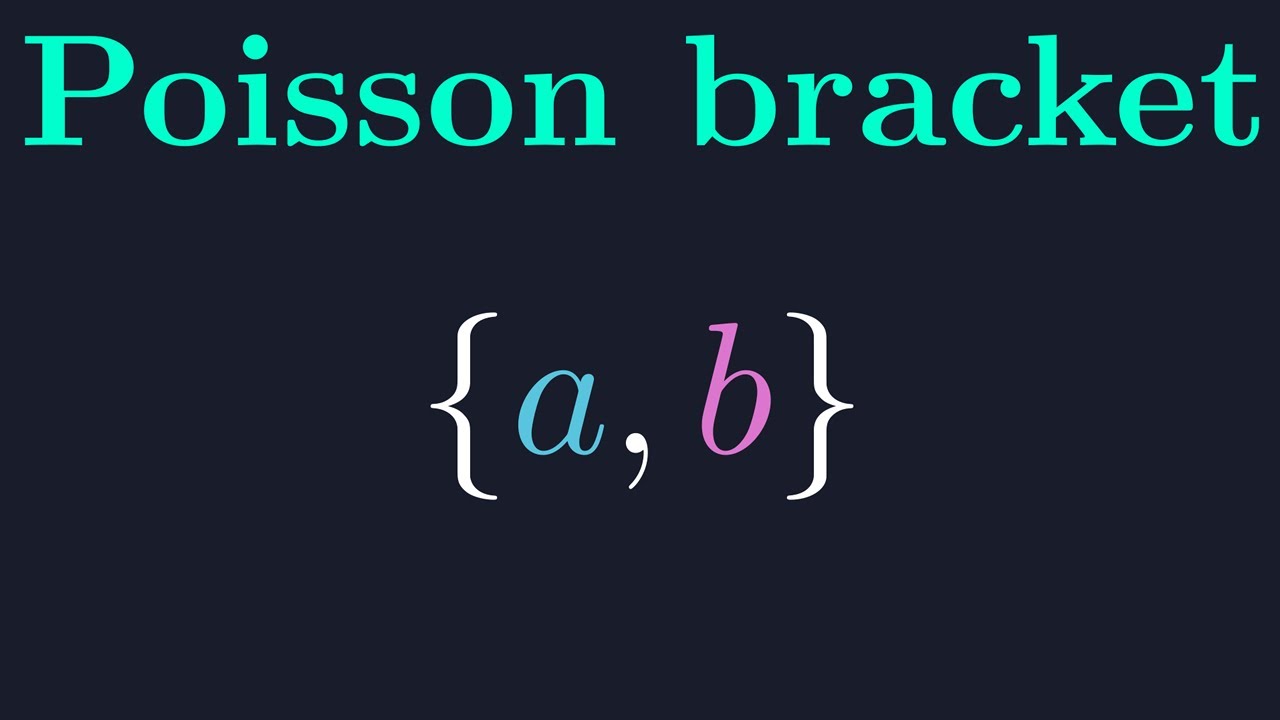





Poisson brackets provide a powerful mathematical framework for formulating classical mechanics, where the time evolution of any dynamical variable is given by its Poisson bracket with the Hamiltonian. For angular momentum, the Poisson brackets between components follow the cyclic relations {L_x, L_y} = L_z, {L_y, L_z} = L_x, and {L_z, L_x} = L_y, which reveal that angular momentum generates rotational transformations in phase space. This formalism elegantly connects conservation laws to symmetries through the equation {G, H} = 0, meaning a quantity G is conserved if and only if it commutes with the Hamiltonian, thereby generating the corresponding symmetry transformation.
Classical Mechanics: Angular Momentum and Poisson Brackets
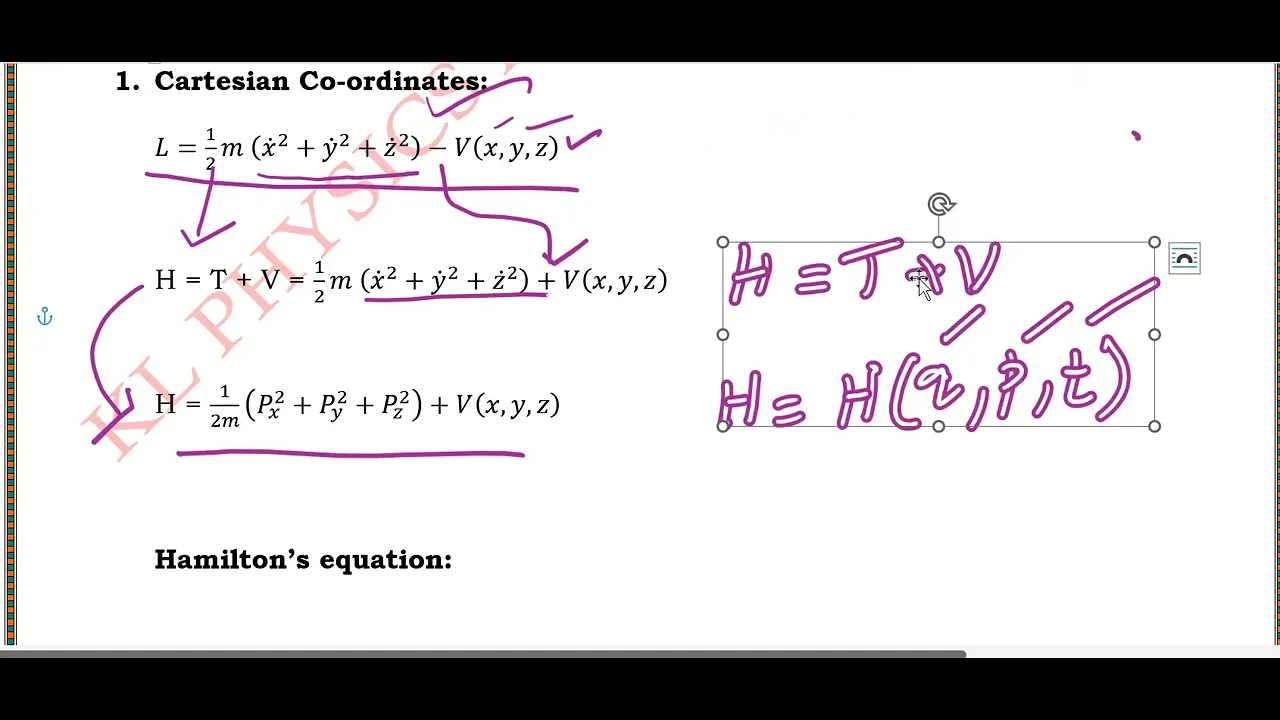
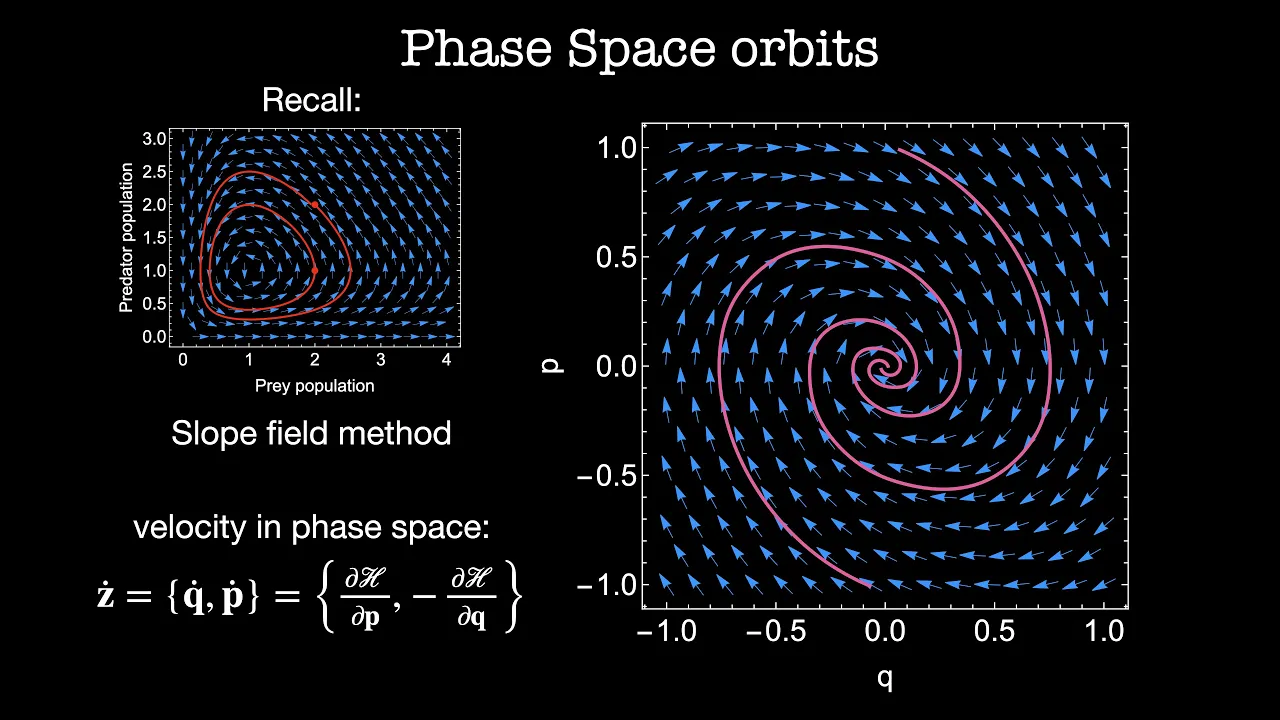
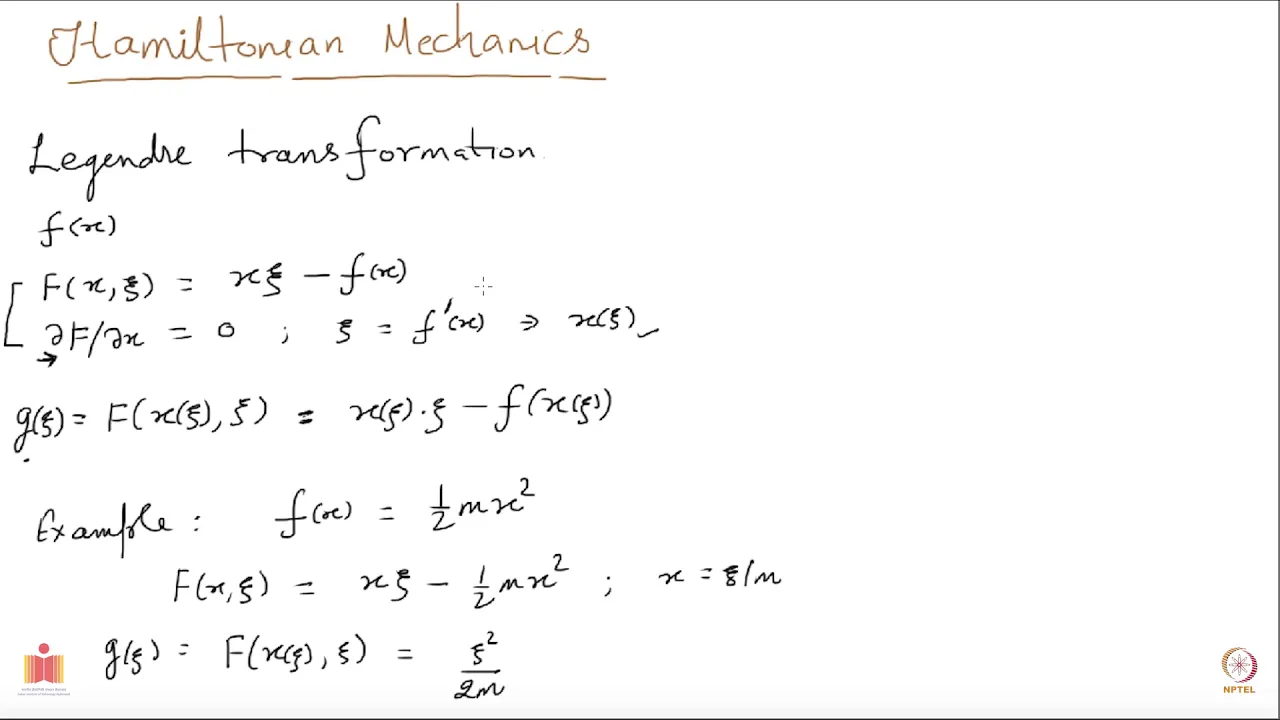
Added:Hamiltonian Mechanics (specifically phase space, conjugate variables, and Hamilton's equations of motion)
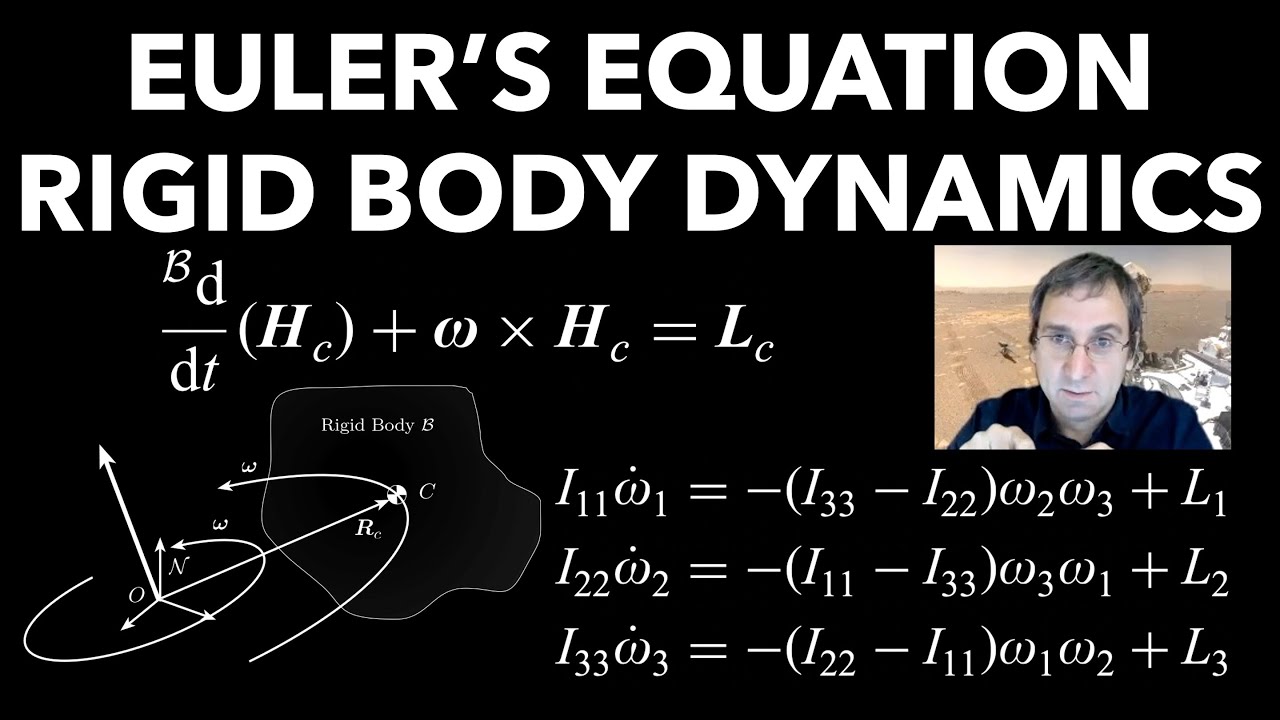
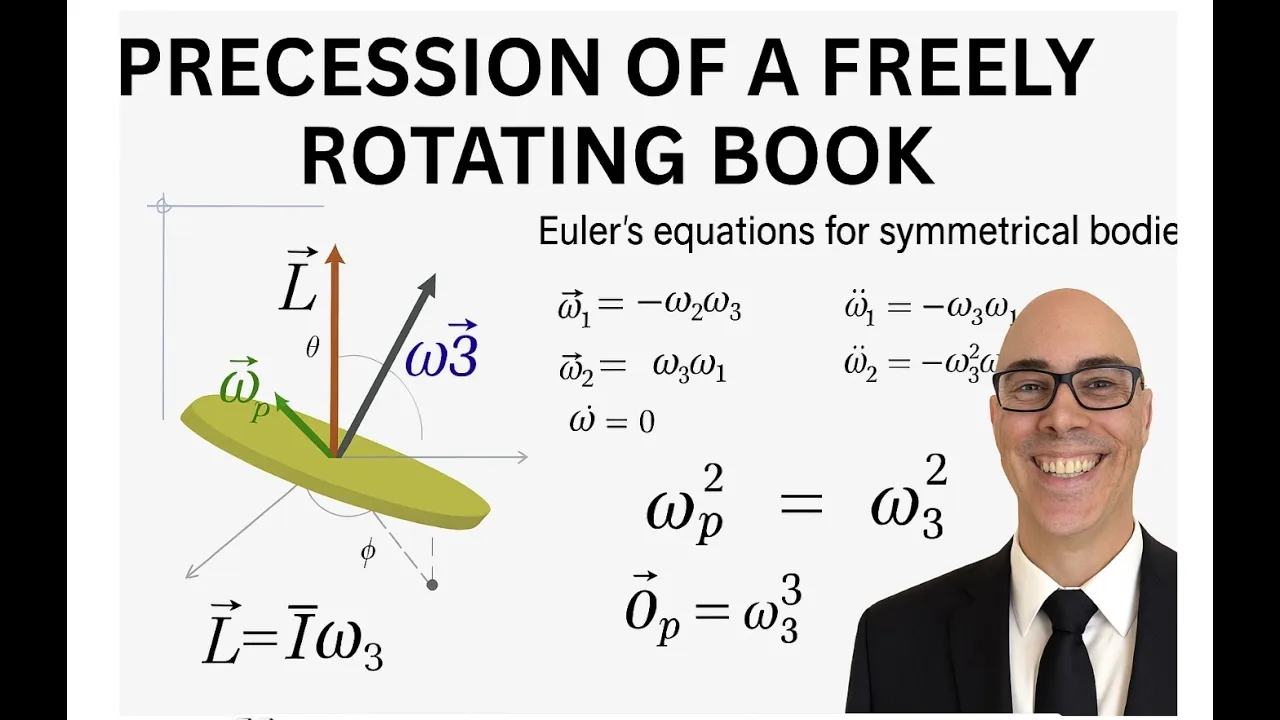
Rigid Body Dynamics (including the inertia tensor, Euler angles, and torque-free precession)
Basic Angular Momentum (Newtonian definitions of angular momentum and its conservation laws)
Multivariable Calculus (partial derivatives, vector fields, and coordinate transformations)
Quantum Mechanics and the Correspondence Principle (how Poisson brackets transition into quantum commutators)
Canonical Transformations and Hamilton-Jacobi Theory
Noether's Theorem and Lie Algebras (connecting rotational symmetry to angular momentum conservation via Poisson brackets)
Symplectic Geometry (the rigorous mathematical framework of Hamiltonian phase space)
Advanced Gyroscopic Applications (attitude dynamics of spacecraft and inertial navigation systems)
139K views1Klikes1:38:07Original Release: 2011-12-16
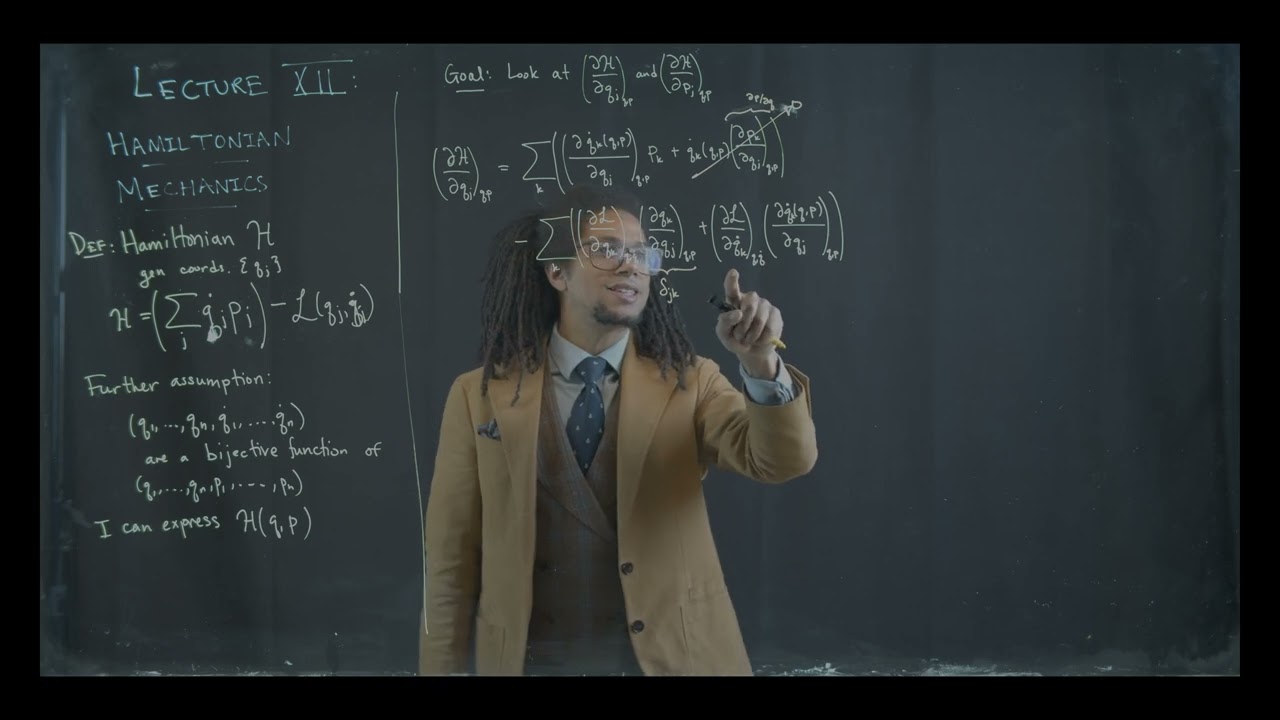
Stanford University we're going to start tonight and maybe finish tonight with more about Pome brackets but uh I think I will go back and we're going to study angular momentum in the context of Pome brackets as a case of mechanics being formulated through the use of Pome brackets okay so Pome brackets and angular momentum tonight but let's uh let's go back I think I told you a little bit about Pome brackets last time and we begin with a question if you have some function of the p's and q's you can think of it as just a function that varies from one point of phase space to another but you can also think of it just as a function of the positions and velocities of a point moving through phase space and because the point is moving through phase space the P's in the q's vary and if the P's in the q's vary the function f of p and Q will vary and we can ask the question along a given streamline we're really thinking about along a given streamline now as the system wanders along that streamline what is the time derivative of an arbitrary function of p and Q now when I say arbitrary I always mean smooth enough and differentiable enough so that any of the operations that we do have meaning what is that and we know what that is I'll just this is quick review from last time it's the derivative of f with respect to P time P dot along the trajectory now if you like you can decorate this thing with little indices I and Su over them I'm going to leave that out just because I get tired of writing it but this expression means derivative of f with respect to P subi * p subi plus derivative of f with respect to Q subi time Q subi dot all summed over all of the coordinates and uh as I said I will not bother uh being explicit about that sum there it is all right now what is p dot P Dot from Hamilton's equations is partial of H minus partial of H with respect ECT to q and Q dot oh minus right no no partial of H yes wait minus right P dot is minus d hdq right I know why I'm confused the reason I'm confused is I always write this one first and I always have the minus sign second so that's all right we'll just leave it DF by DQ time P dot uh DF DF by DQ * Q dot which is DH by DP I'm going to write it the other way because I'm I want to keep a consistent pattern the f F by DQ d h by DP minus d f by DP DH by DQ and as I said well let me put it in now that we finish the expression we put in i i i i and sum overall I all right this kind of expression comes up over and over again in classical mechanics not only in the context of time derivatives not only in the context of time derivatives but in the context of all kinds of situations where you have two functions of p's and q's one could be the hamiltonian but but it might not be it might be anything else and this particular combination comes up all the time and it's called the poome bracket of of f with h and it's written with curly script curly um brackets F in this case h more generally you take any two functions it doesn't as I said doesn't have to be let's let's make it more General now that we've done it now that we've seen the reason why it comes up at least in one context and just generalize it so that g could be anything and F could be anything this is called the Pome bracket and it's written this way and um it seems like a rather arbitrary thing to write down but as I said it does occur over and over and we'll see some uh some examples tonight let me write this one more way let me imagine time has been broken up into little Epsilon intervals and then this of course is nothing but the change in F the variation in F when you change Epsilon by one unit this is nothing but the time derivative the change in F with respect to a small change in time I'm just writing it this way because it'll come up later something like that um yeah that first part of the question is no longer true but you put G arbitrary in there right yeah yeah yeah absolutely right absolutely right once G is arbitrary that's uh it's not F dot this part of the equation is no longer true only if G is the hamiltonian is it true but the other part of the equation is definition definition of the Pome bracket and classical mechanics can be beautifully formulated elegantly formulated French formulated in terms of plusone brackets there's an algebra of Pome brackets which if you know the algebra you don't even really have to remember what they came from you can calculate anything you want uh without in know words a set of rules about Pome brackets and I'm going to tell you what the set of rules we write them over here here's the definition of the Pome bracket let's put them over here and now I'll tell you what the rules are they're not they're not arbitrary rules they follow from this definition they follow from this definition the first fact about Pome brackets is they're anti- symmetric so let's take a and b I'm now going to use a and b for two arbitrary functions the Pome bracket of A and B is equal to minus the Pome bracket of B with a now you can see why that's true uh if I interchange f and g I simply interchange these two terms and so the whole thing changes sign if I replace F by G and G by f it simply changes sign and so whenever I interchange the two things in a Pome bracket it change the sign so that's rule number one rule number two if I add two functions a let's call it B again now and I take the Pome bracket of the sum of them with a third thing it's very simple it's just equal to Pome bracket of a with C plus plus bracket of B with C you can see why that's true if F happens to be the sum of two functions then the derivatives are also sums of two terms and the Pome bracket just adds in that way it's easy enough to get plus bracket of C on the left with a plus b on the right just using the minus sign all right a third rule I didn't write this one down in my notes but I suddenly just realized it if you take the Pome bracket of a with B or C or whatever we use and I multiply a by a number in other words the Pome bracket what's what's a notation for an arbitrary number c constant constant time a all right it's all right it's okay oh I see K the Greek with b or c it's just equal to Lambda time the Pome bracket of a with B that's easy in fact this third one is a special case of one that I'm about to write down uh no that's that's that's a that's that's case all right number four this is the only one that's not completely absolutely transparent I'm not going to work it out for you I'm going to allow you this is your homework work it out but it's very easy it's that if I take not the sum of A and B but the product of a with B poned with C if I take that product and feed it into here and just use the rule for differentiating products in other words a * B here is now substituting for f right I have to differentiate f for example with respect to Q over this there and with respect to p and the second term use the product rule for differentiating a product a * the derivative of B plus b * the derivative of a and you'll find out very quickly that this thing here is equal to a poned with C time B plus a times B Pome bracket with c uh the order that I've written doesn't matter here in quantum mechanics it does matter but in classical mechanics it doesn't matter you can put the B on the left you can put the B on the right it just means ordinary multiplication so when you see an expression like that it consists of two terms one of them is B times the bracket of a with c and then a bracket B with C all right so that's pretty easy the those are the basic rules about Pome brackets and then there are some special cases once you know these special cases and these rules you can pretty much calculate the Pome bracket of any function of p and Q uh with any other you have to use these rules over and over again several times but here are the special cases the Pome bracket of any q q is a function of itself of course so any the Pome bracket of Q subi with any other Q is equal to zero now why is that let's look at it for a minute if f is q1 let's say and uh G is some other Q or Poss possibly the same Q the answer is always going to be zero because every term in here involves differentiating with somebody with respect to P so if there's nobody around who depends on P in fact you could write this more generally any function of Q with any other function of Q gives zero you've got to differentiate the expression with respect with respect to both p and Q and so this is zero it is also equal to the Pome bracket of any P sub I with p subj i can equal J or not equal to J it's still equal to zero okay any p with P or Q with Q is always equal to zero any function of P with a function of p is zero any function of Q with another function of Q is zero the things which are not zero are Pome brackets of functions of p with functions of Q for example and in particular the simplest case is the Pome bracket of Q sub I with P subj if you look up on the top here all right let's see what that would be the f is Q subi the only thing that you can differentiate Q subbi with respect to is Q subi itself in other words you can differentiate Q sub1 with respect to q sub1 and get something namely one or you can but you can try to differentiate Q sub1 with respect to Q sub2 you won't get anything all right so the only contribution comes from differentiating f with respect to Q and G with respect to P the only time you'll get a contribution is if I is equal to J why is that because each term in the sum here mates a cusabi with the same index I the only contributions make the indices together one with one two with two three with three and so forth so the only time you can get something not zero and this is something that you work out is when I is equal to J otherwise it's zero I could write well I'll write it out first zero if I not equal to J 1 if I equal J J or to write it in uh in fancy notation it's equal to the chronica Delta symbol Delta i j okay let's use these rules to calculate let's EAS use these rules without any reference at all to anything but the rules but this set of algebraic rules over here let's use them to calculate the equations of motion for harmonic oscillator right the equations of motion for harmonic oscillator begin let's do it over here with a hamiltonian and now the hamiltonian is a function of p's and q's not q's and Q dots but think of it as a function of p and Q and okay let's suppose the uh the oscillator has a mass m so what's the kinetic energy term in terms of uh M and P it's got a p squ in it what else where's the M go numerator denominator denominator right it's 12 mv^ squared in terms of velocities but momentum squar divided by 2m in uh in terms of momentum p^2 over 2 M plus k/ 2 q^ s let's call it q^ s I don't want to stop mixing notations of P of x's and uh Q's all right this is my hamiltonian now H and I want to work out the equation of motion for the p's and q's using only what's here no reference to L granii and in fact not even a reference to Hamilton's equations although Hamilton's equations went into the rule that the time derivative of something let's write back let's go back to our yeah let's let's go back to the basic rule that given anything of Interest its time derivative is the Pome bracket of that thing with the hamiltonian all right so that's the one thing I would add to the set of rules here that the time derivative of the thing is the PO now we don't care where it came from in fact we don't even need to know this contains certainly contains um Hamilton's equations but let's forget it let's just use this rule okay so here we are H is p^2 over 2 M plus Q Plus uh plus Q ^2 K over2 and I want to calculate the equations of motion in particular let's start with P dot well let's start with Q dot Q dot is Pome bracket of Q with h so I could stick H in here now let's put a let's put p ^ 2 / 2 M plus k/ 2 Q ^2 but Q has zero Pome bracket with any function of Q so I don't need to write that there when I I keep being tempted to say commute with because I tend to think in quantum mechanical language I'll we need a verb for taking the Pome bracket anybody got a good word verb for it pubbing it question pated pated pated good good good pated all right so taking the Pome bracket of f with a hamiltonian we will call posting it Ponting Q with a hamiltonian requires only that we posate Q with p^2 over 2 m because Q pronates with q^2 to posate means to be zero okay well well if two things pass in oh God okay all right does everybody see why I don't have to write Q squ here yeah okay all right now now what do we do we say this is a product well first of all we can take the 1 over 2m on the outside 1 over 2m that's this rule that's one of these rules multiplication by a constant we take that on the outside and then we have q with p^2 now Q with p^ s we use sorry Q with p^ s we use the product rule the product rule and whose product the product is p^ squared incidentally uh you could have written the same way the other way you could have switched this around everybody would have just changed sign and the equation would still be true so if I put C pated with AB then the the orders would change but the equation would still be true okay so what is the Pome bracket of Q with p^2 according to the rule that's P * a Pome bracket of PQ plus P * a Pome bracket of PQ there are two terms p is p * p p^ 2 is p * p and now there's two terms this one time p and this one times this p over here so what's the result the result is twice P times the proone bracket of Q with P but what's the proone bracket with Q with P we just go down to our table over here it's one so our first equation of motion is that Q dot is p/ M okay p over M I think we've seen that before that's just a statement that the moment is M * the velocity okay so that's the first uh that's the first equation and the second equation of motion same thing oops sorry P dot is the Pome bracket of p with the hamiltonian but now I can leave out the p^2 over 2m because prating p with p^2 gives zero pronating p with Q ^2 has a chance of not giving zero so we put here k / 2 Q ^2 let's take the K over2 outside P do equals let's take the K do K over2 on the outside and now we do the same thing it's twice equals twice Q time a Pome bracket of p with Q time k/2 Q * Q we get two terms that's where the two comes from now what's the plus bracket of p with Q it's not one it's minus one minus one because you have to reverse them okay so this is minus one that is where the minus sign in this formalism that's where the minus sign comes from in Hamilton's in one of Hamilton's equations so the twos cancel but the K over here here minus sign because commutate of commutator Pome bracket of p with Q is minus one all right so that's P Dot and that's of course the standard Newtonian equation um Q do is p/ m p do is minus KQ these combined together to give Newton's equations which say that the second derivative of Q * the mass is equal to minus KQ so these two together are Newton's equation for or Hook's equ I don't know whose equation it is but uh the equation of motion for a harmonic oscillator and um it's a simple example okay any questions about Pome brackets yes in terms of mathematical structure it's not a what it's not a grou no it's not a group I think you would call it an algebra does it no no there's no inverses there are product and addition anything else so so what's the connection to commentators H well the main connection is instead of drawing Wiggly things you draw square ones and you put an i on the right hand side let's not do it now well okay poome bracket of two things in classical mechanics is essentially the commutator of the two of them times I time punks constant but we'll get to that that's not for now okay all right now we're going to study angular momentum this is not a separate lecture we're going to study angular momentum the equations of motion for rotating bodies and things of that nature by using plusone brackets we'll do the gyroscope by Pome brackets very efficient and um I seem to have lost one page of my notes but I'll try to do it on the Fly uh motion of a of a rigid body in space Bome brackets are the way to think about it and here obviously it didn't help very much I mean it just it just did what the Hamilton's equations did it's just a sort of redundant way of thinking about Hamilton's equations or Newton's equations but when you start thinking about angular momentum you start to see the power that it has all right now remember what angular momentum was angular momentum was the conserved quantity that's conserved because of rotational invariance if we have a collection of let's just take one particle and not try to think about the lots and lots of particles for right now and let's just go through the little exercise let me write over here on this Blackboard on this part of the Blackboard the quantity Q is conserved if there's a symmetry in particular if the Symmetry is such that it takes the q's Q subi equal to F subi of Q time Epsilon where Epsilon is any small number if this is a symmetry which does not change the lran in the case that we originally studied today we're going to study hamiltonians but this was a symmetry uh if that is a symmetry then there's always a conserved quantity and the conserved quantity is the sum over all the eyes remember what it is P subi times F sub I oops not Delta but F sub I of Q you know it wouldn't be that bad a deal if I just erased the Epsilon here and said it just you just track it through you don't never have to worry about it it really is just P subi * F subi of Q and you could also write this as sum over i p sub I time Delta of Q subi I'm leaving out a factor of Epsilon but the point is that if a thing is conserved so is Epsilon times it so it doesn't really matter whether I put the Epsilon there or not but in any case this is the thing which is conserved if there is a symmetry what was a symmetry a symmetry was an operation that doesn't change the lran an active transformation that doesn't change the lran okay so let's go back to angular momentum in the case of angular momentum the transformation we're talking about is a rotation so there's our particle it's located at Point let's say XY our Q's are now X and Y and we make an infinite decimal Rotation by the small angle Epsilon and the point moves to a new X Plus Delta X and Y plus Delta y so what happens to X Delta X is equal now obviously if Y is positive as it is here and you rotate Delta X will be negative you'll move slightly to the left here obviously so this must be minus and it's minus y * Epsilon and Delta y is equal to plus X time the same Epsilon Epsilon is a small angle uh everybody remembers this and now so now we can write down the conserved quantity in the conserved quantity is called angular momentum and it's labeled with an L in this case Q is being replaced by a thing called L and it's angular momentum okay so what is it it's the sum the sum over I now becomes the sum over the two directions of space of P subx times the change in X which is minus y uh plus P sub y * X let's see do I want to write it that way uh or just X pyus Y PX same thing let me just erase it and write it this way this is L now this is the angular momentum for a particle moving in two Dimensions angular momentum is really a vector what component of angular momentum is this it's the Z component where Z is the axis coming out of the Blackboard the angular momentum about the the z-axis so let's call this L subz now this is the Z component of angular momentum X pyus Y pus y PX what about the X and Y components of angular momentum they would be exactly the same thing instead of rotating about the z- axis you rotate about the Y sorry instead of rotating about the z-axis you rotate about the x-axis and all you have to do to find the components here is to permute Z goes to X goes to Y X goes to Y goes to Z XYZ XYZ X YZ XYZ X goes to y y goes to Z uh I'm never consistent about uh about whether I use a lowercase or an uppercase Z but uh you figure me for that minus z py x y y z y z XY and then L suby is XYZ py pz PX minus yzx p z sorry pz these are the three components of angular momentum and they're all conserved for an isol ated system the oops the conservation corresponds to the symmetry of rotation about the three axes suppose you want to rotate about some arbitrary axis incidentally not the x or the y or the z-axis but the square Ro of 2 * x + > 2 * y know some some cattywampus uh angle you just take the axis that you want to rotate and you dot it as dot product in into the uh you take the unit Vector along the axis you want to rotate by and you take the dot product of L with that direction and that gives you the uh angular momentum which is the angular momentum conserved by virtue of rotational invariance about that axis okay the first thing I want to do with the angular momentum which is an odd thing to do we could solve all kinds of problems we could calc we could study y your motorcycle uh uh flips up in the air when you uh when you accelerate it or whatever but I want to do something different I want to study its plus own brackets oh let's write this in another form just uh we may need it some time in the future I don't know the angular momentum Vector is the r Vector cross product with the p vector same thing these are just the components of the cross product all right but before we do theone brackets of angular momentum with other components of the angular momentum I want to get to that but let's just do the Pome brackets of the angular momentum with the coordinates X Y and Z right so let's take L subz let's take uh the Pome bracket we're just're exploring now think of this in the in the um uh in the spirit of exploration of uh what the hell Pome was talking about so let's take the pon bracket of X with LZ let's begin with that and we'll also do y with LZ and also Z with LZ and see what we get so what is that Pome bracket of X now X is one of the q's x with L subz which is x py minus y PX is there any contribution from anything on the right hand side x with X that doesn't give you a plus own bracket and x with py doesn't give you a plus home bracket only Q's with the same index give you a prome bracket with the corresponding P so X does not have a prome bracket with P sub y and it does not have a prome bracket with X it does have it does it have a Pome bracket with Y no but does it have a Pome bracket with PX the answer is yes so here's where we get the nonzero contribution from and what is it it's minus y times the Pome bracket of X with PX X which is one one uh you're right minus minus from here not from the plus oh bracket so we get minus y anything interesting about that yeah that minus y is the same minus y as here we'll we'll see how related in a moment or we'll we'll recog we'll recognize a set of equations which will be interesting and which will make an interpretation for this so x with L subz is equal to minus y how about y with L subz okay so um all right let's write it out equals y with same thing x py minus y PX again which term contributes when we had X over here it was the last term which contributed now it's this term plus bracket of Y with P sub y is one plus bracket of Y with p subx is zero so it's only this here and that's just equal to X that's x * a Pome bracket of Y with py but that's one so it's just X let's write that X oh I left out an equation here if I want to think about this in three dimensions what about Delta Z when I rotate about the z-axis what happens to Z nothing it just stays the same if you rotate about the z- axis Z doesn't change so this is zero oops equals all right let's calculate finally z z with L subz okay same I I I erased I kept erasing it I shouldn't keep erasing it but nevertheless Z with LZ um LZ has nothing that involves a z in it or a Z it has X Y PX py but nothing that has a Pome bracket with Z itself so the answer is zero it is not an accident that the that you get the same Expressions here everything gets multiplied by uh by Epsilon but but apart from the factor of Epsilon what we found is that taking the Pome bracket of with respect to LX gives you the small change in a variable when you rotate a little bit let's try it for the P's what happens what are the changes in PX py and pz when you rotate axes let's write them out here the change in PX what happens to the to PX when you rotate the axes a little bit exactly the same structure p is a vector p is a vector and the components this is just a way of talking about the way uh the components of a vector change when you rotate axes it doesn't matter whether it's the position Vector the velocity Vector the force Vector they all do the same thing and so the change in PX is minus py and the change in py is equal to PX and the change in pz is zero when you uh when you rotate coordinates whatever the momentum is when you rotate it it changes the same exact way that uh that any other Vector does so let's work that out let's calculate the prome bracket of PX with LZ where does it get a contribution from the only thing in LZ that PX has a Pome bracket with is uh is X is X itself so it's plus own bracket of p with LZ for LZ it's only this term which contributes and what do you get you get py minus py H sorry minus py minus yeah minus py yeah let let's go through it this is plusone bracket of PX with X py okay the py we can take out put it over here and the Pome bracket of PX with X is What minus one minus one because I've got these in the wrong order well in the wrong order but in uh so yes minus py same structure as this one except the vector now is p minus py if I did the same with py LZ I would in fact get plus PX and how about the last one z uh pz with LZ the only thing that has a Pome bracket with Z is pz and pz doesn't appear in LZ so that's equal to zero what we found here is a special case of something very general it really is almost a definition but uh in the hamiltonian language is a definition but we've already used you already SE the Pome bracket of something with an angular momentum is just the change the small change in that something when you make a rotation that's much more General now remember let's go back to the hamiltonian where is it Hamilton's equations all right we've erased Hamilton here it is here's the Hamilton's equations taking the Pome bracket of something with h gives you the small change in that something when you change time a little bit remember what the hamiltonian was it was the conserved quantity that was conserved by virtue of time translation and variance in other words shifting time a little bit we're finding exactly the same kind of equation here that taking a Pome bracket of something with the angular momentum gives you the change in the something thing when you do a small rotation taking the Pome bracket with the hamiltonian gives you something proportional to the change in that something when you shift the time a little bit let's do another case let's this um okay let's do another case you see the pattern what Pome brackets do is they generate by means of posting with them uh with the with a a VAR iable they give you the small change under certain symmetry operations let's try it out in a more for another context let's see where do I want to go I I always run out of blackboards all right we'll we'll use the top Blackboard um I don't let's do translations instead of rotations they're simpler what was a quantity that's conserved by virtue of translation in variance momentum right so it sounds like maybe we ought to try commuting things commuting personating them with momentum and see what we get do we get the small change in quantities when when you shift so what is the shift we're talking about in this case uh let's work with p and Q rather than p and x a small translation or a translation is just Q Delta Q is just equal to Epsilon no function in in front of it you just shift q a little bit in the direction uh whatever Direction you're talking about whatever direction we're only one variable for Simplicity Delta Q is Epsilon in other words f is equal to 1 if f is equal to 1 what's the conserved quantity it's p * Delta Q or P * F and that's just P so the conserved quantity uh conserved by virtue of translation invariance for a single particle is just the momentum let's take the momentum let's um let's let's take the Pome bracket of of any function of Q any function of Q with P well before I do that I will ask you what's the small change in F of Q if you shift q a little bit what's the small change in F of Q if you shift Q it's the derivative of f with respect to Q right the derivative of f with respect to Q if I make a small change in Q then the change in F is Epsilon times DF by DQ so now I have a question when you take the Pome bracket of f of Q with p do you get DF by DQ That's the suggestion that's that that's hanging in the air now if Ponting with respect to an L gives you the small change when you rotate and posting when you with respect to H gives you the small change when you shift time a little bit does posting with respect to P give you the small change in a general thing let's be more General now and take an arbitrary function of Q and ask how it changes or what what you get when you take a Pome bracket with respect to P how do we do this how are we going to do this um I haven't told you any rule for taking an arbitrary function of q but let's take a specific function of Q let's take Q to the N let's take for f of q q to a power in an integer power in and let's try this first the question the question is is is this or is this not the derivative of f with respect to Q question mark means doesn't mean equals it means is it all right Q to the N with P what some bracket of that well Q to the N is Q * Q * Q * q n * dot dot dot n times how do we calculate this we use the product rule we use the product rule it's going to be a Q on the outside times it's a Q on the outside times plus bracket of Q to the nus1 * P can you see what the pattern is how do you prove this thing how do you prove this thing you prove it by induction by mathematical induction let us suppose that uh that this is do I have that right I think I have it right yeah we'll do it for no I just want to check what I'm doing Q with Q to the N minus1 that's Q to the nus1 time P okay so oh oh I know what I'm doing yeah plus plus Q to the N minus1 plus own bracket of Q with P I have to write the full product rule the product rule involves two terms okay so what is this let us assume when we prove something by induction we assume it for n minus one and we see if we get it for uh for n so what's the what's this plus bracket by assumption by assumption it is n-1 * Q to the nus 2 by assumption that's the induction uh that's the induction hypothesis that it's n minus1 q to the N minus 2 but then I multiply by another q and so that gives me n -1 * Q nus1 did I get that right True Q just from this term just from this term the hypothesis is that this plus bracket is the derivative of Q to nus1 with respect to q and that is n -1 * Q to the nus 2 and then we multiply it by another q and that gives us n-1 the Q to the nus1 but how about this one over here what's Q with P that's one okay so we just add one more Q to the N minus one this just adds one more Q to the N minus one and we get n * Q to the nus1 this is the derivative of Q to the N with with respect to Q okay what do you have to do to complete the induction uh theorem the induction uh proof you have to check it for n equals 1 if it's true for n equals 1 and it follows for n from n minus one then you've proved it so is it true for n is it true for uh uh for nals 1 all right for that case the derivative of Q with respect to Q is just one so it's also so it's true for n equals 1 all right so we've just we've we've discovered that for functions of the form Q to the N that the Pome bracket of f with p is equal to DF by DQ now what about for sums of two things Q to the nend and you know a power series a series of terms with different powers and different coefficients well for that we use the rules of Pome brackets which allow you to add things and multiply them by constants and so forth and other the basic rules of Pome brackets will allow you to take sums of different powers of Q times coefficients and in that way you can get basically any function you can approximate any function with a arbitrary polom and so it also follows for an arbitrary function just by adding them together that's a basic theorem about uh Pome brackets but what does it say it says that when you posate something with a momentum it gives you the small change in that something when you translate Q so in fact we have at least three examples of um conservation laws being connected to Pome brackets well conservation laws sorry not conservation symmetries symmetries the Symmetry operation the Symmetry operation is defined or is constructed symmetry operation by taking the Pome bracket with the quantity which is expected to be conserved by virtue of the Sy is that a mouthful for every for every symmetry we have a conservation law we take that thing which is conserved and we take its Pome brackets with things and that gives us the small change or in other words it tells us what the transformation is if I didn't know what the transformation was associated with the angular momentum if I didn't know what the transformation was the Symmetry that was associated with angular momentum all I have to do is take the Pome bracket with angular momentum of all the things in the theory and that will tell me what the small changes are okay that's the idea that um that's the connection well so far we haven't talked about conservation we've talked about symmetries and how they generate the language is that L subz is the generator of rotations about the z-axis it generates rotations about the z-axis or infinite tal ones by plus by Pome bracketing same thing for all things in the theory uh the generator of translations is momentum the generator of time translations is the hamiltonian and to compute how something changes under a small shift of whatever is you're doing you take the plusone bracket okay now let's let's uh before we study more about angular momentum all right we uh we're going to come back to angular momentum in a minute but just one observation what is the connection between um symmetries and conservation laws I've talked about connection between symmetries and Pome brackets but now what's the connection with conservation laws can we see that through the method of Pome brackets can I ask question um so what I'm taking away from this is that when you got your conser I mean maybe this is what you just said when you have your conserved quantity yes and you've got your various so far we haven't discussed conservation laws in this paror you've got some conserved quantity right then from this computation you you can determine what the motion is that provides for that conservation is that no you can provide you can say motion not Motion in the sense of real motion no no no no you're finding what symmetry operation corresponds to that that conservation law for example by using L subz you you find out that L subz is conserved as a cons as a consequence of invariance under rotation that doesn't tell you that things move in a rotational spiral they move in straight lines for all you know or some other way but but what you're saying is is if you if you take as a given your L's and you don't even know how you how you have that that you got those up up above or sort of infinite equations of motion no no they're not equations of motion they are symmetry Transformations the connection with equations of motion is if you use the hamiltonian here okay if you use the hamiltonian its equations of motion otherwise it's just telling you some operation it's telling you there is some if LZ is conserved you should have in your back of your mind okay there must be some operation which is a symmetry let's find out what that operation is here's what the Symmetry is and you conclude that uh that's rotation symmetry that's not the same as saying you know what the hamiltonian is which is the thing which tells you how things move okay but now we come to the hamiltonian let's give a name to these various generators LZ for rotation P for translation H for time translation let's call them generators and call them G all of them g g for generators they're functions of p's and q's everything in Phase space is a function of p and Q right G generates some symmetry okay let's start with G being conserved what does it say that g is conserved well it says that the time derivative is zero and the time derivative of it is the plusone bracket of G with h the plus bracket with anything with h is the time derivative of it so if G is conserved it says the plus bracket of G with h is equal to zero that's one way to read this equation it says that g is conserved right but let's turn the equation around let's turn it around and have it write that h plus own bracket with G is equal to Z same equation except for minus sign but uh zero doesn't care about a minus sign and what does this equation say this equation says that when you do the small transformation associated with g h doesn't change the top equation said that g didn't change as the system evolves the bottom equation says that that H doesn't change when you do a transformation in other words if G was L subz it says that H doesn't change when you rotate the system if G was translation that would mean just P here the conservation of momentum would also say that H doesn't change when you translate the system system what does it mean to say that H doesn't change when you rotate a system or you translate a system it says as a symmetry it says that the hamiltonian the structure of the hamiltonian or the value of the hamiltonian at every point in Phase space doesn't change if your rotated coordinates that's saying there's a symmetry so on the one hand read this way the same equation says that g is conserved that same equation says that H doesn't change under an operation which is generated by G for example if G was the angular momentum it would say that H doesn't change when you rotate the coordinate frame in hamiltonian or in Pome bracket language this is the expression as I said I'm just emphasize it once more is the is the um connection between conservation laws this and symmetries this so it's quite a beautiful uh packaging um of that connection yes does this mean that if you have if you know what's conserved you can always figure out what the Symmetry was they gave that's what it means algorith that's what it means just by taking yes if you know something's conserved G and you want to figure out what the transformation is just pone bracket everything in sight with G and it will tell you how it transforms that's exactly what it says any other questions so you see this it's it was not just a little game of defining something so that Mr Pon could avoid writing down a complicated expression the thing has real power you've given us some examples of this is there a general way to write that statement you just said yeah yeah that's that's saying if they're conserve I'm just saying No this says that the G is conserved this says that that the hamiltonian doesn't change when you do when you do a g transformation right one says the the fact that the hamiltonian doesn't change says there's a symmetry the fact that g doesn't change with time says there's a conservation law this is the thing which is conserved but it's also the thing which generates symmetry yeah I'm looking over there where where there's um where you're you're basically taking a Plus on brag with the with the various pieces and then you're getting the same thing you get above and I'm looking for and in that example and I'm looking for the general statement of that and that that statement of that thing doesn't seem to say anything about conservation no it doesn't and that's what I'm asking is there a general without bringing in conservation yeah yeah is there a general way to state that yeah but at this level it's really a bit of a definition okay it's a bit of a definition the definition is given a quantity here is a transformation rule this transformation rule here and it doesn't doesn't say it's a symmetry it just says that with every quantity that you can write down every CU that whatever is it Q or whatever it was called or every G sorry called it we're calling a g for every G that we write down we can define an infinite decimal transformation that's all this says that's all it says right if that g is conserved it says this but if we write that around the other way it says that H doesn't change when we do a g transformation so it relates conservation to symmetry same equation okay of course we could have done the same thing with l y and LX and discovered uh rotations about the other axes now it's kind of interesting to ask what happens when you take pone brackets of components of the angular momentum with other components of the angular momentum well I don't know if you find it interesting but I think you will find it interesting by the time we finish doing it and using it we will see real power in solving problems by uh and power what does it mean it means we find a nice way to do a problem where we don't have to go back to uh drag ourselves back through the definition of angular momentum through the fact that the angular momentum is um is made up out of lots of little particles but we just use some basic uh basic structures like this okay so let's let's ask now what is the Pome bracket of one component of the angular momentum with another let's just fill out a set of ideas concentrate on angular momentum we don't need this anymore and in particular let's start with Pome bracket of LX with LZ I can guess what the answer is going to be well I won't guess I we'll write them out we'll write out the whole bloody thing and compute it and then I'll tell you what the what my guess would have been after we comput it all right so LX is ypz minus zpy and LZ I believe is X pyus Y PX is that right okay now the question is what can give us a nonzero answer let's begin well let's take them one at a time what here's how about this with this pz and X nothing but y with py what is that one so what you're going to wind up getting if you just uh use the rules is y with py is one and the rest of the expression is pz * X so we'll first of all get pz * X that's coming from combining the Y with the py here how about this one here the uh well first let's go through them all together y pz with Y PX does that give anything uh y you get nothing with y y you get nothing with PX and pz nothing with Y and PX nothing nothing there zpy with xpy nothing but the last term gives you plus here we have py with Y py with Y so that gives us Z * PX and is it plus Z * PX or minus Z * PX the last it's minus because when you take the Pome bracket of py with Y you get one more minus sign there's two minus signs here and then one more because py with Y is minus one so all together you get this and what is that let's see that's um LX with LZ is it plus or minus uh l y Yus l y all right so this is minus l y now what would I have guessed I would have guessed minus l y but for entirely different reasons L is a vector whenever you Pate anything any component of a vector X Y or Z with L subz you get minus the Y component when you take the X component of any vector and pronate it with L subz you get minus the corresponding component same rule LX with LZ gives you minus l y okay I'm going to let's see um o y with L yeah we can find all the other ones by cycling X to Y to Z okay so we have you know what I'm going to do first though I'm going to change the order I want to get rid of the minus sign the reason I want to get rid of the minus sign is because I happen to remember it one way LZ with LX let's change the sign LZ with LX and what do that do that just takes a minus sign away all right the next one Z goes to x x goes to y Y and Y goes to Z and L ZX y XY z y z x all right I usually remember this in the form I remember the first one LX l y is equal to LZ XY Z and then I cycle them through okay these are the basic Pome brackets between components of the angular momentum for those who know a little bit of about quantum mechanics you'll recognize these equations as the classical Pome bracket analog of the commutation relations of angular momentum but that's as I said we're not doing quantum mechanics but I'll just remind you uh not quite there would be an i and an H bar uh for for commutators but we'll come back to it what good is this what do you what do you use it for for can you use it for anything so I'll show you how to think about the gyroscope using this we'll work out the gyroscope using it and we'll see how the gyroscope processes and then I will work out for you the rigid body equations of motion for a torque-free rigid body moving in space uh and not I'm not going to study them in any detail I just want to show you the power of uh plus home brackets all right so we have a gyroscope and this a gyroscope now means a center where something is anchored to an axle and a wheel and the thing about the gyroscope is the wheel is rotating so fast the flywheel the flywheel is roting rotating so fast that the only angular momentum that you have to worry about is the angular momentum about the axle now the flywheel may move a little bit in which case there would be other components of angular momentum but we'll assume that they're much much smaller than the angular momentum about the axle about the direction of the axle so the angular momentum then is along the radial Direction here's the center of the wheel of the of the flywheel and the angular momentum by assumption is along that axis what is the hamiltonian of it well it does have some energy by virtue of the rotation around that axis and it's a large energy it's a large energy but I am going uh all right let's take it into account we'll take it into account what is it proportional to it's proportional to the square of the angular momentum about that axis in fact it's proportional to the square of the total angular momentum since we don't have to worry about any angular momentum except the contribution around there uh remember this thing is going to rotate or do whatever it does I don't know to rotate this way it's going to rotate somehow or move somehow but the magnitude of the angular momentum doesn't change much so we'll assume that the magnitude of the angular momentum doesn't change uh it just changes Direction what is the energy well first of all there is a contribution which is just the square of the angular the square of the angular momentum let's write that down lx2 + L y^2 + LZ 2 just in other words the total spin angular momentum of the uh of the wheel sums of the squares of the components of angular momentum and it has some coefficient in front of it what what would you put for the coefficient I would put the moment of inertia divided by two number I over 2 everybody know what a moment of inertia is if oh no no no I have it wrong don't I what do I have wrong yeah it's one over I moment of inertia of the wheel and if you don't know what a moment of inertia is it's just a number it's of course made up out of the mass and the and the distribution of masses and so forth for but it's just a number for everybody not for everybody in the room for everybody it's a uh it's a number so that's the energy just by virtue of the fact that it's rotating let's take that alone I'm going to add another contribution the other contribution is going to be the potential energy because when to assume the whole thing is in a gravitational field but we'll take that into account in a moment but let's uh Let's ignore it to begin with no gravity it's just in free space that means no torque on the uh nothing pulling it down no torque it's just spinning about that axis I will tell you right now the angular momentum is conserved if there's no torque on this gyroscope it just will continue to point in the same direction but let's prove it let's see what happens let's calculate the time derivative of any component I'll take the X component of angular momentum and let's show that it's zero all right here's all we have to do we take the Pome bracket of LX with 1 over 2 I lx^ 2 plus L y^ 2 plus lz2 what's the prome bracket of LX with lx2 that I tell you among these rules is the rule that says the Pome bracket of anything with itself is zero that's obvious of course that's true yeah anything with itself is zero because it's anti- symmetric okay all right what about the plusone bracket of LX with LX s that's zero because uh it's going to have you know always you're going to be looking for an LX with LX and that's zero so first condition you can throw this one away now what about LX with l y 2 what does that give LX with L y^ 2 you use the product rule is l y * l y so it's twice ly * aome bracket of LX with ly twice ly that gets rid of a two down here all right and then l y ly times the Pome bracket of LX with ly that's equal to LZ all right LX with ly gives an LZ but there's an extra power of LX on the out l y on the outside so it's l y * LZ what about LX can you read that I'm going to rewrite it 1 / i l now I forgotten what it was uh L Y LZ right but now we have to do LX with LZ s for that we're going to have an LZ again and we're going to have the Pome bracket of LX with LZ which is what I hope it's minus l y I'm going to assume it's minus l y and these cancel zero so the time derivative of LX is zero a broader lesson is that L commutes commutes has Z Plus bracket with the sums of the squares of the angular momentum lx2 + L Y2 + lc^ 2 uh gives nothing when you plus on bracket with with with uh with one of the components of angular momentum so and of course the same exact thing would be true for l y and LZ all of the components of angular momentum are conserved good we we knew that to begin with all the components of angular momentum are conserved but what happens now if we impose a torque on this we impose a torque by pulling down down with some force on here uh then there's some potential energy and the potential energy let's forget torque let's just think about a mg let's think of the flywheel the center of the flywheel uh is at this point over here the flywheel has has mass m and it has a gravitational potential energy mg times the height the mass of a thing times acceleration due to gravity times the height that's the potential energy due to gravity and what is the height the height of this is going to be proportional to the to the Z component of the angular momentum why is it proportional to the Z component of the angular momentum it's proportional to the Z component of the angular momentum because the angular the momentum Vector is along the same axis as the radial Vector as you change the direction here the angular momentum also changes and the height of this thing changes exactly the same way as the Z component of the angular momentum changes when it's down at the bottom the Z component of angular momentum is maximum and negative as it comes up the Z component of the angular momentum goes to Z zero when it's horizontal and changes sign when it's above so the potential energy is proportional to minus the Z component of the angular momentum minus because the force is downward all right so I don't there's some coefficient some number the potential energy let's just call it V is going to be proportional to minus some constant made up out of the mass and um uh the little G and whatever else we have to worry about some constant times LZ again when LZ is big and positive that means it's up it's pointing upward then the potential energy is large when LZ is down then uh the potential energy is negative and it changes the same way as the height changes all right so we know we now know something else we now know that there's another contribution in the energy which is proportional to some constant now it's not the moment of inertia it's just some constant minus C time LZ excuse me LZ is the I mean z is the axis of rotation sorry yeah no Z is not the axis of rotation the axis of rotation is the radial Direction here so Z points out of the board is that right no down sorry the torque if I understand right the torque here is don't worry about torque let's just calculate the potential energy no but I mean that's why we have potential energy yeah but the torque the force is down and the torque is into the board force is down the torque is into the board but I never heard of torque shouldn't you put a rest for it like a a base for it if you're that like it's point which is resting on a surface is this a attached to this point oh it's attached to that point it's attached to that point but but doesn't that imply that the other end of it is not moving or or not no no no no it's oh I'm sorry it's it's a gyroscope it's free to it's free to do whatever it wants only this length here is fixed right there's a vector here and that Vector is the position Vector of the center of the uh of the thing yeah other words there's no real axle there it's empty space axle you lab that axle l l Vector let's let's label it all right you want to label it l Vector good fine yeah the axle is along the L axis all right let's so let let's go back a step in fact I'm not going to call this Vector L I'm going to call this the r Vector the position Vector of the center of the wheel so this is R that's the r Vector the assumption is that the angular momentum is along the r Vector so what is the angular momentum the angular momentum the vector angular momentum is some number which is just the spin uh the angular momentum of a it's just some number whatever it is we could call it l and that's a number times the unit Vector along this direction or just R just to forget unit Vector R some number I don't know what to call it let's call it l okay some number times I all this says is that the angular momentum is constrained to be along this radial Direction along this along the direction of the position of this point here as it moves the wheel moves with it and the angular momentum stays aligned with the axle that's what this says okay now given this and this is just a number whatever whatever number of units of angular momentum the thing has then it follows that L subz is just the same number times Z times the coordinate position of this point XYZ the coordinate position of the center of the wheel little l a constant yeah little L is assumed to be a constant do time yeah and that that will be true that will be true if the angular momentum is very large yeah we're postulating that despite introducing the force of gravity L will still largely be alone that's right we're postulating that we could prove that we could prove that with a little more effort but um but we'll just assume that that the spin angular moment or the spin around that direction doesn't change much and it doesn't as long as it's large as long as it's much larger than any other angular momentum in the problem in other words if you really spin that thing up that angular momentum about that axis won't change much okay so let's assume that then all of the components of angular momentum are proportional to all of the components of the position Vector here but what is the position Vector um not what is a position Vector but the potential energy is proportional to Z the Gen the potential energy is mg time z z is the height this is the z-axis here okay vertical axis I've taken to be Z all right so the potential energy is proportional to the height of this thing and therefore it's proportional to LZ that's all just proportional to LZ with some constant some constant I've called the constant c y minus because the for is down uh 0 Z is is where where R the end point of R right do I have wait it's plus maybe it's plus C hold on did I get that wrong um that's plus L sub Z yeah when you raise it it gets positive energy yeah yeah yeah that's plus L of the higher it is the more uh the more potential energy so the origin of the coordinate system where you're talking about X Y and Z is right here right there okay so that's the origin of the Z is the distance from uh Z that's right Z is just I I don't think I explained this well but uh yes Z is this height yeah I'm sorry I I did a poor job of that and it's proportional to LZ because L and R are proportional to each other all right so now we can calculate the equation we can calculate what the components of L do uh let's uh let's start with LZ LZ dot that's just a plusone bracket of LZ with LZ that's zero so the first thing we find out is that the vertical component of angular momentum doesn't change that means that this angle here doesn't change it stays at the same angle if it's spinning really fast that will be true that angle the angle relative to the vert will be unchanged but let's see what else happens how about l subx dot that's that's equal to the plus bracket of LX with C LZ and what is that uh that's C * minus C * l y did I get that right minus C * l y okay so this is uh I'm getting tired I thought to fade about this time minus CL ly and how about ly dot all right so ly dot we would put ly here and the Pome bracket of l y with LZ this is a c here I'm sorry I'm I'm I'm really getting tired now uh my - c * l y and this one will be plus C * LX all right so let's bring it over here LZ dot = Z LX dot is equal to C * l y- c * l y and ly dot is equal to plus c time LX what is this thing doing LZ is staying fixed the X component the small time change in the X component is proportional to the Y component and the small time change in the Y component is proportional to the LX what is that doing it's rotating in the XY plane so if I look down on the XY plane and I look at the component of the angular momentum along the XY plane it's processing around here with an angular velocity that's Z that's C oh that's C that's what's going on uh yes and I think it's processing in in this case in a uh counterclockwise I may have lost track of a sign somewhere I think I got it right but it's processing about the z-axis and doing that sort of thing so that's the gyroscope uh as a uh thought about from Pome brackets I think I'm a at the end of my line for tonight I was going to work out the oiler equations for a rotating body but the the message here y just just to clarify I thought in order to have a procession you had to have like gravity with par on it where where it rests like where where is the uh this this is the gravitational potential okay okay this is the gravitational potential energy right that is the gravitational energy and that's the torque that's the source of the torque on the uh right right but once you know this you know exactly the same thing would be true for any angular momentum whatever it came from it doesn't whatever whatever the source of the angular momentum it might be a a zillion electrons spins all lined up it'll do exactly the same thing if a torque is uh so this is uh quite general and this is equilibrium well it's not it wouldn't be called officially equilibrium but you could call it a steady state motion yeah or a stationary motion yes that's right if you give it a kick down it'll oscillate around here but that oscillation and it's it's not much of an oscillation if it's really spinning fast that oscillation will go together with the small changes in the spin angular momentum around here yeah am I right in saying that depending on whether this thing was rotating clockwise or counterclockwise would being a minus C or C yeah you're right you're right and my intention here was not to teach about gyroscopes but to show you how plusone brackets of uh can be used very quickly and efficiently to um uh to work out equations of motion for things and here we're not even working out the equation of motion for angles or Oiler angles or positions or anything else we jump directly to the angular momentum components and uh so yeah what is confusing to me and and maybe on I don't know confus is whether or not you have physical things associated you mentioned the axle or no axle and yeah there could be an axle there yeah but what I'm saying is it's also true if there is no axle there well if there's no Axle just fall down on the ground well a wheel rolling what about rolling will maintain it w't fall over in other words it's a physical thing and it has to be supported somewhere whether it's supported on the the assumption is that the distance between here and here is fixed in other words um yeah that the distance I assume the distance between here and here was fixed somewhere in that derivation we assume the the distance between here and here is fixed for example if it weren't fixed supposing the wheel could move this way then it would not be true that the component of the angular momentum would be proportional to the Z height it's only because it's fixed and this is a fixed length that as it rotates the angular momentum Ro rotates rigidly with the uh with the position Vector yeah did you split the hamiltonian or did you neglect the the energy to the angular to the angular rotation because it was soar well right so we should right so we should add this to c * LZ right or minus I don't we should add that but we've already shown that the Pome bracket of the components of the angular momentum with respect to the sums of the squares is zero so that doesn't contribute anything right that's a good point uh that implicitly I did have in my mind to add these two right but when you take the paron bracket of the components of the angular momentum with the sums of the squares you don't get anything it all comes from here and we see the the procession this is exactly the same procession as the procession of an electron spin or electron Magnetic Moment In a magnetic field the magnetic field has plays the same role as a gravitational field that tries to pull the spin down that way and instead the spin processes or the it could be it doesn't have to be a electron spin it could be a nuclear spin in which case you get a procession that's sort of the basis for anmr for nuclear magnetic resonance but uh planet around the Sun what's that a planet around the sun a planet around the Sun well well that's a different thing that is a different thing that's a different thing uh it's also called procession I think that's the only real connection between them but uh uh this is procession of angular momentum due to a torque could be a magnetic field pulling down on the spin it could be the gravitational field pulling down on the on the flywheel the net result is procession about the AIS yeah so this is exactly the same as a top except you would have drawn your vector maybe going up and St mhm yeah oh yes yes yes yes right right you call it a gyroscope if it's sticking out to the side of it's almost vertically upward you call it a top right exactly so right yeah so like an electron in a a nuclear particle there's not like a point that's fixed it's just the whole it's around the center of the atom is fixed around the center of mass of the electron I'm sorry I yeah there's okay we don't want to we don't want to give away the punch line from quantum mechanics here okay uh if there are no other questions we're finished for tonight for more please visit us at stanford.edu
Up Next
22:09
Canonical Transformations Explained | Classical Mechanics
@AdvancedPhysics
12.8K views•2021-10-14

12:53
21cm Hyperfine Transition in Neutral Hydrogen: Radio Astronomy Basics
@AaronRobertParsons
12.4K views•2011-10-13
106:33
Quantum Mechanics Introduction: States, Vectors & Lecture 1
@stanford
910.9K views•2012-02-17

27:14
Entropy and the Second Law of Thermodynamics Explained
@veritasium
27.5M views•2023-07-01
Related Study Plans & Knowledge Roadmaps
Structured learning paths in Physics
physics
Nuclear Physics (Decay, Fission & Reactors)
01Atomic Structure and the Binding Force
02Radioactive Decay and Half-Life
03Nuclear Fission Mechanics and Chain Reactions
+ 2 more learning modules
12h5 modules
Explore Roadmap
physics
Soft Matter (Polymers, Colloids & Rheology)
01Foundations of Soft Matter & Thermal Forces
02Polymer Physics and Macromolecules
03Colloids, Surfactants, and Self-Assembly
+ 2 more learning modules
38h5 modules
Explore Roadmap
physics
Analytical Mechanics: Lagrangian & Hamiltonian
01Mathematical Foundations: Calculus of Variations
02From Newtonian Mechanics to Constraint Dynamics
03The Principle of Least Action & Lagrangian Mechanics
+ 3 more learning modules
28h6 modules
Explore Roadmap
physics
General Relativity (Spacetime & Cosmology)
01Foundations of Relativity: Special Relativity
02The Geometry of Spacetime: Equivalence Principle & Curvature
03Einstein's Field Equations: The Mathematics of Gravity
+ 2 more learning modules
55h5 modules
Explore Roadmap