
![2 - Mecánica Teórica [Euler-Lagrange 1]](https://i.ytimg.com/vi_webp/_6vYEdTQxCs/maxresdefault.webp)





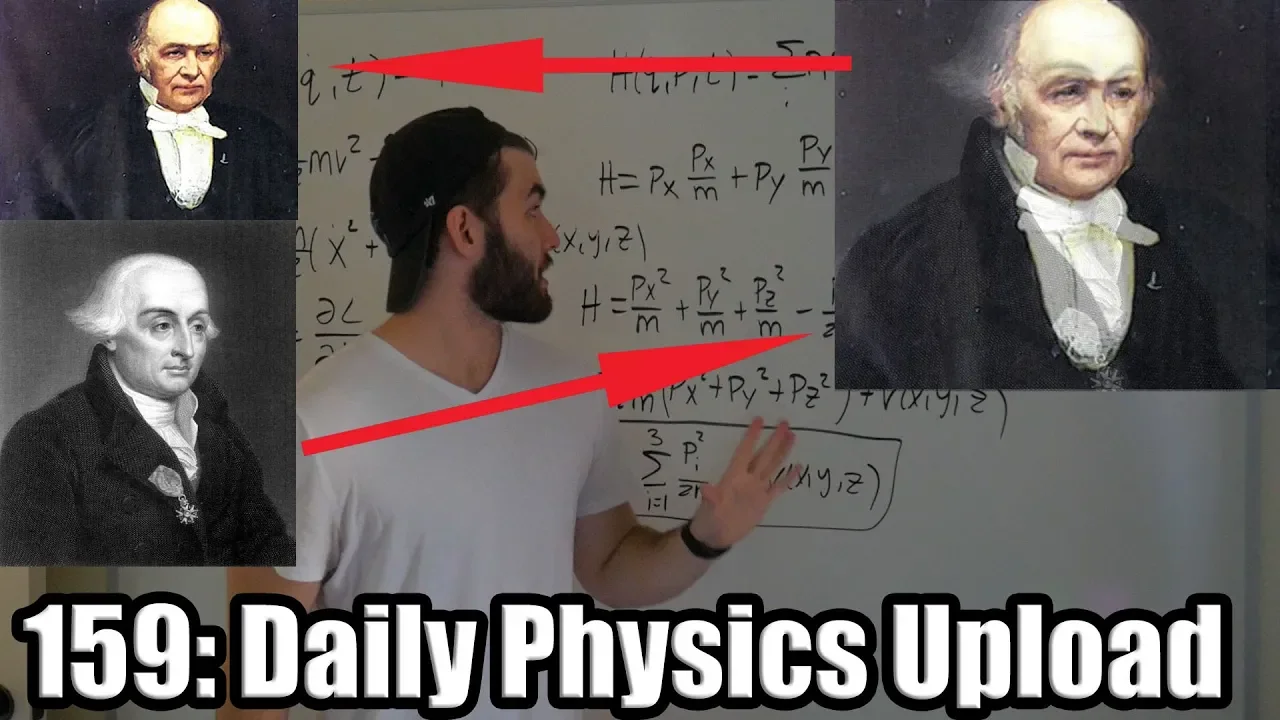










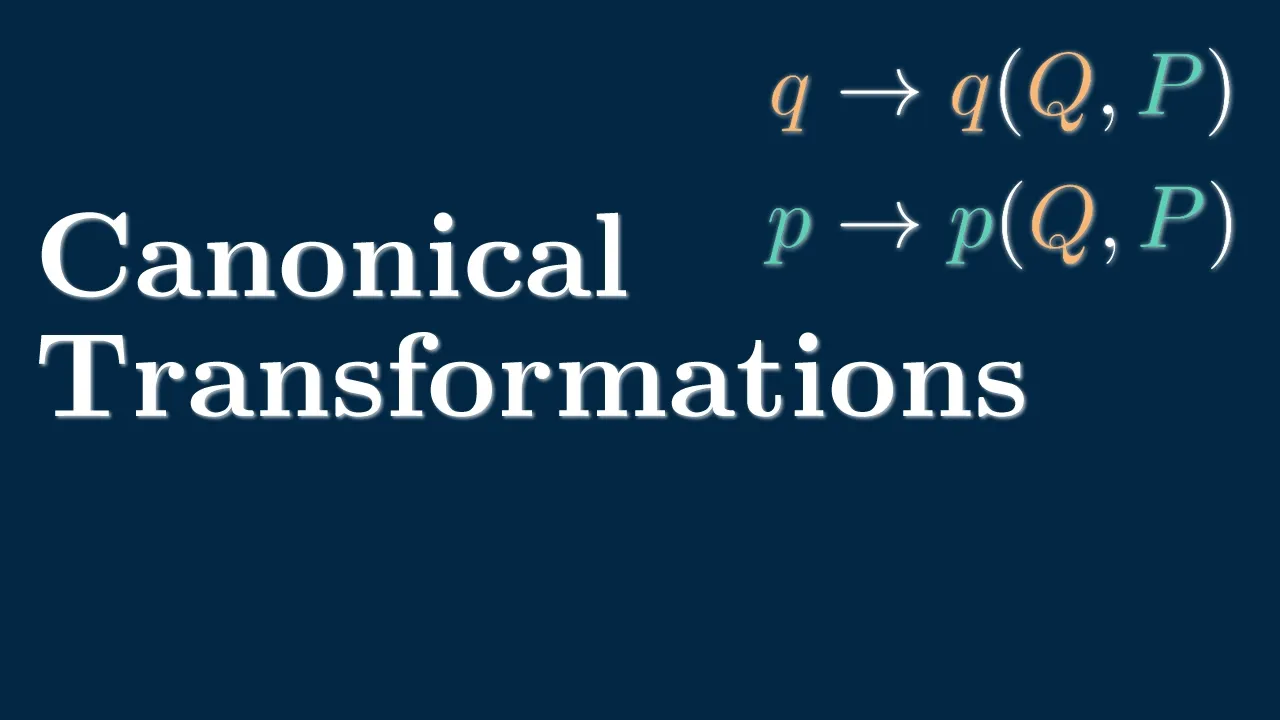










A canonical transformation is a transformation of phase space (both position and momentum coordinates) that preserves the form of Hamilton's canonical equations of motion, ensuring that the mathematical structure of the system remains invariant even when changing from one coordinate system to another; unlike point transformations which only transform position coordinates, canonical transformations require that the new coordinates satisfy the same Hamiltonian equations as the original coordinates, making them essential tools for simplifying complex dynamical problems by choosing more convenient coordinate systems.
Canonical Transformations Explained | Classical Mechanics
Added:Lagrangian mechanics, including generalized coordinates, generalized velocities, and conjugate momentum.
The Legendre transformation and how it transitions mechanics from the Lagrangian to the Hamiltonian formulation.
Hamilton's equations of motion and how they describe the time evolution of a physical system.
The concept of phase space as a 2N-dimensional mathematical space representing all possible states of a system.
Generating functions (types F1 through F4) and how they are used to mathematically construct canonical transformations.
Poisson Brackets, their algebraic properties, and their fundamental invariance under canonical transformations.
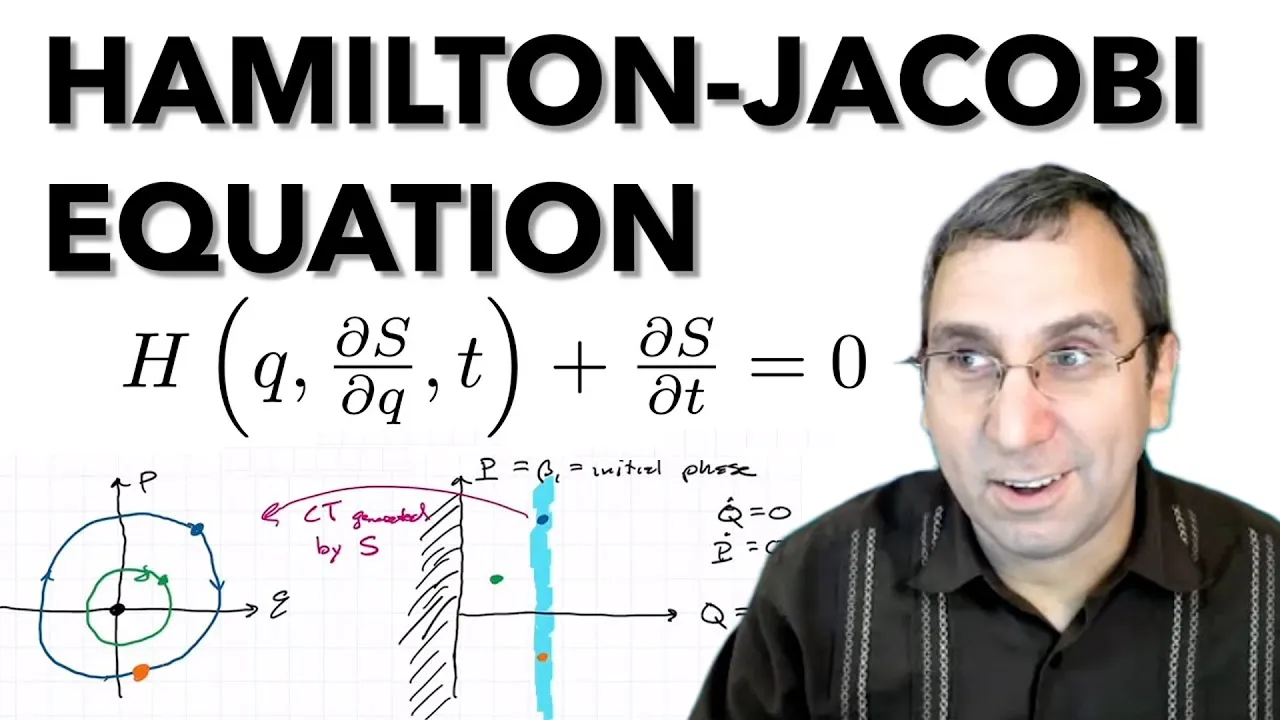
The Hamilton-Jacobi equation, which utilizes canonical transformations to solve complex dynamical systems by finding a trivial Hamiltonian.
Action-Angle variables and their application to periodic/integrable systems and classical perturbation theory.
12.8K views167likes22:09Original Release: 2021-10-14
in classical mechanics today we are going to start a new chapter which is very important actually in this chapter we are going to discuss canonical transformations and regarding this canonical transformations in this first lecture i will just give you an overview of canonical transformations and after this introductory lecture we will see the detailed theory of this canonical transformations in fact you know that dynamical problems can be solved in more than one coordinate system in fact any coordinate system there are a minimum number of independent variables or coordinates to describe this system as you know so in a particular problem it is possible that one of the coordinate system is more convenient than other and that's why we transform a coordinate system from one coordinate system to another for example if you consider motion of a particle in a central force field then you know since motion under a central force field is motion in a plane so in this condition people may either use cartesian coordinate system or the plane polar coordinate system but the use of the plane polar coordinate system while discussing the motion under central force field is actually more convenient what's the reason the reason is that if you will discuss the problem of central force field in cartesian coordinate system then there will be two independent variables that is x and y but if you will use the plane polar coordinate system then actually there will be only one independent variable only r not theta because in this case theta is a cyclic coordinate ah and sorry coordinates will be r and theta but theta is cyclic so it does not appear explicitly in the expression of hamiltonian so it becomes easier to discuss the motion of a particle in central force field when we discuss its motion in the plane polar coordinates so this is followed while discussing the motion of the particle in central force field and this is the region that we transform the coordinate transform the coordinates from one coordinate system to another in fact broadly speaking we can say there are two types of transformations in classical mechanics you talk about whenever you talk about that transformation then we simply say that in broad sense you can say that there are two types of transformations the first one is known as point transformation actually when you say point transformation this is simply a transformation of configuration space and transformation of configuration space means what this is only a transformation of position coordinates not the momentum coordinates so if there will be a transformation of coordinate position coordinate from one coordinate system to another then that is called a point transformation so if you consider that this q k are the position coordinates of the old coordinate system and this capital q k are the poison coordinates in the new coordinate system then transformation between qk and a small qk and capital qk means what if you know the values of this small qk that is the position coordinate in the old coordinate system then it is possible to find the values of this capital q k by using the transformation equation and that converse is also true that if you know the values of this capital q k then it is possible to find the value of this this small qk so in general uh symbolically we represent these transformations like this q k capital q k is equal to capital q k of small q k t where t is actually time and in the same way this q k may be expressed as a function of this capital q k and t so in sort you can say that in point transformation there will be a transformation of only position coordinates from the old coordinate system to new or from the new coordinate system to old but our primary aim in this chapter is to deal with the another transformation which is known as canonical transformation this is actually the core uh concept of this chapter so first of all as i have told you earlier that in this lecture we will see only a very short account a very brief introduction of this canonical transformation when you say canonical transformation which is also known as contact transformation that means actually the transformation of a phase space as you have seen point transformation means transformation of configuration space but canonical transformation means transformation of phase space but you know in phase space the state of a particle or a system is a specified or stated in terms of two coordinates the position coordinates q k and the momentum coordinates p k you know because in phase space this momentum coordinate is placed on the same footing as the the momentum coordinates are placed on the same footing as the position coordinates so in page space this p k are treated as independent coordinate just like q k so if there will be a transformation of position coordinate q k and the momentum coordinate p k but in such a way that the form of hamilton's canonical equations of motion does not change it remains invariant or you can say that the form of these equations remain preserved then such a transformation is known as canonical transformation or contact transformation it means when you will change the small q k and small p k into the new coordinate system that transformation will should be in such a way that the form of hamilton's canonical equation of motion in the new coordinate system must be in the same form as it was in the whole system so let us consider mathematically these things here we consider that the let qk and pk what are these as you know these are actually the position and momentum coordinates in the old coordinate system position and momentum coordinates momentum coordinates in old coordinate system and this capital qk and capital pk let us consider these are position and momentum coordinates in the new coordinate system new coordinate system let us consider then in fact these two sets of coordinates that is the position coordinate and the momentum coordinates are related by the transformation equation like this you can express this transformation in this way that this qk is equal to qk of q1 q2 so on qn and p1 p2 so on pn t and similarly this pk may be written as pk of q1 q2 so on qn p1 comma p 2 comma so on comma p n comma t and say this is your equation 1.
in fact in brief you can write these equations in one by using the proper subscript you can write it so in brief equations in 1 are written as how you can write it this q k h equal to q k comma p k comma t and pk equal to pk of a small qk is small pk and t say this is your equation 2 in fact here k is equal to 1 2 3 so on up to n actually the transformations defined in this equation 1 or this equation 2 both are same these transformations will be called actually the canonical transformation but only when the form of the hamilton's canonical equations of motion in this new coordinate system will remain invariant it means the form will remain same as that it was in the old coordinate system only then you can say that this transformation defined in equation 1 or 2 is actually the canonical transformation so you can say that transformation the transfer mason defined in one and 2 is canonical if if qk dot qk dot equal to del h prime by del p k del p k and p k dot equal to minus del h prime by del q k can you say uh what are these equations actually here i have assumed that this h prime is the hamiltonian in the new coordinate system so h prime equal to hamiltonian in the new coordinate system new coordinate system so let's see what does a canonical transformation means now you can easily understand it just i have written a transform mission equation in equation 1 or in equation 2 both are same actually we have assumed that small q k and small p k are the position and momentum coordinate in the whole coordinate system and capital q k and capital p k are the position and momentum coordinates in new coordinate system then you can express this position coordinate capital q k as a function of the position coordinate momentum coordinate and time of the old coordinate system time remains same and similarly the momentum coordinate of the new coordinate system can be expressed as a function of the position and momentum coordinate of the old coordinate system and this transformation defined in equation 2 or in 1 will be called a canonical transformation but only when the form of the hamilton's equation of motion does not change in this new coordinate system as you know hamilton's canonical equation you have already studied this is qk dot equal to del h by del pk and pk dot equal to minus del h prime sorry del h by del q k so if you consider that h prime is actually the hamiltonian in the new coordinate system then if these two equations will hold that is capital q k dot is equal to del h prime by del p k and capital p k dot equal to minus del h prime by del q k if these equations hold it means the form of the hamilton's canonical equation of motion do not change if these equations hold it means a form of the hamilton's equations do not change then you can say that the transformation defined in equation 1 or 2 is canonical transformation only then you can say it now as a the hamiltonian is different in the new coordinate system from the old coordinate system so you can also say that the lagrangian of the system will be also different from the old lagrangian so in this condition if l prime equal to new lagrangian new lagrangian then you can say that this l prime is equal to help as you know that lagrangian is a function of position coordinate generalized velocity and time so in this new coordinate system the position coordinates are denoted by this capital q k generalized velocity will be capital q k dot and time is t now uh the hamiltonian of our system in the old and new coordinate system you can define because you already know the definition of the hamiltonian so you can say if h be the hamiltonian in the nuke in the not new in the old coordinate system old coordinate system then you know that this h is defined like this h equal to summation over k p k q k dot minus l you know it and so in the light of this equation if the transformation is canonical then the new hamiltonian in the new coordinate system that is h prime will be defined like this this is summation over k capital p k capital q k dot minus l prime you can see we have assumed that this l prime is the new lagrangian so in fact here this capital q k and capital p k are therefore referred as canonical coordinates you can say that this capital qk and capital pk are what these are referred as canonical coordinates canonical coordinates in fact the hamiltonian in the hamiltonian formulation as we have already seen in the previous lectures that the independent variables similar to generalized coordinates are actually the momentum it means momentum is placed on the same footing as the generalized coordinates are placed but the canonical transformation include the simultaneous transformation of independent poisson coordinate and the momentum and the momentum you can say it means this a small q k and a small p k are actually changed to the capital q k and capital p k in the canonical transformation but this transformation will be called canonical only when you have seen the form of the hamilton's canonical equation of motion does not change then you say that such a transformation is canonical transformation actually this is just a brief idea of canonical transformation in fact in the next lecture we will see what what is actually the condition for canonical transformation or how this transformation can be carried actually for carrying this transformation we need an idea of generating function of this transformation so the subject matter of the forthcoming lecture will be the generating function for the canonical transformation
Up Next

35:08
Solving Hamilton-Jacobi Equation via Separation of Variables
@victorlazo9
1.5K views•2025-07-31

12:53
21cm Hyperfine Transition in Neutral Hydrogen: Radio Astronomy Basics
@AaronRobertParsons
12.4K views•2011-10-13

32:32
NMR Spin Physics I: Zeeman Effect, Resonance Condition & Larmor Frequency
@nptel-indianinstituteofsci8064
2.3K views•2024-01-17

27:14
Entropy and the Second Law of Thermodynamics Explained
@veritasium
27.5M views•2023-07-01
Related Study Plans & Knowledge Roadmaps
Structured learning paths in Physics
physics
Nuclear Physics (Decay, Fission & Reactors)
01Atomic Structure and the Binding Force
02Radioactive Decay and Half-Life
03Nuclear Fission Mechanics and Chain Reactions
+ 2 more learning modules
12h5 modules
Explore Roadmap
physics
Soft Matter (Polymers, Colloids & Rheology)
01Foundations of Soft Matter & Thermal Forces
02Polymer Physics and Macromolecules
03Colloids, Surfactants, and Self-Assembly
+ 2 more learning modules
38h5 modules
Explore Roadmap
physics
Analytical Mechanics: Lagrangian & Hamiltonian
01Mathematical Foundations: Calculus of Variations
02From Newtonian Mechanics to Constraint Dynamics
03The Principle of Least Action & Lagrangian Mechanics
+ 3 more learning modules
28h6 modules
Explore Roadmap
physics
General Relativity (Spacetime & Cosmology)
01Foundations of Relativity: Special Relativity
02The Geometry of Spacetime: Equivalence Principle & Curvature
03Einstein's Field Equations: The Mathematics of Gravity
+ 2 more learning modules
55h5 modules
Explore Roadmap