













![ДИВНА МАТЕМАТИКА ЕЙНШТЕЙНА 🤯 [VERITASIUM]](https://i.ytimg.com/vi_webp/QZQptiZOQfs/maxresdefault.webp)



![The Other Side of a Black Hole [4K]](https://i.ytimg.com/vi/ZVPsNDonA84/maxresdefault.jpg)


![48 - TEORÍA CUÁNTICA de CAMPOS [ Yang - Mills: Transporte Paralelo ]](https://i.ytimg.com/vi_webp/TarascUBCLc/maxresdefault.webp)

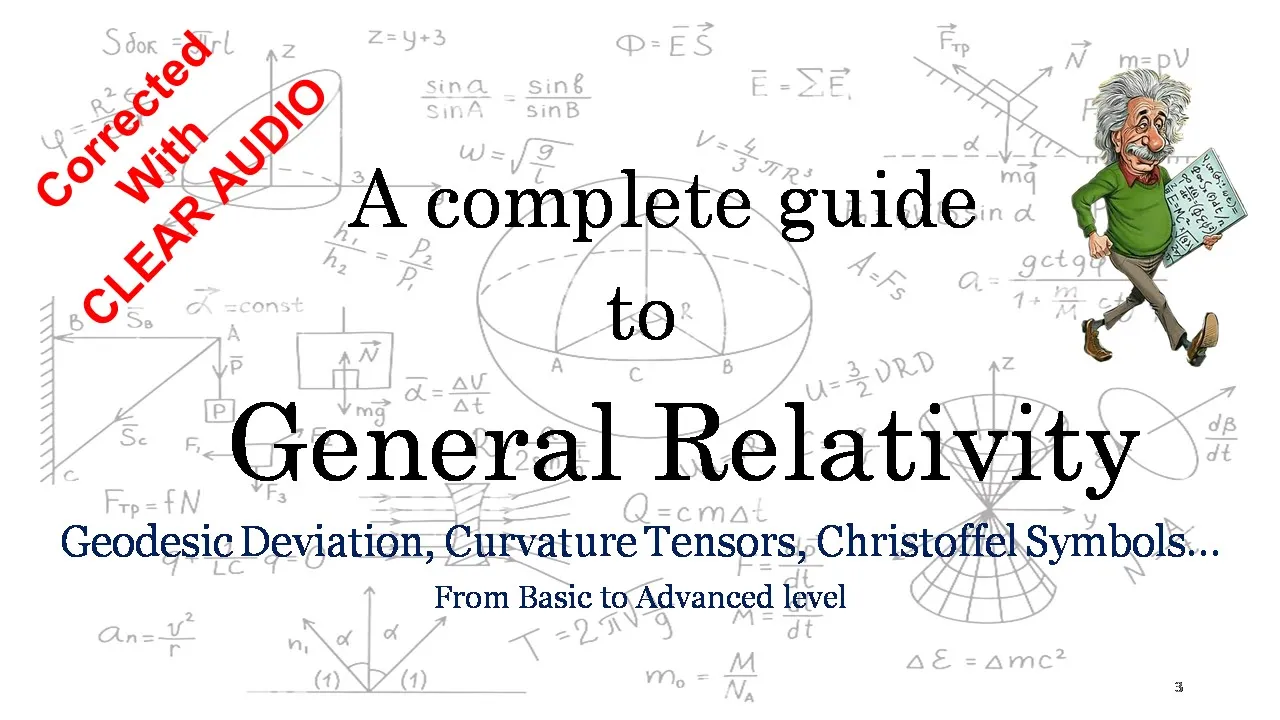
In general relativity, objects naturally move along geodesics—paths where the velocity vector doesn't change, meaning its derivative with respect to proper time is zero. However, because coordinate grids can be irregular, the basis vectors themselves change along the trajectory, requiring the introduction of Christoffel symbols (gamma) to encode how the grid varies. Using these symbols, the geodesic equation describes how each component of velocity changes over proper time, allowing prediction of an object's entire trajectory given its initial velocity and the Christoffel symbols throughout spacetime.
General Relativity Explained: Geodesics & Christoffel Symbols
Added:Special Relativity and Spacetime: Familiarity with 4-vectors, spacetime intervals, and the flat Minkowski metric.
Tensor Calculus and Einstein Notation: Understanding index notation, coordinate transformations, and the distinction between covariant and contravariant tensors.
The Metric Tensor: Knowing how the metric tensor defines distance, angles, and geometry in curved manifolds.
Multivariable Calculus and Variational Principles: Comfort with partial derivatives and the Euler-Lagrange equations for path minimization.
The Riemann Curvature Tensor: Learning how derivatives of Christoffel symbols are used to construct Riemann, Ricci, and Weyl curvature tensors.
Einstein Field Equations: Understanding how spacetime curvature relates to energy and momentum density.
The Schwarzschild Metric and Black Holes: Applying the geodesic equation to calculate planetary orbits, gravitational lensing, and light bending around a spherical mass.
Parallel Transport and Covariant Derivatives: Generalizing the concept of directional derivatives of vectors and tensors to curved manifolds.
256.1K views7.4Klikes7:26Original Release: 2020-12-08
[Music] welcome back to science clique today the mathematics of general relativity part 3 geodesics in the previous videos we have defined the concepts of world lines motion as proper time goes by and velocity which indicates the direction in which an object moves through space and time we would now like to describe the evolution of this velocity as proper time passes in order to predict the shape of the trajectory in our universe objects naturally move in straight lines when no force is applied world lines tend to be straight through the dimensions of space and time this comes from the symmetry of such trajectory an object has no reason to turn one way or the other this simple consideration gives us a method to predict the trajectory of a body as soon as we know its velocity at a given instant we can just transport the arrow along itself to gradually predict the movement of the object this type of trajectory which is formed by transporting velocity along itself is called a geodesic [Music] in the universe all objects tend to follow geodesics on a geodesic the vector does not turn we can thus write that its derivative with respect to proper time is zero along the trajectory the velocity vector of the apple does not vary this equation simply says that the natural movement of bodies is non-accelerating and therefore that when they experience no force objects tend to move straight ahead but we saw previously that the velocity vector can be written as the sum of its components multiplied by the basis vectors [Music] using this expression and knowing that the derivative of a product is the sum of each term multiplied by the derivative of the other term we obtain a relation between on one side the change in the components of the velocity and on the other side the change in the basis vectors themselves the basis vectors can indeed vary throughout the trajectory because the grid that we choose as our coordinate system can very well be irregular although the vector remains the same as a geometric object its components on the grid can vary as the apple moves when we think about it the evolution of a basis vector along the world line can be decomposed as the sum of its evolution along each of the two coordinates multiplied by the speed of the apple because the faster the apple moves the faster the basis vector will vary [Music] for each coordinate this gives us a new quantity which indicates how the basis vector varies along the coordinate this variation is expressed as a vector that is the derivative of the basis vector with respect to the coordinate in question this vector is very interesting because it no longer depends on the trajectory but only on the structure of the grid itself this vector can be expressed through its components denoted by the capital letter gamma in our two-dimensional case these components exist in eight different versions two components for four different vectors these numbers are called christopher symbols the christopher symbols are essential quantities for general relativity because they encode how the grid changes along each direction they contain crucial information on how our coordinates behave [Music] rewriting the previous equation using christopher symbols we finally get to the geodesic equation this very important equation allows us to calculate for each component of the velocity its rate of change as proper time passes the geodesic equation thus allows us to predict the whole trajectory of an object as long as we know its velocity at a given moment and the value of each christopher symbol all throughout the grid to illustrate all these ideas let's imagine not a space-time but simply the surface of the earth we decide to use a latitude longitude coordinate system which at first glance seems to be a very good fit for the geometry now imagine that an airplane is moving in a straight line when an object moves straight ahead without ever turning its trajectory forms what is called a geodesic in our situation the geodesic is a great circle around the planet on this geodesic trajectory the airplane is always moving straight ahead its velocity vector does not change orientation but when we plot the coordinates the trajectory seems curved the airplane seems to change orientation along the grid in reality its trajectory is perfectly straight the problem does not come from the airplane but from our grid it's our coordinates that are curved their axes do not correspond to straight lines on a sphere compared to real straight lines geodesics they turn starting from a basis vector and transporting it along the grid we can measure how much this vector changes by another vector it's the components of this vector that are called christophel symbols the christopher symbols measure the extent to which our coordinates deviate from straight lines along the grid [Music] you
Up Next
9:31
LIGO Detects Gravitational Waves: A New Era for Astronomy
@pbsspacetime
876.7K views•2016-02-11

12:53
21cm Hyperfine Transition in Neutral Hydrogen: Radio Astronomy Basics
@AaronRobertParsons
12.4K views•2011-10-13
14:16
Metric Tensor in General Relativity Explained | Geodesics & Spacetime
@ScienceClicEN
231.3K views•2020-12-15

27:14
Entropy and the Second Law of Thermodynamics Explained
@veritasium
27.5M views•2023-07-01
Related Study Plans & Knowledge Roadmaps
Structured learning paths in Physics
physics
Nuclear Physics (Decay, Fission & Reactors)
01Atomic Structure and the Binding Force
02Radioactive Decay and Half-Life
03Nuclear Fission Mechanics and Chain Reactions
+ 2 more learning modules
12h5 modules
Explore Roadmap
physics
Soft Matter (Polymers, Colloids & Rheology)
01Foundations of Soft Matter & Thermal Forces
02Polymer Physics and Macromolecules
03Colloids, Surfactants, and Self-Assembly
+ 2 more learning modules
38h5 modules
Explore Roadmap
physics
Analytical Mechanics: Lagrangian & Hamiltonian
01Mathematical Foundations: Calculus of Variations
02From Newtonian Mechanics to Constraint Dynamics
03The Principle of Least Action & Lagrangian Mechanics
+ 3 more learning modules
28h6 modules
Explore Roadmap
physics
General Relativity (Spacetime & Cosmology)
01Foundations of Relativity: Special Relativity
02The Geometry of Spacetime: Equivalence Principle & Curvature
03Einstein's Field Equations: The Mathematics of Gravity
+ 2 more learning modules
55h5 modules
Explore Roadmap