

























String theory proposes that fundamental particles are not dimensionless points but tiny vibrating strings whose different vibrational modes correspond to different particle types, naturally predicting both matter particles (fermions) and force carriers (bosons) including gravitons; however, the theory requires 10 dimensions (with 6 compactified into tiny curled-up spaces) and incorporates supersymmetry to resolve mathematical inconsistencies, making it one of the most promising approaches to unifying quantum mechanics with general relativity despite remaining experimentally unverified.
String Theory Explained: Quantum Gravity & Extra Dimensions
Added:Einstein's General Theory of Relativity, specifically how gravity is modeled as the geometric curvature of spacetime.
The core principles of Quantum Mechanics, including quantum states, wave-particle duality, and the probabilistic nature of subatomic particles.
The Standard Model of Particle Physics, which classifies elementary particles and describes three of the four fundamental forces of nature.
The mathematical and conceptual incompatibility between General Relativity and Quantum Field Theory at Planck scales (the problem of quantum gravity).
M-Theory and Superstring Dualities, studying how five distinct 10-dimensional string theories unify into a single 11-dimensional framework.
The Holographic Principle and AdS/CFT Correspondence, which proposes a mathematical equivalence between a gravity-filled volume and its boundary.
String Cosmology, examining the implications of extra dimensions on the early universe, cosmic inflation, and the concept of the landscape/multiverse.
The search for experimental evidence, including supersymmetry (SUSY) particles and testing string theory predictions through high-energy particle colliders or astrophysical observations.
4.8M views161Klikes16:01Original Release: 2021-07-02
[Music] welcome back to science clique today string theory our universe contains mata which when we look closer is made up of particles there are different types of particles electrons quarks or neutrinos particles move in the universe and can interact by exchanging other particles the electromagnetic force for example is mediated by the exchange of photons all these different particles are accounted for in what we call the standard model it is currently our most precise mathematical description of the quantum world it contains two main categories of particles fermions which mostly constitute matter and bosons which mostly describe interactions at first glance one might think that this is the ultimate theory that the standard model describes everything but unfortunately there is another interaction that this model doesn't account for gravity on a large scale we know that gravity is described by general relativity objects curve space-time thus attracting other objects as with other types of interactions we expect that the curvature of space-time is made up of small particles at the quantum scale quanta of space-time curvature called gravitons [Music] but when we try to include the graviton in the standard model the calculations give absurd results with infinite values that cannot be removed we cannot describe gravity on the quantum scale it is to solve this problem that physicists have been looking for new theories for more than half a century in this video we are going to build together one of the most promising approaches string theory [Music] the basic idea is quite simple in the standard model particles are described as small dimensionless points we admit that these points do not all have the same properties to account for the fact that there are different types of particles in string theory we will assume that this is only an approximation and that if we zoom in on the particles they are all made up of a small string sometimes open and sometimes closed these little strings have tension like tiny rubber bands and they can vibrate a guitar string can vibrate in different modes harmonics likewise our little strings can vibrate in different ways one ripple two ripples three ripples and so on and the different vibrating modes behave on our scale like particles of different types when we perform the calculations we discover in particular that some strings behave like photons [Music] and better still some like gravitons starting from the sole principle that particles are tiny strings with tension we already explain why there are different types of particles [Music] and we naturally predict the existence of the graviton thus describing gravity at the quantum scale we now want to understand how these strings evolve through the universe for that we will use the same principles as our current models imagine that we throw an electron at a target the electron propagates like a wave and when it reaches the target we can't know for sure where it will materialize at the quantum scale the same experiment can give different results we can only predict the probability of observing such or such results and the goal of physics at this scale is to determine these probabilities [Music] the mathematical approach to determine the probability of observing a particular result is to consider all possible scenarios that lead to it at the same time we sum all trajectories but also all possible interactions for example an electron can emit a photon then reabsorb it or two photons or even three in all the scenarios that we consider we manually decide to allow such or such types of interactions to reproduce what we observe in reality and by summing all these scenarios we obtain the desired probability in string theory the approach is the same however the particles are no longer points a point traces a trajectory over time but a string traces a surface and to describe the evolution of a string in a probabilistic way as in quantum physics we will consider all possible geometries that the string can trace over time it can follow a specific trajectory vibrate in a certain way but also duplicate itself which amounts to emitting a particle or recombine which amounts to reabsorbing the particle forming a geometry with a hole by summing up all possible geometries string theory automatically includes interactions there is no need to add them manually incidentally interactions in the standard model were local the emission of a photon was instantaneous for example in string theory interactions are now continuous particles are no longer emitted instantaneously but gradually this gets rid of the infinities that we obtained when we tried to include the graviton in the standard model in this way string theory not only predicts the existence of the graviton but it also allows us to calculate how it interacts with other particles and therefore to describe quantum gravity [Music] so far the theory looks very promising it explains why there are different types of particles it predicts that they can interact and it includes a quantum description of gravity unfortunately at this stage the model exhibits three problems first problem all the strings behave like bosons such as photons or gravitons in our world there is another category of particles fermions such as electrons but so far our model does not predict such particles second problem one of the particles predicted by the theory is what we call a tachyon its mass appears to be an imaginary number the square root of a negative number it is a mathematical problem that we must get rid of finally the third problem our space time has four dimensions three dimensions of space and one of time but this theory only seems to work in a universe with 26 dimensions at this stage string theory seems very far from describing our universe to solve these problems we'll have to push the theory a little further to include fermions in our model the idea is to add spinners on the strings they are the mathematical ingredient that already described fermions in the standard model by simply adding spinners to the strings we solve two problems the model now predicts the existence of fermions and it no longer predicts the tachyon the particle that was problematic this more complete theory is called super string theory in fact now that we added spinners our theory exhibits a fundamental symmetry between fermions and bosons in a way it predicts that there would be as many bosons as there are fermions this is called supersymmetry what about the third problem before we included supersymmetry the mathematics required a 26-dimensional universe now superstring theory requires a universe with 10 dimensions [Music] unfortunately this third problem is not resolved the theory does not seem to fit our universe which only has four dimensions yet so far the model was very promising should we abandon it for all that if they exist where would these six missing dimensions be one possibility is that our universe could just be a three-dimensional slice of a larger nine-dimensional universe [Music] another possibility could be that the six dimensions that we do not observe are curled up on themselves to understand let's imagine an ant walking on a straw the straw has two dimensions the ant can walk back and forth and left to right around the circumference of the straw if we zoom out enough we only notice one of the two dimensions the second one that curls around the straw is very small and cannot be seen on this scale in string theory we can assume a similar phenomenon our universe would have nine dimensions of space but six of them would be very small dimensions curled up on themselves so that we do not see them on our scale this hypothesis may seem a little far-fetched is it reasonable to assume the existence of dimensions that we do not observe but it turns out that the existence of additional dimensions is a very interesting question that suggests phenomena that we might observe for example we could imagine a massless particle that moves at the speed of light but partially inside a compact dimension [Music] from our point of view we do not see this dimension and therefore the particles seem slower to us we only observe part of its full motion it seems slowed down as if it had a mass the idea of additional compactified dimensions thus suggests a fairly simple mechanism through which some particles might exhibit a large mass however it would currently require too much energy for us to create them in our particle accelerators and confirm or not their existence the presence of these additional dimensions also allows a much more varied range of vibrational modes and therefore a greater diversity of potential types of particles in addition there are a multitude of different ways to curl up six dimensions and each possibility will predict a different universe where the strings can adopt different vibrational modes and therefore behave like different particles by carefully choosing the way in which these six dimensions are compactified we can adjust our description so that it predicts the same particles as those we observe in our world that said among the myriad of possibilities it is not yet clear why our universe would contain the particles of the standard model rather than some other possibility according to some still speculative hypotheses the geometry of the universe might even have varied over time transitioning from one compactification to another and the laws of physics could thus have changed during the first instance of our universe to conclude string theory remains to this day a speculative model very difficult to test experimentally since the strings would be incredibly tiny and which is only one approach among many others in the quest of finding the ultimate theory however it is still one of the most promising models whose insights have far exceeded its original goals strings allow us to describe gravity on the quantum scale and open doors to the study of black holes they help develop several fields of mathematics and get a better understanding of the standard model itself string theory even offers hypothetical candidates for particles such as axions to potentially explain dark matter that said there is still a lot of research to do in particular the aspects of string theory that are best understood rely heavily on supersymmetry which tends to predict the existence of additional particles which we don't seem to observe yet there are some compactifications that would explain that we don't observe supersymmetry however these are still very rare and not well understood finally to venture even further there actually exist five different versions of superstring theory describing different types of universes we can show mathematically that these five theories are in reality approximations of a single more complete model describing a universe with eleven dimensions m [Music] theory [Music] you
Up Next
6:01
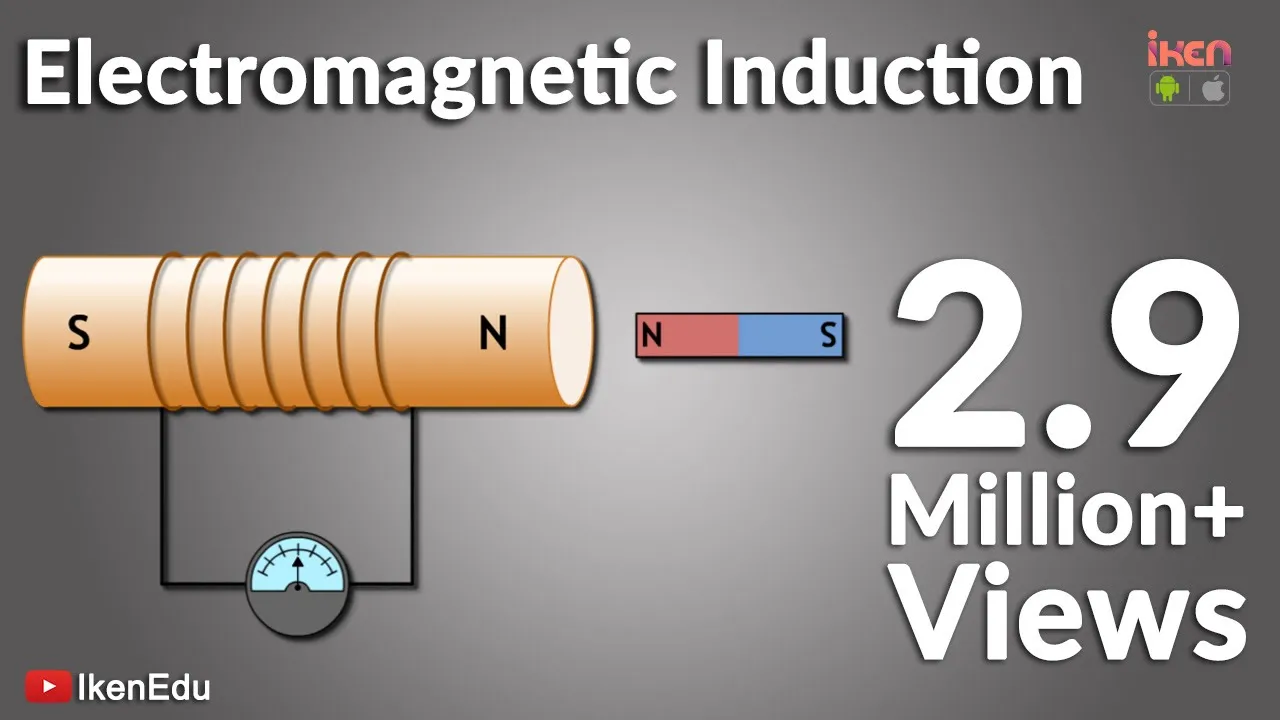
Electromagnetic Induction: Faraday's Laws and Lenz's Law Explained
@IkenEdu
3.2M views•2016-03-22

4:32
How Tuned Mass Dampers Stop Structures from Shaking
@MinutePhysics
573K views•2018-08-28
14:16
Metric Tensor in General Relativity Explained | Geodesics & Spacetime
@ScienceClicEN
231.3K views•2020-12-15

33:44
The Blue LED: A Decade-Long Scientific Challenge Explained
@veritasium
46.5M views•2024-02-08
Related Study Plans & Knowledge Roadmaps
Structured learning paths in Physics
physics
Medical Physics: Imaging, MRI & Radiotherapy
01Foundations of Radiation and Matter Interaction
02X-Ray Imaging and Computed Tomography (CT)
03Magnetic Resonance Imaging (MRI) Physics
+ 3 more learning modules
15h6 modules
Explore Roadmap
physics
Nuclear Physics (Decay, Fission & Reactors)
01Atomic Structure and the Binding Force
02Radioactive Decay and Half-Life
03Nuclear Fission Mechanics and Chain Reactions
+ 2 more learning modules
12h5 modules
Explore Roadmap
physics
Soft Matter (Polymers, Colloids & Rheology)
01Foundations of Soft Matter & Thermal Forces
02Polymer Physics and Macromolecules
03Colloids, Surfactants, and Self-Assembly
+ 2 more learning modules
38h5 modules
Explore Roadmap
physics
Analytical Mechanics: Lagrangian & Hamiltonian
01Mathematical Foundations: Calculus of Variations
02From Newtonian Mechanics to Constraint Dynamics
03The Principle of Least Action & Lagrangian Mechanics
+ 3 more learning modules
28h6 modules
Explore Roadmap