





![DYNAMICS Lesson 1 [AS Physics 9702]#gcse #exam #cambridge#physics#alevel #educational #physicsexam](https://i.ytimg.com/vi/mOHDwXcCPFM/maxresdefault.jpg)


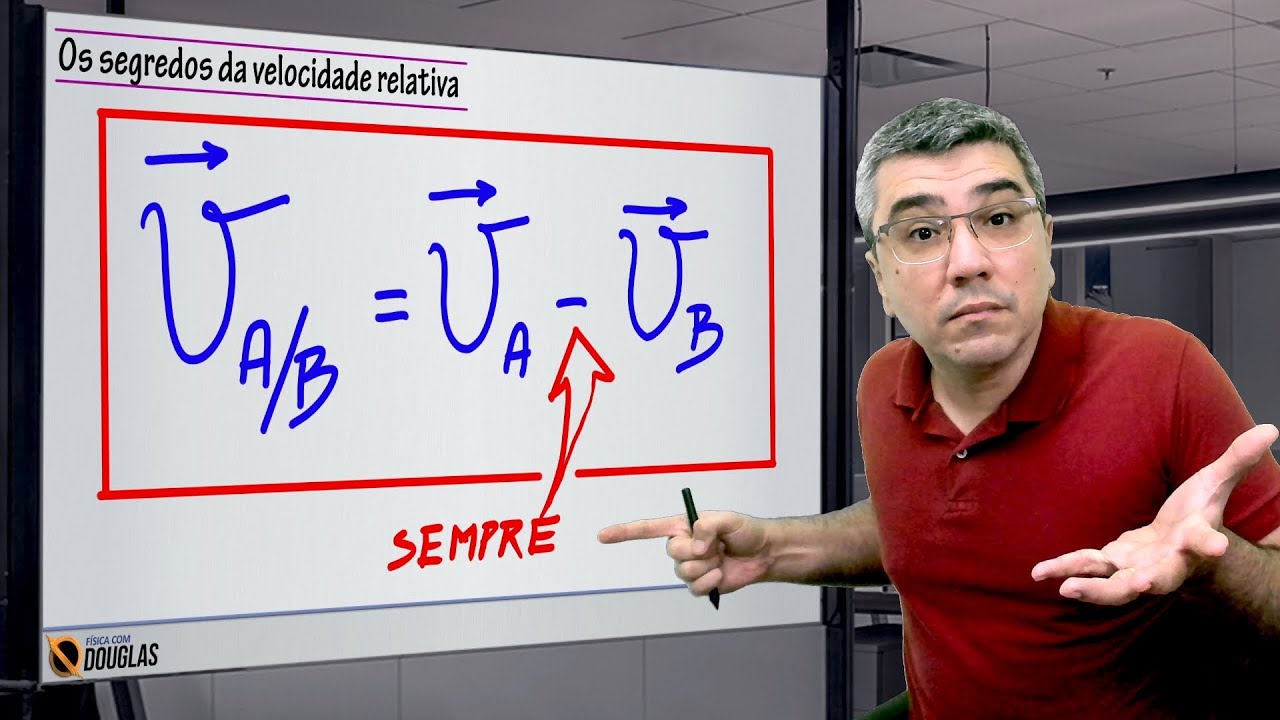












Galilean relativity, formulated by Galileo and later refined by Newton, establishes that the laws of motion are identical in all inertial reference frames (non-accelerating frames), meaning observers in different frames may disagree on specific measurements like velocity, momentum, and kinetic energy, but will always agree on the fundamental laws of physics, the passage of time, and the mass and size of objects; this principle fails in accelerating (non-inertial) reference frames where fictitious forces appear, necessitating Einstein's later development of special relativity to address high-speed phenomena.
Galilean Relativity Explained: Inertial Frames & Motion
Added:Basic kinematics, including the definitions of displacement, velocity, and acceleration.
Newton's First Law of Motion and the conceptual definition of inertia.
The concept of a coordinate system and how to plot positions in 2D or 3D space.
Vector addition and subtraction, specifically applied to velocity vectors.
Galilean transformation equations and their application to coordinate systems moving at constant velocity.
The limitations of Galilean relativity when dealing with the speed of light, leading to the Michelson-Morley experiment.
Einstein's Special Theory of Relativity and the derivation of Lorentz transformations.
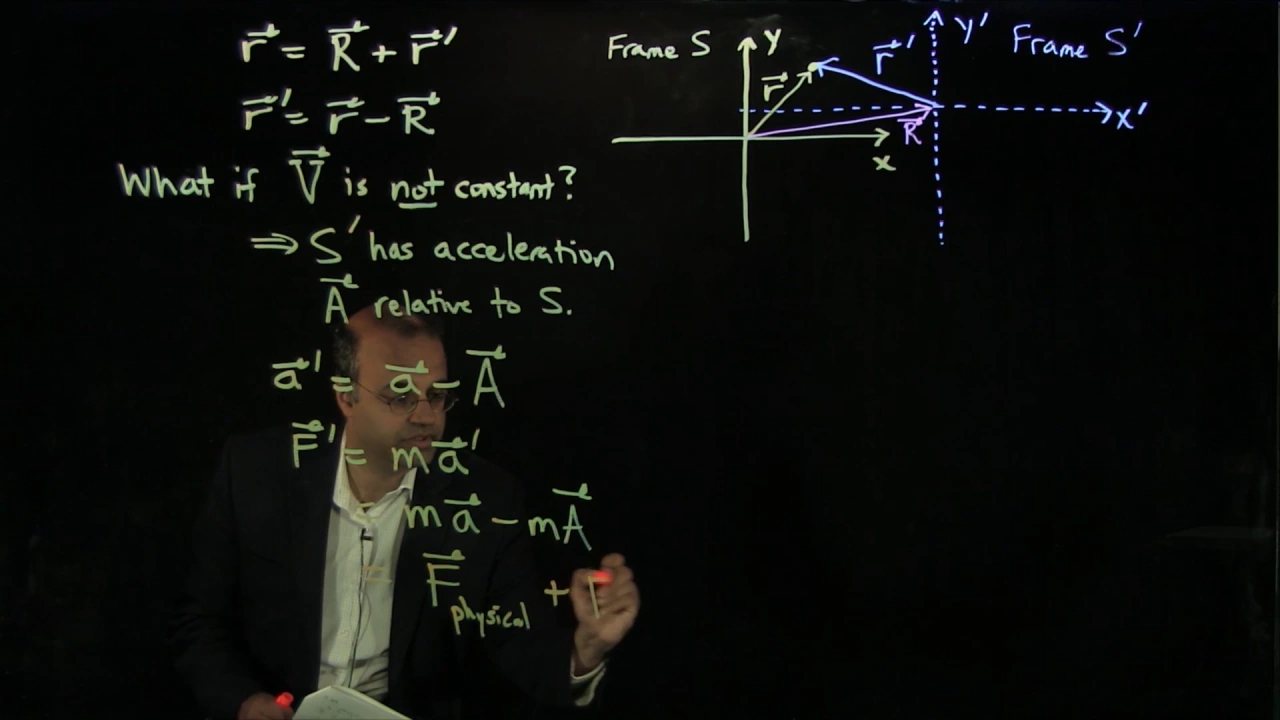
Non-inertial (accelerating) reference frames and the introduction of fictitious forces like the centrifugal and Coriolis forces.
170.5K views2.2Klikes10:15Original Release: 2020-03-14
Welcome to this video series on relativity. In this video series, I'm going to try and help someone who is familiar with basic calculus, basic linear algebra, and basic physics... and guide them toward a mathematical understanding of general relativity, including topics like black holes, the expansion of the universe, gravitational time dilation, and gravitational waves.
Now, this video series is going to be several hours long, but the first few videos that you're watching right now-- Relativity 101--will be a self-contained introduction and it won't use too much math In these Relativity 101 videos, I'm going to explain how the ideas of relativity came about, starting with Galileo in the 17th century and going up to Einstein in the 20th century.
So there are really three scientific theories of relativity. There is Galilean relativity, which is the relativity we experience at everyday speeds like inside trains or elevators. And this is the type of relativity that was understood by Galileo, Newton and other physicists before the 20th century. Then in 1905, Albert Einstein built on the work of other physicists and came up with special relativity, which is the relativity we see when we travel close to the speed of light. The famous equation E = mc^2 is a result from considering physics in special relativity. Finally, in 1915, Einstein published a generalized version of special relativity, called "general relativity".
General relativity is a new theory of gravity that replaces Newton's older theory of gravity. General relativity treats gravity geometrically, and says that gravity is the result of space-time curvature. Before we start, we should ask: "what is relativity?" Relativity is the study of how the laws of motion work in different reference frames. When we're talking about the laws of motion, we're talking about laws like Newton's three laws of motion which determine how forces cause objects to move and accelerate, and also Newton's law of gravity.
Galilean relativity was the first theory of relativity that considered how the motion of objects would work in different reference frames. The Galilean principle of relativity tells us that the laws of motion are the same in all inertial reference frames. The word "inertial" here refers to frames of reference that are not accelerating. To understand what the principle of Galilean relativity means, let's take a look at an example of a scientist standing on the ground, dropping a ball. To the scientist, this ball appears to be falling straight down toward the ground... But other observers, such as a person driving a car at a constant speed toward the right, or a passenger in an airplane traveling at a constant speed toward the left, will see things differently.
This is because the car and the plane have different frames of reference than the scientist standing on the ground.
Let's first consider the frame of reference of the scientist who is standing on the ground.
The scientist drops the ball, which travels straight downward due to gravity.
The scientist also sees the car drive by him to the right at constant velocity.
will look different in the frame of reference of the car and it's driver.
The driver could view their car as simply standing still, with the ground and the surrounding neighborhood passing by with a constant speed toward the left.
When the scientist on the ground drops the ball, the car driver will see the ball fall in an arch shape, which is a combination of the balls downward motion toward the ground and also the horizontal motion that the ground, scientist, and neighborhood are all moving with towards the left.
Finally, we can consider the frame of an airborne plane. Passengers on the plane could consider themselves to be still, but when they look outside the window, they'll see the ground traveling beneath them with a constant speed.
When the scientist drops the ball, it travels in a long arc because the world is traveling horizontally beneath the plane very quickly. The car, which is driving on top of the ground in the opposite direction, appears to travel by even faster.
So we've seen that different observers in different frames of reference will observe the motion of objects differently. In our example the scientist and the driver will disagree on how the ball is moving.
The scientist sees the ball having vertical motion only... While the driver sees the ball having vertical motion as well as horizontal motion.
This means that the scientist and the driver will disagree on the ball's speed (or velocity).
Because of this, they will also disagree on the ball's momentum, which is mass times velocity.
They will also disagree on the ball's kinetic energy, one-half times the mass times velocity squared.
So the scientist and the driver disagree on a lot of things.
You might be wondering if they agree on anything at all?
It turns out that the scientist and the driver do agree on some things.
If we watch the ball drop from both of their perspectives, we see the ball takes the same amount of time to reach the ground in both cases.
So the scientist and the driver will both agree on the passage of time.
They will also agree on the size (or spatial dimensions) of the ball.
They will also agree on the ball's mass. Most importantly, the scientist and driver will agree on the laws of motion, like Newton's three laws of motion and Newton's law of gravity. We already know that in the scientist's frame of reference, when the scientist drops the ball, it travels straight down towards the ground.
But now let's consider what happens if the driver has the ball and drops the ball in their car as they drive along at constant speed.
The ball also travels straight down towards the floor of the car. This is exactly what the scientist saw in his own frame of reference when he dropped the ball.
Finally, if a passenger on the plane dropped the ball, it would also travel straight down to the floor of the plane... exactly what the scientist and driver would have seen dropping the ball in their own reference frames.
So the scientist, driver and plane passenger all see a ball fall with the same motion in their own reference frames. That's because these are all examples of "inertial" reference frames, which are reference frames that are not accelerating.
The reason that the motion is the same is because of the Galilean principle of relativity, which says that the laws of motion and gravity are the same in all inertial reference frames. Because of this, there is no physical experiment you can do to determine if your own reference frame is stationary or moving at a constant speed. The scientist may think that he is standing still on the ground, watching the car and the plane travel past him.
But it's equally correct to say that the car is stationary, with the scientist and plane moving around it. In Galilean relativity, there's no special reference frame that's truly stationary. All motion is always relative to something else.
But when reference frames are traveling at constant speed relative to each other, like the scientist, car and plane, they will all experience the same laws of motion.
So let's sum up what we've learned about Galilean relativity.
In Galilean relativity, there are some things that we'll disagree on and other things that we'll agree on, depending on which reference frame we're observing from.
We'll disagree on the motion of objects, such as a falling ball.
This means that we'll disagree on an object's velocity, momentum and kinetic energy.
But there are other things that we'll agree on in all reference frames. The most important thing we all agree on is the laws of motion. But we will also agree on the passage of time, size and space, and the mass of objects.
You might ask what would happen if we're in an accelerating reference frame, which would be a non-"inertial" reference frame, meaning the rules of Galilean relativity don't apply.
We can understand what would happen using our experiences in everyday life.
If you've ever been in an elevator that's accelerating upward, you might have noticed that you feel heavier, like you're being pulled downward toward the floor.
If you've ever been inside an accelerating car, you might have felt that you were being pulled into the back of your seat. And if you've ever been inside a car that took a sharp turn, there was actually a centripetal acceleration inward. This makes the passenger feel like they're being thrown outward toward the side door of the car. So we can see that when a passenger is in an accelerating box or an accelerating reference frame, they will feel a mysterious fictitious force pulling on them in the opposite direction of the box's acceleration. This means that a passenger in an accelerating reference frame will have a different set of laws of motion.
Every time they use Newton's second law, they will need to add an extra term for the fictitious force in order to predict the motion of objects correctly.
For example, when you drop a ball in an elevator that's accelerating upward, it would appear as though the ball is being pulled down to the floor more quickly than if you had dropped the ball outside on the ground. Also, if you drop a ball inside an accelerating car, the ball will appear to fly backward, just as you're being pulled backward into your seat because of the cars acceleration.
Because these are non-inertial reference frames, the principle of Galilean relativity does not apply, and observers in different reference frames will disagree on the laws of motion that cause the ball to move.
Remember that the Galilean principle of relativity means that the laws of motion are the same only for inertial reference frames.
In the next video, in "Relativity 101", we'll cover special relativity, which tells us how the rules of relativity change when we go close to the speed of light.
Up Next

9:07
Why Time Slows Down in Rockets: Deriving Gamma
@sixtysymbols
625.9K views•2013-12-24

12:53
21cm Hyperfine Transition in Neutral Hydrogen: Radio Astronomy Basics
@AaronRobertParsons
12.4K views•2011-10-13

36:21
General Relativity: Manifolds, Covariant Derivative, and Geodesics
@eigenchris
115.7K views•2021-05-11

27:14
Entropy and the Second Law of Thermodynamics Explained
@veritasium
27.5M views•2023-07-01
Related Study Plans & Knowledge Roadmaps
Structured learning paths in Physics
physics
Nuclear Physics (Decay, Fission & Reactors)
01Atomic Structure and the Binding Force
02Radioactive Decay and Half-Life
03Nuclear Fission Mechanics and Chain Reactions
+ 2 more learning modules
12h5 modules
Explore Roadmap
physics
Soft Matter (Polymers, Colloids & Rheology)
01Foundations of Soft Matter & Thermal Forces
02Polymer Physics and Macromolecules
03Colloids, Surfactants, and Self-Assembly
+ 2 more learning modules
38h5 modules
Explore Roadmap
physics
Analytical Mechanics: Lagrangian & Hamiltonian
01Mathematical Foundations: Calculus of Variations
02From Newtonian Mechanics to Constraint Dynamics
03The Principle of Least Action & Lagrangian Mechanics
+ 3 more learning modules
28h6 modules
Explore Roadmap
physics
General Relativity (Spacetime & Cosmology)
01Foundations of Relativity: Special Relativity
02The Geometry of Spacetime: Equivalence Principle & Curvature
03Einstein's Field Equations: The Mathematics of Gravity
+ 2 more learning modules
55h5 modules
Explore Roadmap