





























The muon paradox demonstrates Einstein's special relativity: muons created in Earth's atmosphere at 15 km altitude with a 2.2-microsecond lifetime should only travel ~660 meters before decaying, yet they are detected on Earth's surface because time dilation (moving clocks run slow) extends their lifetime from Earth's frame, and length contraction (distances shrink) reduces the distance from the muon's frame, resolving the apparent contradiction using only two laws: the laws of physics are the same in all inertial frames, and the speed of light is constant in all inertial frames.
Muon Paradox: Proof of Einstein's Special Relativity
Added:Einstein's Postulates of Special Relativity: The constancy of the speed of light in a vacuum and the principle of relativity.
Inertial Reference Frames: Understanding how observers in relative, non-accelerating motion perceive physical events.
The Concept of Time Dilation: The theoretical prediction that a clock in motion runs slower relative to a stationary observer's clock.
The Concept of Length Contraction: The theoretical prediction that objects in motion are measured to be shorter along the direction of travel.
Basic Particle Decay: Understanding what a muon is, how it is created by cosmic rays, and its extremely short mean lifetime at rest.
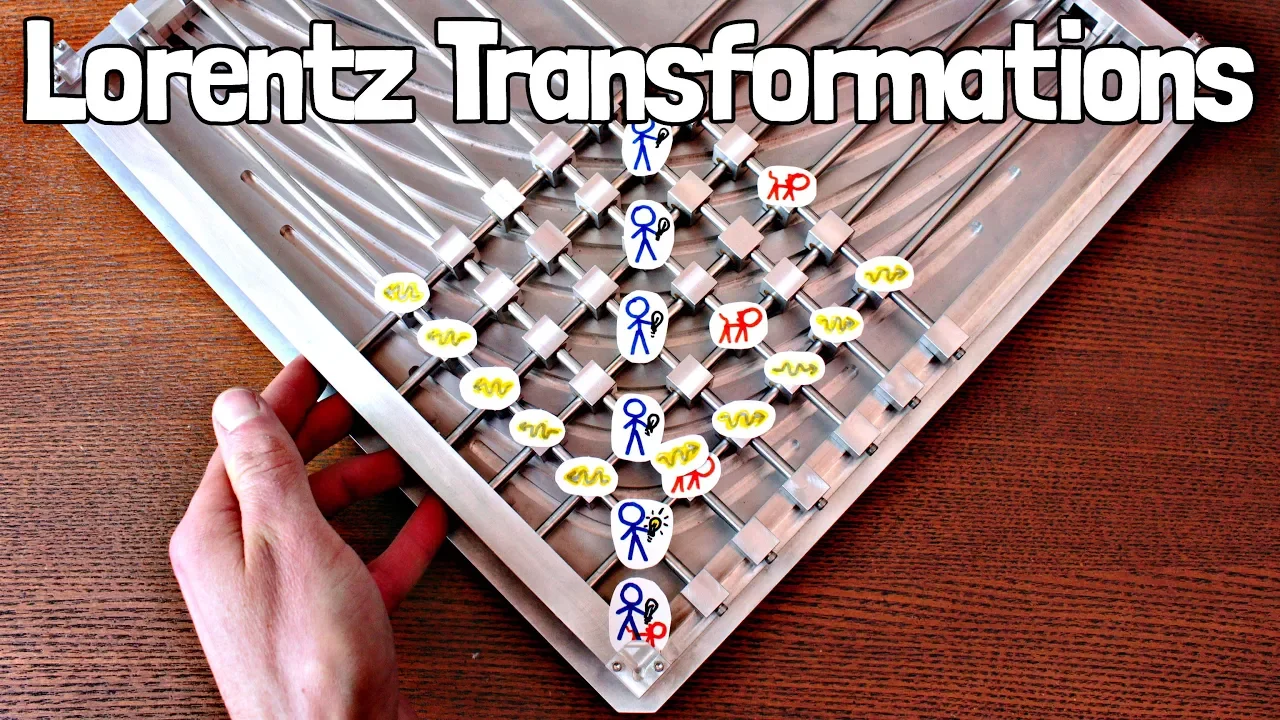
Lorentz Transformations: The mathematical equations used to convert space and time coordinates between two inertial frames of reference.
The Twin Paradox: An advanced thought experiment exploring the asymmetric aging of twins where one travels into space and returns.
Relativistic Doppler Effect: How the frequency and wavelength of light change for observers in relative motion, with applications in astronomy.
Relativistic Momentum and Energy: Exploring how mass, momentum, and energy scale at near-light speeds, leading to the famous E=mc² equation.
Practical Applications of Relativity: Investigating how relativistic corrections are essential for the precision of Global Positioning Systems (GPS).
486.4K views26.4Klikes15:48Original Release: 2021-12-17
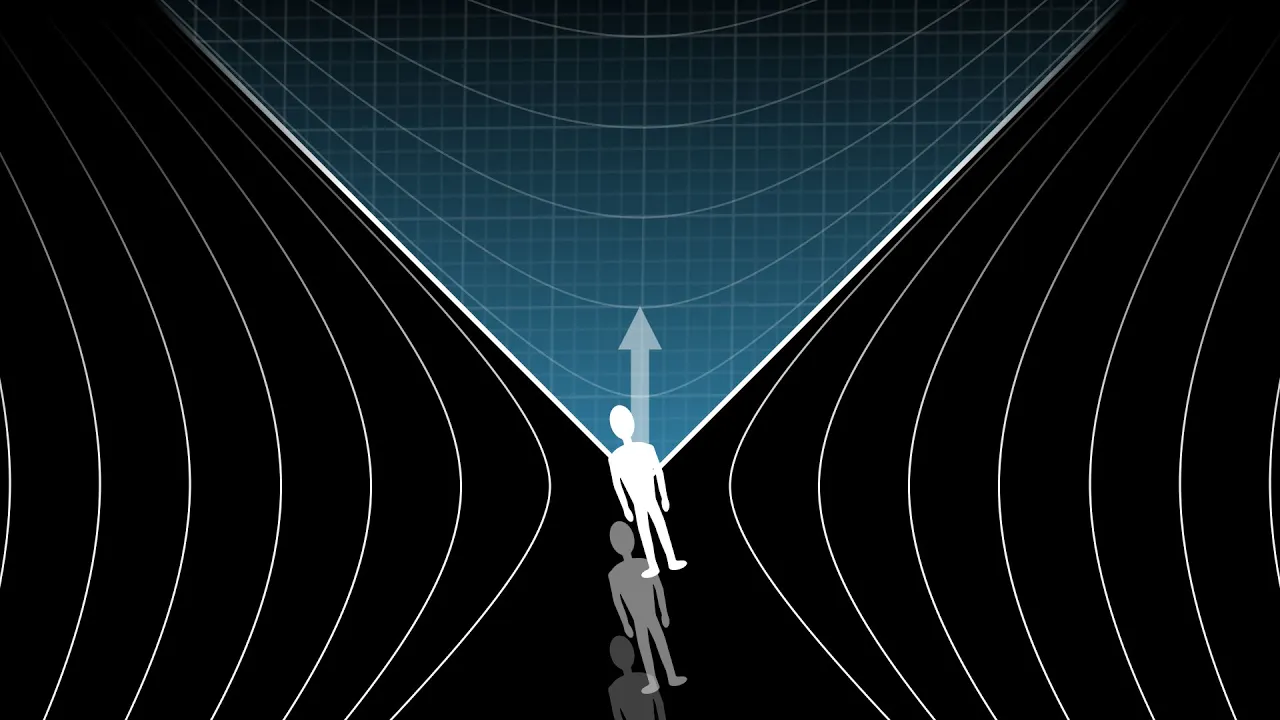
this episode was made possible by curiosity stream i'm gonna level with you i can't hold a lot of information in my head at once sometimes i feel like when i learn something new it pushes something else out or i have so much in my brain already that new ideas just won't go in so in today's video we're going to solve a paradox which proves einstein's special theory of relativity using only two laws of physics then we'll just follow the trails of logic all the way to the solution if you happen to like this video please subscribe so you don't miss other videos similar to this one here's the paradox this is a subatomic particle called a muon the muon is like the awkward cousin of the electron much bigger and much more unstable they have an average lifetime of just 2.2 microseconds this means that if you take a bunch of muons and measure how long they last from the time they're created to the time they decay the average lifetime will be 2.2 microseconds now muons are created by high energy collisions in the earth's atmosphere about 15 kilometers above the earth's surface they make their way down to earth at speeds of up to 99 the speed of light but because of their short lifetime they should only travel about 660 meters before dying so how many would you expect to detect on earth well almost none right there might be some ambitious ones that make the journey but most of them would never get here it'd be like us traveling to a planet that takes over 2 000 years to get to we die long before we reached it but here's the thing this is a muon detector built by my friend grady from the channel practical engineering every time it flashes that's a muon being detected and i'm pretty sure grady was on earth's surface when he used this in fact if you hold out the palm of your hand approximately one muon passes through it every second that is a lot more than expected so how do muons make the impossible journey down to earth's surface a journey 22 times their lifespan and if muons can cheat time does that mean we can too this is called the muon paradox and it was one of the first pieces of evidence supporting einstein's special theory of relativity as promised we're going to solve it using just two laws of physics the first is this every time i see this some part of me expects the trampoline will keep moving forward without the guy and he'll miss it when he lands but it never happens because the laws of physics are the same in all inertial frames of reference this sentence sounds more complicated than it is so let's break it down what is an inertial frame of reference a frame of reference is a fancy way of saying a point of view imagine this is you from your point of view or frame of reference as we're now calling it this is what you see from my frame of reference this is what i see so that's all a frame of reference means different points of views from different observers the word inertial just means not accelerating so either moving at constant velocity or stationary we'll soon see that there's no such thing as absolutely stationary but just go with it for now this is an inertial frame of reference this is an inertial frame of reference this is not an inertial frame of reference you probably have a rough idea of what the laws of physics means motion matter energy all the equations that govern the universe so what does it mean to say the laws of physics are the same in all inertial frames of reference well i could tell you but i'd rather show you imagine you're standing on the ground throwing a ball in the air it's only moving in the vertical direction straight up and down you then see me move past you with some constant velocity also throwing a ball in the air you see my ball trace out an arc or upside down parabola if you're feeling fancy you conclude that because my ball is moving both vertically and horizontally you must be standing still and i must be moving to the left but let's look at things from my reference frame here i am happily throwing a ball on the back of a vehicle watching it go up and down in the vertical direction i see you and this time it's your ball that's tracing out a parabola i therefore conclude that because your ball is moving both vertically and horizontally i'm the one who's standing still and it's you and the ground that are moving to my left the laws of physics in this case motion work the exact same way for both of us there is no experiment we can perform to tell us who is standing still and who is moving you might be thinking jade that's outrageous you can play your physics tricks but i know the ground isn't actually moving and i'd reply why do we have day and night then the earth is rotating at roughly 1 700 kilometers per hour so the surface of the earth is also moving at 1 700 kilometers per hour not only that but we're orbiting the sun at about 30 kilometers per second and the milky way galaxy is moving through the universe at around 230 kilometers per second so you are definitely not standing still in fact nothing and no one is everything in the universe is moving the closest we can get to stillness is to say that we're moving with zero speed relative to something else so coming back to the muon paradox from our frame of reference we are stationary and the muon is traveling toward us but the muon also has a frame of reference and it can just as easily say that it is still and earth is the one traveling toward it but that still doesn't explain how it's able to travel a distance 22 times its lifetime for that we need our second law the speed of light is the same in all inertial frames of reference okay so this is one of the weirdest ideas in all of physics i still cannot wrap my head around it it may sound innocent but it is not if you don't see why yet don't worry i literally went my entire physics degree without really getting why this is so weird so to understand we need to take a drive here i am parked on the side of the road totally not creepily filming cars go by it's a 60 zone so let's say everyone is a good law abiding citizen and driving exactly 60 kilometers per hour not surprisingly for a my frame of reference all cars appear to be traveling exactly that speed now let's drive it's still a 60 zone but i'm being a rebel and doing 40. this guy's odometer will read 60 and an observer on the street will view him as going 60 but for my frame of reference they appear to be travelling at 20 kilometers per hour similarly for the cars going in the opposite direction an observer on the street sees them as doing 60 kilometers per hour but i see them as doing 100 this is a demonstration of relative speed speed being dependent on your frame of reference in other words the speed of normal things is different from different inertial frames of reference now let's contrast this with our second law the speed of light is the same in all inertial frames of reference the speed of light is about 300 million meters per second this means that if we were measuring the light coming from the car's headlights in all scenarios both me and the observer would measure it to be the exact same speed it doesn't matter if the light beams are traveling toward me away from me doesn't matter how fast i'm going we will always measure the speed of light to be 300 million meters per second i cannot stress how weird and counterintuitive this is it goes against all of our experience of relative speed now we've learnt the two laws of physics needed to solve the muon paradox we just need to see what happens when these two laws work together we're going to do our ball experiment again except this time we're going to use light as we can't exactly throw light up and down we're going to bounce it between these two mirrors okay so light moves way too fast for us to actually do a real demonstration with light so we're going to animate it instead but this is what would really happen if we could do the demo in my frame of reference i see the light beam bounce like this straight up and down between the mirrors from your frame of reference you see it bounce like this tracing out a diagonal path as it bounces between the mirrors from your frame of reference the light beam traveled a longer distance we can show it with some simple trig we simply make a right angle triangle with this side being the light beam i saw from my reference frame and the hypotenuse being the light beam you saw from your reference frame and we all know that the hypotenuse is the longest side of any right angle triangle now speed is just a measure of distance covered per unit time usually if the distance covered in the same amount of time increases the speed increases but the speed of light is a constant it doesn't change under any circumstance even when it covers a greater distance how is this possible the only way this logically makes sense is if the light beam takes a longer amount of time to get from one mirror to the other in one reference frame than it does in the other that's right the time between two events passes at different rates for different observers time is not absolute but depends on how fast you're moving this is summed up by the expression moving clocks run slow this effect is called time dilation the dilating or stretching of time i know it sounds crazy and the effect is much too small to observe at our everyday speeds but it's one of the insane consequences of the two postulates of special relativity oh yeah our two laws of physics they're einstein's two postulates of special relativity i probably should have mentioned that but i didn't want to give everything away so how do our muons reach earth's surface well time dilation may be too small to observe at our everyday speeds but muons travel at up to 99 the speed of light they are all about time dilating from our frame of reference on earth we are stationary and the muon is traveling toward us and because of time dilation they experience time more slowly remember moving clocks run slow so to us they last longer and can travel a further distance so time dilation explains how the muons make it down to earth but something's off we said that the mions were moving toward us and moving clocks run slow that's why they're time dilated but the first postulate of special relativity says that there is no special frame of reference so a muon can equally say hey i'm not moving it's the earth's surface that's moving toward me your clocks are running slow you're being time dilated not me from the muons perspective it still has an average lifetime of just 2.2 microseconds so it still can't make the 15 kilometer journey to earth it can't reach earth in one frame of reference and not in another so what gives here's where one of the most famous results of special relativity comes into play the realization that space and time are not separate entities but are in fact two sides of the same coin space-time we said that the muon is traveling toward the earth at 99 the speed of light and likewise the muon says the earth is traveling toward it at 99 the speed of light the speed of travel does not change depending on the reference frame so in the muons frame of reference the only way it can travel the same speed in a shorter amount of time is if it travels a shorter distance this is called length contraction and is another crazy consequence of special relativity distances actually shrink depending on how fast an observer is moving so to sum up from our frame of reference on earth the muons reach earth's surface because they experience time dilation and from the muon's frame of reference the earth's atmosphere experiences length contraction oh yeah and to answer the question from the beginning of the video if muons can travel distances many times their lifetime does that mean that we can too could we ever travel to galaxies thousands of years away yes we could but we need to invent rockets that could travel at speeds close to the speed of light so far the fastest spacecraft ever built travels at around 0.05 percent the speed of light um so yeah we've got a long way to go but i have faith the cool thing about special relativity is that you only need to know these two laws and you can just derive everything else from them it's great for people like me with terrible memory and limited brain capacity speaking of limited brain capacity some of you have noticed that it takes me a while to make these videos and it's because physics is not something that comes very naturally to me it takes me a really long time to digest these concepts and in fact the whole reason i started this channel was to help people like me people who want to understand the secrets of our universe but find the information hard to digest someone that shares this passion for enlightening and inspiring is today's sponsor curiositystream they make award-winning documentaries about our universe one i just finished binge watching and i think you'll like it too is stephen hawking's favorite places steven takes us on a fantastical journey to his favorite places in the universe planets made of solid diamond inside a black hole saturn's rings and more curiosity's stream is so passionate about sharing knowledge that they've partnered with a bunch of us educational youtube creators in helping us to promote our own platform nebula nebula is a place where we can make content without the pressure of the youtube algorithm so we can be more experimental and try new things curiosity stream is offering nebula completely free when you sign up with them at only twenty dollars a year for both streaming services it's very affordable and you're literally getting thousands of hours worth of high quality content if you'd like to start learning the secrets of our universe and support the channel sign up to curiosity stream and nebula by going to curiositystream.com up and atom or click the link in the description that's it from me and i'll see you in the next episode bye [Music] you
Up Next
118:14
Special Relativity Lecture 1: Einstein's Theory Explained
@stanford
2.4M views•2012-04-27

12:53
21cm Hyperfine Transition in Neutral Hydrogen: Radio Astronomy Basics
@AaronRobertParsons
12.4K views•2011-10-13

21:01
Quantum Biology Explained: The European Robin's Quantum Compass
@upandatom
108.9K views•2020-03-13

27:14
Entropy and the Second Law of Thermodynamics Explained
@veritasium
27.5M views•2023-07-01
Related Study Plans & Knowledge Roadmaps
Structured learning paths in Physics
physics
Nuclear Physics (Decay, Fission & Reactors)
01Atomic Structure and the Binding Force
02Radioactive Decay and Half-Life
03Nuclear Fission Mechanics and Chain Reactions
+ 2 more learning modules
12h5 modules
Explore Roadmap
physics
Soft Matter (Polymers, Colloids & Rheology)
01Foundations of Soft Matter & Thermal Forces
02Polymer Physics and Macromolecules
03Colloids, Surfactants, and Self-Assembly
+ 2 more learning modules
38h5 modules
Explore Roadmap
physics
Analytical Mechanics: Lagrangian & Hamiltonian
01Mathematical Foundations: Calculus of Variations
02From Newtonian Mechanics to Constraint Dynamics
03The Principle of Least Action & Lagrangian Mechanics
+ 3 more learning modules
28h6 modules
Explore Roadmap
physics
General Relativity (Spacetime & Cosmology)
01Foundations of Relativity: Special Relativity
02The Geometry of Spacetime: Equivalence Principle & Curvature
03Einstein's Field Equations: The Mathematics of Gravity
+ 2 more learning modules
55h5 modules
Explore Roadmap