



![ДИВНА МАТЕМАТИКА ЕЙНШТЕЙНА 🤯 [VERITASIUM]](https://i.ytimg.com/vi_webp/QZQptiZOQfs/maxresdefault.webp)

















![[Cosmologie] Nouvelle détermination de la constante de Hubble en désaccord avec les données du CMB](https://i.ytimg.com/vi/PvZZU_MtizE/maxresdefault.jpg)


The Friedmann equations, derived from Einstein's field equations using the FLRW metric and perfect fluid model, govern the expansion of a homogeneous and isotropic universe. These equations show that matter density scales as a⁻³, radiation density as a⁻⁴, and dark energy density remains constant, explaining why energy isn't conserved in an expanding universe. Different combinations of spatial curvature (k = +1, 0, -1) and cosmological constant (Λ) produce distinct evolutionary models: Einstein's static universe, de Sitter's exponentially expanding universe, and anti-de Sitter's collapsing universe. Modern observations indicate our universe is flat (k=0) with positive cosmological constant, transitioning from radiation-dominated to matter-dominated to dark energy-dominated eras, ultimately leading to accelerated expansion and heat death.
Deriving the Friedmann Equations: Universe Evolution Models
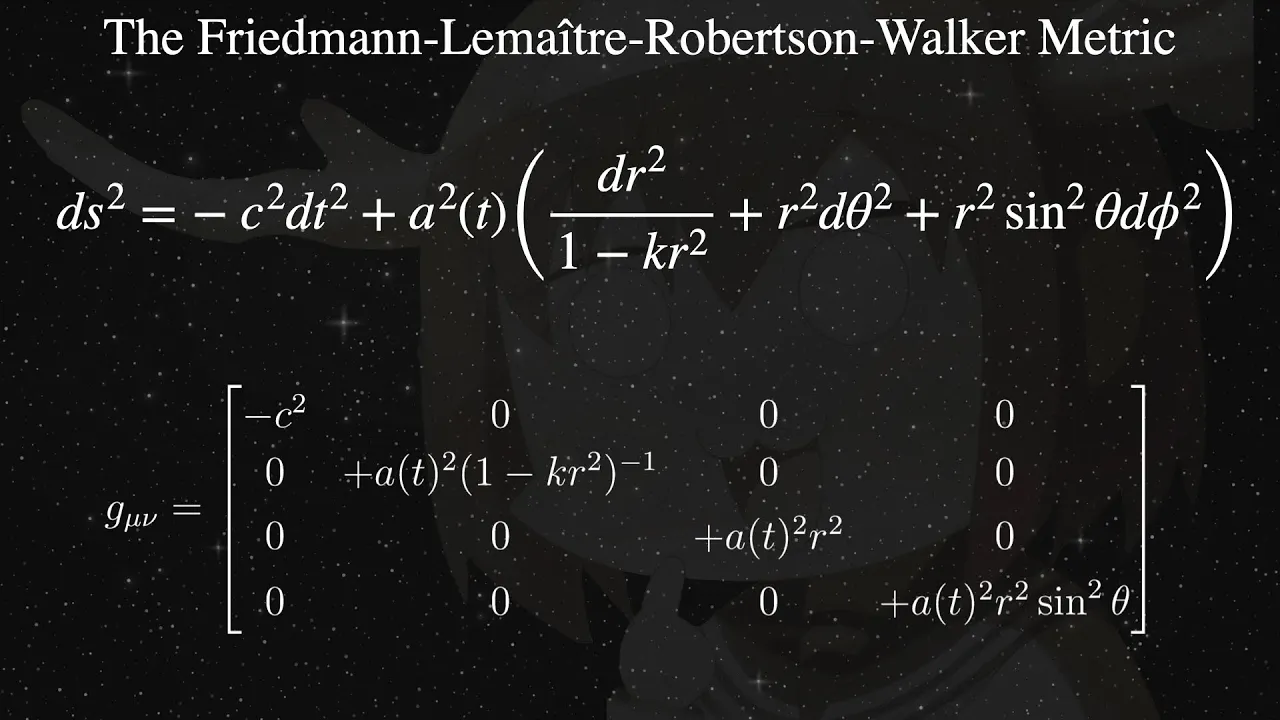
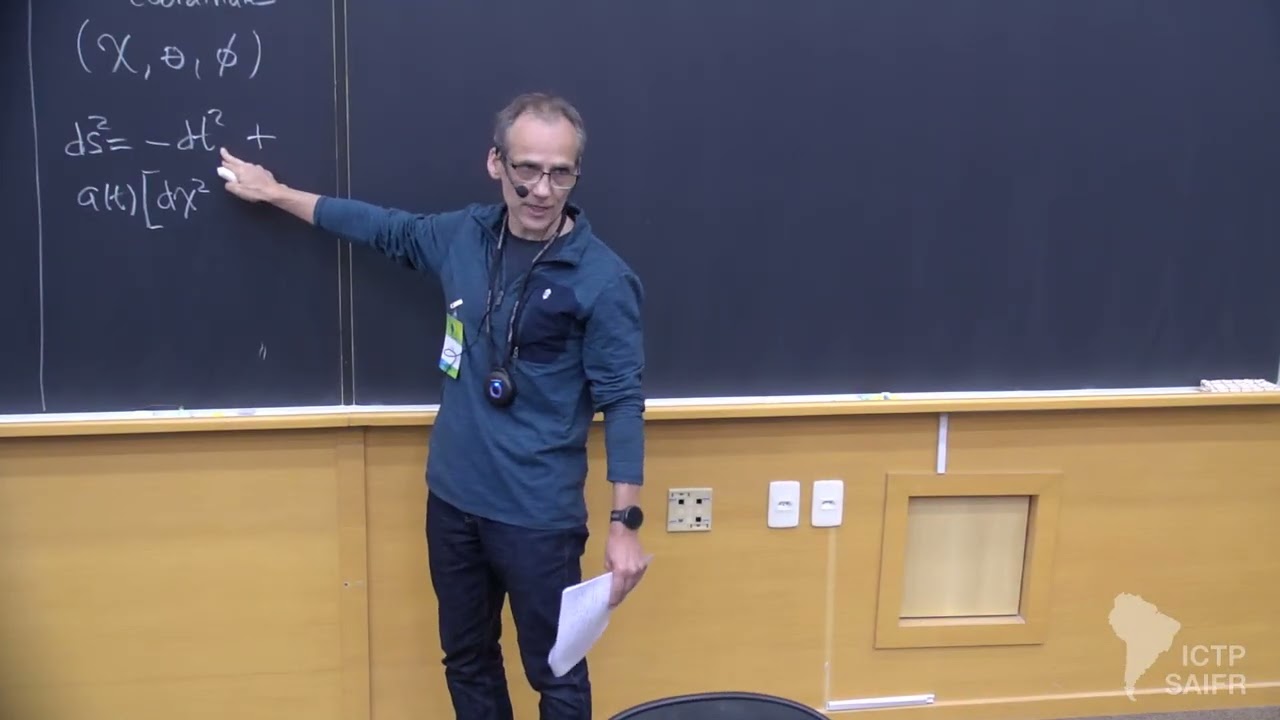
Added:in this video we're going to derive the friedman equations which are the equations that describe the expansion of the universe and then we'll interpret them to understand various models of how the universe could expand so we're going to cover a lot of topics in this video first we'll do a quick review of the flrw metric and perfect fluids then we'll derive the friedman equations then we'll see how the universe behaves when it's dominated by matter dominated by radiation and dominated by dark energy and why energy is not conserved in an expanding universe then we'll consider multiple different types of universes that the friedman equations describe such as static universes universes that expand and then contract in a big crunch universes that expand but decelerate and universes that expand and accelerate which leads to the so-called heat death of the universe then we'll talk about which model best describes our universe so remember we're assuming our universe is spatially homogeneous meaning it looks the same at all points and spatially isotropic meaning it looks the same in all directions we found three possible geometries that meet these criteria which are the closed or spherical universe the flat universe and the open or hyperbolic universe after using a clever change of coordinates we were able to write down all three metrics for these universes in a unified way using a parameter k which is either plus 1 0 or negative 1 for closed flat and open universes respectively we also have a scaling function a of t which allows the spatial scale of the universe to change over time also we're going to denote the derivative of a with respect to time as a dot and the second derivative of a with respect to time will be denoted a double dot we also calculated all the necessary curvature tensors related to the flrw metric in the video relativity 110c we also said that the matter and radiation in the universe can be described by the energy momentum tensor for a perfect fluid which has uniform energy density rho c squared and uniform pressure p in all directions these can change over time but their uniform over space for a homogeneous and isotropic universe and this tensor's components are measured in the cosmic rest frame which is the unique frame of reference where the cosmic microwave background radiation has no redshift and where the average velocity of matter at large scales is zero also in this video i won't worry too much about the difference between mass density and energy density since they are related by the constant factor of c squared to get the friedman equations we just have to dump all this information into the einstein field equations i'm using the mostly minus metric convention so my cosmological constant term has a minus sign in front and the energy momentum tensor has minus signs on the spatial diagonal terms but the resulting friedman equations will look the same regardless of the metric sign convention that you use the first friedman equation comes from the zero zero component of the einstein field equations and the second friedman equation comes from the trace of the einstein field equations let's start with the first equation so we have our flrw metric the energy momentum tensor for a perfect fluid the zero zero component of the richie tensor and the richie scalar now we write out the zero zero component of the efes we can plug in r00 r g00 which is just positive 1 and t 0 0 which is just rho c squared we can simplify things by multiplying and dividing the first term by a which will give it a common denominator with the second term in the second term we can simply do one half times six to get three and on the right hand side we can cancel two powers of c the first two terms now have a common denominator so we can cancel the first term with the a a double dot term in the second term i'm also going to multiply and divide the cosmological constant by c squared which lets us cancel c squared in all the denominators then we'll move the cosmological constant term to the other side giving it a plus sign then divide both sides by 3 and this gives us the first friedman equation the second friedman equation is obtained by taking the trace of the einstein field equations which means summing all the terms with the inverse metric the inverse metric raises an index on the richie tensor and on the energy momentum tensor in the middle terms the metric and inverse metric cancel two four by four chronic deltas the trace of the richie tensor is the richie scalar and the trace of the energy momentum tensor is the t scalar and since the chronicle deltas are the four by four identity matrices this trace is just the number four one half times four is two and r minus two r is negative r we can now plug in the richie scalar and the trace of the perfect fluid energy momentum tensor is rho c squared minus three p we can cancel these minus signs and distribute multiply all terms by c squared and divide all terms by 6 to get 4 over 6 and 8 over 6.
now this term with a dot squared and k is exactly the left-hand side of our first friedman equation so we can replace it with the right hand side involving rho and the cosmological constant we can then move the row and cosmological constant terms to the other side of the equation here minus one-third plus two-thirds gives plus one-third and negative eight pi g over three plus four pi g over three becomes negative four pi g over three and we can factor that out of the row and pressure terms and the result is our second friedman equation so we have the two friedman equations the first tells us about the universe expansion rate a dot and the second tells us about the universe expansion acceleration a double dot as an aside there is another equation related to the expansion of the universe which is sort of like the third friedman equation but it doesn't have an official name as far as i know you can pause if you want to see the details but we get this by taking the derivative of the first friedman equation and then substituting in the second friedman equation this equation tells us how mass density changes over time as the universe changes size unsurprisingly as the universe gets bigger with positive a dot the mass in the universe gets less dense so the result is a negative row dot there are actually two other ways to derive this third friedman equation one other option is using the first law of thermodynamics where we assume the universe expands adiabatically meaning no heat is transferred into it we can also derive the third friedman equation using the local conservation of energy law which says that the covariant divergence of the energy momentum tensor is zero so there are many ways to arrive at this equation but the equation basically encapsulates how local conservation of energy works in a universe with a changing spatial scale before we start looking at different possible models of the universe let's quickly look at the behavior of universes that are dominated either by matter radiation or the cosmological constant also called dark energy these are defined by the w parameter from the equation of state we talked about in relativity 110e which is a relationship between the energy density of the universe and the pressure in the universe matter has w equals zero since dust like matter exerts no pressure and the only non-zero component of the energy momentum tensor is the energy density radiation has w equals one-third because we showed that the energy momentum tensor for radiation must have zero trace and dark energy has w equals negative one because this turns the energy momentum tensor into a constant times the metric which is exactly what the cosmological constant term in the einstein field equations looks like if we take our equation for the rate of change of energy density and replace pressure using our equation of state formula we can factor out rho and divide by rho then integrate both sides to get lon row and lawn a with an additional constant of integration k we can then exponentiate both sides e to the lon rho just becomes rho and we can take this additive term and turn it into a multiplicative constant using exponent rules also the exponent of a product can be rewritten as repeated exponentiation so e to the lawn a becomes a and this gives us an equation for the energy density of the universe in terms of the universe's scale factor a and we can combine all of these constants together into a new k constant in front so given our three types of universes if we sub in w equals zero for matter we find that mass density is proportional to a to the negative three and this makes sense if we make the universe twice as big the universe will become half as dense in all three spatial dimensions so this negative three exponent is really telling us that the mass density changes inversely with the scale factor in all three spatial dimensions for radiation which has w equals one-third we find the energy density is proportional to a to the negative four with radiation not only does it become less dense due to the expansion of the three spatial dimensions radiation waves also get stretched out in the cosmic rest frame due to cosmological redshift when the universe expands by a factor of a the wavelength of light also increases by a factor of a this means the frequency decreases by a factor of a and by planck's relation the energy also decreases by a factor of a which is why we see energy proportional to a to the negative 4 for radiation the energy density changes with a power of negative 3 for the three spatial dimensions and an extra negative one power for the energy lost due to cosmological redshift finally dark energy has w equals negative one and we get that the energy density of dark energy doesn't depend on the scale factor at all dark energy is just a constant property of empty vacuum space itself it doesn't matter how big or small space gets one meter cubed of space will always have a constant amount of dark energy so increasing the size of the universe fundamentally increases the amount of dark energy and decreasing the size of the universe fundamentally decreases the amount of dark energy now for matter since energy density is proportional to the inverse cube of a the total mass energy is conserved as the universe expands but with radiation we actually lose energy in the cosmic rest frame as space expands and for dark energy we gain energy as space expands energy is not globally conserved in general relativity according to a result called nother's theorem conservation of energy is a law that only holds true globally if the universe is invariant under time translations but if the universe's scale is changing over time we don't have time translation symmetry and there is no resulting conservation of energy law we do still have local conservation of energy which is given by the covariant divergence of the energy momentum tensor being zero at a specific point but we can't extend this law globally to all of space-time basically the cosmic rest frame is really a collection of individual frames all over the universe and we can't directly compare the energy measured in one frame to the energy measured in another frame moving from one frame to another requires parallel transporting the frame across curved space time and there is no unique way to do this in curved space time if we parallel transport a frame to the same destination using two different paths we get results that are different so we can't meaningfully compare energies at different points in space-time and this means that we can't define a global law of conservation of energy now let's look at the different possible universes that evolve according to the friedman equations which are the equations that determine the behavior of a homogeneous isotropic universe over time it's important to note that all these parameters mass density pressure curvature and the cosmological constant must be determined by experiment now no matter what values we plug in we will get results for the universe's expansion or collapse that are consistent with general relativity however if we plug in values that don't match up with reality the universe modeled by the equation won't reflect our universe in real life with that said for the rest of this video i'm going to explore different kinds of universes that could arise based on the friedman equations not all of them will necessarily match up with our universe but looking at different possibilities can help give us a feel of what the friedman equations mean to start let's look at einstein's static universe from einstein's 1917 paper we know that our universe is expanding from observations of cosmological redshift which tell us that distant galaxies are moving away from us but the friedman equations can tell us what a static universe would look like a static universe doesn't change size over time so a dot and a double dot would both equal zero from the second friedman equation after some manipulation we get an equation telling us the value of the cosmological constant in terms of the universe's mass density and pressure from the first friedman equations we set a dot to zero and we can plug in our formula for the cosmological constant we end up with a formula for the curvature k in terms of mass density and pressure so these formulas are true for a static universe and einstein's static universe from his 1917 paper also had zero pressure so this simplifies the formulas even further so that they're all equal to each other so we know that the mass density rho must be positive which means everything else in this formula must also be positive including the cosmological constant and the curvature k we know that the curvature k only has three possible values plus one zero or negative one so since k is positive that means it must be plus one meaning that the universe is spatially spherical and if we go far enough in one direction we'll end up back where we started this also means the cosmological constant is inversely related to the square of the radius of the spherical universe so einstein's static universe is a universe with positive curvature and a positive cosmological constant this is exactly what einstein predicted in 1917.
it doesn't match with observation but it's impressive that einstein could deduce the math correctly before the friedman equations were derived in 1922 let's look at another early model of the universe which is the de sitter universe proposed by willem de sitter in november 1917 just under a year after einstein's paper on cosmology in february 1917.
de sitter proposed an alternative cosmological solution to the einstein field equations where the universe is empty and so the density and pressure are zero for simplicity we're also going to assume the universe is spatially flat so the curvature k equals zero the sitter did not start with this assumption but this will simplify our calculations so in deceitr's universe mass density pressure and curvature are all set to zero so the first friedman equation tells us that the ratio of a dot and a is the square root of the cosmological constant times c squared over three this ratio a dot over a is also the definition of the hubble parameter h in theory the hubble parameter could vary with time but in descenders universe h is a constant from basic differential equations we know that when a function is proportional to its derivative the solution is an exponential so a deceiter universe expands exponentially over time where the exponential parameter is proportional to the square root of the cosmological constant so we can see here that the cosmological constant has the effect of causing the universe to have accelerated expansion outward for all time the second friedman equation doesn't tell us anything new but the exponential solution we got is consistent with it now even though our universe obviously has matter in it the de sitter universe can be a useful model for a universe that does have matter but where the cosmological constant or dark energy heavily dominates to the point where the existing matter is negligible on cosmological scales and since the most recent evidence says that the universe's expansion is accelerating the mass density of the universe will become smaller and smaller over time whereas the cosmological constant will remain the same so as time goes on in the far future a dissider universe will be a good model for our universe when mass density becomes negligible on cosmological scales compared to the cosmological constant the ultimate fate of the descender universe is for all mass and energy to be spread out more and more causing the universe to cool more and more until it basically approaches a density of zero and a temperature of absolute zero as well this ultimate fate is called the heat death of the universe it turns out we can also get deceiter universes for k equals negative one and plus one even though these solutions look different they actually describe the same desitter universe where we've chosen coordinate systems with spatial slices that are either open flat or closed so the descender universe we just described was an empty universe with a positive cosmological constant we could also ask what an empty universe with a negative cosmological constant looks like this is called the anti-descender universe so looking at our first friedman equation with zero density we get this equation if we try the case with k equals zero because the cosmological constant is negative this solution involves the square root of a negative number so the solutions are imaginary scaling the universe's metric by an imaginary number doesn't make sense so the solution is not physical for k equals plus one we also get negative numbers under the square root so we ignore this solution as well for k equals minus one we actually get real solutions where the scale factor is sinusoidal you can pause and look at the proof here so just as a positive cosmological constant causes the universe to accelerate outward a negative cosmological constant causes the universe to accelerate back inward and collapse to a single point in a so-called big crunch where the scale factor becomes zero now the physical interpretation of this first half period of the sinusoid is obvious but when we reach a negative scale factor the interpretation is less clear it could mean that the solution is not physical or it could mean that the universe will continue in an infinite cycle of big bangs and big crunches but i'm not going to speculate about this here in the relativity 110b video we talked about homogeneous and isotropic spaces for three spatial dimensions determined by k equals plus one zero or negative one and these were the spherical flat and hyperbolic spaces and they each had a constant reachy scalar everywhere in the same way we can now consider space times that are homogeneous and isotropic not just over space but over time as well so the universe appears to be the same at all times and the future looks the same at all times and the past also looks the same at all times these correspond to empty universes with a cosmological constant that's positive zero or negative these are called the de sitter minkowski and anti-dissider universes and again each one has a constant richie scalar so for example the descender universe is expanding exponentially and the rate of expansion is always proportional to whatever the current size of the universe is for this reason all times in the descender universe appear identical there's no way to tell how old or how new the universe is just by looking at the current time and just as we can model 3d spherical and hyperbolic spaces by using surfaces in four dimensions with a constant radius or curvature parameter we can also model the 4d dissider and anti-decider spaces by using surfaces in five dimensions with a constant curvature parameter i'm not going to go into the mathematical details here so check the description for links to more info now before we continue talking about more possible universes i'm going to introduce some definitions and quantities that will help us understand the universe's evolution so we already know that k equals plus one for a closed universe k equals zero for a flat universe and k equals negative one for an open universe here k equals 0 is the crossover point between closed and open universes we can see what constraints this crossover point places on the universe's density the crossover density between closed and open universes is called the critical density denoted by rho subscript c we'll also define the density parameter omega m r as the ratio of the actual density and the critical density the m and r subscripts refer to the fact that the energy density could be due to matter m or radiation refers to to define the critical density let's take the case of a flat universe with k equals zero and with no cosmological constant so lambda equals zero as well taking the first friedman equation and canceling these terms out we can rewrite this ratio between a dot and a as the hubble parameter h of t although we will often just write it as h solving for the critical density we get three h squared over eight pi g the corresponding density parameter rho over rho c equals this we're going to see that the overall shape of the universe being closed flat or open will depend on how the actual density of the universe compares to this critical density quantity looking at the first friedman equation again we can rewrite the fractions and then bring the curvature term to the other side we can then rewrite a dot over a as the hubble parameter h then divide all terms by h squared we see that the first term on the right hand side is our density parameter we're also going to define these other two terms as the dark energy parameter omega lambda and the curvature parameter omega k so this is an alternative way of writing the first friedman equation where these three parameters sum to one so knowing any two of them will automatically determine the third since we want to examine the relationship between density and curvature let's look at the case where the cosmological constant is zero so our first friedman equation can be rewritten like this we can now look at the cases of the density being less than equal to or greater than the critical density and see how this affects the curvature of the universe for density less than rho c the density parameter is less than one and the left hand side becomes negative since the right side of the equation has a squared and h squared which must be positive the only way to make the right hand side negative is by choosing negative k meaning we have negative curvature or an open universe if rho equals the critical density omega equals one forcing both sides to equal zero so with k equals zero the universe is flat and for rho greater than rho c omega is greater than one so both sides are positive and we get k equals plus one for a closed universe so we see that when the cosmological constant is zero the density of the universe directly determines the universe's curvature so the hubble parameter h and density parameter omega can tell us about the universe's shape but they can also tell us about the general evolution of the universe's scale factor a over time loosely speaking h tells us about the slope of the scale change and omega tells us about the overall behavior of the scale change the first thing to note is that since density and pressure are always positive and we're assuming for now that the cosmological constant is zero the second friedman equation tells us that a double dot is always negative so the universe's expansion is always decelerating the second thing to note is that if we take the first friedman equation with lambda equals 0 and rearrange we get a term with density times a squared recall that for matter dominated universes density evolves as a to the negative three and for radiation dominated universes density evolves as a to the negative four so in this term rho will always overpower the a squared and as the universe gets bigger and bigger this term will go to zero we can prove this mathematically here so in an open universe that's expanding this term will eventually go to zero but since k equals negative one this positive c squared term will always stick around so in this case the universe starts off expanding fast then decelerates and in the far future where the density approaches zero the expansion reaches a constant expansion rate of c for a flat universe an expanding universe will eventually send this term to zero and since k equals zero this term doesn't exist so in the long term we end up with an a dot of zero and an a double dot of zero so an expanding flat universe in the far future will tend toward a maximum size that it can never expand beyond for a closed universe with k equals plus one since we have both positive and negative terms here it's actually possible for the right hand side to equal zero this means that we can start off with an expanding universe hit a maximum a scale value with a dot equals zero and then a dot will change sign and the universe will start contracting again since a double dot is always negative this contracting universe will contract faster and faster until the size reaches zero which is the so-called big crunch so for a zero cosmological constant an open universe's expansion will slow down to a value of c a flat universe's expansion will slow down to zero reaching a maximum size and a closed universe will expand to a maximum size then shrink back down to nothing in a big crunch these three cases are also determined by the density parameter the hubble parameter h determines the slopes on these curves with larger h giving steeper slopes now all of this is with a cosmological constant equal to zero so what if lambda is non-zero going back to our first friedman equation this means that the density parameter dark energy parameter and curvature parameter all sum two one so knowing any two of them will determine the third for example if we look at the sum of the density parameter and dark energy parameter by checking if it's less than equal to or greater than one we can determine if k is negative one zero or positive one but what about the evolution of the universe well if the cosmological constant is negative the answer is easy the second friedman equation has a portion involving density and pressure that's less than or equal to zero by default so a negative cosmological constant just guarantees that a double dot is negative for all time meaning the universe expansion is always decelerating so regardless of the universe's spatial geometry the universe will always expand and then contract back down in a big crunch when the cosmological constant is negative what about a positive cosmological constant looking at the first friedman equation these terms are greater than or equal to zero and if k equals zero or minus one this term is also greater than or equal to zero this means a dot squared is always positive and so a dot is never zero so it can never change sign meaning a dot itself is always positive so the universe is always getting bigger and as the universe expands the density and pressure go to zero so while the acceleration is initially determined by density and pressure as time goes on the acceleration will be determined only by the cosmological constant and a will increase exponentially so with a positive cosmological constant and k equals zero or negative one the universe evolution looks like this decelerating when density and pressure dominate but accelerating when the cosmological constant dominates the case with positive cosmological constant and k equals plus 1 is more complicated because the curvature term is now negative this means a dot squared can be zero and so a dot can change sign although whether the sign change actually happens depends on how large the density and cosmological constant are we know for the einstein static universe the cosmological constant exactly balances with density and we get a static universe that doesn't change over time however if density is just a bit larger the universe will contract in a big crunch but if the cosmological constant is a bit larger will eventually get accelerated expansion off to infinity a summary of all the universe evolutions for each combination of k and the cosmological constant are given here based on a figure in lamborn's textbook so with all of that said out of all of these models which describes our universe well since 1998 we've known that the rate of galaxies receding away from us is accelerating indicating a positive cosmological constant also by examining the geometry of hot and cold spots on the cosmic microwave background radiation we can determine the overall curvature of the universe multiple experiments have measured that the universe is very close to being flat so we'll take k equals zero as we've already seen a flat universe with positive cosmological constant evolves like this starting with a big bang followed by deceleration then transitioning to acceleration the cmb radiation is leftover evidence of an early universe dominated by radiation where energy density changes as a to the negative 4 and lambda is negligible solving the friedman equations gives us a scale factor that grows with time to the power of one-half since radiation loses energy density very quickly in an expanding universe matter eventually ended up becoming the dominant form of energy density in a matter dominated universe energy density changes with a to the negative 3 and lambda is negligible this gives us a scale factor that grows with time to the power of two-thirds as the universe expands the energy density of matter continues to decrease and we transition to a universe where the cosmological constant or dark energy dominates and the universe grows exponentially so this is a bit simplified but generally speaking this is a good approximation of our current knowledge of the history of the universe if we were to draw this timeline to scale it would look like this we currently live in an era where the current composition of the universe looks like this dominated by dark energy also i'll mention that the extremely early universe in the first fraction of a second is hypothesized to have undergone a period of extremely rapid expansion called cosmic inflation i'm not going to discuss inflation but you can check the description for links to more information on it so for a quick summary of this video the assumption of a homogeneous and isotropic universe leads naturally to the flrw metric and a perfect fluid model of energy and momentum densities plugging these into the einstein field equations gives us the friedman equations which govern the expansion of the universe and analysis of the cosmic microwave background radiation and the redshift of distant galaxies has helped us estimate these parameters and come up with a model of the history of our universe so this is the last video i plan on making in my relativity series i hope you enjoyed it and i'll leave some links in the description on further topics that i didn't cover
Up Next

General Relativity: Friedmann Equations & Dark Energy
@barriorqi2831
1.8K views•2021-01-26

21cm Hyperfine Transition in Neutral Hydrogen: Radio Astronomy Basics
@AaronRobertParsons
12.4K views•2011-10-13

General Relativity: Manifolds, Covariant Derivative, and Geodesics
@eigenchris
115.7K views•2021-05-11

Entropy and the Second Law of Thermodynamics Explained
@veritasium
27.5M views•2023-07-01
Related Study Plans & Knowledge Roadmaps
Structured learning paths in Physics